June 17, 2026 · Texas Autopsy Services
Montour County Coroner: Your Guide for 2026
Understand the Montour County Coroner's duties, death investigation, and family rights. Get expert guidance during a difficult time.
On this page
- Understanding the Montour County Coroner's Official Role
- When and Why the Coroner Is Notified of a Death
- The Death Investigation and Autopsy Decision Process
- Coroner vs Medical Examiner An Important Distinction
- A Family's Rights and the Option for a Private Autopsy
- Frequently Asked Questions about Coroner Procedures
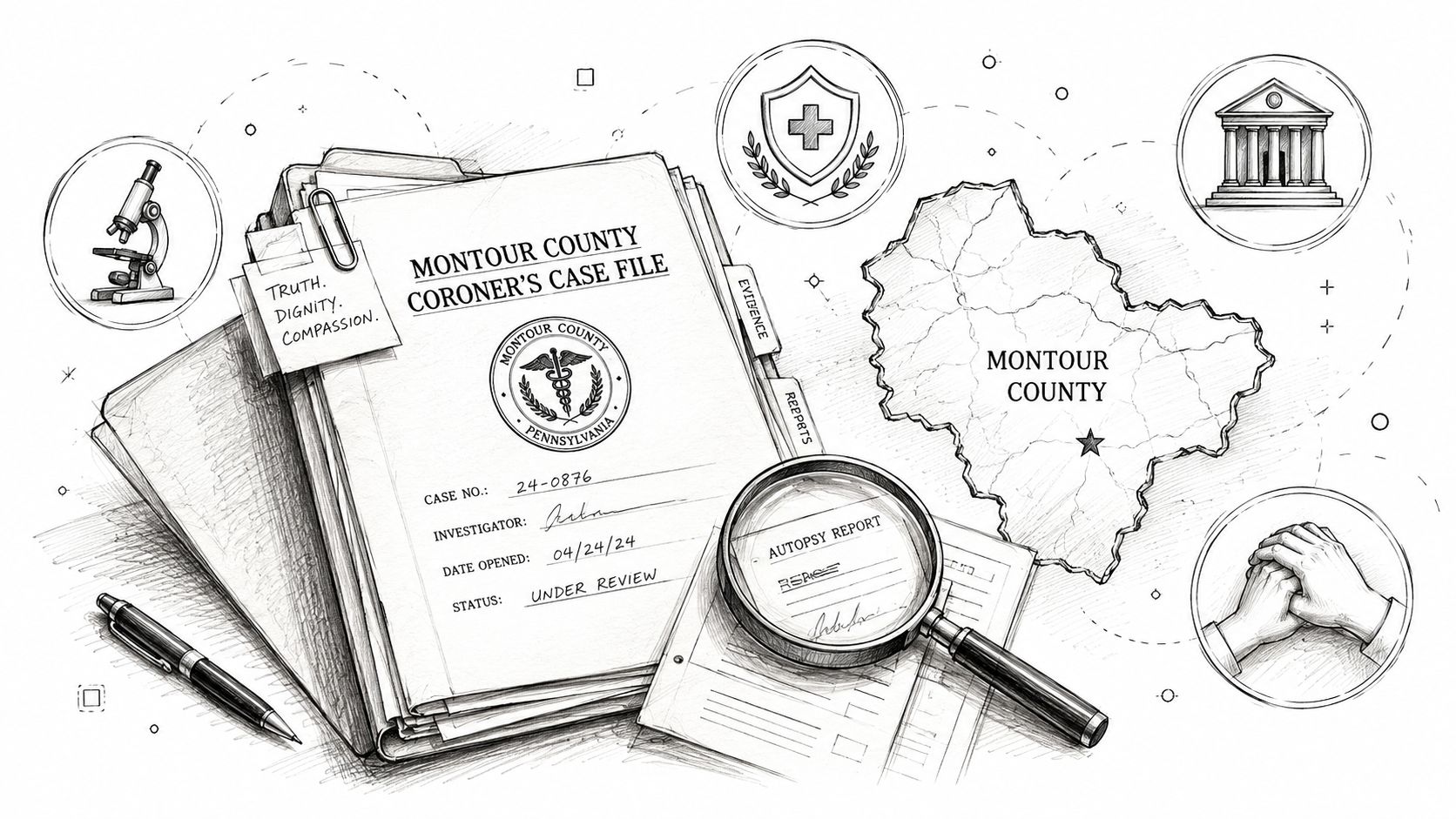
When a loved one dies unexpectedly, families often find themselves searching for the Montour County Coroner in the middle of shock, paperwork, and urgent decisions. Families aren't looking for a government overview. They're trying to understand who is in charge, why the case was reported, how records work, and what options remain if questions aren't being answered.
From a forensic pathology perspective, that confusion is understandable. The death investigation system can feel opaque even when everyone involved is acting appropriately. A coroner case doesn't automatically mean a crime occurred. It means the death falls into a category that requires formal review so the medical facts and legal documentation are handled correctly.
Clear distinctions are important. A county coroner has a public duty. A funeral home has a different role. A death certificate serves a different function than a coroner report. And if the official process ends without the clarity a family needs, an independent private autopsy may still be an option.
- Montour County Coroner is an official county office with public contact information and formal records procedures.
- The coroner investigates deaths that are sudden, unexpected, medically unattended, suspicious, or otherwise reportable.
- Not every coroner case results in an autopsy. The office first reviews scene facts, circumstances, and medical records.
- Coroner reports in Montour County may require a phone request, fees, and either next-of-kin authorization or a subpoena.
- A coroner system and a medical examiner system are not the same thing, and that difference matters when medical complexity is high.
- If official findings leave important questions unresolved, families may consider an independent private autopsy performed by a board-certified forensic pathologist.
Understanding the Montour County Coroner's Official Role
A common crisis moment sounds like this: a family has just lost someone, the funeral home is waiting, and then they hear that the coroner is involved. Many people hear that word and worry that something suspicious has happened. In a county coroner system, the safer way to understand it is this. The coroner is the public official responsible for reviewing certain deaths when the ordinary path for signing the death certificate is not enough.
That office serves several groups at once. It helps families get answers, helps funeral homes obtain the legal paperwork needed to proceed, and helps courts and public agencies establish an official record of how a person died. The work is partly medical, partly legal, and partly administrative. That mix is what often makes the process feel confusing in the first hours after a death.
Why this office exists
A useful comparison is a traffic officer at an intersection after the signal stops working. The goal is not to create trouble. The goal is to restore order, document what happened, and make sure the next steps happen lawfully. In the same way, the coroner steps in when the usual medical certification process cannot answer the needed questions on its own.
In practical terms, the coroner's public role is to investigate deaths that fall within coroner jurisdiction, complete the coroner's portion of the death certificate when required, and handle cremation authorization in the cases the office oversees.
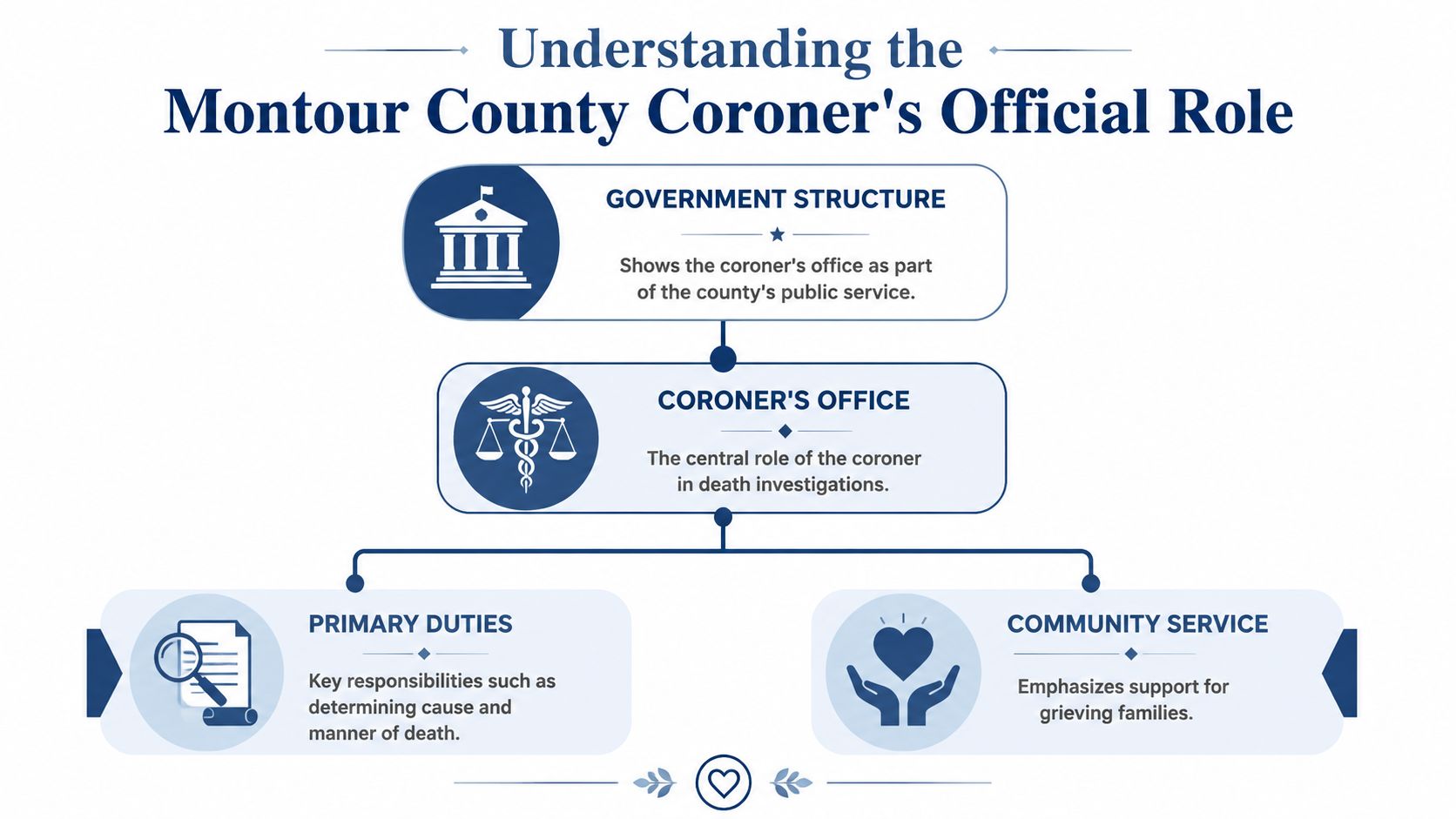
For families, one point matters most. Coroner involvement usually means the law requires an independent review of the circumstances. It does not, by itself, mean anyone is under suspicion.
What the office handles
Several responsibilities tend to blur together during a loss, so it helps to separate them clearly.
- Death investigation examines the circumstances of a reportable death and helps determine whether more review, testing, or examination is needed.
- Death certification duties involve completing the part of the death record assigned to the coroner when the case falls under that office's authority.
- Cremation approval provides the legal clearance required before cremation can move forward in coroner cases.
Families are often surprised by another detail. Public office hours and death investigation response are not the same thing. An office may have standard administrative hours for phone calls, records, and walk-in business, while the legal duty to respond to a reportable death can arise at any hour.
That distinction helps explain why communication can feel uneven at first. The investigative process may begin quickly, even when routine office staff are not available in the usual way.
When and Why the Coroner Is Notified of a Death
The moment of notification is often where confusion begins. A family may be told that the coroner has been called, but no one has yet explained why. In a coroner system, that notification is the legal starting point for a possible death investigation.
Common situations that trigger notification
The coroner's role in systems like Pennsylvania's is to determine cause, time, and manner of death when those questions cannot be settled by routine medical certification alone. In such systems, the coroner may use scene circumstances and recent medical records, and can issue subpoenas, call witnesses, order autopsies, and request toxicology testing when the case remains unresolved, as outlined in this explanation of coroner responsibilities and legal authority.
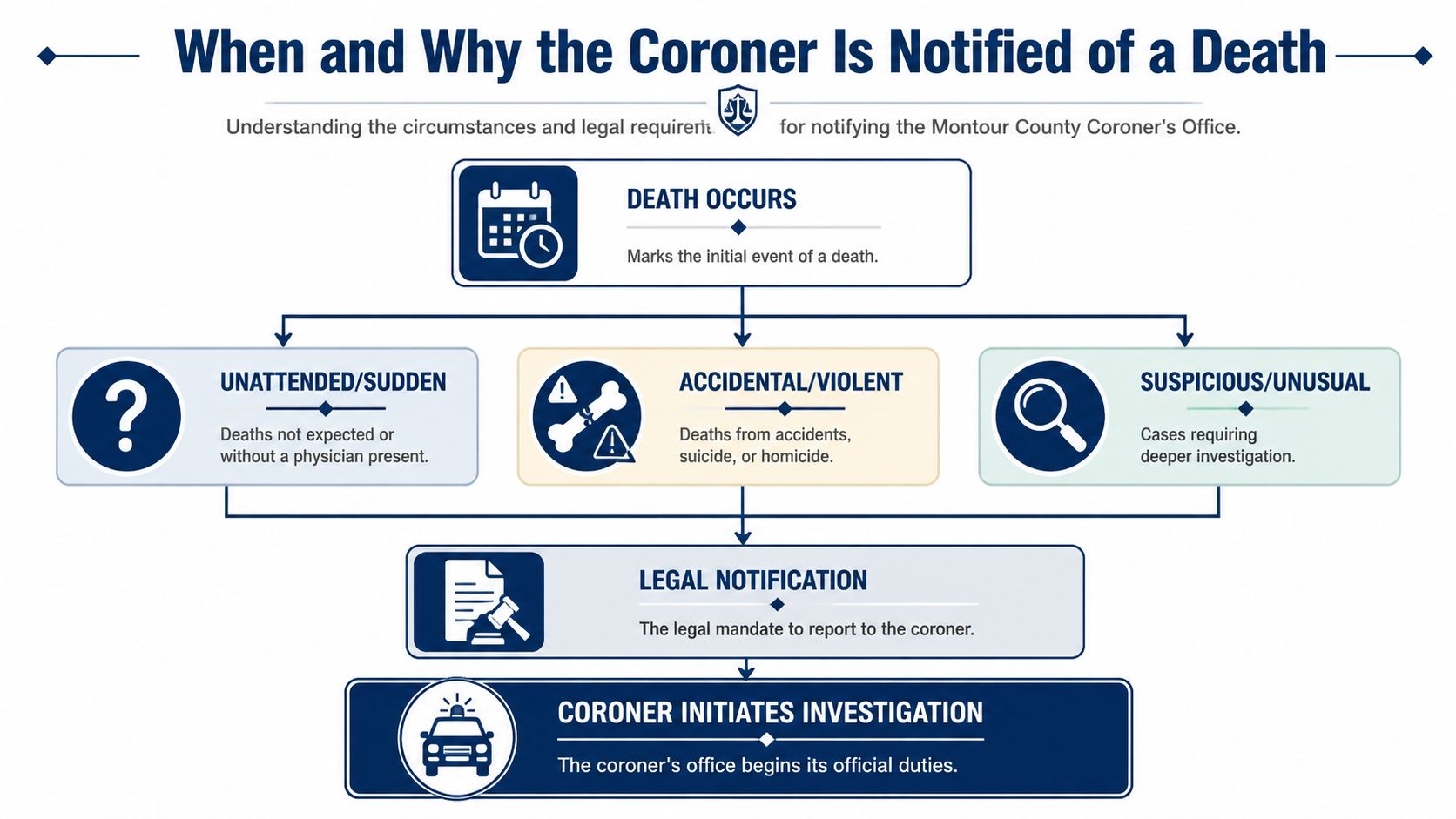
In plain language, notification commonly happens when the death appears to fall into one of these categories:
- Unexpected circumstances where the death was sudden or not anticipated.
- No recent medical attendance when there isn't a physician prepared to certify the death in the ordinary course.
- Possible injury or non-natural factors such as an accident or other external event.
- Suspicious or unclear facts when the available information doesn't fit neatly into a natural death explanation.
Why notification doesn't mean wrongdoing
Many families hear "the coroner is involved" and immediately fear a criminal investigation. Sometimes law enforcement is present only because they are the first agency called to the scene. That presence doesn't decide the outcome.
The legal duty to notify the coroner is about proper investigation and documentation, not about assigning blame at the outset.
This is especially important after an at-home death, an unwitnessed collapse, or a hospital death where the clinical picture is incomplete. The coroner may need to gather enough information to determine whether the death can be certified based on records and circumstances, or whether more formal forensic steps are necessary.
The notification itself is best understood as a checkpoint. It is how the system pauses, verifies, and makes sure the final legal record is grounded in evidence.
The Death Investigation and Autopsy Decision Process
Families usually experience this part as a series of short, stressful updates. A deputy speaks with them. A funeral home asks whether release has occurred. Someone mentions medical records. Hours later, there may still be no answer about whether an autopsy will happen.
That uncertainty is difficult, but the sequence is more structured than it may appear.
What usually happens first
A coroner investigation often begins with basic fact gathering. The office may review where the person was found, who last saw them alive, what symptoms or complaints were known before death, and whether recent medical care might explain the event. In many cases, the coroner also considers available records, emergency response information, and observations from the scene.
Montour County's public materials describe the office as investigating the circumstances, cause, and manner of death in cases that are sudden, unexpected, medically unattended, suspicious, or otherwise reportable, and also note that the office handles cremation authorizations and report requests through the official county process, as shown on the Montour County Coroner public page on Facebook.
A practical point families often overlook is the scene itself. If a death occurred in a home, the family may also need to think about when the residence can be safely re-entered or cleaned. If the circumstances involve trauma, decomposition, or hazardous contamination, a specialized guide to biohazard remediation can help explain why ordinary cleaning is not always appropriate.
How the autopsy decision is made
Not every coroner case leads to an autopsy. That is one of the most common misconceptions we see in forensic practice. An autopsy is a medical-legal tool. It is typically considered when the cause or manner of death cannot be determined confidently from external examination, known history, scene facts, and record review.
A simple way to think about it is this:
| Question the coroner asks | If the answer is clear | If the answer is not clear |
|---|---|---|
| Is there a medically supported explanation for the death | Certification may proceed without autopsy | Further testing or autopsy may be considered |
| Do the scene facts match the medical history | The case may be resolved administratively | The inconsistency may need deeper review |
| Is there concern for injury, intoxication, or uncertainty | Additional invasive exam may not be needed | Autopsy or toxicology may help answer the question |
For readers who want a more detailed forensic explanation of that reasoning, our earlier article on how a coroner determines cause of death walks through the same decision logic in plain language.
A decision not to perform an autopsy does not necessarily mean the office ignored the case. It often means the coroner believed the available evidence was sufficient for certification.
That said, families may still feel unsettled when official certainty arrives faster than emotional certainty. That gap is real, and it becomes especially important when we compare coroner and medical examiner systems.
Coroner vs Medical Examiner An Important Distinction
People often use the terms coroner and medical examiner as if they mean the same thing. They don't. Both systems deal with death investigation, but they are built differently, and the difference can matter when the medical issues are complex.
Two different systems
A coroner system centers on a county official with legal authority over certain deaths. A medical examiner system centers on a physician appointed for medical expertise in death investigation. In everyday conversation, that may sound like a small difference. In practice, it can shape how medical questions are evaluated.
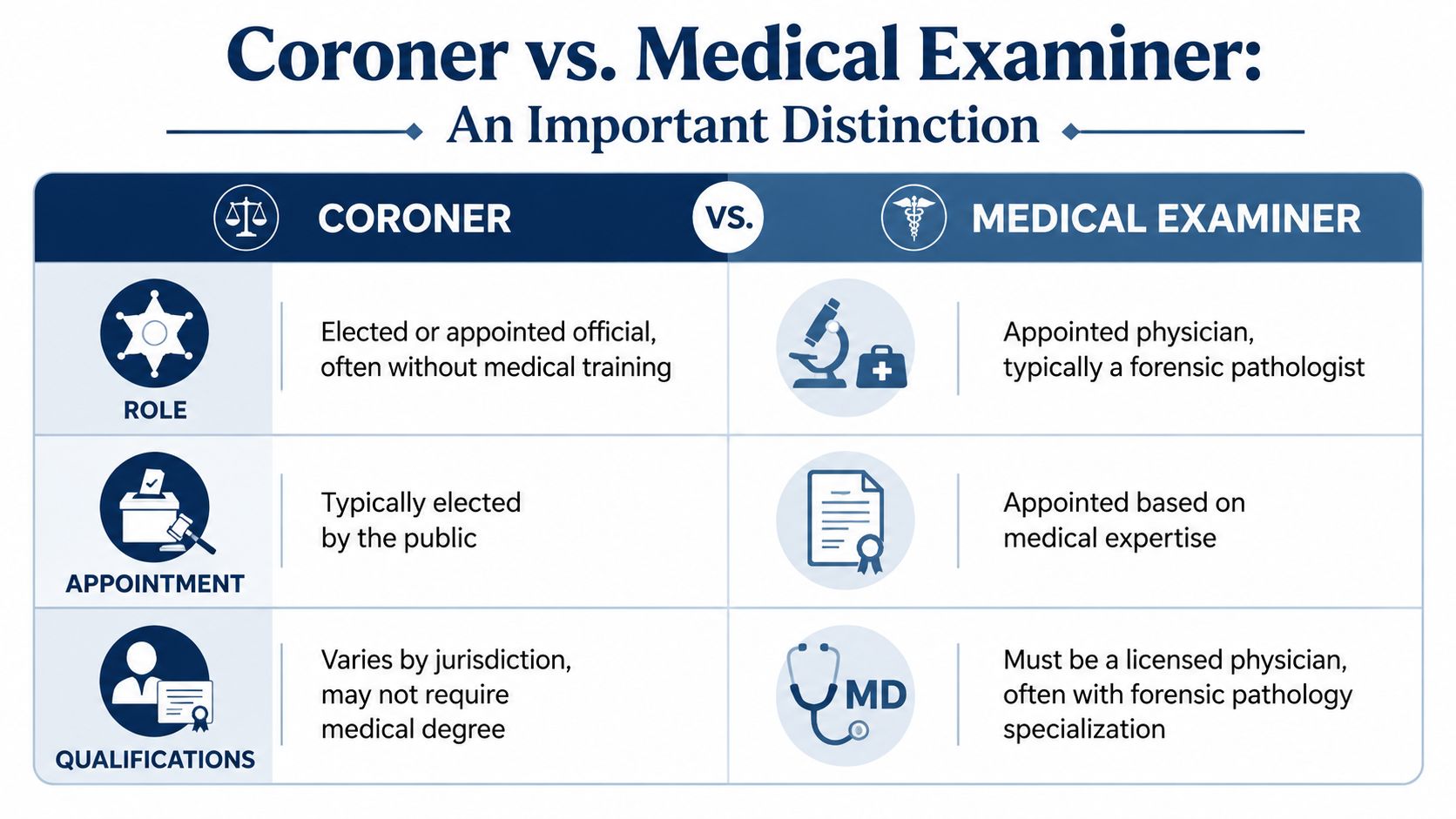
Here is the clearest side-by-side comparison:
| System | Core role | Medical training expectation |
|---|---|---|
| Coroner | Public official handling death investigation duties under local law | Varies by jurisdiction |
| Medical examiner | Appointed physician responsible for medical death investigation | Typically physician-based and specialty-driven |
For a fuller plain-language comparison, our article on the difference between coroner and medical examiner breaks down the systems without legal jargon.
Why the distinction matters to families
This is not about criticizing one county or one model. It is about understanding what kind of expertise is built into the system from the start. A family may assume that every official death investigation is automatically led by a forensic pathologist. In a coroner jurisdiction, that assumption may not be correct.
When the central issue is heavily medical, such as subtle natural disease, medication interaction, diagnostic uncertainty, or disputed timing, physician-level forensic analysis can be especially important. That is one reason counties and attorneys sometimes seek specialized forensic services beyond a local office's ordinary administrative function, including resources related to County Forensic Autopsies.
The key question is not which title sounds more official. The key question is who is performing the medical analysis and what training supports that opinion.
For families in crisis, that distinction can explain why an official answer may feel legally complete yet medically thin. It also explains why some families later explore an independent review.
A Family's Rights and the Option for a Private Autopsy
After an official investigation, families often expect a simple packet of records and a clear explanation. What they usually encounter instead is a narrow release process, a funeral home handling one set of documents, and unanswered questions about who is allowed to receive what.
Records, releases, and practical next steps
Montour County's own public guidance states that the coroner's portion of the death certificate is sent to the funeral home selected by the family, while coroner reports can be requested by phone and may require fees plus a signed release from the next of kin or a subpoena, according to the Montour County coroner department page.
That leads to several practical consequences:
- The death certificate and the coroner report are not the same document. Families often receive one through the funeral home process and assume the full investigative record is included. It usually is not.
- Access may depend on legal status. Next of kin, attorneys, insurers, and other interested parties may not all have the same right of access.
- The public instructions are limited. The county notes fees and release requirements, but it does not lay out a full step-by-step timeline on that page.
If a death may involve civil liability, families sometimes need broader legal context while they wait for records. In that setting, Porter Law Group's insights on wrongful death can help readers understand the kinds of questions attorneys often evaluate after a loss.
For related guidance on document access and decision authority, our educational post on who can request an autopsy may also be useful.
When a private autopsy may help
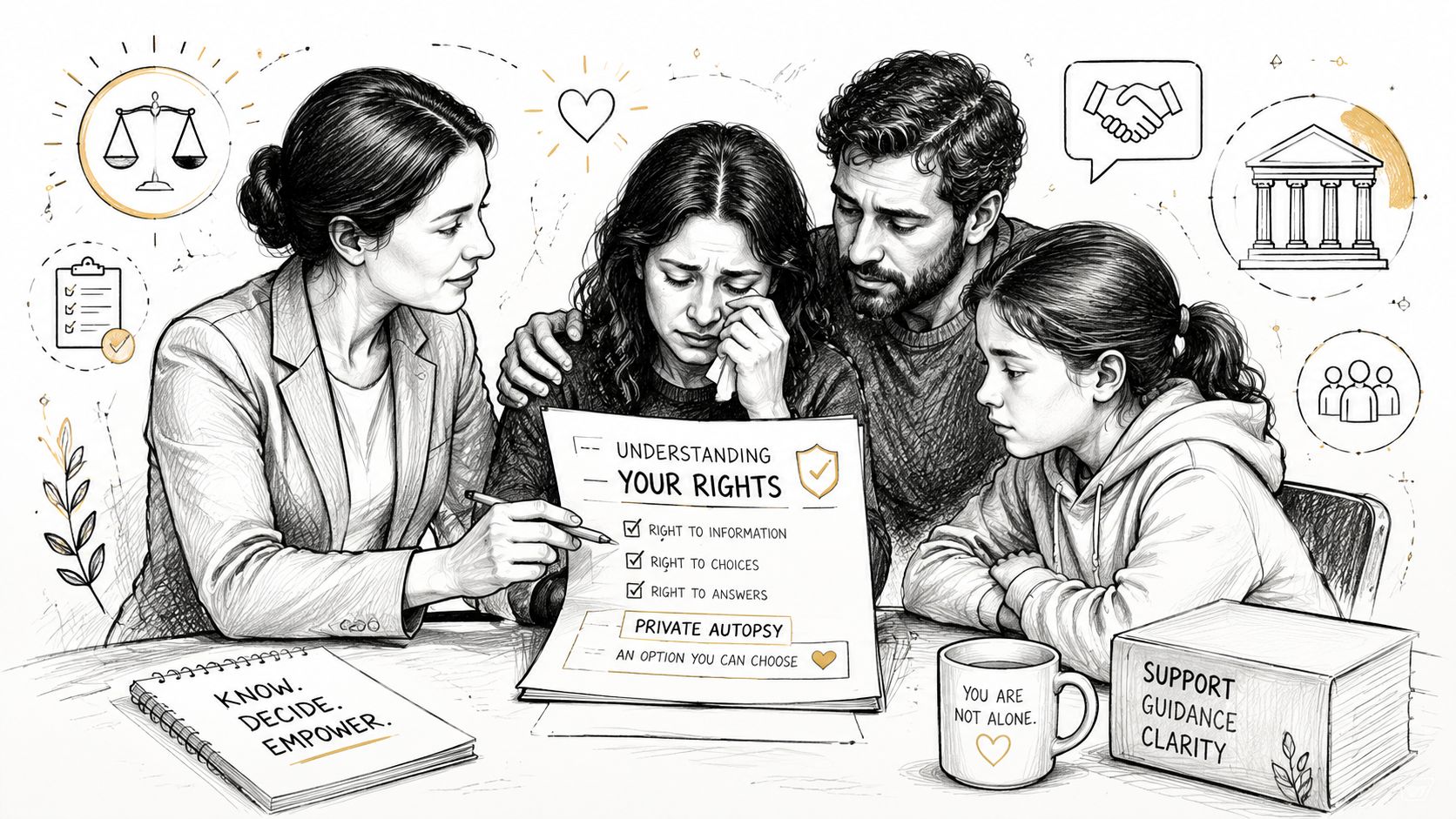
A private autopsy becomes relevant when the official process does not fully answer the family's concerns. That may happen when no autopsy was ordered, when the reported cause of death feels too general, or when the family needs an independent medical opinion for insurance, litigation, or personal closure.
A private autopsy is an independent postmortem examination arranged outside the county coroner system. In our field, its value comes from medical objectivity, documentation, and full chain of custody when needed. It is not a replacement for the county's legal role, but it can provide a separate forensic analysis.
This short video gives a helpful overview of what families often want to know before making that decision.
The most important point is that families do have options. If the official system has concluded its work and serious questions remain, seeking an independent evaluation can be a reasonable next step.
Frequently Asked Questions about Coroner Procedures
Practical questions usually matter more than formal definitions once the immediate crisis begins to settle. These are the issues families and attorneys most often need clarified.
How do I contact the coroner's office
The Montour County Coroner is publicly listed with the phone numbers 570-275-1867 and 570-214-4960, and an office address of 100 N. Academy Avenue, Danville, PA 17822 on the Pennsylvania State Coroners' Association listing for Montour County.
If you're calling about a report request, it helps to have the decedent's full name, date of death, and your relationship to the decedent ready before the call. The office's records process is formal, so basic identifying information matters.
How do records and death certificate documents work
Families often assume the coroner's office sends every document directly to them. In practice, the coroner's portion of the death certificate goes to the chosen funeral home, while a formal coroner report may require a separate request through the office's records process, as noted earlier.
Ask specifically which document you are requesting. "Death certificate," "coroner report," and "autopsy report" may refer to different records.
The office has publicly indicated that report release may involve fees and may require a signed release from the next of kin or a subpoena. If you're an attorney or insurer, that legal distinction is especially important.
Who handles cremation approval
In Montour County, cremation authorization is part of the coroner's function in reportable deaths, as discussed earlier in the article. Families usually encounter this through the funeral home, but the authority for release in a coroner case may rest with the coroner's office until its review is complete.
That doesn't mean cremation is being denied. It usually means the office must complete its required review before irreversible disposition can proceed.
Can a family question the official findings
Yes. A family can question the findings, ask what records are available, and seek legal advice when appropriate. Whether an official finding can be formally changed is a separate matter governed by the underlying evidence and the procedures of the relevant agencies.
There is also a practical distinction between challenging an opinion and supplementing the record. In many situations, an independent private autopsy or expert review is not an accusation against the coroner. It is a separate forensic effort to answer medical questions that remain unresolved for the family.
If you're dealing with uncertainty after a death, it's reasonable to slow the process down enough to understand which office has authority, which records exist, and whether you need an independent forensic opinion before making final decisions.
If your family, law firm, or county office needs a clear independent forensic opinion after a death, Texas Autopsy Services is available to help. We provide private autopsies, second-opinion reviews, and county forensic autopsy support across Texas. Every examination is performed by a forensic pathologist certified by the American Board of Pathology, with direct communication, full chain of custody, and compassionate guidance throughout the process. If you need to talk through next steps, our team is available 24/7 at (806) 230-1889.