October 20, 2025 · Texas Autopsy Services
Cause of Death Determination: A Pathologist’s Guide to Finding Answers
A forensic pathologist explains the medical and legal process of cause of death determination. Learn how autopsies and investigations provide answers.
On this page
When you lose a loved one, the world stops. Amidst the profound grief, one question often rings louder than any other: Why? As a forensic pathologist, my entire professional life is dedicated to answering that question. My work involves carefully piecing together the final chapter of a person's life to bring clarity, and hopefully some measure of closure, to the families left behind.
This guide is written from my perspective on the other side of the microscope and the examination table. I want to pull back the curtain on how a cause of death is determined—not with cold, clinical language, but with the compassion and precision that this sensitive process demands.
The goal is always to build a clear, evidence-based narrative. It is a methodical, scientific investigation, but it is never just a procedure to me. The information we uncover is vital for legal matters, for insurance claims, and most importantly, for a family’s peace of mind.
The Building Blocks of a Death Investigation
To grasp how this process works, it helps to understand the three core concepts that frame every investigation. Think of them as the “what,” the “how,” and the “circumstances.”
- Cause of Death: This is the specific injury or disease that initiated the chain of events leading to death. It is the root cause—the first domino to fall. This could be a heart attack due to coronary artery disease, injuries from a car crash, or a malignant tumor.
- Mechanism of Death: This is the physiological process that results from the cause. If the cause of death was a gunshot wound to the chest, the mechanism might be massive blood loss (exsanguination) or a collapsed lung. It is the direct biological reason life ended.
- Manner of Death: This is the official, legal classification of the death. In the United States, there are five recognized categories: Natural, Accident, Suicide, Homicide, and Undetermined.
My role is to connect these three pieces. The cause, mechanism, and manner of death come together to form a complete and coherent narrative, transforming a medical puzzle into a human story that provides the answers your family is searching for.
Why This Process Matters: A Quick Look Back
The careful, systematic way we determine cause of death is not new. It grew from a critical need for public health data. Back in the 19th century, pioneers like William Farr advocated for a standardized method of classifying diseases to track how and why populations were dying.
This work eventually led to a system proposed by Jacques Bertillon in 1893, which became the foundation for the International Classification of Diseases (ICD) we use today. You can learn more about the historical development of cause of death statistics and its importance. This framework is not just about individual cases; it allows us to see the bigger picture, spot mortality trends, and ultimately, protect the health of our communities.
The Four Pillars of a Death Investigation

Figuring out why someone died is almost never a single "aha!" moment. It is a methodical process, much like weaving a tapestry. Different threads of evidence—medical, circumstantial, personal—must be gathered. Only when you see how they all connect does the full picture emerge.
I view every cause of death determination as a structure built on four foundational pillars. Each one provides a different angle, a unique stream of information. If one is missing, the entire conclusion could be compromised. Think of it like a detective building a case; you need more than one piece of evidence to arrive at the truth.
Pillar 1: Medical History Review
Before we can understand how a life ended, we must understand how it was lived. A deep dive into the person's medical history provides an essential baseline.
This is not just a quick scan for a fatal illness. It is about building a complete health profile that paints a detailed picture.
- Past Diagnoses: We need to know about any chronic conditions like heart disease, COPD, diabetes, or cancer. These are major parts of the story.
- Surgical History: Previous operations can leave scars or internal changes that are crucial to recognize during an examination.
- Prescription Medications: A list of what they were taking, both recently and in the past, offers clues about their health and potential side effects or interactions.
- Recent Symptoms: Did they complain of chest pain? Dizziness? Shortness of breath? These recent complaints can point me directly toward a specific organ system.
This information, pulled from medical records and physicians' notes, frames the entire investigation. It tells me what the person was already dealing with, which is vital for correctly interpreting what I find during the autopsy.
Pillar 2: Scene and Circumstantial Evidence
The "where" and "how" of a death provide objective context that a purely medical exam simply cannot. While I may not personally visit the scene in a private autopsy case, the details gathered by first responders, law enforcement, or the medical examiner’s investigators are incredibly important.
This circumstantial evidence helps reconstruct the final moments. For instance, finding a weapon, a suicide note, or drug paraphernalia can immediately steer an investigation. Even something as simple as the condition of a person's home can offer clues about their physical and mental state before they died.
In my work, context is everything. An autopsy finding might be ambiguous on its own, but when viewed through the lens of the circumstances surrounding the death, its meaning often becomes crystal clear.
Pillar 3: Witness and Family Interviews
Medical charts tell a clinical story, but the people who knew the decedent tell the human story. Speaking with family, friends, and any witnesses provides a rich, personal history that you will never find in a file.
These conversations can uncover subtle but critical details: recent changes in behavior, physical complaints they never told a doctor about, or a major life stressor. For families, I know this is an incredibly difficult conversation, but it is also a vital part of the process. It is their chance to ensure their loved one’s full story is heard and considered.
Pillar 4: The Postmortem Examination
The final pillar is the autopsy itself—the hands-on, physical examination of the body. This is where we can confirm, challenge, or uncover evidence that the other pillars have only hinted at. The autopsy provides the hard medical proof needed to finalize the cause of death determination.
During this systematic examination, I can see the state of every organ with my own eyes, find injuries that were not visible on the outside, and take tissue and fluid samples for further testing. A toxicology report can reveal the presence of drugs or poisons, while microscopic examination of tissues can identify diseases that were otherwise invisible.
When building a conclusion, a forensic pathologist relies on these four pillars to provide a complete and corroborating set of facts. Each pillar contributes a unique type of evidence, and together they create a comprehensive understanding of the death.
Here’s a breakdown of what each pillar brings to the investigation:
Pillars of Death Investigation and Their Roles
| Pillar of Investigation | Information Provided |
|---|---|
| Medical History | Provides a baseline of health, including chronic illnesses, past surgeries, and medications that could contribute to the death. |
| Scene & Circumstances | Offers objective context about the environment, events, and potential external factors involved in the final moments. |
| Witness & Family Interviews | Fills in the personal narrative with details on recent behavior, unreported symptoms, and the decedent’s state of mind. |
| Postmortem Examination | Delivers direct physical evidence from the body, including organ damage, injuries, and toxicological findings. |
Ultimately, relying on all four pillars ensures that the final determination of cause of death is not just a guess based on one piece of data, but a conclusion firmly supported by the total weight of the evidence.
A Detailed Look Inside the Autopsy Process
Let's be direct: the word "autopsy" likely brings to mind intimidating scenes from television shows or movies. The reality is far less dramatic and much more methodical. An autopsy is a precise, respectful medical examination, and my goal here is to demystify how each step helps us find definitive answers for a final cause of death determination.
Think of the examination itself as a two-part investigation. It always starts with a careful, non-invasive look at the outside before moving to a comprehensive evaluation on the inside.
The External Examination
Before a single incision is made, my work begins with a thorough external examination. This is essentially a head-to-toe documentation of the body as it was received, and you would be surprised how much information this step alone can provide.
I meticulously record every physical detail: height, weight, hair and eye color, and any unique identifiers like scars, tattoos, or birthmarks. I also note any signs of medical intervention, such as IV lines or surgical staples, which add important context to the person's final days. This initial pass is all about observing and documenting everything visible on the surface—it can reveal subtle signs of injury, trauma, or underlying disease that tell part of the story.
The Internal Examination
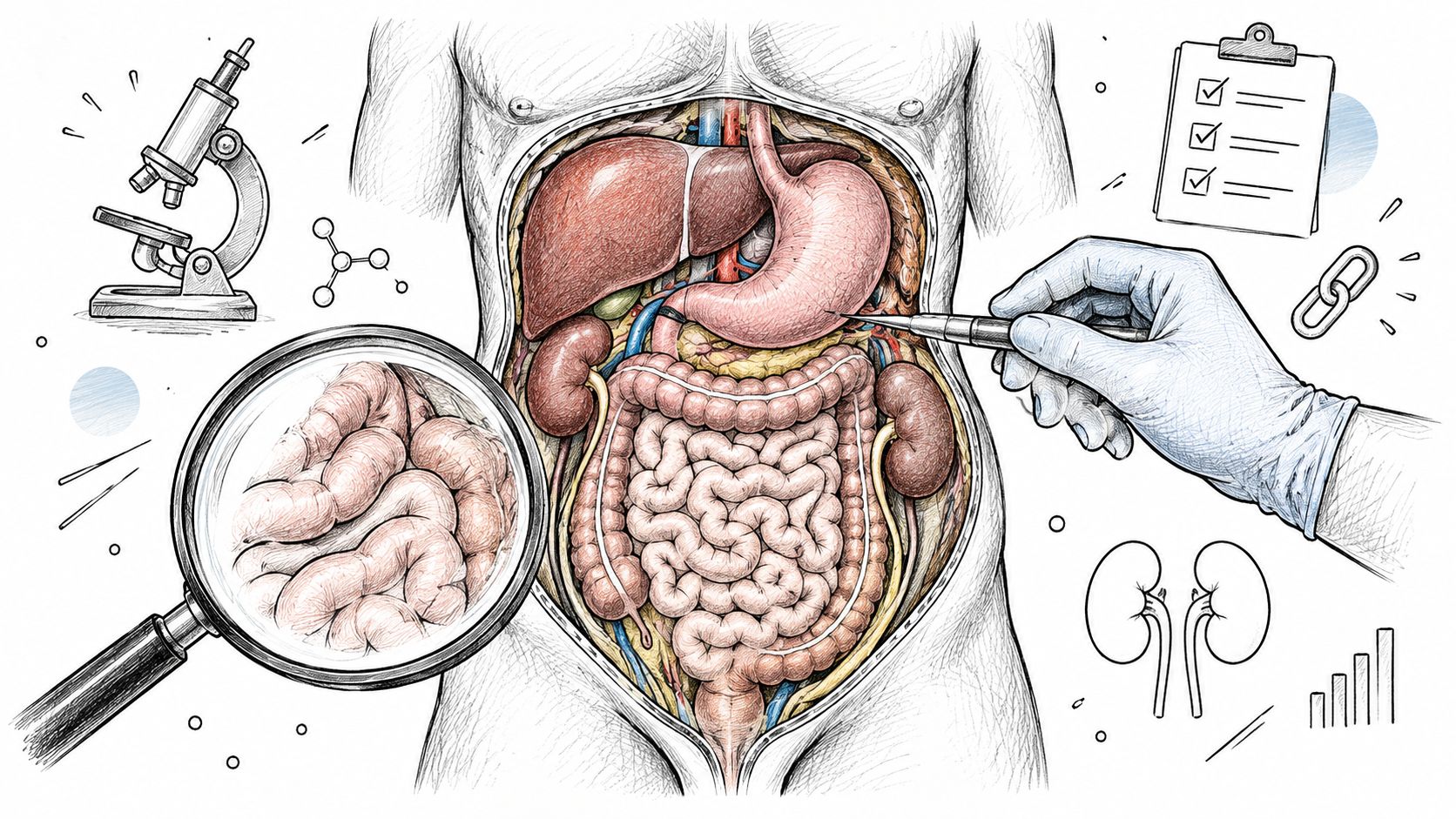
Once the external review is complete, the internal examination begins. This is where we systematically evaluate each organ system to identify any disease, injury, or other abnormalities. I want to assure you, this is performed with the same level of respect and care as any surgical procedure.
I examine each organ system—cardiovascular, respiratory, gastrointestinal, and so on—searching for the physical evidence that explains what happened. This could be anything from a blockage in a coronary artery that points to a heart attack, to signs of pneumonia in the lungs, or even an undiagnosed tumor. We also measure and weigh key organs; changes in their size can be a tell-tale sign of chronic conditions like high blood pressure or liver disease.

This visual helps show the contrast between what we can see on the outside versus the crucial evidence that is only revealed by looking within.
An autopsy is often called "the body's final story." The internal examination is how we read each chapter, uncovering the physiological events that led to the end of life. Every organ holds a piece of that narrative.
The Crucial Role of Ancillary Studies
Sometimes, the most important clues are invisible to the naked eye. That’s where specialized laboratory tests, or ancillary studies, come in. These tests are absolutely fundamental to a complete cause of death determination, giving us microscopic and chemical evidence we simply cannot get any other way.
These studies elevate the autopsy from a purely anatomical procedure to a full medical investigation. They help us confirm what we see and, just as importantly, uncover hidden factors that may have contributed to the death.
Here are a few of the most common and vital tests we use:
- Toxicology: We analyze samples of blood, urine, and tissue to check for drugs (both prescription and illicit), alcohol, poisons, or other chemicals. A toxicology report tells us whether a substance was present at a therapeutic level or a fatal dose.
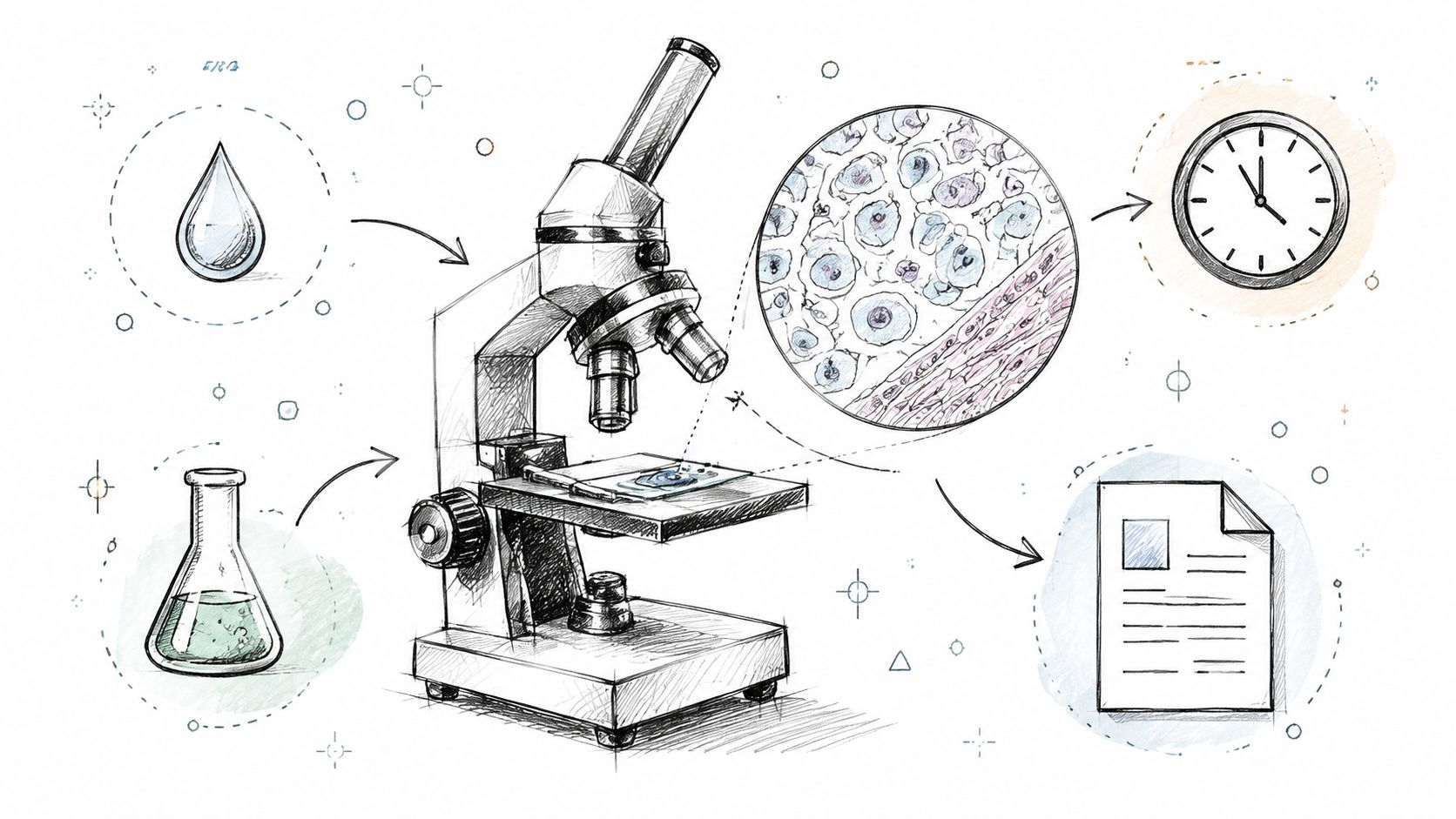
- Histology: During the internal exam, I take small, carefully selected tissue samples from major organs. In the lab, these are sliced paper-thin, placed on glass slides, and stained to be viewed under a microscope. This is how we see disease on a cellular level—identifying cancer cells, inflammation, or signs of a hidden infection.
- Microbiology: If we suspect an infection caused or contributed to the death, we can culture blood or tissue samples to identify the specific bacteria, virus, or fungus responsible. This is absolutely critical in cases of suspected sepsis or infectious diseases like meningitis.
- Genetics: In some situations, especially with sudden and unexplained deaths in younger people, we might recommend genetic testing. This can identify inherited heart conditions or other genetic disorders that might have played a silent, but deadly, role.
By combining the physical findings from the external and internal exams with the hard data from these ancillary tests, I can put together a complete, evidence-based picture. This multi-layered approach ensures the final report is as accurate and thorough as possible, providing the clear, definitive answers that families and legal professionals need.
Understanding Cause, Mechanism, and Manner of Death

When I prepare an autopsy report or a death certificate, I must be incredibly precise with my language. Words that people might use interchangeably in everyday conversation have very specific, legally binding meanings in a death investigation.
Nowhere is this more important than with three key terms: the cause, the mechanism, and the manner of death.
These are not just different ways of saying the same thing. They are three distinct pieces of a puzzle, each answering a different question about how a life ended. Think of it as a logical chain of events: the cause explains why the process started, the mechanism explains how the body failed, and the manner explains the circumstances surrounding it all.
The Cause of Death: The "Why"
The cause of death is the specific injury or disease that initiated the chain of events leading to death. It is the first domino that falls. This could be a chronic illness that progressed over decades, like coronary artery disease, or a sudden, violent event, like a gunshot wound.
Globally, chronic diseases are the most common culprits. For example, in 2019, heart diseases were behind roughly 33% of all deaths worldwide, and cancers accounted for nearly 20%. These conditions are the fundamental "why" for the vast majority of natural deaths.
The Mechanism of Death: The "How"
If the cause is the "why," then the mechanism of death is the physiological "how." It is the specific way the body shut down as a result of the cause.
Let’s say the cause of death was a heart attack (a myocardial infarction). The mechanism could be a lethal arrhythmia—a catastrophic disruption of the heart's rhythm. If the cause was a stab wound to the chest, the mechanism would be exsanguination, which is the medical term for bleeding to death.
The mechanism is the final step, the physiological event that directly leads to death. It is important to note that very different causes can lead to the very same mechanism. For example, severe blood loss can be the mechanism for a death caused by a car crash, a ruptured aneurysm, or a deep laceration.
The Manner of Death: The "Circumstance"
Finally, we have the manner of death. This is not a medical finding; it is a legal classification that describes the circumstances surrounding the death. It is determined by evaluating everything—the autopsy findings, the scene investigation, and the person’s history.
In the United States, there are five official options for the manner of death:
- Natural: Death resulting solely from disease or old age. This is by far the most common classification.
- Accident: Death from an unplanned, unintentional event. Think car crashes, accidental falls, or unintentional drug overdoses.
- Suicide: Death caused by an intentional, self-inflicted act.
- Homicide: Death at the hands of another person. It’s important to note this is a neutral medical-legal term and does not automatically mean a crime occurred—that is for the justice system to decide.
- Undetermined: When there is not enough information to confidently choose one of the other four categories.
Determining the manner of death is often the most complex part of the process, requiring a synthesis of all available evidence. For a deeper dive, our guide on the legal classifications of manner of death is a helpful resource.
To help put all this together, let's look at a few scenarios.
Cause vs. Mechanism vs. Manner of Death Examples
The following table shows how these three elements work together in different situations. Notice how the same cause can sometimes lead to a different manner of death depending on the circumstances.
| Scenario | Cause of Death | Mechanism of Death | Manner of Death |
|---|---|---|---|
| A person has a heart attack at home. | Coronary Artery Disease | Cardiac Arrhythmia | Natural |
| An individual is in a car crash. | Blunt Force Trauma to the Chest | Aortic Rupture | Accident |
| A soldier is shot in combat. | Gunshot Wound to the Abdomen | Exsanguination | Homicide |
| Someone intentionally takes a fatal dose of medication. | Acute Drug Toxicity (e.g., Oxycodone) | Respiratory Arrest | Suicide |
As you can see, each term provides a unique and necessary piece of information. Only by understanding all three can we get a complete and accurate picture of how and why a person died.
The Final Autopsy Report and Death Certificate
Once all evidence is gathered and every test result is received, the entire investigation culminates in two crucial documents: the autopsy report and the death certificate. These are not just forms to be filled out; they are the official, final records that deliver answers to a grieving family, provide evidence for legal matters, and contribute vital data to public health.
The autopsy report tells the complete story of the investigation. It is a detailed, comprehensive document that weaves together all our findings into one clear narrative. Think of it as the full explanation behind our conclusions, written to provide transparency for families and attorneys who need to understand exactly how the cause of death determination was made.
What a Comprehensive Autopsy Report Includes
A professional report is structured to be both thorough and easy to follow. It typically breaks down into a few key parts:
- Final Pathological Diagnoses: This is the at-a-glance summary, right at the beginning. It is a list of all important medical findings, with the primary cause of death listed first.
- Summary and Opinion: This is where I connect the dots in plain English. I explain how the person's medical history, the circumstances of their death, and the physical autopsy findings all point to the final conclusion.
- External and Internal Examination Findings: Here, you will find a detailed, system-by-system description of everything I observed during the postmortem examination.
- Ancillary Study Results: This section contains all the lab results—toxicology reports, microscopic tissue analysis (histology), and any other specialized tests that were performed.
This report is the foundation of the entire process, built to give families the deep, meaningful answers they are searching for. For the professionals involved, like healthcare providers and law firms, discussing these sensitive findings requires absolute privacy. That’s why secure communication is so important, often using tools like HIPAA compliant video conferencing for healthcare and legal firms.
The Death Certificate: A Legal and Public Health Record
If the autopsy report is the full story, the death certificate is the official, condensed summary for legal purposes. It is a vital public document, used for everything from settling a loved one's estate to processing life insurance claims. It also allows public health officials to spot and track mortality trends in our communities.
I take the key findings from the autopsy report to complete the medical section of the death certificate. This includes the immediate cause of death along with any underlying conditions that played a significant role. The language here must be precise, because this document is what formally establishes the cause, mechanism, and manner of death in the eyes of the law. You can read more about how we translate complex medical findings into the standardized format of the cause of death listed on death certificates in our dedicated article.
It is important for families to know that a death certificate is not always set in stone. If new information comes to light—such as toxicology results that take several weeks to process—the death certificate can be amended to reflect the most accurate information. This ensures the final record is as complete and correct as possible.
In the end, these two documents work as a team. The autopsy report gives you the deep, detailed "why," while the death certificate provides the official summary that helps families and legal systems move forward.
When to Consider a Private Autopsy
After a loved one passes, families are often left with more questions than answers. The local medical examiner or coroner steps in for deaths that are suspicious, sudden, or fall under specific legal categories, but most deaths do not meet that criteria.
This is where a private autopsy can be a powerful tool. It is a choice—an option for families who need a clear, unbiased cause of death determination when the official system is not required to provide one. Think of it as a path to clarity, driven by a need for truth, not a legal mandate.
Finding Clarity Amid Uncertainty
So, when does it make sense to pursue one? A common scenario is when a loved one dies during or right after a hospital stay, and the exact cause of death feels uncertain. The doctors might have a good idea of what happened, but an autopsy provides a definitive, science-backed diagnosis.
This becomes especially important if you have concerns about the quality of medical care your loved one received. An independent examination helps put the pieces together. It can confirm whether treatments were working, identify unexpected complications, or simply provide an objective medical record that either brings peace of mind or clarifies potential legal questions.
Another crucial reason is to uncover hereditary diseases. Discovering a genetic condition, like a specific heart ailment, can be life-altering for surviving family members. To put this in perspective, ischaemic heart disease was the leading cause of death worldwide in 2021, accounting for roughly 9.0 million deaths. Finding out if a condition like that runs in the family gives relatives a critical heads-up about their own health risks. You can read more about the leading causes of death worldwide directly from the World Health Organization.
A private autopsy is fundamentally about providing answers where none exist. It is a compassionate, medically rigorous process designed to serve a family’s need for understanding, separate from any public or legal investigation.
Ultimately, the decision often boils down to a single question: Are you comfortable with the information you have? If the answer is no, a private autopsy is one of the most effective ways to find the truth.
Of course, cost is a factor. But for many families, the certainty it brings is invaluable. If you are weighing your options, our guide explains in detail how much a private autopsy costs.
Common Questions About the Determination Process
Over the years, I have noticed that families and attorneys tend to ask the same kinds of questions when they are grappling with a death investigation. I want to take a moment to answer some of the most common ones I hear, speaking directly from my experience as a forensic pathologist.
My goal here is to demystify the process. Gaining clarity can be a small but meaningful step toward finding peace during an incredibly difficult time.
How Long Does It Take to Determine the Cause of Death?
This is the number one question I get, and the honest answer is: it depends.
In some clear-cut cases, where the physical examination reveals everything we need to know, I can give a preliminary answer within a day or two. But it is often more complicated than that.
Many deaths require specialized lab work. Toxicology reports, for instance, can take weeks or even months to come back. That information is often the final piece of the puzzle needed for a definitive cause of death determination. So, while I can share initial thoughts, the final, certified death certificate must wait until all scientific evidence is in.
Can a Family Refuse an Autopsy?
This truly depends on the situation. If a death is considered a "medicolegal" or "coroner's case"—meaning it was sudden, unexpected, or occurred under suspicious circumstances—an autopsy is typically required by law. In those scenarios, it is part of an official investigation, and the family cannot refuse it.
On the other hand, if someone passes away in a hospital from a well-documented illness, the decision for a private autopsy is entirely up to the family or next of kin.
Is the Body Disfigured After an Autopsy?
This is a deep and understandable concern for so many families. Let me reassure you: we treat every autopsy as a respectful surgical procedure. All incisions are carefully planned and placed so they will not be visible when the person is dressed in regular clothing.
I treat every examination with the same care and dignity that a surgeon would for a living patient. My team and I take every possible measure to ensure that the body is properly reconstructed, allowing for an open-casket viewing if the family wishes.
What Happens if the Cause of Death Is Unclear?
Sometimes, even after a complete autopsy and all the tests are back, a clear-cut answer is not there. When that happens, the cause of death is listed as "undetermined."
This does not mean the investigation failed. It is an honest conclusion acknowledging that the available evidence simply does not point to a single, definitive cause. This is most common when a body has been decomposing for a long time or when we have very little background information to work with.
In these complex situations, the findings and opinions of medical experts are indispensable. To learn more about how these opinions are used in legal settings, you can explore the vital role of medical experts in breaking down complicated medical facts for judges and juries.
The path to understanding is often filled with difficult questions. If you are seeking answers that a routine investigation may not provide, my team at Texas Autopsy Services is here to help.
For a confidential consultation about private autopsy services, please contact us by phone or email. We are here to offer clarity with compassion and precision.