February 3, 2026 · Texas Autopsy Services
How Long Does a Pathology Report Take to Complete
Understand how long does a pathology report take with a clear timeline from a Texas forensic pathologist, from the initial autopsy to the final report.
On this page
- Why the Timeline for a Pathology Report Matters
- The Autopsy Itself What Happens First
- Why Laboratory Analysis Is the Longest Step
- Why Some Reports Take Longer Than Others
- Understanding the Difference Preliminary vs Final Reports
- How We Deliver Faster More Personal Answers
- Common Questions About Autopsy Timelines
It’s one of the first questions I’m asked in nearly every consultation: “How long will the pathology report take?” While there isn’t a single timeline that fits every case, I can typically provide a preliminary report based on initial observations within 24 to 72 hours. The final, comprehensive report is a much more detailed document and usually takes 3 to 6 weeks to complete.
That longer wait is necessary for the meticulous laboratory work that underpins every conclusion.
Why the Timeline for a Pathology Report Matters
Understanding the timeline for a pathology report is about more than just knowing a date. For families navigating a loss, it’s a critical step toward finding closure. For attorneys, it’s about establishing the essential facts needed to build a case or meet legal deadlines.
The process is structured and careful by design. In my work at Texas Autopsy Services, I guide families and legal professionals through each stage, from the initial physical examination to the complex laboratory tests that form the core of my investigation. My goal is to give you a clear, realistic picture of the process and demonstrate a commitment to both medical precision and compassionate communication.
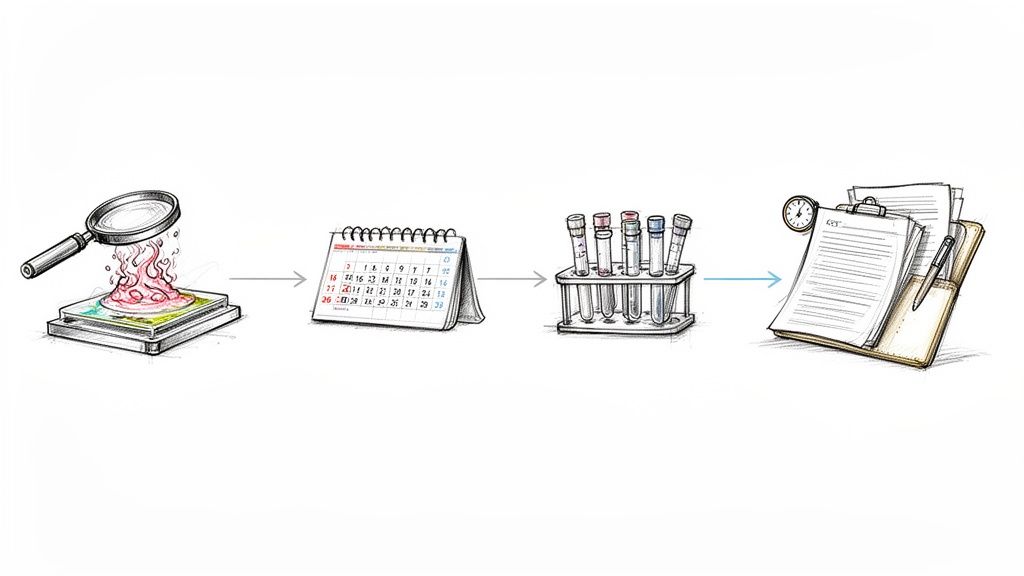
This timeline shows how the report progresses from preliminary findings to the final, detailed document.
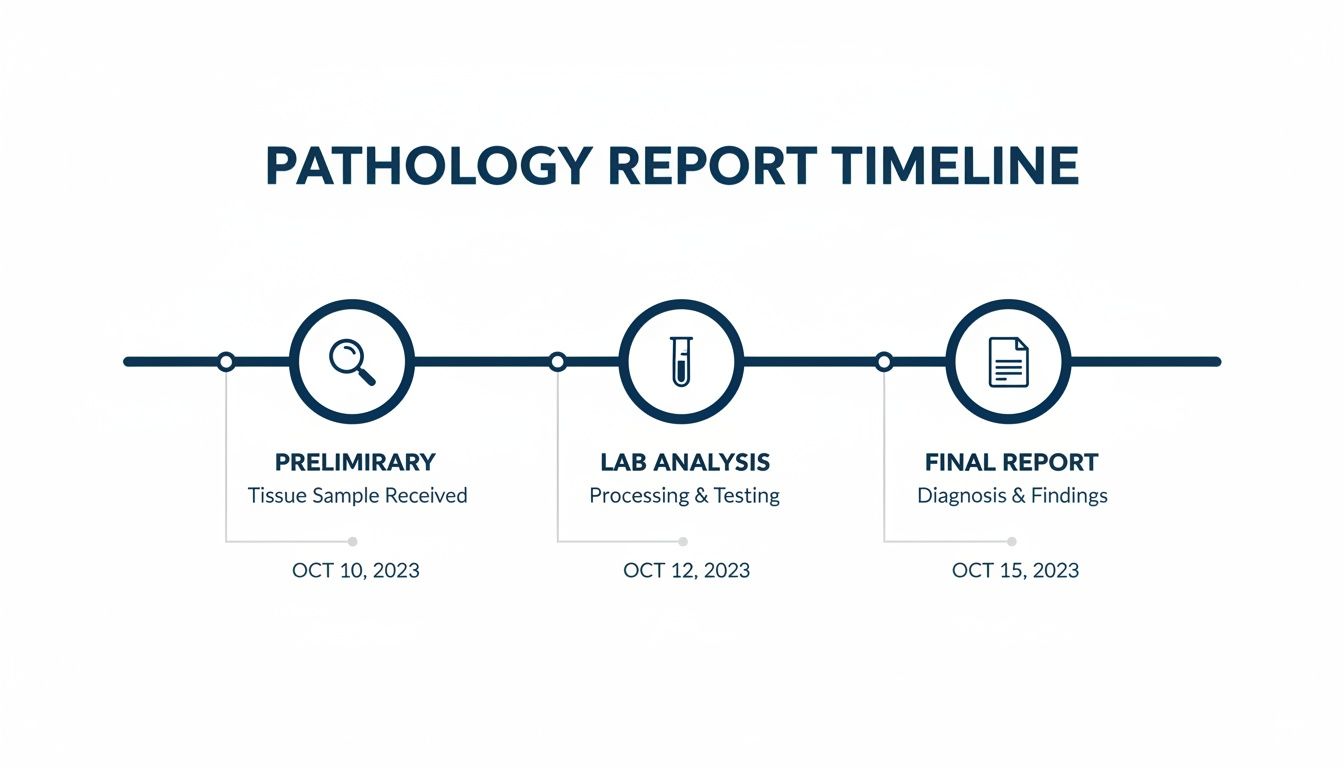
As you can see, the laboratory analysis is the most time-intensive phase. That’s because it’s where we ensure every conclusion is supported by scientific evidence.
The Path to Definitive Answers
A pathology report isn't a single event; it's a sequence of deliberate steps. Each one is essential for creating an accurate and legally sound document that provides the answers families and legal teams need. The process is designed to be thorough, not fast, because the integrity of the findings is paramount.
Here’s a brief overview of the journey:
- Initial Examination: This is the physical autopsy itself, where I make direct observations and carefully collect tissue and fluid samples. This stage provides the first set of clues.
- Laboratory Analysis: The collected samples are sent for various tests, like histology (examining tissue under a microscope) and toxicology. This is the longest part of the process.
- Data Integration and Review: I meticulously review all findings—lab results, medical records, and relevant circumstances—to assemble a complete picture.
- Final Report Compilation: The last step is writing the comprehensive report that details the cause and manner of death, supported by all the evidence gathered.
The Autopsy Itself What Happens First
To understand the timeline, it’s important to first understand the physical autopsy. As a forensic pathologist, I conduct a meticulous examination. At Texas Autopsy Services, this involves a complete external and internal assessment to document every injury, sign of disease, or any unusual finding.
The physical procedure usually takes a few hours. During that time, I’m not just observing; I am also collecting small tissue and fluid samples that are critical for the analysis that follows. They allow me to investigate further and find the full story.
While the physical exam gives me immediate information about the body's structures, the microscopic and chemical details are revealed only after careful lab work. You can learn more about the full scope of what happens in my detailed guide on how long an autopsy takes, but this initial stage sets the foundation for everything else.
Getting the Preliminary Findings
In most situations, I can share preliminary findings within 24 to 72 hours after the physical examination is complete.
These initial observations are based on what I can see with my own eyes, which we call "gross findings." It's crucial for families and attorneys to remember that these are preliminary. They represent my initial expert assessment, but they aren't the final word.
Think of a preliminary finding as the first chapter of a book. It offers immediate direction and answers some early questions, but it’s not a substitute for the comprehensive final report.
Definitive answers can only come after every lab test is back, analyzed, and placed into context. This first stage is essential for building the thorough, accurate, and legally sound final report that families need. The next steps are where the deeper, often hidden, pieces of the puzzle come to light.
Why Laboratory Analysis Is the Longest Step
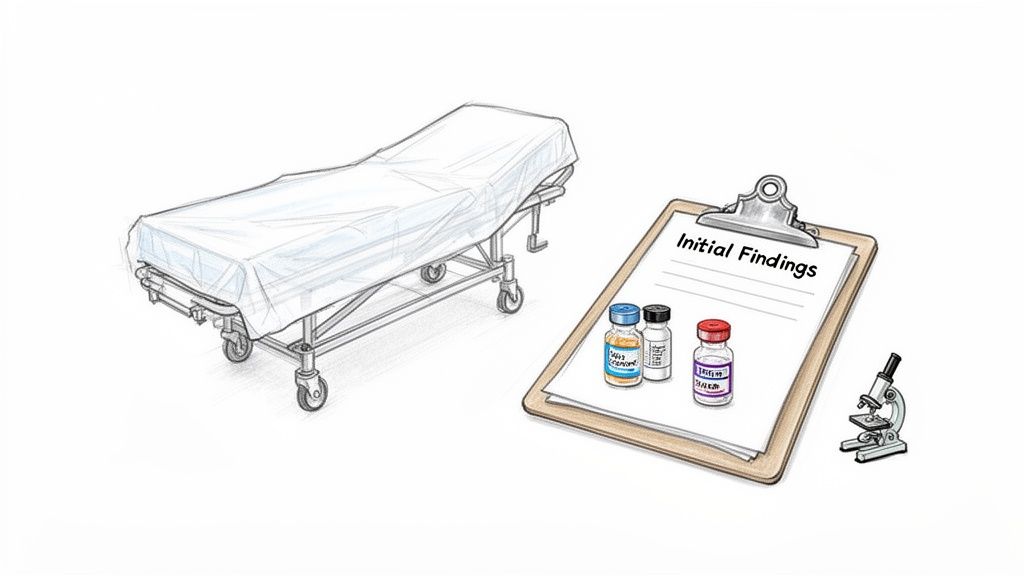
Once I've completed the physical examination, the small tissue and fluid samples I collected begin their journey through the lab. This is almost always the longest part of the process and the main reason a final report takes weeks, not days.
This stage can’t be rushed without risking an incorrect conclusion. As a pathologist, my work is guided by two core principles: precision and thoroughness. Every sample goes through a meticulous, multi-step process to reveal the microscopic and chemical clues invisible to the naked eye.
Histology A Look Under the Microscope
Histology, the microscopic study of tissues, is a cornerstone of nearly every autopsy. Before I can examine a tissue sample on a slide, it has to be carefully prepared. It’s a delicate process.
- Fixing: First, the tissue is preserved, typically in formalin. This stops decomposition and keeps the tissue’s structure intact.
- Processing: Next, it’s dehydrated and embedded in a block of wax for stability.
- Sectioning: Using a specialized instrument called a microtome, I slice incredibly thin sections from the wax block.
- Staining: Finally, these sections are mounted on glass slides and stained with specific dyes that highlight different parts of the cells.
Only after all these steps can I examine the tissue under the microscope. This process alone can take several days, sometimes up to a week.
Toxicology and Specialized Testing
If we need to check for drugs, alcohol, or other substances, toxicology testing is required. This can add significant time, and the wait depends on what we're looking for. I explain this further in my article on why toxicology reports take so long. While some basic tests might come back in a few days, a comprehensive screen for less common substances can take several weeks.
The timeline can stretch even longer if the case calls for more specialized work. This could include microbiology cultures to identify an infection, genetic analysis, or a detailed neuropathology exam of the brain.
Each test provides another piece of the puzzle. My job as a forensic pathologist is to assemble all these pieces—the lab data, toxicology results, and my own physical findings—to build an accurate picture of what happened.
It's a methodical process where getting it right will always be more important than getting it done fast. A thorough investigation can't be hurried.
Why Some Reports Take Longer Than Others
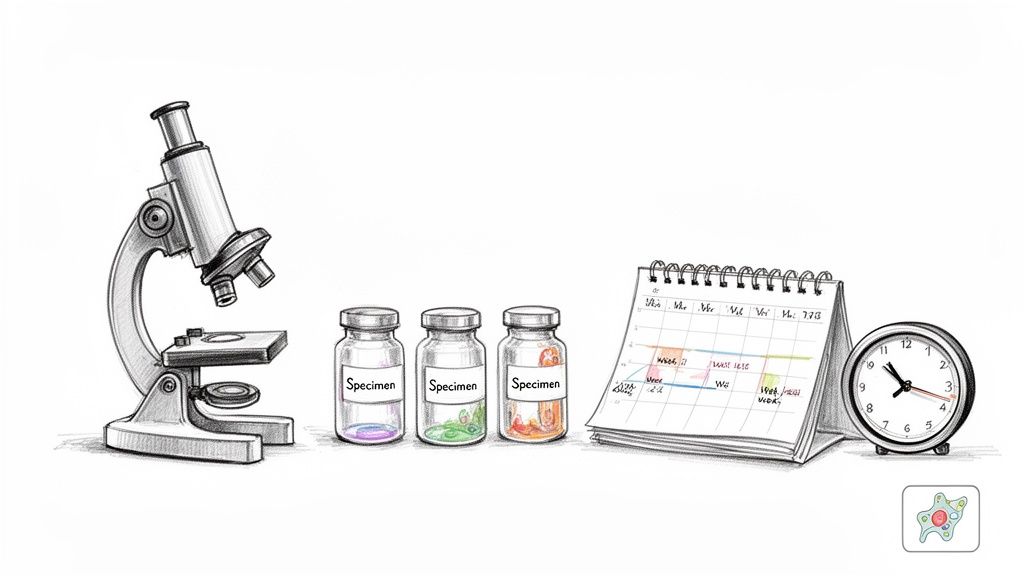
Several factors can affect how long it takes to get a final pathology report. Knowing them helps set realistic expectations for families and attorneys.
The most common reason for a longer wait is a particularly complex case. An investigation involving multiple organ systems, complicated toxicology results, or a long-term disease process requires more detailed work. Similarly, if a death occurred under unusual circumstances, I might need to consult other specialists. That adds another layer of expertise, but it also adds time.
Medical Records and Logistical Hurdles
Another significant factor is obtaining complete medical records. A person’s medical history gives me critical context for my examination. If there are delays in getting those documents from hospitals or clinics, it can pause the final analysis until I can connect their history with my findings.
Simple logistics can also play a part. Sometimes, we need to send specimens to specialized labs for unique tests, and that transport and processing time adds up. Here at Texas Autopsy Services, I make it a point to keep the family or their attorney informed about the case status and anything that might be slowing things down.
The Need for a Smooth Lab Workflow
An efficient lab is a fast lab. The entire process hinges on a smooth workflow, which is why a lot of effort goes into mastering standard operating procedure templates and optimizing every step. The College of American Pathologists (CAP) sets a goal for labs to finalize 90% of routine surgical pathology cases within two business days.
But even with that goal, a study found that an average of 24% of reports still missed the deadline because of various bottlenecks. These kinds of systemic delays highlight why a streamlined process is so important. You can find more details in the research on pathology report timelines.
For families in Texas, this is why a dedicated service like Texas Autopsy Services is different. As a board-certified forensic pathologist, I prioritize transparency and efficiency. By focusing on a clear, optimized process, we can often provide preliminary findings in days, not weeks, which is a world away from what you might experience with larger systems.
Understanding the Difference Preliminary vs Final Reports
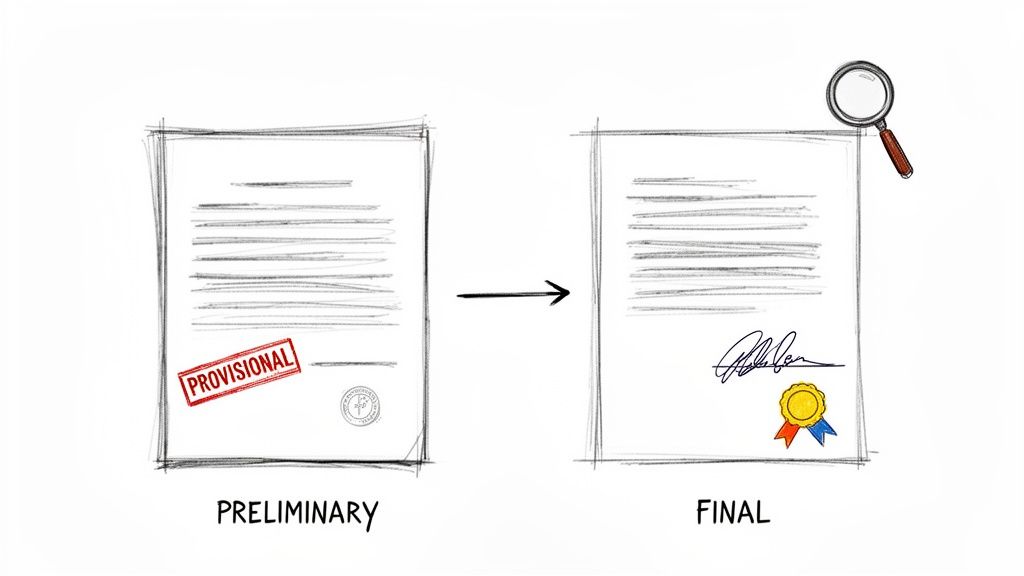
It's important to know that there are two kinds of reports in an autopsy investigation: the preliminary and the final. Each serves a different purpose, and only one tells the complete story.
The preliminary report is like a first draft. I can usually prepare this within a few days of the examination. It’s based on my direct observations—the "gross findings"—and it provides a provisional cause of death. This is often enough for families to move forward with funeral arrangements or address urgent legal matters.
However, this initial report is just a snapshot, not the full picture.
The All-Inclusive Final Report
The final report is the definitive document. It’s where all pieces of the investigation come together to provide conclusive answers. This is the legally binding record that integrates every piece of evidence.
This comprehensive document includes:
- The detailed findings from the physical examination.
- Results from the microscopic study of tissue samples, which we call histology.
- The full toxicology analysis, which checks for any medications, drugs, or other substances.
- A careful review of the person's medical history and the circumstances of their death.
This report lays out the complete narrative, lists all medical diagnoses, and provides the definitive cause and manner of death. As a board-certified forensic pathologist, I ensure this document is clear, precise, and built on a solid scientific foundation. To get a better sense of what these look like, you can see a sample pathology report here.
The wait for the final report allows for certainty. It ensures every conclusion is backed by thorough scientific evidence. This is the official record for families, courts, and insurance companies, and its accuracy is my top priority.
How We Deliver Faster More Personal Answers
I founded Texas Autopsy Services to solve the frustrating delays common in larger, bureaucratic systems. As an independent pathologist serving all 254 counties in Texas, I maintain a focused caseload. This means I can give each investigation the dedicated, personal attention it deserves.
My entire process is built for efficiency and clarity.
A Direct and Streamlined Approach
I work with a network of accredited Texas laboratories that I've built relationships with over many years. This ensures that both toxicology and histology samples are processed without unnecessary hold-ups. Our service packages are transparent, so you won’t be surprised by hidden fees or administrative hurdles.
Whether your family needs a Private Autopsy to get closure about a loved one’s illness or an attorney needs a second opinion, my approach is centered on direct communication.
From your first call to the day you receive the final report, you will work directly with me, our forensic pathology team. This one-on-one contact is crucial for keeping you informed with clear and consistent updates.
Waiting for answers is difficult. One study found that logistical problems—like having a single pathologist stretched across multiple locations or shipping samples out of state—pushed diagnosis confirmations to an average of 12 days. The good news is that simple process improvements cut these turnaround times by more than half.
My independent practice is designed to bypass those issues. By keeping everything local and avoiding the administrative red tape of larger organizations, I can deliver definitive answers as quickly as accuracy permits, blending compassion with medical precision.
Common Questions About Autopsy Timelines
Families and legal teams often have the same pressing questions about how this all works. Let's walk through some of the most common ones I hear.
Can We Expedite the Final Report?
This is a frequent question, and it's understandable when legal or personal matters are on hold. While the detailed lab work itself can't be rushed—accuracy is essential—we can make the overall process more efficient.
The single most helpful thing you can do is provide my office with all relevant medical records and a list of the decedent's doctors from the start. Getting that information upfront prevents administrative delays. My independent practice at Texas Autopsy Services is already structured to be much quicker than larger institutions.
What Kind of Updates Can We Expect?
I believe in clear, consistent communication. You won't be left in the dark. I will personally call you with preliminary findings within 24 to 72 hours of the physical examination. After that, I'll provide proactive updates as major results, like the toxicology report, become available.
You will not be left wondering about the status of your case. I maintain a direct line of communication, ensuring you are informed at key milestones.
My job is to bring clarity during a difficult time. You will always know where we are in the process and what to expect next.
Does the Final Report Include Everything?
Yes, absolutely. The final autopsy report is a complete, comprehensive document. It brings together every piece of the investigation into one definitive record.
Here’s what you can expect to see inside:
- Gross Findings: A detailed description of everything observed during the physical exam.
- Microscopic Findings: What the histology revealed when I examined tissue samples under the microscope.
- Toxicology Results: The full breakdown of any drugs, alcohol, or other substances found.
- Ancillary Studies: The results from any other specialized tests that were needed.
- Final Diagnoses: A conclusive summary of all medical conditions and injuries identified.
- Cause of Death Opinion: My final medical determination of the cause and manner of death, backed by all scientific evidence.
It is the complete story, told through science. It’s written to be precise and clear, serving as the official record for any legal, insurance, or personal needs.
What Happens After the Final Report Is Delivered?
Receiving the report is the next step, not the last one. Once it's in your hands, I schedule a follow-up call to go over the findings with you personally. I’ll walk you through each section, translate complex medical terms into plain English, and answer your questions.
My role isn't just to perform the autopsy; it's to ensure you fully understand what the results mean. This final conversation is crucial for bringing the closure and clarity that families and their attorneys are seeking. My commitment to you doesn't end when the report is sent.
If you have questions about a loved one's passing or require the expertise of a forensic pathologist, please do not hesitate to reach out. At Texas Autopsy Services, my team and I are here to provide the clear, compassionate, and medically sound answers you deserve. You can contact us directly for a confidential consultation.