February 14, 2026 · Texas Autopsy Services
How Long Does an Autopsy Take A Pathologist's Timeline
Discover how long to do an autopsy from a forensic pathologist. Learn what factors impact the timeline from the exam to the final report.
On this page
As a forensic pathologist, one of the first questions families ask me is, "How long does an autopsy take?" I explain that we operate on two timelines. The first is for the physical examination itself, which I can usually complete in a few hours. The second, more critical timeline is for delivering the final, medically certain cause of death, a process that takes weeks to months. Understanding this distinction is key to managing expectations during a difficult time.
- The hands-on physical autopsy examination typically takes 2 to 4 hours.
- The complete investigation, including lab tests like toxicology, can take 4 to 6 weeks or longer.
- Complex cases, such as those involving trauma or extensive medical histories, require more time.
- A private autopsy provides focused attention, often resulting in a faster final report than a public medical examiner's office.
- The autopsy process does not delay funeral arrangements, including open-casket viewings.
The Two Timelines of an Autopsy
The main source of confusion for families is the difference between the physical procedure and the full investigation. As a forensic pathologist at Texas Autopsy Services, I manage both timelines with precision. The hands-on examination is about collecting evidence; the subsequent analysis is about interpreting what that evidence means.
The Initial Examination Phase
The first timeline begins when the decedent arrives for examination. This phase has two main parts:
- External Examination: I conduct a detailed visual inspection of the body, documenting injuries, scars, tattoos, and any other features that might offer initial clues.
- Internal Examination: I perform a systematic and respectful examination of the internal organs, collecting small tissue and fluid samples for later analysis. This is a careful medical procedure designed to find answers.
Every observation is meticulously recorded, and every sample is preserved under a strict chain of custody, ensuring our work meets all Texas legal standards.
This graphic helps visualize the general flow from the hands-on exam to the final report.
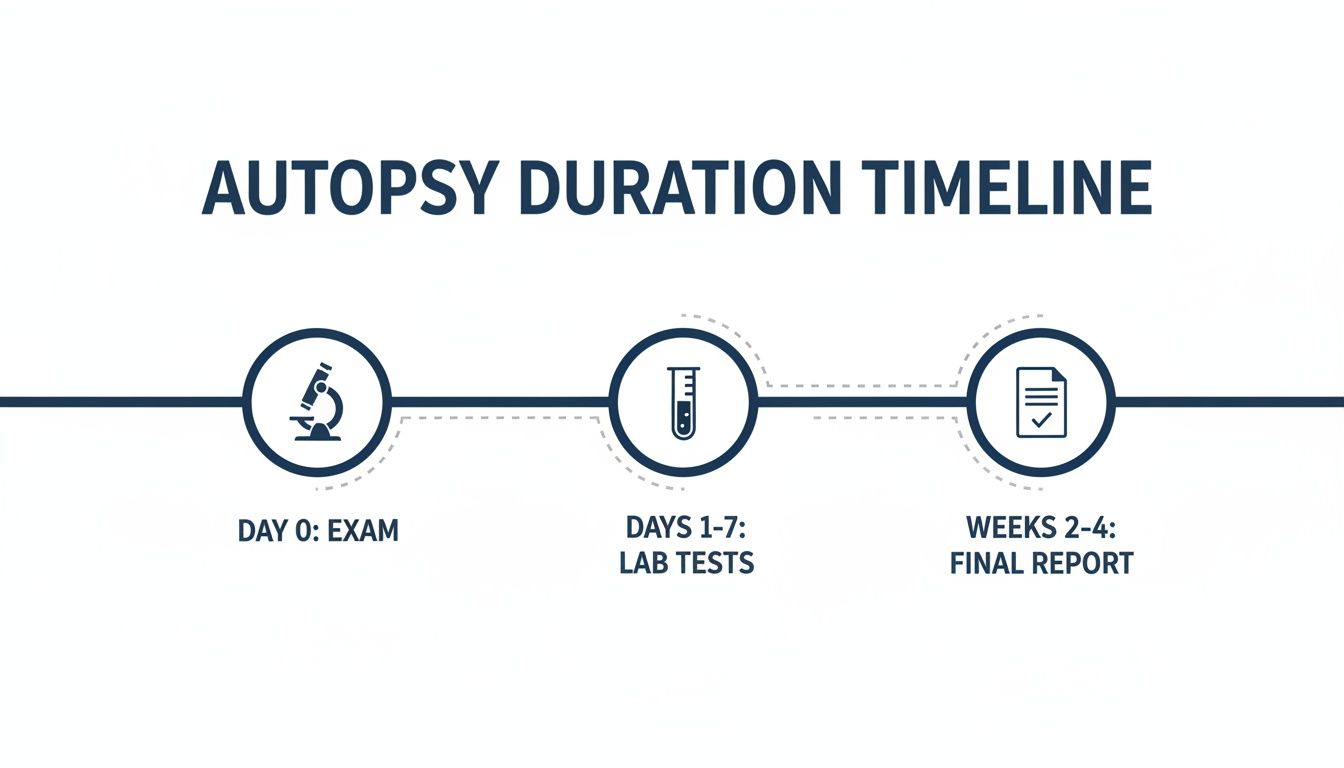
As you can see, the physical examination is just the first step in a much longer analytical journey.
The Comprehensive Investigation Phase
This is where the second, longer timeline begins. After the physical exam, I send the collected specimens to specialized laboratories for testing.
The real work of determining the cause of death often happens at a microscopic and chemical level. This process of careful scientific analysis cannot be rushed if accuracy is the goal.
Tests like toxicology and histology turn initial observations into definitive medical conclusions. While the hands-on part might take only a morning, the full investigation ensures the final report is accurate, objective, and legally defensible. During this second timeline, the true story of what happened is pieced together, providing the clear answers that families and legal professionals need.
How Long the Physical Examination Takes
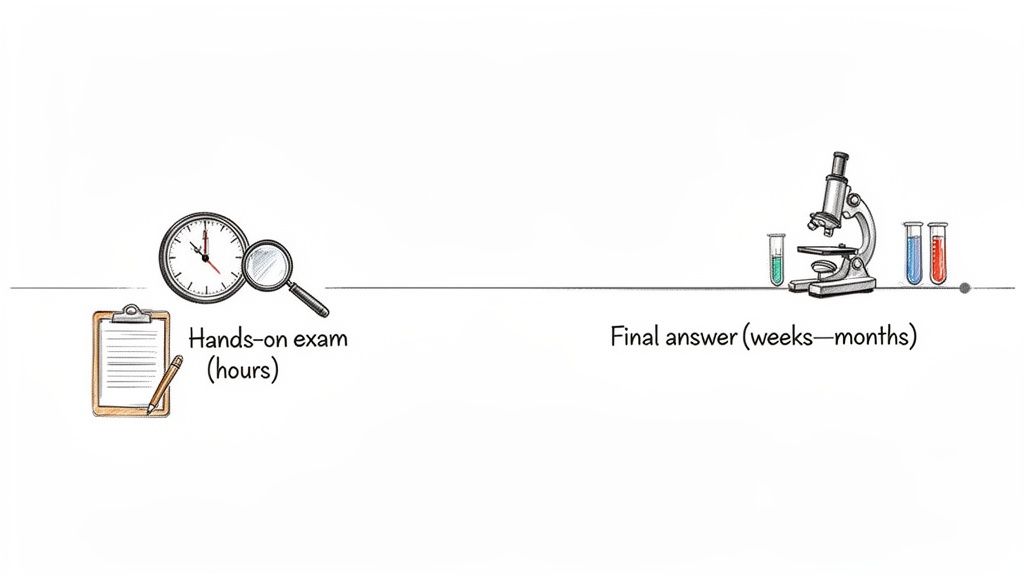
For a standard, uncomplicated private autopsy, the physical procedure typically lasts between two and four hours. During this time, my complete attention is on the decedent, performing a detailed and respectful examination to gather the critical medical information needed for answers.
This timeframe is a baseline. Every person is unique, and so is every case. Certain factors can extend the time I spend on the examination. A complex medical history, for example, often requires a more detailed dissection to fully understand how different diseases may have interacted. My job is to be methodical, not fast, to make sure no detail is overlooked.
Factors That Extend Examination Time
The complexity of a case drives the timeline for the physical exam. Some situations demand a more meticulous, time-intensive approach.
- Traumatic Injuries: A death involving severe trauma, like multiple gunshot wounds or injuries from a major vehicle accident, requires an exhaustive documentation process. Each injury must be precisely measured, photographed, and described to help reconstruct events accurately.
- Complex Medical Histories: Individuals with chronic illnesses, multiple past surgeries, or implanted medical devices require a more involved examination. It takes careful, detailed work to trace the effects of these conditions on the body.
- Infant and Pediatric Cases: Performing an autopsy on an infant or young child demands an incredible level of precision. Their smaller anatomical structures call for more delicate techniques and specialized dissections, making these cases some of the most time-consuming.
Having performed over 1,000 autopsies, I've learned that efficiency can never come at the cost of accuracy. Rushing an examination means risking a missed detail, a subtle but crucial finding that could change the entire understanding of a case.
For example, an examination for a presumed natural death in an elderly person with a clear medical history might be completed within two hours. In contrast, a complex forensic case with legal implications could easily stretch beyond four hours because of the strict evidence collection protocols we must follow.
The external examination in an autopsy is a crucial first step that often guides the internal investigation. No matter how long it takes, I am committed to treating every procedure with the utmost respect and diligence. The goal is always the same: to provide clear, definitive answers for families and legal professionals.
Why Lab Tests Extend the Final Timeline
The physical examination is just the first step. The factors that most significantly extend the timeline for a final answer are the ancillary studies, the laboratory tests providing crucial information at a microscopic and chemical level.
While the hands-on examination identifies visible abnormalities, these lab tests explain why they occurred. As a board-certified forensic pathologist, I rely on this data to connect the findings. An accurate cause of death depends on integrating all of this information into a coherent and medically sound narrative. Rushing this process is not an option when absolute accuracy is the goal.
The Critical Role of Ancillary Studies
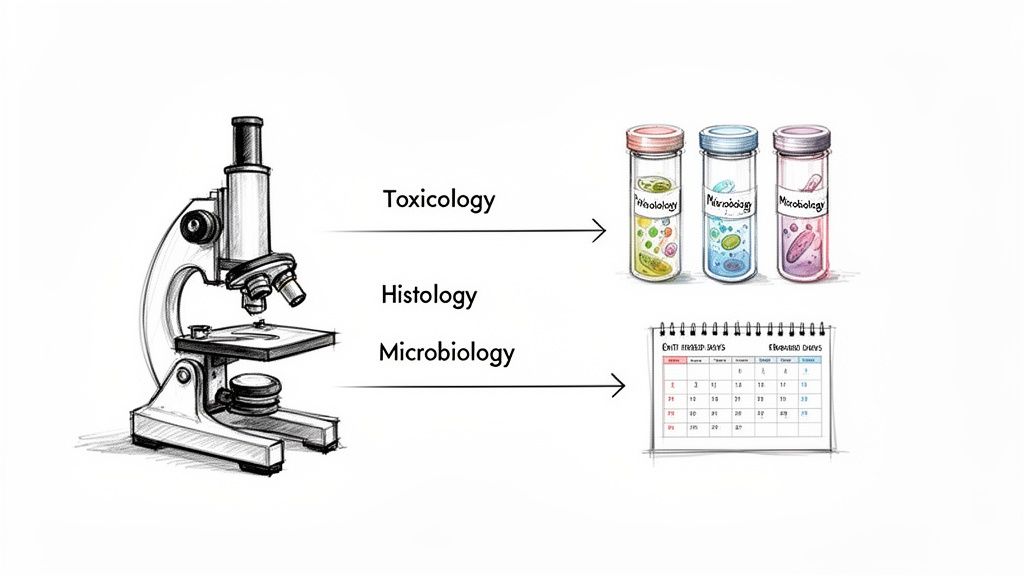
Several types of laboratory analyses are standard in a comprehensive autopsy. Each answers a different set of questions and operates on its own timeline.
- Toxicology: This is the analysis of blood, urine, and tissue for the presence of drugs, alcohol, poisons, or other chemical substances. This is often the longest part of the wait. Specialized labs must run complex screenings, and confirming specific substances can take several weeks.
- Histology: This involves the microscopic examination of tissue samples. Tissues must be preserved in formalin, processed into wax blocks, thinly sliced, and stained before I can examine them under a microscope. This process alone can take a week or more.
- Microbiology: If an infection is suspected as a cause of death, we may collect cultures to identify bacteria or viruses. Growing these organisms in a lab for a definitive identification can take several days to weeks.
These tests are sent to accredited, specialized laboratories. This ensures the results are reliable and unbiased, but it also adds transit and processing time to the overall timeline.
The patience required during this phase is essential. A preliminary opinion might be possible based on physical findings, but the final, definitive cause of death can only be determined once all laboratory results are received and carefully interpreted.
This analytical work happens behind the scenes, but it is the most critical part of the investigation. For families and attorneys seeking closure or evidence, understanding this waiting period is key. The delays are not administrative; they are a necessary part of a meticulous scientific process. We explain more about why toxicology reports can take so long in a separate article, offering deeper insight into that specific process.
How Public and Private Autopsy Timelines Differ
One of the biggest frustrations for families is the long and often unpredictable wait for answers from a public medical examiner. The core difference between a government-run autopsy and a private one is focus and caseload, and this has a massive impact on how long everything takes.
Public offices are almost always dealing with enormous caseloads, administrative tasks, and jurisdictional duties that create serious backlogs. The pathologists are dedicated professionals, but their attention is split across dozens, sometimes hundreds, of cases at once. This inevitably leads to long waits for the final report. This is simply the reality of the system. An in-depth analysis of pathology departments found that report turnaround times could range from 14 to 150 days, with an average wait of around 66 days.
The Advantage of a Focused Private Service
When your family retains my services as a private forensic pathologist, your case receives my dedicated attention. I am not balancing a heavy public docket. This focused approach creates a more predictable and faster process.
- The Public System: A government office operates like an emergency room, taking in a constant flow of mandated cases. Your loved one's case gets in line, and its priority can be affected by other public safety emergencies outside your control.
- A Private Service: Hiring a private autopsy service is like booking a specialist for a dedicated procedure. The investigation starts immediately, and because I manage a much smaller caseload, the final report is typically completed more efficiently once all lab results are in.
At Texas Autopsy Services, my commitment is to provide families and their legal teams with clear answers within a structured timeframe. While scientific precision is always the priority, I understand that timely information is crucial for grieving, closure, and making important decisions.
This efficiency isn't about rushing the science. It's about a system designed to serve the needs of a single family, resulting in a clearer timeline during an uncertain time.
Crafting the Final Autopsy Report
After the physical examination and laboratory work are complete, the final step is to bring everything together into the official autopsy report. This is the definitive medical narrative that integrates every piece of information into a clear conclusion.
I take my detailed notes from the physical examination, the intricate lab results from toxicology and histology, and the decedent’s medical history. My job as a forensic pathologist is to see how these pieces connect to build an evidence-based explanation for why and how a person died.
Synthesizing All Findings
Writing the report demands absolute precision. Every conclusion must be directly supported by medical evidence. There is no room for guesswork. I use clear, factual language because this document must provide solid answers for grieving families and objective facts for attorneys, courts, or insurance companies.
A well-crafted report can provide the closure a family needs and the critical evidence legal professionals require.
This report is the final answer. It must be thorough, unbiased, and fully compliant with all Texas legal and ethical standards, as outlined by the Texas Funeral Service Commission and relevant health codes. I am committed to delivering this crucial document with both medical accuracy and compassion.
The value of this detailed work is significant. Research consistently shows that autopsies uncover major, unexpected medical findings in many cases, proving their importance for medical quality control. Unfortunately, long delays in public systems often create a frustrating barrier. A focused, private service aims to bridge that gap, providing these critical answers much more efficiently.
Why a Timely Report Matters for Families and Legal Cases
When someone passes away, the wait for answers can be agonizing for their family. This period of uncertainty deepens the pain and makes it nearly impossible to find closure. The effects of a delayed cause of death can also halt life for those left behind. Attorneys find themselves unable to move forward with investigations, settle insurance claims, or handle estate matters. The need for a timely report is both personal and practical.
An efficient, independent autopsy provides the solid answers needed to resolve questions. My focus at Texas Autopsy Services is to deliver unbiased, factual information, and doing so promptly is a cornerstone of that commitment.
The Practical Impact of a Prompt Report
When an official cause of death is pending, many essential tasks are put on hold. A definitive report is the key that unlocks progress for:
- Finalizing Death Certificates: This is the foundational legal document needed for almost every administrative task after a death.
- Processing Life Insurance Claims: Payouts are often directly tied to the official cause and manner of death.
- Initiating Legal Actions: Attorneys can’t build a case for negligence or wrongful death without concrete medical evidence.
In the legal world, autopsy reports are a critical piece of evidence. They often become central to the process of discovery in litigation. A quick turnaround keeps these legal proceedings moving. While accuracy is always the top priority, the efficiency of a private service is designed to meet these urgent needs without compromise.
My goal is to equip families and their representatives with the clear, medically sound answers they need to navigate these complexities with confidence and without unnecessary delay.
Sadly, the perception of long waits has contributed to a steep decline in autopsies. By ensuring timeliness, we can restore trust and demonstrate the immense value of this vital medical procedure.
Frequently Asked Questions About Autopsy Timelines
Over the years, I've had countless conversations with families and attorneys navigating the period after a loss. They almost always have the same urgent questions. I’ve put together some straightforward answers to the questions I hear most often, drawing from my experience as a board-certified forensic pathologist.
How soon after an autopsy can we expect the final report?
A preliminary report with initial findings is often available within 24 to 48 hours after the physical examination. However, the complete and final report, which includes all laboratory results, typically takes 4 to 6 weeks. The wait is necessary to allow specialized labs time to conduct thorough toxicology and histology tests.
Can the autopsy process be expedited for urgent cases?
While the scientific analysis in the laboratory cannot be rushed without sacrificing accuracy, a private autopsy service eliminates the administrative delays common in an overloaded public system. I give every case my full attention, ensuring the process moves forward as quickly as is medically and ethically responsible. This focused approach provides a significant time advantage.
Will having an autopsy delay our funeral plans?
No, an autopsy should not delay your funeral arrangements. The physical examination is typically completed within 24 hours of receiving authorization. Afterward, your loved one is released directly to the funeral home of your choice. The longer investigation for the final report occurs behind the scenes and will not hold up your family's plans to say goodbye.
An autopsy should not interfere with your ability to have an open-casket service. All procedures are performed with the utmost respect for the decedent, and incisions are made in a way that does not affect a normal viewing.
My team and I work closely with funeral directors, including our trusted partners at Waterloo Mortuary, to ensure this transition is as seamless and respectful as possible. It is a crucial part of our commitment to compassionate care.
At Texas Autopsy Services, my goal is to provide clear, timely, and definitive answers when you need them most. If you have questions or need guidance, I am here to help. Please do not hesitate to reach out.
Contact our pathologist at Texas Autopsy Services for a Consultation