November 2, 2026 · Texas Autopsy Services
Wrongful Death Attorney Guide for Texas Families
A wrongful death attorney handles the claim, evidence and deadlines. Learn when Texas families should call one and what to bring to the first meeting.
On this page
A loved one has died, the hospital's explanation leaves questions, and funeral arrangements are already underway. Your family may be considering a wrongful death attorney while also deciding whether to request an autopsy. Those decisions overlap because the records, photographs, and specimens preserved now may determine what a medical expert can explain later.
At Texas Autopsy Services, we approach these questions from the forensic side. Our role is to explain what the medical evidence supports, what remains uncertain, and which examination or testing options are still available.
- Legal eligibility comes first. The right to bring a claim and the authority to authorize an autopsy aren't necessarily the same.
- Preservation shouldn't wait for litigation. Records and specimens need attention while the legal review begins.
- An autopsy provides medical evidence. It doesn't automatically establish negligence or liability.
- Independent findings must remain objective. A useful report explains both conclusions and limitations.
Who Can Bring a Wrongful Death Claim in Texas
In Texas, a wrongful-death action is for the exclusive benefit of the deceased person's surviving spouse, children, and parents, under Texas Civil Practice and Remedies Code Chapter 71. A sibling, unmarried partner, or grandparent generally doesn't qualify solely through that relationship. Identifying the eligible family members is therefore an early task for a wrongful death attorney.
Families also need to distinguish a wrongful-death claim from a survival claim. The former addresses losses caused to surviving family members; the latter preserves the deceased person's underlying injury claim, as recognized by the Texas survival statute.
Texas wrongful death and survival claims compared
| Claim | Who can bring it | What it covers | Key point |
|---|---|---|---|
| Wrongful death | Surviving spouse, children, and parents | Family's losses caused by the death, such as lost support and companionship | Damages are not subject to the decedent's debts |
| Survival claim | Estate, heirs, or legal representative | Decedent's own injuries, pain, and medical expenses before death | Pursued through the estate, separate from family losses |
For example, a person may receive hospital treatment after an injury and die later. The family's lost support and companionship are different from the person's medical expenses and suffering before death. The same records may inform both claims, but an attorney must identify which losses belong to whom.
What the medical evidence needs to address
Texas law also permits exemplary damages, in addition to actual damages, when death results from a willful act or omission or gross negligence. That makes the sequence of events important, not just the final diagnosis. A pathologist may assess how an injury or treatment contributed to death, while counsel evaluates whether the evidence meets the applicable legal standard.
Bring these questions to the first consultation:
- Qualifying family members: Who falls within the legally eligible group?
- Estate authority: Has a representative been appointed, and is probate assistance needed?
- Conduct requiring investigation: Do the facts warrant reviewing a potentially willful act or gross negligence?
We keep the medical and legal roles separate. Forensic findings can help counsel evaluate causation, but they don't determine who is legally entitled to recover.
Situations That Call for a Wrongful Death Attorney
A consultation is appropriate when another person's conduct may have contributed to a death. The reason to speak with counsel is to assess the facts and preserve options, not to assume that someone is legally responsible.
Events that deserve a legal review
- Traffic collisions: Crashes involving another driver, a commercial truck, or a rideshare vehicle may require examination of vehicle records, scene evidence, and injuries.
- Medical care: Questions about surgery, anesthesia, hospital treatment, or a missed deterioration may require a detailed treatment timeline.
- Care facilities: Suspected nursing home neglect, falls, or failures to respond to a resident's condition deserve careful record review.
- Workplaces and products: Machinery incidents, unsafe working conditions, and product failures can involve several parties and different legal rules.
- Assaults and unsafe property: Intentional violence or dangerous premises may raise civil liability questions.
- Unexplained deaths: Conflicting accounts or an uncertain cause of death may justify medical investigation before anyone can evaluate liability.
Behavior after the death can also justify early advice. An insurer may request a recorded statement or propose a quick settlement. A company may blame the deceased person before completing a review, or the medical records may conflict with an official account.
Our explanation of a wrongful death investigation provides context for organizing those questions. For attorneys assessing document-management technology, the discussion of personal injury AI with Lighthouse Legal is a supplementary resource, not a substitute for reviewing original records or obtaining qualified expert opinions.
Practical rule: A civil wrongful-death claim doesn't require criminal charges. Civil and criminal proceedings have separate purposes and standards.
Many attorneys offer an initial consultation. Before signing an agreement, ask about consultation charges, attorney fees, case costs, and expert expenses. If another person's act or omission may have caused the death, an initial conversation can be a low-cost way to check the deadline and identify evidence at risk.
First Steps and the Filing Deadline
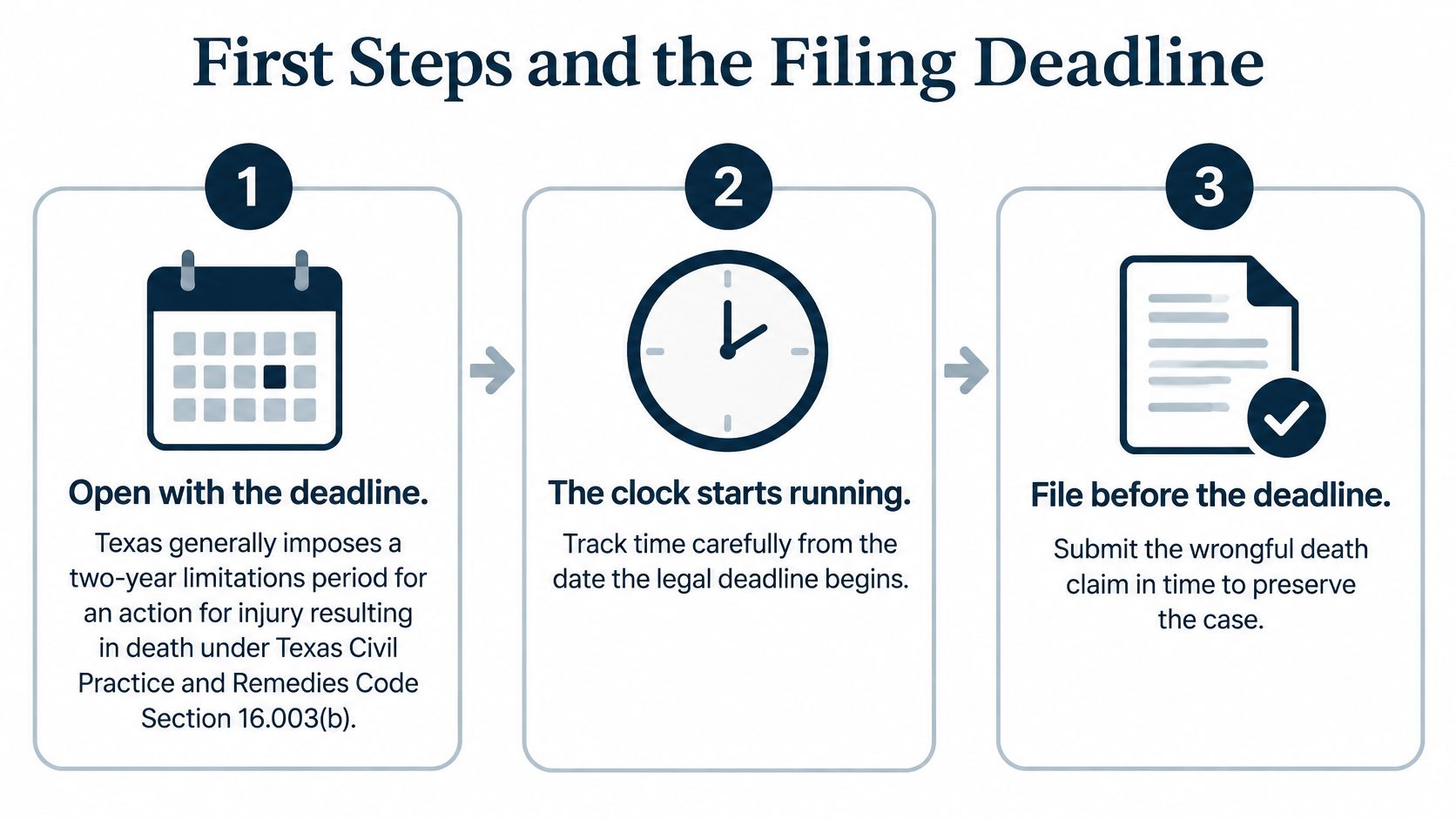
Texas generally imposes a two-year limitations period for an action for injury resulting in death under Texas Civil Practice and Remedies Code Section 16.003(b). Counsel should confirm the applicable accrual rule, any exceptions, and any separate notice requirements rather than relying on a family's calendar calculation.
Write down the date of death and every relevant injury, treatment, admission, and discharge date. Evidence preservation operates on a different schedule from the filing deadline, so the opening weeks deserve attention even when litigation hasn't been decided.
Actions to organize promptly
Confirm legal authority. Identify the potential claimants and the person authorized to make decisions about the remains. These may be different people. A common mistake is assuming that any close relative can authorize every step.
Have counsel check the governing law. The attorney should identify the claim type, filing deadline, and legally relevant starting date. Don't calculate the deadline from a remembered event without review.
Request complete treatment records. Include ambulance, emergency department, nursing facility, and pharmacy records, along with medication administration records, nursing notes, imaging, and laboratory results. Waiting until after funeral arrangements are complete can postpone important requests.
Send written preservation requests. Counsel can identify hospitals, employers, insurers, and other holders of relevant material. Relying on routine retention practices isn't an evidence plan.
Establish what examination occurred. Confirm whether an autopsy was performed, declined, or limited, and whether specimens remain available. A declined official examination doesn't necessarily close every independent option.
Arrange a forensic review. A board-certified forensic pathologist can distinguish established findings from possible explanations and identify useful additional testing. Don't treat preliminary findings as a completed investigation.
Document each transfer. Record who released and received each item, when it moved, and its identifying information. Undocumented handoffs can create avoidable questions later.
Evaluate resolution after developing the evidence. Counsel can assess damages and discuss settlement or suit. A premature valuation may overlook unresolved causation or estate issues.
A manageable starting packet
Gather the death certificate, discharge or death summary, any autopsy report, and insurance correspondence. Keep original files where possible, and maintain a dated list of requests and responses.
If you're uncertain about authority to request an examination, our team can walk you through the authorization requirements and help coordinate arrangements promptly. We work from Elgin with families and professionals across all 254 Texas counties.
A written list of next steps can reduce the burden of making unfamiliar decisions while grieving.
When the early review reveals disputed causation, counsel and the forensic pathologist should develop a formal plan covering records, specimens, testing, and unanswered questions. This is general educational information, not legal advice or medical advice for living patients.
Evidence a Wrongful Death Case Depends On
Evidence items, their purpose, and the risk of delay
| Evidence | Why it matters | Risk if delayed |
|---|---|---|
| Medical records from hospital, nursing, and medication administration | Show treatment, timing, and the decedent's condition before death | Routine retention periods may apply |
| Imaging and laboratory data | Support or challenge the stated mechanism and disease process | Originals and digital files may be purged or overwritten |
| Autopsy file with photographs, histology, and toxicology | Show what the examiner observed and which tests were run | Specimens can degrade under poor storage |
| Specimen identifiers and chain-of-custody records | Show who handled each sample and when | Gaps can weaken expert testimony |
| Death investigation and inquest records | Document the official investigation and any justice of the peace decision | Requests take time and should start early |
| Specimens collected before embalming | Allow testing that embalming can compromise | The opportunity to collect unaffected specimens is lost after embalming or cremation |
Forensic findings require stated limits. The National Academies' report on forensic science warns against unsupported claims of certainty and infallibility. A useful expert opinion explains its foundation rather than asking a reader to accept a conclusion on credentials alone.
What an opinion should explain
A cause of death is the injury or disease responsible for death. A manner of death classifies the circumstances, such as natural, accident, suicide, homicide, or undetermined. Neither term, by itself, answers whether someone was negligent.
Counsel should ask the forensic pathologist to separate direct observations from interpretations, consider alternative causes, and identify unresolved findings. Trauma, disease, intoxication, treatment, and timing may interact. A finding can be consistent with an explanation without proving that explanation exclusively.
Chain of custody means the documented history of an item's collection, handling, storage, and transfer. Specimens collected before embalming and stored appropriately can support later testing; embalming can compromise some analyses, while cremation can eliminate examination opportunities.
Evidence standard: An independent opinion should remain the same whether its findings support, weaken, or leave uncertainty about a potential claim.
Our private autopsy report belongs to the requesting family. We keep it confidential and deliver the complete written report directly to that family, which decides whom to share it with, subject to applicable legal disclosure obligations.
To begin organizing the medical picture, gather:
- Clinical summary: The discharge or death summary.
- Existing findings: Any autopsy or examination report.
- Medication information: Prescriptions and known administered medications.
- People involved: Names of responders and witnesses.
When a Private Autopsy Fits Into the Case
Texas has an official death-investigation system and a separate route for independently authorized examinations. A private autopsy doesn't replace a statutory inquest or override an official's authority over the remains. For a family weighing a claim, the practical question is what happens when the official process ends without an examination, or with questions still unanswered.
Under Texas death-inquest law, a justice of the peace conducts an inquest in specified circumstances, including certain unnatural deaths. The justice may direct a physician to perform an autopsy or certify that none is necessary, and must order one when the statutory necessity standard is met.
Choosing the appropriate route
Families most often approach us when the medical examiner declined the case, when they want an independent second opinion, or when the cause of death remains unclear. A private examination requires authorization from the legal next of kin or their designated representative, coordinated around any official investigation. Once authorized, the examination is typically completed within 24 to 48 hours, and we coordinate directly with the funeral home so planned services are not delayed.
The available routes serve different purposes:
- A new independent autopsy: The pathologist examines the body and considers targeted testing, such as histology, toxicology, imaging, or molecular analysis. The examination is scoped to the family's questions, commonly how and why the person died and whether something was missed.
- A review without another examination: The pathologist evaluates an existing autopsy report and medical records. This route works like re-reading the imaging rather than ordering a new scan: it can identify gaps or assess whether the documented findings support the conclusion, but it cannot recreate uncollected specimens.
We offer both private autopsies and second-opinion reviews of prior reports and records. Our discussion of whether to seek a second opinion can help families distinguish those options.
Independent work and legal safeguards
Every examination is performed by a board-certified forensic pathologist, certified by the American Board of Pathology. We coordinate authorized access, transport, and documented handling of the remains throughout the process.
County officials can consult our County Forensic Autopsies information, and funeral professionals can work with us directly on behalf of the families they serve.
A private report doesn't automatically prove negligence. A private examination often remains available after an official decline, but how the report is admitted and how much weight it carries depend on the applicable Texas court and evidence rules. What the report gives an attorney is an independent, documented account of the cause and manner of death, which counsel can then evaluate against the rest of the evidence.
How a Texas Case Moves After Filing
Consider a family whose attorney files after reviewing a disputed treatment history. The lawsuit begins with a petition, which states the allegations and requested relief. The defendant's answer responds through the court process; neither filing establishes the medical facts.
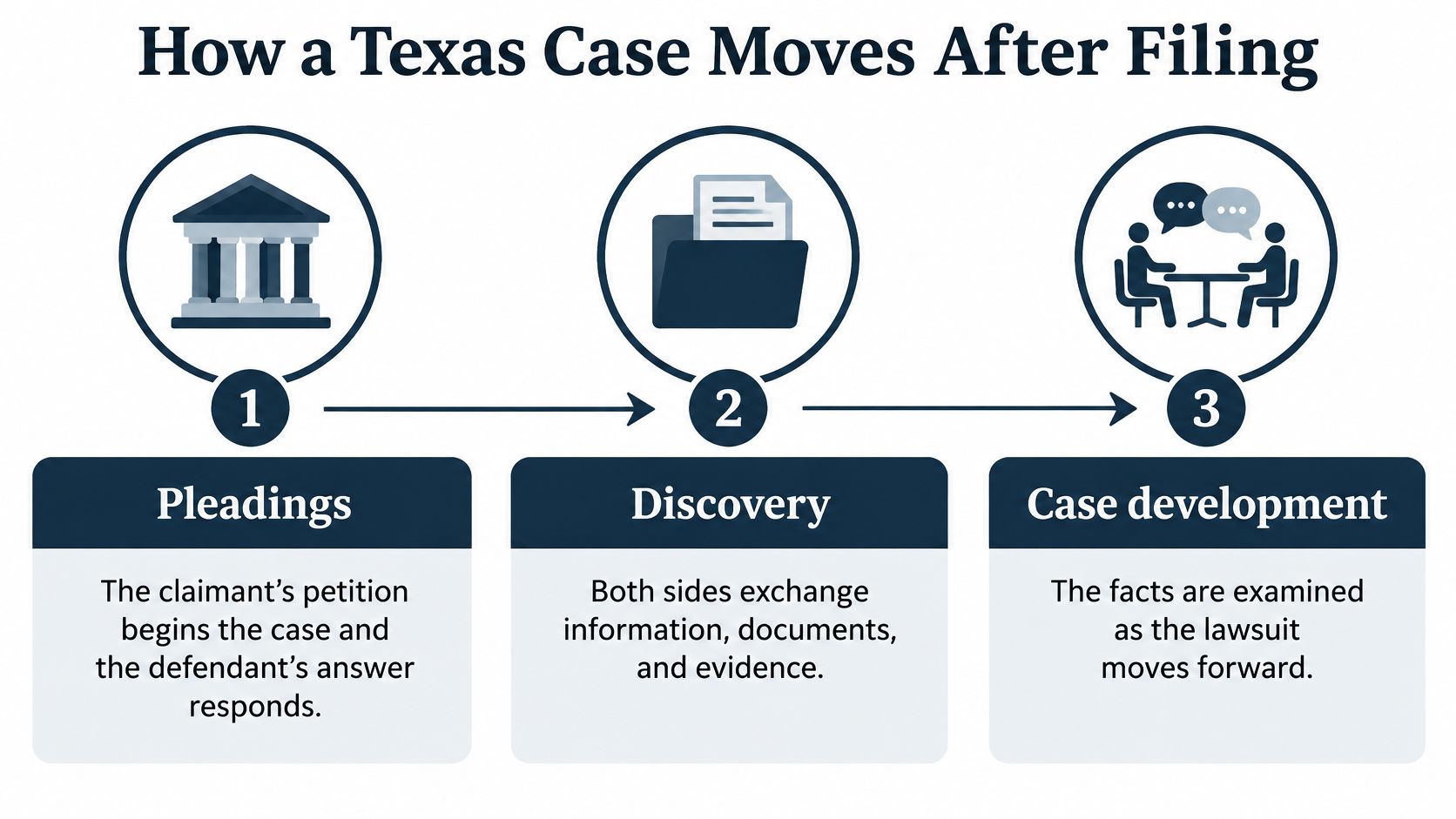
During discovery, the parties obtain records, question witnesses, and develop expert opinions. A treating physician may give a deposition, meaning testimony under oath outside the courtroom. A forensic pathology expert may prepare a report explaining the medical sequence and the limits of the available evidence.
The parties may then attend mediation, where a neutral mediator helps them discuss a possible resolution. If settlement doesn't occur, the case may proceed to trial. Our explanation of a wrongful death settlement addresses how medical findings can inform those discussions without determining the outcome.
Questions families commonly ask
How long will the case take?
No universal timeline can be promised. The number of defendants, disputed causation, insurance issues, the court's schedule, and additional toxicology or molecular testing can affect progress. Counsel can estimate more meaningfully after reviewing the file.
Will the forensic pathologist testify?
Expert testimony may be needed to explain findings or answer competing medical interpretations. The court determines admissibility, and the expert should address only conclusions the evidence supports.
What does the family need to do?
Stay available for attorney meetings and depositions, preserve expense records, and send new correspondence to counsel. Discuss settlement offers with the attorney rather than treating a medical report as a valuation of the claim.
The family's role isn't to resolve every scientific disagreement. Clear communication, organized documents, and careful decisions about proposed settlements allow counsel and the medical experts to address their respective responsibilities.
We provide independent autopsies and second-opinion reviews to help families and attorneys understand the medical evidence behind a potential wrongful-death claim. Visit Texas Autopsy Services to contact our team directly about authorization, available records, and examination options that fit your family's questions.