October 30, 2026 · Texas Autopsy Services
Nursing Home Neglect Signs and What Records Show
Nursing home neglect shows up in wounds, weight loss, falls, and missed care. See the signs, Texas report deadlines, and records that test the timeline.
On this page
- Signs of Nursing Home Neglect Families Can Check
- What Nursing Home Neglect Is and Is Not
- Texas Deadlines for Reporting Suspected Neglect
- Records to Gather Before They Disappear
- Medical Findings That Follow Missed Care
- When Staffing Records Support a Neglect Theory
- When a Private Autopsy Can Still Answer Questions
You got the call after breakfast. Your mother was eating in the dining room and walking with a walker last month. This week staff say she has a deep sore on her hip, her clothes hang loose, and she died after a fall the facility calls unavoidable. The death certificate names heart disease. You still do not know whether the care matched the plan.
That gap is what families and attorneys bring to us. Nursing home neglect is often a string of missed basics, not one dramatic moment. A sign is a reason to look at the chart. It is not, by itself, proof that poor care caused a death.
We are Texas Autopsy Services, an independent practice in Elgin. Every examination is performed by a forensic pathologist certified by the American Board of Pathology. We cover all 254 Texas counties when a county declines a case or a facility disputes what happened.
- A clue starts a record check. A sore, a fall, or a weight drop points you to a named page in the chart.
- Neglect is a failure to provide care. Abuse is an act that harms. Exploitation is about money and sits outside this medical review.
- Texas expects an immediate report when you have cause to believe a resident was harmed. Facilities have shorter clocks of their own.
- Staffing counts only in context. It matters when ordered care was missed at the hour the person declined.
- An exam has a limit. It can describe injuries and complications. It cannot, alone, prove a staffing violation.
Signs of Nursing Home Neglect Families Can Check
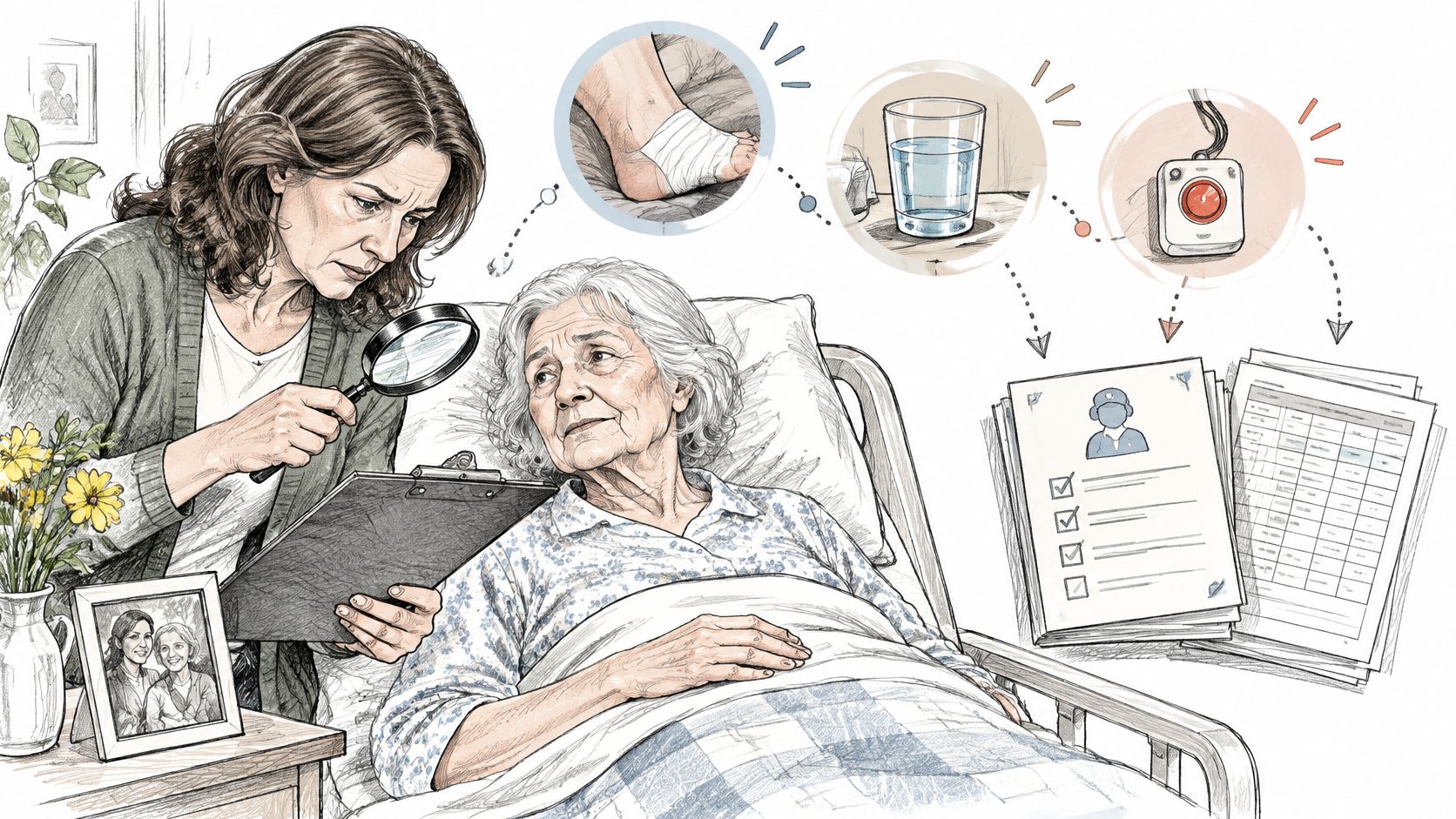
Picture the same resident a week earlier. She was still finishing most of her tray. Then a heel turns dark, the weight sheet drops, and a night fall is written up as unavoidable. Families often see those changes in one visit. The chart may tell a slower story, or it may not tell it at all.
Nursing home neglect, in plain terms, is a repeated failure to provide nutrition, hydration, hygiene, repositioning, medication, supervision, or a prompt response to decline. One missed task can be a mistake. A pattern of missed tasks, against a care plan that already named the risk, is what deserves a closer look.
Use the table as a three-part read. Notice what you saw. Name the medical concern. Then ask for the record that can confirm the concern or weaken it.
| Warning domain | What families often notice | Medical concern | Record that tests it |
|---|---|---|---|
| Pressure injury prevention | New or worsening sore on heel, sacrum, or hip | Unrelieved pressure and missed wound care | Skin assessments, turning schedule, care plan |
| Hydration | Dry mouth, dark urine, confusion, low intake | Dehydration or kidney stress | Intake and output, labs, physician notification times |
| Nutrition | Loose clothes, uneaten trays, falling weight | Malnutrition | Weights, diet orders, feeding assistance notes |
| Falls and supervision | Unwitnessed fall, head injury, fracture | Inadequate supervision or delayed help | Incident report, fall plan, staffing at that hour |
| Medication management | Missed doses, wrong drug, sudden sedation | Omission or adverse drug effect | Medication administration record and orders |
| Hygiene and toileting | Soiled clothing, urine odor, untreated rash | Unmet daily care | Bathing, toileting, and incontinence logs |
| Response to decline | Long call-button waits, late hospital transfer | Delayed recognition of illness | Call logs, vital signs, notification notes |
| Unexplained injury | Bruises, skin tears, or injuries with no clear account | Trauma or rough handling | Photos, progress notes, incident investigation |
Two rows, read the way an investigator would
Pressure injury prevention is the row families ask about first. You may see a new open area on the heel, sacrum, or hip. The medical concern is unrelieved pressure and missed wound care. The test is not the wound alone. Compare baseline skin status, the turning schedule, and the care plan. A high-risk resident can still develop a wound when the plan was followed. An unstaged wound with no turning record raises a different question.
Hydration is easier to miss on a short visit. Dry mouth, dark urine, confusion, or trays that come back full can point to dehydration or kidney stress. Intake and output sheets, diet orders, and labs such as sodium or kidney values show whether anyone measured the problem and called a physician.
The other rows work the same way. An unwitnessed fall is checked against the incident report, the fall plan, and who was on duty that hour. Missed medicines are checked on the medication administration record. Soiled clothing is checked against bathing and toileting logs. Long call-button waits are checked against call logs and vital signs. Bruises need photos, progress notes, and the incident investigation, not only a family's memory.
Practical rule: A sign is a reason to look, not proof. Date your photographs and personal notes, then request the chart column named in the table for that row.
What Nursing Home Neglect Is and Is Not
A resident may develop an illness or injury while living in a nursing home, and the facility may dispute that care was missed. To assess what happened, it helps to separate the terms used for harmful conduct from the medical terms used to describe a death.
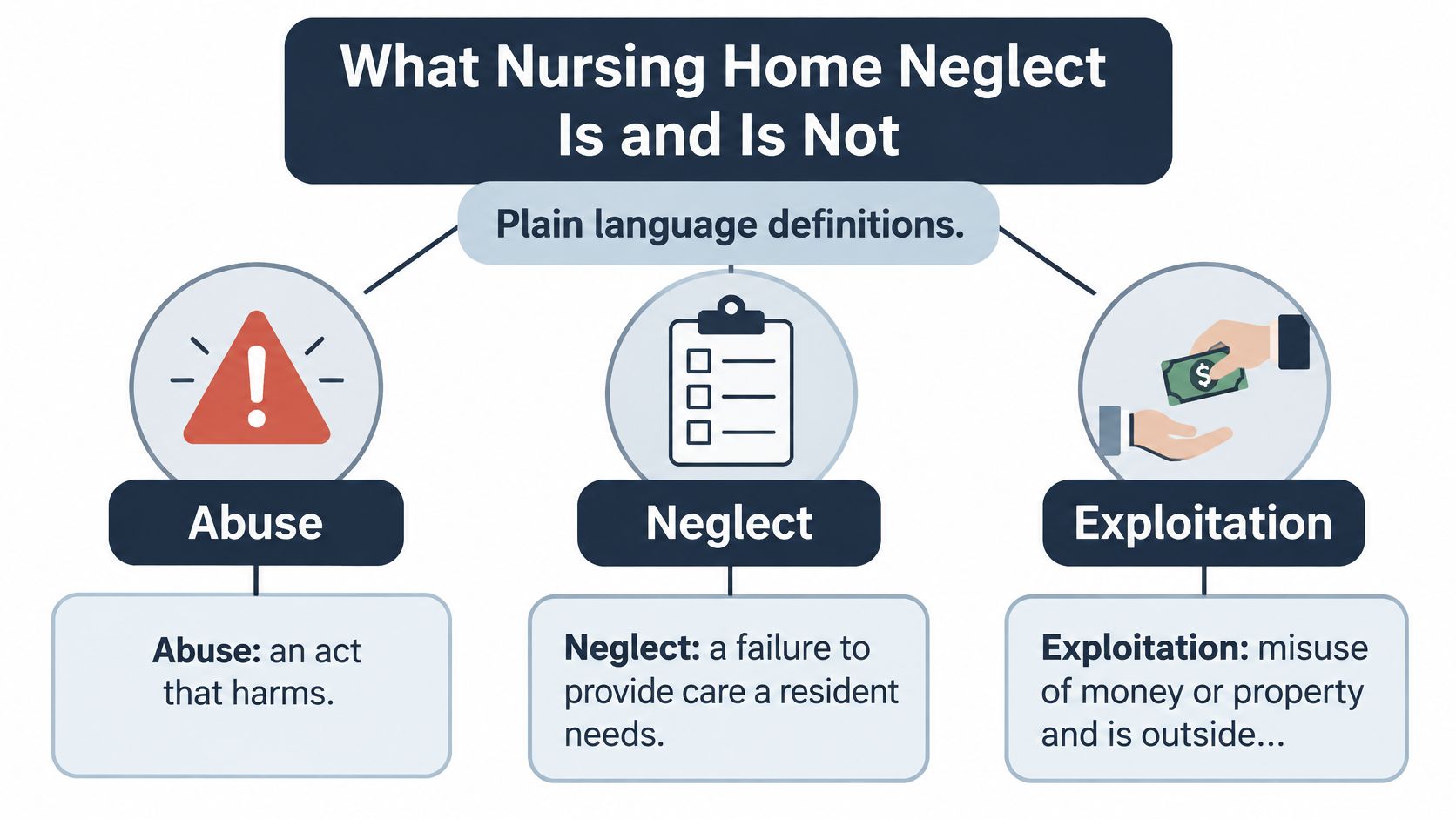
Abuse is an act that harms. Neglect is a failure to provide care a resident needs. Exploitation is misuse of money or property, which is separate from this article's medical focus.
Two other terms describe different things. Cause of death is the disease or injury that led to death. Manner of death is the category, such as natural or accident. A death may have a natural manner while preventable dehydration, infection, or a pressure injury contributed to the outcome. The death certificate can name the disease without explaining whether care was missed. Our explanation of how medical negligence differs from the disease named at death describes that distinction.
What the percentages can and cannot tell you
A World Health Organization review of studies in institutional settings found that 12.0% of staff reported perpetrating neglect during the previous year, while 11.6% of older residents or their proxies reported neglect. In the same evidence base, 64.2% of staff reported perpetrating at least one form of abuse, including psychological, physical, financial, or sexual abuse, or neglect. These figures reflect different perspectives: staff reports of conduct and residents' or proxies' reports of experienced harm.
Those estimates describe groups, not an individual facility. Studies can use different methods, and some neglect may go unreported. A percentage cannot establish whether a particular resident missed care or whether that failure contributed to illness or death.
The difference is between a single event and a pattern. One missed dose may be a mistake; repeated gaps in a documented care plan can raise questions about medication, nutrition, hydration, hygiene, pressure-injury prevention, supervision, or response to a resident's decline. Investigators compare the medical timeline with care records to assess what happened. An independent postmortem review can examine medical findings, but those findings alone cannot establish who was responsible or why care was missed.
Texas Deadlines for Reporting Suspected Neglect
Texas splits the clocks by who is reporting and how urgent the incident is. Families are not the facility, so you do not file the facility's investigation form. You do make the immediate report when you have cause to believe.
| Who | Deadline | Report to | What follows |
|---|---|---|---|
| Any person with cause to believe, including owners and staff | Immediately | HHSC or law enforcement | Investigation; knowingly failing to report is a Class A misdemeanor |
| Licensed nursing facility, urgent incident categories | Within 2 hours | HHSC Complaint and Incident Intake | Internal investigation and corrective action |
| Facility after the initial urgent report | Within five working days | HHSC on Form 3613-A | Written findings of the investigation |
| Facility after its first oral or electronic report | No later than the fifth day | Texas Health and Human Services Commission | Provider investigation report |
| Facility evidence retention | At least 3 years after the allegation is reported | Kept by the facility | Records of the investigation results |
| Public report on a nursing home or assisted-living resident | As soon as there is cause to believe | DSHS 1-800-458-9858 | Regulatory and protective follow-up |
| Suspected criminal conduct in a Medicaid-funded long-term-care facility | As soon as there is cause to believe | Attorney General Medicaid Fraud Control Unit 1-800-252-8011 | Possible criminal or Medicaid fraud review |
The duty that does not wait for proof
Under Texas Health and Safety Code Chapter 260A, a person who has cause to believe a nursing-home resident's physical or mental health or welfare has been, or may be, adversely affected by abuse, neglect, or exploitation must report orally or electronically immediately. The duty covers owners and employees. It does not wait until every fact is proven. Reports go to the Texas Health and Human Services Commission or to local or state law enforcement. The facility then submits its provider investigation report to the Commission no later than the fifth day after that first report.
Chapter 260A also makes a knowing failure to report a Class A misdemeanor. The offense turns on reasonable cause to believe harm may have occurred or may continue, not on a finished finding.
The facility clock is separate from yours
HHSC guidance sets a shorter path for certain urgent incidents in licensed nursing facilities. Those incidents go to Complaint and Incident Intake within two hours. The facility investigates, takes corrective action, and sends findings within five working days on Form 3613-A. Investigation evidence is kept at least three years after the allegation is reported. You do not complete that form. Write down the date, time, and confirmation number of any report you make.
The Texas Attorney General directs reports of suspected abuse or neglect of nursing-home or assisted-living residents to the Department of State Health Services at 1-800-458-9858. Suspected criminal abuse, neglect, or exploitation in a Medicaid-funded long-term-care facility may go to the Attorney General's Medicaid Fraud Control Unit at 1-800-252-8011. When a regulatory case is substantiated, measures can include closing the facility, revoking its license, relocating residents, and a law-enforcement referral, plus notice to the Department of Family and Protective Services when the statute requires it. None of that is a promised outcome.
HHSC intake, a police report, a civil claim, and a death investigation are different tracks. A report starts one of them. It does not decide cause of death.
Records to Gather Before They Disappear
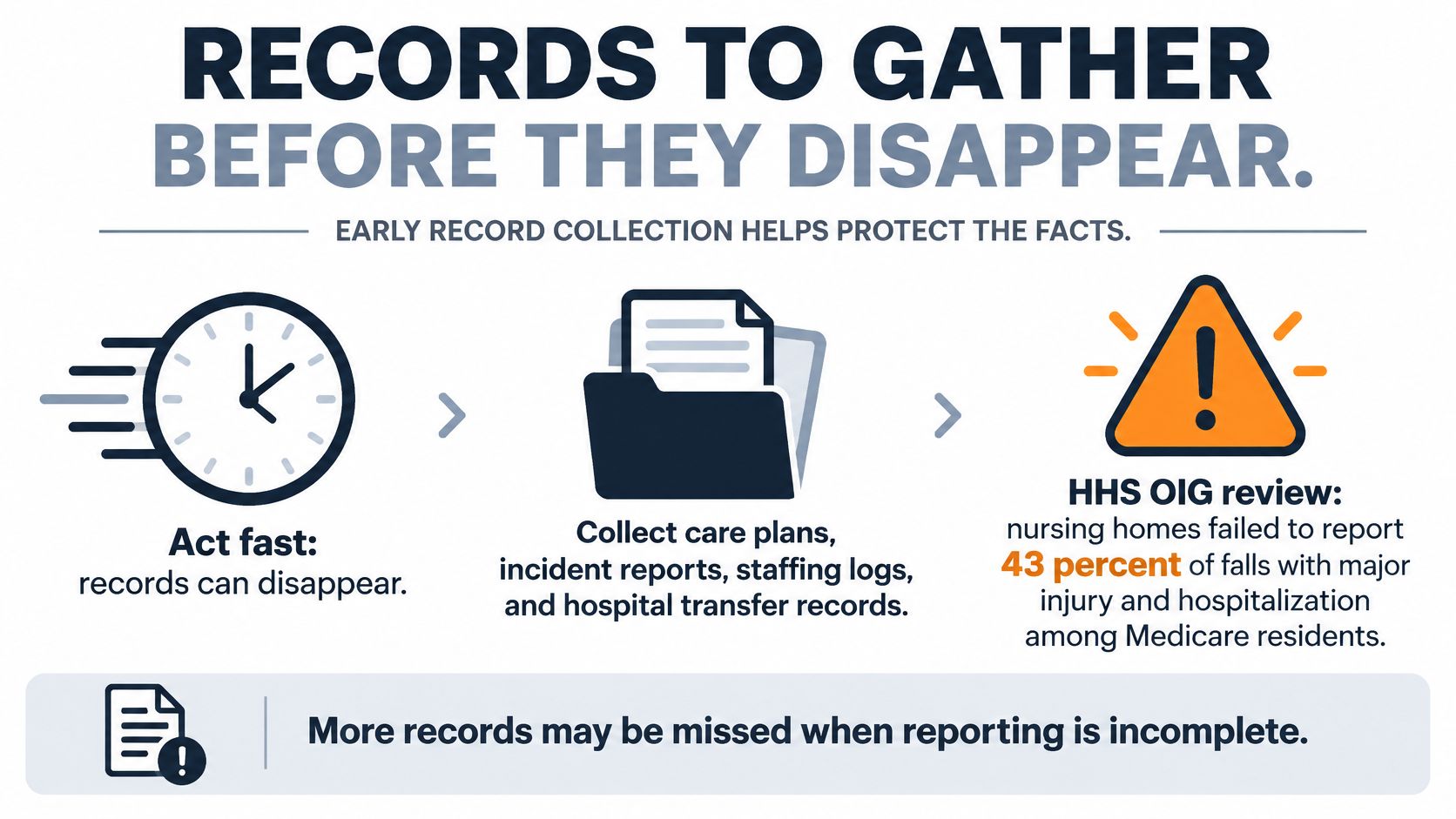
Speed matters because some events never reach the public record. An HHS Office of Inspector General review summarized by The Compliance Store found nursing homes failed to report 43% of falls involving major injury and hospitalization among Medicare-enrolled residents, with underreporting more common among for-profit, chain, and larger facilities. A death certificate that names heart disease or pneumonia can still leave the care process unexamined. Burial or cremation can close off some physical findings.
What to request, in order
- Complete chart. Ask for care plans and revisions, medication and treatment records, weights, intake and output, wound notes, vital signs, and physician orders.
- Incidents and the last hospital stay. Request incident and internal investigation reports, transfer records, and hospital records from the last admission.
- Who was working. Request staffing schedules and payroll-based staffing for the relevant shifts, plus call-system or alarm logs if they exist.
- Your own file. Save photographs, texts, and emails with dates.
- The official papers. Compare that timeline with the death certificate and any prior autopsy.
- A paper trail of the request. Put requests in writing and keep copies. Our walk-through on how to request medical records covers the practical sequence.
Chain of custody is a written record of who held evidence, and when, so a later reader can trust it was not altered. Surveillance may be limited by facility policy and Texas privacy rules. Ask what was retained. Do not assume video exists.
Poor care is not automatically the legal or medical cause of death. An apparently natural death can still involve preventable dehydration, infection, a pressure injury, a missed medicine, or a late transfer. After cremation, tissue injury patterns, some toxicology, and measurements that were never photographed usually cannot be rebuilt.
Families who already hold a declined county case often come to us with this packet. Private autopsy services in Texas use these same records beside the examination. They do not replace the chart.
A short public briefing on falls and facility reporting is worth watching while you organize the file. It will not answer your relative's case, but it shows why the missing incident report matters.
Medical Findings That Follow Missed Care
Four patterns show up again and again when a chart and a hospital course are read together. Each one has an innocent alternative. This is education about postmortem and record review. It is not a diagnosis of a living person, and it is not a promise that any one finding equals neglect.
Pressure injury, then infection
A stage II, III, IV, or unstageable ulcer can be followed by cellulitis or sepsis. CMS quality surveillance tracks stage II-IV or unstageable pressure ulcers among long-stay residents, new or worsened pressure injuries among short-stay residents, and falls with major injury. The question is whether risk was known, a plan existed, and repositioning and wound care happened before fever or a transfer. Severe vascular disease can injure skin even with attentive care. Progression without wound notes is a different record.
Dehydration and poor intake
Rising sodium or kidney tests, a falling weight, and little recorded fluid can fit dehydration. The same labs can fit a disease that itself reduces drinking. The chart has to show whether fluids were offered, refused, or never recorded, and when a physician was told.
An unwitnessed fall
A hip fracture or a head bleed after an unwitnessed fall is checked against bed alarms, footwear, and whether help was available. Some residents fall despite a solid plan. The incident report should still say who found the person and how long the gap was.
Missed medicine or aspiration
Omitted antibiotics or insulin leave a time gap on the medication record. Choking and pneumonia in a resident who needed help to eat raise a different question, about whether feeding assistance was given. The immediate anatomical cause may still be pneumonia or fracture complications. A possible contributing care failure is a separate statement.
Photographs, wound measurements, and lab time stamps often matter more than a family's memory of the last visit.
Hospital records belong beside the facility chart for each of these patterns. The request list above is how you get both.
When Staffing Records Support a Neglect Theory
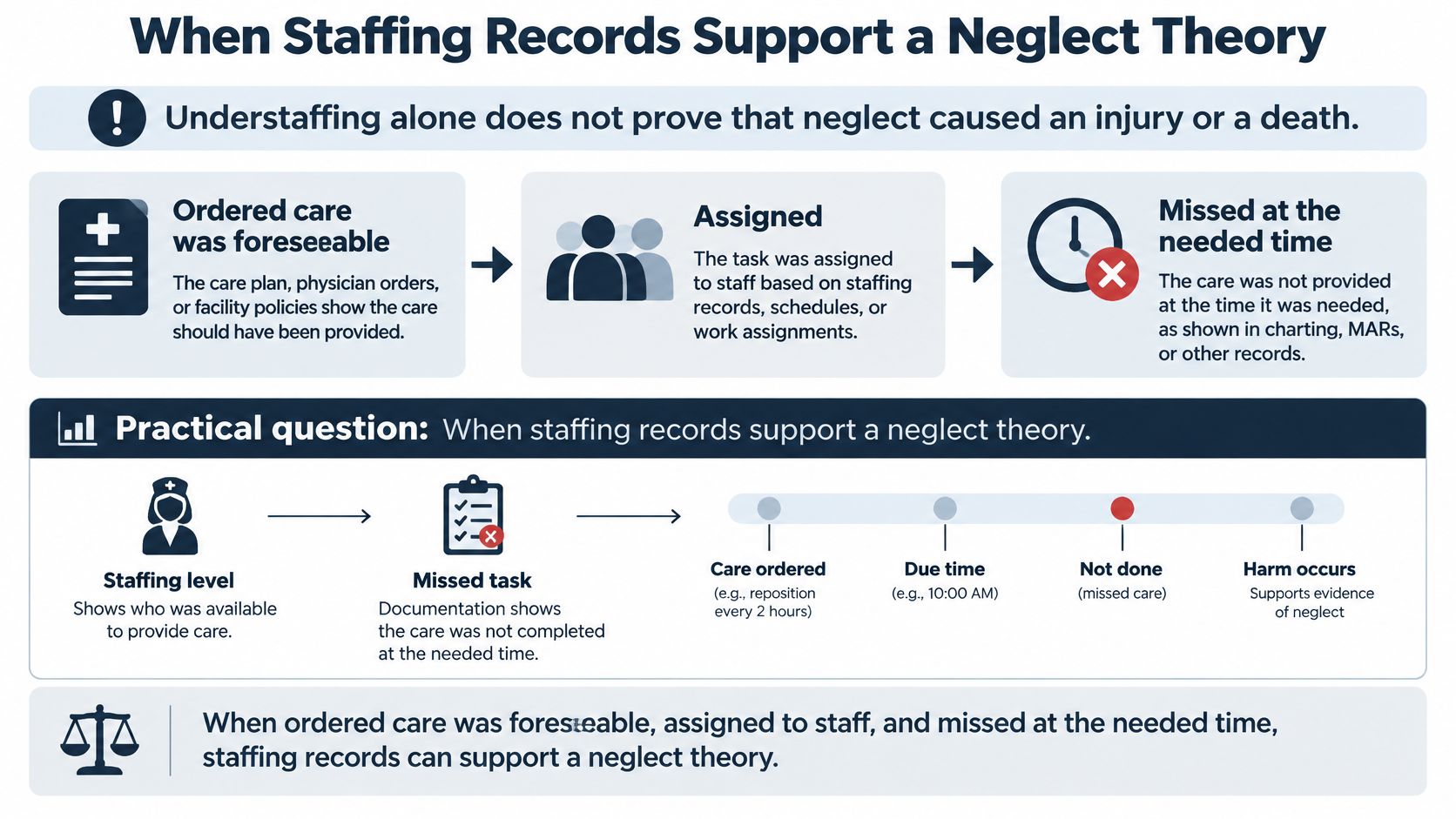
Understaffing alone does not prove that neglect caused an injury or a death. It becomes evidence when ordered care was foreseeable, assigned, and then missed at the hour the resident declined.
The gap public tools can miss
Federal rules expect eight hours of registered-nurse coverage a day. HHS Office of Inspector General oversight found that CMS does not identify every facility below that line. Its system primarily flags facilities reporting zero RN hours. States also lack enough context to tell whether a shortfall involves RNs, aides, or both. A home can show some nurse time and still lack people for turning, hydration, wound care, or a timely call to a physician.
A related national analysis in that same review found average nursing-home deficiencies increased from 6.8 in 2015 to 9.5 in 2025, while average daily nursing care decreased 7% over the decade. 27% of facilities received deficiencies involving actual harm or jeopardy. Those are national averages. They describe the setting. They do not decide one resident's night.
A comparison you can actually run
Set payroll-based staffing and the posted schedule next to resident acuity, the care plan, call-light logs, medication records, repositioning notes, incident reports, and the clock time of the first abnormal vital sign or hospital transfer.
Say a night shift lists one aide for a heavy unit. No turn is documented for six hours. At dawn a new stage III wound is found. That sequence can support a neglect theory if the care plan already required turning and nobody recorded an exception. It weakens if the turning record is complete, a physician was already treating a wound judged unavoidable, or the decline matches known end-stage disease with the ordered care in place. For the wound itself, coordinating resident wound care with specialists is the clinical task facilities are supposed to arrange, and the notes of that coordination belong in the same packet.
The causation test stays narrow. Did missed or delayed care materially contribute, separate from the disease named on the death certificate?
When a Private Autopsy Can Still Answer Questions
A county may decline a case while family questions about care remain unanswered. A facility may dispute neglect, and the death certificate may name a disease without explaining whether missed care contributed. When a county has declined a case, we can still examine the body and explain our findings to the family.
Our board-certified forensic pathologists assess injuries, pressure wounds, infection, dehydration, malnutrition, and other findings when the body and records allow. They also consider natural diseases that could explain the death. The examination can help clarify cause of death and describe complications, but it cannot by itself establish a staffing violation or legal neglect. That requires comparing medical findings with the care timeline.
We use a restoration-conscious examination, planning thorough findings with the funeral that follows in mind so families can still have the farewell they hoped for. If the person is already in our care, the family can submit a body release form. Reports are prepared to be court-admissible, with chain of custody maintained. Timing depends on release, distance across Texas, and any testing needed.
Families unsure whether an earlier examination answered their questions can learn about requesting a second-opinion autopsy. Counties seeking forensic autopsy services for official cases can review our county forensic autopsy services. A county service request is separate from a family's private request.
Questions families ask before they call
Can you examine the body if the medical examiner declined the case? Yes, with proper authorization. A decline does not determine what a private examination may find.
Is a scheduled cremation a barrier? Call before cremation, because some findings cannot be assessed afterward.
Will an examination delay the funeral? We provide in-house licensed transport statewide and coordinate with the funeral home. Share the service date when you call so our team can discuss timing.
An autopsy can clarify medical findings, but it cannot promise a legal result. We explain what the body and records can support, and where the evidence leaves questions unanswered. Texas Autopsy Services is available 24/7 at (806) 230-1889.
Texas Autopsy Services provides independent autopsy and second-opinion review for families and attorneys seeking answers after a nursing home death, including when a medical examiner has declined the case. Every examination is performed by a board-certified forensic pathologist. We assess the body and available records to help distinguish disease from possible complications of missed care, without promising a legal outcome. If you are facing these questions, contact Texas Autopsy Services to discuss the next step.