October 25, 2026 · Texas Autopsy Services
How to Make a Medical Records Request in Texas
Learn how to make a medical records request in Texas, with HIPAA deadlines, fee limits, a sample letter, and steps for late or refused records.

On this page
- Know Your Rights and Deadlines Before You Ask
- Who Can Sign the Request and Prove Authority
- How to Send a Records Request in Seven Steps
- Which Records Help an Autopsy or Second-Opinion Review
- What Records Cost and Which Formats You Can Request
- Sample Request Letter and Follow-Up Template
- Frequently Asked Questions About Texas Records Requests
- What to Do When Records Are Late or Refused
A death was unexpected. The family called the hospital, asked for the chart, and waited. Weeks passed with no records and no clear answer about when a reply was due.
That wait often starts with a simple gap. Nobody wrote down the date the provider received the medical records request, so nobody could track the deadline. We see this pattern when records are needed for a private autopsy, a cause of death investigation, or a second opinion autopsy.
- Two clocks apply in Texas, one federal and one state based.
- Authority must be proved before records are released after a death.
- Each record holder needs a separate request with proof of delivery.
- Fees have ceilings, and electronic delivery often costs less than paper.
Know Your Rights and Deadlines Before You Ask
A records request is a timed procedure, and the timer starts on the day the provider receives it. Not the day you mailed it. Not the day someone opened the envelope. Families who needed a chart for a private autopsy have told me the same story: the request went out, nobody logged a receipt date, and weeks later no one could say whether the provider was late. Write that date down before anything else.
Two clocks run at the same time. The federal HIPAA Privacy Rule gives individuals a right to copies of their designated record set, which covers medical, billing, claims, enrollment, payment, and case management records used to make decisions about them, under HHS guidance on the HIPAA right of access. Texas sets shorter deadlines for physicians and hospitals, so the clock that controls your request is the shorter one for the holder you are asking.
Texas and Federal Deadlines for Medical Records Requests
| Rule | Who it covers | Deadline | Governing source |
|---|---|---|---|
| Federal HIPAA access request | Covered providers and health plans | 30 calendar days, plus one written extension of up to 30 days | HHS HIPAA Privacy Rule |
| Texas physician records | Physicians licensed in Texas | 15 business days after a written request with proper consent | Texas Medical Board |
| Texas hospital records | Hospitals | 15 days after written authorization and any authorized payment | Texas Health & Safety Code 241.154 |
Off-site storage does not buy extra time. Under the HHS guidance cited above, the 30-calendar-day deadline and the single 30-day extension apply even when a provider keeps records in off-site or archived storage.
The federal clock has one pause button. If a covered entity cannot respond within 30 calendar days, it may take one extension of no more than 30 additional calendar days, and only after giving you a written explanation for the delay within the first window. Without that written notice, the extension does not count. Records must also arrive in the form or format you requested when that format is readily producible, which matters for portal downloads, electronic files, and copies sent to an attorney or another designated third party.
Practical rule: Record the receipt date for every request, then calendar both the Texas deadline and the federal deadline.
These are general rules, not legal advice for a specific case. Limited exclusions apply, such as psychotherapy notes and information compiled for legal proceedings. For background on why a complete chart matters before any review begins, our discussion of the purpose of medical records in a death investigation explains how records build the treatment timeline a pathologist works from.
Who Can Sign the Request and Prove Authority
A patient can request their own records. After a death, that right generally passes to a personal representative, such as a court appointed executor or administrator of the estate. A provider will not release records on a family relationship alone if the legal authority isn't documented.
Providers usually ask for a certified copy of the death certificate, letters testamentary or letters of administration from the probate court, a government issued photo ID, and a signed authorization form. When authority rests on a court appointment during life, showing proof of your guardianship authority helps explain the type of court documentation an institution may expect. Attorneys usually send a signed authorization from the personal representative or rely on a valid subpoena, and the letter should state which basis applies.
Why One Request Rarely Covers Everything
One death can produce records from a hospital, several physicians, a laboratory, an imaging center, a pharmacy, an insurer, and a health information exchange. Each holder keeps its own file and its own proof requirements, so each one needs a separate request. A mismatch between the name on the chart and the authority presented is a common reason for delay, and a provider can ask for more documentation when that happens.
Federal enforcement shows that delay after repeated requests carries consequences. In March 2025, HHS announced a $200,000 settlement after finding that a health system failed to act timely on repeated access requests made by a personal representative, according to the HHS press room announcement of that settlement. Our overview of HIPAA compliant release of information procedures explains how authorization and identity checks fit together.
A relative who isn't the personal representative can still help. Collect facility names, dates of service, and contact details so the representative can act without searching for basic facts during a difficult period.
How to Send a Records Request in Seven Steps
The visual below shows the full sequence at a glance, from listing record holders to follow up.
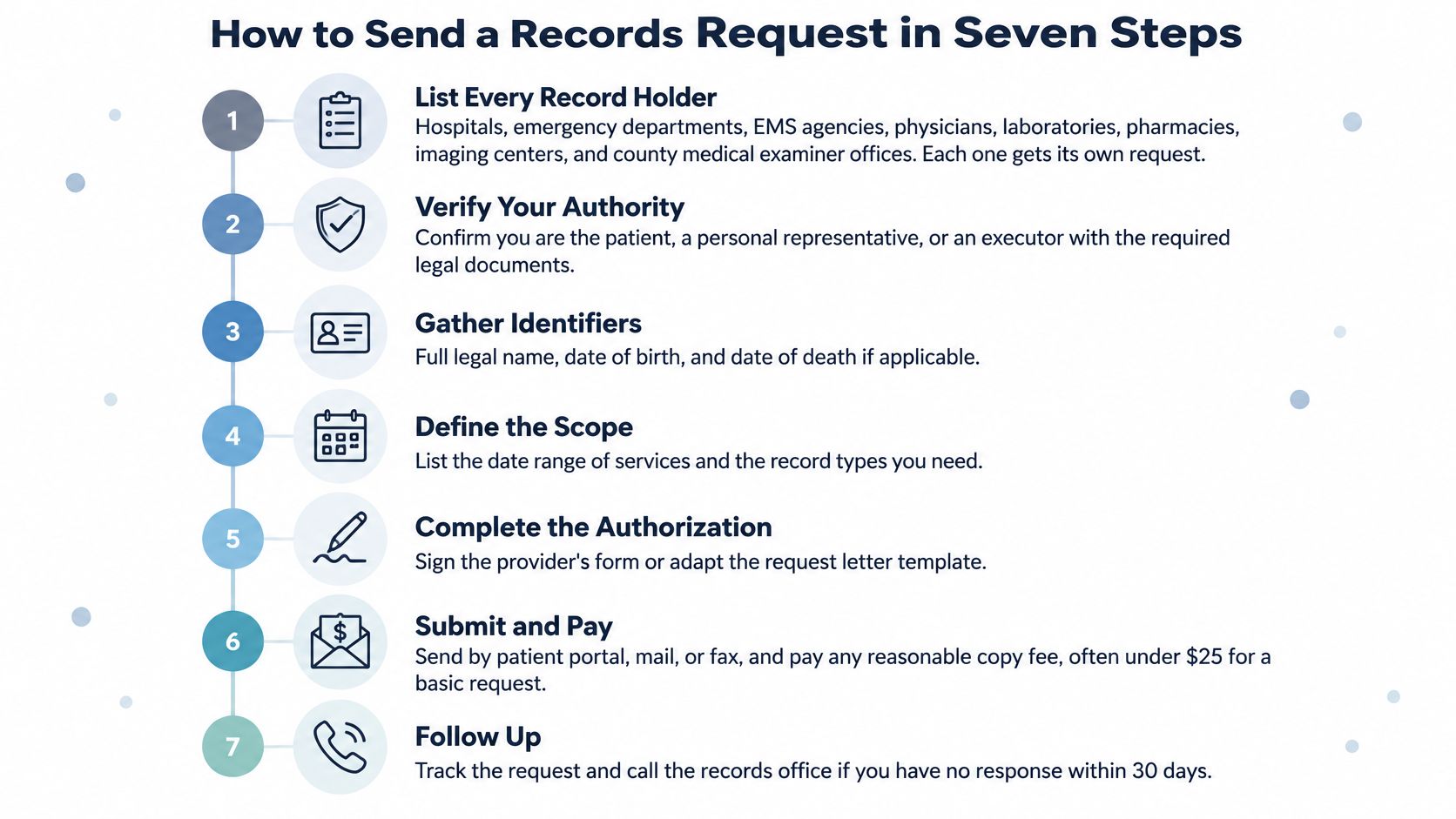
- List every record holder. Include hospitals, emergency departments, EMS agencies, physicians, laboratories, pharmacies, imaging centers, and county medical examiner offices. Each holder gets its own request because no single office holds the complete file.
- Gather identifiers. Use the full legal name, date of birth, date of death, dates of service, facility names, and medical record numbers if known. Accurate identifiers reduce mismatches that pause processing.
- Use the provider form or write a clear letter. A provider authorization form is usually faster because it matches internal intake requirements. If you write a letter, name the patient, the records sought, the date range, and the requested format.
- Attach proof of authority and photo ID. Include the documents described in the section above. Missing proof is a frequent reason a request is returned without action.
- Send by a trackable method. Keep a full copy of everything sent and note the date of receipt. Proof of delivery starts the deadline clock and supports any follow up.
- Ask for electronic delivery in a usable format. Request PDF files for reports and native image files for imaging when available. A readable format prevents a second request for the same material.
- Calendar the deadline and follow up in writing. Count from the receipt date, not the mailing date. If nothing arrives by the deadline, send a dated written follow up rather than relying on a phone call.
The short video below walks through the request sequence in the same order.
Timing supports prompt follow up in Texas. A Texas physician generally must provide records or a narrative summary within 15 business days after receiving a written request based on proper consent, and records may go to the patient, another provider, or an authorized third party, according to Texas Medical Board patient information and medical records guidance. A narrow request for the complete designated record set for stated dates, plus imaging if needed, usually moves faster than a vague request for everything.
Which Records Help an Autopsy or Second-Opinion Review
A reviewer works from the full timeline. The most useful records show what happened before, during, and after the final event, not only the last note in the chart. A cause of death states the disease or injury that started the chain leading to death, while manner of death classifies the circumstances.
Record Types for Autopsy and Second-Opinion Reviews
| Record type | What it shows | Why it matters for review | Usual holder |
|---|---|---|---|
| Inpatient hospital chart | Admission, progress notes, orders, discharge summary | Shows the treatment timeline and clinical decisions | Hospital medical records department |
| Emergency department record | Triage, vital signs, nursing and physician notes | Documents condition on arrival and resuscitation efforts | Hospital that treated the patient |
| EMS run report | Scene findings, vital signs, interventions | Captures first responder observations outside a hospital | Responding EMS agency |
| Imaging studies and reports | X-ray, CT and MRI images with radiologist reports | Shows injuries, prior fractures, and disease progression | Imaging facility or hospital |
| Laboratory and toxicology results | Blood work, drug screens, prior biopsy pathology | Supports or challenges findings when read with reference ranges | Hospital or reference laboratory |
| Medication and pharmacy history | Prescriptions, dispensing dates, dosages | Shows medication exposure before death | Pharmacy and prescribing physician |
| Prior autopsy report, slides and blocks | Gross and microscopic findings, toxicology | Basis for an independent second opinion review | Performing pathology office or county medical examiner |
| Death certificate | Cause and manner of death as certified | Shows what the certifier recorded | Texas Vital Statistics or county registrar |
Start with the inpatient chart and emergency department record. They document condition, interventions, and clinical reasoning in sequence. EMS run reports matter when death occurred outside a hospital because they capture scene findings before transport or treatment changed the picture.
Imaging files are often separate from imaging reports, so request both when images themselves need review. Laboratory and toxicology results should be read with their reference ranges, since a number without its range can mislead. For a second opinion on a prior autopsy, request the prior report, slides, tissue blocks, and toxicology results from the performing pathology office or county medical examiner, where release rules differ by office.
Ask for the complete record rather than a portal summary, since portal views often omit nursing notes and full order histories. Check for missing pages, missing date ranges, and prior biopsy pathology reports. Our medical records review expert service overview describes how records are organized for review by a forensic pathology expert, and that review supports, but doesn't replace, clinical and pathologic judgment.
What Records Cost and Which Formats You Can Request
I'm going to fix the two issues I found.
I'm reconciling the Texas hospital retrieval fee with HIPAA's restrictions on search and retrieval fees. HIPAA's fee limits apply to patient access requests, while the Texas fee applies to other disclosures like subpoenas or third-party requests. For patient access requests, HIPAA preempts state law, barring retrieval fees. For requests made under an authorization, state fee limits may apply.
I'm adding a section on record formats, including PDF, DICOM, portal downloads, secure email, paper, and CD. I'll also weave in the unique angle of overlapping HIPAA and Texas clocks, noting how payment can pause release under section 241.154, which ties into the cost and format discussion. The goal is to keep the word count around 300 words, vary sentence structure, and preserve existing links and the table. I'll open with a concrete example of a 60-page paper chart costing up to $45 before postage, then explain the fee ceilings.
I'm clarifying the distinction between Texas Medical Board fees for paper charts and hospital fees under a separate statute. HIPAA's cost-based fee rule for patient access requests overrides state law, prohibiting separate search and retrieval fees. However, Texas fee limits may still apply to other request types, like those made under a signed authorization to a third party, so the invoice must be read in context. Prompt payment of an upfront estimate can prevent delays under the Texas statute.
Format choices impact cost and utility. I need to clarify that DICOM is for physicians, not pathologists, and avoid repeating that portal summaries omit nursing notes. I'll also ensure the request explicitly states the desired format, as the next section includes a placeholder for it. The bullet points at the end should be updated to reflect these decisions.
I need to steer clear of a list of specific phrases and constructions, including "Also," "On top of that," "Beyond that," and others like "open," "improve," and "smooth." I also need to avoid certain sentence structures like "Not X. But Y." and phrases such as "moving forward," "circle back," and "deep dive." The goal is to maintain a similar word count to the original draft, around 300 words, and to ensure I don't repeat myself.
Sample Request Letter and Follow-Up Template
The image below shows the basic materials for a written request, including the letter, envelope, and signed authorization.

Adapt the wording to the provider form if one is required, and keep every bracketed field specific.
[Date]
[Provider name, Medical Records Department, address]
Subject Medical records request for [Patient full legal name]
Patient [Patient full legal name], date of birth [Date of birth], date of death [Date of death], medical record number [Number if known].
Please provide the complete designated record set for [Date range of services], including [specific records such as emergency department record, inpatient chart, laboratory results, imaging reports and image files, medication history].
Requested format [Requested format]. Please send records to [Name, address, secure email or portal destination].
Authority is based on [patient request, personal representative status, or authorization from the personal representative]. Enclosed are [death certificate, letters testamentary or administration, photo ID, signed authorization].
Please contact [Phone number] or [Email] with questions, and please provide an itemized fee estimate before copying.
Signature [Requester signature]
Printed name [Requester printed name], relationship or authority [Relationship to patient]
Short Follow-Up Wording After a Deadline
Reference is made to the medical records request dated [Original request date] and received on [Receipt date]. The applicable deadline is [HIPAA 30 calendar day rule or Texas 15 business day physician rule or Texas hospital 15 day rule]. Please provide the records or the written explanation required for an extension, and state the expected completion date.
- Send to medical records, not billing. The wrong department can sit on a request.
- Keep a signed copy. Retain the authorization and every enclosure.
- Use proof of delivery. Certified mail or a tracked portal submission documents receipt.
Frequently Asked Questions About Texas Records Requests
How Long Does a Texas Records Request Take
Federal HIPAA generally allows 30 calendar days with one written extension, while Texas physician and hospital rules use the 15 business day and 15 day periods described earlier. Off-site storage, payment, and scope affect timing, so a provider can't promise a fixed delivery date in every case.
Can a Family Member Request Records Without Being the Personal Representative
A relative can gather facility names, dates of service, and contact details for the representative. The provider releases records only to the patient, the personal representative, or an authorized third party with documented authority.
Does a Request Need a Court Order
A patient access request under HIPAA doesn't require a court order. A subpoena is a separate legal process with its own notice and scope rules, and it shouldn't be mixed with a patient access request.
What Records Are Needed for a Second Opinion on a Prior Autopsy
Request the prior autopsy report, slides, tissue blocks, and toxicology results. Ask the performing pathology office or county medical examiner about its release process, since each office sets its own requirements.
What to Do When Records Are Late or Refused
A late response is a clock problem, so treat it like one. Once the applicable deadline passes, whether the federal access window or the shorter Texas period, send a dated written follow up. Cite the date you sent the original request, the date the provider received it, and the rule that governs the response window, then ask for the reason for delay in writing. If the provider claims an extension, request the required written explanation by name, and record the new date the clock is due to expire.
Sort refusals by type before responding. Under HIPAA, a covered provider generally cannot deny a copy because a patient has not paid for care, cannot charge for searching or retrieving records, and may charge only reasonable, cost based copying and mailing expenses, as explained in HHS guidance for individuals on medical records. When records are also headed toward litigation, keep the two tracks on separate paper: the family sends its own patient access request under HIPAA, and the attorney issues any subpoena under its own notice and scope rules. Combining them in one letter gives the provider a reason to stall both.
Ask the provider to identify the exact basis for any item withheld, rather than accepting a general refusal.
A provider may withhold psychotherapy notes and information compiled for legal proceedings, so the stated basis matters. Incomplete productions often trace back to a vague scope or a missing date range, and a corrected request naming the designated record set and dates of service can close the gap. Complaints about a physician can be filed with the Texas Medical Board, and HIPAA access complaints can be filed with the HHS Office for Civil Rights.
If records are needed to evaluate a death or prepare a second opinion, call Texas Autopsy Services at (806) 230-1889 to discuss which records to request first. The team can help families and attorneys identify the documents a pathology review will need.
If you need an independent autopsy, a second opinion review, or guidance on which records to request first for a cause of death investigation, contact Texas Autopsy Services to speak directly with our team. We'll explain the autopsy process, the records that support review, and the next practical step for your family, law firm, or county office.