September 4, 2026 · Texas Autopsy Services
HIPAA Compliant Release of Information for Autopsy Reports
Learn what a HIPAA compliant release of information requires for autopsy and forensic records, including who can authorize, required form elements, and how
On this page
- What HIPAA Compliant Release of Information Means
- Required Elements of a Valid Authorization Form
- Who Can Authorize Release for a Decedent in Texas
- How Releases Work in Autopsy and Forensic Pathology
- How Texas Autopsy Services Handles Releases and Chain of Custody
- Practical Checklist for Families Attorneys and Providers
- Compliance Boundaries and When to Call Our Team
A family member may be waiting for an autopsy report while an attorney needs the same file for a second-opinion review, and a county official may be confirming whether a justice of the peace had authority to direct an examination. These requests can involve the same decedent, but they don't follow the same release pathway. A HIPAA-compliant release of information must match the requester, the legal authority, the records sought, and the purpose of disclosure.
At Texas Autopsy Services, we translate those requirements into a documented process that families, attorneys, providers, and county officials can follow. Our independent private autopsy and forensic pathology practice is based in Elgin, serves all 254 Texas counties, and uses examinations performed by forensic pathologists certified by the American Board of Pathology.
- A valid release is specific. It identifies the records, recipient, purpose, expiration, and signer.
- The minimum-necessary standard matters. A request for an entire file may be broader than the stated purpose requires.
- Decedent authority follows a legal order. A surviving spouse, personal representative, executor, next of kin, or justice of the peace may have different roles.
- Autopsy records and custody records must be handled carefully. Secure delivery and documented handoffs protect both privacy and evidentiary integrity.
- Not every disclosure requires an authorization. Treatment-related disclosures, certain legally required disclosures, and court-directed releases follow separate rules.
A grieving family might ask for “everything related to the death” during the first call. That request is understandable, but it doesn't identify who may receive the records or explain whether the family needs a final report, toxicology materials, photographs, slides, or documents showing how specimens were handled. The safest response is to pause, identify the lawful signer, define the scope, and preserve the record of every decision.
What HIPAA Compliant Release of Information Means
A HIPAA-compliant release of information is a documented disclosure of protected health information to an authorized recipient for an identified purpose, using the authority and limits required by HIPAA and applicable Texas law.
Protected health information, or PHI, is individually identifiable health information held or transmitted by a covered entity or its business associate. In an autopsy setting, that can include a clinical history provided for examination, an autopsy report, toxicology results, microscopic findings, photographs, and related records that identify the decedent. A chain-of-custody log may also become part of the disclosure when it is connected to an identifiable case and is released with the medical or forensic file.
The HIPAA Privacy Rule, finalized in 2000 and effective in 2003, established the modern framework by requiring covered entities to make reasonable efforts to limit disclosures to the minimum necessary information needed for the intended purpose. The rule also makes an important distinction: the minimum-necessary standard doesn't apply to a disclosure to a health care provider for treatment. The Federal Register's discussion of accounting of disclosures describes this broader framework of limited disclosure and traceable records.
Specific requests are easier to defend
A verbal request from a family member may begin the conversation, but it usually doesn't replace a signed written authorization when the disclosure requires one. A defensible authorization should identify the covered entity holding the records, the recipient, the purpose, the information to be released, and the expiration.
“Release all records” may be too broad if an attorney only needs the final autopsy report and toxicology results for an initial review. A request for the final report, specified supporting worksheets, and identified custody documentation is easier to match to the stated purpose.
The rules also distinguish an authorization-based release from a subpoena response, court order, or medical-examiner disclosure. Each follows its own legal pathway. Families seeking more background about access to reports can review our explanation of whether an autopsy report is a public record in Texas.
Required Elements of a Valid Authorization Form
A valid authorization should give the record holder enough information to answer five basic questions: whose records are involved, what may be released, who may receive them, why they're needed, and how long the permission lasts. It must also show that the person signing understood the authorization and signed it voluntarily.
For autopsy records, the description should be concrete. “Final autopsy report, microscopic slides, toxicology results, and chain-of-custody documentation” is more useful than “all medical information.” If photographs or imaging are needed, they should be named rather than assumed.
Six elements that should appear
Identification of the decedent and covered entity. The form should identify the deceased person and the organization holding the requested records.
Description of the information. The form should specify the final autopsy report, toxicology results, microscopic materials, photographs, slides, blocks, or custody documentation sought.
Recipient identification. Name the person, law firm, agency, provider, or defined class authorized to receive the records.
Purpose of disclosure. State whether the records are requested for family review, a second-opinion autopsy, litigation, insurance administration, or another defined purpose.
Expiration. The authorization needs an expiration date or event, such as one year from signature or the conclusion of litigation.
Signature and date. The signer must date the form and acknowledge the right to revoke the authorization in writing. The form also needs the required statement that treatment, payment, enrollment, or eligibility can't be conditioned on signing.
| Required Element | Autopsy-Context Example |
|---|---|
| Decedent and covered entity | Named decedent and Texas Autopsy Services or another record holder |
| Information described | Final autopsy report, microscopic slides, toxicology results, and chain-of-custody documentation |
| Authorized recipient | Named attorney, surviving spouse, county office, or provider |
| Purpose | Family review, litigation evaluation, or second-opinion review |
| Expiration | One year from signature or conclusion of litigation |
| Signature and date | Authorized signer's signature, date, and written-revocation acknowledgment |
The conditioning statement can feel unusual on a decedent file, but it remains part of the authorization requirements. Families who need a broader overview of the mechanics may also find this resource on how to request health records useful when organizing a records request.
A form that omits the recipient, purpose, expiration, or signature may not support the intended disclosure. If the scope changes later, the safer practice is to obtain an updated authorization rather than stretching the original language.
Who Can Authorize Release for a Decedent in Texas
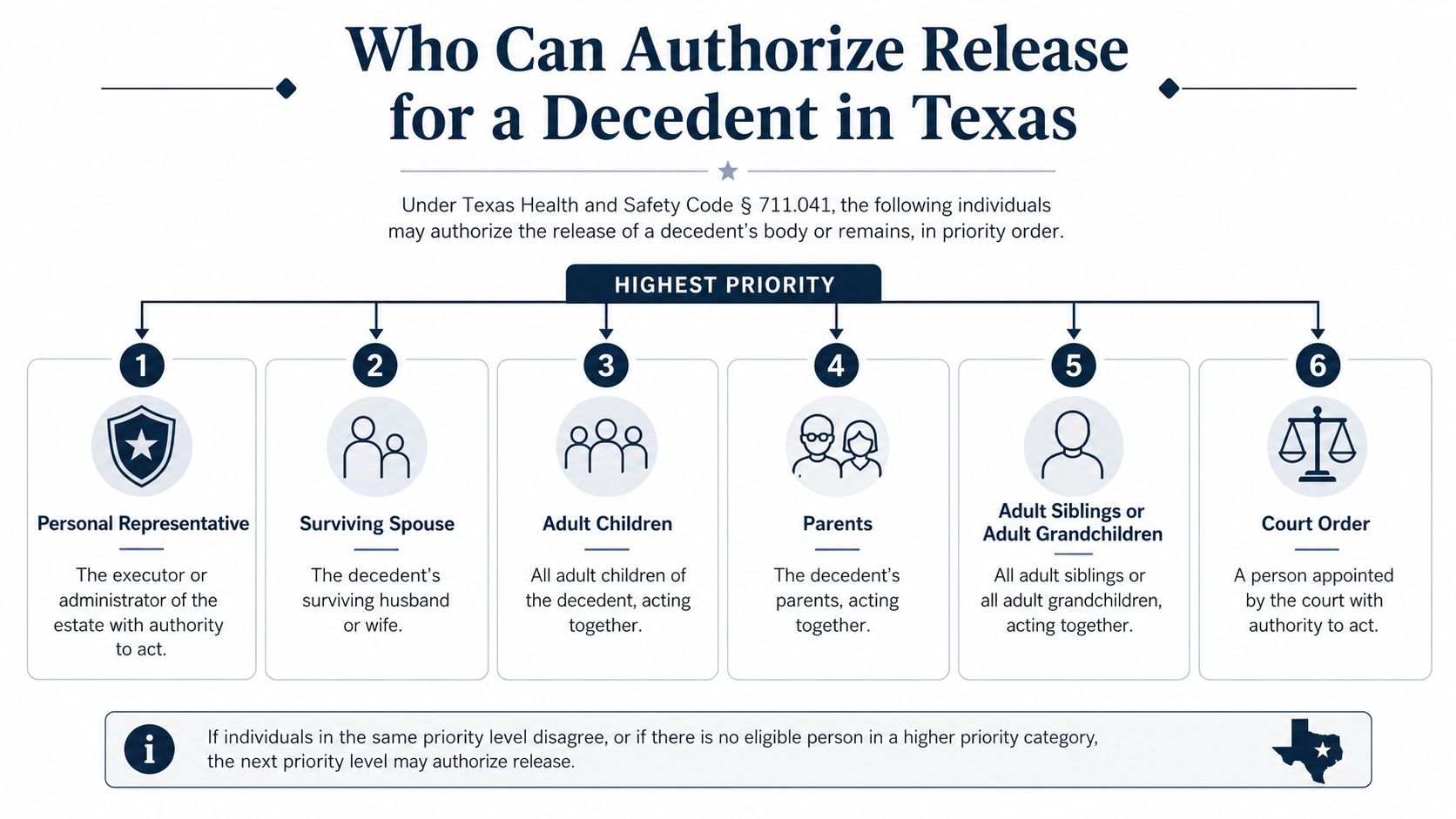
Authority to request or authorize a deceased person's health records isn't determined only by who calls first. Texas practice generally turns on the relationship to the decedent, formal estate authority, the status of the death investigation, and any governing order.
A personal representative appointed by a probate court may act for the estate. An executor named in a will may also have authority, but the practical question is whether that person has been formally appointed or otherwise has recognized authority to act. A will alone may not resolve every records-release question before probate proceedings establish the representative.
Texas law also recognizes a statutory next-of-kin hierarchy for certain decisions involving a decedent. In ordinary family circumstances, a surviving spouse generally precedes adult children. If there's no surviving spouse, the analysis may move through other eligible relatives under the applicable Texas Estates Code provisions.
When public authority changes the pathway
A death under a justice of the peace's jurisdiction can involve a different process. Texas Health & Safety Code Chapter 716 gives the justice of the peace a special role involving the disposition and release of a decedent's remains in circumstances governed by that chapter. A justice's order or direction may therefore supply authority that a private family signature doesn't replace.
If no relative can be located, or if relatives disagree about authority, a court order may be needed. A non-Texas court order may be honored in some circumstances, but it should be reviewed before records are released. A divorce also matters. A former spouse's authority doesn't automatically continue after the marriage has ended.
The governing authority should be documented with the request. That may include probate appointment papers, evidence of the family relationship, a justice of the peace order, or another applicable court document. Because decedent access can intersect with Texas Health & Safety Code Chapters 711, 716, and 651, the practice should verify the exact circumstances instead of relying on an informal family understanding.
How Releases Work in Autopsy and Forensic Pathology
The same report can move through very different channels depending on who commissioned the examination and who has legal authority to receive it. These examples show why the signer, purpose, scope, and restricted materials should be recorded separately.
A family-requested private autopsy
A surviving spouse may request a private autopsy for personal understanding after a hospital or other authority declines to perform one. If the spouse has the applicable authority, the spouse signs a written authorization identifying the decedent, the practice holding the records, and the records to be released.
The scope might include the final autopsy report, identified laboratory findings, and supporting materials needed for personal review. If an adult child is the authorized signer instead, the practice must confirm that the child's position in the applicable priority structure permits the requested release. Materials not named in the authorization remain outside its scope unless the authority and form are updated.
An attorney's second-opinion review
An attorney may request records to evaluate whether a prior autopsy supports the stated cause of death. The personal representative or other authorized signer should identify the attorney or law firm as the recipient and state the litigation or case-evaluation purpose.
The practice may deliver the authorized records to counsel rather than directly to every family member. The signed authorization should address whether the request includes the final report, toxicology, medical records, photographs, microscopic materials, or custody documents. A law-enforcement file or restricted investigative material isn't automatically opened merely because counsel requests a second opinion.
A county forensic autopsy
A county forensic autopsy directed by a justice of the peace follows public authority rather than a family-paid private-autopsy pathway. The justice's order functions as the authorizing instrument for the examination, while family access to applicable records remains subject to the relevant Texas authority and disclosure rules.
Law-enforcement records may remain restricted from civil disclosure. A family member's request for the autopsy report doesn't itself authorize release of every investigative record, evidence item, interview, or agency file connected to the death.
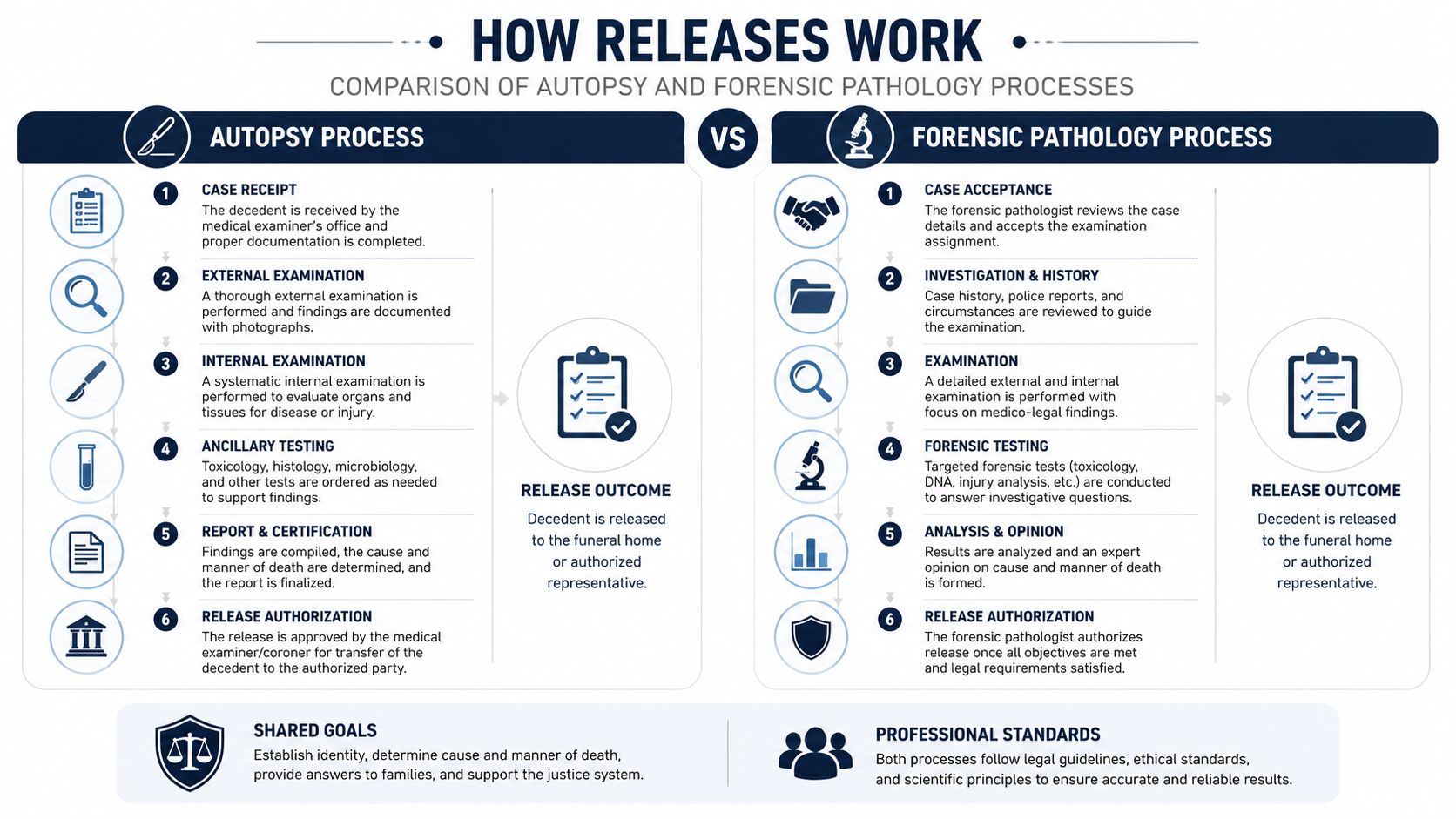
The practical distinction is simple: the examination authority and the records-release authority may not be the same person. Our County Forensic Autopsies information explains how county-directed forensic services fit within the broader Texas death-investigation structure.
How Texas Autopsy Services Handles Releases and Chain of Custody
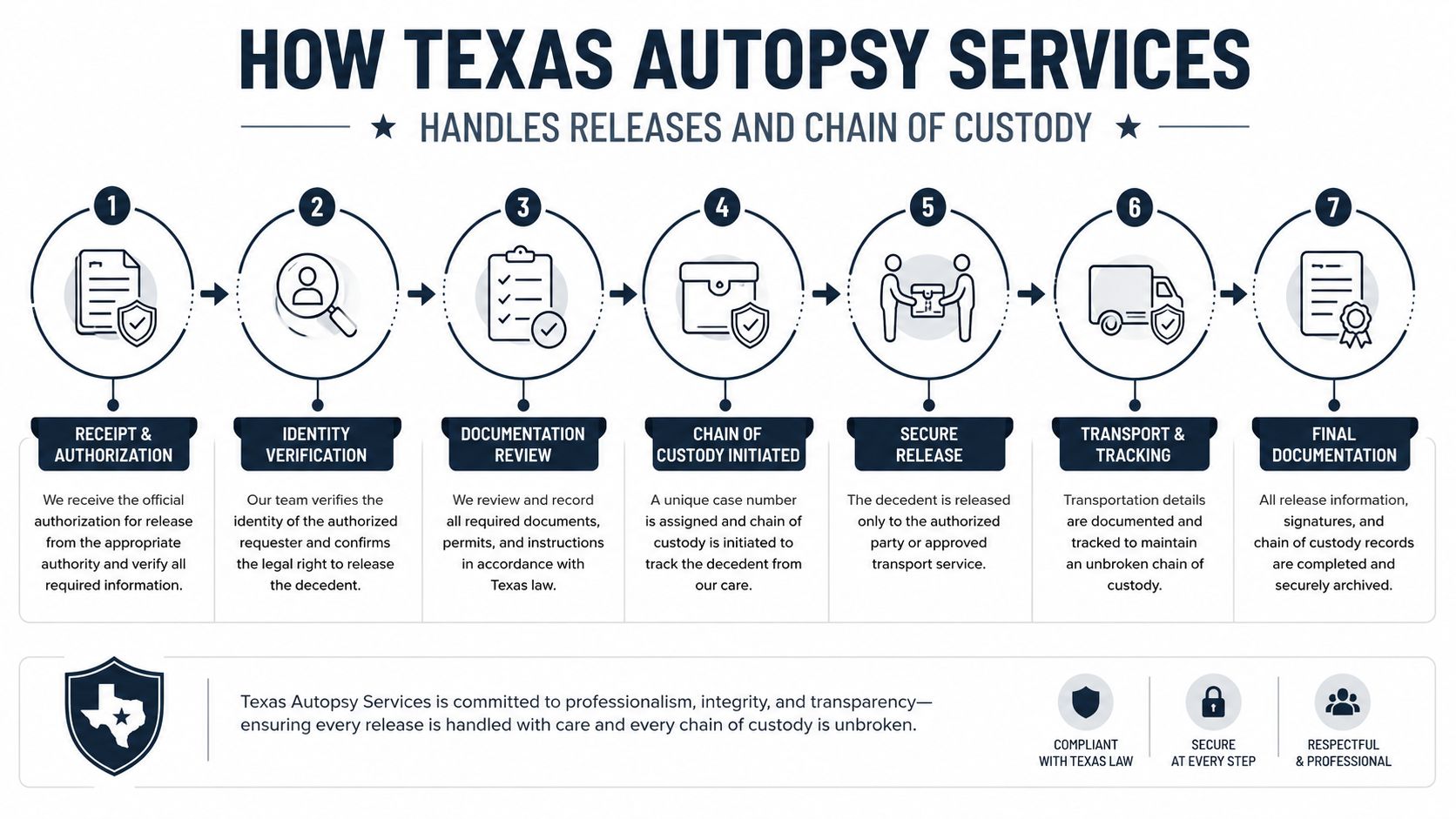
A release request enters two tracking systems at the same time. The first verifies privacy authority. The second protects the evidentiary history of materials connected to the examination.
Our team begins by confirming the signer's identity and authority. We review the authorization for the decedent's identity, the covered entity, the recipient, the stated purpose, the records described, the expiration, and the signature. We then associate the approved authorization with the case number so staff can see which document supports each disclosure.
The record and the evidence follow parallel paths
If the request includes slides, tissue blocks, photographs, specimens, or other examination materials, custody documentation travels with the release review. Chain of custody means the recorded history of who possessed an item, when the handoff occurred, what was transferred, and where the item went. It helps establish that the material released is the material identified in the file.
Our staff document each handoff and limit delivery to the authorized recipient. Secure transmission is used for reports and other records, while physical materials require documented transfer arrangements. Before a second release occurs, or before another recipient is added, the authorization is reviewed again rather than treated as permanently open.
Practical rule: A signature authorizes only the disclosure described. It doesn't authorize an unrelated later transmission.
The final report is released only after the team confirms that the recipient and delivery method match the approved request. Families and attorneys can review our explanation of chain-of-custody procedures for a fuller description of how evidence documentation supports a defensible forensic file.
Practical Checklist for Families Attorneys and Providers
The most useful checklist is the one that identifies the person responsible for each decision. A family member may supply relationship information, an attorney may define the litigation need, and a provider or justice of the peace may rely on statutory authority. Those roles should be documented separately.
Families
- Confirm authority first. Identify whether the signer is the surviving spouse, another eligible next of kin, a court-appointed personal representative, or a person acting under a justice of the peace order.
- Describe the records. Name the final report, toxicology results, photographs, slides, medical records, or custody documentation needed.
- State the purpose. Explain whether the request is for family review, a second opinion, insurance administration, or legal evaluation.
- Complete the form. Sign and date the authorization, include its expiration, and acknowledge the written-revocation right.
- Provide identification. Submit the identification and authority documents needed to verify the signer.
Families considering an independent examination can review our information about autopsy reports in Texas before deciding which records may be relevant.
Attorneys
- Identify the client's authority. Pair the authorization with a representation letter and, when applicable, probate appointment documentation.
- Name every recipient. Specify the firm, individual counsel, expert, insurer, or other intended recipient.
- Limit re-disclosure. Explain who may review the records and whether materials may be shared with experts or opposing parties.
- List exhibits separately. State whether photographs, slides, blocks, toxicology worksheets, or custody records are needed.
- Match the purpose to the scope. A request for initial case evaluation may not require the same materials as a deposition or trial exhibit.
Providers and justices of the peace
- Document statutory authority. Attach the applicable order, directive, or other legal basis for the disclosure.
- Limit the release. Provide only what the authority and purpose require.
- Keep the file complete. Retain the authorization or order, identity verification, delivery record, and custody documentation.
- Recheck changed circumstances. Update the file if a personal representative changes, an authorization expires, or a new recipient is added.
An authorization can be revoked in writing before the covered entity acts on it, subject to the limits of the applicable rule. A new authorization should be obtained after an expiration event or a change in the person authorized to act. Some disclosures, including treatment, payment, health care operations, and certain required public health disclosures, may fall under exceptions rather than an authorization-based release. HHS explains authorization requirements and exceptions, including the ability of individuals to direct records to a third party.
Compliance Boundaries and When to Call Our Team
HIPAA authorization isn't required for every disclosure. HHS distinguishes disclosures for treatment, payment, and health care operations from disclosures that generally require a valid authorization or a specific exception. A disclosure required by law, a court order, or a justice of the peace directing a forensic autopsy may follow its own authority. That doesn't mean every record connected to the case is automatically available.
Private autopsy reports, attorney requests, insurance inquiries, and media inquiries should be treated as authorization-based requests unless a documented exception or order applies. The request should identify the recipient and purpose, and the scope should remain limited to the records needed. Media interest alone doesn't create authority to receive protected information.
Accounting and auditability
HIPAA's accounting rules reinforce why every release needs a clear paper trail. Under the standard rule, an individual may request an accounting of certain disclosures during the prior 6 years, or a shorter period if requested. The accounting generally includes the disclosure date, recipient's name and address if known, a brief description of the PHI, and the purpose or a copy of the written request. The HHS Privacy Rule overview identifies major exceptions, including disclosures to the individual and disclosures for treatment.
HITECH-era electronic disclosures tied to treatment, payment, and health care operations were later addressed with a 3-year lookback for certain categories, as described in the same HHS materials. Disclosures made under an individual's authorization are generally exempt from the accounting requirement under the applicable rule. The federal regulation on accounting of disclosures lists the required elements and exclusions.
A release may need to be renewed when its expiration date or event occurs. A written revocation should be logged, and an amended report or newly created record may require separate documentation before it is sent. Because a mistaken disclosure can compromise a criminal investigation or deepen a family's distress, the record of authority is not administrative clutter. It's part of responsible forensic practice.
Attorneys and agencies building broader compliance systems may also review By Design Law Firm's guide for organizational and legal considerations, while recognizing that a general guide doesn't replace case-specific review.
Families dealing with an active investigation, attorneys preparing for a deposition, and county officials verifying custody documentation should contact our team before relying on an uncertain form or order. We can review the requested scope, clarify what authority is missing, and identify the records that can be released through the appropriate pathway.
Texas Autopsy Services provides independent private autopsy services Texas families, attorneys, providers, and county officials can use when a clear, documented cause-of-death review is needed. Visit Texas Autopsy Services to discuss a private autopsy, second-opinion review, county forensic service, or HIPAA-compliant records release with our team.