September 3, 2026 · Texas Autopsy Services
Forensic Dental Records and How They Support Identification
Learn how forensic dental records support identification, what records matter, and how families and attorneys in Texas can request and transfer them securely.
On this page
- What Forensic Dental Records Are
- How Dental Identification Became a Forensic Tool
- The Types of Dental Records That Matter Most
- How Antemortem and Postmortem Records Are Compared
- Requesting and Transferring Dental Records Safely
- Chain of Custody and Court Admissibility
- Common Limitations and Honest Gaps
- Questions Families and Attorneys Ask Most
After a death, a family may be asked for something that seems ordinary, dental records. The request can feel confusing, especially when the family already has medical documents, funeral arrangements, and questions about what happened. In some investigations, however, those records provide the clearest path to identifying a person when the face, fingerprints, or soft tissue can no longer be used reliably.
Forensic dental records turn routine dental information into evidence for identification. They can support a private autopsy, a county investigation, a missing-person inquiry, or litigation involving an unidentified or incorrectly identified decedent. The process depends on careful collection, secure transfer, disciplined comparison, and a report that explains both the findings and their limits.
- Dental records can survive severe damage: Teeth and restorations often remain available for comparison after decomposition, burning, or trauma.
- Radiographs are especially valuable: Images preserve tooth shape, restorations, roots, and the relationships among teeth.
- Identification requires more than one matching feature: A reliable conclusion depends on consistent findings and no unexplainable discrepancies.
- Record quality controls confidence: Incomplete, inconsistent, or unavailable records may prevent a positive identification.
- Texas families and attorneys can request an organized review: Records may be gathered through a dental office and transferred under documented custody to the appropriate forensic team.
A family may know that a loved one had crowns, implants, or several root canals, but memory alone usually isn't enough for a formal identification. Investigators need the underlying records, the postmortem findings, and a qualified comparison that can be explained clearly.
What Forensic Dental Records Are
A family may know that a loved one had crowns, implants, or root canals, yet memory alone cannot establish identity. Forensic dental records are the written, drawn, radiographic, photographic, and digital files created during dental care and later used for that purpose. A routine chart can list tooth numbers, treatment notes, fillings, missing teeth, crowns, root canals, and periodontal findings. It becomes evidence when a qualified professional compares those records with findings documented after death.
Teeth have a hard structure that generally resists decomposition and may withstand environmental damage better than soft tissue. Restorations, root shapes, implant components, and unusual tooth positions can remain recognizable after facial features change or fingerprints cannot be recovered. That makes dental comparison useful in disaster victim identification, burned or decomposed remains cases, and investigations involving severe trauma.
A chart and a comparison file are different
A family dentist creates a clinical record to diagnose conditions, plan treatment, and document care. A forensic odontologist, a dental specialist who applies dental science to legal identification, organizes those materials into an antemortem profile, meaning information recorded before death. The specialist compares it with a postmortem profile, meaning findings documented from the body after death.
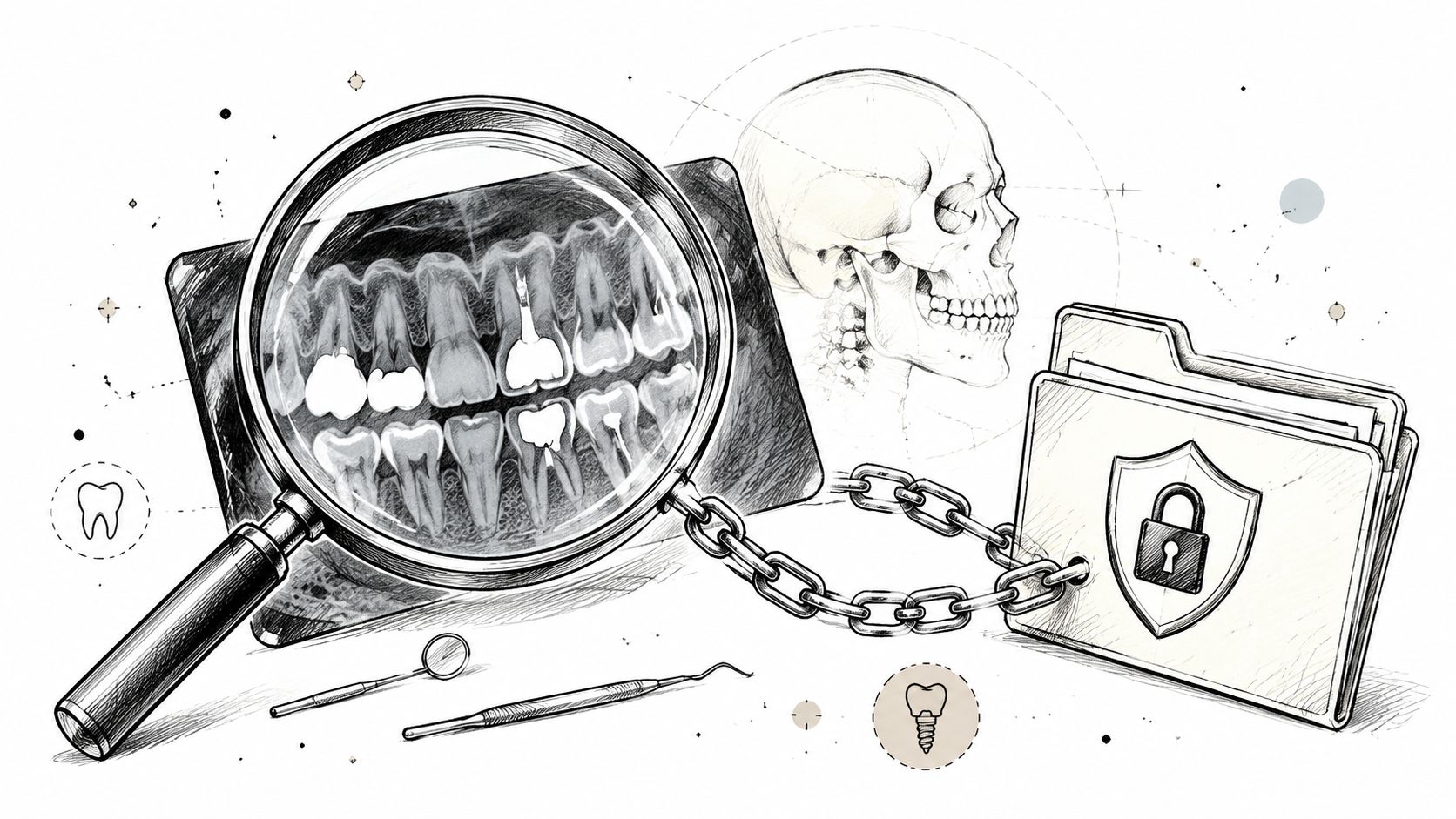
The comparison may include dental charts, photographs, radiographs, dental CT or CBCT scans, and surface scans. Radiographs are especially useful because they preserve internal and external features that written descriptions may miss. A review of dental identification records and comparison methods examines the records and comparison methods that may support an identification.
In Texas, a medical examiner, private autopsy pathologist, justice of the peace conducting a county death investigation, coroner, or attorney may help obtain or review these materials. In a private autopsy, records may be requested from dental offices, transferred to the forensic team, and compared with postmortem findings. The resulting report should explain the supporting matches, any unexplained differences, and the limits of the conclusion. It does not replace the authority of the jurisdiction responsible for the death investigation.
A related explanation of medical record analysis describes how clinical documents are organized and interpreted, which can help families and attorneys understand the records gathered for review.
How Dental Identification Became a Forensic Tool
In 1897, a fire at the Bazar de la Charité in Paris killed 126 people. Investigators examined surviving teeth and dental appliances, then compared them with dental records to identify victims whose bodies could not be recognized visually. The event became an important turning point because it connected routine dental documentation with legal identity and helped establish forensic odontology as a recognized discipline. The historical account of the 1897 identification effort explains why teeth provided practical evidence after the fire.
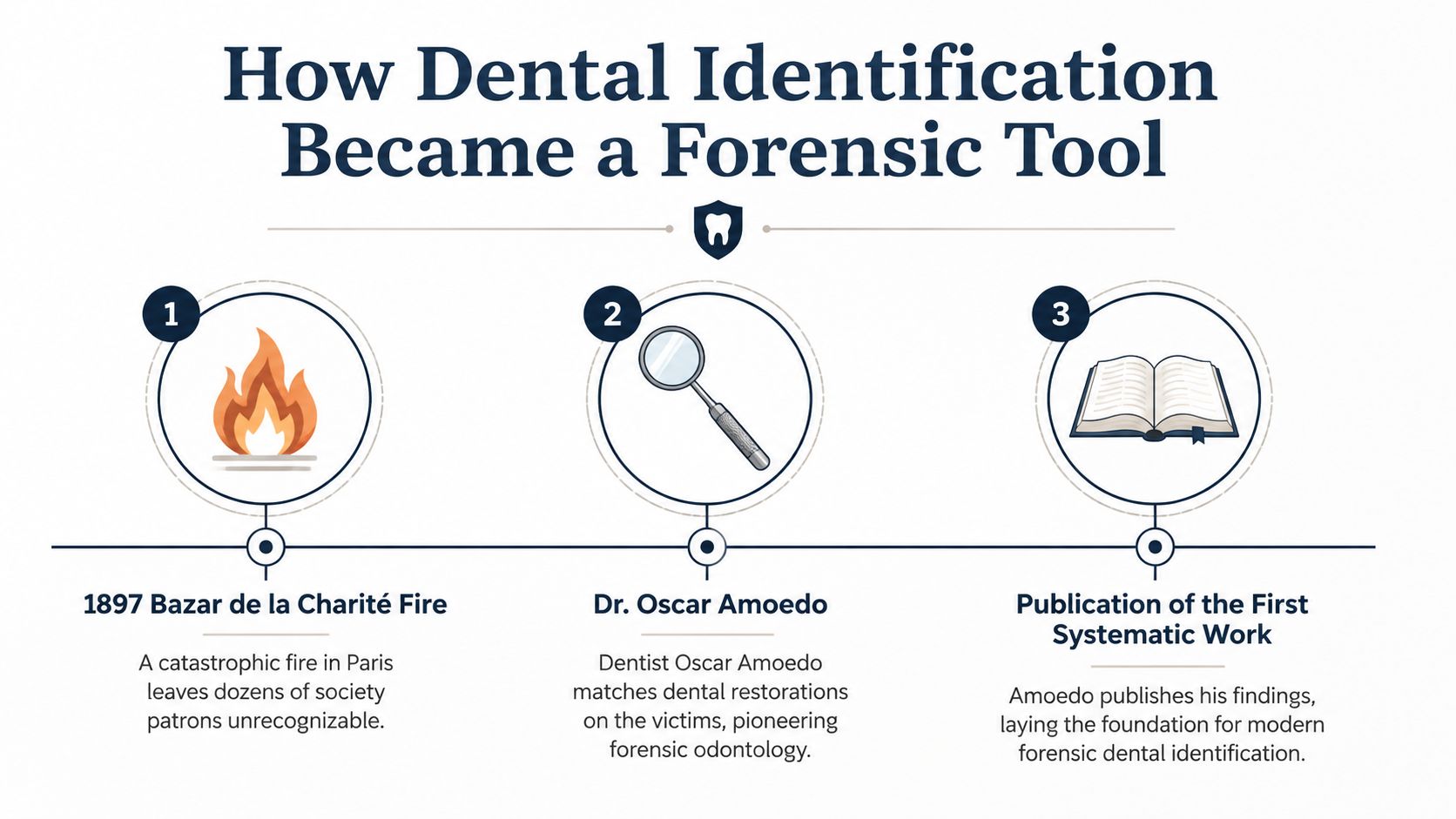
The method rests on a simple sequence. A dentist treats a person during life and records distinctive features. After death, a forensic team documents the teeth and dental work again. The two sets of information can then be compared. A filling, crown, extraction, root shape, or unusual tooth arrangement may provide a finding that another identification method does not show.
That process remains useful in mass-fatality investigations, especially when remains are fragmented or heavily degraded. A review of 17 mass-disaster cases involving 23,654 victims reported 20,569 victims were positively identified overall, an overall identification rate of 86.96%. The review reported 3,025 identifications, or 14.70%, attributed to forensic odontology in primary reports, and another 1,094 victims, or 5.31%, identified through dental comparison combined with other methods. The statistical review of forensic odontology in disaster victim identification provides those figures and discusses results across several disasters.
The same principle can guide a Texas case outside a mass disaster. If a decedent's identity is uncertain, a medical examiner, county official, private forensic pathologist, or attorney may help gather dental records, transfer them to the forensic team, and compare them with postmortem findings. In a private autopsy, that comparison can become part of a written report explaining the supporting matches and any limits on the conclusion.
Dental identification is therefore a working process, not only a historical example. It connects records created during life with findings documented after death.
The Types of Dental Records That Matter Most
Not all dental records carry the same amount of identifying information. The strongest comparison usually begins with image-based records because they show anatomy and treatment directly, rather than relying only on a written description.
The most useful records
Bitewing and periapical radiographs often provide the most detailed antemortem evidence. Bitewings show the crowns of upper and lower teeth and the bone between them, while periapical images show entire teeth, including roots and surrounding bone. These images can reveal fillings, crowns, root canals, root shapes, bone levels, and other features. For readers who want a basic explanation of understanding dental X-rays, a patient-facing guide can make the image types easier to recognize.
A full-mouth radiographic series can provide a broad comparison set. A panoramic film shows both jaws and many teeth in one image, although it generally doesn't preserve every detail as sharply as individual intraoral films.
The written or electronic dental chart supplies context. It may list restorations, extractions, missing teeth, periodontal status, treatment dates, and clinical observations. A chart can support an image match, but shorthand, errors, or incomplete entries can make interpretation harder.
Intraoral photographs show tooth color, position, restorations, wear, and visible anatomy. Study models and stone casts preserve the arrangement and shape of the teeth, which can be particularly helpful when a person had unusual spacing, rotation, crowding, or a distinctive bite.
CBCT, or cone-beam computed tomography, and other 3D scans can preserve spatial relationships in three dimensions. These records are increasingly relevant, but their forensic value depends on image quality, file accessibility, standardization, and the ability to explain the comparison.
Implant identification markings and laboratory stamps on prosthetic devices can provide highly specific evidence when they are documented and recoverable. They don't stand alone in every case, but they can narrow the comparison and support other findings.
| Record Type | What It Reveals | Forensic Ranking |
|---|---|---|
| Bitewing and periapical radiographs | Restorations, roots, crowns, root canals, bone levels, and tooth anatomy | Highest |
| Full-mouth series | Broad tooth-by-tooth internal and external features | Very high |
| Dental chart | Treatment history, missing teeth, restorations, and clinical notes | High when complete |
| Intraoral photographs | Visible tooth position, color, wear, and restorations | Supportive to high |
| Study models or casts | Tooth shape, alignment, spacing, and morphology | Supportive |
| Panoramic radiograph | Overall jaw and tooth arrangement | Supportive to high |
| CBCT and surface scans | Three-dimensional anatomy and spatial relationships | Growing, case dependent |
| Implant or prosthesis documentation | Device markings, components, and laboratory information | Highly specific when available |
The best foundation is usually a complete set, not one isolated document. Full-mouth images, chart notes, photographs, casts, and CT or CBCT data allow the forensic odontologist to reconcile findings across sources and identify discrepancies rather than overlooking them. Guidance on identification methods and the importance of complete records explains why record completeness affects confidence.
How Antemortem and Postmortem Records Are Compared
A dental identification begins with two profiles. The antemortem profile describes the person's teeth before death, using records from dentists, orthodontists, oral surgeons, or other treatment providers. The postmortem profile describes what the forensic team finds after death through examination, photography, radiographs, and other imaging.
Four stages of comparison
The antemortem chart is assembled. The odontologist organizes records by date and tooth, noting restorations, extractions, missing teeth, root canals, crowns, implants, and unusual anatomy. Dates matter because dental treatment changes over time.
The postmortem chart is created. The examining team documents each observable tooth and restoration in a consistent format. Full-mouth radiographs, visual examination, photographs, and CT or CBCT imaging may contribute to this record.
The findings are compared point by point. A concordance is a feature that agrees between the two profiles. A non-concordance is a clear difference that may be explained by treatment, postmortem change, or an inaccurate record. An unexplainable discrepancy is a conflict that the same person couldn't logically account for.
The conclusion is reported. The odontologist explains whether the findings support a positive identification, exclude the person, or remain insufficient for a definitive conclusion. The forensic pathologist incorporates that conclusion into the broader identification and death-investigation record when appropriate.
Practical rule: A positive dental identification requires consistent concordances and no unexplainable discrepancies between the antemortem and postmortem profiles.
This rule prevents a dramatic single feature from controlling the result. A crown may match, but the reviewer must also consider adjacent teeth, roots, restorations, missing teeth, treatment dates, and the quality of the records. A peer-reviewed discussion of comparative dental identification emphasizes the need for detailed documentation and discrepancy analysis.
| Comparison Result | Definition | Effect on Identification |
|---|---|---|
| Positive identification | Sufficient consistent findings with no unexplainable discrepancy | Supports identification on dental grounds |
| Exclusion | A discrepancy shows the profiles cannot belong to the same person | Rules out the proposed identity |
| Inconclusive | Records or findings don't support a reliable conclusion | More information or another method is needed |
| Identification using multiple methods | Dental findings support fingerprints, DNA, or other evidence | Strengthens the overall identification |
For families and attorneys, the practical point is that the dental conclusion is one part of a documented forensic process. A private autopsy may examine medical cause and manner of death, while dental comparison addresses identity. Those questions can overlap in one investigation, but they aren't interchangeable.
Digital files also need consistent naming, storage, and transfer practices. Guidance on digital imaging standards can help explain why image quality and file integrity affect later review.
Requesting and Transferring Dental Records Safely
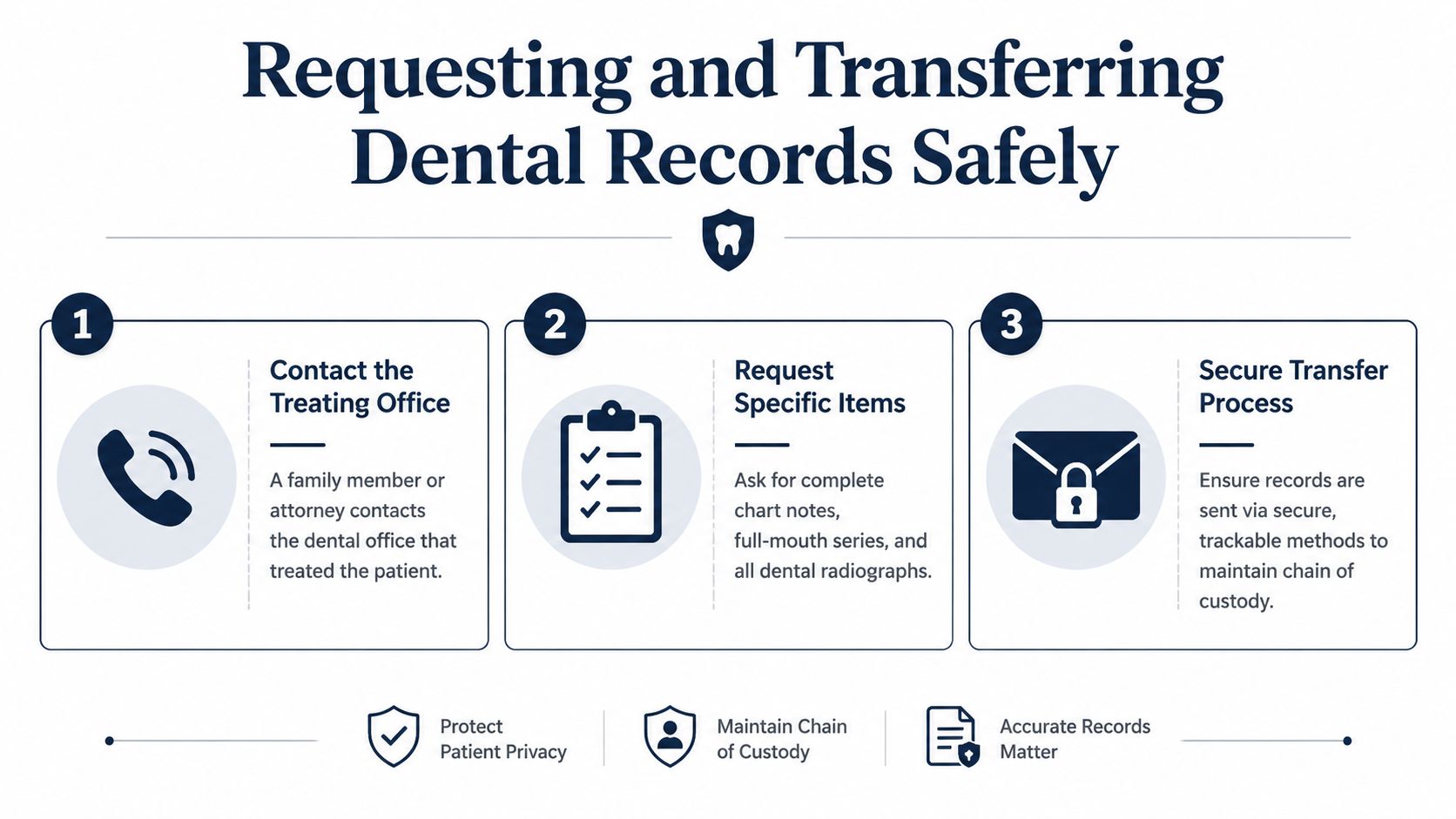
A family member or attorney should request the complete dental record, not only the most recent X-ray. The treating office may need a signed authorization and proof that the requester is legally permitted to receive the deceased person's records. The exact release requirements can depend on the person's legal status and the circumstances of the investigation.
Ask the dental office for specific materials
A short written request should identify the deceased person, provide relevant identifying information, name the receiving facility, and ask the office to preserve all responsive material. The request should include:
- Complete chart notes: Ask for treatment notes, tooth charts, procedure history, and dated entries.
- Radiographs: Request full-mouth series, bitewing and periapical images, and panoramic images, with dates whenever available.
- Photographs: Include intraoral photographs and any images documenting restorations or orthodontic treatment.
- Periodontal records: Ask for periodontal charting and related measurements if they exist.
- Models and scans: Request orthodontic models, study casts, intraoral scans, CBCT files, and associated dates.
- Prosthetic information: Include implant documentation, laboratory records, appliance details, and identifying marks.
HIPAA can permit disclosure to a legally authorized requester when the required authorization process is followed. The dental office may also need to clarify whether it will provide copies, digital exports, or records through a secure release system. Families shouldn't assume that a general medical authorization automatically covers every dental record request.
Make the handoff traceable
Small files may be sent through encrypted email if the receiving team approves that method. Larger imaging sets are better handled through a secure portal or a trackable courier, with the sender and recipient confirmed before transfer.
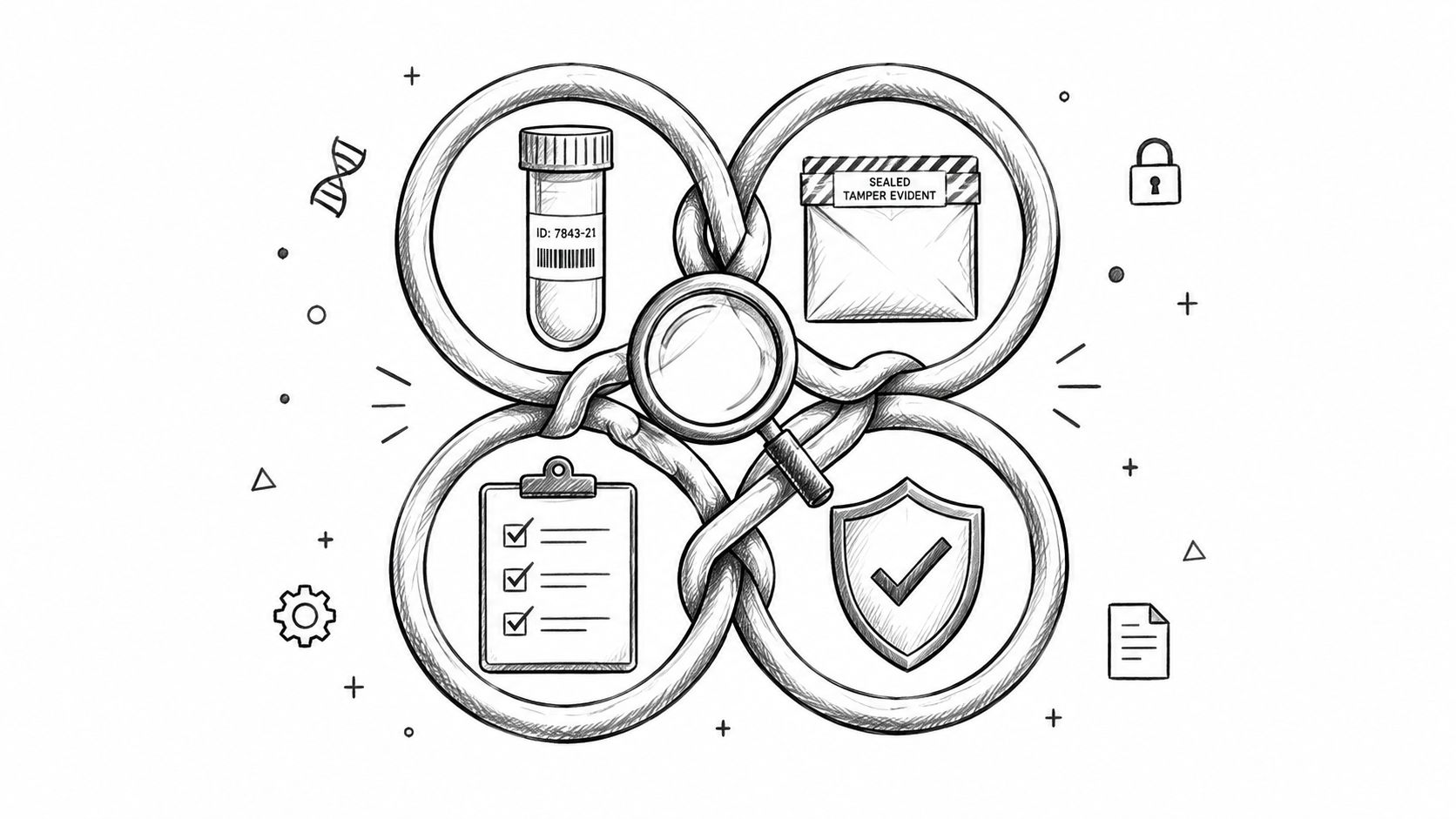
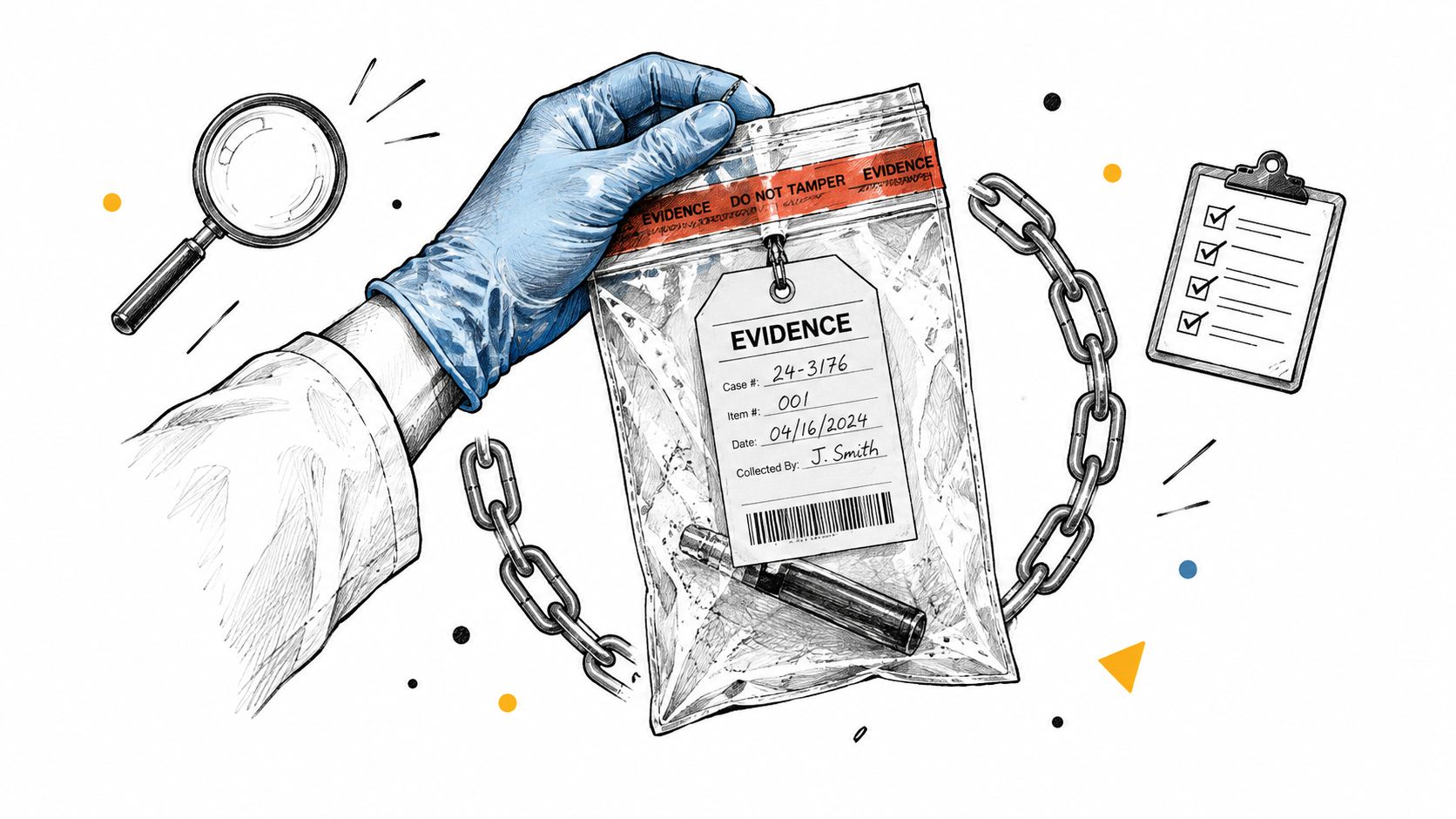
The receiving team should document the source, date, file type, condition, and person who accepted the materials. A written receipt or evidence log helps preserve chain of custody, meaning the documented history of who possessed, transferred, reviewed, and stored the records.
Dental offices generally provide copies rather than surrendering original clinical files. Families and attorneys should ask how the office will label duplicate images and whether the digital files will retain their original dates and metadata. A clear cover letter can reduce confusion, especially when a practice treats many patients with similar names.
Chain of Custody and Court Admissibility
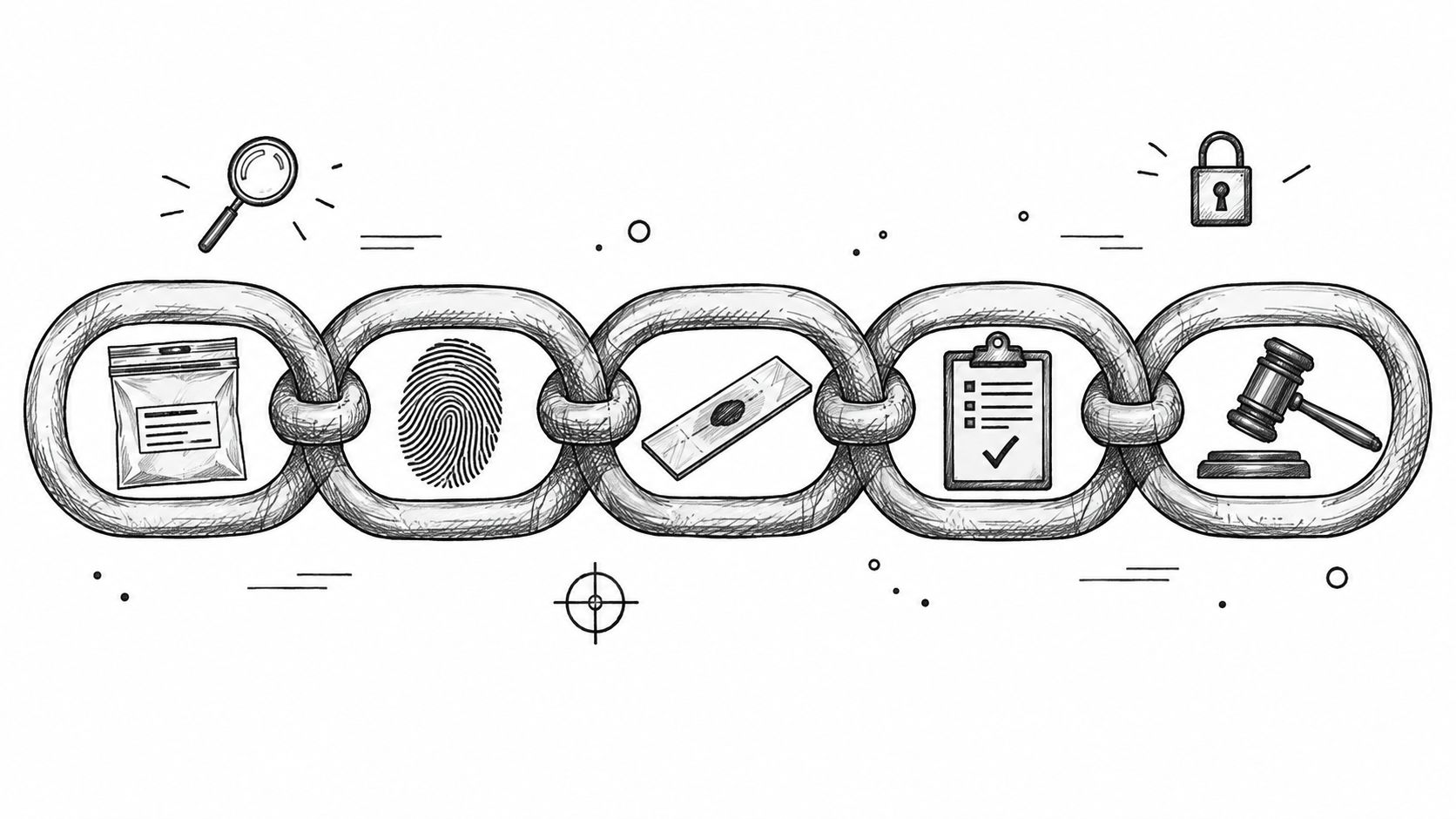
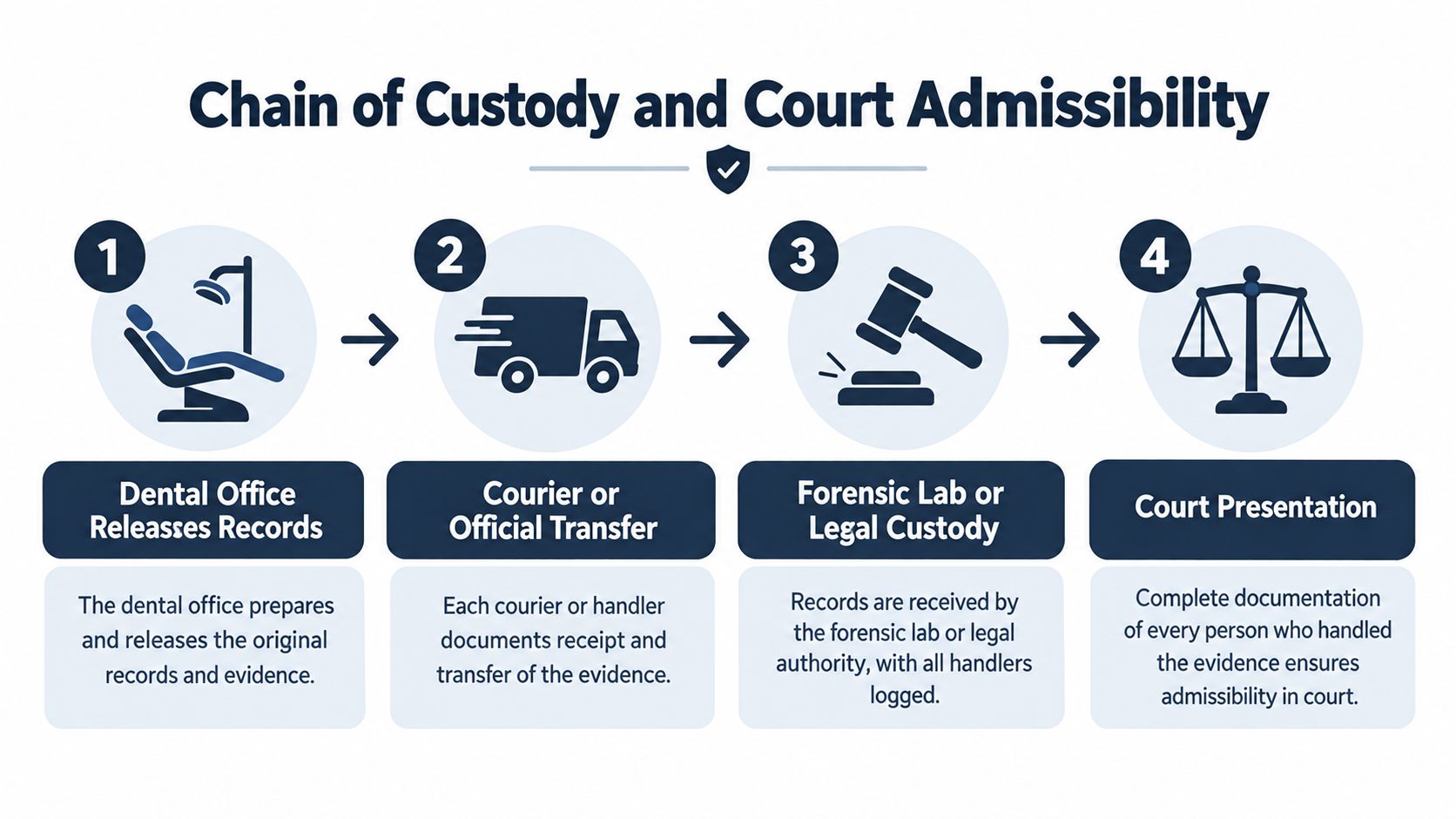
Chain of custody is the record that shows where evidence came from, who handled it, when each transfer occurred, and how it was stored. With forensic dental records, the chain may begin at the treating dental office and continue through a courier, forensic technician, odontologist, pathologist, attorney, or court.
The purpose isn't paperwork for its own sake. A reviewer must be able to show that the records presented for comparison are the same records received from the identified source and that no unexplained alteration occurred during handling.
What documentation should show
When dental records arrive for a forensic review, the case file should identify:
- The source: The dental practice, agency, attorney, or family representative that released the records.
- The receipt: The date, time, delivery method, and person who accepted the material.
- The contents: The images, charts, photographs, casts, scans, or prosthetic documents received.
- The reviewers: Each professional who accessed or evaluated the material.
- The storage location: Where originals, copies, and digital files were maintained.
- The transfers: Dates, times, signatures, tracking information, and receiving parties.
A defensible identification depends on both the dental comparison and the documentation showing how the evidence reached the reviewer.
Court review may address the comparing expert's qualifications, the records' authenticity, the methods used, the possibility of error, and whether the conclusion goes beyond what the evidence supports. The American Board of Forensic Odontology's certification requirements illustrate the specialized nature of the work. Applicants must complete at least 20 human identification cases, including 15 positive dental identifications, with postmortem radiographs included in at least 10 cases. The ABFO certification requirements describe that experience standard.
For attorneys preparing an expert record, a practical overview of expert witness work can help explain the organizational demands of reports, testimony, and supporting documentation. Texas courts apply their own rules to admissibility, so families and attorneys should obtain case-specific legal advice from counsel.
A forensic dental report should state what was compared, what findings agreed, what discrepancies were considered, and why the conclusion follows from the evidence. It shouldn't present certainty that the records can't support.
The record-handling procedures used in a case can be reviewed alongside chain-of-custody procedures when an attorney or agency needs to understand the documentation from receipt through reporting.
Common Limitations and Honest Gaps
Dental comparison can be decisive, but it isn't always possible. Some dental practices don't take full-mouth radiographs, and some records contain shorthand that only the original dentist can interpret. A practice may also have incomplete files, corrupted digital exports, missing dates, or no usable images from the relevant period.
Record retention creates another problem. A dental office may no longer have files by the time a death investigation begins, particularly when the person changed providers or the records were removed under applicable retention practices. A 2024 survey of 71 dental practices in South Australia found that practitioners often created 3D records but were frequently unaware of their forensic value, while retention practices varied widely. The survey and its findings about 3D dental records illustrate the gap between routine documentation and forensic needs.
| Limitation | What Happens | Forensic Result |
|---|---|---|
| No usable radiographs | Internal tooth features can't be compared in detail | Identification may remain inconclusive |
| Incomplete chart | Treatment history is missing or unclear | Fewer concordances can be established |
| Records can't be located | No antemortem profile is available | Dental comparison may not be possible |
| Conflicting documentation | Dates or tooth descriptions don't agree | Reconciliation is required before a conclusion |
| Major postmortem damage | Some teeth or restorations can't be examined | The comparison set becomes smaller |
| Unstandardized digital data | Files are difficult to open, interpret, or authenticate | Review may require additional technical work |
When records are partial, the proper result may be exclusion or inconclusive, rather than positive identification. Exclusion means the proposed identity is inconsistent with the findings. Inconclusive means the available material doesn't support either confirmation or exclusion.
AI-assisted comparison tools remain an area of development rather than a substitute for expert judgment. A 2025 review reported promise for CBCT, 3D scanning, intraoral imaging, age and sex estimation, and restorative-pattern recognition, while also identifying legal-admissibility, ethical, privacy, security, training, and dataset concerns. The review of digital and AI-assisted forensic odontology supports a careful conclusion: digital tools may assist comparison, but their output must be standardized, explainable, securely handled, and accepted under the applicable legal process.
Questions Families and Attorneys Ask Most
How long does identification take after records arrive?
There isn't a guaranteed timeline. Most cases are completed within 24 to 48 hours when records are complete, images are readable, the remains are available for examination, and no major discrepancy requires additional review. More complicated cases can take longer because the team may need records from multiple offices, repeat imaging, consultation, or coordination with the jurisdiction handling the death investigation.
Can a dental match overturn a presumed identity?
Yes, a documented identification can challenge an assumption based on visual recognition or incomplete information. A dental comparison should be considered with other identification evidence and the authority responsible for the death investigation. It doesn't automatically change legal records without the appropriate agency or court process.
What happens if the decedent never saw a dentist?
The team may have no antemortem dental record to compare. Postmortem findings can still be documented for future use, and investigators may pursue fingerprints, DNA, medical records, implants, or other identifying evidence. The absence of dental records doesn't prove that a person can't be identified, but it removes one possible comparison source.
Can a dental comparison be challenged in court?
Yes. An opposing party may question the source records, chain of custody, image quality, comparison method, expert qualifications, or the wording of the conclusion. A careful report should identify limitations rather than claim more certainty than the evidence permits. Texas Health & Safety Code provisions, including Chapters 711, 716, and 651, and the Texas Funeral Service Commission may be relevant to different parts of funeral, disposition, and professional regulation, while the responsible county or medical examiner jurisdiction governs the death investigation itself.
Families and attorneys should gather the records, preserve the release documentation, and discuss the case with the appropriate forensic and legal professionals before making decisions about disposition or litigation.
Texas Autopsy Services provides independent autopsy and forensic pathology services across all 254 Texas counties, including secure record handling and forensic dental record coordination when identification or cause-of-death questions remain unresolved. If you need help gathering records or arranging a private autopsy or second opinion, contact Texas Autopsy Services directly so our team can explain the next practical step with care and clarity.