September 12, 2026 · Texas Autopsy Services
Chain of Custody Issues: Texas Private Autopsy Guide
Learn how chain of custody issues affect private autopsies and how Texas practices ensure evidence integrity remains intact.
On this page
- What Chain of Custody Means in a Forensic Autopsy
- The Most Common Chain of Custody Issues We See
- Real-World Scenarios Where Custody Gaps Changed the Outcome
- How a Texas Private Autopsy Practice Maintains a Court-Admissible Custody Trail
- How Courts and Attorneys Evaluate Custody Gaps
- Best Practices for Prevention and Steps to Remediate a Gap
- Chain of Custody Questions Families and Attorneys Ask Most
A body arrives for an independent examination, and the family expects one thing above all: a trustworthy answer about what happened. Attorneys and county officials need that answer to rest on evidence that can be followed from intake through testing and reporting. That is why chain of custody issues matter. A strong medical finding can still face avoidable challenges if the record does not show who handled the body, specimens, photographs, and files at each stage.
At Texas Autopsy Services, we treat custody documentation as part of the forensic examination itself. Every examination is performed by a forensic pathologist certified by the American Board of Pathology, and our team uses documented handoffs, secure storage, controlled testing, and clear reporting for families, attorneys, medical professionals, and Texas counties.
- Chain of custody is a continuous record of where evidence traveled, who handled it, and what happened to it.
- Small administrative errors may be explainable, but unexplained gaps, broken seals, mislabeled specimens, and missing transfer records can weaken evidence.
- Digital evidence requires special controls, including hashing, write-blocked acquisition, and documented copies or conversions.
- Post-analysis handling matters, especially when specimens return from a laboratory or move into long-term storage.
- Texas-specific requirements apply, including documentation rules under Texas Health & Safety Code § 691.031 and the Texas Attorney General's evidence protocol.
A family may contact a private autopsy practice after a medical examiner declines a case, after receiving an unexpected cause-of-death finding, or when an attorney needs an independent review. In each situation, the custody trail should be understandable to someone who wasn't present at the examination. The record should show not only what our pathologists found, but also why the body, tissue, fluids, images, and reports can be identified as the same materials collected and examined.
What Chain of Custody Means in a Forensic Autopsy
Chain of custody is the continuous, documented trail showing where evidence has been, who handled it, and what each person did with it. Modern forensic guidance treats that trail as a core safeguard for authenticity, integrity, and admissibility. The record should cover movement from discovery and recovery through transport, examination, laboratory work, storage, and presentation in court. The National Center for Biotechnology Information explains the forensic role of chain-of-custody documentation.
In a private autopsy, the evidence can include the body, tissue samples, toxicology specimens, photographs, physical items, slides, and digital reports. The workflow may include licensed transport, body receipt and identification, sealing, external examination, organ examination, tissue retention, toxicology transfer, slide preparation, report drafting, and final release to the family or retaining attorney. Each event needs an entry that connects the item to its next location.
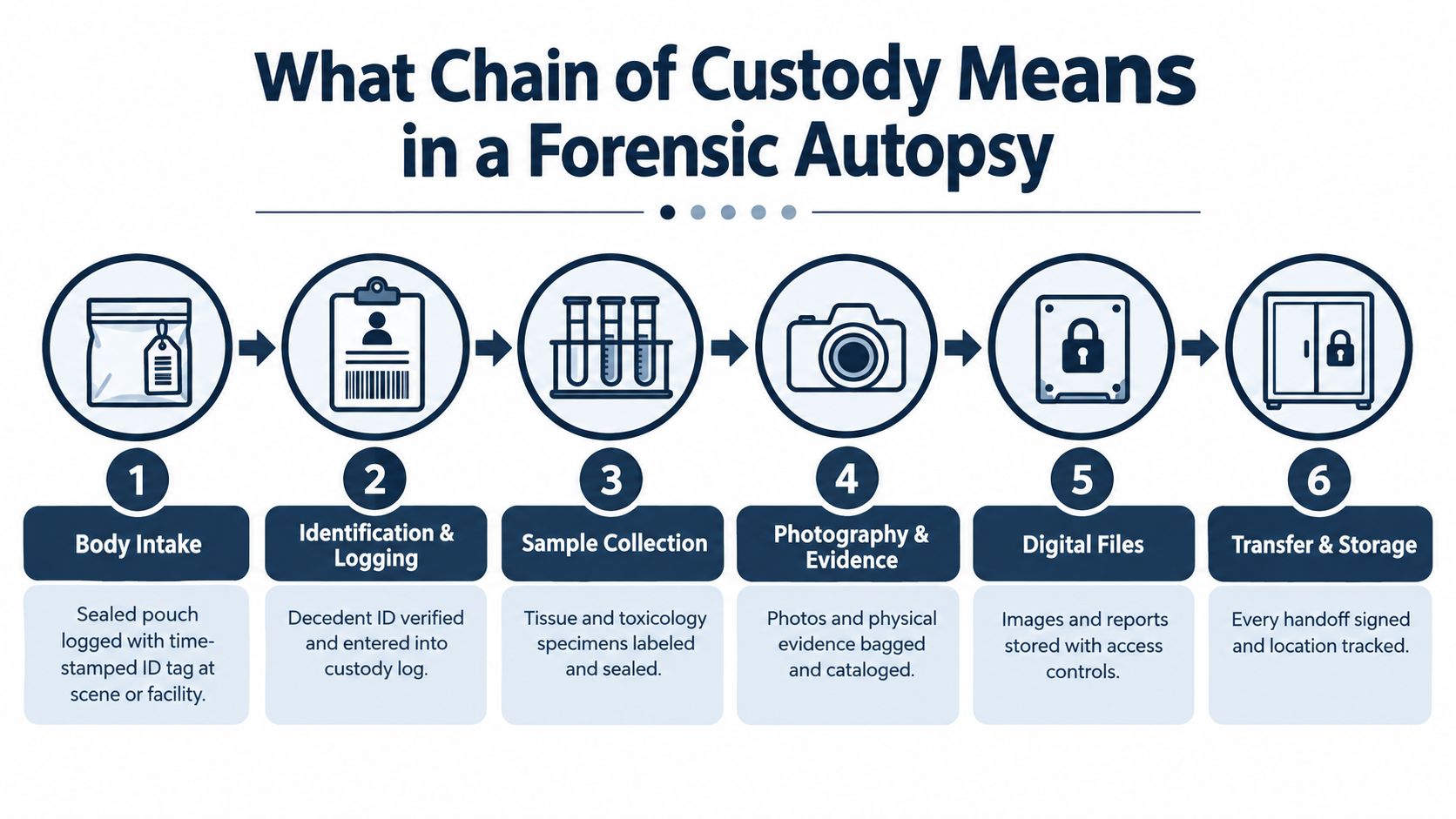
The documentation must follow the evidence
A useful analogy is a registered letter. The letter itself matters, but the delivery record proves who accepted it, when it changed hands, and where it went. In an autopsy, the body or specimen is the letter. The custody log, seal numbers, timestamps, signatures, storage entries, and laboratory records provide the delivery history.
This means the documentation chain is evidence in its own right. A specimen can remain scientifically sound while the surrounding record becomes difficult to defend. A gap doesn't automatically prove that the sample was altered, but it creates a question about identity, integrity, contamination, substitution, or access.
Nurses and other healthcare professionals who may encounter evidence before transport can benefit from structured training on forensic evidence collection for nurses. For Texas-specific custody documentation, our team also maintains a resource on chain-of-custody requirements.
Practical rule: If a person, location, action, or transfer isn't recorded close to the time it occurred, someone may later have to reconstruct it from memory.
The Most Common Chain of Custody Issues We See
Most custody failures begin with ordinary operational pressures. A shift changes, a staff member is interrupted, a specimen is moved to make space, or a transfer form is completed after the handoff instead of during it. A recent forensic study reported limited understanding of chain-of-custody protocols among many investigators, with procedural errors that can undermine reliability in court. The same source reported that 40% of chain-of-custody paperwork mistakes in the analyzed Indian setting occurred when officers rushed and lacked a proper format. The forensic evidence-handling study provides that context.
The risks below aren't equal. A late signature may be curable through testimony and supporting records. A broken seal combined with an unexplained access period creates a more serious identity and integrity problem.
| Issue | Typical Cause | Courtroom Consequence |
|---|---|---|
| Missing or late transfer signature | Shift change, fatigue, or paperwork completed later | Counsel may challenge the timing and the identity of the custodian |
| Broken or resealed tamper-evident seal | Testing, repackaging, or undocumented access | The court may question whether the contents remained unchanged |
| Mislabeled specimen container | Multitasking or similar case materials handled together | A toxicology or tissue result may be linked to the wrong item |
| Unlogged refrigerator or freezer access | Shared storage or informal retrieval | Counsel may argue that an undocumented person could have accessed evidence |
| Evidence left on an open counter | Space constraints or an interrupted workflow | The practice may need to explain possible contamination or unauthorized access |
| Digital file emailed outside the secure case folder | Convenience, forwarding, or unclear permissions | The digital custody line may require forensic review and additional testimony |
| Hash mismatch in photographs or copied files | Conversion, editing, or an unlogged change | The party offering the file may face an authenticity challenge |
For digital material, the concern is technical as well as administrative. A single unauthorized write can change an evidence hash, which can prevent later verification. Best practice includes write-blocked acquisition, immediate cryptographic hashing, and re-verification before examination or transfer. Digital forensic guidance explains the custody requirements for files and media.
The same principle applies outside pathology. Organizations managing retired computers and storage devices can compare their documentation practices with chain of custody for IT asset disposal. In both settings, the strongest system assigns a named custodian, a recorded purpose, a time, and a controlled location to each handoff.
Real-World Scenarios Where Custody Gaps Changed the Outcome
A custody problem often starts with a detail that looks minor on the day it occurs. Its importance grows when another party asks whether the item presented in court is the same item collected earlier.
In one composite scenario, a county-contracted transport driver stopped for fuel while moving a decedent to the examination facility. The body pouch remained sealed, but the seal number on arrival differed from the dispatch sheet by one digit. The pathologist identified the discrepancy during intake rather than correcting the form. Defense counsel challenged the custody record, and the toxicology result was excluded. The practice incorporated a requirement that transport documentation and the arriving seal be compared by two people before the body enters storage.
A second composite scenario involved tissue blocks in a shared histology laboratory. The blocks remained in the laboratory over a weekend, but access was logged only when staff returned on Monday. Defense counsel argued that the undocumented period prevented reliable confirmation of who could reach the material. During wrongful-death mediation, the autopsy report received reduced weight. The corrective protocol required a documented transfer into restricted storage whenever tissue blocks leave the direct control of the examining team.
A third scenario involved photographs rather than tissue. An attorney's office emailed case photographs to co-counsel outside the secure portal. The original files remained available, but the transfer created an undocumented digital copy and forced a costly re-deposition of the pathologist about the file history. The practice responded by requiring secure portal delivery, preserved originals, and a record of every authorized recipient.
These examples don't mean every discrepancy destroys a case. They show why early disclosure and controlled remediation are more credible than trying to explain a gap after cross-examination begins.
How a Texas Private Autopsy Practice Maintains a Court-Admissible Custody Trail
Texas-specific custody controls begin with authorization and continue through release. Under Texas Health & Safety Code § 691.031, each person who has control or possession of a body or anatomical specimen must complete the prescribed chain-of-custody form, keep a copy for records, and transfer the form to the next custodian. The statutory language is available through Texas Health and Safety Code § 691.031.
The Texas Attorney General's evidence-collection protocol calls for documentation of receipt, storage, transfer, the date and time of each transfer, and the printed name and signature of each person who had or transferred custody. The Texas Attorney General's protocol describes evidence handling and custody records.
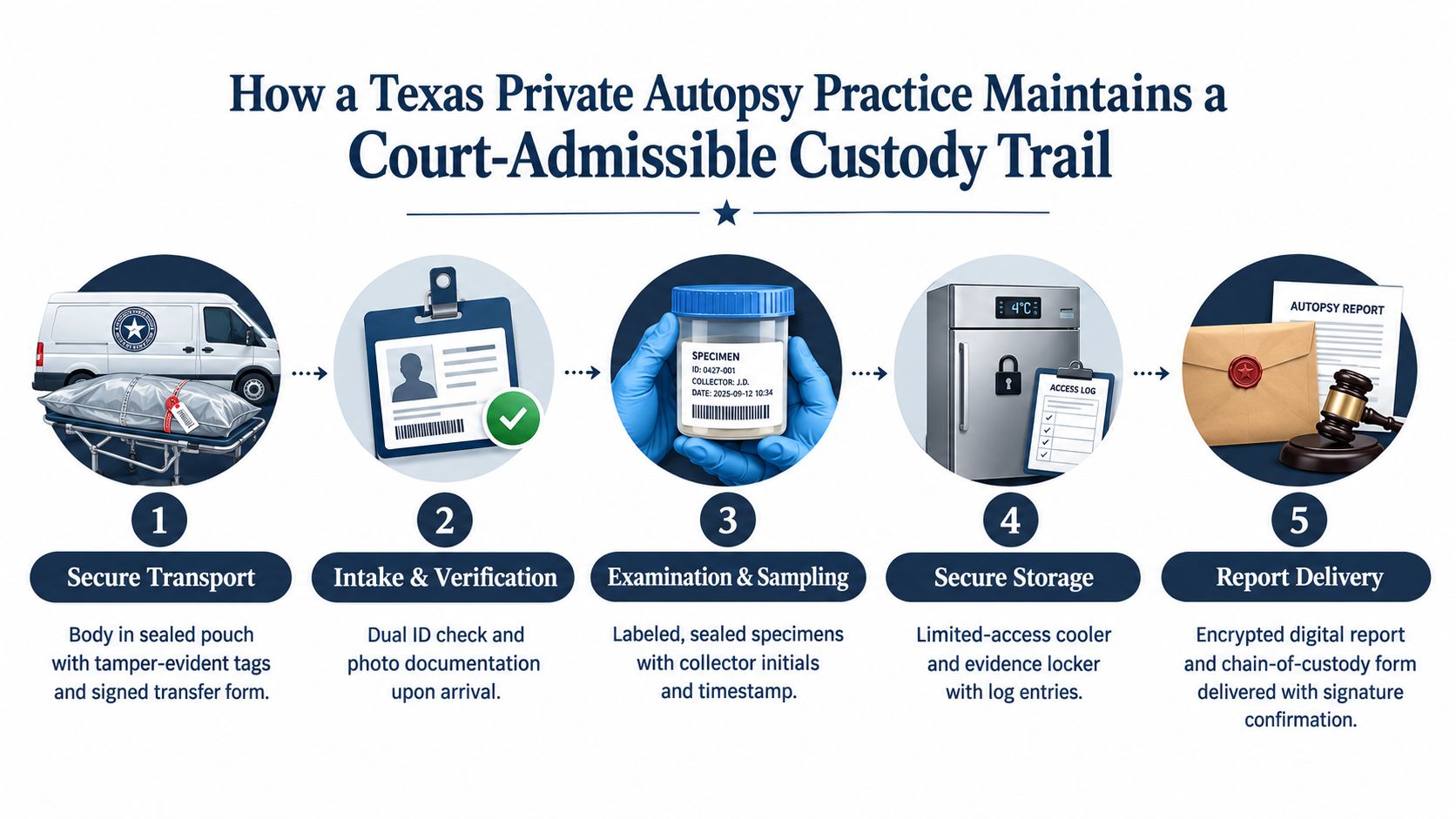
A handoff-by-handoff process
Secure transport. Our licensed transport team uses sealed body pouches and tamper-evident tags. The transfer record identifies the sending and receiving parties, the time, and the condition of the seal.
Intake and verification. At arrival, our team verifies identity against the available authorization and death documentation, records the seal information, and creates an accession entry. A second person confirms the identifying information and photographs relevant packaging or markings.
Examination and sampling. During the autopsy, the pathologist and trained support staff label tissue, fluids, toxicology specimens, and retained materials with case-linked identifiers. The record states who collected each item, when it was collected, what was done with it, and how it was sealed.
Secure storage and laboratory transfer. Refrigerated storage and evidence areas have controlled access. When specimens move to a toxicology, histology, molecular, or reference laboratory, the transfer record identifies the courier or receiving laboratory, the package condition, and the signatures at both ends.
Report delivery and retention. Reports are versioned so the working draft, reviewed report, and final report can be distinguished. Raw photographs, examination records, laboratory results, and custody forms remain associated with the case file rather than being replaced by an edited summary.
Digital evidence receives additional controls. Image files can be hashed so later copies can be compared to the original. Device or body-camera downloads should use a write blocker when appropriate, and the acquisition method, hash value, operator, software environment, and subsequent copies or conversions should be documented. Raw data remains preserved even when selected images are placed into a report.
For a detailed discussion of controlled storage, readers can review our guidance on a secure storage facility.
The following video provides additional visual context for how a documented forensic workflow can be organized.
A court-admissible report doesn't result from a single form. It results from matching every physical and digital item to a controlled process that another qualified person can audit and explain.
How Courts and Attorneys Evaluate Custody Gaps
Texas courts generally focus on whether the proponent can show that the evidence is what the proponent claims it is. Under Texas Rules of Evidence 901 and 902, authentication may rely on testimony, records, certifications, or other permitted foundations. A custody defect becomes more serious when it prevents a reliable connection between the material collected and the material later examined or offered.
Defense counsel may compare transport times, seal numbers, refrigerator access, specimen labels, laboratory receipts, photograph metadata, and report versions. Prosecuting attorneys, retaining attorneys, judges, and justices of the peace may ask whether a missing entry reflects a harmless clerical oversight or an unexplained opportunity for alteration. The answers depend on the complete record, not on the label attached to the error.
Curable gaps and serious breaks
A small omission may be addressed through testimony from the people involved, corroborating storage records, laboratory receipts, or a supplemental sworn statement. Courts often distinguish minor documentation defects from substantive gaps that raise a genuine question about identity or integrity. This distinction is why an honest, contemporaneous disclosure can protect credibility better than an unexplained correction made later.
More serious problems include:
- Unexplained custody periods: No record identifies who had access or where the evidence was stored.
- Contradictory identifiers: Seal numbers, labels, accession numbers, or timestamps conflict.
- Unexplained condition changes: Packaging appears opened, resealed, damaged, or altered without a testing record.
- Unverifiable digital copies: The file offered in court cannot be tied to the original through hash verification or documented transfer.
A judge may limit the weight of an exhibit, require additional foundation, or exclude material when authentication and reliability cannot be established. A Daubert-style challenge may also focus on whether the expert's method was applied to evidence whose identity and integrity remain dependable.
For families, the practical consequence is significant. A report can contain careful pathology and still become difficult to use if counsel must spend the hearing explaining an avoidable custody inconsistency. The objective is not to claim that every error is fatal. It's to ensure that the report and its underlying materials can withstand questions about timing, location, personnel, and access.
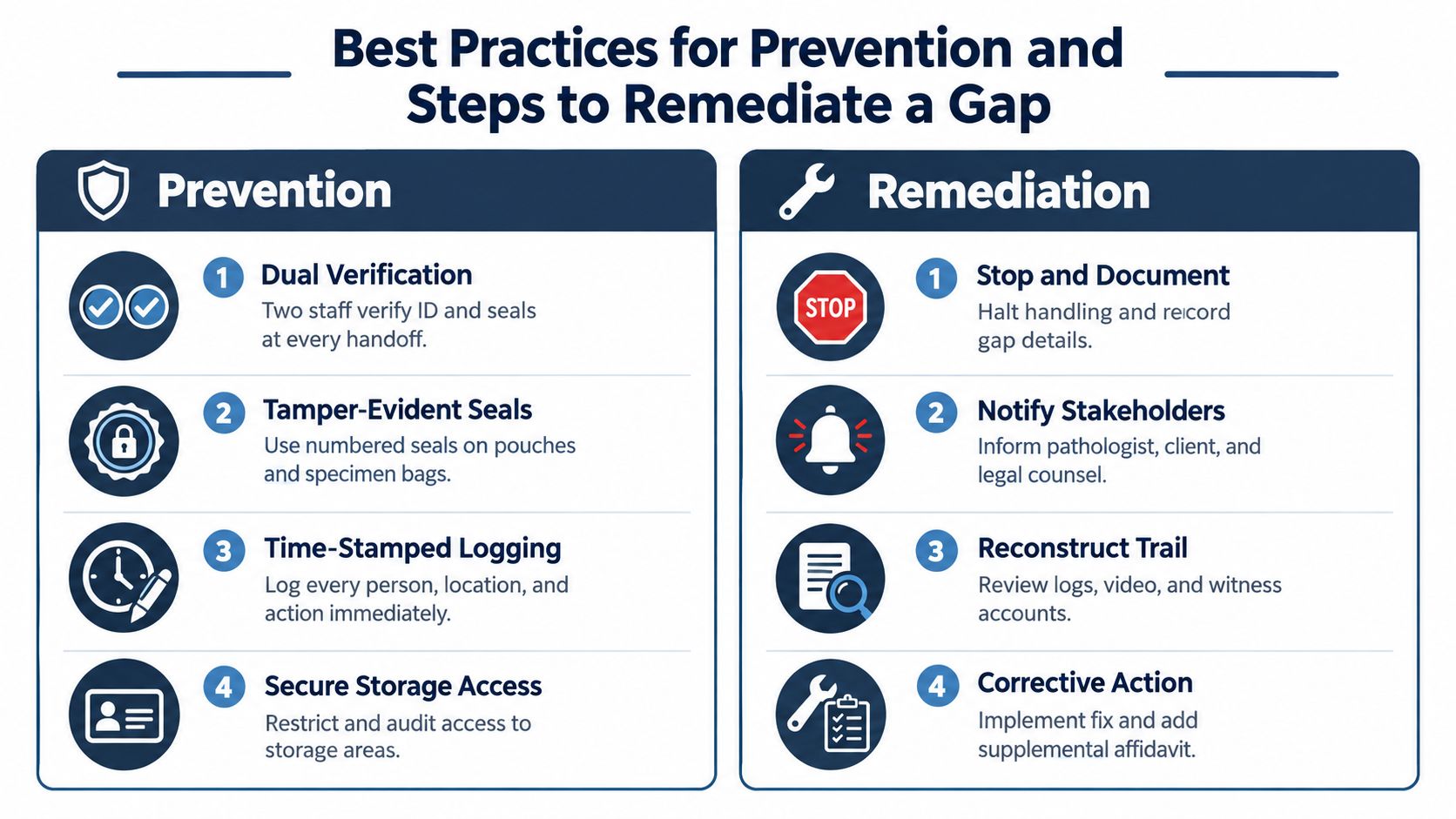
Best Practices for Prevention and Steps to Remediate a Gap
A defensible custody program makes the right action easy at the moment of transfer. It doesn't depend on staff remembering details weeks later or on a pathologist reconstructing the file before testimony.
Prevention controls
- Verify identity twice. Two staff members compare the body, authorization, labels, and seal information at intake and at significant handoffs.
- Use serialized seals. Numbered tamper-evident seals connect packaging to the custody record and make unexplained opening easier to detect.
- Log events immediately. The entry should identify the person, location, action, purpose, date, and time while the event is still occurring.
- Restrict storage access. Refrigerators, freezers, evidence lockers, and digital repositories should be accessible only to authorized personnel, with access reviewed against the custody log.
- Photograph condition changes. If a package is opened for testing, staff document the seal, the reason for opening, the contents, and the replacement packaging.
- Hash digital originals. Photographs, device images, and other files should be preserved in original form, with hash values checked after authorized transfers or conversions.
- Audit the records. Internal reviews should compare custody forms, laboratory receipts, storage entries, and report files against Texas Health & Safety Code § 691.031 requirements.
The audit should test the process, not confirm that forms exist. A reviewer can select a specimen and trace it backward from the final report to the collection entry, then forward from intake through each laboratory receipt and storage location.
Remediation after a gap
When a discrepancy appears, staff shouldn't continue handling the item as though nothing happened.
- Isolate and document. Stop unnecessary handling, preserve the current condition, record the discrepancy, and identify the person who found it.
- Notify responsible parties. The supervising pathologist, retaining attorney or family contact, and relevant laboratory or agency should receive a clear description of the issue.
- Reconstruct carefully. Review access logs, transport records, photographs, laboratory receipts, system metadata, and witness accounts. Don't backdate a form or create a record that suggests an event was documented contemporaneously when it wasn't.
- Correct transparently. Use a supplemental affidavit, declaration, or amended report when appropriate, and explain what is known, what remains uncertain, and how the issue affects interpretation.
A 2026 Illinois State Police quality report identified 103 items with incomplete chain of custody across 1990–2024, with 96 later resolved, and traced the gaps to LIMS program errors and analyst errors during the return process. The report also characterized the operational risk to testing results as low. The Illinois State Police report illustrates why post-analysis custody deserves attention.
That example is useful because it avoids the simplistic idea that every gap automatically invalidates a result. The proper response depends on what happened, what can be verified, and whether the remaining record supports the material's identity and integrity.
For a practical form reference, our team provides a guide to the chain-of-custody form.
Chain of Custody Questions Families and Attorneys Ask Most
Who can authorize a private postmortem examination?
Authorization depends on the circumstances, the person's legal authority, and the applicable Texas requirements. Families and attorneys should confirm authority before transport or examination begins. Texas Health & Safety Code provisions, the Texas Funeral Service Commission, and the responsible death-investigation agency may affect the process, so our team reviews the documentation before intake.
How long are tissue, fluids, photographs, and digital files retained?
Retention depends on the type of material, the purpose of the examination, applicable Texas law, laboratory requirements, litigation needs, and the relevant records schedule. Storage and release aren't based only on practice preference. A request should identify the case, the material sought, and the person authorized to receive it.
What happens when a sample goes to a reference laboratory?
The sample is packaged, labeled, sealed, and transferred with a record showing the sending custodian, receiving laboratory, date, time, condition, and purpose. The laboratory's receipt and testing records become part of the case documentation. When the specimen returns, the return handoff receives the same attention as the original departure.
Can a report be amended if a custody error is discovered later?
It may be possible to issue a supplemental report or sworn declaration, depending on the nature of the error and its effect on the findings. The practice should disclose the discrepancy, preserve the original report, explain the corrective review, and distinguish established facts from unresolved uncertainty. Silent replacement is not a reliable remediation method.
Can a family or attorney request the custody log?
A request should be made by the person with authority over the case or through retaining counsel. Release may be governed by authorization, confidentiality, litigation obligations, laboratory restrictions, and Texas law. The custody log should be reviewed alongside the report, laboratory records, and any applicable release documentation so the handoff is complete.
Texas Autopsy Services provides independent private autopsy services, second-opinion reviews, secure in-house licensed transport, and documented custody controls for families, attorneys, healthcare professionals, and counties across all 254 Texas counties. If you need to discuss an examination or review a possible custody concern, contact our team directly through Texas Autopsy Services for clear guidance on the next step.