August 29, 2026 · Texas Autopsy Services
Excited Delirium Death Explained for Texas Families
A medically grounded explainer of excited delirium death, what autopsy can and cannot show, the restraint controversy, and next steps Texas families can take.

On this page
- What Excited Delirium Death Actually Means
- Clinical Features and Proposed Mechanisms
- Why the Term Is Now Controversial
- What an Autopsy Can and Cannot Show
- Restraint, Positional Asphyxia, and Toxicology
- Legal Implications in Texas Death Investigations
- When and How to Request a Private Autopsy
- Frequently Asked Questions for Families
A family may receive a death certificate, an autopsy report, or a media account stating “excited delirium death” before anyone has clearly explained what caused the person to die. The phrase can sound like a complete medical answer. It usually isn't.
For Texas families, the important question is more specific: What physical, toxicological, positional, and circumstantial findings support the certified cause of death? A careful forensic review separates observed behavior from medical cause, evaluates restraint and custody conditions, and explains what the evidence can and cannot establish.
- “Excited delirium” describes a disputed clinical label, not a single anatomical disease.
- An autopsy cannot identify a psychiatric state through one distinctive lesion or laboratory test.
- Restraint, body position, toxicology, hyperthermia, underlying disease, and witness evidence must be assessed together.
- A cause of death and a manner of death answer different questions.
- A private autopsy or second opinion may help when the official explanation is incomplete, disputed, or unsupported by the available evidence.
What Excited Delirium Death Actually Means
The phrase excited delirium has been used to describe a cluster of observed behaviors and physical findings, often involving severe agitation, confusion, unusual strength or pain tolerance, high temperature, rapid breathing, and sudden collapse. Historically, some clinicians treated it as a syndrome rather than a single disease. The label appeared in emergency medicine and psychiatric discussions and was later incorporated into certain diagnostic and injury-coding approaches.
That history doesn't answer the forensic question. A clinical syndrome observed before death is not automatically the cause of death. A death investigation must still determine whether the person died from a toxic effect, a heart condition, restraint-related physiology, hyperthermia, positional asphyxia, or a combination of factors. A forensic pathologist uses the autopsy, toxicology, medical history, scene evidence, and witness accounts to make that assessment.
Practical rule: A behavioral description should never substitute for a complete explanation of the physical mechanisms that led to death.
Consider a general emergency-department situation. A young adult man arrives acutely confused and combative. Staff document shouting, sweating, rapid breathing, and resistance to attempts at control. After restraint, he becomes quiet and then loses consciousness. That sequence may lead witnesses to use the term excited delirium, but it doesn't establish whether the fatal event involved arrhythmia, drug toxicity, oxygen deprivation, hyperthermia, or another medical problem.
The phrase “excited delirium death” most often appears when a person collapses during restraint, shortly afterward, or in a custodial or forensic setting. That context matters because the restraint itself becomes part of the medical analysis. A 1998 Ontario coroner review of 21 unexpected deaths associated with excited delirium found restraint in every case. 18 of 21 people, or 86%, were in a prone position, and 3 of 21, or 14%, were under neck pressure; 18 of 21, or 86%, were in police custody when they died (Ontario coroner review). The study also reported sudden tranquillity shortly after restraint in all 21 cases. Its historical importance lies in the documented sequence of agitation, restraint, and rapid collapse, not in proving one universal mechanism.
Clinical Features and Proposed Mechanisms
A person may appear intensely agitated, confused, and physically active before suddenly becoming quiet and unresponsive. Historical descriptions of this pattern include incomprehensible shouting, apparent resistance to pain, rapid breathing, sweating, increased body temperature, and collapse after a brief period of calm. Some observations are measurable. Others depend on witnesses interpreting a fast-moving, chaotic encounter.
What clinicians may observe
Proposed biological mechanisms include a large catecholamine surge, sympathetic overactivity, altered dopamine and serotonin regulation, metabolic acidosis, overheating, and rhabdomyolysis. A 2010 forensic review described deaths labeled excited delirium as likely multifactorial, with possible contributions from positional asphyxia, hyperthermia, drug toxicity, catecholamine-related fatal arrhythmias, and stress cardiomyopathy (forensic review of proposed mechanisms).
Possible precipitants include stimulants such as cocaine, methamphetamine, or synthetic cathinones, alcohol withdrawal, and acute psychotic decompensation. These contexts do not, by themselves, explain a death. A positive drug result establishes exposure or the presence of a substance, but cannot alone establish impairment, timing, or the mechanism of death.
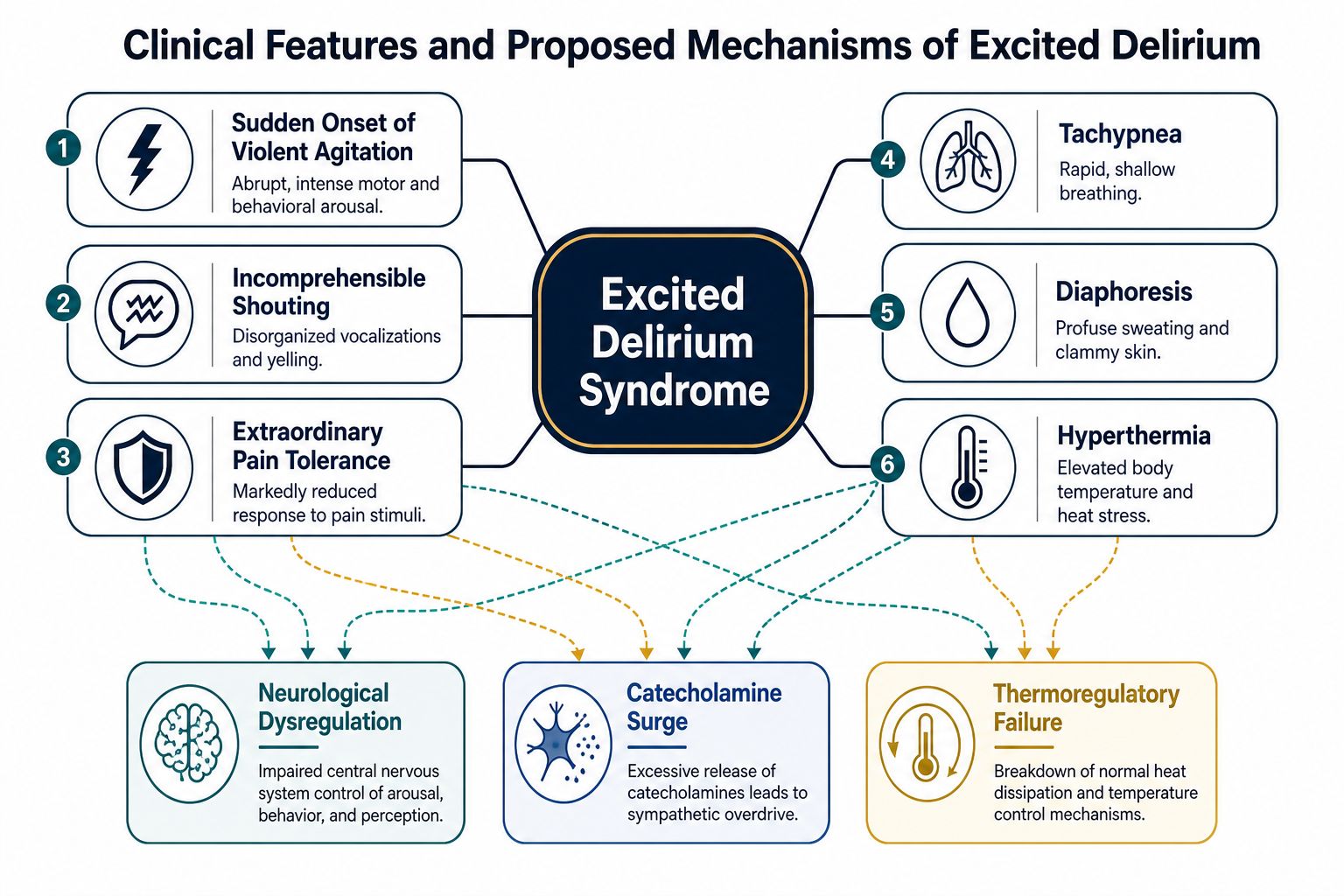
Emergency-department data may provide objective evidence of physiologic stress. Core temperature, creatine kinase, troponin, lactate, blood gases, and related results can help establish what was happening before death. Descriptions such as “extraordinary strength,” “imperviousness to pain,” or “instant tranquility” require comparison with video, witness accounts, medical records, and the timing of restraint.
Why the proposed mechanism matters
A catecholamine surge or stimulant cardiotoxicity may contribute to a fatal arrhythmia. Severe exertion, acidosis, overheating, or an underlying cardiac condition may increase that risk. Restraint may also affect breathing, chest movement, venous return, and the person's ability to recover from physical struggle.
Cardiac arrest is the final event in every death, not an explanation for why the heart stopped. A board-certified pathologist must compare competing mechanisms and identify which autopsy, toxicology, medical, and scene findings support or weaken each one. That analysis helps determine what belongs on a death certificate and whether an independent review is warranted.
Why the Term Is Now Controversial
The controversy is not limited to terminology. It concerns whether a disputed label is being used as though it were a proven disease, especially when a person dies during or after forceful restraint.
The scientific problem is that the syndrome has no validated objective biomarker or distinctive neuropathological signature. The historical approach relied on a cluster of observed characteristics. A 2022 review describes one task force framework requiring delirium, psychomotor agitation, physiologic excitation, and at least six of ten proposed criteria (review of the historical diagnostic approach). Those criteria can be difficult to apply consistently after a fatal encounter, particularly when accounts conflict or video is incomplete.
The medical and forensic objections
Major medical organizations have questioned or rejected the term. Recent coverage describes the American College of Emergency Physicians, the American Psychiatric Association, and the Royal College of Psychiatrists as opposing or limiting its use. The National Association of Medical Examiners has rejected the term for medicolegal death investigation, and California has barred it from death certificates and autopsy reports (Scientific American coverage of the medical controversy).
A 2020 synthesis reviewed 61 articles describing 168 cases, of which 104 were fatal, a mortality rate of 62% (pooled analysis of excited and agitated delirium cases). The analysis found substantially stronger associations between excited delirium cases and aggressive restraint, including odds ratios of 4.7 for manhandling, 14 for handcuffs, and 29.2 for hobble ties. Among fatal cases, the corresponding odds ratios were 7.4, 10.7, and 50. The authors found no evidence supporting excited delirium as a cause of death in the absence of restraint.
These findings don't prove that restraint caused every individual death. They do show why restraint cannot be treated as background information.
The civil-rights and litigation concern
Recent legal reporting describes the term as continuing to appear in custody death investigations and court disputes, with uneven application and particular concern about deaths involving police encounters, substance use, or mental health crises (custody investigations and continuing legal disputes). Attorneys may contest the label because it can shift attention away from the actions taken during restraint. Families may also question whether the term was used to certify a death without enough anatomical, toxicological, or scene-based support.
The useful reframing is direct: Was the person agitated, and what then caused the death? Those are separate questions.
What an Autopsy Can and Cannot Show
A forensic autopsy examines the body and integrates the findings with the circumstances of death. It can document external injuries, restraint marks, needle punctures, bruising, abrasions, and other signs of force or medical intervention. Internally, the pathologist may evaluate the heart, lungs, brain, liver, and other organs for disease, injury, congestion, edema, or changes that support a proposed mechanism.
The examination may also include toxicology, vitreous chemistry, histology, brain preservation, and testing for structural causes of sudden death. These studies can identify important evidence, but none should be interpreted in isolation.
The limits of postmortem evidence
The medical literature states that excited delirium syndrome has no pathognomonic autopsy finding, meaning there is no single postmortem marker that proves the diagnosis. The autopsy's central purpose is to identify or exclude other diseases or injuries that could explain the death in context (postmortem limitations in suspected excited delirium cases).
A pathologist can't reconstruct a person's precise mental state from the body alone. The examination also can't determine intent, decide whether force was legally justified, or prove that restraint alone caused cardiac arrest. Those conclusions require additional evidence, including video, testimony, medical records, policies, and expert analysis.
| Autopsy CAN Show | Autopsy CANNOT Show |
|---|---|
| Injuries, restraint marks, and medical intervention sites | The person's exact mental state at the moment of death |
| Structural heart disease and other internal disease | Whether an officer or caregiver acted with legal intent |
| Toxicology findings and relevant tissue changes | That a disputed behavioral label was itself a disease |
| Findings that support or weaken oxygen deprivation, toxicity, or hyperthermia | That restraint alone caused arrest without considering other evidence |
| Evidence relevant to cause and manner of death | The complete legal outcome of a civil or criminal case |
Cause of death identifies the disease, injury, intoxication, or combination of conditions that resulted in death. Manner of death classifies the circumstances, such as natural, accident, suicide, homicide, or undetermined, depending on the jurisdiction and evidence. A report may use language such as “cardiac arrest in the setting of restraint and stimulant use” or classify the cause as undetermined when the evidence doesn't support a more specific conclusion.
Families seeking a plain-language explanation of report terminology can review this guide to the report of autopsy. A careful report should make clear which conclusions are established, which are probable, and which remain uncertain.
Restraint, Positional Asphyxia, and Toxicology
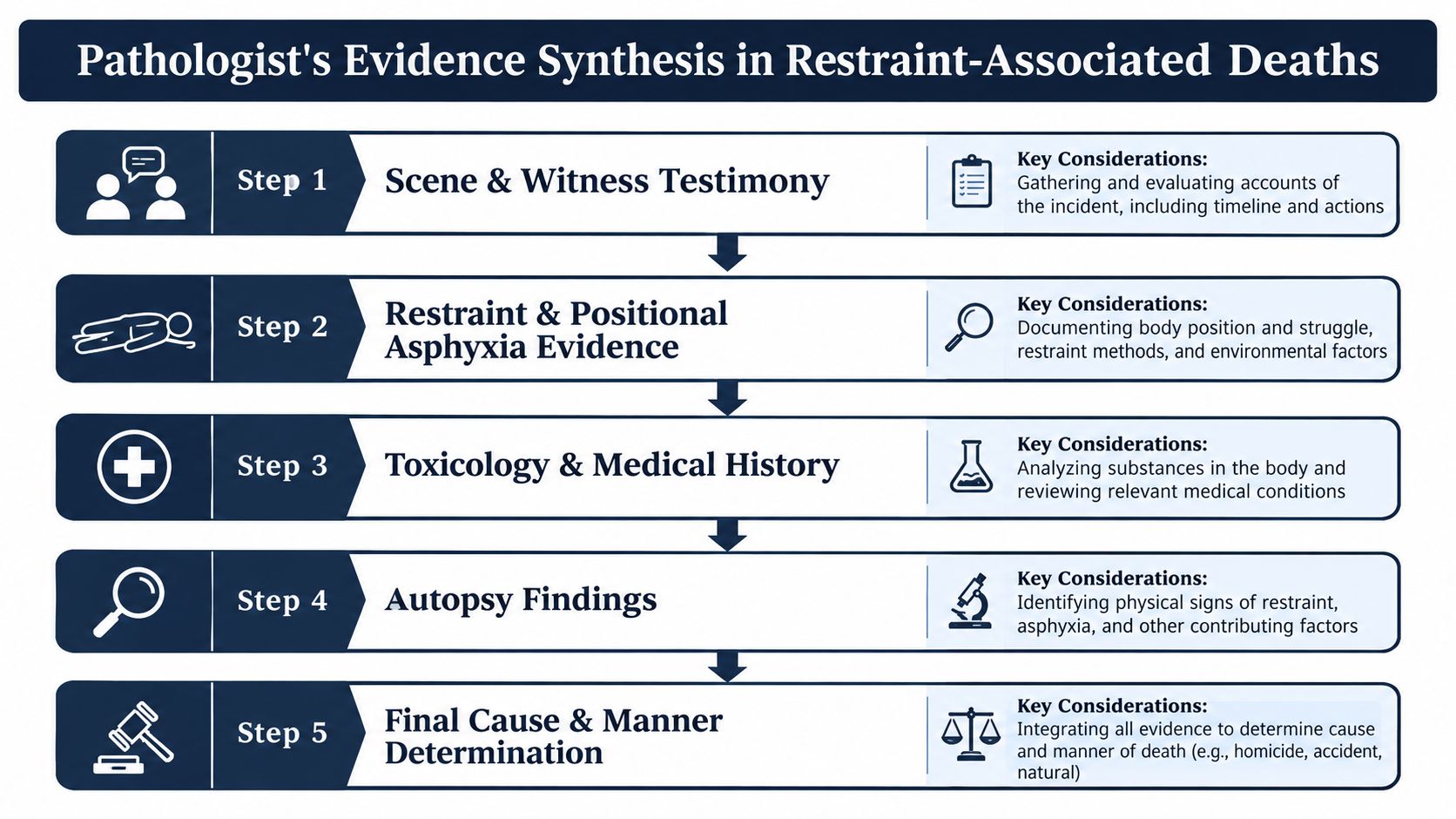
In a restraint-associated death, the pathologist generally weighs three connected evidence streams. The first is the encounter itself. The second is the body position and physical restraint. The third is toxicology and medical history. The strength of the final opinion depends on how well those streams fit together.
Physical restraint and body position
Important records may include body-worn camera footage, surveillance video, dispatch audio, witness statements, restraint logs, and photographs from the scene. The review should establish whether the person was prone, how long that position lasted, whether a hogtie or hobble restraint was used, whether pressure was applied to the neck or torso, and when the person stopped moving or speaking.
Potential findings can include facial congestion, petechiae, facial or oral injury, abrasions, bruising, and injuries associated with struggle or restraint. These findings aren't always present, and their absence doesn't automatically exclude breathing compromise. Position, timing, force, body size, illness, intoxication, and the quality of scene documentation all affect interpretation.
Evidence principle: The last position documented before collapse may be medically important, but it must be placed in a verified timeline.
Toxicology and overlapping causes
A routine toxicology screen may not answer every relevant question. A detailed evaluation may consider cocaine, methamphetamine, synthetic cathinones, PCP, ketamine, fentanyl analogs, antipsychotic medications, and therapeutic levels of prescribed drugs. Specimen type, collection timing, postmortem redistribution, laboratory methods, and chain of custody affect interpretation.
The key issue is often relative contribution. Stimulant cardiotoxicity, restraint physiology, hyperthermia, and pre-existing cardiac disease may coexist. A pathologist must explain whether one factor predominated, whether several factors acted together, or whether the evidence remains insufficient.
For families and attorneys, questions about the legal meaning of intent, causation, and homicide classifications are separate from the medical findings. A plain-language resource on homicide misconceptions debunked can help distinguish legal concepts from forensic conclusions. For a closer look at specimen interpretation and limitations, see this discussion of post-mortem toxicology.
Legal Implications in Texas Death Investigations
Texas death investigations may involve a justice of the peace, a medical examiner's office, county officials, law enforcement agencies, hospitals, and prosecutors. Authority depends on the county's system and the circumstances of the death. The Texas Code of Criminal Procedure and the Texas Forensic Science Commission provide parts of the governing framework, while Texas Health and Safety Code provisions also affect disposition, records, and professional responsibilities.
A death involving custody or restraint may lead to an inquest, additional investigative review, or a grand jury process. The legal system may examine force, supervision, medical response, training, and institutional policies. A medical examiner's cause and manner determination is important evidence, but it doesn't decide whether a criminal offense or civil wrong occurred.
Why the wording matters
A cause listed as restraint-related asphyxia, drug toxicity, cardiac disease, hyperthermia, or an undetermined combination can affect how attorneys evaluate a case. Civil claims may involve the Texas Wrongful Death Act or Survival Statutes. Criminal proceedings may focus on use of force, causation, recklessness, or failure to provide care. The same autopsy evidence can therefore matter to different legal questions without answering all of them.
TASER deployment, prone positioning, hobble restraints, and pressure to the neck or torso should be evaluated against the complete timeline. The relevant issue isn't merely whether a restraint was used. It's whether the documented restraint, position, duration, force, medical condition, and toxicology contributed to the fatal process.
An independent autopsy report can be submitted alongside the jurisdiction's findings. It doesn't automatically replace a county or medical examiner determination, and it doesn't guarantee a different conclusion. Its value is that an independent forensic pathologist can review the body, records, retained specimens, photographs, videos, and prior opinions without being part of the original investigative office.
Texas statutes and forensic procedures can be difficult to apply to a particular death. Families and counsel may benefit from a focused explanation of forensic science and Texas law before deciding whether additional examination or records review is appropriate.
When and How to Request a Private Autopsy
Time matters because embalming, cremation, burial, organ retention, and specimen handling can affect later examination. Families should seek guidance as soon as possible, ideally within 24 to 72 hours, when they suspect the official explanation may not address restraint, custody conditions, toxicology, or an unexplained collapse. The funeral home can often help pause or redirect arrangements, but families should communicate their request clearly and promptly.
A practical Texas roadmap
Contact a forensic pathologist immediately. Explain the circumstances, location, custody status, known restraints, and planned disposition. A hospital autopsy service may have a different purpose and may not be equipped for an independent medicolegal review.
Coordinate with the funeral home. Ask whether embalming or cremation has occurred and whether the body can be held for examination. The applicable authority may involve the justice of the peace, medical examiner, or requirements under Texas Code of Criminal Procedure Article 49.
Preserve the case file. Gather the draft or final death certificate, scene photographs, EMS records, hospital records, restraint logs, police reports, prior medical history, existing toxicology, and requests for body-worn camera or surveillance footage.
Choose the appropriate examination. A full private autopsy examines the body directly. A limited review may examine prior reports, slides, photographs, and retained specimens. A case-file consultation may be appropriate when no second examination is possible or when the central dispute concerns records and interpretation.
Confirm reporting and evidence procedures. Ask how chain of custody will be documented, what tissues or specimens will be retained, what testing is planned, and whether the pathologist can provide testimony if litigation follows.
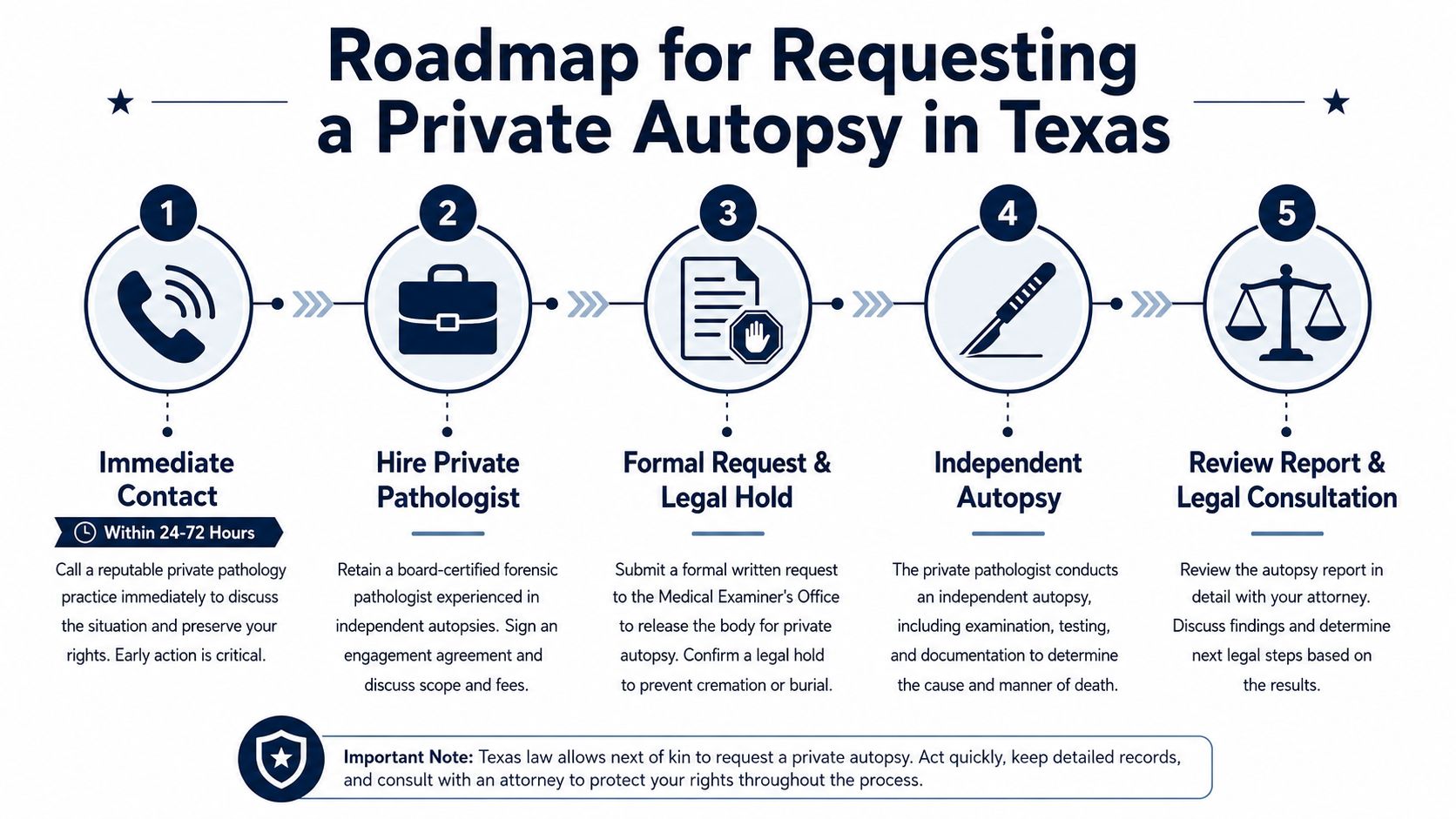
Every examination should be performed by a forensic pathologist certified by the American Board of Pathology. The practice should also explain how records are received, how specimens are identified, and how conclusions will be communicated. Under Texas standards, families should ask how the process aligns with the Texas Funeral Service Commission and relevant Texas Health & Safety Code provisions, including Chapters 711, 716, and 651.
Most cases within 24 to 48 hours may receive an initial report when records, testing, and logistics permit, but no responsible provider should guarantee a turnaround. Toxicology, histology, outside records, and additional consultation can affect completion.
Families should receive a written explanation that distinguishes established findings from opinions and limitations. A private examination doesn't promise a result favorable to a claim. Its purpose is to clarify the evidence, even when that evidence complicates the case.
Frequently Asked Questions for Families
Can excited delirium be listed as a cause of death in Texas?
The answer depends on the investigating authority and the wording used in the final record. Major medical organizations no longer recognize the term, California has prohibited it from death certificates and autopsy reports, and the National Association of Medical Examiners has rejected it for medicolegal death investigation. A 2020 forensic review concluded that the term should be abandoned and that deaths during aggressive restraint should instead use restraint-related modifiers such as no restraint, mild restraint, or aggressive restraint (forensic recommendations on abandoning the term).
The practical question is what specific cause is supported, such as toxic effects, hyperthermia, positional asphyxia, cardiac disease, or an undetermined combination.
How long do toxicology results take?
Timing varies with the laboratory, specimens, testing requested, and whether confirmatory analysis is needed. A preliminary screen may not answer the full forensic question. Families should ask whether testing includes the substances relevant to the scene and medical history, whether confirmation was performed, and whether the result can establish causation rather than exposure alone.
Does a private autopsy override the medical examiner?
No. An independent autopsy creates a separate professional opinion. It may agree with, refine, or disagree with the official determination, but it doesn't automatically replace the jurisdiction's certificate or findings. Attorneys can decide how to use the report in a civil or criminal matter.
What does a private autopsy cost?
There is no universal price that applies to every case. Cost depends on whether the service involves a full examination, limited review, toxicology, histology, transport, storage, records analysis, or testimony. Families should request a written, all-inclusive estimate and ask which services are included.
Can the family still view the body?
Often, arrangements remain possible, but embalming, examination findings, funeral-home procedures, and the timing of viewing can affect what is practical. Families should discuss viewing plans before the examination and tell the funeral home and pathologist about religious, cultural, or personal requirements.
A negative toxicology result doesn't rule out restraint-related breathing compromise. Conversely, a positive toxicology result doesn't prove that drugs caused the death. Pre-existing cardiac disease may increase vulnerability, but the pathologist must still assess how that disease interacted with the events immediately before collapse.
Families may request EMS records, police reports, and hospital records through the appropriate agency and the Texas Public Information Act, subject to exemptions, privacy rules, and active-investigation restrictions. An independent forensic pathologist can help identify which records matter and coordinate questions about the medical evidence, but legal counsel may be necessary for subpoenas, preservation demands, or disputed access.
When the body is no longer available for examination, a second-opinion autopsy review can still assess reports, photographs, histology slides, toxicology, scene evidence, and video. The result may support a civil claim, identify a stronger alternative explanation, or show that the existing determination is adequately supported. Each outcome provides information that families and attorneys can use to make careful decisions.
Texas Autopsy Services provides independent autopsy examinations and second-opinion forensic pathology reviews for families, attorneys, healthcare professionals, and Texas counties across all 254 Texas counties. Every examination is performed by a board-certified forensic pathologist certified by the American Board of Pathology, with licensed transport, documented chain of custody, transparent communication, and court-admissible reporting. If you need help evaluating an excited delirium death or another disputed cause of death, contact our team through Texas Autopsy Services to discuss the records, timing, and examination options.