August 24, 2026 · Texas Autopsy Services
Insurance Claim Support Through Independent Autopsy Services
Learn how independent autopsy services provide insurance claim support with court-admissible reports, chain-of-custody documentation, and forensic evidence.
On this page
- When an Insurance Claim Depends on Cause of Death
- What Evidence Insurers Accept for Claim Verification
- Chain of Custody Requirements Under Texas Law
- Private Autopsy Versus Hospital or Medical Examiner Reports
- Documentation Checklist for Insurance Claim Support
- Legal Considerations and Timelines for Claim Resolution
- Next Steps for Contacting Texas Autopsy Services
A family may receive a death certificate, submit a life insurance claim, and still face a denial because the document doesn't answer the policy's central question. Was the death accidental, natural, or caused by a condition excluded from coverage? When that answer remains uncertain, insurance claim support may require evidence beyond standard medical records.
Texas Autopsy Services is an independent private autopsy and forensic pathology practice based in Elgin, Texas. We serve families, attorneys, medical professionals, agencies, and county officials across all 254 Texas counties. Every examination is performed by a forensic pathologist certified by the American Board of Pathology, with reporting designed to explain medical findings clearly and preserve their usefulness for insurance review, legal proceedings, and second opinions.
- An independent autopsy can address disputed cause and manner of death when a death certificate or existing report is incomplete.
- Forensic evidence must connect medical findings to the exact insurance policy question, including accidental-death and double-indemnity provisions.
- Chain of custody protects the credibility of remains, specimens, photographs, and laboratory results under Texas law.
- A private autopsy doesn't replace the authority of a justice of the peace or medical examiner, but it can provide an independent medical opinion.
- Complete documentation reduces avoidable delays when adjusters, attorneys, or courts review a disputed claim.
When an Insurance Claim Depends on Cause of Death
A family contacts an insurer after an unexpected death. The policy includes an accidental-death benefit, but the death certificate lists an uncertain cause. Hospital records describe several medical conditions, the scene investigation is incomplete, and the insurer asks for more evidence before deciding whether the benefit applies.
That situation can leave relatives facing financial uncertainty while they're also trying to understand what happened. A denial may not mean the claim lacks merit. It may mean the available records don't establish the connection between the death and the policy's coverage terms.
A standard death certificate serves an important official purpose, but it may not answer every medical or contractual question. It generally identifies the cause of death and manner of death based on the certifying authority's available information. An insurer reviewing accidental death coverage may need more detailed findings about injury, disease, intoxication, treatment, or the circumstances surrounding the death.
The key issue is not whether an autopsy was performed. It's whether the findings resolve the disputed policy question.
An independent examination can evaluate the body, medical records, toxicology, photographs, investigative materials, and other relevant evidence. Our board-certified forensic pathologists then prepare a written opinion that distinguishes established findings from limitations and unresolved possibilities. The report should address the medical question directly, without adopting the interests of the family, insurer, or another party.
Accidental-death riders, double-indemnity clauses, and exclusions can make precise classification especially important. Cause of death describes the disease, injury, or condition that led to death. Manner of death describes the broader classification, such as accident, natural causes, suicide, homicide, or undetermined, when the available evidence supports such a classification.
Families and attorneys considering an independent examination can review our explanation of cause-of-death determination. The practical question is whether additional forensic evidence can clarify causation, test an existing conclusion, or identify why the current documentation doesn't satisfy the policy.
What Evidence Insurers Accept for Claim Verification
Insurers evaluate death claims by comparing the policy language with the available evidence. The strongest file is not necessarily the file with the most pages. It's the file in which each important conclusion can be traced to a documented medical or investigative fact.
The evidence should answer the coverage question
A death certificate is often the starting point. It may not be sufficient when the cause is listed as pending, unknown, undetermined, or inconsistent with other records. Medical records can show symptoms, diagnoses, treatment, and clinical decisions, but they may not establish what happened after death or resolve a disputed manner of death.
A forensic pathology report adds a structured postmortem evaluation. Depending on the case, it may include:
- External examination: Documentation of identifying features, injuries, medical intervention, and other visible findings.
- Internal examination: Examination of organs and tissues for disease, trauma, and competing explanations.
- Histology: Microscopic examination that can clarify disease processes or injury patterns.
- Toxicology: Laboratory testing for medications, alcohol, drugs, or other substances when relevant.
- Investigative context: Review of scene information, photographs, witness accounts, medical records, and treatment history.
- Forensic opinion: A reasoned conclusion addressing cause, manner, and the limits of the available evidence.
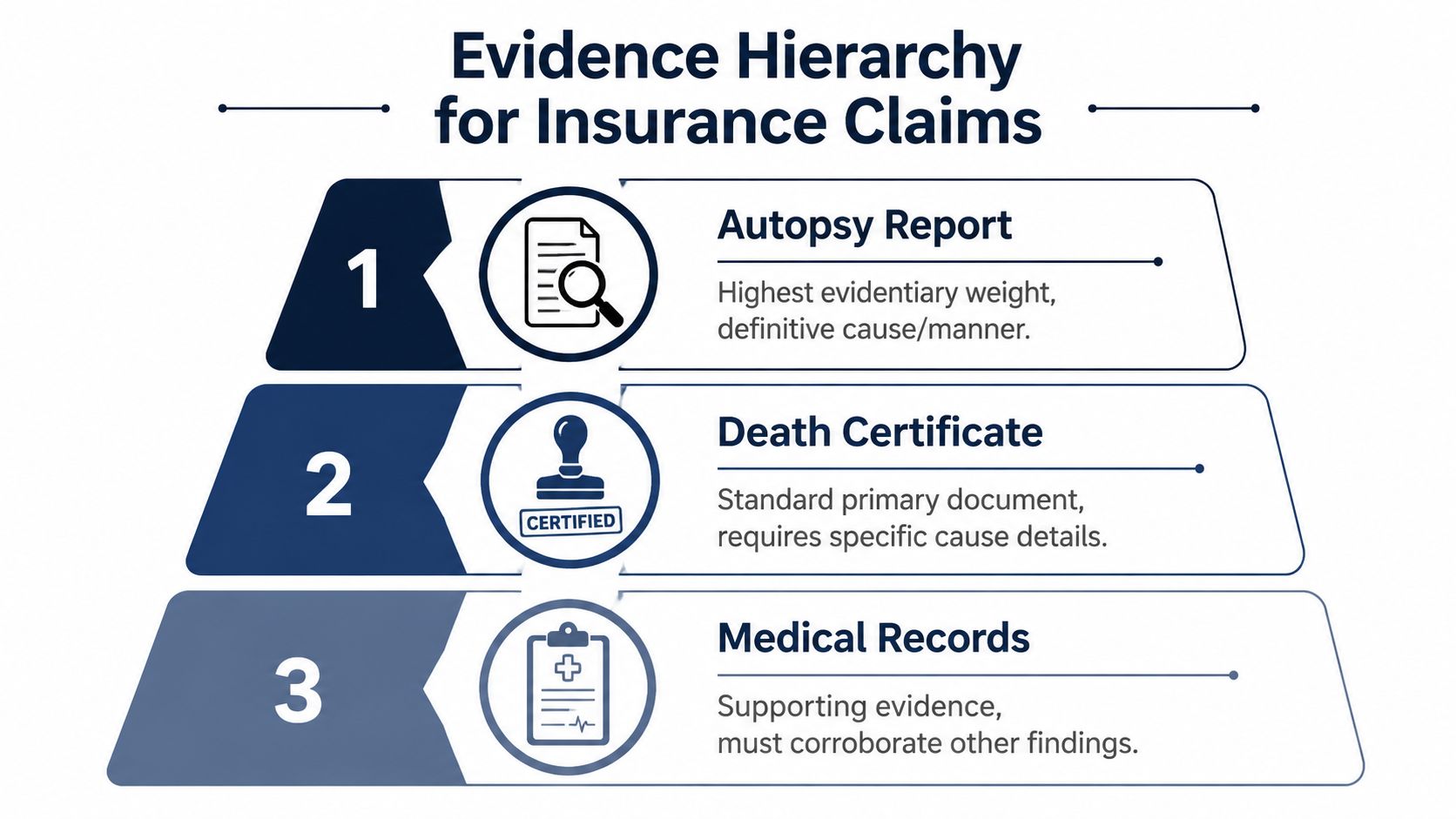
Every examination at Texas Autopsy Services is performed by a forensic pathologist certified by the American Board of Pathology. The American Board of Pathology requires forensic pathology applicants to complete prior anatomic and clinical pathology certification requirements and 12 months of training in an ACGME-accredited forensic pathology program, while also maintaining a valid, unrestricted medical license (American Board of Pathology standards). Those standards help insurers and attorneys evaluate the qualifications behind a forensic opinion.
A report's value also depends on independence and methodology. A conclusion should explain how the findings support or fail to support a policy trigger. It shouldn't repeat the wording on a death certificate or assume that one diagnosis explains the entire death.
Cause and manner have different insurance roles
An insurer may ask whether a death resulted from an accident, but that question can depend on the medical cause. For example, a fall might be documented as an event, while the forensic examination determines whether the fatal condition was traumatic injury, a natural disease, intoxication, or a combination.
The report should identify those distinctions plainly. It should also state when evidence is insufficient, because a careful limitation is more defensible than an unsupported certainty.
Chain of Custody Requirements Under Texas Law
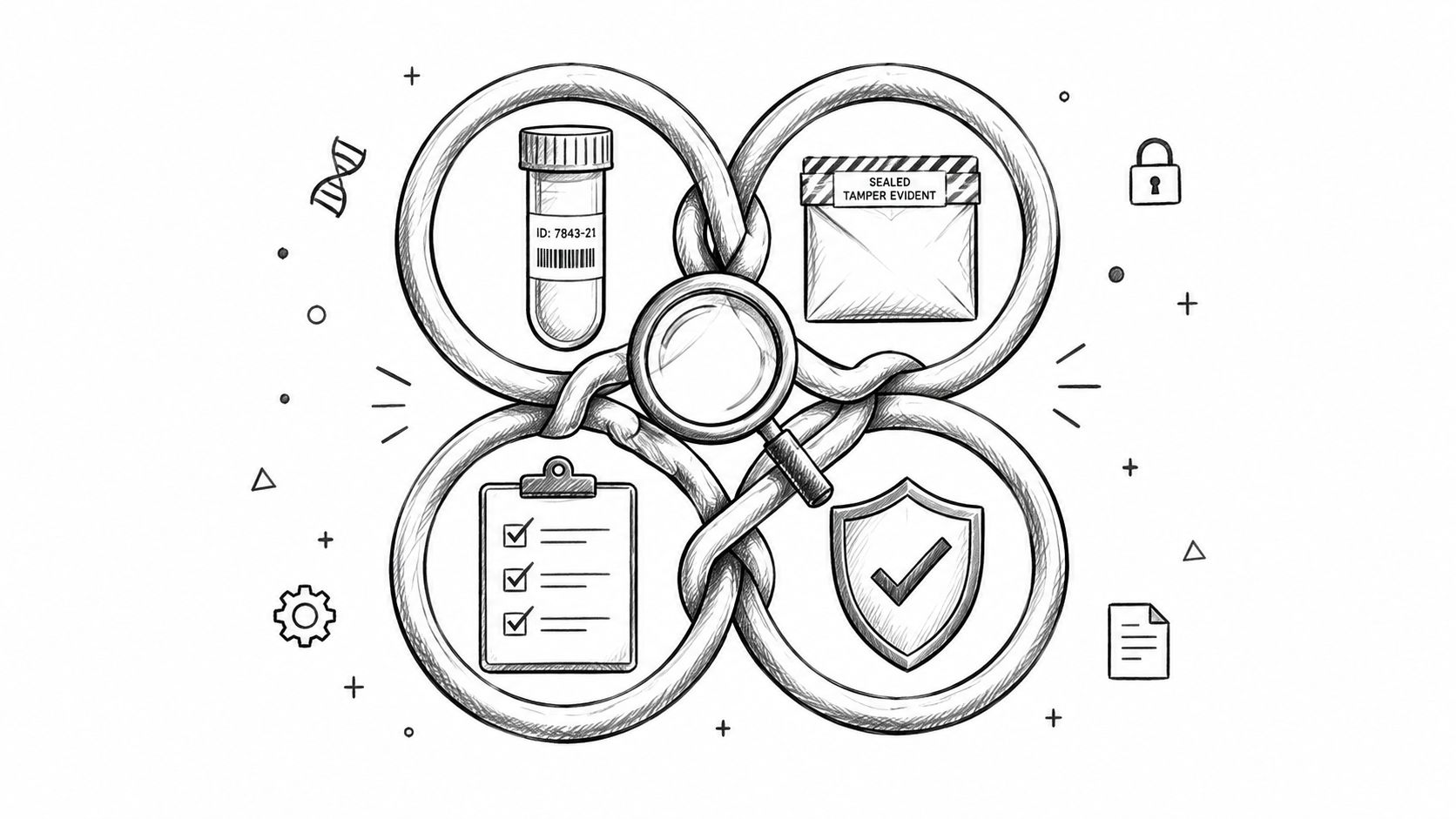
Chain of custody is the documented history of who possessed a body, specimen, photograph, or other item of evidence, when control changed, and how the item was preserved. For an insurance claim, that history supports confidence that the material examined is the same material described in the report.
Texas law requires each person with control or possession of a body or anatomical specimen to complete the prescribed chain-of-custody form, retain a copy, and transfer the form to the next person receiving the body or specimen. Required records must be filed under commission rules and remain available for inspection by the commission, a district attorney, or a county attorney (Texas Health and Safety Code Section 691.031).
Each transfer creates a documentation point
A reliable process accounts for every handoff:
- Release and collection: The responsible authority or facility identifies the remains and documents the initial transfer.
- Transport: The transport provider records receipt, destination, and delivery.
- Examination: The facility documents access, specimens collected, and materials retained for testing.
- Return or further transfer: The receiving funeral home, facility, laboratory, or other authorized custodian receives the remains and associated records.
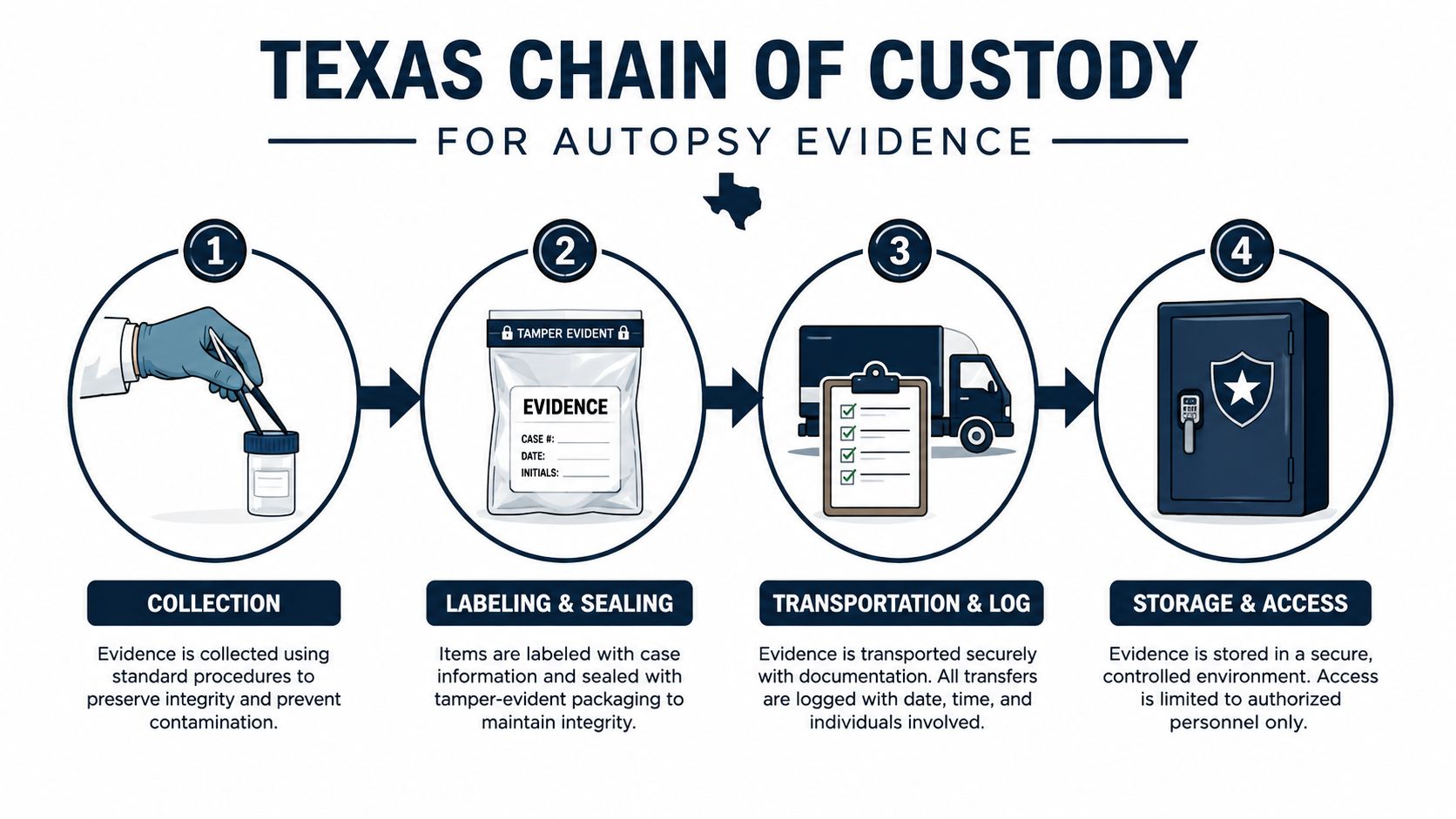
The purpose isn't administrative perfection for its own sake. A missing signature, unclear specimen label, or unexplained storage interval can give an insurer or opposing attorney an opportunity to question the evidence. Detailed records allow the reviewing party to follow the material from collection through examination and laboratory analysis.
Families and legal teams building an evidence file can also use an AI Video Detector evidence form as a general documentation reference for custody events. It doesn't replace Texas-required forms or professional legal advice, but it illustrates the level of detail a custody log should preserve.
Our chain-of-custody procedures are structured around traceability, secure handling, and records that can be reviewed later. In-house licensed transport and controlled storage help keep responsibility clear from the first transfer through completion of the examination.
Private Autopsy Versus Hospital or Medical Examiner Reports
A private autopsy, hospital autopsy, and medical examiner investigation can all produce useful information, but they serve different purposes. The right choice depends on the unanswered question, the authority already involved, and the evidence still available.
| Report or examination | Typical purpose | Possible limitation for an insurance dispute |
|---|---|---|
| Hospital autopsy | Review of clinical diagnosis, treatment, and disease | May not focus on policy exclusions, accident classification, or legal causation |
| Medical examiner or justice of the peace investigation | Official investigation within the governing jurisdiction | The report may not address the specific language of a private insurance contract |
| Private autopsy | Independent examination commissioned by an authorized party | Requires timely access, proper consent or authorization, and coordination with official agencies |
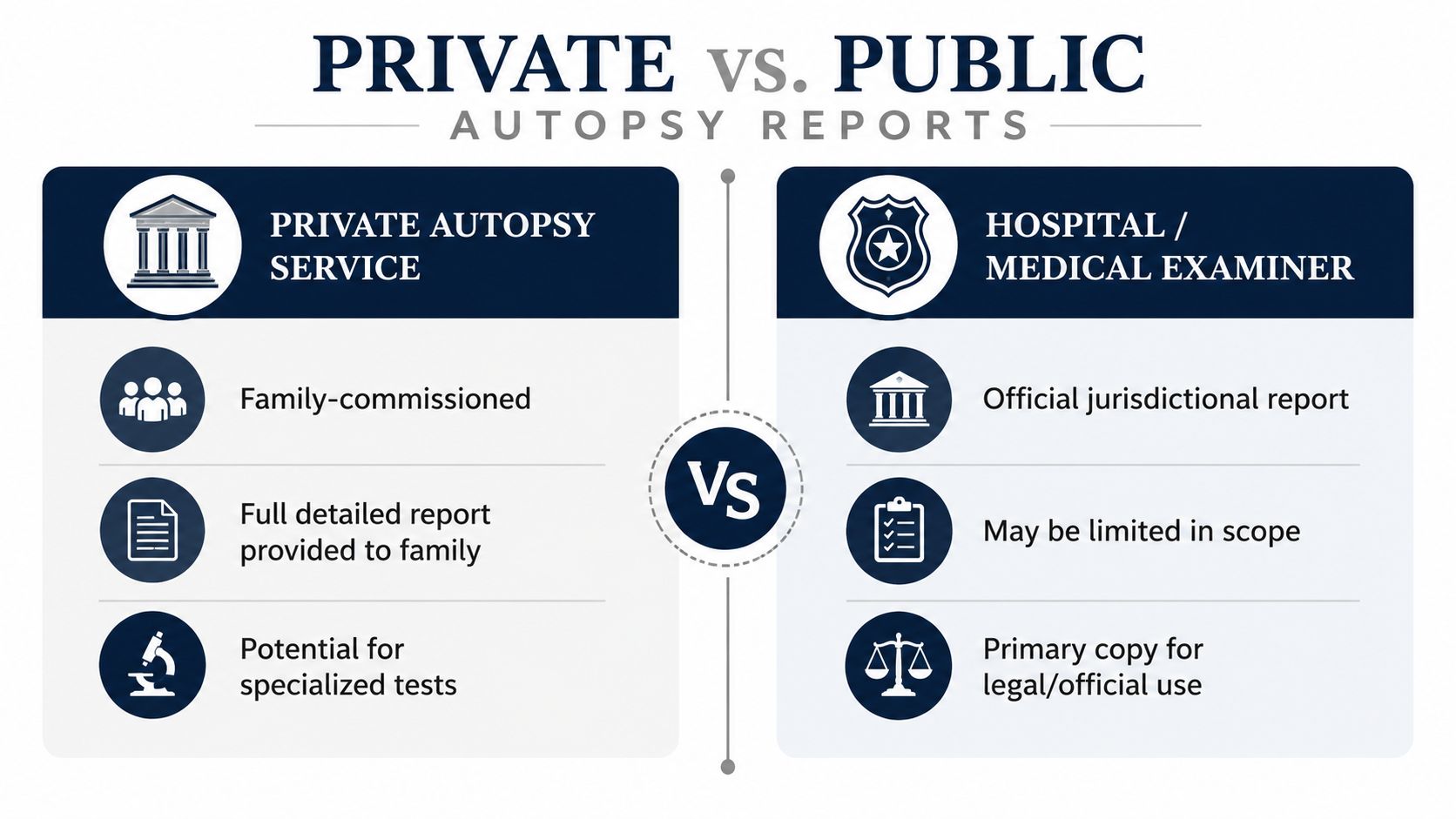
A hospital autopsy may be clinically thorough while still leaving an insurance question unanswered. Its focus may be the relationship between treatment and death, rather than whether an accidental injury triggered a benefit or whether a policy exclusion applies.
A medical examiner or justice of the peace report has official significance. It may establish the jurisdiction's findings and can contain valuable scene, investigative, and laboratory information. A private autopsy doesn't override that official authority. Instead, it can provide a second opinion when the original investigation was limited, inconclusive, declined, or disputed.
When a second opinion may help
An independent examination may be considered when:
- The cause of death remains unknown or disputed.
- The manner of death affects accidental-death coverage.
- Existing records don't explain an apparent injury or medical event.
- A toxicology result requires further interpretation.
- The insurer requests evidence tied to a specific exclusion or benefit.
- The family or attorney needs an independent forensic opinion for litigation.
Our board-certified forensic pathologists prepare reports that separate observed findings, laboratory results, reviewed records, and medical conclusions. A report can be useful in an insurance file only when it remains medically reasoned and transparent about uncertainty.
For related clinical documentation issues, families and attorneys may review our discussion of hospital mortality review. The important distinction is that a mortality review examines care and outcomes, while a forensic autopsy addresses postmortem findings and cause-of-death questions.
Documentation Checklist for Insurance Claim Support
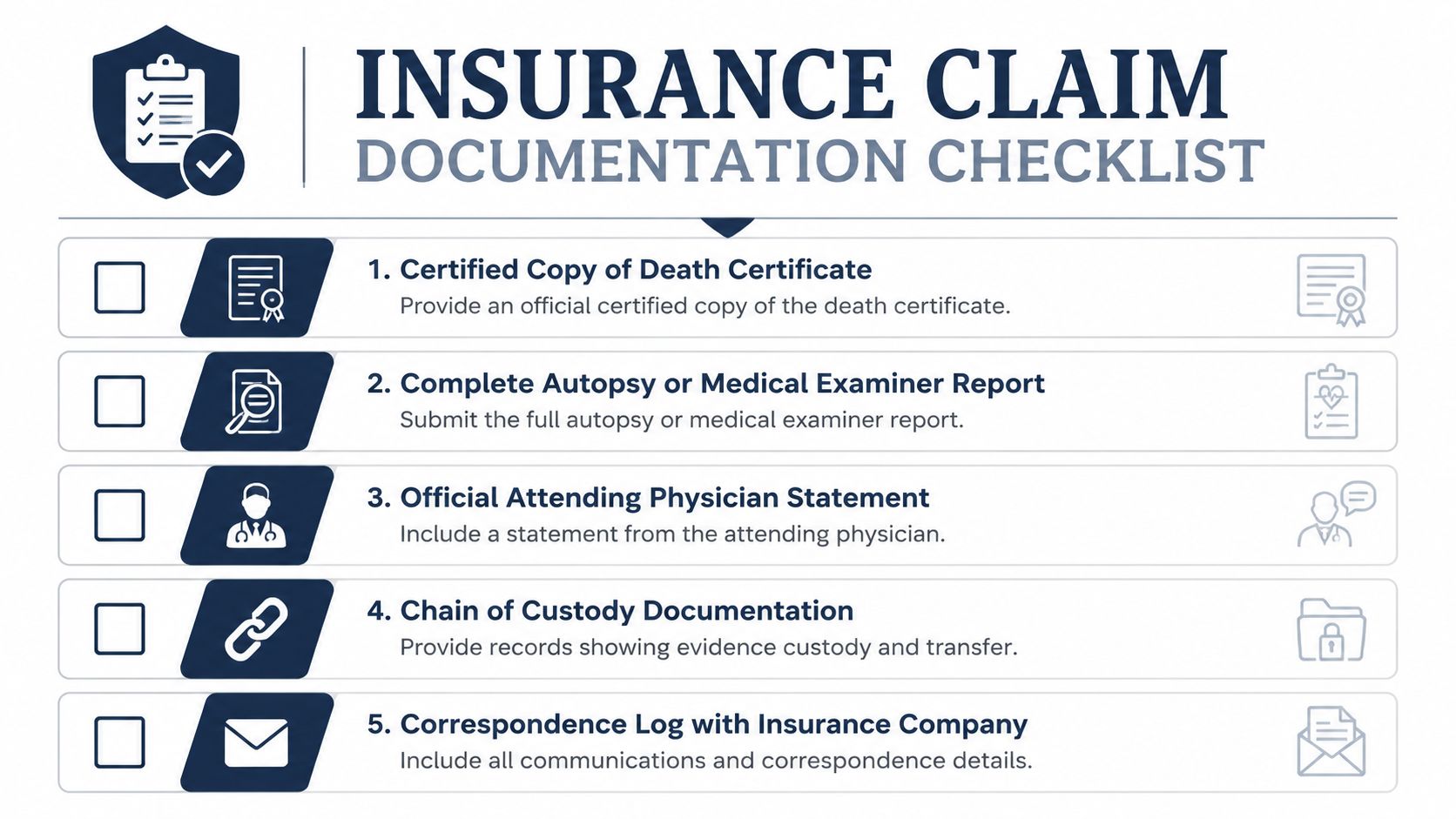
A claim file should tell one coherent story. Organize documents by source and date, preserve the original versions, and maintain a correspondence log showing what the insurer requested and when the family or attorney responded.
Gather records before the examination
Start with the policy, including endorsements, accidental-death provisions, double-indemnity language, definitions, and exclusions. The policy's wording identifies the medical questions the forensic report needs to address.
Collect the following where available:
- Certified death certificate: Include every available version, including amended or pending documentation.
- Existing medical records: Gather emergency, hospital, physician, pharmacy, and relevant prior-treatment records.
- Official investigative materials: Request incident reports, scene photographs, witness information, and agency documentation when available.
- Insurance correspondence: Preserve the claim number, adjuster communications, requests for information, reservations of rights, and denial explanations.
- Prior opinions: Include medical examiner reports, hospital autopsy reports, toxicology results, and prior reviews.
Request a complete forensic file
After examination, ask what materials will be included and which studies remain pending. Depending on the case, the file may contain the autopsy report, toxicology report, histology findings, photographs, specimen information, and a written opinion addressing the requested policy issue.
Not every case requires every test. Additional testing should have a reason connected to the disputed cause, manner, or exclusion. Testing without a clear question can add expense and delay without improving the opinion.
Present the material in review order
A practical submission sequence is:
- Policy and relevant benefit provisions.
- Claim denial or information request.
- Death certificate and official reports.
- Medical records and investigative materials.
- Independent forensic report and supporting laboratory findings.
- A concise cover letter identifying the precise question the evidence answers.
This organization helps the adjuster locate the controlling documents and reduces repeated requests. It also gives attorneys a defensible record if the claim proceeds to an appeal, negotiation, or lawsuit.
Legal Considerations and Timelines for Claim Resolution
Insurance policies sometimes contain autopsy provisions that require an examination before payment. Historical legal analysis has found that courts have treated these clauses as enforceable prerequisites in many contracts when the insurer makes the request reasonably and in a timely manner (legal analysis of autopsy clauses).
That makes early communication important. Families and attorneys should notify the insurer, identify the governing agency, preserve available records, and determine whether the remains can be released for an independent examination. A private autopsy cannot proceed without appropriate authorization, and an official investigation may control access or disposition.
Timing depends on the evidence
Most cases have an initial examination within 24 to 48 hours, but that isn't a guarantee of a completed final report. Case complexity, toxicology, histology, molecular testing, record collection, and the need for outside consultation can affect final reporting.
A prompt examination may preserve findings that become harder to evaluate after delay. It can also allow the pathologist to document injuries, collect appropriate specimens, and review the scene context while information remains available. Speed matters, but a rushed examination that omits a relevant study may create a weaker claim file.
Texas law assigns autopsy authority according to specific circumstances. A justice of the peace must conduct an inquest when a person dies without physician attendance, and also when a physician attended the death but can't certify the cause and requests an inquest. Texas law permits the justice of the peace to seek a physician's opinion about whether an autopsy is needed to determine or confirm the nature and cause of death (Texas coroner and medical examiner law).
For families reviewing a denial, legal strategy depends on the policy, jurisdiction, and reason for denial. A general discussion of options for denied claim payouts may help identify questions for an insurance attorney or licensed adviser, but it doesn't replace case-specific legal advice.
Texas Autopsy Services uses flat-rate, all-inclusive pricing for its services, with direct communication about what the examination includes. Fees and logistical requirements should be confirmed before authorization, particularly when specialized studies or extended records review may be necessary.
Next Steps for Contacting Texas Autopsy Services
The first call should establish whether an independent autopsy is legally and medically feasible, what evidence is available, and which question the insurance claim requires answered. Families and attorneys can speak directly with our team, without a call center or intermediary, 24/7 at (806) 230-1889.
Have the following information available if possible:
- The decedent's current location and the facility holding the remains.
- The date and circumstances of death.
- The insurance company, policy type, and claim status.
- The cause and manner listed on any death certificate.
- Existing medical examiner, hospital, toxicology, or investigative records.
- The insurer's specific request, reservation of rights, or denial explanation.
- Any upcoming funeral, cremation, burial, or transportation arrangements.
We coordinate with funeral homes, official agencies, attorneys, and other facilities. Our in-house licensed transport serves all 254 Texas counties, and our team can discuss secure storage, examination arrangements, specimen handling, records review, and report delivery.
Every examination is performed by a forensic pathologist certified by the American Board of Pathology. Our reports are thorough, court-admissible, and written to address the medical questions that matter to the claim, while acknowledging limitations when the evidence doesn't support a definitive conclusion.
Families don't need to organize every document before making contact. A preliminary conversation can clarify what should be preserved, which authority controls release, and whether a second-opinion autopsy or records review may be appropriate.
Texas Autopsy Services provides independent autopsy examinations, second-opinion reviews, forensic pathology reporting, and licensed transport across Texas to support clear cause-of-death findings in disputed insurance claims. Visit Texas Autopsy Services or call (806) 230-1889 to discuss the circumstances and receive direct guidance about the next appropriate step.