October 9, 2026 · Texas Autopsy Services
What a Chain of Custody Test Involves and Why It Matters
Learn what a chain of custody test covers, how specimens are tracked, and why documentation matters for admissibility in Texas death investigations.
On this page
- When a Chain of Custody Test Becomes the Deciding Evidence
- How Chain of Custody Works From Collection to Disposition
- What Each Handoff Looks Like in Practice
- Biological Toxicology and Digital Evidence Under One Custody Standard
- Why Custody Gaps Matter in Texas Courtrooms
- What Families Attorneys and Officials Can Expect From the Practice
- Questions Readers Most Often Ask About Chain of Custody Tests
A family can have a complete autopsy report and still feel uncertain if one question remains unanswered: did the specimen tested in the lab come from the person examined? That doubt is where a chain of custody test matters. It is not the chemistry itself, it is the documented identity system that proves the specimen stayed tied to the right person, the right case, and the right result.
For families, that record can answer hard questions with calm detail. For attorneys and county officials, it can determine whether the result is defensible later. At Texas Autopsy Services, we treat custody as part of the forensic finding, not as a separate clerical file.
- Chain of custody means identity plus history, not just a signature on a form.
- The record should show every transfer, custodian, storage condition, and intervention from collection through final disposition.
- Biological specimens, toxicology samples, and digital files all need the same custody logic, even though the handling details differ.
- Texas law and federal evidence rules focus on authenticity, so gaps can affect weight, admissibility, or both.
- Families and attorneys should expect a custody timeline, not a vague statement that the specimen was “secured.”
When a Chain of Custody Test Becomes the Deciding Evidence
A death certificate can settle the administrative record and still leave a family with practical doubts. If a toxicology result does not match the observed facts, or an outside report raises new concerns, the custody record may become the deciding evidence because it shows whether the specimen tested was the same specimen collected. Under Federal Rule of Evidence 901(a), the party offering evidence must give enough proof for a fact-finder to conclude that the item is what it claims to be. Rule 901(b) then gives examples, including witness testimony and a reliable process or system.
That is the part many people miss. A chain of custody test is not the lab instrument or the chemistry inside it. It is the documented identity system that ties the original specimen to the final result. Federal guidance treats chain of custody as especially important for fungible items, things that can be swapped, degraded, or affected by handling, such as biological specimens, toxicology samples, trace evidence, and extracted digital files. The burden generally rests with the party offering the exhibit, so the record has to hold up in court.
What families, attorneys, and county officials are really looking for
Families usually want a plain answer. Was the specimen protected, and can someone explain each handoff without making them chase jargon? Attorneys want continuity in the identifiers, seals, transfers, and retained records. County officials need a process that holds up across examination, transport, and laboratory review.
A specimen identity system works like a patient chart for evidence. If the name, date, seal, and movement history do not line up, the record stops speaking clearly.
Practical rule: if a specimen's identity cannot be reconstructed from the paperwork and the physical controls, the science alone will not quiet the challenge.
Published forensic case data show why that matters. A retrospective analytical study reviewed 20 sensational rape and murder cases, and 13 had properly handled forensic samples while 7 involved improper handling or inconsistent forensic reports. The study is not a universal error rate, but it shows how quickly credibility can suffer when specimen management breaks down. Forensic case handling study
How Chain of Custody Works From Collection to Disposition
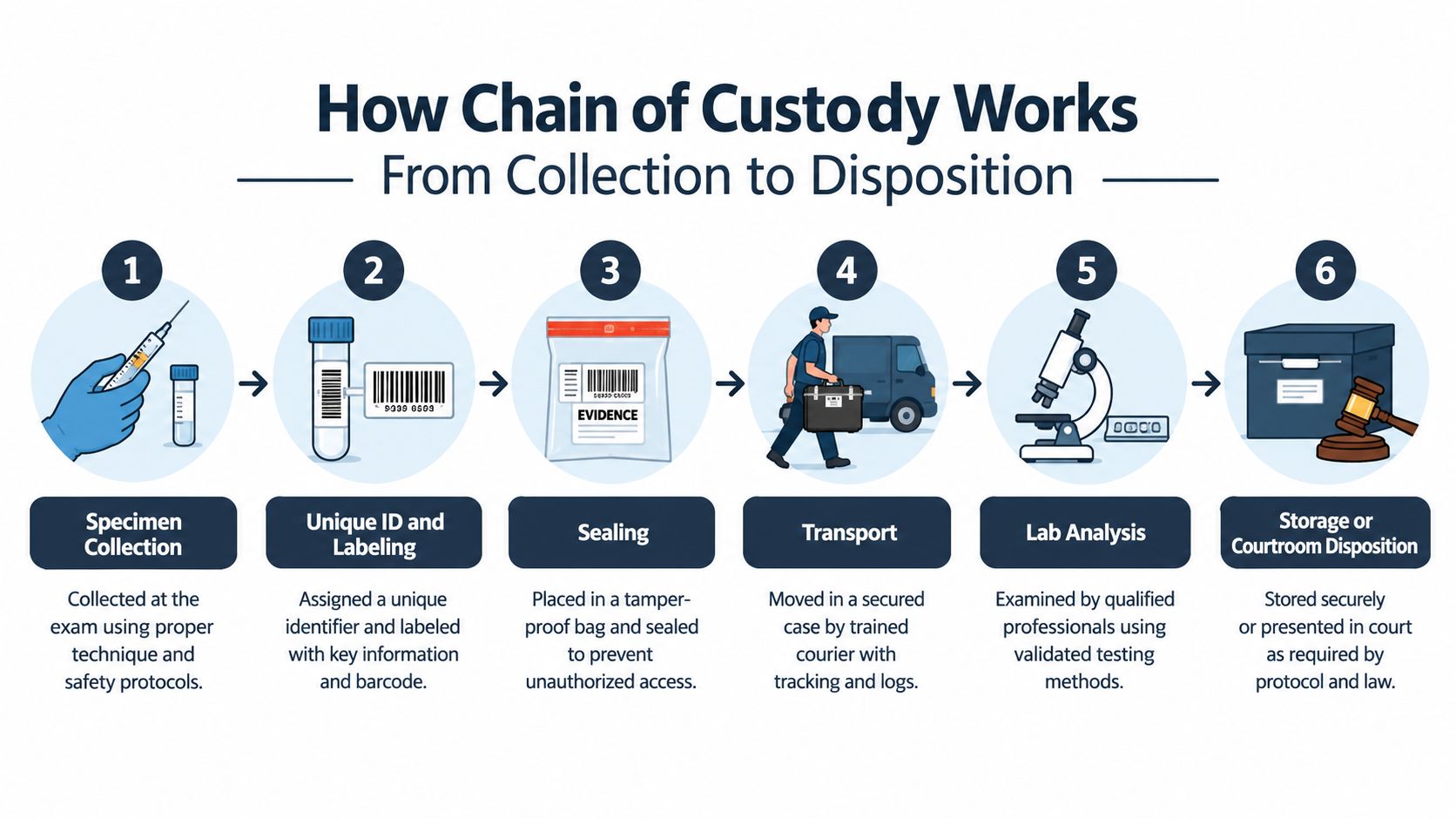
The cleanest way to understand custody is to follow the specimen from the exam table to the end of its life cycle. NIST describes chain of custody as an auditable chronological control system linking collection, identification, storage, transfer, analysis, and final disposition. That means the record should show where the item was collected, who handled it, where it was stored, why it moved, and what happened to it at each stage. NIST IR 7928
A plain-language definition helps here. Cause of death is the medical condition or injury that directly led to death. Manner of death is the broader classification, such as natural, accident, homicide, suicide, or undetermined, based on the investigation and autopsy findings. Those findings only matter if the specimen trail supports them.
The custody timeline from collection to final record
- Collection at examination. The specimen is gathered during the autopsy or related examination, and the label should identify the item clearly.
- Unique identification. NIST recommends a unique case and item identifier so every specimen can be traced without guessing.
- Sealing and packaging. The container should be protected against leakage, contamination, and unauthorized access.
- Transfer. Every handoff should identify who gave the item, who received it, when it moved, and why.
- Laboratory work. Accessions, testing, repackaging, or subsampling must remain tied to the source specimen.
- Disposition. The retained material, report, or destruction record should close the loop.
The same logic applies to derivative materials, like DNA extracts or aliquots. If the tested material can't be linked back to the authenticated source, the result loses force. NIST also says records should remain available for the legal retention period, even if the physical evidence is later destroyed or unavailable. For readers who want a deeper procedural map, our internal overview of chain of custody procedures lays out the same continuity principle from a practice standpoint.
For teams comparing specimen management to other data-controlled systems, implementing data provenance in practice is a useful parallel. The idea is similar, trace the source, the transfers, and the changes so the final output stays defensible. We see the same discipline in postmortem work every day.
What Each Handoff Looks Like in Practice
A defensible custody record is built at the handoff level, not at the summary level. When our team documents a specimen leaving the examination area, the record should show the specimen identifier, the condition of the container, the seal status, and who received it. If the specimen is transferred to transport, the handoff should include the time, the custodian, and the purpose of the move.
Intake, storage, and accessioning
When the item arrives at the Elgin facility, the receiving team should reconcile the container seal, label, condition, and submission paperwork before accessioning. If something doesn't match, the discrepancy should be logged as an exception, not corrected behind the scenes. That distinction matters because a reviewable exception is honest, while a hidden fix can break trust later.
Secure, temperature-controlled storage is part of the evidence, not a back-office detail. For biological specimens, the record should show where the item was stored, who had access, and whether conditions changed during transport or holding. A custody log that skips those facts leaves too much to memory.
Attorney's checkpoint: ask for the specimen label, transfer log, accession record, storage record, and final report together, then confirm the identifiers match across all five.
Laboratory submission paperwork should reconcile with the custody log before analysis begins. That same discipline appears in our own direct workflow and in our public guidance on chain of custody form requirements. When a handoff is documented correctly, a reviewer can follow the record without depending on verbal explanations.
For organizations that use third-party transport or digital exchange, the same principle still holds. Texas Autopsy Services also uses in-house licensed transport as part of continuity control, which helps keep the custody trail under one documentation standard. That's a process choice, not a slogan, and it matters because every extra transfer adds another place where identity can be questioned.
Biological Toxicology and Digital Evidence Under One Custody Standard
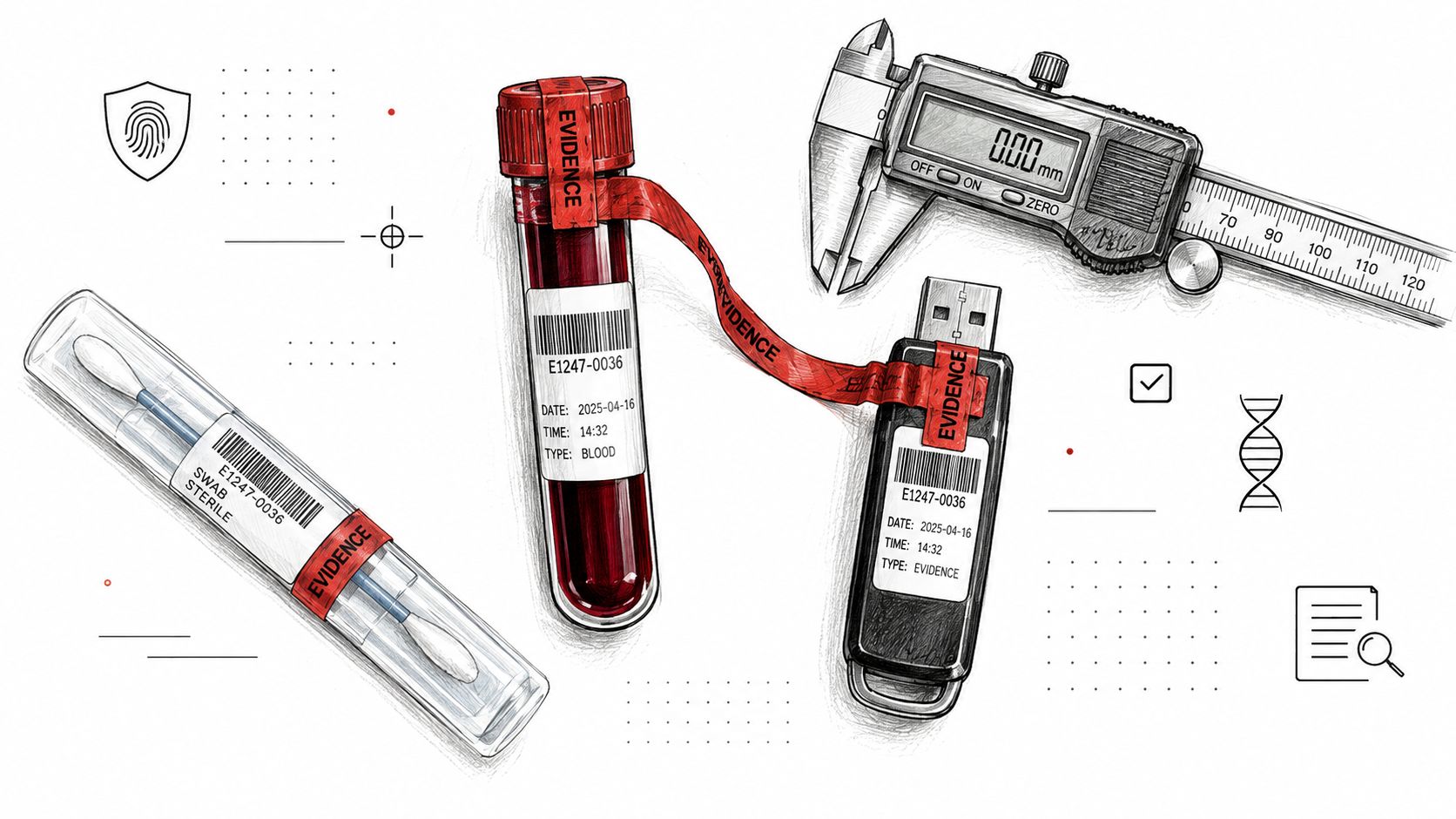
A blood vial and a case file can fail for the same reason, loss of identity. Biological specimens and digital files follow one custody standard because both can be altered by time, temperature, packaging, contamination, or unauthorized access. NIST guidance calls for tamper-evident packaging, controlled access, and condition checks at each handoff so the item stays tied to the record from start to finish. NIST trace evidence guidance
Why the same controls apply to files and extracts
Digital evidence has the same vulnerability, but in a different form. NIST explains that files can be changed with little visible trace, so source details, transfer records, hashes, and digital signatures help show whether a file stayed intact. Metadata matters too, because an extracted image or report loses value if it is separated from the case record. NIST IR 8387
That is why custody for digital material should include:
- Hash verification to confirm the file has not changed
- Metadata preservation so the file stays tied to the source
- Version control when reports or images are updated
- Parent-child identifiers for DNA extracts and aliquots
- Restricted access to limit silent alteration
The same custody logic that protects blood vials also protects digital case files. Our guidance on chain of custody and cybersecurity explains those controls in practical terms.
For biological testing, the steps are familiar. Record specimen condition at each handoff, keep a separate trail for every aliquot, and document any temperature-sensitive handling. Texas Autopsy Services applies the same chain to digital images, toxicology data, and derivative materials, because a file or extract that loses its linkage can raise the same problem as a mislabeled vial.
Digital does not mean custody-free. It means the identity controls change, and the record has to follow them closely.
Why Custody Gaps Matter in Texas Courtrooms
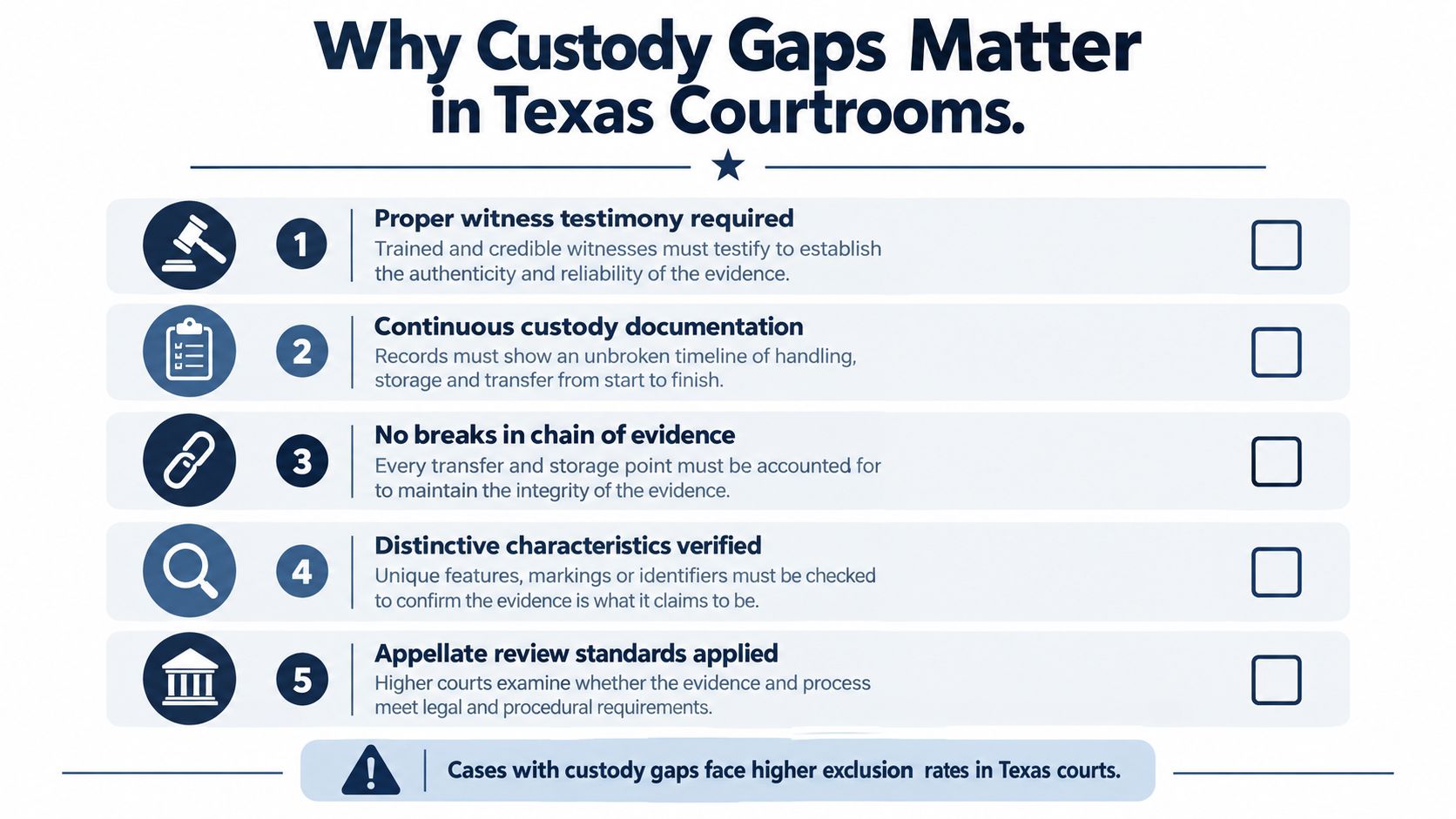
A mislabeled vial, a broken seal, or a missing transfer note can change the way a judge reads the evidence. Texas law asks a simple question first. Can the proponent show enough to support a finding that the item is what it claims to be? For physical evidence, Texas appellate authority says authentication usually turns on the beginning and end of the chain of custody, especially when the item reaches a laboratory. Texas Rules of Evidence
A gap does not always bar admission. Federal commentary and IRS legal analysis both recognize that a missing link does not always bar admission when other proof shows the item is authentic and unaltered. But the gap still matters, because the party relying on the test may need to explain why the irregularity did not affect the result. Federal Rule 901 follows the same basic idea.
The Texas affidavit path
Texas Code of Criminal Procedure Chapter 38 allows a compliant chain-of-custody affidavit to show handling history without calling every custodian to testify in person. That helps when a specimen moves through several hands, but it does not repair weak records. A broken seal, missing signature, unexplained delay, or temperature excursion still leaves a weak point in the specimen identity system, even if the case can continue. Texas Code of Criminal Procedure Chapter 38
The court is not only asking whether the lab can read a sample. It is asking whether the sample can still be trusted as the same item collected at the start. When a custody gap appears, the dispute shifts from science to proof.
For lawyers who live in PDF-heavy case files, secure PDF signing for law firms is a practical reminder that signatures, timestamps, and tamper evidence matter in digital records too. The same rule applies to specimen records, if the chain cannot be verified, the document stops carrying the identity of the specimen.
What Families Attorneys and Officials Can Expect From the Practice
Families should expect plain language, not jargon. If we identify a custody issue, we explain it in the report and in the discussion around the report, including whether the issue affects the identity of the specimen, the condition of the specimen, or only the paper trail. The family should receive the autopsy findings and the custody timeline together, because those records belong together.
What the record package usually needs to show
- Identification of the specimen or retained material
- Collection and receipt times
- Seal status and packaging condition
- Every transfer and custodian
- Storage location and access controls
- Laboratory submission and final disposition
Attorneys usually want the same core materials, then more detail if litigation is likely. That includes accession records, lab worksheets when available, and any exception logs tied to the specimen. A defensible system doesn't hide the irregularities, it preserves them so they can be evaluated.
County officials need continuity across jurisdictions, and that's where statewide coverage and in-house licensed transport matter in practice. Direct communication with our team reduces the chance that a transfer note gets lost between offices, especially when multiple agencies are involved. If the case needs a second opinion or outside review, the chain still has to read cleanly from collection through analysis.
For firms that coordinate family-law or custody-related matters, family law firm solutions show how structured documentation supports contested decisions. The same idea applies here, the cleaner the record, the less room there is for avoidable dispute.
Most cases are completed within 24 to 48 hours, but that depends on specimen type, outside testing, and case complexity. We don't promise a fixed outcome or a fixed schedule, because a truthful custody record has to reflect the case as it is, not as anyone wishes it to be.
Questions Readers Most Often Ask About Chain of Custody Tests
What if a custody seal is broken?
It doesn't automatically invalidate the result, but it does create a vulnerability that must be explained. The question becomes whether the break could have affected identity, contamination, or analytical reliability.
Can retained material be retested independently?
Yes, when material remains available and the custody history supports it. A parent-child identifier and retained record help show that the extract or aliquot still belongs to the original specimen.
How are digital photos and toxicology files protected?
They need the same custody logic as physical evidence, with source information, transfer records, access control, and, when appropriate, hash verification. Digital convenience doesn't remove the need for proof.
Does HIPAA-compliant reporting replace the custody record?
No. HIPAA addresses privacy and permitted disclosure, while custody documents show identity, handling, and integrity. Those are different questions, and both matter.
If your family, attorney, or county office needs a case reviewed through that lens, we'll walk through the record with you plainly and carefully.
If you need a clear review of an autopsy, a custody timeline, or a second opinion on specimen handling, Texas Autopsy Services can help. We provide independent forensic pathology with documented chain of custody, direct communication, and plainspoken explanations for families and attorneys. Visit Texas Autopsy Services to reach our team and discuss your case.