October 2, 2026 · Texas Autopsy Services
Chain of Custody Cyber Security for Digital Evidence
Learn how chain of custody cyber security protects digital evidence, supports HIPAA compliance, and keeps forensic reports court-admissible.
On this page
- What Chain of Custody Means in Cyber Security
- The Four Phases Every Digital Custody Workflow Follows
- Anatomy of a Defensible Custody Record
- HIPAA, Court Admissibility, and the Custody Connection
- Where Modern Custody Breaks and How to Prevent It
- Policies and Controls That Keep Records Tamper-Evident
- How Texas Autopsy Services Applies These Safeguards
- Frequently Asked Questions
A coroner's laptop may arrive at a forensic laboratory beside autopsy images, toxicology files, and access logs connected to the same death investigation. The hard drive can be tagged and secured, but the digital records require a different form of protection. Investigators must show who accessed each file, what was done, when it occurred, and whether the original data remained unchanged.
That is the practical meaning of chain of custody in cyber security. The same discipline that protects a physical specimen also protects a CT image, a toxicology export, a forensic report, or a cloud-based audit log. For families, attorneys, county officials, and IT security leads, careful documentation protects both the integrity of the evidence and the dignity of the person whose story the evidence helps explain.
- Chain of custody is a chronological record of collection, handling, storage, transfer, analysis, and disposition.
- ISO/IEC 27037 organizes digital evidence handling into identification, collection, acquisition, and preservation.
- Cryptographic hashes, access logs, timestamps, and named custodians help show that digital evidence remained authentic.
- Cloud platforms, AI tools, mobile synchronization, and shared editing systems can create custody gaps without obvious tampering.
- Autopsy imaging, toxicology data, and protected health information need controls that support both privacy and forensic review.
What Chain of Custody Means in Cyber Security
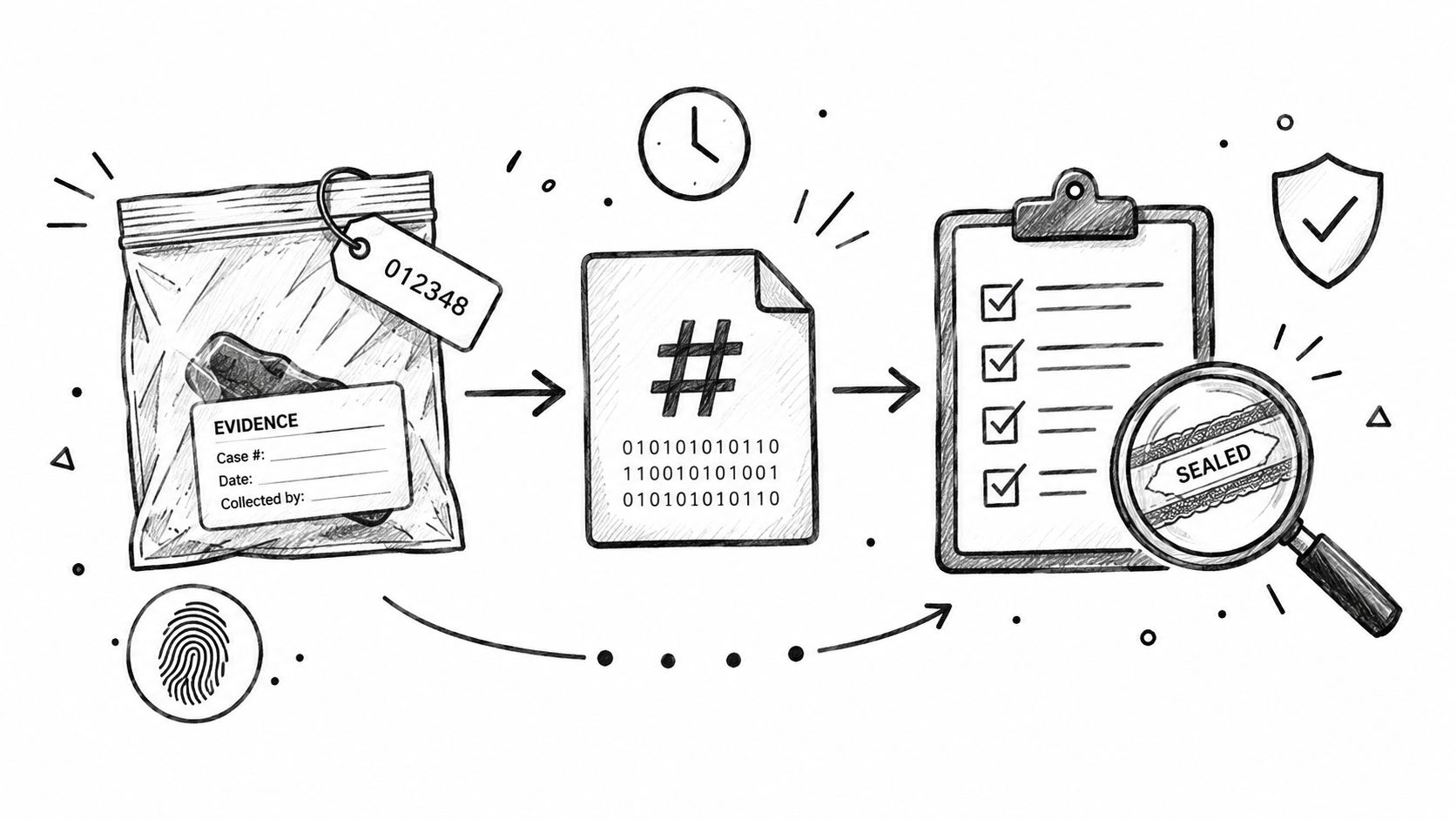
A useful analogy starts with a physical item. A coroner's laptop is seized after a suspicious death. The hard drive is identified, tagged, placed into protective packaging, and transferred to a laboratory. Each person records receipt, storage, examination, and transfer. The record answers a basic question: who had control of this item at every stage?
In cybersecurity, the evidence may be bytes rather than a physical object. The same question still applies to a disk image, an access log, an imaging file, or a toxicology PDF. The evidence record should show what the item is, where it came from, who handled it, what action occurred, when the action happened, and why the transfer was necessary. The NIST definition of chain of custody describes this as chronological documentation of seizure, custody, control, transfer, analysis, and disposition.
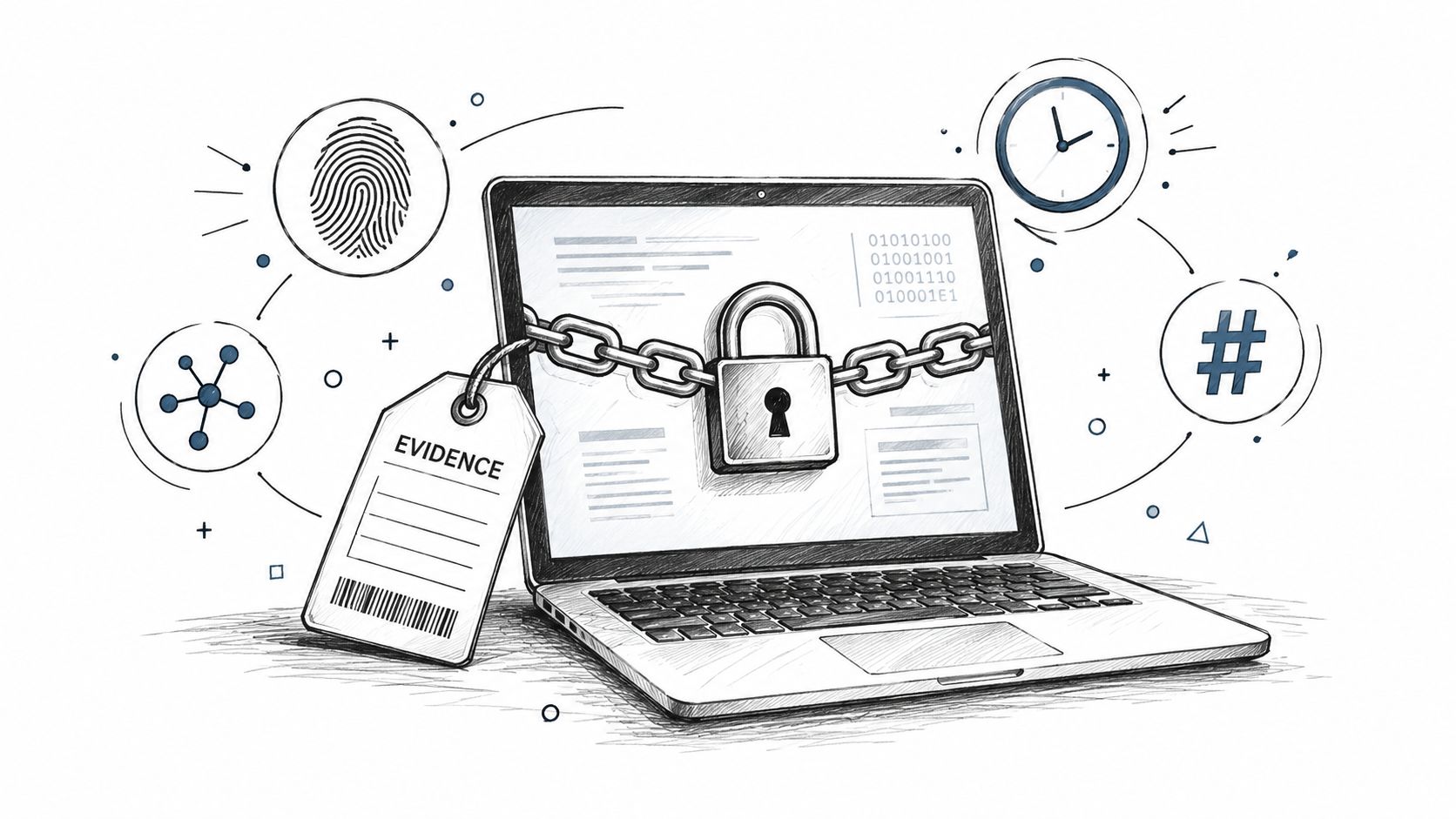
A digital evidence bag cannot be sealed with tape alone. Investigators use cryptographic hashes, controlled storage, and timestamped audit records. A hash creates a digital fingerprint that can be recalculated later. If the new value differs from the recorded value, the team must investigate whether the file was altered, corrupted, or processed incorrectly. NIST recommends hashing digital images and storing the resulting values separately from the evidence in a secure location, as described in its digital evidence preservation guidance.
The legal concern is not paperwork for its own sake. A court, opposing counsel, or independent reviewer may need to determine whether the evidence presented is the same evidence collected at the beginning. A missing custodian, unexplained access event, uncertain timestamp, or undocumented transformation can weaken that showing. Teams seeking a broader explanation of how documented handling can prove authenticity with chain of custody can apply the same principle to both physical and digital records.
For a private autopsy, this may include postmortem imaging, laboratory data, medical records, photographs, and report versions. The chain of custody connects each item to the examination without claiming that the record itself proves the medical conclusion. The forensic pathologist still evaluates the medical evidence. The custody record shows that the evidence was preserved and handled in a traceable way.
The Four Phases Every Digital Custody Workflow Follows
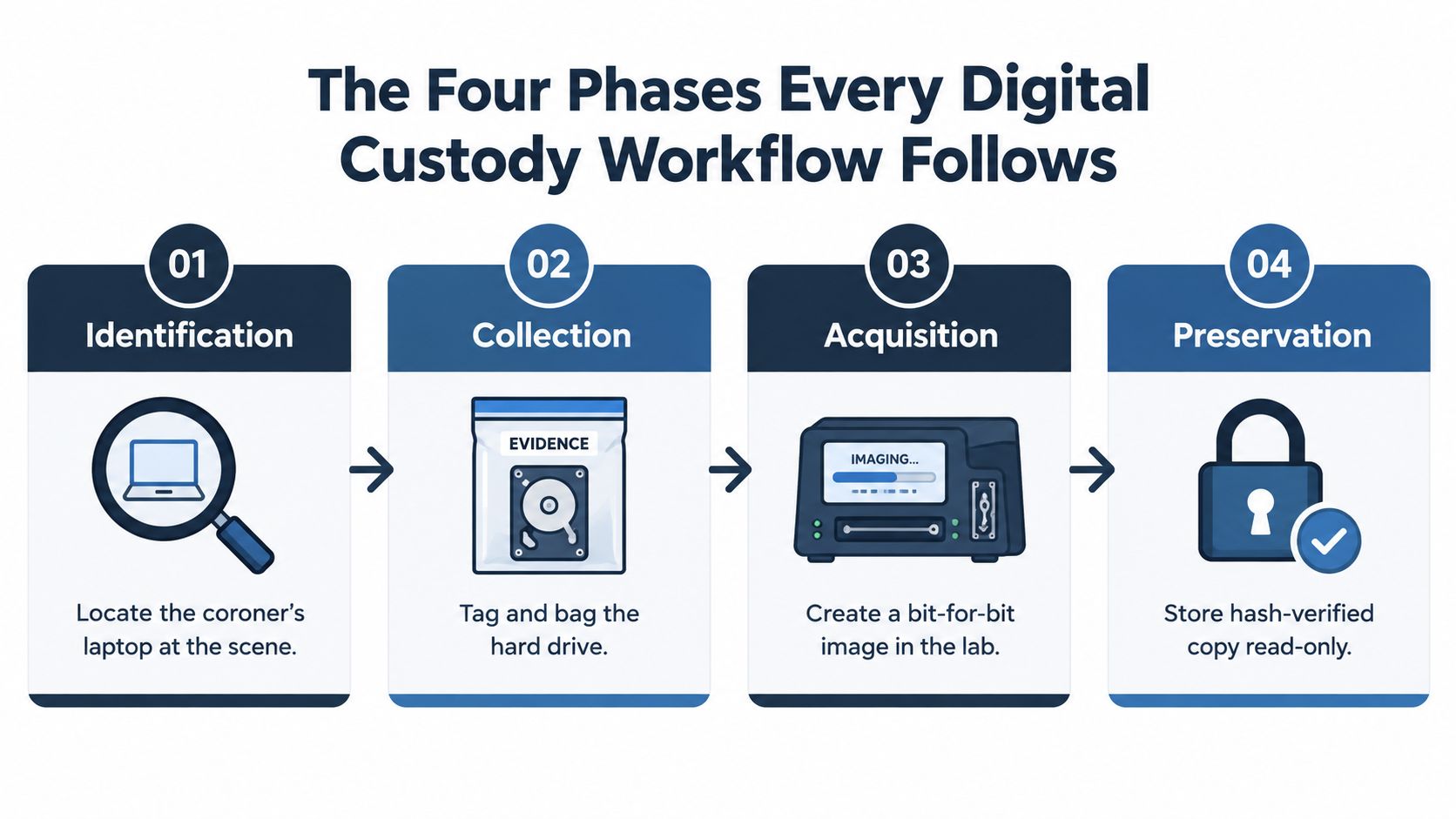
ISO/IEC 27037 provides a practical structure for handling potential digital evidence. Its four phases are identification, collection, acquisition, and preservation. The standard separates the act of locating evidence from the later work of creating a forensic copy and protecting it from change. Its framework is summarized in the ISO/IEC 27037 sample.
Consider a workstation containing a postmortem CT scan and a toxicology report.
Identification begins when a technician determines which systems and files may be relevant. The technician records the case identifier, source device, available file types, and the reason the material may relate to the investigation. Identification should distinguish relevant evidence from unrelated information, especially when the device contains protected health information.
Collection involves securing the identified material and documenting its original condition. A technician may use a controlled transfer method and record the person responsible, the time, the source, and the destination. The objective is to prevent casual access or alteration while the evidence moves into forensic handling. If a damaged drive requires specialist attention, the team should document that decision and the condition of the media before any recovery work. A technical resource on a hard drive data recovery service can help explain why damaged storage needs careful handling, although recovery does not replace a custody record.
Acquisition creates a forensic copy or image for analysis while preserving the original. The team records the tool, method, operator, and resulting hash. If the hash of the acquired image matches the recorded value, that supports the conclusion that the copy corresponds to the captured data. The original should remain protected while analysts work from a documented working copy.
Preservation keeps the evidence and its related records under controlled conditions. Access is limited, every opening or transfer is logged, and hashes can be recalculated to detect an unexpected change. A retention decision should follow the governing statute, legal hold, agency policy, and case requirements. NIST guidance discusses defined retention periods and gives examples such as five years or six months when no statute or local policy applies, but those examples aren't a universal rule. The digital imaging standards guidance provides additional context for controlled imaging workflows.
Each phase answers a different question. Identification asks what matters. Collection asks how it was secured. Acquisition asks how the working copy was made. Preservation asks whether the evidence and its history remained protected afterward.
Anatomy of a Defensible Custody Record
A custody record should let an independent reviewer reconstruct the evidence lifecycle without relying on memory. Each entry should connect a specific item to a specific person, action, time, and purpose.
The following fields are practical because each one answers a predictable courtroom question.
| Custody Field | Courtroom Question It Answers |
|---|---|
| Case identifier | Which investigation does this evidence belong to? |
| Unique evidence item ID | Which exact file, device, image, or export is being discussed? |
| SHA-256 hash or other approved hash | How can the team detect a change in the digital content? |
| Collector name and role | Who acquired the evidence, and were they authorized to do so? |
| Timestamp with time zone | When did collection, access, transfer, or analysis occur? |
| Source device or system | Where did the evidence originate? |
| Transfer method | How did the evidence move from one custodian or system to another? |
| Destination custodian | Who accepted responsibility after the transfer? |
| Purpose of transfer | Why was the item moved or accessed? |
| Signature or MFA confirmation | How was the custodian's identity confirmed? |
| Condition or status | Was the item intact, encrypted, damaged, or otherwise limited at that stage? |
The hash does not identify the person who handled the evidence. It addresses a different issue, whether the digital content changed. Identity and accountability come from named custodians, role assignments, authentication records, and transfer confirmations. NIST guidance emphasizes documenting the people involved, the date and time of collection or transfer, and the purpose of the transfer.
Precise timestamps also matter. A vague entry such as “received in the afternoon” leaves room for avoidable dispute. A time-stamped entry with a time zone, source system, and authenticated custodian gives reviewers a clearer sequence. The chain of custody form guidance can help teams design a form that captures these fields consistently.
A forensic report may include images, laboratory results, photographs, and supporting records. The custody record doesn't decide the medical meaning of those materials. It helps establish the foundation from which the forensic pathologist reached a conclusion and allows counsel to address authentication, reliability, and methodology under the applicable evidentiary rules.
Practical rule: If an action could change, expose, copy, rename, annotate, or relocate evidence, record the action before relying on the result.
HIPAA, Court Admissibility, and the Custody Connection
Protected health information and forensic evidence often occupy the same workflow. Autopsy photographs, imaging files, toxicology results, clinical records, and dictated reports may be stored or transmitted during one investigation. HIPAA compliance and forensic custody aren't identical obligations, but they overlap around access, integrity, accountability, and controlled disclosure.
The Privacy Rule concerns permitted uses and disclosures of protected health information. The Security Rule addresses administrative, physical, and technical safeguards for electronic protected health information. The Breach Notification Rule may become relevant when protected information is accessed or disclosed in an unauthorized way. A missing access log can therefore create two separate problems. The privacy team may need to assess the access event, while counsel may question whether the evidence's handling history is complete.
| HIPAA Control | Evidence It Produces | Court Standard Met | Custody Artifact |
|---|---|---|---|
| Role-based access | A record of who could view or manage the item | Supports identity and authorization analysis | User permission record |
| Audit logging | A time-ordered history of access and activity | Helps reconstruct handling | Append-only access log |
| Integrity protection | Evidence that files remained unchanged | Supports authenticity analysis | Hash or digital signature |
| Secure transfer | A record of how protected data moved | Helps explain continuity of possession | Transfer entry and receipt |
| Disclosure review | A documented reason for sharing information | Clarifies purpose and scope | Authorization or release record |
| Version control | Separation of originals from working copies | Helps distinguish source evidence from analysis | Version identifier and hash |
A hash-verified archive can support an authentication showing, but it doesn't automatically make every record admissible. Counsel must still address the source, relevance, collection method, expert methodology, and applicable Texas rules. Texas Rule of Evidence 901 and related provisions may be relevant to authentication, while expert testimony questions may involve Texas Rule of Evidence 702. The governing agency, court, and facts of the case determine the legal analysis.
Voice dictation creates another point of control. Teams using clinical transcription should evaluate access permissions, retention, export behavior, and whether the original audio and final text are preserved separately. Guidance on secure dictation for HIPAA illustrates why convenience tools need security and audit controls around them. Texas-specific reporting considerations are discussed in HIPAA reporting requirements.
Business-associate arrangements may also matter when a vendor stores, processes, or transmits protected information on behalf of a covered entity. The contract doesn't eliminate the need for custody documentation. Every handoff still needs a named recipient, time, purpose, method, and record of access.
Where Modern Custody Breaks and How to Prevent It
Custody doesn't fail only when someone deliberately tampers with evidence. It can fail silently when ordinary technology changes a file, creates a new copy, or removes the context needed to understand which version was reviewed.
Cloud storage may create automatic versions or place encryption keys and stored data under the same administrative control. A stronger design separates duties where possible, uses customer-managed keys when appropriate, and places the original into write-once or otherwise immutable archival storage. The exact control should reflect the provider, the data, and the legal requirements of the investigation.
AI tools create a different risk. An automated redaction, transcription, classification, or summarization process may produce a useful working product, but it shouldn't overwrite the source evidence. Preserve the original, record the tool and configuration used, retain the output as a separate version, and identify the human reviewer. An AI result is an analytic artifact, not a substitute for the underlying file.
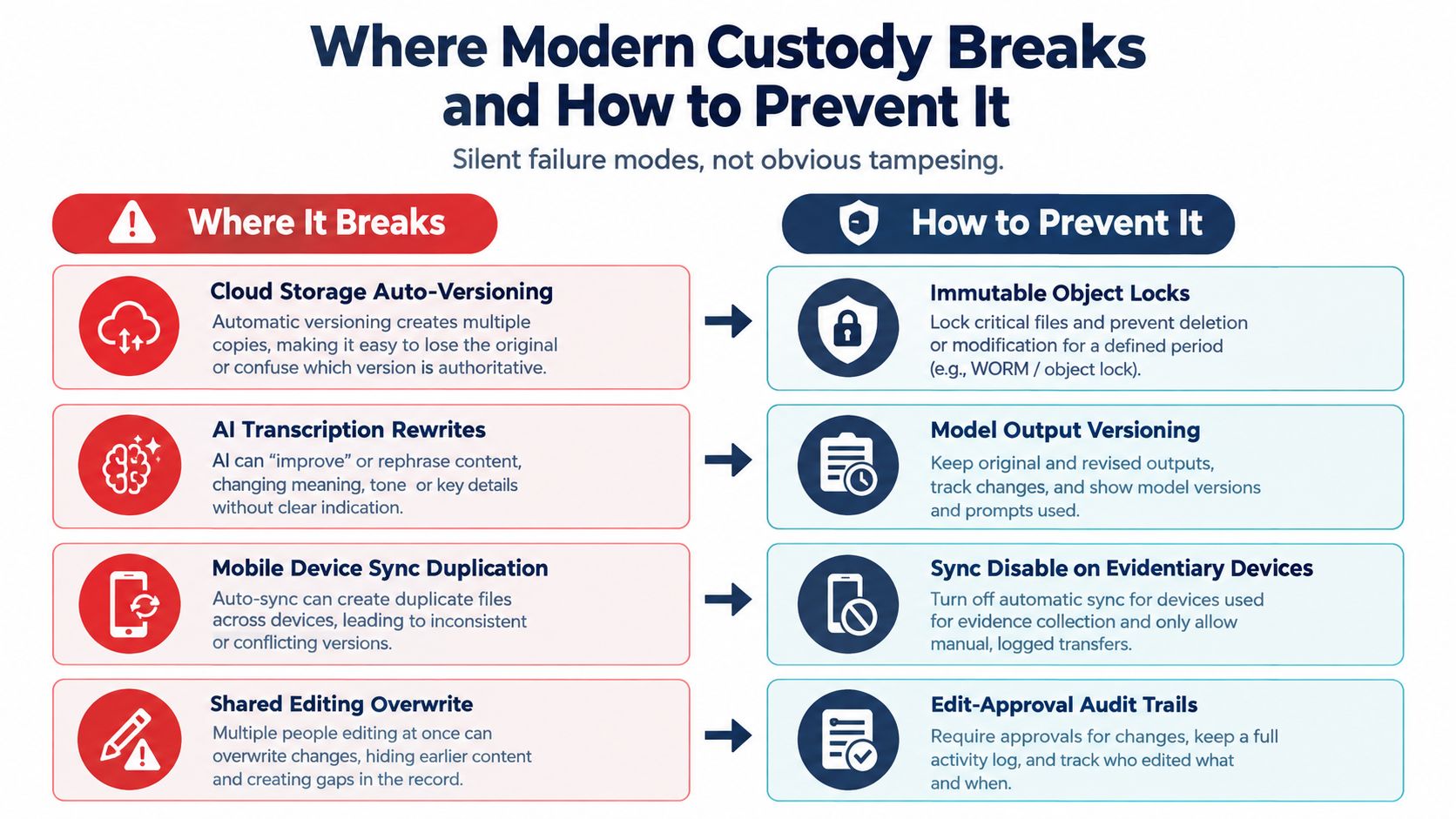
Mobile synchronization can create unlogged duplicates. A phone photograph may automatically upload to a personal account, a shared folder, or a messaging application before intake personnel assign an evidence ID. Investigators should disable automatic synchronization on devices used to capture evidence and use a dedicated forensic capture process that creates an intake record and hash.
Shared editing platforms can also obscure which draft was reviewed. A final report should be separated from working notes, with version history, reviewer identity, approval, and a detached signature or equivalent integrity check. A practical question for any team is simple: Can an independent reviewer identify every original, every working copy, every automated process, and every person who accessed them? If the answer is no, the workflow has a custody gap.
The following video provides another visual explanation of the relationship between handling, documentation, and digital integrity.
Policies and Controls That Keep Records Tamper-Evident
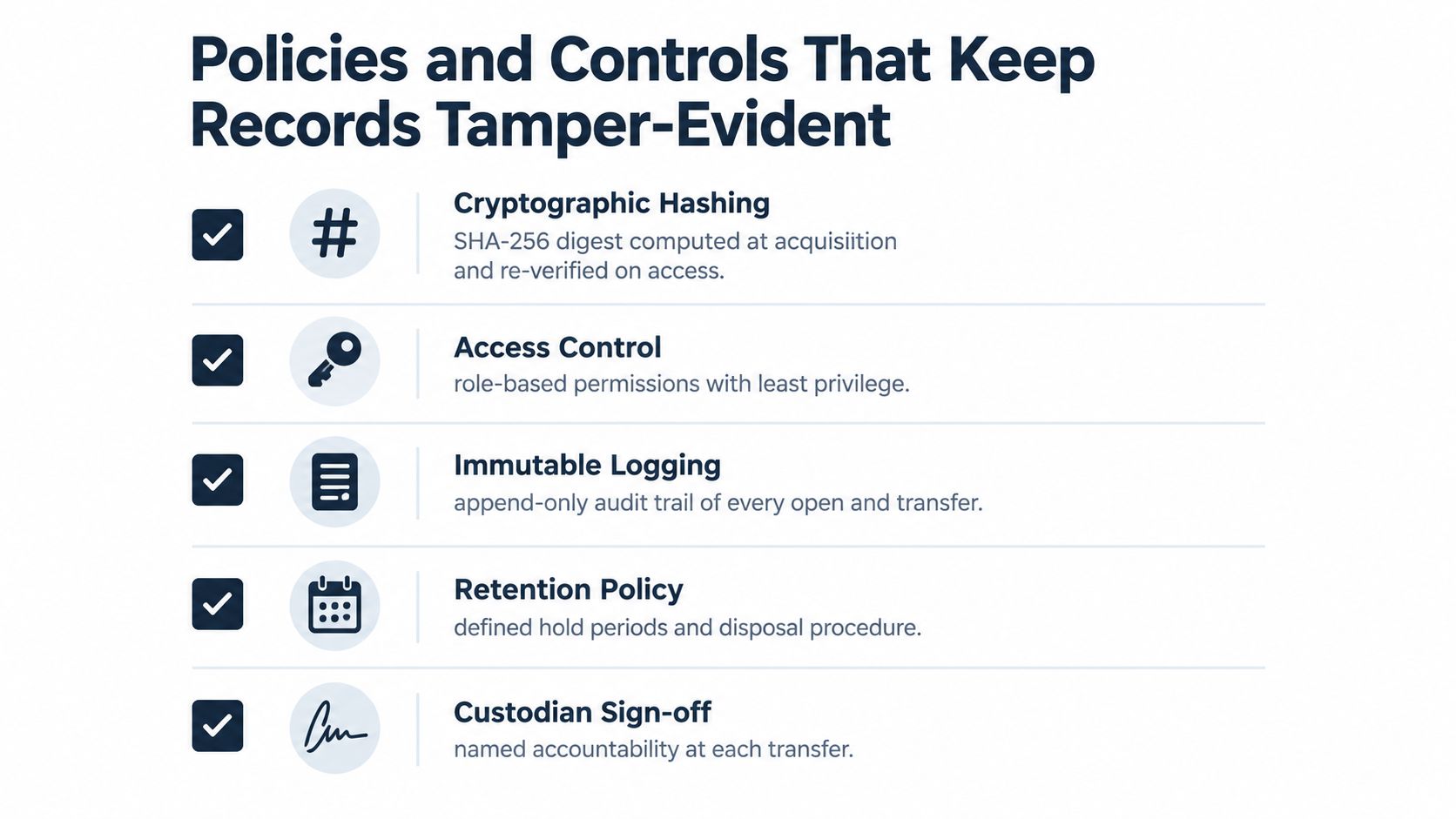
A policy becomes useful when it assigns a control to a specific risk. The following checklist can be adapted by an incident-response team, laboratory, medical practice, or county office.
- Hash at intake: Calculate a SHA-256 digest or another approved hash when evidence is acquired. Store the value separately in protected custody records, then recheck it before analysis, transfer, and final production.
- Preserve the original: Keep source files and original images read-only where possible. Perform analysis on documented working copies, and record the tool and operator associated with each derivative.
- Use append-only logs: Forward access and transfer events to storage that prevents ordinary users from editing or deleting the history. A log should show the custodian, timestamp, action, item ID, and purpose.
- Assign access by case: Role-based permissions should follow the person's assignment to the matter, not broad department membership. Least privilege reduces unnecessary exposure of protected records.
- Require strong authentication: Multi-factor authentication helps establish who accessed the repository. It doesn't replace a custody entry, but it strengthens the connection between an account and a person.
- Synchronize time: Systems should use trusted time sources and document the time zone used in reports. Consistent time makes it easier to compare access records across systems.
- Define retention and disposal: A policy should state how long evidence, hashes, access logs, reports, and transfer records remain available. NIST discusses defined retention after adjudication and gives examples of five years or six months where no statute or local policy applies, but counsel and the responsible agency must determine the applicable period.
- Sign final reports: A detached digital signature or comparable integrity control can reveal a post-signature change to a final report. The signed version should remain available with its custody record.
- Test the process: Periodic custody exercises, repository security reviews, and documented emergency-access procedures expose weaknesses before a dispute does. Break-glass access should be exceptional, approved, and fully logged.
These controls answer different challenges. A hash addresses alteration. An access log addresses handling. A retention policy addresses availability. A signed report addresses later modification. No single tool proves the entire chain.
How Texas Autopsy Services Applies These Safeguards
Our team applies custody principles to the digital materials that support a private autopsy and cause of death investigation. Every examination is performed by a forensic pathologist certified by the American Board of Pathology. That credential addresses professional qualification, while the custody process addresses how supporting evidence is collected, stored, reviewed, and delivered.
Referral records and protected medical information should enter through controlled channels. Imaging archives should use role-based access. Toxicology PDFs and other source records should remain distinguishable from annotated or reviewed copies. Each transfer should identify the custodian, time, purpose, and destination, with integrity checks used where appropriate.
The same structure applies to a second opinion autopsy. When our board-certified forensic pathologists review prior reports, medical records, imaging, or laboratory results, the review should preserve the distinction between the source material and the new interpretation. A signed report can explain the evidence considered, the limits of the review, and the basis for the medical conclusion without suggesting that custody records replace forensic judgment.
Families and attorneys deserve a record that is understandable as well as technically sound. A carefully documented digital trail helps protect the deceased person's story from confusion, accidental alteration, or unauthorized disclosure. It also gives counsel and public agencies a clearer foundation for evaluating the report.
Frequently Asked Questions
What counts as digital evidence in a private autopsy?
Digital evidence can include CT scans, radiographs, photographs, toxicology files, molecular testing results, electronic medical records, emails, access logs, dictated audio, and forensic reports. The relevant question is whether the item may help document the examination, support a medical conclusion, or establish how information was handled.
How long should custody records be retained?
The applicable period depends on the legal hold, agency policy, contract, court order, and governing law. NIST guidance discusses defined retention after adjudication and gives examples such as five years or six months when no statute or local policy applies. Those examples aren't a universal retention requirement for every Texas autopsy or cybersecurity investigation.
Can a family request custody documentation?
A family may ask what records exist and how protected information can be released. Access may depend on authorization, legal representative status, court involvement, privacy obligations, and the interests of an active investigation. Copies may require redaction of unrelated protected information or third-party data.
How can an attorney verify a report before filing it?
Counsel should request the final signed report, identify the source materials considered, review the custody entries for relevant images and laboratory records, and compare recorded hashes or signatures where available. Counsel should also confirm the qualifications of the testifying expert and address authentication and methodology under the rules applicable to the proceeding.
Texas Autopsy Services provides independent private autopsy, second-opinion, and forensic pathology services across all 254 Texas counties, with documented handling of imaging, toxicology, medical records, and reports. Families, attorneys, healthcare professionals, and county officials can contact our team directly or visit Texas Autopsy Services to discuss a respectful examination and a clear, traceable evidence process.