October 5, 2026 · Texas Autopsy Services
Digital Pathology Review for Forensic and Medicolegal Cases
Learn how digital pathology review works in forensic cases, from whole-slide imaging to remote second opinions, turnaround, and Texas legal context.
On this page
- What Digital Pathology Review Means in a Forensic Case
- From Specimen to Whole-Slide Image
- The Digital Review Workflow Step by Step
- Remote Second Opinions and Consultation
- Who Benefits and When It Helps Most
- Limits Accuracy and Common Misconceptions
- Texas Legal Context for Forensic Autopsy Review
- What to Expect When You Reach Out
A family in West Texas may need an independent review after an autopsy has already been completed. The original glass slides may be held by another facility, while an attorney or county official needs a qualified opinion without moving the decedent or delaying an inquest. Digital pathology review can connect the original tissue findings with a secure, documented second review by a forensic pathologist.
- Digital pathology converts glass microscope slides into high-resolution whole-slide images that can be reviewed remotely.
- The digital file supports examination, annotation, consultation, and reporting, but it doesn't replace proper specimen identification or chain-of-custody documentation.
- A digital review can help families, attorneys, healthcare professionals, and Texas county officials seek an independent opinion on sampled tissue.
- Accuracy depends on appropriate validation, image quality, case context, and the qualifications of the reviewing pathologist.
- Every examination performed by Texas Autopsy Services is performed by a forensic pathologist certified by the American Board of Pathology.
What Digital Pathology Review Means in a Forensic Case
A county may refer a death investigation to a board-certified forensic pathologist when local resources are limited or when an independent opinion is needed. The original slides and tissue blocks can remain with the performing facility while authorized digital copies are prepared for secure review.
Digital pathology review means examining a scanned image of a glass microscope slide on a computer rather than placing the physical slide under a conventional microscope. The scan is called a whole-slide image, or WSI. It captures the tissue section at high resolution and allows the reviewing pathologist to move across the specimen, zoom into cellular detail, and record observations.
A useful analogy is a high-detail photograph of a tissue section. The photograph isn't the tissue itself, and it can't show an area that was never sampled. But it can preserve a detailed view of the section that was placed on the slide. A pathologist can enlarge that view, compare regions, mark an area of interest, and share the file with another authorized reviewer.
Practical rule: A digital slide is evidence only when the team can connect it to the correct case, specimen, slide, scanner record, and report.
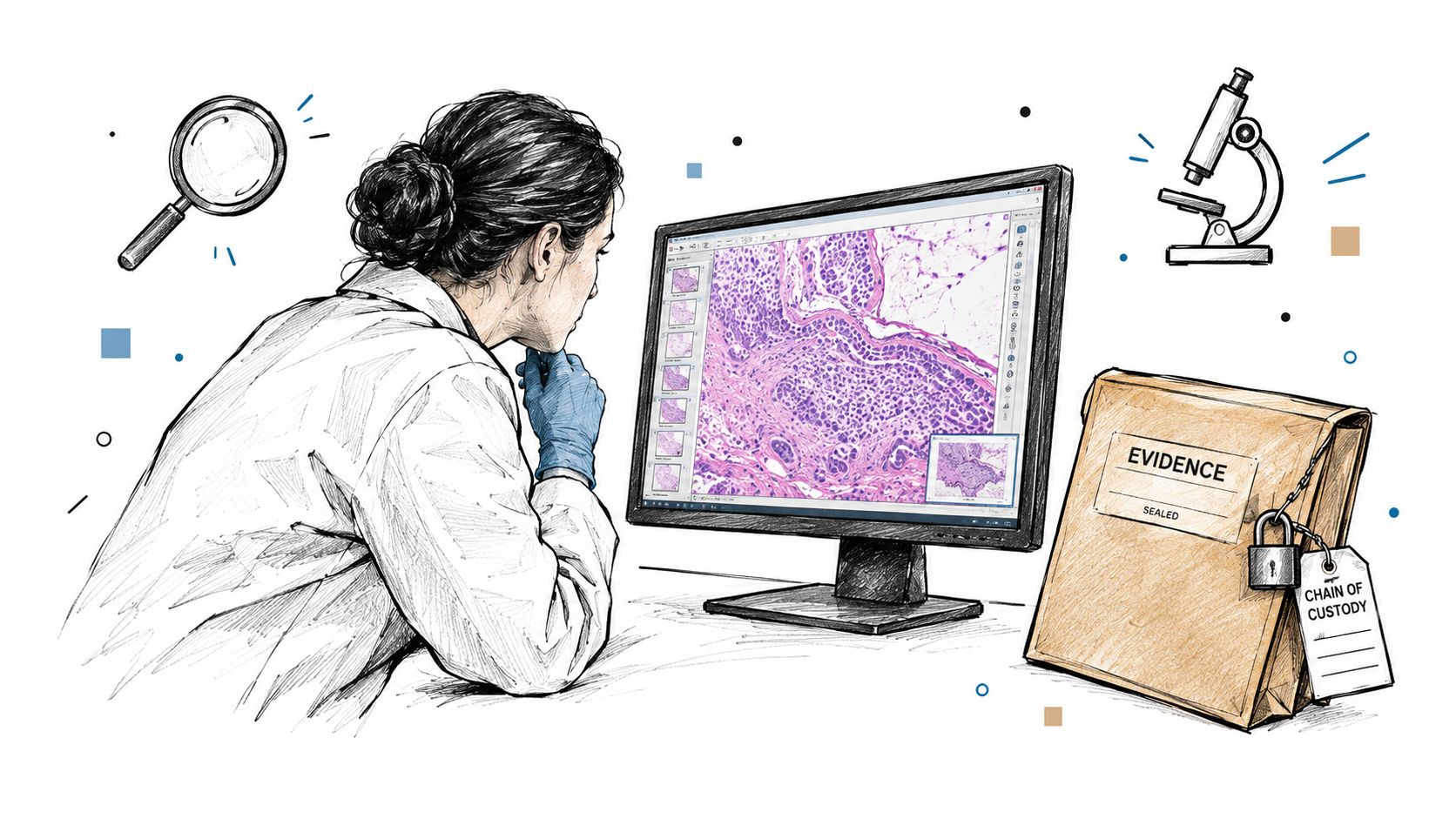
In medicolegal work, the image is only one part of the review. Our team must also establish who requested the examination, who released the materials, how the slides were scanned, who accessed the file, and how the findings were incorporated into a written opinion. That documentation supports a defensible chain of custody, which means a recorded history of possession and handling.
The reviewing pathologist doesn't interpret the image in isolation. The digital findings are considered with the autopsy report, gross examination, medical records, toxicology, circumstances of death, and other relevant information. The final opinion addresses the medical evidence available for review. It doesn't claim to answer questions that the sampled tissue cannot answer.
From Specimen to Whole-Slide Image
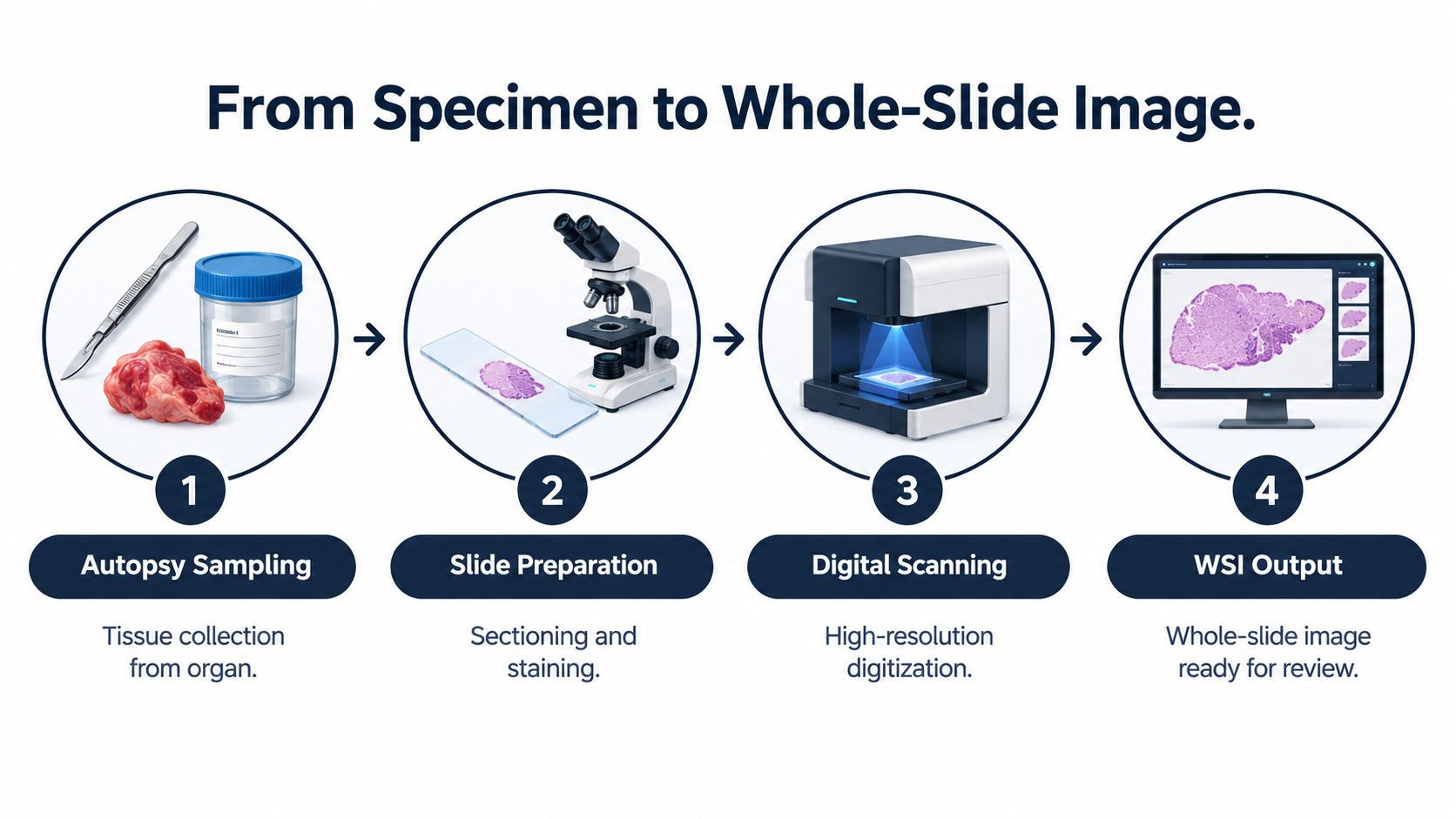
The digital review begins long before a pathologist opens a viewer. During a forensic autopsy, the team collects representative tissue from organs or lesions that may help explain disease, injury, or another possible contributor to death. The sample is identified and placed in a preservative, commonly formalin, so the tissue can be processed for microscopic examination.
The laboratory then performs several preparation steps. Relevant areas are dissected, processed, embedded in paraffin, and cut into thin sections with a microtome. Sections are commonly cut at roughly four to five microns, then placed on glass slides and stained with hematoxylin and eosin, often abbreviated H&E. Special stains or immunohistochemistry may be added when the question involves a particular disease process, tissue component, or toxicology-related finding.
The finished slide contains a thin tissue section that a pathologist would traditionally examine through a microscope. A whole-slide scanner captures that section in overlapping image strips and stitches them into a single digital file. The file can be viewed at low magnification for overall architecture and at higher magnification for cellular detail.
What the reviewing pathologist sees
On screen, the pathologist sees a reproduced microscope field that can be moved in any direction. The reviewer can pan across the tissue, return to a prior location, compare different regions, and annotate a finding without writing directly on the original slide.
The scanner must capture the entire tissue section adequately. Focus problems, missing areas, folds, bubbles, staining variation, and incomplete coverage can affect the usefulness of the image. Quality control is therefore part of the review, not an administrative afterthought.
Ancillary stains and immunohistochemistry can also be scanned when they are part of the case. Our digital image quality guidance explains why scan quality, tissue coverage, and viewing conditions matter when a digital image is used for an independent opinion.
The Digital Review Workflow Step by Step
A court-ready digital review begins with case control. Our team first identifies the requesting party, confirms the purpose of the review, and determines whether the person or agency requesting materials has authority to receive them. A family request, attorney request, county inquiry, and medicolegal agency request may involve different records and different release requirements.
The next step is locating the original material. Depending on the case, that may include paraffin blocks, stained slides, unstained sections, the original pathology report, and related records. Each item is identified, packaged, transferred, and documented. The record should show what was received, from whom, when it was received, and where it was stored.
Image preparation and secure access
Scanning requires more than placing a slide into a machine. The operator checks that the correct slide is being scanned, that the tissue is in focus, that color representation is suitable for review, and that the scan includes the intended tissue. If a scan is incomplete or technically poor, the team may need to rescan the slide or request another preparation.
The digital case is then placed in a restricted-access system. Authorized users receive defined permissions, and access records can show who opened the case, viewed the image, or added an annotation. The platform and the parties handling the information should account for medical privacy and criminal-justice information requirements when those requirements apply.
The pathologist reviews the image alongside the available case information. Findings may be marked with annotations or screenshots, but the written report remains the controlling expression of the opinion. The report identifies the material reviewed, describes relevant findings, explains limitations, and states conclusions in language suitable for an inquest, deposition, or civil filing.
A digital workflow doesn't eliminate professional judgment. It creates a controlled way to deliver the tissue image to the pathologist, preserve the review record, and connect the findings to the broader cause of death investigation.
Remote Second Opinions and Consultation
Traditional consultation usually requires physical slides to be packaged and transported. Digital pathology review allows an authorized consulting pathologist to receive secure access to the scanned material without waiting for the original glass slides to arrive.
| Factor | Glass Slide Shipping | Digital Pathology Review |
|---|---|---|
| Access | The consultant waits for physical materials to arrive | The consultant opens the authorized digital case remotely |
| Preservation | Original slides are handled during packaging and transport | Original slides remain with the originating facility |
| Consultation reach | Limited by shipping, location, and scheduling | A qualified consultant can review from another location |
| Review record | Notes depend on the consultant's documentation | Annotations and access activity can be retained with the case |
| Evidence handling | Physical transfers require careful packaging and documentation | Digital access still requires identity, authorization, and chain-of-custody controls |
Digital review can reduce the practical burden of sending fragile glass slides across jurisdictions. It can also make it easier to ask a subspecialist to examine a focused issue, such as an inflammatory process, a suspected malignancy, or a question involving special stains.
The originating pathologist or agency doesn't lose authority merely because a consultant reviews a digital copy. The consultant provides an independent opinion within the scope of the materials supplied. The original slides, blocks, and underlying records remain important if the matter proceeds to testimony or a dispute about the evidence.
For families and attorneys, the decision to seek another opinion should be based on the unresolved question, not on the availability of a new viewing method. Our second-opinion autopsy guidance describes the records and questions that can help determine whether a review is appropriate.
Who Benefits and When It Helps Most
Digital review is useful when the question is specific and the available tissue is adequate. It isn't automatically the right response to every disagreement about a death investigation.
Families seeking clarification
A family may have received an autopsy report but still have questions about how disease, injury, or other findings contributed to death. A slide-only review can provide an independent opinion without requiring another examination of the decedent. It may also be appropriate when a hospital or facility completed an examination but the family wants a forensic perspective on the tissue findings.
The reviewer needs more than a family's concern. The report, available slides or blocks, medical records, toxicology, and circumstances surrounding the death help the pathologist understand what the tissue can and cannot establish.
Attorneys evaluating evidence
An attorney may need an independent review after receiving an adverse pathology finding in a criminal, civil, or wrongful-death matter. The digital file can help counsel evaluate whether the documented interpretation is supported by the sampled tissue and whether a focused expert challenge is warranted.
A review may also support credible evidence when counsel needs to understand a disputed diagnosis before deposition. The reviewing pathologist should distinguish between an observation on the slide, an interpretation of that observation, and a conclusion about cause or manner of death.
Counties and justices of the peace
A county official may need pathology input during an inquest when local resources are unavailable or when a second opinion is needed. Texas law gives a justice of the peace discretion to direct a physician to perform an autopsy during an inquest and requires an autopsy in specified circumstances, including when the justice determines it's necessary to confirm cause of death or when directed by certain prosecuting authorities. The CDC summary of Texas coroner and medical examiner law describes these authorities in plain language.
Digital consultation can help an authorized review proceed without moving the original slides between offices. It doesn't remove the county's statutory responsibilities, and it doesn't replace the official decision-maker's role.
Limits Accuracy and Common Misconceptions
Digital pathology isn't a lower-quality opinion just because the pathologist isn't looking through a traditional microscope. In a systematic review of 25 studies covering 10,410 histology samples, digital and conventional microscopy showed 98.3% overall concordance, with 92% complete concordance. These findings are reported in a review published by Modern Pathology and should be understood as evidence about validated digital workflows, not a promise about every case or every scanner. The systematic review is available through Nature.
Accuracy still depends on validation and the intended use. Whole-slide imaging used for clinical review requires an in-house validation study before deployment. The guidance calls for at least 60 cases for one intended use, with another 20 cases when additional applications such as immunohistochemistry or special stains are included. Laboratories should investigate concordance below 95% between digital and glass-slide reads. The validation recommendations are described in this pathology practice review.
What digital review can and cannot establish
Comparative evidence shows strong performance when the workflow is properly validated. One academic-center study reported 99.3% glass-slide to WSI diagnostic concordance, with more than 97% agreement for stage and 100% agreement for margin status. Another large study of an FDA-cleared WSI platform found noninferior primary-diagnosis accuracy, with accuracy around 92% in both arms and a difference of about 0.6 percentage points. The comparative evidence is summarized in this Nature review.
Those results don't mean every finding is equally easy to assess digitally. Complex features, including lymphovascular or perineural invasion, may show lower agreement than the overall diagnosis. A digital review also can't substitute for gross examination, recover tissue that was never sampled, or answer a question outside the material provided.
Turnaround depends on slide availability, scanner access, scan quality, records, case complexity, and the questions presented. Most cases may be completed within 24–48 hours when the necessary materials and authority are already in place, but that isn't an unconditional guarantee.
Cost also varies. A private review fee applies, and the total depends on the number of slides, additional stains, records, and the required scope of the opinion. Digital access may reduce travel and courier needs, but it doesn't eliminate professional review, secure handling, or report preparation.
Texas Legal Context for Forensic Autopsy Review
Texas separates a private examination requested by a family from a medicolegal investigation conducted under government authority. A family may seek a private autopsy or an independent review for answers, documentation, or litigation. A justice of the peace or medical examiner may control materials generated during an official death investigation.
That distinction matters before anyone requests slides, blocks, or digital images. The organization holding the materials must determine whether release is permitted, who has authority to request it, and whether the release could affect an active investigation or evidence record.
The role of Chapter 49
Texas Code of Criminal Procedure Chapter 49 addresses inquests and death investigations. In counties where a commissioners court establishes an office of medical examiner, the powers and duties of justices of the peace relating to death investigations and inquests transfer to that office. The Texas Code of Criminal Procedure PDF explains this county-level structure.
A digital slide prepared from official evidence should be treated as part of the documented case record. The scan should be linked to the original slide and specimen, and the report should identify what was reviewed. Digital review may support testimony at an inquest, a deposition, or a grand jury proceeding, but the reviewing pathologist's evidentiary weight depends on qualifications, methodology, records, and the court's rules.
Private requests and evidence preservation
A private autopsy request doesn't automatically give a family or attorney control over materials held by a medical examiner, justice of the peace, law enforcement agency, or other authorized custodian. Consent and release requirements must be addressed before the review begins.
Our explanation of chain-of-custody requirements covers the practical documentation needed when physical or digital materials move between parties. Texas Autopsy Services also works within the broader compliance context of the Texas Funeral Service Commission and Texas Health & Safety Code Chapters 711, 716, and 651. The governing agency and statute depend on the specific facts, so a legal question should be directed to qualified counsel.
What to Expect When You Reach Out
The first conversation should identify the question, the available material, and the authority behind the request. A family member, attorney, healthcare professional, justice of the peace, or county official may contact our team by phone or email. We ask for enough information to determine whether the matter involves a full private autopsy, a slide-only review, or a remote second opinion.
Have the following information available if possible:
- Decedent information: The full name and relevant identifying details help us match the request to the correct case.
- Case information: Provide an agency case number, medical examiner number, hospital number, or attorney file reference if one exists.
- Ordering authority: Identify whether the request comes from a family representative, attorney, county official, justice of the peace, medical examiner, or another authorized party.
- Existing records: Send the original autopsy report, pathology report, toxicology report, medical records, and photographs when available.
- Specific questions: Explain what remains unclear, such as a disputed cause of death, a tissue interpretation, or the relationship between a finding and the final opinion.
Our team then confirms what can be released and what additional consent or authorization is required. We don't assume that a person who has received a report automatically has authority to obtain every slide, block, image, or investigative record.
Choosing the appropriate review
A full private autopsy involves a new postmortem examination when legally and practically appropriate. A slide-only review focuses on existing tissue sections. A remote second opinion may combine digital slides with the original report, medical history, toxicology, and other records.
The scope affects both the work and the report. A narrow question may require focused slide review, while a disputed cause of death may require a broader examination of all available records and materials. Every examination is performed by a forensic pathologist certified by the American Board of Pathology.
Reports and communication
The written report describes the materials reviewed, relevant findings, limitations, and conclusions. Depending on the request, it may be used to support an inquest, litigation review, a deposition, or communication with a family. A report doesn't replace legal advice, and it doesn't provide medical treatment guidance for living people.
Most cases within 24–48 hours is a possible expectation when the request is properly authorized, the slides are available, the scans are usable, and the question is defined. Records held by another facility, additional testing, poor tissue quality, complex interpretation, or an active investigation can change the timing.
After the report is issued, our team can explain the findings in plain language and address questions about the scope of the opinion. Questions about litigation strategy, subpoena practice, or evidentiary objections should remain with the attorney handling the matter.
Preparing the basic documents before calling helps prevent avoidable delays. Families and attorneys should gather the original reports, case numbers, contact information for the facility holding the slides or blocks, proof of authority, and a short written list of unresolved questions.
Texas Autopsy Services offers private autopsy services Texas families, attorneys, healthcare professionals, and county officials can use when an independent forensic pathology review is needed, including whole-slide digital microscopy and remote consultation on authorized material. Visit Texas Autopsy Services to contact our team, explain the case, and learn what records and authorization are needed before a digital pathology review can begin.