September 6, 2026 · Texas Autopsy Services
Chain of Custody Requirements for Texas Autopsies
Learn chain of custody requirements for forensic evidence in Texas. Understand documentation, legal standards, and how Texas Autopsy Services ensures
On this page
- Why Chain of Custody Determines Whether Evidence Holds Up in Court
- What Chain of Custody Actually Means in Forensic Practice
- Texas Laws That Govern Chain of Custody for Forensic Evidence
- Documentation Standards for Biological Specimens and Toxicology
- How Texas Autopsy Services Maintains Court-Admissible Chain of Custody
- Common Questions About Chain of Custody in Texas Autopsy Cases
A family may receive an autopsy report that appears medically clear, yet an attorney later discovers that a specimen changed hands without a complete transfer record. The scientific observation may still be sound, but the legal path connecting that observation to the evidence can become difficult to defend. For grieving families, that distinction can affect whether important answers are accepted in court, insurance proceedings, civil litigation, or a family dispute.
At Texas Autopsy Services, we treat chain of custody requirements as part of the medical-legal examination itself. Every examination is performed by a forensic pathologist certified by the American Board of Pathology, with attention to identification, transport, specimen control, storage, laboratory work, imaging, and reporting. Our practice is based in Elgin, Texas, and serves families, attorneys, healthcare professionals, and county officials across all 254 Texas counties.
- Chain of custody connects evidence to the courtroom by documenting possession, handling, storage, and transfer.
- Texas law provides specific mechanisms, including a chain-of-custody affidavit under Article 38.42.
- Biological specimens and toxicology samples require detailed records, including handling actions, dates, purposes, and specimen identity.
- A private autopsy depends on both medical findings and defensible evidence control.
- Families and attorneys should ask how evidence was identified, sealed, transported, stored, analyzed, and reported.
Why Chain of Custody Determines Whether Evidence Holds Up in Court
A family contacts an independent practice after a death because the official explanation leaves unanswered questions. An attorney wants a tissue sample, toxicology result, photograph, or retained specimen reviewed. The examination is performed carefully, and the findings are medically persuasive. Later, during litigation, someone asks who possessed the specimen between collection and laboratory intake. The record shows the transfer occurred, but the date, handler, or seal condition was not documented clearly.
That gap doesn't automatically decide the case. It does create a point of challenge. The opposing side may argue that the item presented in court cannot be reliably connected to the item collected during the examination, or that its condition changed before analysis. The issue isn't limited to whether someone acted improperly. A missing or delayed record can make proper handling harder to prove.
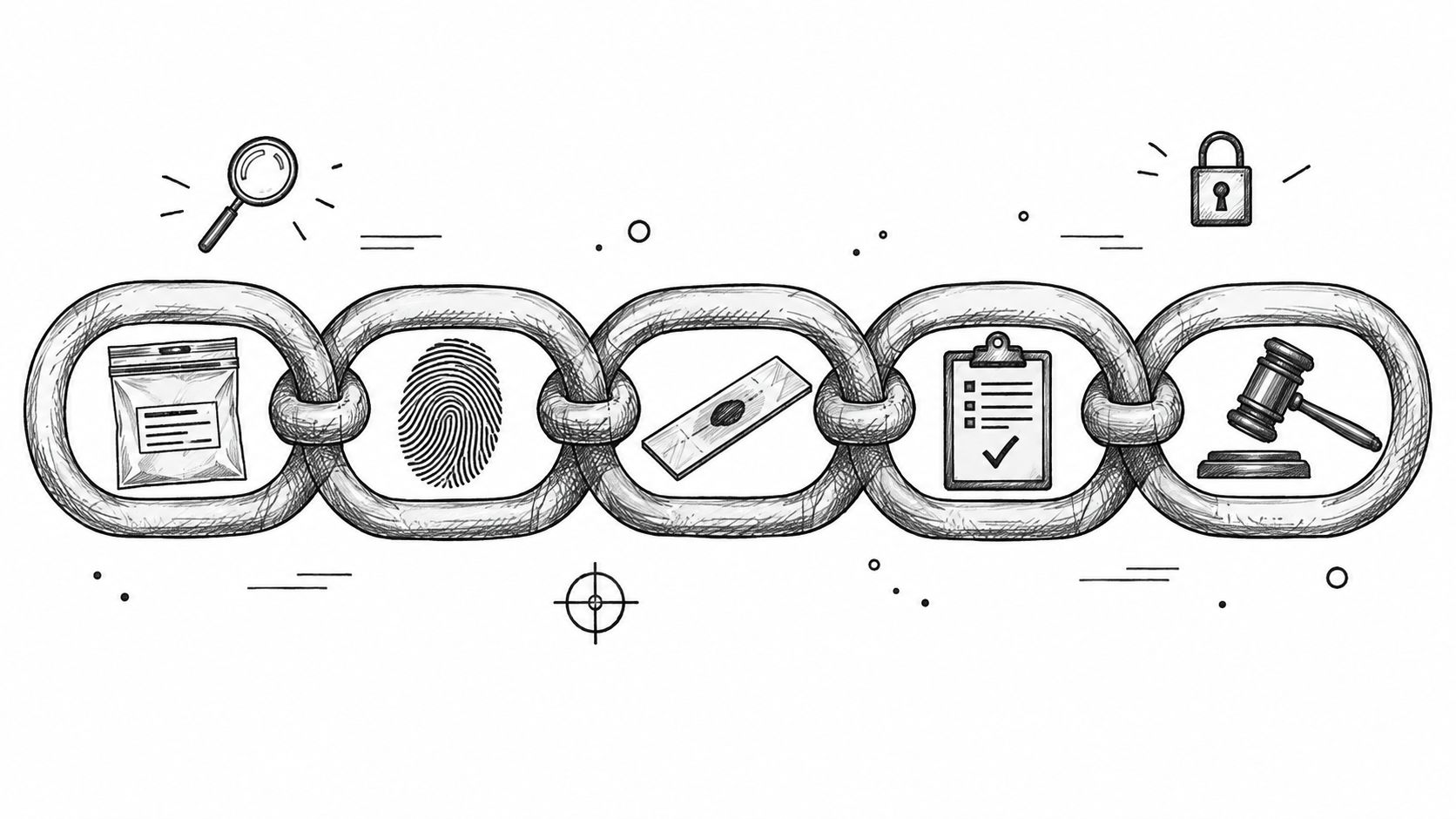
Chain of custody is the documented continuity of possession from discovery through transport, examination, storage, and eventual court admission. The record should show what the item was, who collected it, how it was packaged and sealed, where it went, and who had control of it at every transfer. The forensic science and law discussion provides related context on why scientific evidence must also satisfy legal authentication requirements.
Practical rule: A medically reliable result still needs a credible evidence history.
For families, the concern may arise during a wrongful-death claim, an insurance dispute, a probate matter, or a request for a second opinion. For attorneys, the concern may involve admissibility, evidentiary weight, disclosure, or preparation for testimony. For county officials, it may affect whether an outside provider can receive, transport, preserve, and return evidence under a documented process.
The strongest workflow records each custody event when it happens. Reconstructing the history later from memory, emails, or informal notes is less reliable. A complete chain doesn't promise that a court will accept every item. It gives the court a clear basis for evaluating identity, condition, handling, and authenticity.
What Chain of Custody Actually Means in Forensic Practice
In forensic practice, chain of custody is a formal evidence-control requirement. It begins when an item is identified or recovered and continues through transport, secure storage, laboratory examination, return, disposition, and court presentation. The National Institute of Justice guidance summarized through StatPearls describes the record as including identifiers for the evidence, the collector, packaging and sealing information, movement, and each person who possessed the item.
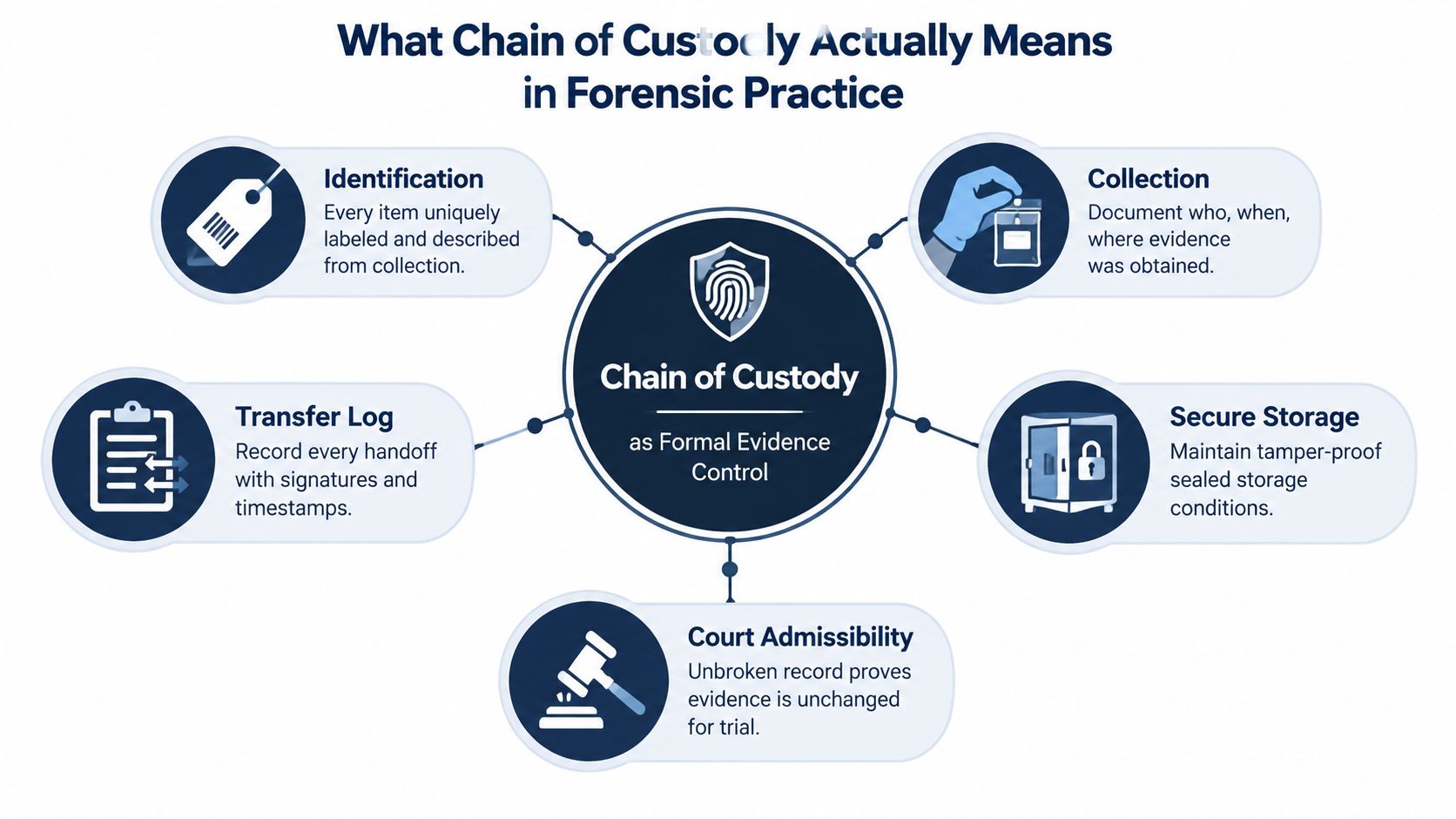
A defensible record answers five practical questions:
- What is the item? The evidence receives a unique identifier and a description that distinguishes it from other items in the same case.
- Who collected it? The collector, location, circumstances, and relevant date or time are documented.
- How was it protected? Packaging, seals, container condition, and any required storage conditions are recorded.
- Who handled it afterward? Every authorized transfer identifies the releasing and receiving parties, with signatures or equivalent verification and the reason for the movement.
- What happened during examination? The record connects the item to accessioning, testing, imaging, aliquoting, storage, reanalysis, return, or disposal.
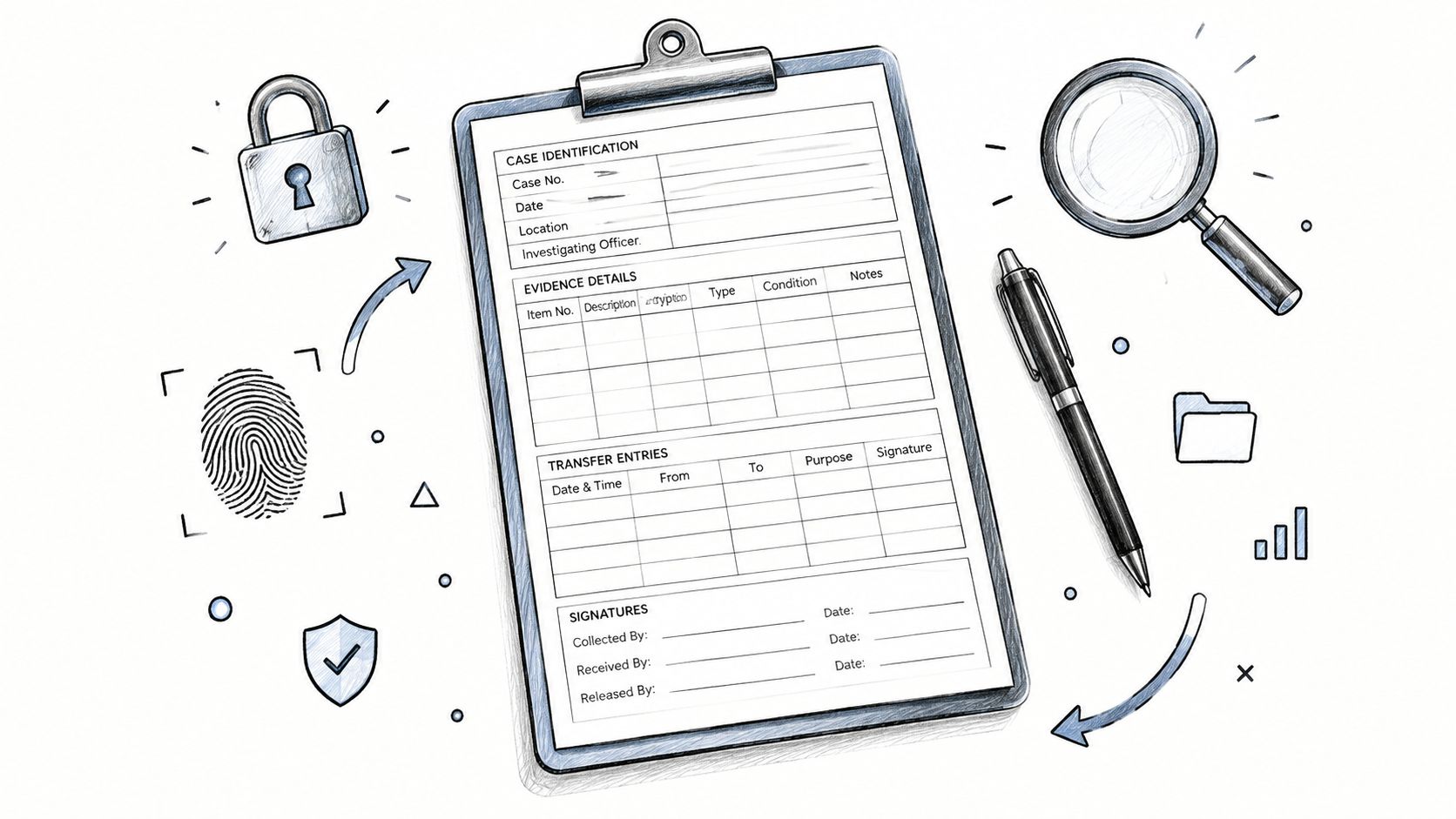
The purpose isn't to create paperwork for its own sake. It is to allow another person, including a judge, attorney, laboratory reviewer, or family representative, to follow the evidence history without guessing. A chain-of-custody form should also contain handler contact details, item details, and the type of analysis requested when those fields apply.
The same principle appears outside forensic medicine. Organizations designing traceability systems can compare this work with the evidence lifecycle for product passports, particularly when multiple parties must document possession, status, and verification. The setting differs, but the central question is similar: can the record show what happened to a specific item over time?
A signature alone isn't enough if the item isn't uniquely identified or if the seal condition is unknown. Conversely, a digital record can be useful only when access, edits, and custody events are controlled and explainable. Good chain-of-custody practice combines identification, timely documentation, secure handling, and a clear connection between the preserved item and the final finding.
Texas Laws That Govern Chain of Custody for Forensic Evidence
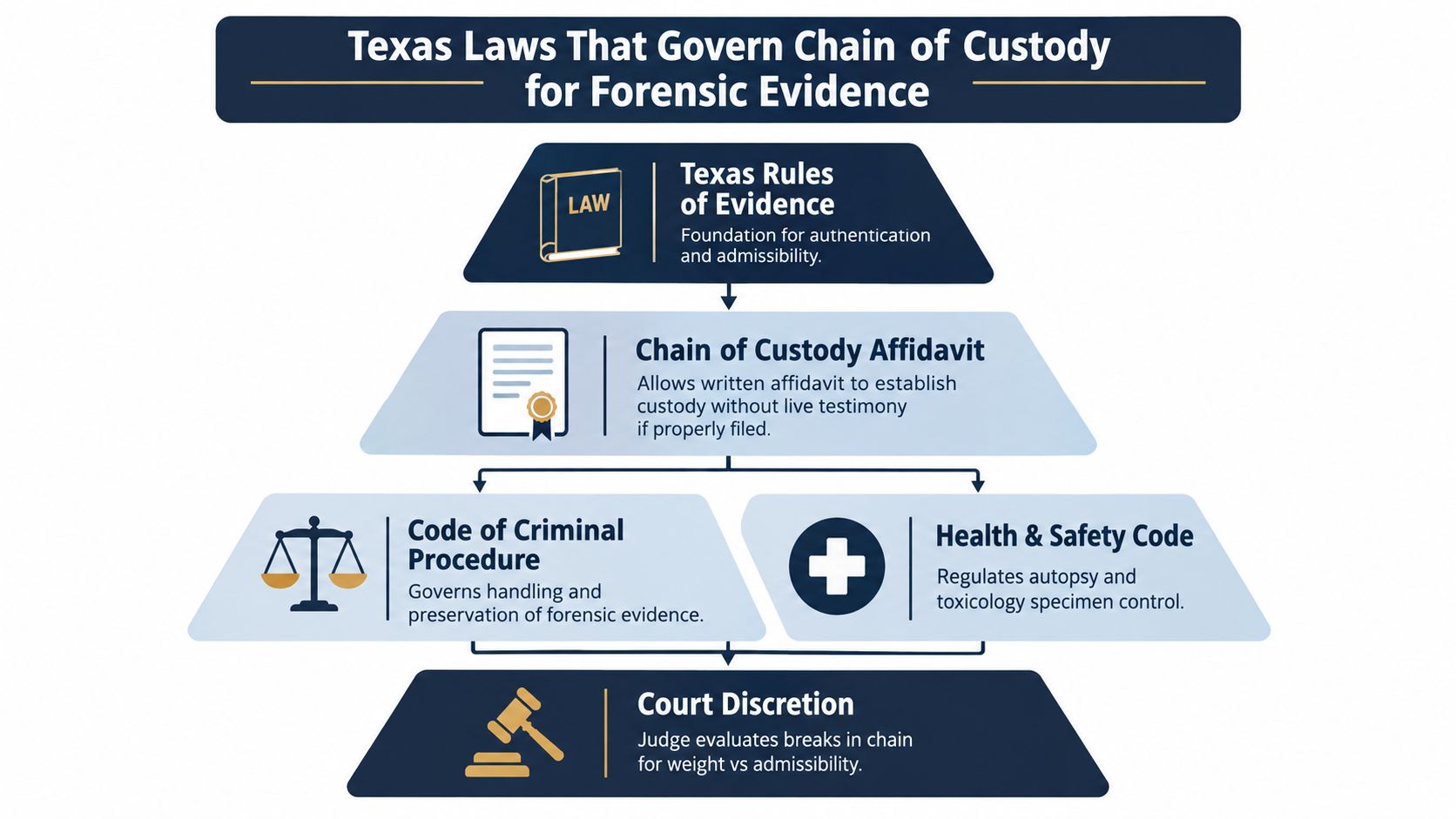
Texas cases require attention to the type of evidence, the proceeding, and the agency or professional responsible for the evidence. Chain of custody is not governed by one universal form for every autopsy, laboratory, criminal, civil, or county matter. The applicable statute and evidentiary rule depend on the circumstances.
Texas Article 38.42 of the Code of Criminal Procedure allows a chain-of-custody affidavit to substitute for live testimony when the affidavit satisfies the statute. The affidavit can be admissible for either side to establish the chain of custody of physical evidence without requiring every custodian to appear personally. The statutory text is available through this Texas Article 38.42 reference.
That mechanism can reduce the need for every person in the custody sequence to testify, but it doesn't make weak documentation strong. The underlying record still needs to identify the evidence and establish the relevant transfers. If the affidavit omits a material event or conflicts with the laboratory record, an attorney may challenge its reliability or ask the court to give the evidence less weight.
Statutory duties for sex-offense evidence
Texas Government Code Section 420.033 imposes a continuous custody duty for sexual-assault and other sex-offense evidence. Medical, law-enforcement, department, and laboratory personnel must maintain the chain from collection until destruction. The Texas statute governing custody of sex-offense evidence makes clear that preservation is an ongoing responsibility, not merely a collection-stage task.
What belongs in a Texas autopsy record
Health and Safety Code Chapter 671 defines the scope of a Texas autopsy report. It includes the postmortem examination report, x-rays and photographs taken during the actual examination, toxicology reports, and other internal-organ examination reports. It does not include investigative reports or other documents the physician reviewed while determining the cause of death. The Texas statutory material addressing autopsy reports should be consulted for the governing language and context.
These distinctions matter when attorneys request records. A custody form, toxicology report, investigative file, and autopsy report may be related, but they aren't necessarily the same document or controlled by the same authority. Our team identifies the evidence category and preserves the corresponding documentation so the final report doesn't blur medical findings with outside investigative material.
Documentation Standards for Biological Specimens and Toxicology
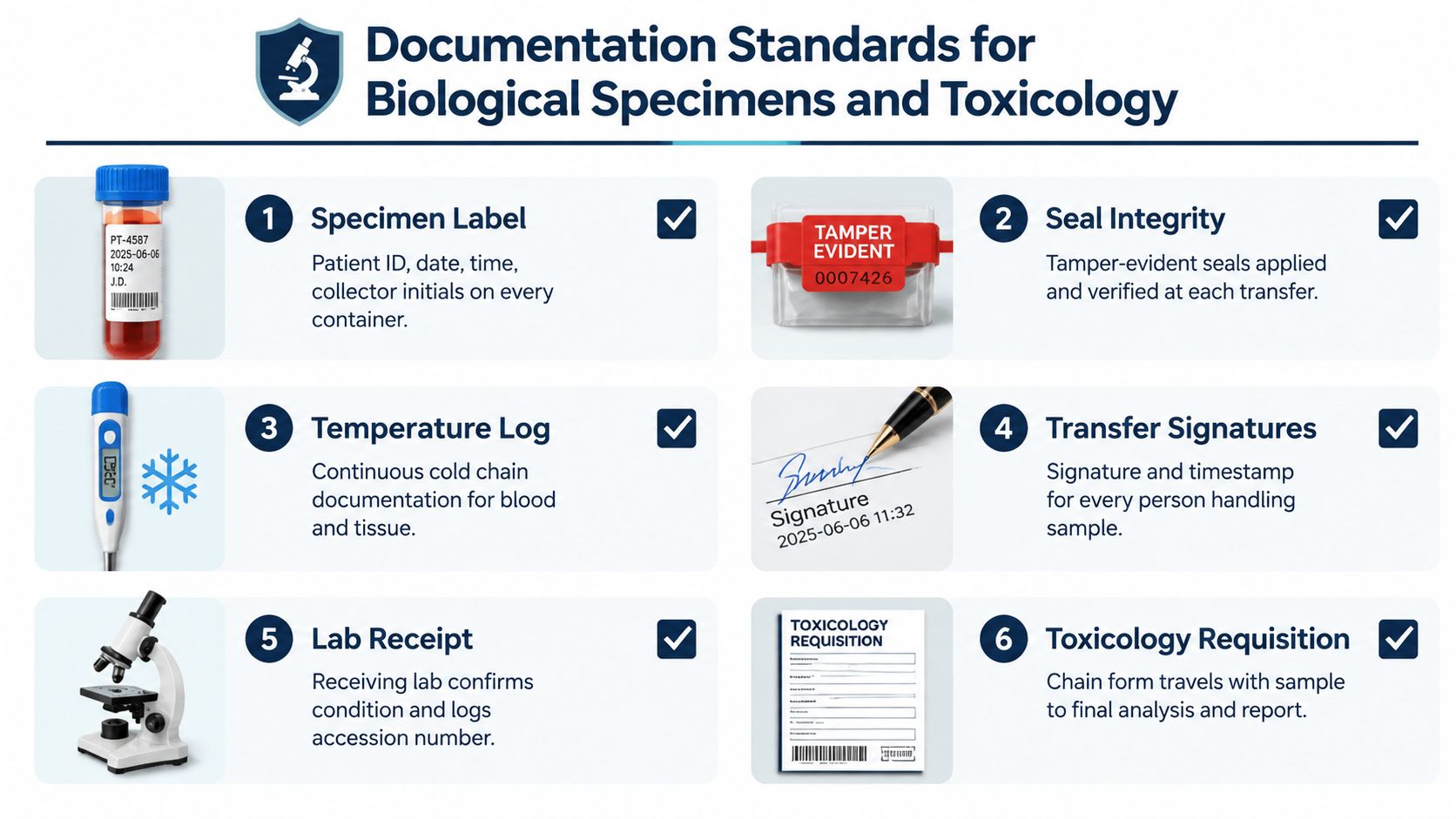
A blood tube, tissue container, swab, or aliquot needs more than a sign-out line. For biological specimens and toxicology, the laboratory should document every person who handles the specimen or aliquot, the exact date of each receipt, handling, transfer, and action, and the purpose of each action. The forensic toxicology documentation standard identifies activities such as accessioning, storage, analysis, and disposal as part of that record.
Why aliquots create additional risk
A specimen may be divided so the laboratory can perform different analyses or preserve material for later review. Once that happens, the original container and each resulting aliquot must remain connected through identifiers and records. A report that names only the case, without identifying the exact specimen analyzed, leaves an avoidable weakness in the evidence history.
The record should show:
- Specimen identity: The case identifier, container description, and specimen type must remain consistent.
- Action and purpose: Each receipt, transfer, storage event, analysis, reanalysis, or disposal should state what occurred and why.
- Handler accountability: The person performing or receiving the action should be identifiable.
- Storage conditions: Refrigerated or otherwise controlled storage should be documented when it affects specimen integrity.
- Seal and container condition: The record should show whether packaging was intact when received and when transferred.
- Synchronized timing: The event time and the entry time should not leave unexplained gaps.
Delayed logging can create a problem even when the specimen was handled properly. If the transfer occurred before anyone recorded it, the organization may have difficulty demonstrating the sequence after the fact. That is why a clear lab stakeholder plan can help define who communicates, who receives, who authorizes testing, and who closes the record.
Our team also treats preservation as a separate operational concern. Families and attorneys seeking more detail can review our guidance on specimen preservation. The medical conclusion should be tied to the precise material examined, not to a case number or an informal description.
How Texas Autopsy Services Maintains Court-Admissible Chain of Custody
Our practice treats custody control as a continuous workflow, beginning with the first contact and continuing through the final written report. We document the release information, identify the decedent and relevant evidence, coordinate licensed in-house transport, and maintain controlled handling during examination and laboratory work. We serve all 254 Texas counties from our Elgin, Texas facility.
Transport and intake
Transport is a custody event, not a scheduling detail. Our licensed transport team records the authorized release, movement, receipt, and condition of the decedent or evidence. Secure temperature-controlled storage supports preservation after intake, while access is limited to authorized personnel and documented within the case workflow. Our secure storage facility information explains the role of controlled storage in evidence protection.
Examination and laboratory work
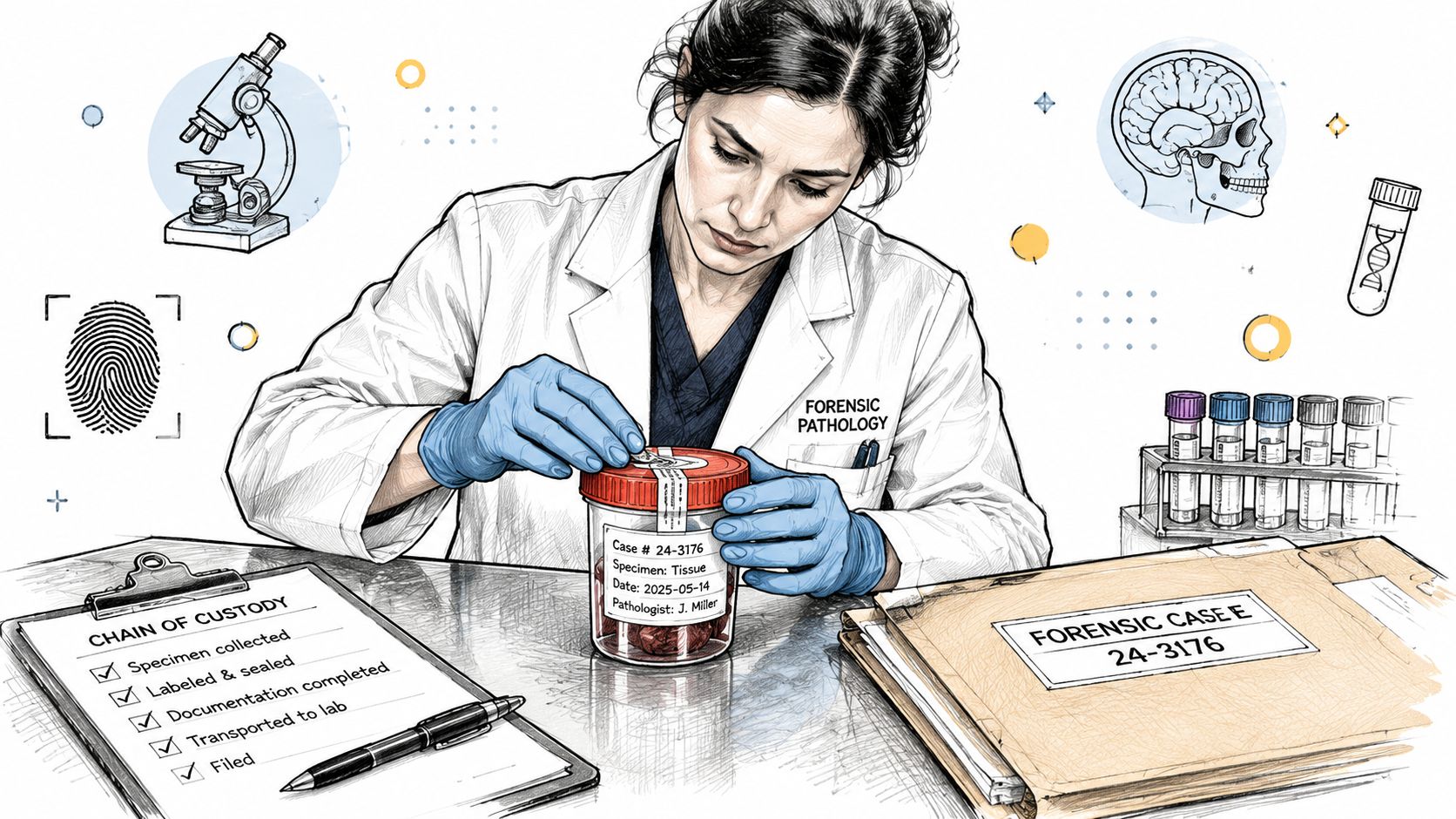
During examination, our board-certified forensic pathologists connect observations, photographs, retained specimens, and requested testing to the case identifier. Containers are labeled, sealed, and tracked. When specimens move to a laboratory, the transfer record identifies the receiving location, the requested analysis, and the relevant condition or seal information.
Digital images and reports require the same attention to identity and access. We maintain digital imaging protocols and HIPAA-compliant reporting so that the documented medical findings remain connected to the correct examination. If testing involves aliquots or later review, the record must preserve the relationship between the original specimen, the derivative sample, and the reported result.
Reporting and communication
The final report distinguishes cause of death, manner of death, and supporting observations. Cause of death identifies the disease, injury, or condition that produced death. Manner of death is the classification of how the death occurred, such as natural, accident, suicide, homicide, or undetermined, when the available evidence supports such a classification. These are medical-legal conclusions based on the postmortem examination and related evidence, not general diagnoses for living patients.
We provide direct communication with families, attorneys, healthcare professionals, and county officials. Our flat-rate, all-inclusive pricing covers the agreed examination and related custody workflow without separating each routine handling event into an unexpected charge. Most cases are completed within 24–48 hours, although examination complexity, laboratory testing, preservation needs, and legal circumstances can affect the process.
Common Questions About Chain of Custody in Texas Autopsy Cases
What happens if a custody gap is discovered?
A gap should be identified, described, and evaluated rather than filled from memory. The significance depends on what is missing, whether the item can still be identified, whether its condition is documented, and whether other records independently support the sequence. A court may consider the issue when deciding admissibility or the weight assigned to the evidence.
A gap isn't automatically proof of tampering. It is a reason to examine the complete record, including release documentation, transport records, laboratory intake, seal observations, storage access, testing notes, and reporting history. Chain-of-custody disputes are often not about a missing signature alone. They concern whether the organization can show a plausible, tamper-resistant history afterward, as discussed in this digital evidence governance report.
Does chain of custody matter outside criminal cases?
Yes. The same evidence-control principles can matter in civil litigation, wrongful-death claims, insurance disputes, employment matters, estate proceedings, and family disagreements about the cause of death. The legal standard and discovery process may differ, but the parties still need to connect a specimen, image, report, or physical finding to a specific examination and demonstrate that the evidence was handled consistently.
How should digital records be handled?
A hybrid case may include physical specimens, digital photographs, laboratory files, emails, electronic signatures, and cloud-stored reports. The record should show who accessed or transferred each item, when the event occurred, what version was used, and how changes were controlled. Role-based access, version control, audit trails, and secure storage should work with physical custody logs rather than replace them.
The practical test is simple: can an independent reviewer reconstruct the evidence history without relying on undocumented assumptions? If the answer is no, the record needs attention before testimony or legal submission.
What should families or attorneys ask?
Ask for the evidence identifier, collector, collection circumstances, packaging and seal information, transport record, storage history, laboratory receipt, testing record, and final disposition. If a specimen was divided, ask how each aliquot was tracked and which exact portion produced the reported result.
Families should also ask who performed the examination and whether every examination was performed by a forensic pathologist certified by the American Board of Pathology. Attorneys may need the underlying custody forms and laboratory records in addition to the autopsy report, depending on the proceeding.
Can a private autopsy provide an independent review?
A private autopsy or second-opinion autopsy can provide an independent medical examination when the family or legal team needs additional review. It doesn't override the authority of a medical examiner, justice of the peace, court, or other governing agency. The available options depend on the decedent's location, legal restrictions, preservation status, and whether evidence has already been released or cremated.
Texas Autopsy Services provides independent private autopsy services, second-opinion reviews, forensic pathology support, licensed in-house transport, specimen preservation, and documented chain-of-custody handling across all 254 Texas counties. If you need to discuss an examination, an existing report, or evidence documentation after a death, please contact our team directly and visit Texas Autopsy Services for respectful guidance on the next step.