July 25, 2026 · Texas Autopsy Services
Forensic Investigation Services Explained for Texas Families
Learn how forensic investigation services work in Texas. We explain private autopsies, toxicology, chain of custody, and what to expect from a provider.
On this page
- What Forensic Investigation Services Mean in a Postmortem Context
- The Main Types of Forensic Examinations and Testing
- How the Forensic Examination Process Works Step by Step
- Chain of Custody and Texas Legal Safeguards
- Logistics Families Should Know About Up Front
- Common Misconceptions About Private Autopsies and Forensic Reviews
- Questions to Ask Before Choosing a Forensic Investigation Provider
- How Texas Autopsy Services Supports Families, Attorneys, and Counties
A death can leave a family with two hard questions at once, what happened, and whether the first report tells the whole story. An attorney can face the same problem in a different form, when a case turns on a finding that was never fully tested or clearly explained. In those moments, forensic investigation services are less about drama than discipline. They bring structure to uncertain facts, preserve evidence correctly, and produce findings that can stand up in a courtroom or in a family meeting.
Texas Autopsy Services uses that same disciplined approach in postmortem work. Every examination is performed by a forensic pathologist certified by the American Board of Pathology, with the same care given to evidence, documentation, and plain-language communication. Families, attorneys, healthcare providers, and county officials often need the same thing first, a clear explanation of what the service does and what it does not do.
What Forensic Investigation Services Mean in a Postmortem Context
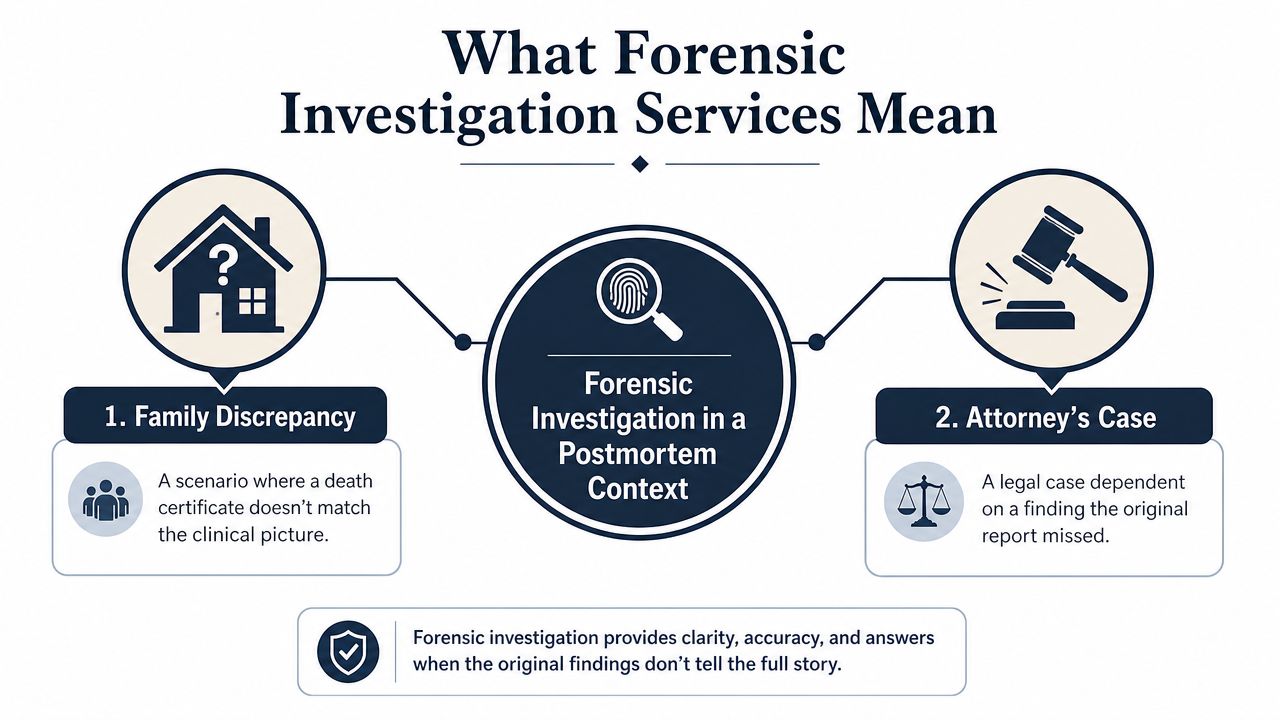
A family may receive a death certificate that doesn't fit what they saw in the hospital. An attorney may review a file and notice that the original report never answered the central question in the case. In both settings, forensic investigation services mean a structured, evidence-based examination of a death, or of a prior autopsy, so the findings are independent, documented, and usable in legal or administrative settings.
The service is different from digital forensics, although the same basic habits apply, identify what matters, preserve it, analyze it, and report it clearly. In a postmortem context, the evidence is the body, the medical record, the tissue, the lab result, and the chain of handling around all of them. The goal is a court-admissible answer about cause of death and manner of death, not a guess dressed up as certainty.
Practical rule: if the question is medical, legal, or both, the work has to be documented like evidence from the start.
Independent providers often serve private families, civil litigants, and counties that don't have a medical examiner office. That scope matters because the original institution may not be able, or willing, to revisit the case with fresh eyes. For readers who want a deeper foundation in the specialty itself, our explanation of forensic pathology is available in this overview of postmortem medical-legal work.
The Main Types of Forensic Examinations and Testing
Not every case calls for a full autopsy. Some need a second look at records. Others need chemical testing, tissue review, or a burial site examination done much later. The right service depends on what question still needs answering, and what material is still available to test.
Private autopsy and second opinion review
A private autopsy is a family-initiated examination that happens outside the original hospital or medical examiner process. It's used when the family wants an independent finding, or when the original conclusion doesn't match the known history. A second opinion autopsy review is narrower, it may focus on slides, photographs, reports, and medical records instead of repeating the full body examination.
Ancillary studies that support the opinion
Toxicology checks for drugs, medicines, and poisons. Molecular testing can help with infection questions, genetic contributors, or other findings that don't always show up on gross examination. These studies don't replace the pathologist's interpretation, they support it. For a plain-language explanation of postmortem chemistry, see our guide to the toxicology report after death.
Important distinction: a lab result by itself doesn't answer the legal question. The pathologist has to place it in context with the body, the history, and the records.
Exhumation and county forensic autopsy services
An exhumation is a postmortem examination after burial, usually when earlier findings were incomplete or disputed. It takes added planning because remains, permits, and transport have to be handled carefully. County forensic autopsy services are different again, they involve independent pathologists working with justices of the peace in places that need forensic capacity but don't have a medical examiner office.
| Situation | Likely Service | What It Involves |
|---|---|---|
| Family wants an independent answer after a hospital death | Private autopsy | Full postmortem examination, documentation, and report |
| A lawyer needs review of an old case file | Second opinion review | Re-examining records, slides, and prior findings |
| Toxic exposure or overdose is disputed | Toxicology | Targeted laboratory testing with medical interpretation |
| Questions arise after burial | Exhumation | Recovery, examination, and re-documentation of remains |
| A county needs forensic coverage without a medical examiner | County forensic autopsy service | Independent pathology support through local authority |
A useful comparison from legal practice appears in this discussion of scientific proof for assault charges. The subject is different, but the principle is the same. Evidence only helps if it is gathered, preserved, and explained in a way that can survive scrutiny.
How the Forensic Examination Process Works Step by Step
The workflow should feel orderly, because disorder weakens the findings. In postmortem work, the path from first call to final report follows the same core logic seen in other forensic settings, identification, collection, preservation, analysis, documentation, and presentation.
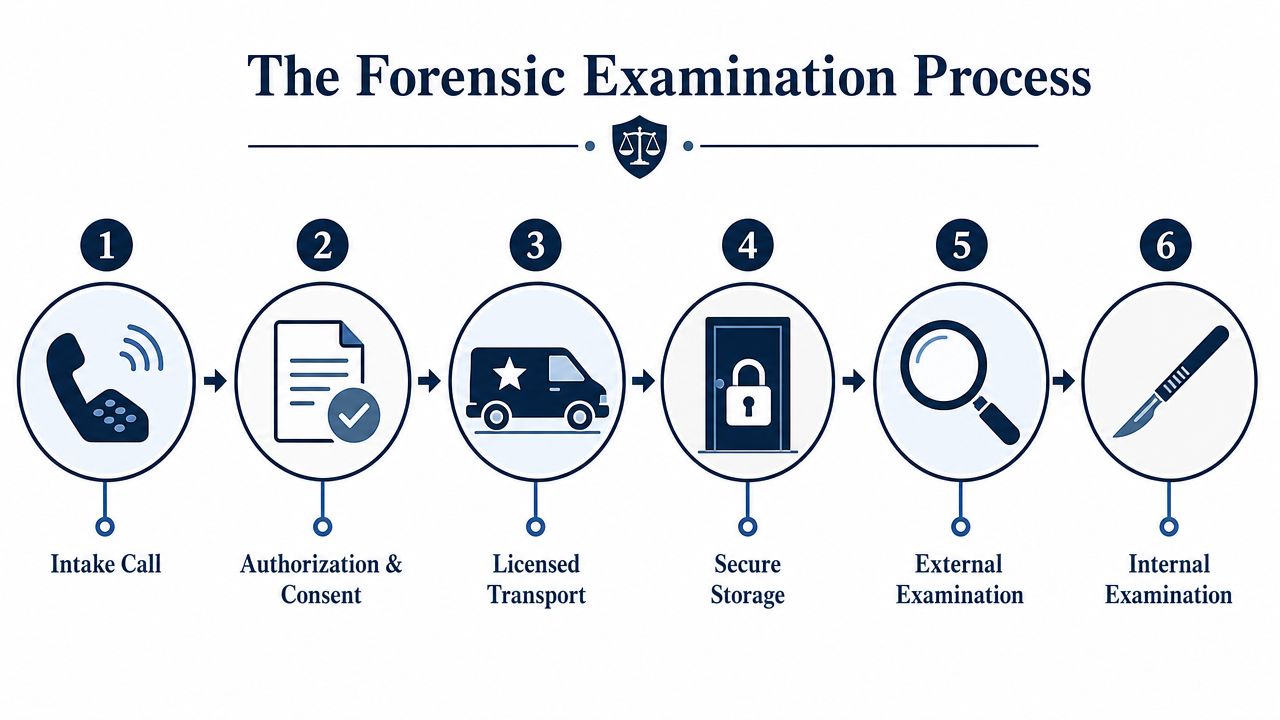
The front end of the case
The process starts with an intake call, where the team gathers the basic facts and the reason the case is being requested. Next comes authorization and consent, because the legal authority to proceed has to be clear before anything else happens. After that, a licensed transport team moves the deceased to the facility and the remains are placed into secure storage.
Examination, testing, and report
The pathologist then performs the external examination, which documents visible findings before any internal work begins. If the case calls for it, the internal examination follows, along with tissue sampling, toxicology, or other ancillary studies. Digital imaging and written notes capture the findings so they can be reviewed later and explained in the final report.
For a fuller explanation of how evidence handling supports a defensible record, our earlier note on chain of custody procedures is a useful reference.
Timing depends on the case. Simple findings move faster than cases that need toxicology, histology, or exhumation logistics, because each added step needs careful handling and interpretation.
The video below offers a visual reference for the general sequence of forensic work.
Chain of Custody and Texas Legal Safeguards
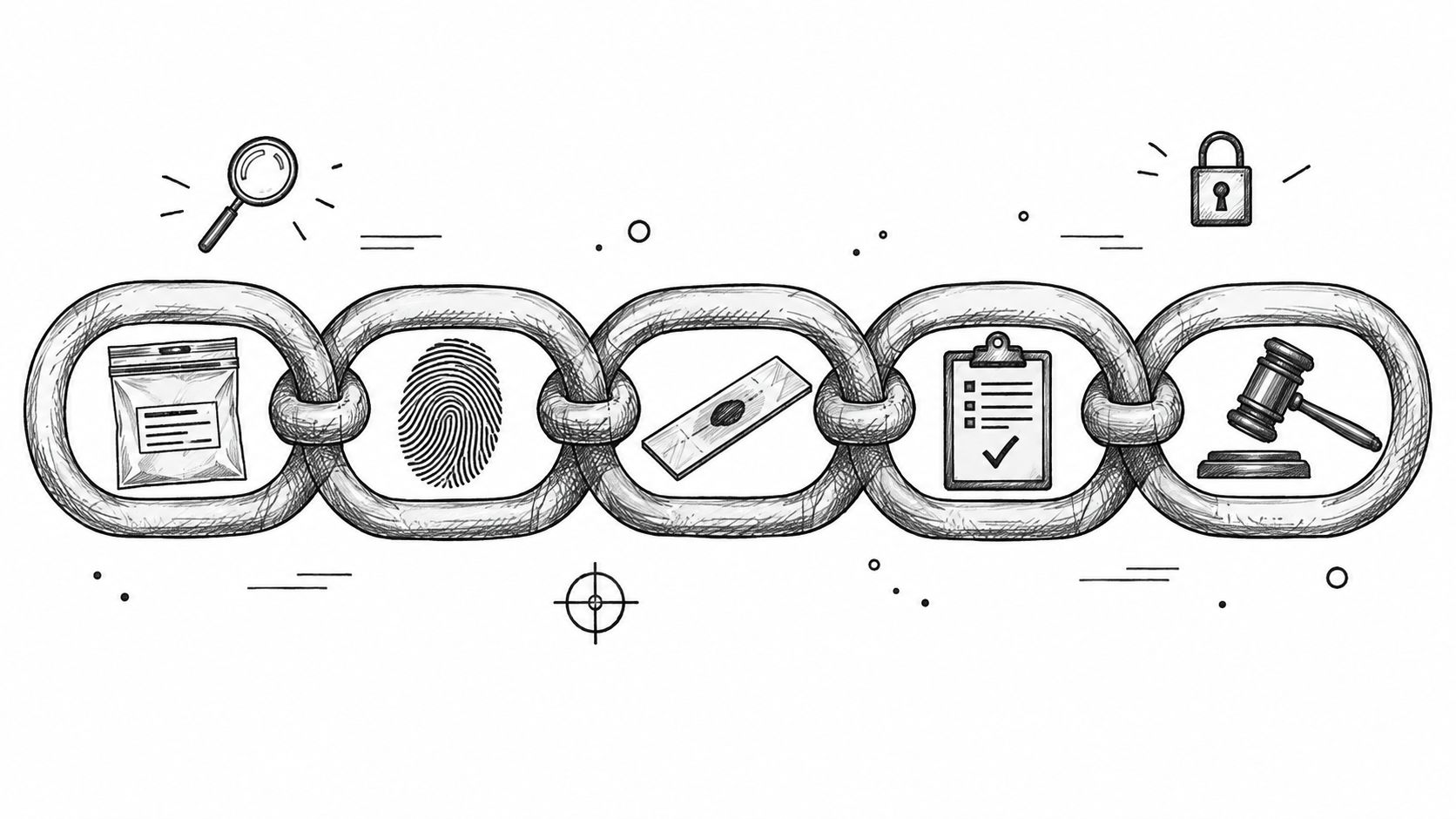
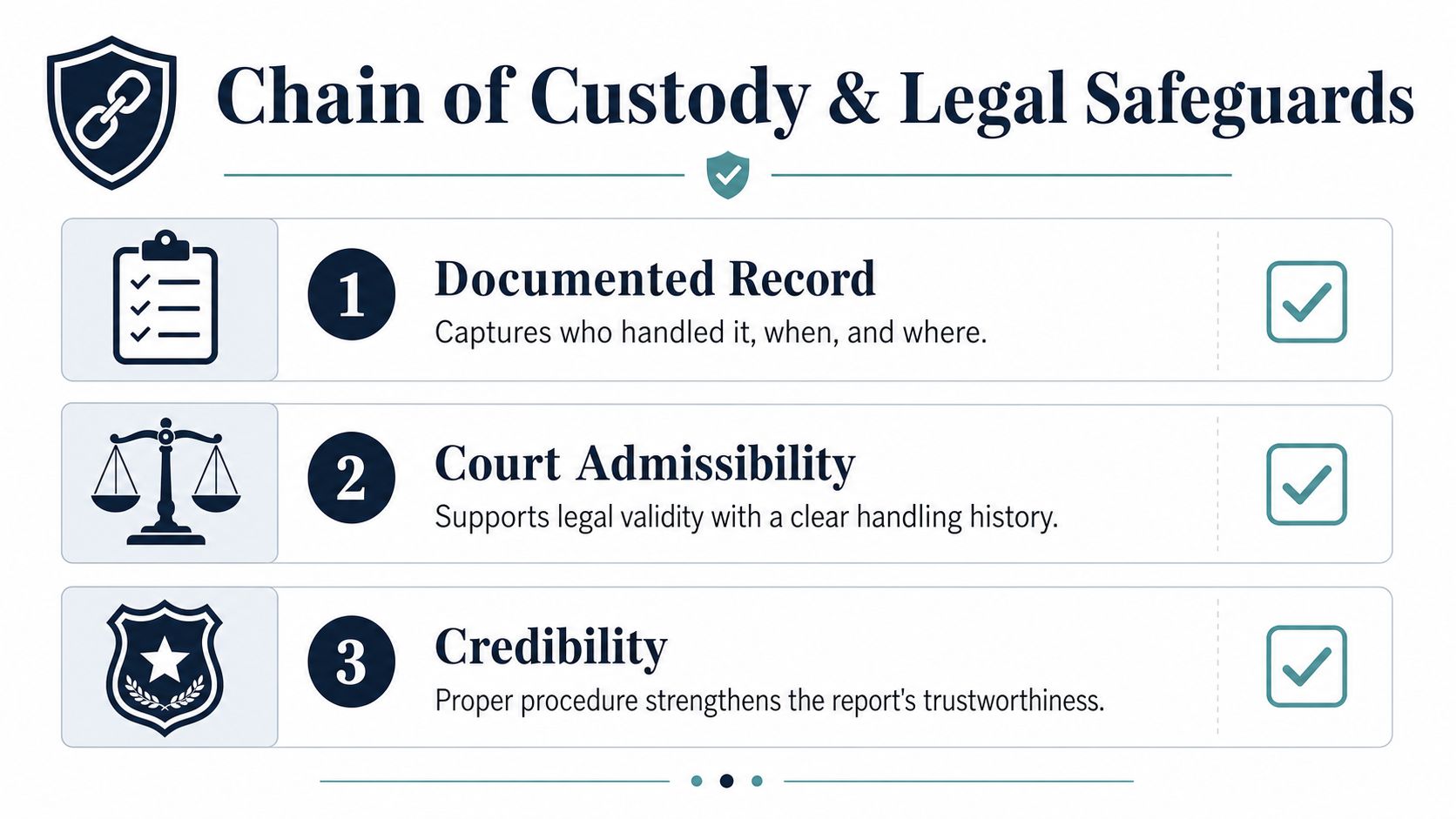
Chain of custody is the documented record of who handled the body or evidence, when they handled it, and where it was at each step. That record matters because a report is only as credible as the handling behind it. If a specimen is mishandled or poorly documented, the findings can be challenged even when the medical work itself was careful.
The Texas legal frame
In Texas, the Texas Funeral Service Commission regulates funeral and embalming practices, while Texas Health & Safety Code Chapters 651, 711, and 716 govern cemeteries, cremation, and the disposition of human remains. Those statutes sit alongside the medical-legal work of the autopsy itself. Families and attorneys should know which part of the process is governed by professional practice rules and which part is governed by state law.
Cause of death and manner of death
Cause of death is the disease or injury that started the chain of events leading to death. Manner of death is the classification, such as natural, accident, suicide, homicide, or undetermined. Both are required on a death certificate, and both need to be based on documented medical findings rather than assumption.
For a practical preservation framework in another forensic setting, see AI Video Detector's evidence guide. The field is different, but the underlying idea is the same, once evidence is compromised, the later analysis loses strength.
Independence matters when the findings may be questioned later. A review done outside the original institution can reduce the appearance of conflict and give families, attorneys, and counties a cleaner basis for trust.
Logistics Families Should Know About Up Front
Most families never see the work that happens between transport and report. They just know that a loved one has been moved, examined, and eventually returned with answers, or with some questions resolved and others narrowed. The logistics matter because they protect both dignity and evidence.
Transport storage and imaging
In-house licensed transport means one team can handle the move without forcing families to coordinate multiple vendors. That helps statewide, especially across all 254 Texas counties, where geography alone can complicate timing. Secure temperature-controlled storage protects the remains before examination, and digital imaging captures findings that may need later review by counsel, clinicians, or another pathologist.
Testing and reporting
When toxicology or molecular testing is needed, specimens are sent to accredited laboratories and the results are integrated into the final opinion. The report should read clearly enough for a grieving family and precisely enough for court use. Our team also remains available for depositions and expert testimony when the case requires it. For families, transparent flat-rate, all-inclusive pricing avoids surprise line items at a stressful time.
Common Misconceptions About Private Autopsies and Forensic Reviews
Some families avoid asking for an autopsy because they've heard the wrong thing. Those misunderstandings can delay answers that were available all along.
What people often fear
A common belief is that an autopsy always prevents an open casket. In practice, that isn't usually how respectful postmortem care works, because the examination is done with attention to appearance and aftercare. Another worry is that requesting a private autopsy will anger the hospital or medical examiner. A lawful request for independent review doesn't work that way.
What a second look can and cannot do
Another misconception is that a second opinion isn't needed if the original report sounds confident. Confidence isn't the same as completeness. If the question wasn't fully answered the first time, a careful review can still add value.
Forensic work also isn't just for criminal cases. Families use it for clarity, attorneys use it in civil disputes, and physicians may need it to understand an unexpected outcome. The service changes with the question, but the method stays the same, document well, interpret carefully, and report thoroughly.
A second look doesn't mean the first team failed. It means the facts matter enough to examine them again.
Questions to Ask Before Choosing a Forensic Investigation Provider
A family or attorney shouldn't have to judge a provider by polished language alone. A short checklist usually reveals more than a brochure does.
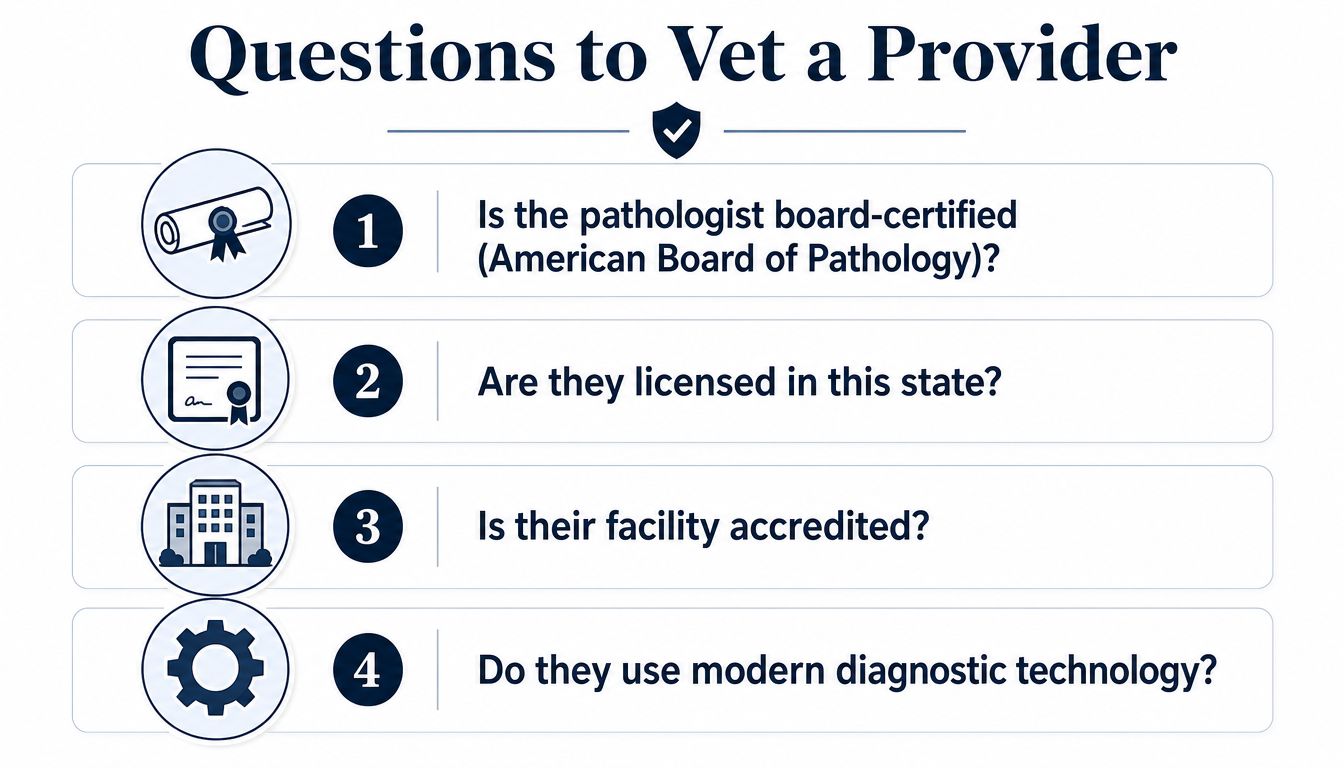
- Is the pathologist certified by the American Board of Pathology? Certification is a basic marker of training and accountability.
- Does the same pathologist perform the examination and sign the report? Continuity reduces confusion about who reviewed the evidence.
- How is chain of custody documented? Clear handling records support admissibility and confidence in the findings.
- Where is the facility located, and is it in Texas? Local control matters for transport, storage, and legal coordination.
- What is included in the price? Families need to know whether transport, testing, and reporting are part of the fee.
- Will the provider testify if the case goes to court? If the report may be challenged, testimony can be part of the service.
- What ancillary testing is available? Toxicology, tissue studies, and imaging can change the final conclusion.
Those questions help compare providers on substance, not on marketing language. They also make it easier to see whether the team can explain the process in plain terms, which usually tells you a lot about how the final report will read.
How Texas Autopsy Services Supports Families, Attorneys, and Counties
Families usually want clarity and respect. Attorneys need findings that are organized, documented, and ready for legal use. Healthcare providers often need a careful review of an unexpected death, while county officials need forensic capacity when local systems don't include a medical examiner office. Texas Autopsy Services fits those needs through private autopsy services Texas families can request, second opinion autopsy review, and county forensic autopsy support.
Our board-certified forensic pathologists perform each examination with direct communication, in-house licensed transport, and court-admissible reporting. For counties and justices of the peace, that means practical coverage where it's needed. For families, it means one conversation with the team, not a maze of intermediaries.
If you need help now, call Texas Autopsy Services. The phone is answered 24/7, and the first conversation is a conversation, not a sales pitch. We cover all 254 Texas counties and we'll speak plainly about what the case needs, what it doesn't, and what the next step should be.
If you're facing an unanswered death, a disputed report, or a county case that needs independent forensic support, contact Texas Autopsy Services today. We'll listen carefully, explain the options in plain language, and help you decide whether a private autopsy, second opinion review, or county forensic service is the right next step.