October 18, 2026 · Texas Autopsy Services
What Is Chain of Custody: Forensic Evidence Explained
What is chain of custody? Learn how this legal process protects evidence integrity in forensic pathology and why it is critical to court cases.
On this page
- What Chain of Custody Actually Means
- Why Chain of Custody Protects Evidence in Court
- How Chain of Custody Works From Scene to Report
- The Overlooked Half of Chain of Custody - Condition and Environment
- Common Pitfalls That Break a Chain of Custody Record
- How Texas Autopsy Services Maintains Chain of Custody
- Practical Guidance for Families, Attorneys, and County Officials
Chain of custody is the documented chronological history of evidence from collection through storage, testing, court presentation, return, or authorized destruction. When a transport professional delivers a deceased family member or a sealed specimen to an autopsy facility, the receiving team should document who transferred it, when it arrived, and its identifying information and condition.
You may be arranging an independent examination after a death, or reviewing records with an attorney. A signed delivery receipt can look reassuring, but it doesn't answer everything. The record also needs to explain what happened before delivery and how the remains or specimens were protected afterward.
We recognize that families shouldn't have to become evidence specialists while grieving. These are the main distinctions we encourage them to understand:
- Identity matters: Records should connect the person, specimen, image, and report to the correct case.
- Condition matters too: Signatures don't establish that biological material was appropriately preserved.
- Transfers need documentation: Each handoff should leave a record that someone outside the process can follow.
- Custody supports interpretation: It establishes handling history, not the cause of death by itself.
What Chain of Custody Actually Means
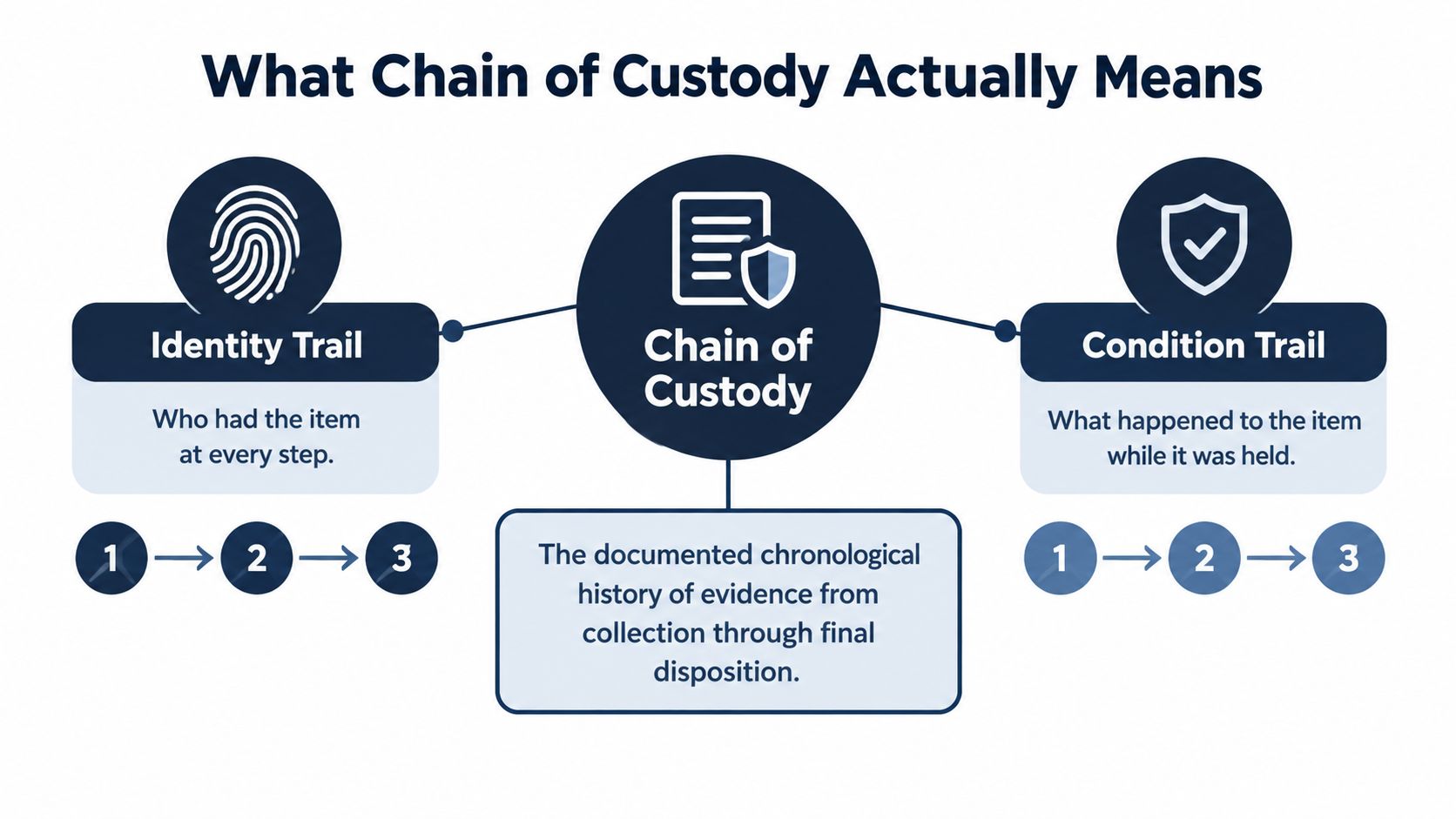
When families ask what is chain of custody, we explain it as a history that another person can verify without relying on anyone's memory. It begins when evidence is found or collected and continues through its final disposition, meaning its documented retention, return, or authorized destruction.
The National Institute of Justice's evidence documentation guidance identifies essential information: the collector's name or initials, subsequent custodians, collection and transfer dates, agency and case number, and an item description. A useful record also explains where the item was found and how it was packaged and preserved.
The identity trail and the condition trail
We teach custody as linked responsibilities rather than a signature sheet:
- Identity trail: Who collected the item, who possessed it afterward, and how each record connects to that specific item.
- Condition trail: How the item was packaged, transported, stored, opened, examined, and protected while someone held it.
In an autopsy process, the record extends beyond the decedent's arrival. Clothing, biological specimens, toxicology samples, retained tissue, medical devices, and digital images also need traceable handling histories. A final laboratory report cannot replace the documentation connecting those materials to their collection and examination.
For example, a specimen container may carry the correct case label. That establishes a connection to the case, but the receiving professional still needs to check its contents, packaging, seal, and accompanying records. A label alone doesn't account for its journey.
What the record can establish
Chain of custody establishes identity, continuity, and handling history. It doesn't independently establish what a finding means. Our pathologists must interpret examination findings and test results within the available medical and investigative context.
For readers discussing an evidence challenge with counsel, Fiscella Law LLC's resource on how to fight chain of custody provides a legal-context reference. We distinguish that legal review from our responsibility to document and explain the forensic handling process.
Why Chain of Custody Protects Evidence in Court
A laboratory may perform a test correctly, yet an attorney may still question whether the laboratory tested the right specimen. That distinction explains why custody records matter independently of the analytical method.
Under Federal Rule of Evidence 901(a), authentication requires evidence sufficient to support a finding that an item is what its proponent claims it is. The NIJ explanation of chain of custody and pretrial challenges connects custody documentation to that requirement and describes its protective purpose: preventing substitution, tampering, mislabeling, contamination, alteration, damage, loss, and falsification.
Authentication isn't the same as scientific meaning
Authentication addresses the identity of the material being offered. Scientific interpretation addresses what its examination or testing supports. Neither question should be treated as a substitute for the other.
A hypothetical example makes this clearer. An attorney receives a toxicology result bearing the decedent's name, but the transfer documentation doesn't connect the submitted container to the specimen collected during examination. The concern isn't necessarily the laboratory's equipment or technique. It's the missing connection between collection and testing.
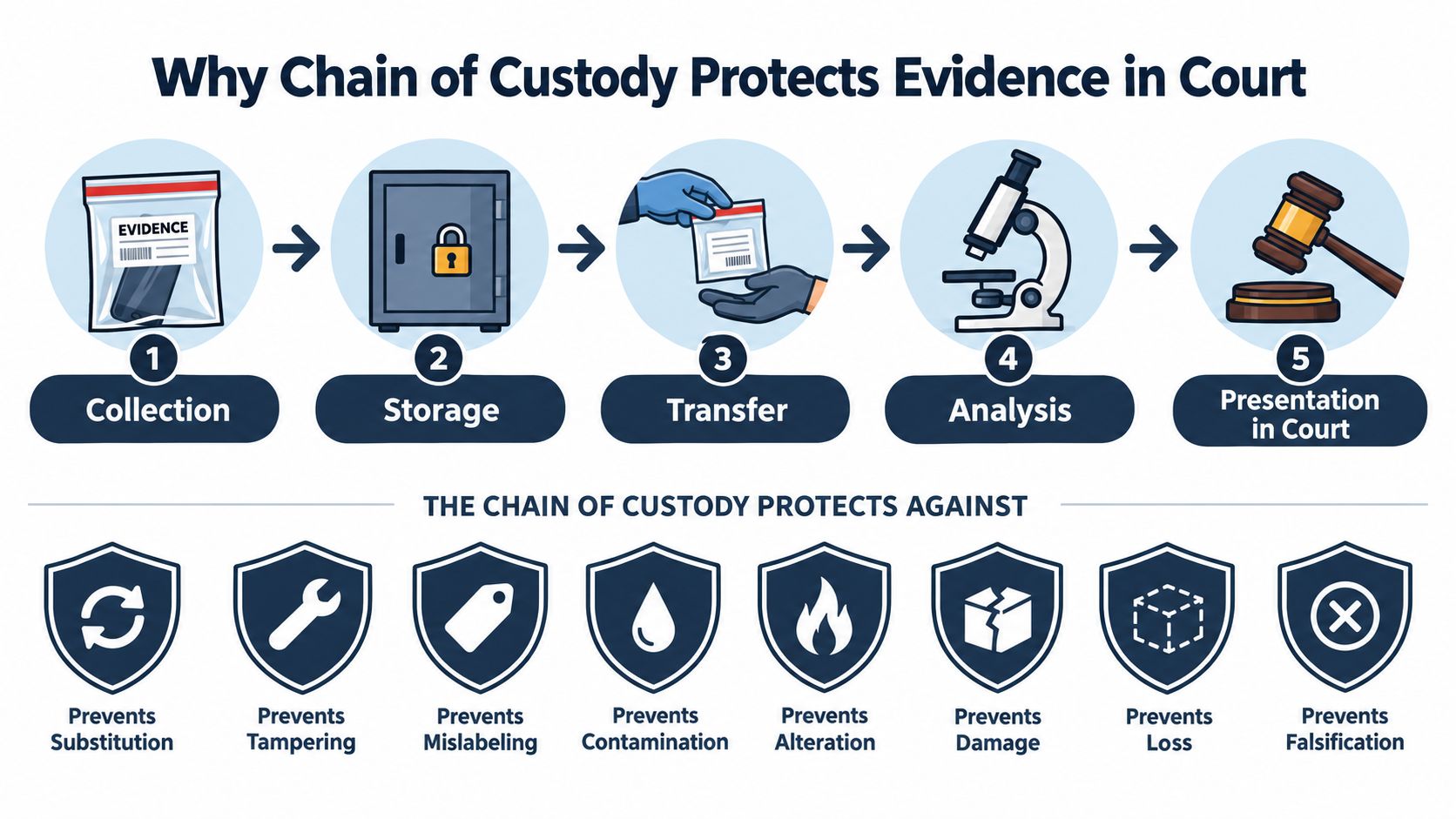
A gap doesn't automatically require exclusion in every case. It may be explainable, may reduce the weight assigned to the evidence, or may lead to exclusion when the offering party cannot adequately account for it. The legal consequence depends on the circumstances and the court's assessment.
Practical distinction: An unexplained handoff raises a question about evidence integrity. It isn't, by itself, proof that someone tampered with the evidence.
Records must support an independent review
A defensible transfer produces a signed receipt or equivalent secure record, not only an assurance that staff followed their usual routine. Attorneys should be able to compare the custody history with the examination and laboratory records.
Our discussion of forensic science and the law provides additional context for the relationship between forensic findings and legal review. Federal authentication principles shouldn't be mistaken for a complete statement of Texas procedure. Counsel should identify the applicable evidentiary rules for the particular proceeding.
How Chain of Custody Works From Scene to Report
A complete autopsy workflow connects the initial collection record to intake, examination, laboratory work, reporting, and disposition. If another agency collected the original evidence, an independent facility should preserve that earlier history rather than begin the record as though nothing happened before arrival.
At intake, a unique case identifier connects the decedent and associated materials to the examination. Individual specimens need descriptions that distinguish them from other items in the same case. Staff should reconcile the received inventory against the transfer documentation and record discrepancies before proceeding.
Match each action to a record
The table below illustrates records that can support a custody history. Record names may differ between facilities, but the information must remain traceable.
Stages of a Chain of Custody Record in an Autopsy Case
| Stage | Record Created | Information Captured |
|---|---|---|
| Collection and intake | Collection record and intake entry | Case identifier, item description, collector, collection location, date, time, and condition |
| Packaging and sealing | Packaging entry or seal log | Container, preservation method, seal condition, and responsible handler |
| Transport and receipt | Custody transfer form or receipt | Releasing and receiving parties, transfer time, destination, purpose, and receipt checks |
| Storage | Storage and access entry | Location, applicable conditions, authorized access, and movement |
| Examination and testing | Examination record, laboratory record, and instrument output | Specimen identity, handler, analytical action, opening, and repackaging |
| Retention or release | Disposition record | Items retained, returned, or disposed of, authorization, and responsible party |
The NIST Biological Evidence Preservation Handbook recommends written procedures for opening, resealing, and transferring biological evidence, secure access-controlled storage, and trained, authorized handlers. It also addresses retention responsibilities that remain relevant if evidence is later destroyed or lost.
Account for examination as well as movement
Opening a container for legitimate testing isn't a custody failure. The record should explain who opened it, why, what was removed or examined, and how the remaining material was repackaged or resealed. Comparing the inventory before and after examination helps account for those changes.
Digital imaging deserves the same attention. Photographs and imaging files should connect to the case identifier and remain protected against untracked alteration. Instrument outputs should likewise be connected to the specimen examined, rather than stored as disconnected files.
Our explanation of forensic evidence collection addresses the collection side of this workflow. Families and attorneys can use the stage-by-stage record to identify where custody responsibility changed and which supporting documents should exist.
The Overlooked Half of Chain of Custody - Condition and Environment
A specimen can have a complete list of handlers and still be unsuitable for the intended examination. Documented possession isn't the same as documented preservation.
The NIJ guidance on preserving evidence explains that secure, temperature-controlled storage helps protect biological specimens against degradation that could compromise toxicology, DNA, histology, or molecular findings. Limiting handlers also reduces opportunities for loss or tampering.
What signatures leave unanswered
Consider a hypothetical toxicology specimen with signed receipts at collection, transport, and laboratory intake. If its storage conditions weren't recorded, the reviewer may know who held it but lack information needed to evaluate preservation. That uncertainty warrants investigation, not an automatic conclusion that the result is invalid.
Histology materials require attention to preparation and preservation history as well. A reviewer assessing a concern about fixation, meaning the tissue-preservation process, needs the relevant handling records rather than only a transfer signature. Clothing received with a broken seal presents a different question: who opened the package, for what purpose, and whether the change was documented.
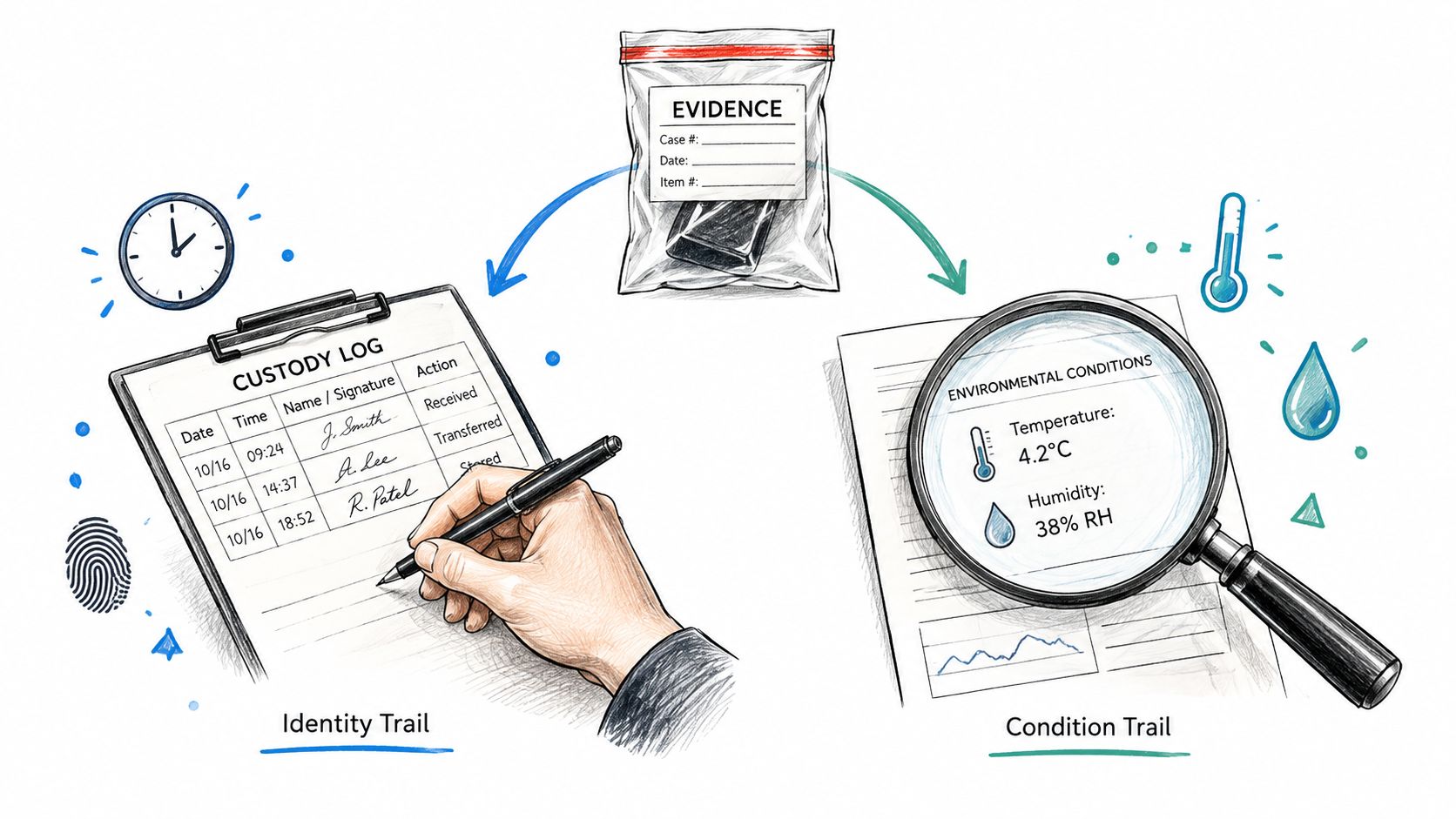
These examples illustrate review questions, not findings from identifiable cases. Their significance depends on the material, the intended analysis, and the documented circumstances.
Read the preservation history alongside the custody history
Families and attorneys should look beyond a completed signature column:
- Storage conditions: Records should identify the location and conditions relevant to the material.
- Transport conditions: The history should address preservation during movement, not just departure and arrival.
- Receipt checks: Staff should record visible damage, leakage, seal discrepancies, or other concerns when received.
- Handling intervals: Timestamps should allow reviewers to assess delays and intervening storage.
A specimen's correct identity doesn't establish that it remained fit for every possible test.
Our discussion of specimen preservation provides related context. We don't recommend a universal storage temperature or handling interval because preservation requirements depend on the specimen and planned examination.
A forensic pathologist should explain whether a documented condition could affect interpretation and whether the available information permits a reliable conclusion. Educational examples cannot determine the validity of an individual result without reviewing the actual records.
Common Pitfalls That Break a Chain of Custody Record
Custody concerns often become visible when someone compares documents that were created by different people. A receipt may appear complete on its own while conflicting with the intake inventory or laboratory submission.
The NIJ guidance on evidence transfers calls for signatures or secure transfer records, verified identifying information, sealed and marked packaging, and receipts when custody changes. Discrepancies should be recorded promptly and preserved through an auditable paper or electronic process.
Recognizable documentation failures
- Unsigned or late receipts: The record doesn't establish who accepted custody at the actual handoff. A later entry should be identifiable as a later entry, with its basis explained.
- Mismatched identifiers: The intake form and laboratory paperwork describe apparently different items. A documented connection or correction is needed, not an assumption that similar descriptions refer to the same specimen.
- Uncontrolled storage access: A handler list may omit people who could enter the storage area. Reviewers should compare custody entries with available access records.
- Undocumented repackaging: A new container or seal appears without an account of who made the change.
- Missing or altered digital files: An image appears in a report, but its original case-linked file or change history cannot be accounted for.
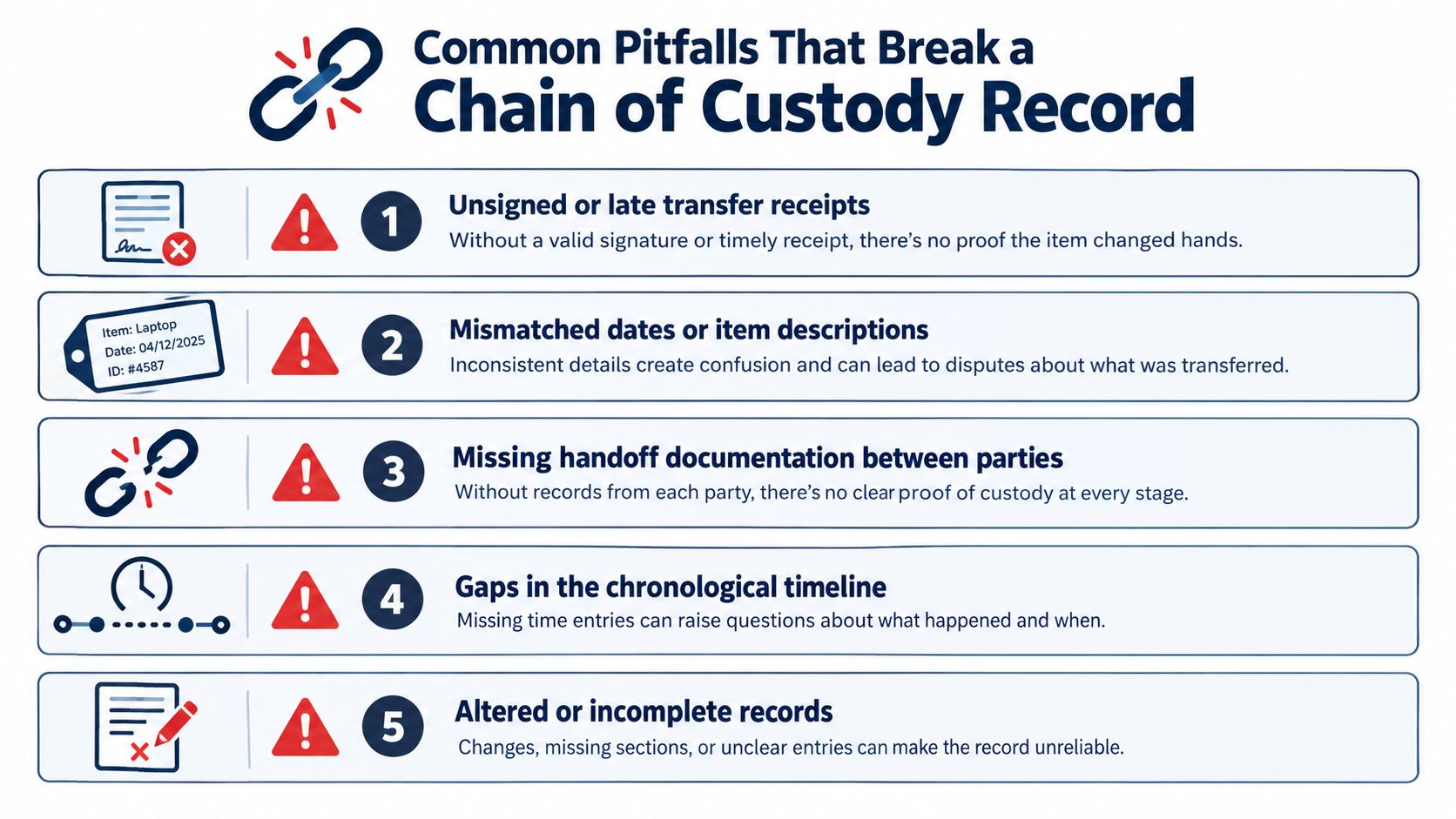
Transfers between organizations need particular attention
When a medical examiner declines a case and a family seeks an independent autopsy, the receiving practice needs documentation of the release and transfer. A decision not to conduct an examination doesn't replace the custody history for remains or materials already handled.
A second opinion autopsy review creates similar responsibilities when retained specimens move to another pathologist. The sending inventory, receiving inventory, seal information, and supporting records should account for what changed hands. A report-only review should be distinguished from a review that includes physical evidence.
For an attorney considering comparable authentication issues in criminal evidence, Brian Hansford Law's resource on how to question drug case evidence chain offers a separate legal-context reference. Autopsy custody questions still require case-specific medical and legal assessment.
Review standard: A correction should preserve what was originally recorded, identify what changed, and explain the basis for the change.
An explainable clerical discrepancy differs from an unexplained period of possession. We encourage reviewers to request the supporting records before deciding whether a gap is administrative, scientifically significant, or legally consequential.
How Texas Autopsy Services Maintains Chain of Custody
We are an independent private autopsy and forensic pathology practice based in Elgin, TX, serving Central Texas and the wider state. Our Private Autopsies service provides coverage across all 254 Texas counties, including in-house licensed transport and direct communication with our team.
Every examination is performed by a forensic pathologist certified by the American Board of Pathology. Our pathologists work in medicolegal death investigations involving adult, pediatric, and complex forensic cases, while licensed professionals support transport, logistics, and family communication.
Connect logistics to the examination record
Our process includes documented transport, secure temperature-controlled storage, case-linked digital imaging, laboratory coordination, and HIPAA-compliant reporting. Keeping transport and facility responsibilities within our operation helps limit organizational handoffs. When materials leave for testing or review, those transfers still require documentation.
The NIST definition of chain of custody emphasizes tracking collection, safeguarding, and analysis through handler identities, dates and times, and transfer purposes. We use that accountability framework to connect the examination to the materials and records supporting it.
- Families and attorneys: We provide reporting and explain the basis and limitations of an unbiased cause-of-death determination.
- County officials: Our County Forensic Autopsies service supports agencies seeking forensic examinations.
- Coordination needs: Information about the Waterloo Mortuary Partnership helps readers understand related mortuary arrangements.
Separate compliance from courtroom decisions
Our Texas compliance context includes the Texas Funeral Service Commission and applicable provisions of the Texas Health & Safety Code Chapters 711 and 716. For statutory accuracy, Chapter 651 is in the Texas Occupations Code, not the Health & Safety Code. These references aren't interchangeable, and custody documentation doesn't replace required authorization or applicable disposition procedures.
We prepare reports for medical and legal scrutiny, including potential courtroom use. Court admissibility remains a judicial decision, not something a private practice can guarantee.
Our flat-rate, all-inclusive pricing and direct team communication let families ask about services, records, and responsibility without working through a call center. Independence means we evaluate the evidence objectively, not that we promise a particular finding.
Practical Guidance for Families, Attorneys, and County Officials
Before authorizing an examination, ask who will receive the decedent, who will perform the autopsy, and who will handle specimens afterward. Request an explanation of which custody documents can be provided, including transfer receipts, inventory records, and relevant storage entries.
The NIJ chain-of-custody checklist provides a useful basis for reviewing collection, preservation, handling, transfers, testing, and disposition.
- Families: Ask how any earlier agency records will connect to the independent examination.
- Attorneys: In deposition, ask who opened or repackaged materials and how handler lists reconcile with access records.
- County officials: Require contracts to identify transport, storage, laboratory, records-retention, and disposition responsibilities, with applicable Texas compliance documented.
Brief FAQ
Is chain of custody the same as consent for an autopsy?
No. Authorization addresses permission to proceed. Custody records address identity, control, and handling.
Does a private autopsy guarantee an answer?
No. A cause of death investigation depends on available findings, records, and specimen suitability.
What do cause of death and manner of death mean?
Cause of death is the disease or injury responsible for death. Manner of death describes the circumstances in which death occurred.
What should an “autopsy near me” search prioritize?
Ask about the examiner, licensed transport, custody documentation, preservation, and reporting. Location alone doesn't establish the quality of the process.
For guidance about private autopsy services Texas families can access, call our team at (806) 230-1889. These explanations are educational, not individual medical or legal advice.
We offer independent autopsies, second-opinion reviews, and county forensic examinations with documented custody from transport through reporting. Visit Texas Autopsy Services or contact our team directly to discuss the available records, the custody questions in your case, and the next steps without pressure to proceed.