June 20, 2026 · Texas Autopsy Services
Forensic Evidence Collection a Guide for Texas Families
A clear guide to forensic evidence collection in Texas. Learn about the process, chain of custody, and how an independent autopsy can provide answers.
On this page
A sudden death often leaves families and attorneys with the same difficult feeling. There are facts on paper, but the full picture still seems incomplete. In those first hours, the quality of forensic evidence collection can shape what can later be learned through scene review, laboratory testing, and an independent autopsy.
That's why evidence handling matters so much. It is not merely a police procedure or a hospital checklist. It is the practical foundation for answering basic questions about how a person died, what happened before death, and whether later findings will stand up to medical and legal review.
Key takeaways:
- Forensic evidence collection is about preserving facts before they are lost, altered, or contaminated.
- Fragile evidence such as biological material and trace material is generally collected first because it is easiest to destroy or transfer.
- Chain of custody is the documented history of who handled each item, when, and why. If that record is incomplete, evidence can become unusable in court.
- Proper storage matters. Some forms of body-related evidence require temperature-controlled storage and documented access.
- For families and attorneys, the most important early step is often restraint. Do not disturb potential evidence, even if it seems minor.
The Unanswered Question Why Evidence Matters
A family may be told that a death was accidental, natural, or still under review. Yet the personal effects don't seem to fit the explanation. Clothing may show staining. A phone may contain recent messages. Medication bottles may be present, but it is unclear whether they were used correctly. In that situation, the first concern is often not litigation. It is clarity.

Forensic evidence collection exists to preserve that clarity before time erases it. The National Institutes of Health review in StatPearls on forensic evidence collection and preservation notes an estimated 1,197,704 violent crimes nationwide in 2015 and emphasizes that trace evidence must be documented, photographed, packaged, sealed, labeled, and tracked through chain of custody to remain usable in court. The same review explains that incomplete or inaccurate chain-of-custody documentation can render evidence inadmissible.
That may sound procedural, but it has direct consequences for families. If a clothing item is handled by several people without documentation, its evidentiary value can be challenged. If a biological sample is not sealed or labeled correctly, later testing may answer less than it should.
Practical rule: Evidence is strongest when its physical condition and its documented history both remain intact.
This is one place where readers often get confused. They assume the autopsy is where the facts begin. In reality, the autopsy is only one part of a larger process. A forensic pathologist interprets findings in light of what was preserved before the body ever reaches the examination room.
For attorneys, this is equally important. A case can hinge not only on what was found, but on whether the item was collected, stored, and transferred in a way that allows others to trust the result.
Understanding Types of Forensic Evidence
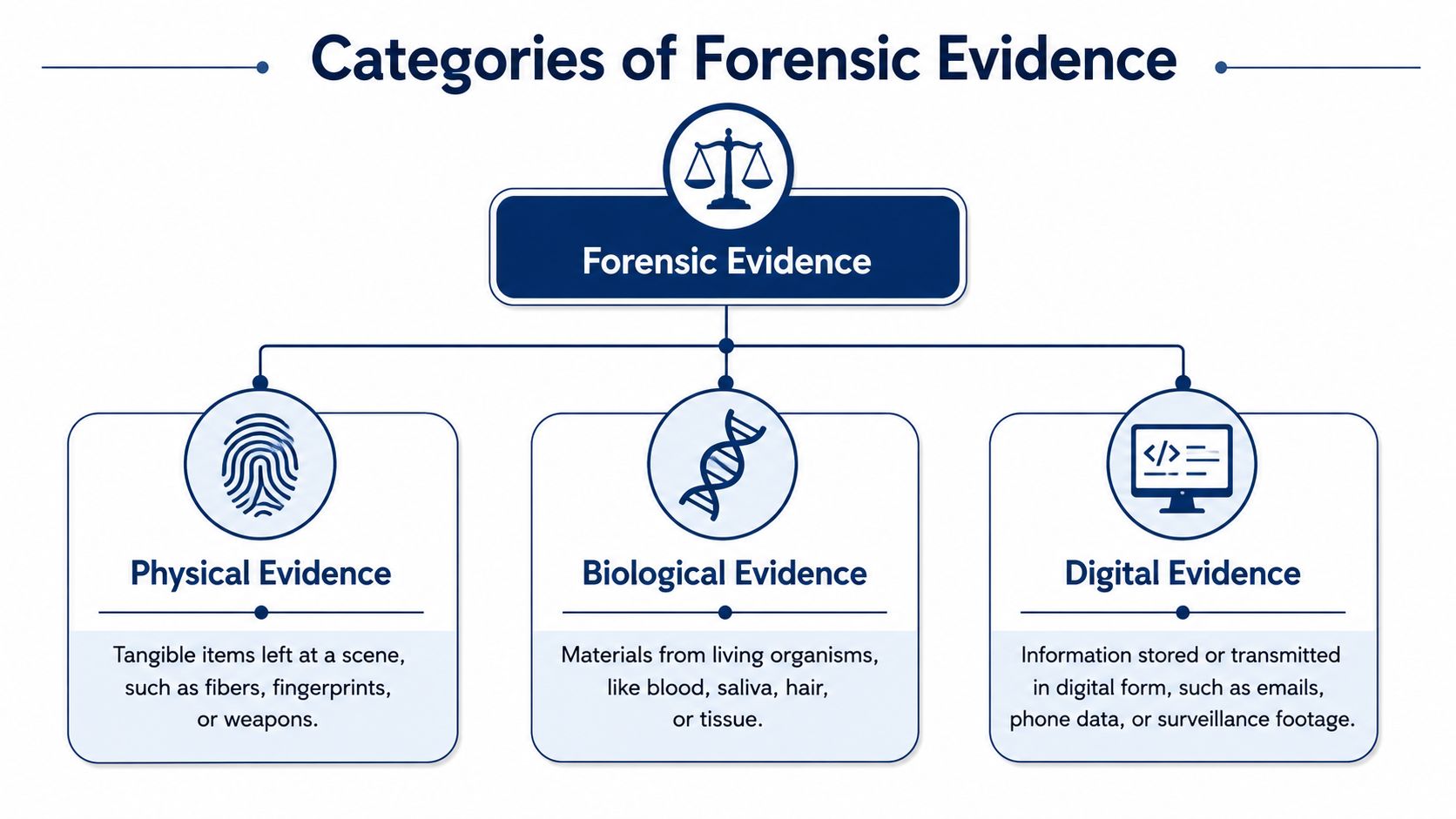
People often use the word “evidence” as if it describes one thing. It does not. Different categories answer different questions, and they require different handling.
Physical evidence
Physical evidence refers to tangible items. That can include clothing, weapons, ligatures, medication containers, bedding, broken objects, fingerprints, or impression evidence. These items may help establish contact, movement, injury mechanisms, or the sequence of events.
Some physical evidence is durable. Some is not. A shoe can remain stable for a long time. A faint fingerprint or loose fiber may not.
A simple way to think about it is this:
| Category | Plain-language example | Main concern |
|---|---|---|
| Physical | Clothing, bottle, weapon, fingerprint | Damage, mixing, undocumented handling |
| Biological | Blood, saliva, tissue, hair with root | Degradation, contamination |
| Trace | Fibers, soil, glass fragments | Loss through transfer or movement |
| Digital | Phone data, messages, surveillance files | Preservation and proper extraction |
Biological, trace, and digital evidence
Biological evidence comes from living organisms. In death investigation work, that may include blood, tissue, hair, nails, or other samples collected for toxicology or DNA-related analysis. Readers who want a deeper explanation of laboratory testing after death may find our discussion of post mortem toxicology useful.
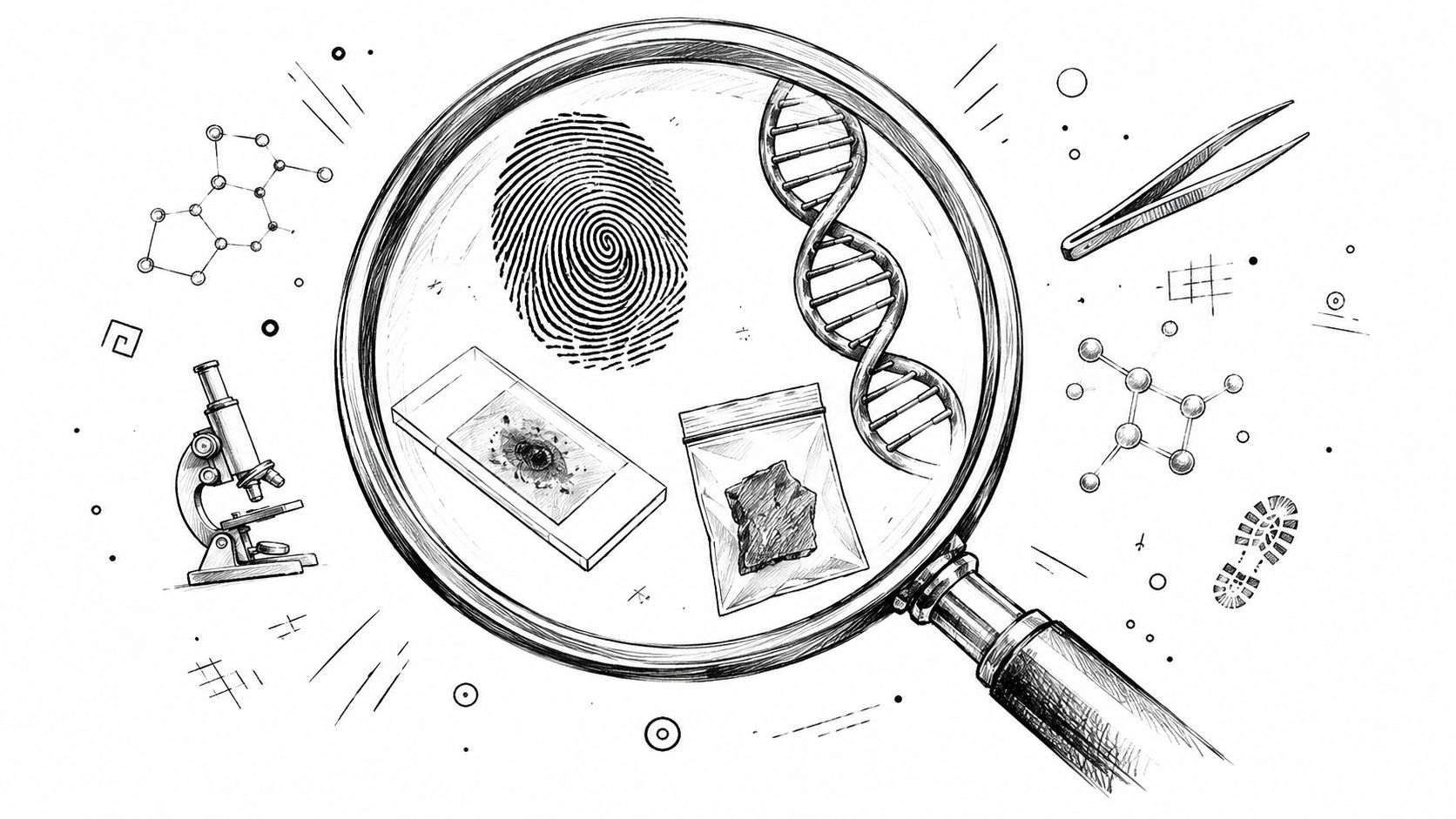
Trace evidence is often the easiest to overlook because it may be microscopic. Hair, fibers, soil, and tiny fragments can carry important information, but they are also easy to transfer from one surface to another. The National Institute of Justice training on location and collection of evidence explains that the order of collection is critical to prevent loss and contamination, and that investigators are trained to collect the most fragile evidence, including biological and trace materials, first.
Digital evidence includes information stored or transmitted electronically. Phones, computers, smart watches, home cameras, and message histories may all matter. In many cases, digital evidence does not replace physical evidence. It helps place it in context.
Small does not mean unimportant. Some of the most meaningful findings in forensic work come from material that can barely be seen without magnification.
A common misunderstanding is that collecting more is always better. It is not. Good forensic evidence collection depends on identifying what is relevant, preserving it correctly, and avoiding unnecessary handling that can create confusion later.
The Forensic Evidence Collection Workflow
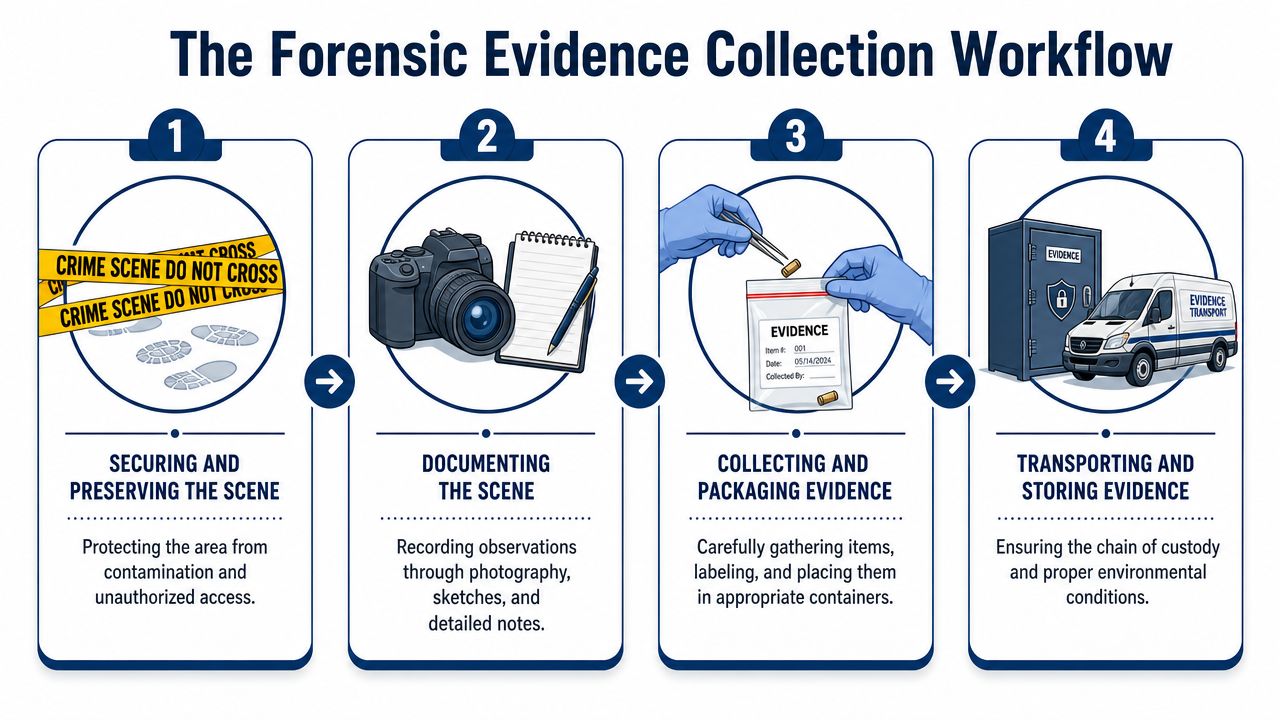
Forensic evidence collection works best when it follows a disciplined sequence. The order may vary with the setting, but the logic stays the same. Protect the scene. Record what is there. Collect carefully. Package and store in a way that preserves the item's condition.
Scene protection and documentation
The first task is to limit unnecessary contact. That is true in a home, outdoors, in a hospital room, or in a transport setting. Once people begin moving objects, opening containers, or gathering belongings, the original condition of the scene may be lost.
Documentation begins before collection. Investigators typically photograph, take notes, and map the location of items before removing them. This is more than record keeping. It helps preserve relationships between objects that may later matter medically or legally.
The video below gives a general visual sense of how evidence processing is approached in practice.
Attorneys who are reviewing assault-related investigations sometimes need context on how evidence questions fit into the broader case process. The discussion of criminal defense insights on assault evidence offers a useful legal perspective on how early investigative steps can affect later disputes.
Collection, packaging, and storage
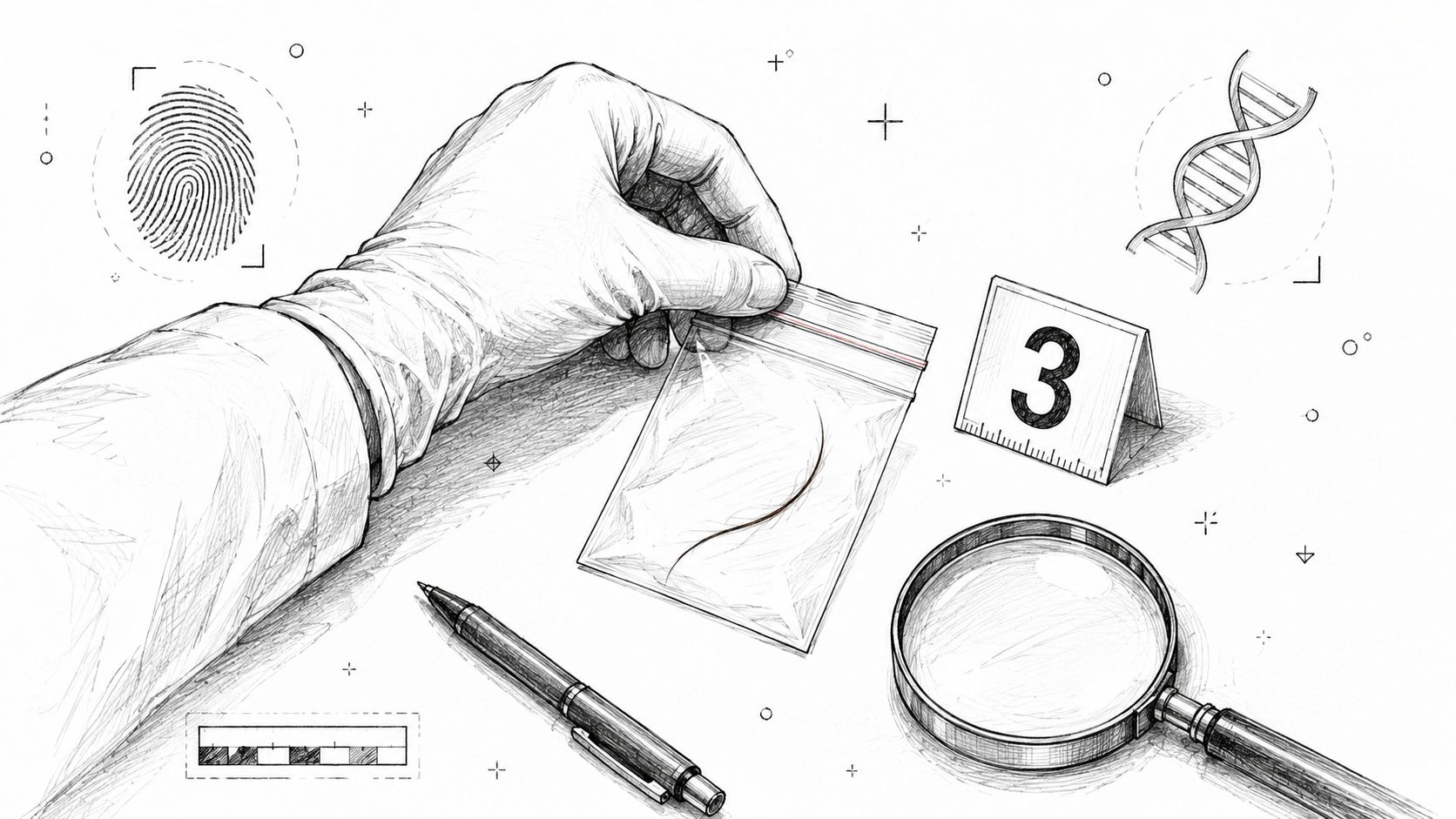
Once documentation is complete, collection usually proceeds from the most fragile material to the least fragile. That means biological and trace evidence often come first. More durable items may be handled later.
Packaging matters because the wrong container can damage the sample or encourage degradation. Labels, seals, dates, and initials are not formalities. They show what the item is, when it was collected, and whether anyone opened it later. For readers comparing medical and forensic specimen handling, our overview of specimen collection procedures explains why method and labeling must stay aligned.
A practical workflow often looks like this:
- Secure the area so access is controlled.
- Photograph and note the location and condition of items.
- Collect fragile material first to reduce transfer and loss.
- Package items separately so one item does not contaminate another.
- Seal and label each container clearly.
- Transfer and store under appropriate conditions.
Some settings impose additional storage requirements. The National Institute of Standards and Technology standard for sexual-assault medical forensic evidence, described in this NIST evidence collection and management standard, requires temperature-controlled storage, with temperatures recorded daily for evidence held 72 hours or longer, and transfer to a lab as soon as possible to reduce degradation.
When people hear “evidence collection,” they often picture the moment an item is picked up. In practice, the larger issue is whether that item remains reliable after collection.
This is also why independent review can matter. A later forensic opinion is only as sound as the material that was preserved and the records that accompany it.
The Unbroken Chain of Custody
What chain of custody means
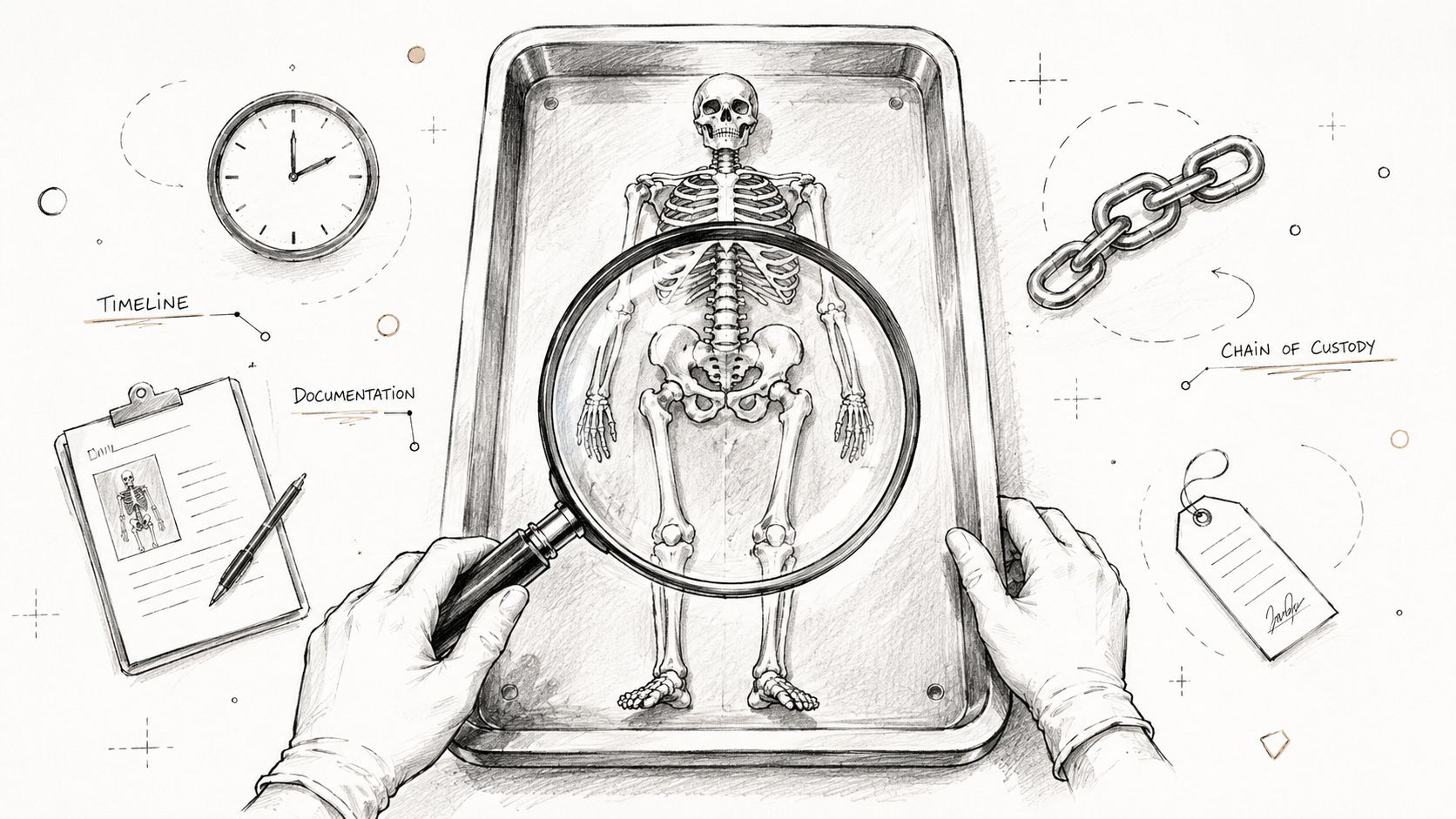
Chain of custody is the documented history of an item from the moment it is collected until the moment it is released, tested, stored, or presented in court. In plain language, it answers four simple questions: who had it, when did they have it, where was it, and why was it transferred.
A helpful comparison is a relay race. The baton is only trustworthy if every handoff is known. If the baton disappears for a stretch, no one can say with confidence that it is the same baton in the same condition.
That same principle applies to biological specimens, clothing, trace debris, and other materials. In our field, this can include blood tubes, tissue samples, sealed bags, or retained items from an examination. Families sometimes ask what happens after testing. Our explanation of what they do with blood after testing addresses that practical concern in plain language.
Why missing documentation causes problems
If a record is incomplete, the item can still exist physically, but its legal value may be damaged. A court may be asked whether the sample was mixed up, opened, altered, or handled by an unknown person. Those questions are often avoidable when the documentation is complete from the start.
The concern becomes even clearer when materials are lost or altered altogether. Attorneys and families trying to understand that problem may find this explanation of the impact of destroyed materials useful because it shows how missing evidence can affect a case long before trial.
The NIH review cited earlier makes the legal consequence plain. Every piece of trace evidence must be tracked through chain of custody, and incomplete or inaccurate documentation can make the evidence inadmissible.
A well-kept chain of custody does not prove what happened by itself. It proves that the item being examined is the same item that was originally collected.
That distinction matters. Science answers one set of questions. Documentation protects the credibility of the scientific answer.
Guidance for Families and Attorneys
A family gets a late-night call from a hospital or law enforcement. By morning, they are being asked about clothing, medications, phones, funeral timing, and whether anyone wants an independent review. Attorneys often enter the case at the same moment, with the same problem. Important evidence can be altered, discarded, or overlooked before anyone understands what questions the case will later need to answer.
That is why the first goal is not speed for its own sake. The first goal is to preserve choices.

For Texas families and attorneys, this point matters in a practical way. A case may later turn on whether the original findings can be verified, whether additional testing is possible, or whether an independent autopsy can examine the same body, specimens, clothing, or records. Preserving those materials early is like keeping the original pages of a document before anyone starts making notes in the margins. Once the original condition changes, some questions become much harder to answer with confidence.
What families should do early
Families usually help the case most by preserving what already exists and recording what they personally observed.
- Leave items in their current condition: Clothing, bedding, medications, containers, and personal devices may later answer questions about timing, exposure, injury, or treatment.
- Write down observations promptly: Note dates, times, names, statements you heard, and what you directly saw. Keep firsthand facts separate from your suspicions.
- Request records through proper channels: Medical records, official reports, and available scene documentation may become important for later review.
- Save communications in original form: Keep text messages, voicemail, email, and photographs without editing, renaming, or sorting them into new formats if possible.
Healthcare settings can create special problems because treatment and evidence preservation are happening at the same time. Guidance on collecting and preserving evidence in healthcare settings explains why bias control, clothing preservation, and careful handling of material such as under-nail debris can affect whether later review is reliable. For a family, the practical takeaway is simple. Ask early what was collected, what was discarded, and what is still being retained.
What attorneys often need to secure
Attorneys are often trying to identify the evidence that disappears first, not just the evidence that is easiest to request. In Texas matters, that may include surveillance footage, emergency department records, medication administration records, EMS documentation, body-worn camera files, retained specimens, transport logs, and the decedent's personal property.
A focused preservation plan often looks like this:
| Priority | Why it matters |
|---|---|
| Medical records | They help establish timeline, treatment decisions, and documented observations |
| Personal effects | Clothing, devices, and medications may support or challenge witness accounts |
| Digital materials | Messages, photos, and video can clarify sequence, contact, and condition |
| Laboratory and specimen records | They show what was collected, retained, transferred, or tested |
In some cases, attorneys also ask whether the physical handling environment could have affected biological material. That is a narrower technical issue, but it can matter in the right case. For that context, information about Flowserve for biological samples may help frame questions about controlled transfer systems and sample movement.
An independent review may also become important if the official examination leaves unanswered questions. In these situations, private autopsies can provide a separate medical-legal assessment when families or counsel need another opinion about cause of death, manner of death, injury interpretation, or specimen collection concerns.
Preserve first. Interpret second. Early assumptions can narrow the investigation before the evidence has had a fair chance to speak.
Families also ask what actions can create problems. Washing clothing can remove trace material. Opening a phone and sorting messages can change metadata or disturb the original state of digital evidence. Public accusations can influence witnesses. Direct confrontations can create new factual disputes that distract from the original event.
Two terms often cause confusion. Cause of death is the disease or injury that produced death. Manner of death is the classification of how that cause arose, such as natural, accident, suicide, homicide, or undetermined. For families and attorneys considering an independent autopsy in Texas, that distinction matters because a second examination may agree on one and disagree on the other, and that difference can affect both legal strategy and the final understanding of what happened.
How Texas Autopsy Services Upholds Standards
A family may hear an autopsy result and assume the answer rests only on what the pathologist saw during the examination. In practice, the opinion is only as dependable as the way the body, specimens, clothing, records, and transfers were handled from the first handoff forward. That is the part families and attorneys in Texas often do not see, yet it can shape how much weight a finding carries later in court, in settlement discussions, or in a second medical review.
Texas Autopsy Services builds its work around that reality. Each examination is performed by a board-certified forensic pathologist, with close attention to documentation, specimen labeling, storage conditions, secure transfer, and chain of custody. Those steps are not paperwork for its own sake. They work like a labeled evidence map. If one point on the map is missing, an attorney may have trouble showing that a sample tested later is the same sample collected earlier.
That matters in both private and county cases. The medical conclusion must be tied to traceable facts. A tissue section, toxicology sample, retained specimen, photograph, or clothing inventory has more value when the record shows when it was collected, who received it, how it was stored, and when it changed hands. For Texas families considering an independent autopsy, that same record can also help the second reviewing doctor assess whether the original work supports the stated cause and manner of death, or whether important limits need to be spelled out more clearly.
The legal setting matters too. Postmortem handling in Texas is governed by state rules, including the Texas Health & Safety Code and applicable Texas Funeral Service Commission requirements. Lawful transport and facility coordination are part of that process, which is why operational support matters, including partnerships such as the Waterloo Mortuary Partnership.
For attorneys, one practical question usually sits underneath all of this: will the findings hold up under scrutiny? Standards in specimen handling and documentation help answer that question. NIST explains in its overview of evidential statistics that forensic interpretation increasingly uses statistical methods for DNA and is developing stronger tools for pattern and digital evidence. The lesson is straightforward. Careful collection at the start improves the reliability of interpretation later.
For families, that structure can provide reassurance during a confusing and painful process.
For counsel, it helps create a medical record that can be examined, challenged, defended, and, if needed, compared against an independent autopsy without guessing where the evidence history breaks.
Frequently Asked Questions About Evidence and Autopsies
Can a private autopsy still matter if the original scene has already been processed
Yes. A private autopsy cannot recreate material that was never preserved, but it can still provide important independent review of injuries, disease, toxicology-related questions, retained specimens, and the consistency between records and physical findings. It can also identify where missing evidence limits the certainty of any opinion.
What is chain of custody in plain language
It is the written history of an item from collection to final transfer. It records who handled it, when they handled it, and why. Without that history, a court or opposing expert may question whether the item remained unchanged.
Why are biological and trace items collected before more durable objects
Because they are easier to lose, transfer, or contaminate. Once moved or mixed, they may be impossible to interpret reliably. That is why trained investigators usually start with the most fragile material.
If evidence is collected in a hospital, does that count the same as evidence from a scene
It can, but hospital collection brings added concerns about consent, bias, handoff, storage, and documentation. Healthcare teams are balancing patient care with preservation, which is why protocol-driven collection and clear records are so important.
What should families save if they think there may be legal questions later
Save what you already lawfully possess without altering it. That may include clothing, prescription containers, photographs, written notes of your observations, and digital communications. Do not clean, sort, or relabel items if preserving original condition may matter.
Does an autopsy determine both cause and manner of death
An autopsy contributes to both, but those conclusions may also depend on scene information, records, laboratory testing, and other investigative findings. In some cases, the body alone cannot answer every question.
If you need help understanding whether evidence was preserved properly, whether an independent autopsy is appropriate, or what records and materials may matter next, families and attorneys can contact Texas Autopsy Services for direct, case-specific guidance. We speak plainly, handle these matters with care, and explain the process in terms you can use.