January 4, 2026 · Texas Autopsy Services
Finding Answers in Post Mortem Toxicology Investigations
A forensic pathologist explains post mortem toxicology, how it helps determine cause of death, and what families and attorneys should know about the process.

On this page
When someone passes away, the people left behind often face a whirlwind of grief and unanswered questions. As a board-certified forensic pathologist, my job is to find the answers hidden within the silence, and that's where post mortem toxicology comes in. It’s the science of analyzing fluids and tissues after death to see what drugs, chemicals, or poisons were in the body. This isn't just about running tests; it's about piecing together a story to understand if a substance played a role in, or was the direct cause of, a person's death.
- Post mortem toxicology is the scientific analysis of bodily fluids and tissues to identify substances and determine their role in a death.
- The process involves screening tests to find drug classes and confirmatory tests to pinpoint exact substances and concentrations.
- Interpreting a toxicology report requires more than just identifying a substance; it demands context from medical history, tolerance, and potential drug interactions.
- Toxicology findings are critical for determining the official manner of death: natural, accident, suicide, homicide, or undetermined.
- A private autopsy with toxicology can provide clarity when official findings are uncertain or disputed.
I've sat with countless families reeling from a sudden, unexpected loss. When a seemingly healthy person dies without a clear reason, the "why" can be haunting. This is the exact moment when post mortem toxicology becomes one of the most vital parts of a private autopsy. It’s a standard step in nearly every case I handle, especially when the initial physical examination doesn't point to an obvious cause of death. My goal is to provide clear, medically sound answers, and toxicology is an incredibly powerful tool for that. The real work isn't just finding a substance; it's figuring out what its presence actually means in the context of the person's health and final moments.
A toxicology report is a sheet of objective data. My job is to translate that complex science into a clear, factual story that explains what happened and why.
What Can Toxicology Tell Us?
A proper toxicology investigation goes far beyond a simple "yes" or "no." It digs deeper to answer the tough questions that families and attorneys in Texas need addressed:
- Cause or Coincidence? Was a prescription medication at a normal, therapeutic level, or was it at a toxic concentration that could have been fatal?
- The Role of Other Substances: Were illegal drugs or alcohol involved? If so, how did they contribute to the chain of events that led to the death?
- The Hidden Danger of Combinations: Could several different substances, each at a seemingly low level, have interacted to create a lethal cocktail effect?
Having performed over 1,000 autopsies, I’ve seen time and again how these findings provide the crucial missing piece of the puzzle. The results often illuminate a person's final hours, bringing much needed closure to families and providing essential facts for insurance claims, liability questions, or criminal cases. Ultimately, this process turns uncertainty into understanding. It provides the unbiased, evidence based information families deserve, which is the heart of my mission at Texas Autopsy Services.
The Science Behind a Toxicology Investigation
When I walk families through a toxicology investigation, I tell them to think of it like a detective story told by science. We start with a very broad search for clues and then systematically narrow our focus until we have a clear answer. It's a two step process that peels back the layers to get to the truth.
This flowchart gives you a bird's eye view of how we move from the initial question to a final, evidence based conclusion.

At its heart, my job is to follow this rigorous path, applying sophisticated analysis to provide reliable findings for families and legal proceedings.
Step 1: Casting the Net with Screening Tests
The first move is always the screening test. This is our wide net approach. We use a proven method called immunoassays to quickly scan for whole families of common drugs and substances.
This initial screen gives us a "yes" or "no" for major categories, including:
- Opioids (like fentanyl or oxycodone)
- Benzodiazepines (sedatives such as Xanax)
- Cannabinoids (THC)
- Amphetamines
- Cocaine
A positive result here doesn't name the specific drug, but it tells us we’ve found something from a particular class. It’s a vital signpost that points us exactly where to look next.
Step 2: Pinpointing the Truth with Confirmatory Tests
Once a screening test comes back positive, we move on to the confirmatory test. This is where the precision work begins. We use incredibly powerful instruments, like liquid chromatography mass spectrometry (LC MS), which are like a high powered microscope for chemicals.
These machines can isolate and identify a substance based on its unique chemical fingerprint. This step doesn't just confirm that a drug is present; it tells us the exact drug and, critically, measures the precise concentration in the body. This is how we determine if a substance was at a normal therapeutic dose, a toxic level, or a fatal one. You can learn more about the science in our guide, What is Forensic Toxicology?
Think of it this way: The screening test asks, "Is anything there?" The confirmatory test answers, "Yes, it's exactly this, and here's how much." Both are absolutely essential for a complete picture.
Collecting the Right Evidence: Why Samples Matter
A huge part of my job as a forensic pathologist is choosing which biological samples to collect. This isn’t random; the right sample can be the difference between a clear answer and a question mark. Different parts of the body tell a different part of the story.
Different biological samples provide distinct insights during a toxicology investigation. This table outlines the most common specimens and their primary uses.
| Specimen | Primary Use and Significance |
|---|---|
| Femoral Blood | Considered the "gold standard" blood source. It's drawn from the large artery in the leg, which is less affected by postmortem redistribution—a process where drugs can seep out of organs after death and artificially inflate drug levels in the heart's blood. |
| Vitreous Humor | The clear gel from inside the eye. Because it's so isolated, it's incredibly stable and resists contamination and decomposition. It's fantastic for detecting alcohol, electrolytes, and glucose (key in diabetic cases). |
| Uurine | This sample reveals what the body was trying to get rid of. It’s excellent for showing recent drug use, as drug byproducts (metabolites) can linger in urine long after they've vanished from the bloodstream. |
| Liver/Bile | The liver is the body's main processing plant for drugs. A tissue sample can show very high concentrations of substances, pointing to chronic use or a massive, sudden overdose. |
By analyzing several of these samples, not just one, I can cross reference the data and build a comprehensive toxicological profile. This approach ensures that the findings in my final report are built on a foundation of solid, verifiable science, giving families in Texas the objective answers they deserve.
How to Interpret a Toxicology Report
Getting a toxicology report can feel like trying to read a foreign language. It's often a dense page of chemical names, abbreviations, and numbers that mean very little on their own. A huge part of my job is to act as a translator, taking that raw scientific data and explaining what it actually means for families and legal teams.
The single most important thing to understand is this: finding a substance in the body doesn't automatically mean it caused the death. That's just the first step.

My real work begins after the lab identifies what was present. The analysis goes much deeper to build a complete picture of what happened in the final moments of a person's life.
Beyond Presence to Significance
The core of the interpretation isn't just about what was found, but how much was there and what it was doing in the body. To figure that out, I piece together several key parts of the puzzle:
- Concentration Levels: This is where we start. I look at the measured amount of a drug and compare it to established ranges. Is the level consistent with a normal, prescribed dose? Or does it fall into a toxic or even lethal range? What’s therapeutic for one person can be fatal for another.
- Medical History and Tolerance: Context is everything. If someone was prescribed opioids for chronic pain, their body may have built up a significant tolerance over time. A dose that would be lethal to a person who has never taken the drug might be completely normal for them.
- Polypharmacy Interactions: It's incredibly rare to find just one substance. More often, we see a combination of multiple drugs, sometimes with alcohol involved. These substances don't just add up; they can multiply each other's effects. For instance, mixing certain sedatives with opioids creates a dangerous synergistic effect that can severely suppress the drive to breathe.
Making sense of this often requires sophisticated data parsing techniques to pull the crucial details from a complex report.
Navigating Postmortem Challenges
Interpreting postmortem toxicology isn't straightforward. The body continues to change even after death, and these processes can create challenges that affect our findings.
One of the biggest hurdles is a phenomenon called postmortem redistribution (PMR). After death, drugs that have built up in organs like the liver or lungs can seep back into the blood. If we take a blood sample from the heart or chest cavity, the drug concentration might look artificially high.
To get around this, we always prioritize collecting blood from the femoral vein in the leg. This "peripheral" sample is much less affected by PMR, giving us a truer picture of the drug levels that were actually circulating in the body at the time of death.
The constant flood of new synthetic drugs presents another challenge. A systematic review of deaths related to synthetic cannabinoids, for example, found that fatal blood concentrations were often low, typically between 0.5-2.5 ng/mL. These cases almost always involved other substances, making it much harder to pinpoint the exact cause of death and underscoring the need for highly sensitive lab methods.
By carefully considering all these factors, the drug levels, the person's tolerance, potential interactions, and postmortem changes, I can provide an accurate and objective opinion. My final report connects the dots between the lab results and the physical autopsy findings, creating a complete and defensible cause of death.
How Toxicology Helps Pinpoint the Manner of Death
Once the lab work is done, my final job is to fit the toxicology findings into the puzzle of the entire death investigation. These results often become the linchpin in determining the official manner of death, a classification required on every death certificate. My analysis provides the hard evidence needed to decide which of the five possible categories fits.
Those classifications are:
- Natural: Death caused solely by disease or the aging process.
- Accident: An unplanned death from an unexpected event, like a drug overdose or a serious fall.
- Suicide: A death that was intentionally self inflicted.
- Homicide: When one person causes the death of another.
- Undetermined: Used when the evidence doesn't point clearly to a single manner.
From Lab Data to a Final Answer
Toxicology turns speculation into solid, objective fact. For example, if I find a high concentration of a prescribed painkiller in someone with a long history of chronic pain, that might point toward an accidental overdose. Perhaps they lost track of their doses or had an unforeseen reaction.
But if I find that same drug in someone with no prescription and no medical need for it, that raises a completely different set of questions. This is why the context from the physical autopsy and the person's history is so important.
The Fine Line Between Accident and Suicide
Toxicology is especially critical when trying to distinguish between an accident and a suicide, as they can look very similar at first glance. Even if there's a suicide note, the scientific findings from a post mortem toxicology analysis provide concrete, unbiased proof of what was in the body.
A cross sectional study of over 13,000 suicide deaths revealed that toxicology testing was performed in every single case. Poisoning was the cause in 25% of them, and in nearly two thirds of those poisoning deaths, prescription or illicit drugs were involved. That statistic alone shows just how essential toxicology is for accurately classifying these deaths. You can dig into the specifics in the full study on poisoning-related suicides.
By weaving together the toxicology report, the physical autopsy findings, and the decedent's case history, I build a complete, evidence based story of what happened. This clarity is vital for the official record, but just as importantly, for the family’s peace of mind.
Providing Clarity for Families and Legal Cases
This final determination carries enormous weight. For families, it can bring a painful kind of closure by answering the most fundamental question: how did this happen? Knowing the official manner of death helps them process their grief with a clear, factual understanding of their loved one's final moments.
For attorneys across Texas, the manner of death is often a make or break piece of evidence in civil and criminal proceedings. It can directly impact insurance claims, workers' compensation cases, and liability lawsuits. The objectivity that toxicology brings is indispensable. As a forensic pathologist, my role is to deliver that unbiased, scientific conclusion, ensuring the truth is documented clearly and accurately. It's a responsibility I take to heart in every cause of death investigation I perform.
Why You Might Need a Private Toxicology Investigation
Many families and attorneys in Texas don't realize they can order a private autopsy and toxicology analysis. My work at Texas Autopsy Services often starts when a family is left with more questions than answers after an official report. A private investigation can be the key to finding clarity in some very specific and difficult circumstances.
This path is often taken when the official cause of death is listed as "undetermined." While sometimes unavoidable, that label leaves families stuck in a painful limbo, unable to find closure.
When Answers Remain Unclear
An independent autopsy is also incredibly valuable if you have doubts about the findings from a government mandated one. Perhaps you feel the first investigation was rushed or didn't fully consider your loved one's complete medical history.
A private review is especially crucial when you suspect medications, prescribed or illicit, played a role that was either missed or not fully understood. It's not uncommon for a substance to be noted in a report but for its actual impact on the cause of death to be left unexplored.
As a board-certified forensic pathologist, my job is to provide an unbiased, expert perspective. My investigation can either confirm the original findings, giving you peace of mind, or uncover new information that is critical for legal, insurance, or personal reasons.
Seeking an Objective Second Opinion
A private investigation brings in a fresh set of expert eyes, completely removed from the heavy caseloads that can sometimes weigh down public agencies. My only focus is your case, which allows for a much deeper and more thorough examination of all the evidence.
This independence ensures every angle is considered. The situations where this kind of objective review becomes most critical include:
- Unexplained Sudden Death: When someone who appeared perfectly healthy dies without any obvious cause.
- Concerns About Medication: Suspicions of a medication error, an accidental overdose of a prescription drug, or a dangerous interaction between multiple medications.
- Contested Insurance Claims: When a life insurance payout is being disputed based on the official manner or cause of death.
- Potential Legal Action: If there are questions of negligence, liability, or foul play that require solid, scientific evidence to pursue.
The results from a private post mortem toxicology investigation can build the factual foundation you need to tackle these complex issues. If a private toxicology investigation points toward a legal matter, you may need professional guidance. For help with this, you can look into resources for discovering top attorneys in Texas.
My commitment is to provide a clear, comprehensive, and medically precise report that shines a light on the most difficult circumstances, helping you find the answers you deserve.
The Private Autopsy and Toxicology Process in Texas
When a family or attorney gets in touch with me, it's almost always during an incredibly difficult time. That’s why I’ve built my entire process on being transparent, thorough, and compassionate from the very first phone call. It all begins with a consultation where I simply listen. I want to understand your concerns, answer every question you have, and set realistic expectations for what a private autopsy and post mortem toxicology can reveal.
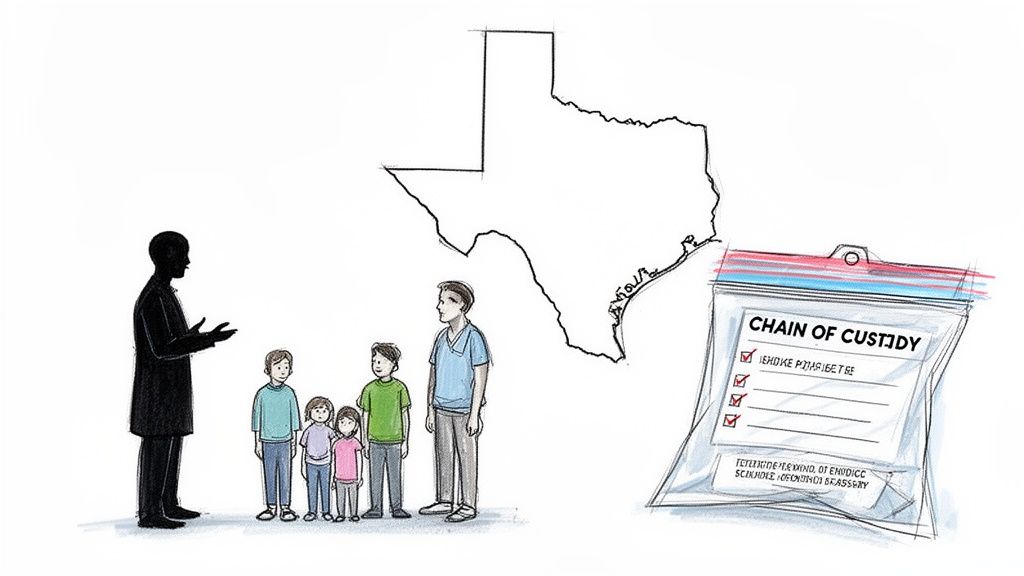
From that point on, my team and I manage every single step with the professionalism and respect your loved one deserves. A critical piece of this puzzle is the chain of custody. Think of it as a detailed, unbroken paper trail that follows every specimen from the moment it's collected until the final test is complete. This isn't just paperwork; it's what ensures the integrity of the evidence, making our findings legally defensible if they're needed in court.
Upholding Standards Across Texas
I’m here to serve families and legal professionals throughout Texas. To make sure the process is handled with dignity and meets every regulation from the Texas Funeral Service Commission, I partner with trusted professionals like Waterloo Mortuary. These partnerships create a seamless, respectful experience, no matter where you are in Texas. We take care of the logistics so you don't have to.
My commitment is to deliver a scientifically sound, objective, and comprehensive report. While we work efficiently, a meticulous analysis takes time, and I will always provide a realistic and transparent timeline for receiving the final results.
What to Expect from the Process
Going through a private autopsy can feel daunting, so I've broken down the key steps to give you a clear picture of what to expect.
- Initial Consultation: We’ll have a confidential conversation to understand your specific situation and figure out if a private autopsy is the right path forward.
- Coordination and Logistics: My team handles all the arrangements, from transportation to coordinating with our professional partners, ensuring your loved one is cared for every step of the way.
- The Examination: I personally conduct the autopsy and carefully collect all the specimens needed for toxicology and any other specialized tests.
- Reporting: You will receive a detailed, comprehensive report that clearly explains the cause and manner of death. I make sure to translate complex medical findings into language that is easy to understand.
My goal throughout this entire journey is to provide you with the answers and clarity you’re looking for. For a more in depth look, you can review our complete guide to the private autopsy process.
Your Questions About Post Mortem Toxicology Answered
When I speak with families and attorneys, certain questions about postmortem toxicology come up again and again. My goal here is to answer them directly and clearly, helping you understand the process so you can make the best decisions for your situation.
How long does post mortem toxicology testing take?
There isn't a single answer, as the timeline really depends on the complexity of the case. We can often get preliminary results from initial screening tests within a few days, but the deep dive confirmatory tests are a much more meticulous process.
A quick screen might flag a potential substance, but proving exactly what it is and how much was present requires careful, methodical work. This comprehensive analysis can take several weeks, especially if we're hunting for a rare or unusual substance that needs a special testing method. At Texas Autopsy Services, we prioritize being thorough over being fast, but we will always keep you in the loop on our progress.
Can toxicology detect every possible drug or poison?
This is a common point of confusion. While modern toxicology is incredibly advanced, it’s not magic. A standard toxicology panel is designed to look for the most common culprits, such as common prescription medications and well known drugs of abuse.
If we suspect something out of the ordinary, like a specific poison or a rare chemical, we have to test for it directly. This is precisely why a detailed history of the deceased is so critical. The more we know about their health, prescriptions, and social history, the better we can narrow our search.
It's a common misconception that a single test can find any poison. In reality, effective toxicology is a methodical process that uses evidence from the case history to narrow down the possibilities and perform the correct analysis.
What is the cost of private post mortem toxicology?
For most of the cases I handle, comprehensive toxicology testing is already included in the cost of a complete private autopsy. I am a firm believer in transparency during what is already a difficult time.
That’s why I provide a clear, all inclusive quote right from the start, based on the specific testing your situation calls for. My commitment is to give you medically sound answers without any financial surprises along the way.
Is it possible to perform toxicology testing long after death?
Yes, in many cases it is. While fresh blood is the ideal sample, it’s not always available, especially if a body has been discovered long after death or requires exhumation.
Fortunately, we can turn to other samples that hold on to evidence much longer. These alternative specimens can be a game changer:
- Hair: Can reveal a history of drug use stretching back for months.
- Bone: Is excellent for detecting heavy metals and can even trap evidence of certain drugs.
- Vitreous humor: This is the fluid inside the eye. It’s remarkably well protected from decomposition and can provide a very clear picture of what was in the body at the time of death.
The right sample depends on the condition of the remains and what we're looking for, but it's an option that can provide answers to questions that have lingered for years.
If you are facing unanswered questions, please know that you don't have to navigate this alone. For a confidential consultation to discuss your specific needs, contact Texas Autopsy Services directly at (806) 230-1889 or visit us online at https://www.texasautopsyservices.com.