November 5, 2026 · Texas Autopsy Services
Medical Malpractice Death Causes and Legal Steps
Learn how a medical malpractice death is defined, how cause is proven, and when a private autopsy helps families and attorneys in Texas.
On this page
- What Counts as a Death from Medical Malpractice
- Who Can Order, Consent to, or Pay for an Autopsy in Texas
- How a Private Autopsy Establishes Cause of Death
- What an Autopsy Can and Cannot Prove
- Timing, Evidence and Why Delay Matters
- Legal Implications of a Medical Malpractice Death in Texas
- Frequently Asked Questions
- Deciding Whether to Request a Private Autopsy
You're holding a death certificate that names a common disease, and the hospital chart says the team did what it could. You still can't tell whether a missed finding, a medication, or a delay changed the outcome. That uncertainty sits next to grief. It deserves a straight answer, not a guess.
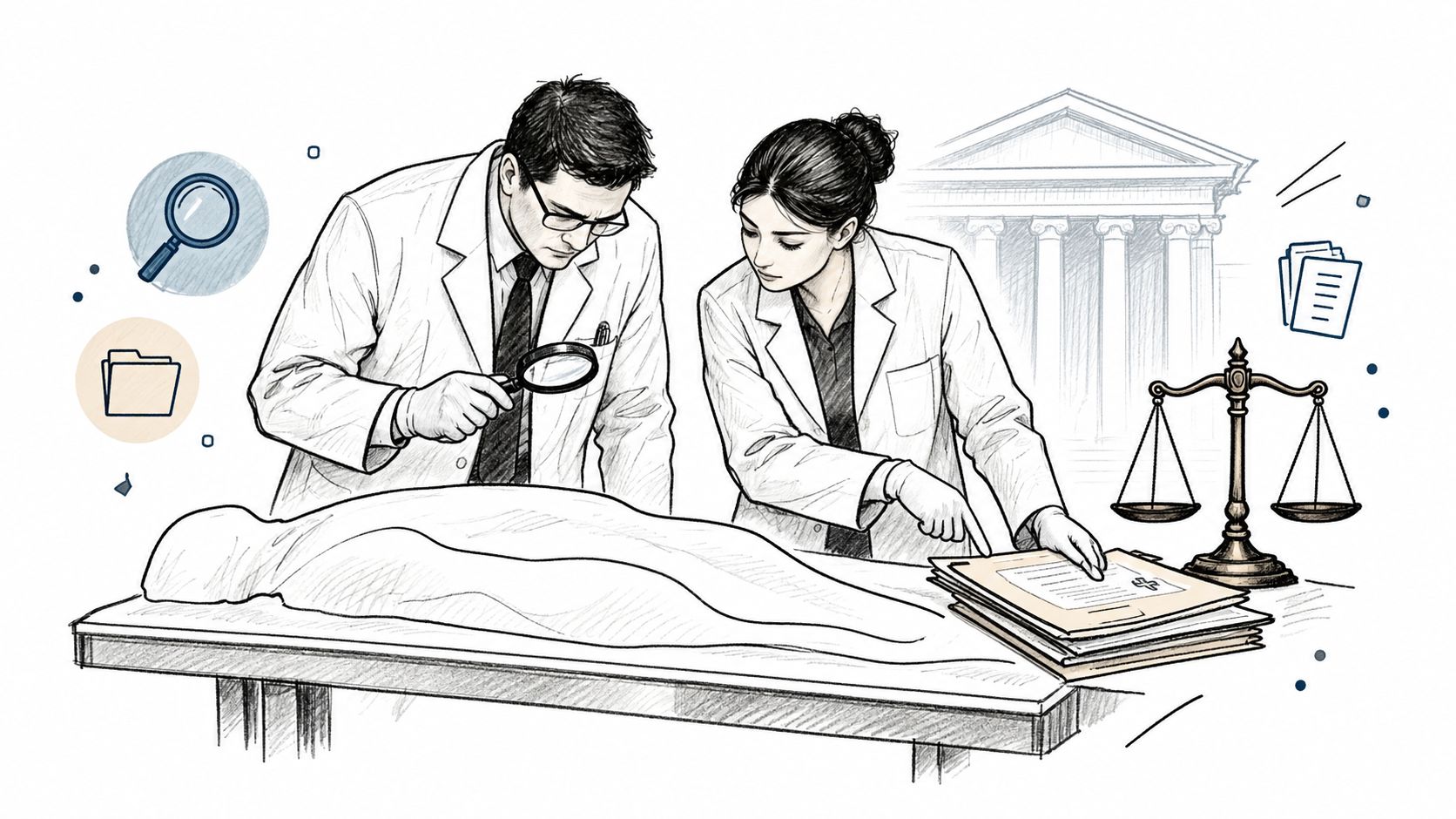
A medical malpractice death is not every death that happens during medical care. It is a death in which care fell below the accepted standard and that shortfall contributed to the outcome. An independent autopsy can show what the body reveals. Whether clinicians met the standard is a separate question for records, experts, and, if a claim follows, the courts.
A few points to keep in mind:
- Cause of death is the disease or injury that started the fatal chain. Manner of death is the category around it.
- Courts look at duty, breach, causation, and damages. A bad outcome alone is not proof of error.
- In Texas, a county exam and a private exam follow different rules for who orders, pays, and receives the report.
- An autopsy can confirm or challenge what happened. It does not, by itself, prove negligence.
- Written consent, timing, and chain of custody decide whether findings stay usable.
What Counts as a Death from Medical Malpractice
Say someone dies on the fourth day of a hospital stay. The family asks whether a missed finding or a medication played a part. No single dramatic mistake jumps off the chart.
In plain terms, a medical malpractice death means care fell below the accepted standard of care, and that departure contributed to the death. Investigators and courts look at four elements.
- Duty of care: A clinician or facility owed the patient a professional duty.
- Breach: Care fell short of what a reasonably careful provider would have done in that setting.
- Causation: The shortfall contributed to the death, rather than the illness running its course alone.
- Damages: The death, and the losses that follow from it, are the harm.
A poor outcome is not proof of error, much as a fever alone does not show which infection is present. The useful question is what the records and the findings show together.
Cause of death is the disease or injury that started the chain of events ending in death. Manner of death is the legal-medical category placed around that cause: natural, accident, suicide, homicide, or undetermined. Fatal problems in care can be diagnostic, medication-related, procedural, or failures of communication. They are not limited to one obvious surgical mistake. Our explanation of how medical negligence is evaluated separates a bad outcome from a breach of the standard.
Why the numbers and the certificate can disagree
In 1999, the Institute of Medicine estimated that 44,000 to 98,000 Americans died each year from medical errors in hospitals, as the National Academies summary of To Err Is Human describes. Later estimates from Johns Hopkins Medicine put U.S. deaths or permanent disabilities from diagnostic error at about 795,000 a year across hospital and outpatient settings. That figure is a model, not a death-certificate count. Diagnostic error means a missed, delayed, or wrong explanation of the patient's problem.
U.S. death certificates code diseases and injuries. They don't code communication breakdowns, cognitive error, or workflow failure as the underlying cause. A certificate can therefore understate a death that may relate to medical error.
Practical rule: A death can be legally relevant without one obvious mistake. Start with the records and the anatomic findings, not with a label.
Who Can Order, Consent to, or Pay for an Autopsy in Texas
Texas does not use one statewide medical examiner office. In counties without a conventional medical examiner, a justice of the peace runs an inquest.
The county route
Under the Texas Code of Criminal Procedure, a justice of the peace may ask a county health officer or physician whether an autopsy is needed to determine or confirm the cause of death. For a body under inquest, the justice generally either directs a physician to perform an autopsy or certifies that none is necessary, subject to statutory exceptions.
One mandatory category is a child younger than six whose unexpected death is determined under Family Code Section 264.514 to involve abuse or neglect. When a medical examiner decides an autopsy is necessary, or when a district attorney, criminal district attorney, or, where applicable, a county attorney requests one, the autopsy must be performed immediately by the medical examiner or an authorized deputy.
A private exam does not replace that county investigation. If jurisdiction has been invoked, coordinate with the justice of the peace or medical examiner before anyone moves the body. Counties that need a forensic pathologist for official work can use our county forensic autopsies. When a county declines a case, we can still examine the body and explain the findings to the family.
How the two routes differ
| Question | County or medical examiner autopsy | Private autopsy |
|---|---|---|
| Who orders it | Justice of the peace, medical examiner, or county authority | Legal next of kin or designated representative |
| Who pays | The government, under its jurisdiction | The family or requesting party |
| Who receives the report | The official agency | The requesting family, who decides who else sees it |
| Typical trigger | Jurisdiction over a death investigation | County declined the case, a second opinion, or an unclear cause |
A private report belongs to the family who requested it. We deliver it to that family, and they decide who else sees it.
Written consent for a private exam
For a privately requested examination, Texas law generally requires written informed consent before a physician performs or assists with a postmortem exam. Consent must come from a person authorized under Article 49.33, on the form prescribed by Article 49.34. That rule is what separates a private exam from a legally compelled forensic autopsy.
If, after due diligence, no authorized person can be found or contacted, an exam may proceed only with authorization from the medical examiner, justice of the peace, or county judge. That exception is time-limited: no sooner than 24 hours and no later than 48 hours after death, or after a physician or another person took possession of the body.
When a complete autopsy isn't needed to establish a cause or to decide whether a crime occurred, Texas law on limited autopsies allows collection of blood, other fluids, tissues, or organs. Targeted sampling can answer a narrow question and still leave injury, treatment complications, or competing causes unanswered. If you aren't sure you have authority to consent, call us and we will walk through it. Direct legal questions about who may consent in a disputed family to an attorney.
How a Private Autopsy Establishes Cause of Death
A private autopsy is an independent post-mortem examination performed by a board-certified forensic pathologist at a family's request, not by a county office. The flow below is the autopsy process we follow for a cause of death investigation.
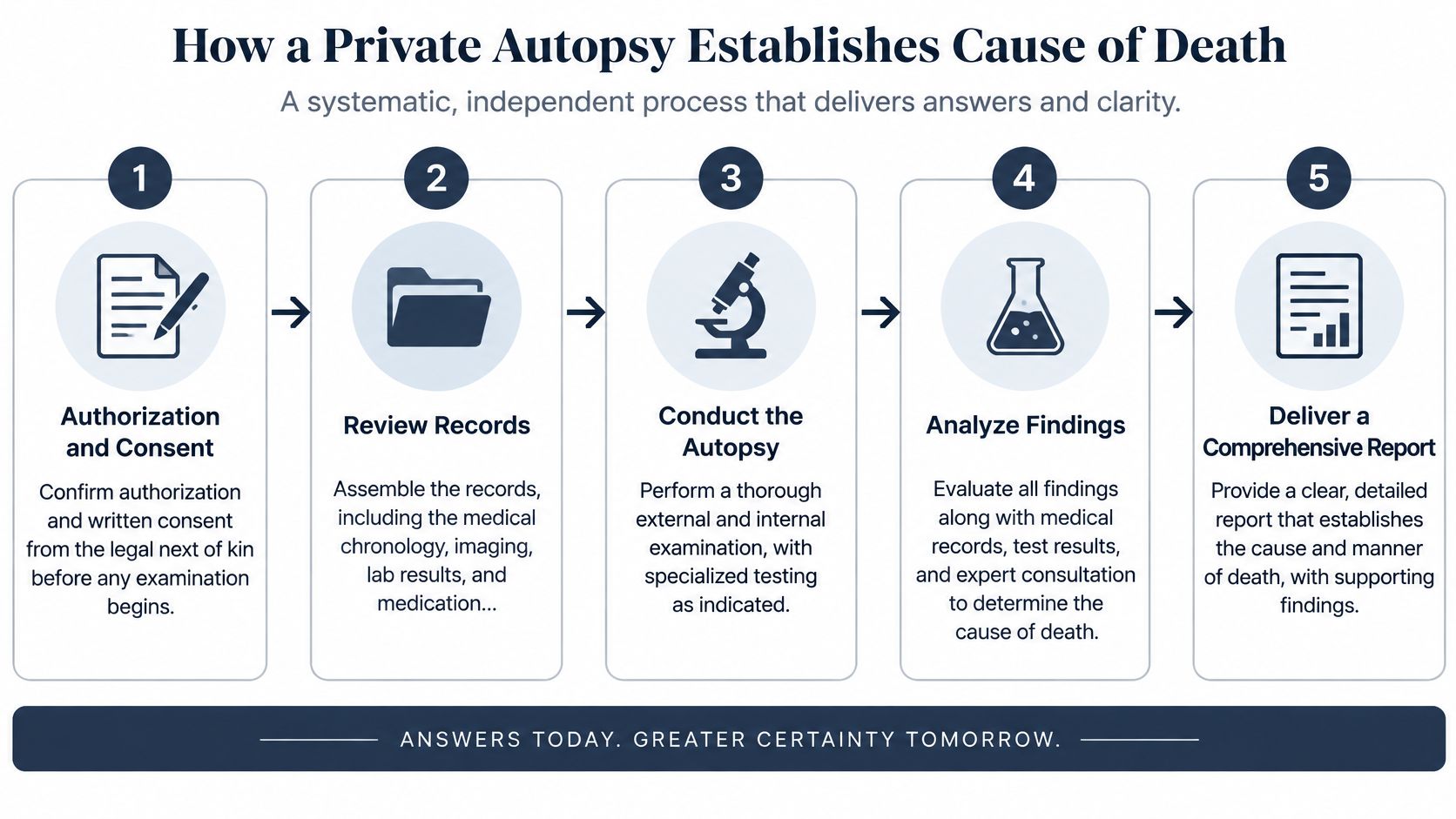
Every examination is performed by a forensic pathologist certified by the American Board of Pathology. The same pathologist who does the exam writes the report and walks the family through each finding. Families are not handed off to a technician. Our private autopsies page describes how that request is arranged.
- Confirm authorization. We obtain written consent from the legal next of kin, or their designated representative, before any examination begins. Without that consent, later findings are harder to defend.
- Assemble the records. We gather the medical chronology, imaging, lab results, and medication administration records. The body answers some questions. The chart answers when a decision was made.
- Examine the body. The pathologist performs the external and internal examination. That comparison is how a treatment complication is separated from the disease that brought the patient to the hospital.
- Collect samples. Toxicology, histology, cultures, or molecular testing are added only when the questions require them. Extra tests don't help if they don't match the issue in dispute.
- Test competing explanations. Anatomic findings are set beside the clinical history. The comparison asks whether the death fits the underlying disease, a complication of treatment, or an independent contributor such as intoxication.
- Issue the report. The written report states the cause and manner of death. The pathologist then walks the family through each finding in ordinary language.
Chain of custody and tests that take longer
Chain of custody is the written record of who handled each specimen, when they handled it, and where it went. We keep that record so a sample can be tied back to the person who died.
Findings are medical opinions based on the evidence available. They are not a promise about what a court will decide. Histology and genetic testing often take longer than the exam itself, so the final report can follow the examination by days or weeks.
This short video shows how we talk families through that sequence before the exam starts.
What an Autopsy Can and Cannot Prove
A medical finding can raise questions without answering whether malpractice occurred. An autopsy can establish or challenge the cause and mechanism of death, identify disease, medication effects, complications, or injury, and document physical evidence. It cannot decide whether clinicians met the applicable standard of care. That judgment depends on the care provided and the full medical record, not on a difference between the autopsy diagnosis and the clinical diagnosis alone.
A study of 293 inpatient-death malpractice claims found that claims without autopsies were more likely to include diagnostic allegations. Having an autopsy was not associated with a greater likelihood of a paid claim or higher compensation, even when the autopsy substantially disagreed with the clinical diagnosis. Those findings help separate two questions: what caused the death, and whether the care fell below the required standard.
What the exam is built to answer
A private autopsy is scoped to the family's questions, often how and why the person died and whether anything was missed. For example, if the recorded cause is heart failure and the family is concerned about a possible bleed, the examination may establish whether a hemorrhage is present, its extent, and whether it fits the known timeline. Those findings do not, by themselves, establish whether clinicians should have ordered a different test at a particular point in the person's care.
A legal review adds context, much like assembling separate pieces of a record into one timeline. Attorneys and experts may consider the autopsy findings alongside medical records, the sequence of events, and the standard of care. Findings that do not support a suspected explanation do not erase the family's concern; they indicate that the examination did not substantiate that explanation.
What can narrow the answers
The evidence available for examination can limit what an autopsy establishes:
- Embalming: Chemical treatment and fluid replacement can obscure injuries and affect toxicology.
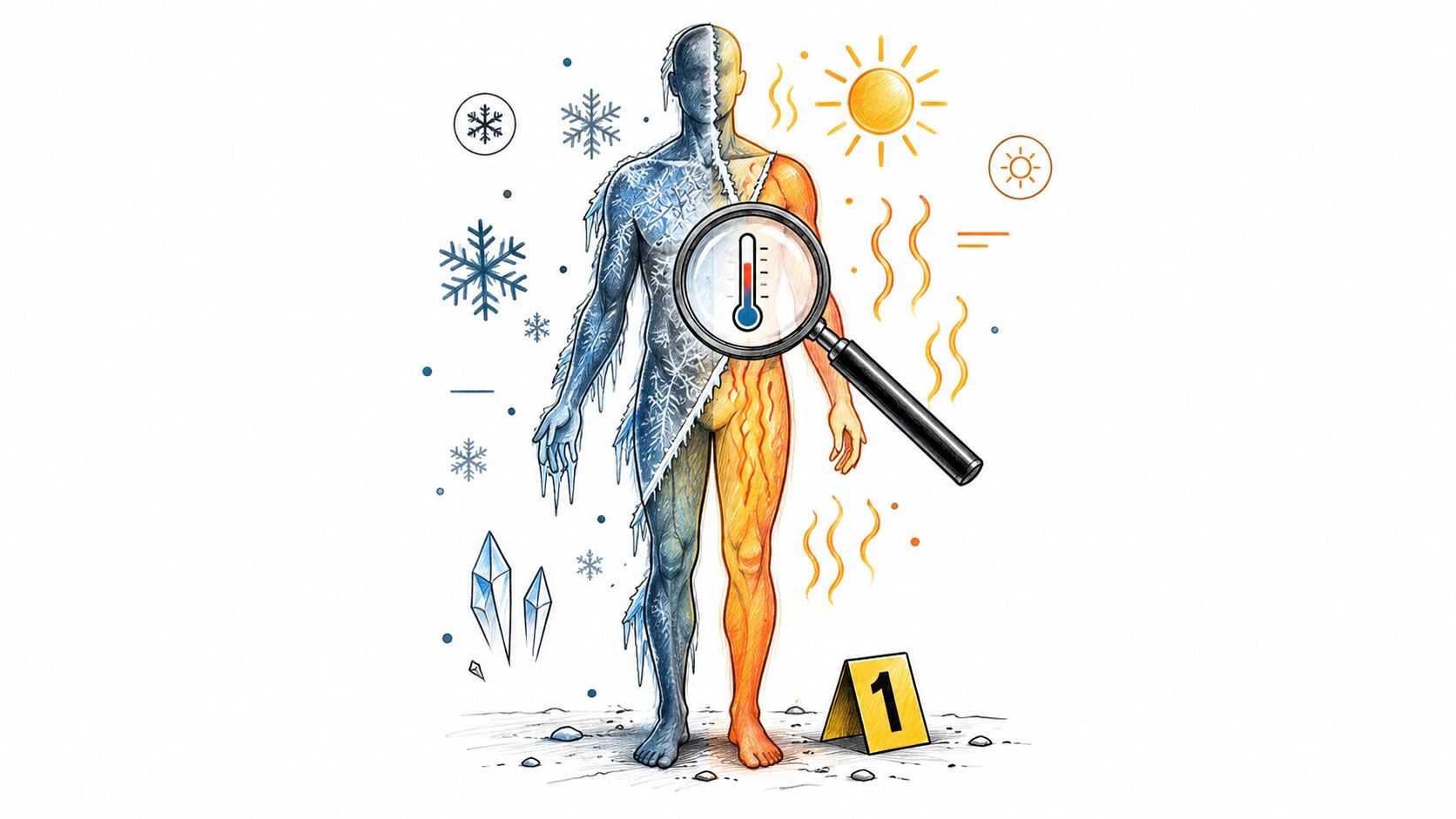
- Delay: Decomposition can reduce what tissues and samples reveal.
- Targeted sampling: An examination focused on a particular question may leave other questions unanswered.
An autopsy clarifies what happened medically. Whether the care was negligent is a separate judgment based on the full evidence.
Timing, Evidence and Why Delay Matters
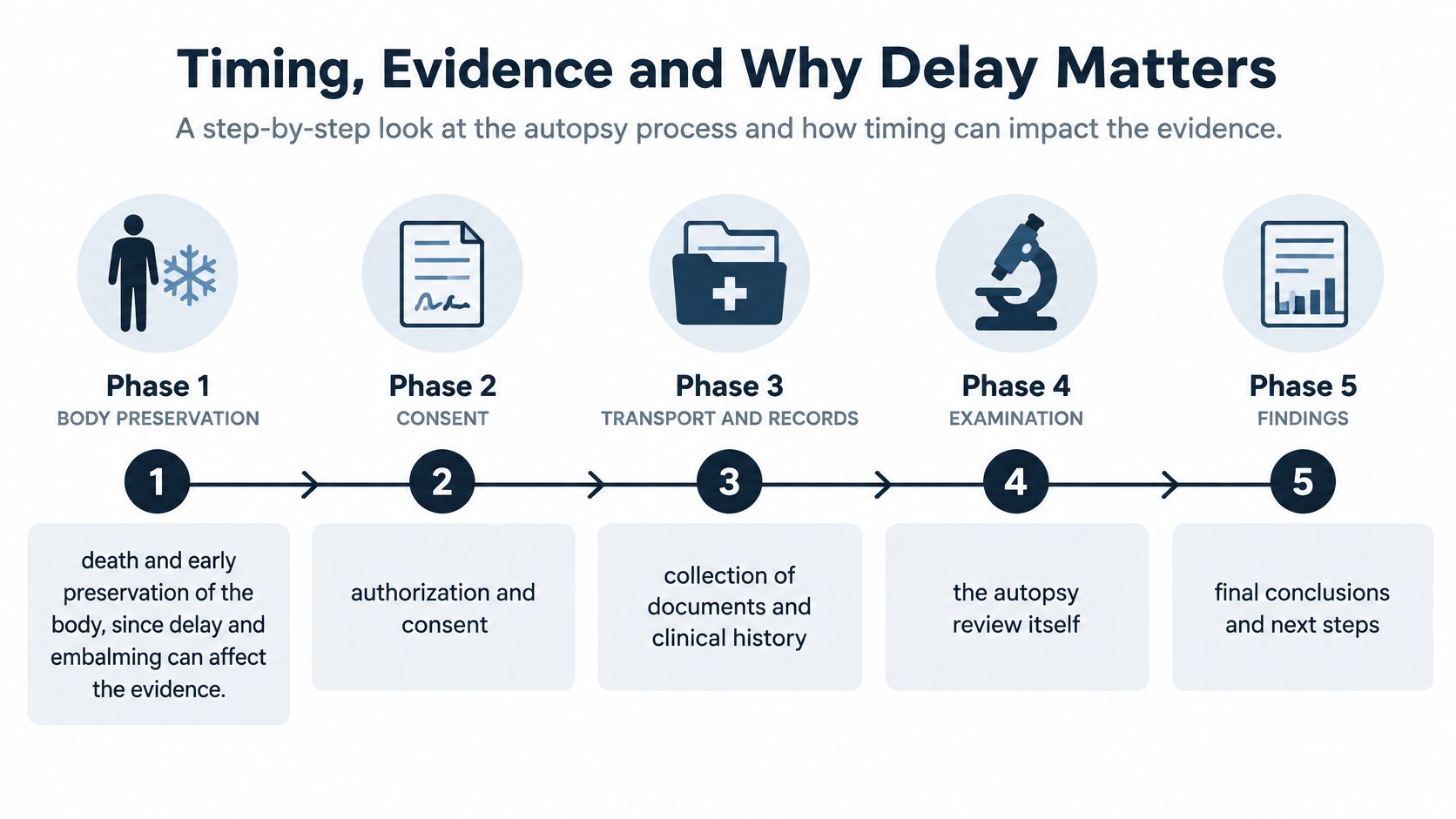
The clock starts at death, not at the first phone call. Delay and embalming can change what an examiner can still see, so early preservation matters more than a fast promise.
| Phase | Typical timing | Why it matters |
|---|---|---|
| 1. Death and preservation | Early, before embalming | Delay and embalming can affect evidence |
| 2. Authorization and consent | Before the exam begins | Only an authorized person can consent |
| 3. Examination | Most cases within 24 to 48 hours | Coordination helps keep funeral plans on track |
| 4. Preliminary findings | Within 24 hours after the exam | Gives the family early direction before the final report |
| 5. Final report | After laboratory results return | Histology and molecular tests can take longer than the exam |
The timeline below is the same sequence, from preservation through the written findings.
Before and during the exam
Death and preservation come first. Refrigeration without embalming keeps more evidence available. If a funeral home has already embalmed, tell us before the exam is scheduled.
Authorization is next. We don't begin until written consent from an authorized person is in hand.
The examination itself is typically completed within 24 to 48 hours. We coordinate directly with the funeral home so planned services are not held up. That is our usual practice, not a guarantee for every case.
After the exam
A board-certified forensic pathologist contacts the family with preliminary findings within 24 hours of the exam. Those comments give direction. They are not the final opinion.
The final written report waits on laboratory results. Histology and molecular testing can take longer than the dissection. Late outside records, specialized testing, a hold on the remains, and a case that needs a second review can each lengthen the schedule. Ask us for the expected timeline on your case. Our guide to requesting medical records after a death lists the documents that most often hold a report up.
Legal Implications of a Medical Malpractice Death in Texas
After a death that may involve medical malpractice, two processes can proceed at the same time: an investigation into the cause and manner of death, and a possible civil claim. They may rely on some of the same records, but they answer different questions. An autopsy can clarify medical findings; it does not, by itself, establish negligence.
The civil track
A wrongful death claim may be brought by eligible family members. A health care liability claim follows a separate legal process, with requirements and deadlines that can affect whether a case proceeds. Because those deadlines may arrive while records are still being collected, families should consult an attorney promptly. The overview of when to speak with a medical malpractice lawyer explains how forensic findings may fit into that process. For a general discussion of wrongful death claims, see Law Office of Bryan Fagan guidance, then bring questions about a specific situation to your own lawyer.
What attorneys usually request
Counsel may review the death certificate, medical records, autopsy report, and documentation showing how specimens were handled. The autopsy report is a medical opinion, not a legal conclusion. Its findings may support a claim, challenge it, or leave questions unresolved. Attorneys assess the full record, and a court determines the outcome if the case proceeds.
The report can be evidence. It is not the verdict.
Rules for handling, transporting, and disposing of remains are separate from the question of whether medical care was negligent. Following those requirements addresses the lawful handling of remains; it does not establish liability.
Frequently Asked Questions
Does a finding that differs from the chart prove malpractice
No. A different diagnosis shows that the clinical explanation and the anatomic findings don't match. Liability still depends on whether the standard of care was met. Attorneys combine the autopsy with the records, the timeline, and expert review before anyone can say a claim is supported.
Does a family need an attorney before requesting a private autopsy
No. A legal next of kin can authorize an exam without filing a lawsuit. If a claim may follow, speak with an attorney early so samples, images, and records are preserved and statutory deadlines are not missed.
Does a limited autopsy answer every question
No. A limited exam collects specific blood, fluid, tissue, or organ samples to answer a narrow question. Other issues, including anatomic injury or a competing cause, can remain open and may need a broader review of records, images, and any earlier autopsy notes.
What does the family need to authorize an exam
Written consent from a person authorized under Texas Code of Criminal Procedure Article 49.33, using the form prescribed by Article 49.34. If you aren't sure you are that person, contact us and we will help you sort out authority before anything is scheduled.
Deciding Whether to Request a Private Autopsy
Families most often request a private autopsy in four situations.
- The county declined. A medical examiner or justice of the peace decided not to autopsy.
- The cause is unclear. The certificate names a common condition, and the course of the death still doesn't fit.
- A second opinion is wanted. A prior autopsy or hospital explanation left a specific question open.
- Records alone didn't settle it. The chart and the death certificate disagree, or both are thin.
The harder question is often how much uncertainty remains when no autopsy was done. A large review of autopsy studies in JAMA reported median rates of 23.5% for major diagnostic errors and 9.0% for the most serious errors, with results that varied by population and autopsy rate. Those figures do not mean every unexplained death involved negligence. They do show why a low autopsy rate can leave a family without an answer.
Before you decide, confirm who has legal authority to consent, check whether a county has already taken jurisdiction, and write down the questions the exam should answer. A complete private autopsy is a flat $5,795, with no hourly billing and no hidden fees. That price covers the examination, histology and laboratory analysis, the written report, a consultation, funeral home coordination, and transportation within 40 miles of Elgin, Texas. Staff at (806) 230-1889 can explain the options before you decide. This is a hard decision, and no step has to be rushed.
Texas Autopsy Services provides independent private autopsy services across all 254 Texas counties for families and attorneys who need a clear cause of death investigation after a possible medical malpractice death. Our board-certified forensic pathologists document what the examination shows and explain it in plain language, without treating the report as a legal verdict. Visit Texas Autopsy Services to see how an examination is arranged and what to have ready before you call.