October 26, 2026 · Texas Autopsy Services
Medical Negligence Signs After a Death in Texas
Learn how medical negligence differs from malpractice, which signs point to a preventable death, and how Texas families can investigate and pursue remedies.
On this page
- What Medical Negligence Means and How It Differs From Malpractice
- Warning Signs That Negligence May Have Contributed to a Death
- What Record Review and Private Autopsy Can and Cannot Show
- How to Start an Independent Death Investigation
- Texas Legal and Administrative Remedies for Negligent Deaths
- Common Questions From Families and Attorneys
- Talk With Our Team Before Deciding Next Steps
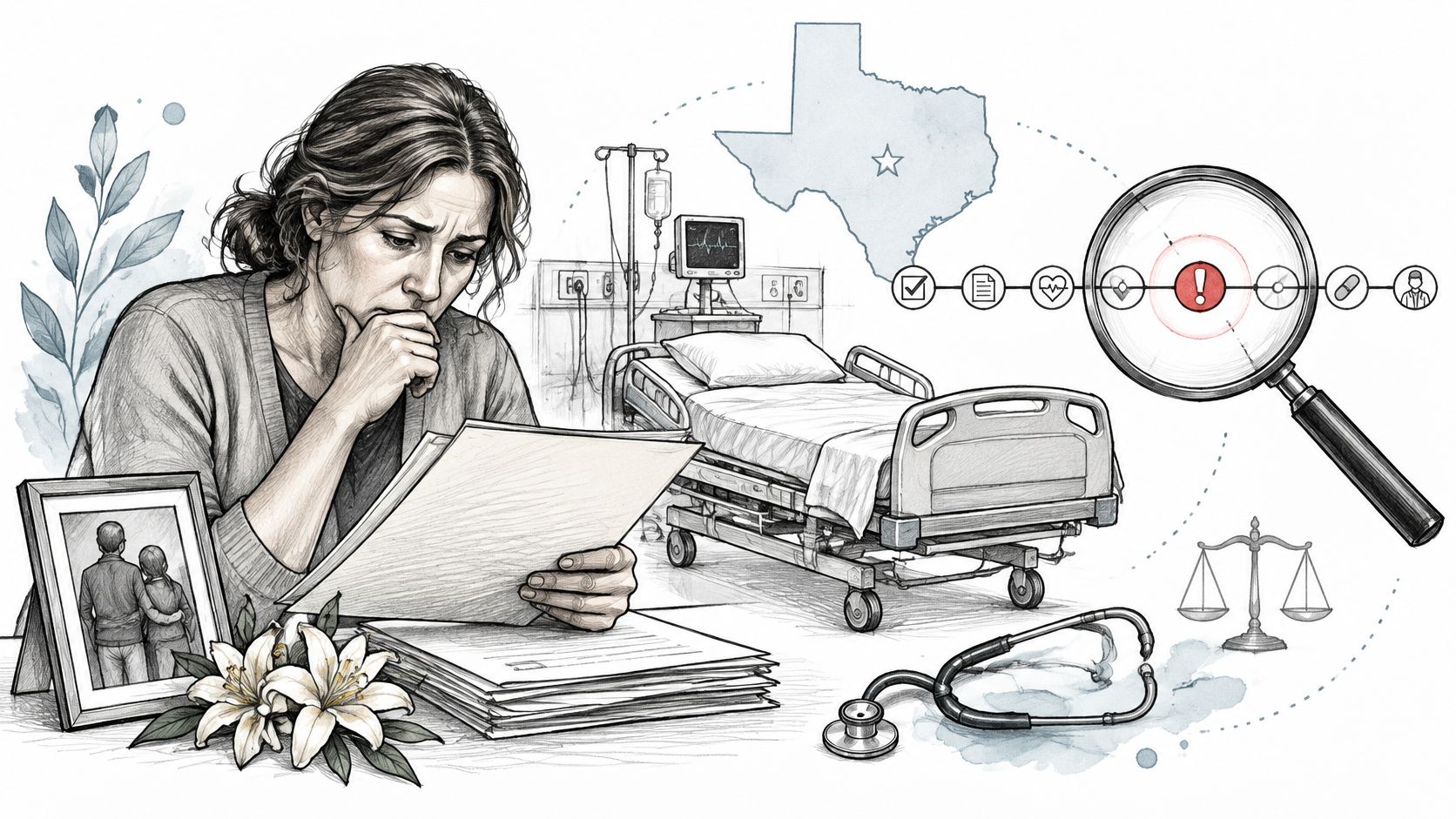
Medical negligence is a health care provider's failure to meet the accepted standard of care that directly causes injury or death, and a bad outcome alone does not establish it. Many families reach that question after a short hospital explanation that doesn't match what they saw, heard, or were told during treatment. The first task isn't deciding fault. It's separating what happened medically from what can be proved legally.
What Medical Negligence Means and How It Differs From Malpractice
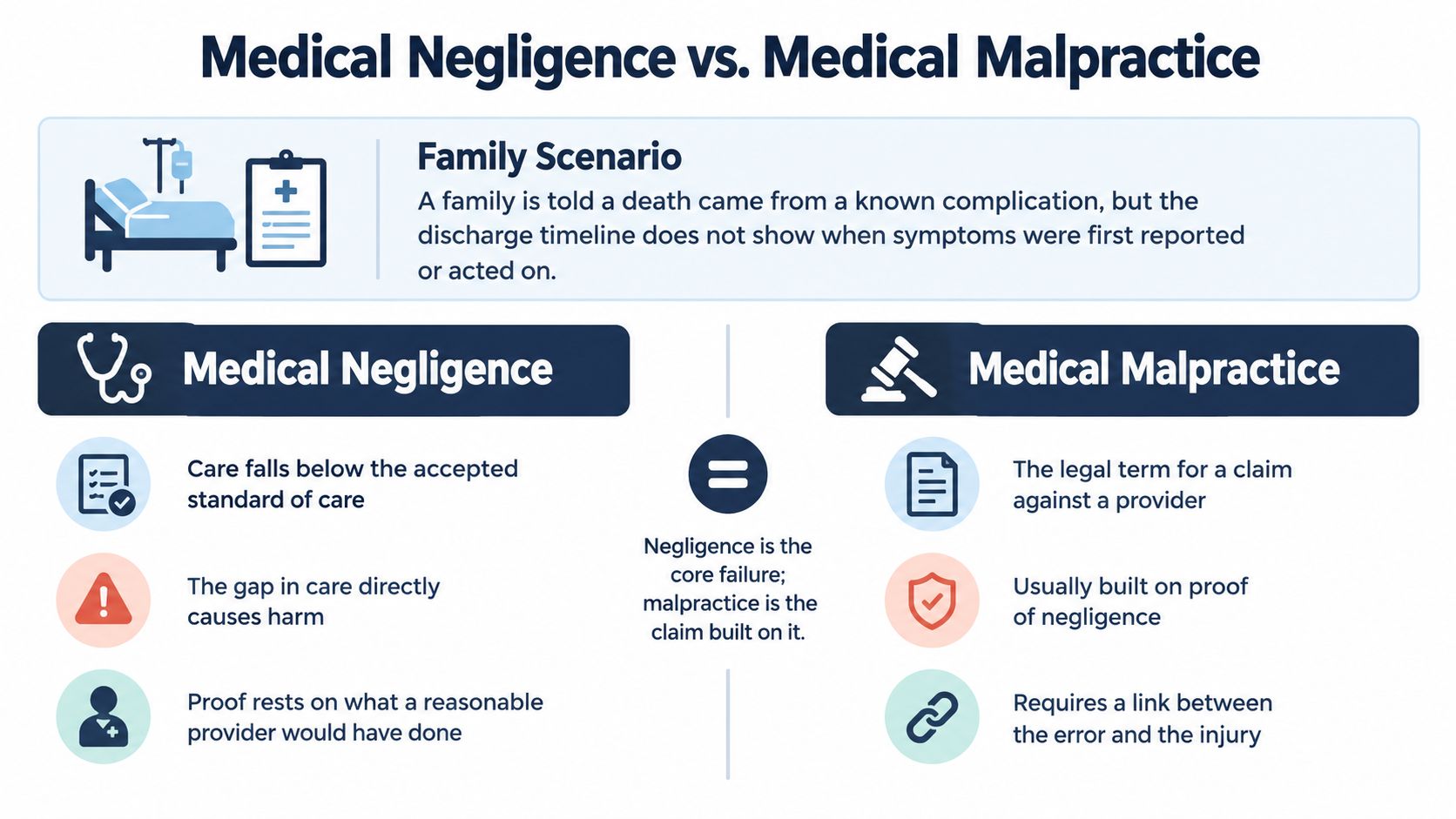
A family is told a death came from a known complication, but the discharge timeline doesn't show when symptoms were first reported or when anyone acted on them. That gap doesn't prove medical negligence. It creates a factual question that records, test results, and postmortem findings may answer.
Medical negligence is a health care provider's failure to meet the accepted standard of care that directly causes injury or death. The standard of care means what a reasonably careful provider in the same field would do in similar circumstances, with similar information and resources available at the time.
Two Terms That Sound Like Different Problems
Malpractice is the everyday term for professional negligence by a licensed provider. Negligence describes the failure in care. Malpractice usually describes the legal claim built on that failure when harm follows.
In Texas, civil claims against physicians and health care providers are generally called health care liability claims under Texas Civil Practice and Remedies Code Chapter 74. That term matters because Chapter 74 controls procedures that don't apply in the same way to ordinary negligence claims against nonmedical defendants.
Three Categories Families Often Blur Together
Think of a smoke alarm. A sound tells you to look, but it doesn't by itself tell you whether there's a fire, burned food, or a faulty sensor. An unexpected outcome works the same way. It prompts review, but the category depends on evidence.
- Adverse event. Harm occurs during treatment or from the underlying condition. Some events happen even when care is appropriate, such as bleeding after a necessary procedure despite correct technique and monitoring.
- Preventable error. Better diagnosis, treatment, medication management, communication, monitoring, or infection control might have avoided the harm. Preventable still doesn't automatically mean a particular provider breached the legal standard.
- Legally actionable negligence. Evidence connects a duty, a breach of the standard of care, causation, and damages. Each part must be supported, not assumed from the outcome.
The World Health Organization patient safety fact sheet estimates that approximately 1 in 10 patients is harmed while receiving hospital care and that more than half of patient harm, roughly 1 in every 20 patients, is preventable. It also estimates more than 3 million deaths occur annually because of unsafe care worldwide. Those population figures explain why review matters. They don't prove negligence in an individual death.
An injury can occur without negligence, and an error can occur without becoming a filed claim. Neither fact answers what happened in a specific case.
Claims records also give an incomplete picture. A Precedent article on medical negligence claims data explains that claims data capture only a small and selective portion of adverse incidents, because many injured patients never file a claim and available data are fragmented across law firms, insurers, and compensation agencies. The absence of a claim isn't evidence that no error occurred. An injury alone isn't evidence that negligence occurred.
Why Causation Needs Separate Proof
Say a treatable infection is recognized late. The record may support a question about delay, but causation asks a different question. Would earlier antibiotics, surgery, or intensive care probably have changed survival, or was the infection already too advanced when the patient arrived?
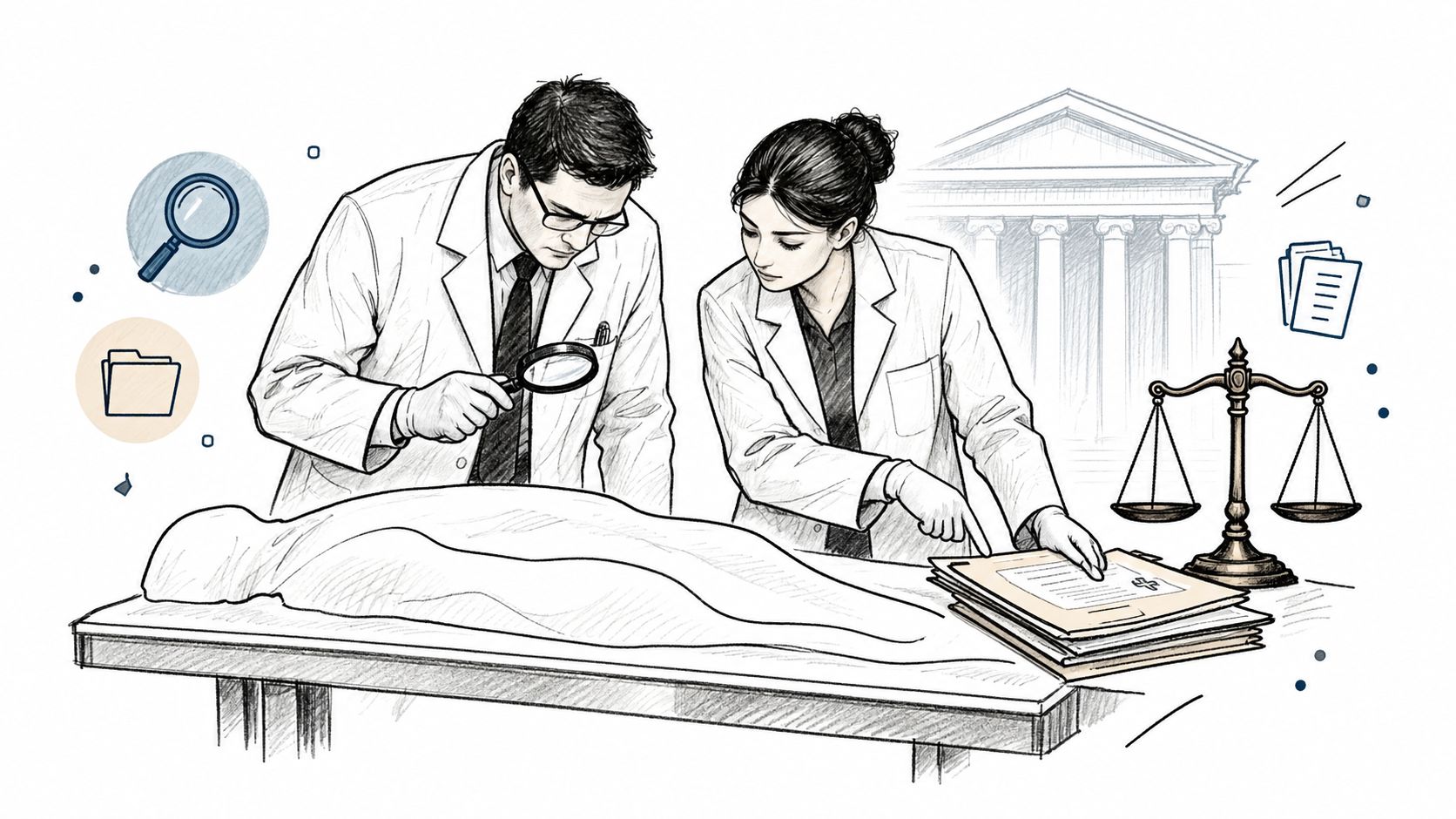
A private autopsy is an independent postmortem examination requested by an authorized family member and performed by a forensic pathologist. It can test whether infection, bleeding, clotting, drug effect, or another process explains death. It can't, by itself, reconstruct every clinical decision.
Chain of custody is the documented record of who collected, held, transferred, and examined each specimen or document from collection through the final report. Clear documentation helps families, attorneys, and officials know that findings are tied to the correct person and materials.
The four elements of a Texas health care negligence claim
| Element | What Must Be Shown | Plain Example |
|---|---|---|
| Duty | A provider-patient relationship existed and the provider owed care | A physician accepted a patient for emergency treatment |
| Breach | Care fell below the accepted standard of care | A recognized warning sign went unevaluated for hours |
| Causation | The breach caused the injury or death | Earlier treatment would probably have changed the outcome |
| Damages | Measurable harm resulted, such as death-related losses | Surviving family members lost financial support and companionship |
This explanation is general information, not legal advice. A Texas attorney should apply Chapter 74 and any other governing law to the facts, records, and deadlines in a particular case.
Warning Signs That Negligence May Have Contributed to a Death
Warning signs are prompts to check the record, not proof of fault. A sign becomes useful when it leads to a specific question with a date, time, document, or test result attached to it.
Diagnostic error means a failure to establish an accurate and timely explanation of a patient's health problem, or a failure to communicate that explanation to the patient. The World Health Organization patient safety facts in pictures page reports the National Academies estimate that approximately 5% of U.S. adults seeking outpatient care experience a diagnostic error each year. It also notes that postmortem research associates diagnostic errors with about 10% of U.S. patient deaths.
A reasonable first diagnosis can still become a concern. Symptoms change, test results return, and a patient may not respond as expected. The review should ask whether clinicians reassessed worsening symptoms, closed the loop on abnormal results, and communicated critical findings to the right person.
Turning a Concern Into a Record Question
The table below pairs common timeline concerns with the question that tests each one.
Warning signs in a death review and the question each raises
| Warning Sign | What It May Suggest | Question to Ask the Record |
|---|---|---|
| Symptoms reported with no documented workup | Possible delayed or missed diagnosis | Was a differential diagnosis or test order recorded? |
| Abnormal lab or imaging result with no follow-up | Results may not have been acted on | Who received the result, and when was it reviewed? |
| Worsening condition with no reassessment | Delayed response to deterioration | Were vital signs and escalation decisions documented? |
| Medication that conflicts with allergies or dosing limits | Possible medication error | Does the administration record match the orders? |
| Death shortly after a procedure with no complication noted | Possible procedural or monitoring error | What do the operative and anesthesia records state? |
| Discharge with a vague or later-revised cause of death | Incomplete or revised diagnosis | Does the death certificate match the clinical record? |
| Discharge instructions or follow-up not provided | Communication or follow-up failure | Are discharge instructions and call logs on file? |
Take one example. Symptoms are noted when a patient arrives, initial tests are ordered, and the patient worsens overnight. If tests aren't repeated and no reassessment note explains the change, the central question is narrow. Was deterioration recognized, evaluated, and documented while treatment could still change?
That question doesn't presume an error. The patient may have declined suddenly despite frequent checks, or additional notes may exist in nursing flowsheets rather than physician notes. A complete review checks both possibilities instead of selecting only the documents that support one conclusion.
Practical rule. Write each concern as a question the chart can answer, then identify the page, result, or witness that should answer it.
Every reviewer should build three timeline points before drawing conclusions. Note when symptoms began, when they were reported, and when action followed. Those points show whether the concern involves delayed recognition, delayed communication, delayed treatment, or a rapid condition that left little time to respond.
What Record Review and Private Autopsy Can and Cannot Show
Each type of evidence answers a different question. Problems arise when one source is asked to do work it can't do, such as treating an autopsy finding as proof of what a clinician knew days earlier.
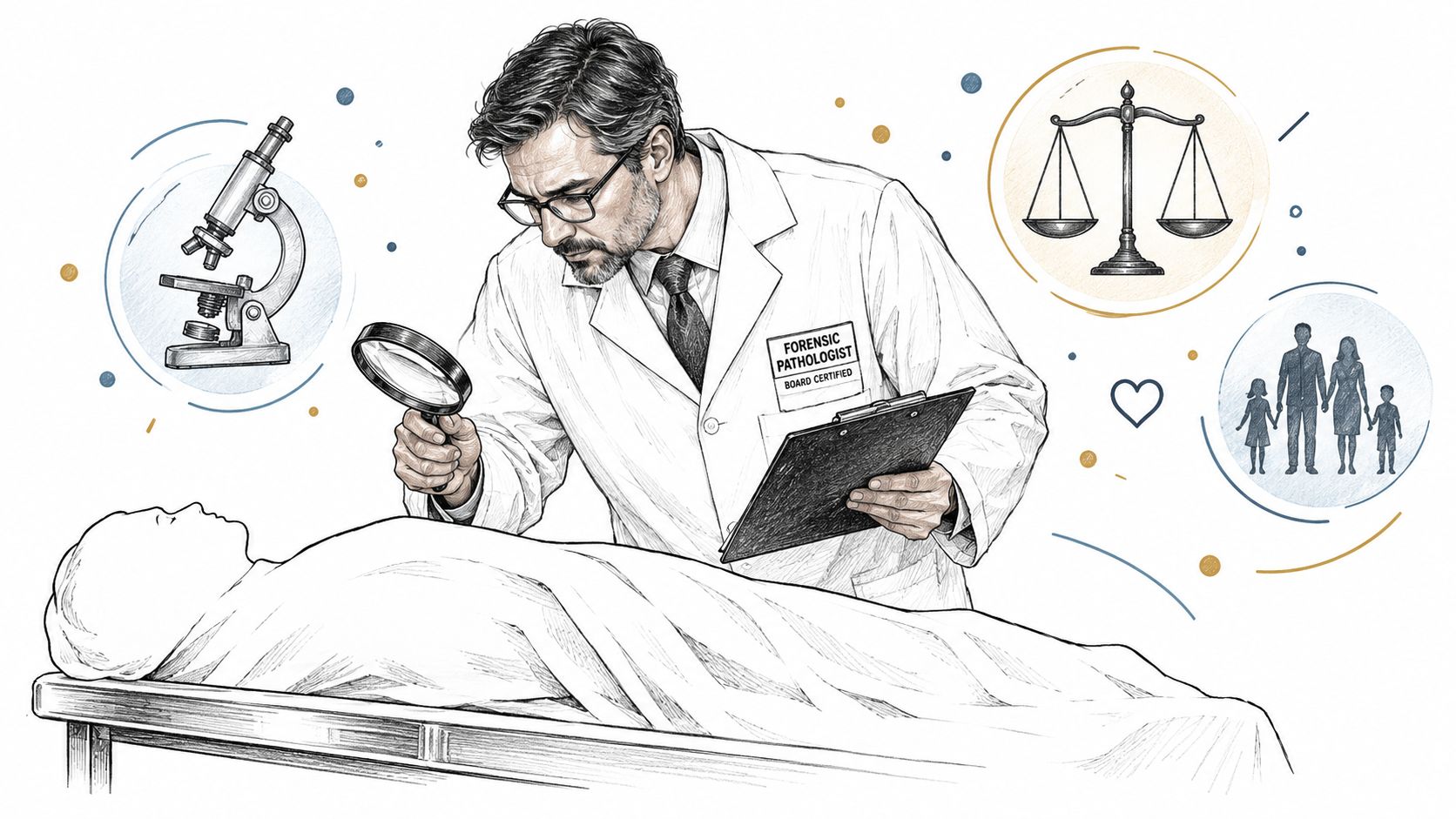
A private autopsy is an independent postmortem examination performed by a board-certified forensic pathologist at the family's request. At Texas Autopsy Services, every examination is performed by a forensic pathologist certified by the American Board of Pathology. Examinations are performed by a board-certified forensic pathologist on our team, and we don't attribute work to a named individual.
Our medical records review expert service fits into that same separation of tasks. Records show the sequence of reported symptoms, orders, results, and responses. Postmortem examination examines the body and selected specimens for the disease or injury that caused death.
Matching Evidence to the Question
Evidence types in a negligence-focused death review
| Evidence | What It Can Show | Limits |
|---|---|---|
| External and internal examination | Injuries, organ changes, and signs of disease or treatment effects | Cannot show what clinicians knew at each decision point |
| Histology (microscopic tissue review) | Infection, cancer, clotting, or other disease processes not visible to the eye | Depends on tissue sampling and the timing of death |
| Toxicology | Drugs, medications, and alcohol in blood and tissue | Levels may not reflect the doses given during care |
| Diagnostic imaging review | Changes over time on X-ray, CT, or MRI | Image quality and reader interpretation affect findings |
| Laboratory timeline | Trends in blood counts, chemistry, and cultures | Only as complete as the tests the facility ran and kept |
| Medication administration records | Doses, timing, and route compared with orders | Missing entries can leave gaps in the timeline |
| Death certificate comparison | Whether the listed cause matches the findings | Certificates can be amended as new information emerges |
The external and internal examination can identify bleeding, organ damage, infection, and other physical changes. Histology adds microscopic review when a process isn't visible to the eye. Toxicology can detect substances in suitable specimens, although a postmortem level doesn't always reproduce the level during treatment.
Imaging and laboratory trends add time. They may show when a condition appeared, whether it was progressing, and whether later results conflict with the working diagnosis. Medication administration records then let a reviewer compare the ordered drug, dose, route, and time with what the record says was given.
Limits That Should Be Stated Plainly
An autopsy can't show what clinicians knew or intended at each decision point. It also can't by itself establish the applicable standard of care for an emergency physician, surgeon, nurse, or other provider. Those questions require the clinical record and qualified expert review within the relevant field.
Timing and tissue quality can also limit findings. Some processes leave clear anatomical evidence. Others, including certain rhythm disturbances or early infections, may leave few findings, so an examination can be inconclusive even when it's performed carefully.
Chain of custody protects the connection between specimens, documents, and conclusions. Postmortem findings remain medical and forensic opinions based on the available evidence, not legal conclusions about liability.
How to Start an Independent Death Investigation
Start with records before requesting opinions. A reviewer who begins with a conclusion may overlook a normal explanation, an incomplete chart, or a document that changes the timeline.
The process below gives families and attorneys a practical order for preserving facts.
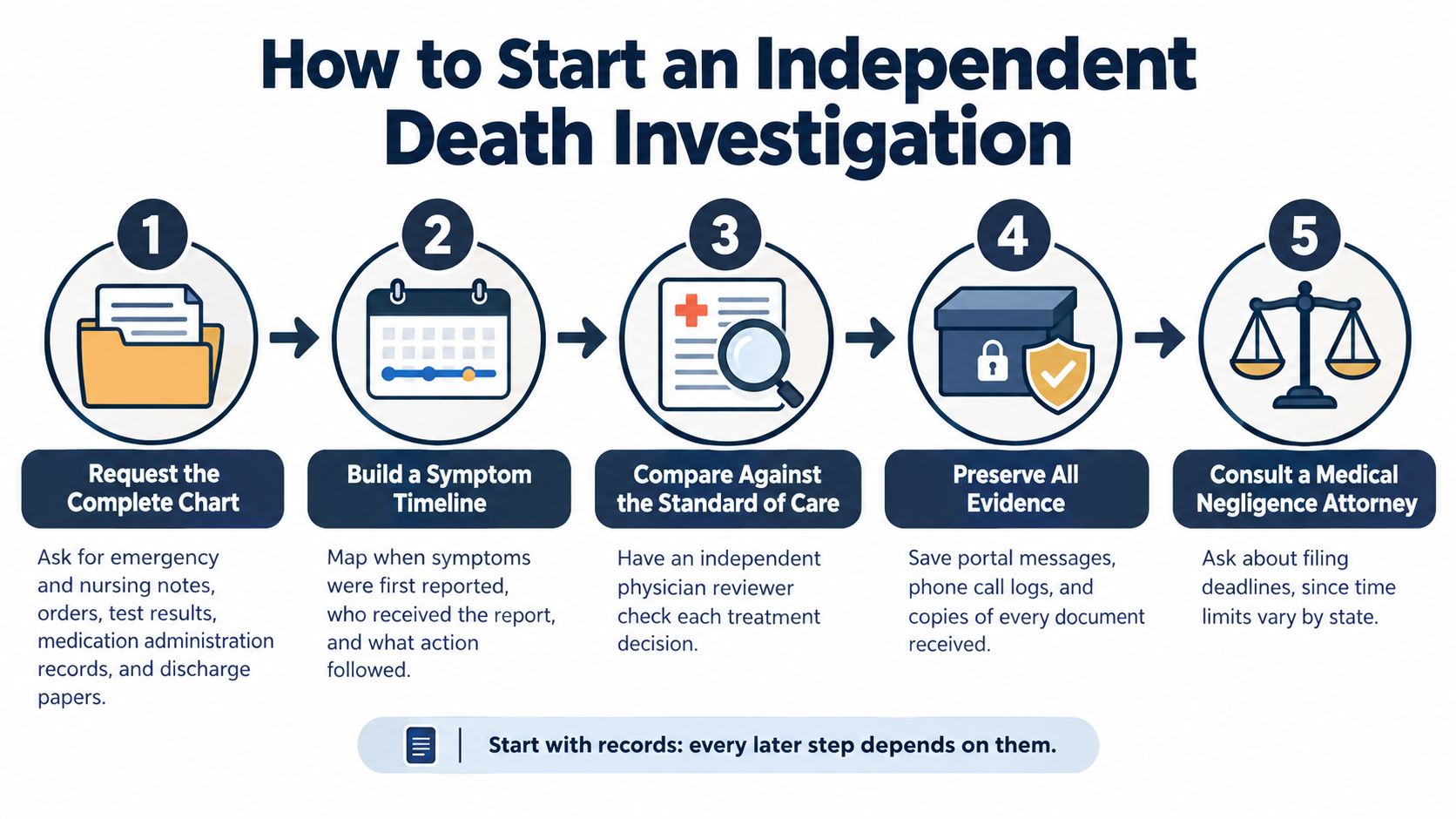
- Request the complete chart. Ask for emergency and nursing notes, orders, test results, medication administration records, consultations, operative records, and discharge papers. Keep a dated list of what was requested and received.
- Build a timeline. Start with the first symptom and mark reports, examinations, tests, decisions, treatments, transfers, and death. Separate documented times from family recollections so each can be checked.
- Obtain the death certificate. Cause of death is the disease or injury that started the chain of events leading to death. Manner of death is the classification of natural, accident, suicide, homicide, or undetermined.
- Confirm authorization. The Texas Department of State Health Services autopsy consent form lists the priority order as the surviving spouse; a guardian or the executor or administrator of the estate; adult children; parents; and adult siblings. It also states that consent isn't required when a justice of the peace or medical examiner orders an autopsy as part of a death inquest.
- Ask about an incident review. Ask whether the facility reviewed the event and whether any findings will be shared. Record who answered and when, without treating a review statement as a legal admission.
- Consider a private examination. Families most often request one when the medical examiner declined the case, when they want an independent second opinion, or when the cause of death was left unclear or unexplained. A private autopsy is authorized by the legal next of kin or a designated representative.
- Coordinate public health questions. When communicable disease may be involved, coordinate with the attending physician or health authority under Texas Health and Safety Code Section 81.045. Official duties may affect authorization, testing, and reporting.
- Share the organized material with counsel. Give the attorney the timeline, chart, death certificate, and any postmortem findings before deciding about a claim or complaint.
Our forensic death investigation guide explains the broader roles involved when jurisdiction and family authorization overlap. The immediate priority is still preservation, because records can be requested later but the opportunity for examination may narrow as arrangements proceed.
The short video below offers an additional overview of independent review.
Texas Legal and Administrative Remedies for Negligent Deaths
Texas remedies fall into two groups. Civil claims seek compensation from a provider or facility. Administrative complaints ask a regulator or death investigation official to review conduct, licensing, facility compliance, or the official death determination. A family may consider one route or both, but each serves a different purpose.
A health care liability claim under Chapter 74 addresses negligent care by a physician or health care provider. A separate wrongful death action under Texas Civil Practice and Remedies Code Chapter 71 allows eligible survivors, generally a spouse, children, or parents, to seek losses resulting from the death. Our wrongful death in Texas overview provides related background for families comparing those civil paths.
Remedies and the Authority Behind Each One
Texas remedies and the law or agency that governs each
| Remedy | Governing Law or Agency | What It Involves |
|---|---|---|
| Health care liability claim | Texas Civil Practice and Remedies Code Chapter 74 | Civil suit against a provider or facility for negligent care that caused injury or death |
| Expert report requirement | Texas Civil Practice and Remedies Code Section 74.351 | Expert report and curriculum vitae due within 120 days after the defendant files its original answer |
| Wrongful death action | Texas Civil Practice and Remedies Code Chapter 71 | Brought by eligible survivors, generally a spouse, children, or parents, for losses from the death |
| Filing period | Texas Civil Practice and Remedies Code Chapter 74 | Generally two years from the breach or treatment, with notice rules that can extend the period |
| Physician complaint | Texas Medical Board under the Texas Medical Practice Act | Review of a licensed physician's conduct and licensing status |
| Facility complaint | Texas Health and Human Services Commission | Complaint review and survey activity for licensed facilities such as hospitals and nursing homes |
| Death investigation review | County medical examiner or justice of the peace | Reconsideration of an inquest, autopsy decision, or the listed cause and manner of death |
The Expert Report Deadline Under Section 74.351
Under Texas Civil Practice and Remedies Code Section 74.351, a claimant generally must serve each defendant physician or health care provider with one or more expert reports and each expert's curriculum vitae no later than the 120th day after that defendant files an original answer. The report must summarize opinions on the applicable standard of care, how the provider failed to meet it, and the causal relationship between that failure and the claimed injury, harm, or damages.
A defendant must object to sufficiency by the later of 21 days after service or 21 days after filing the answer, or objections are waived. If a report is deficient, the court may grant one 30-day extension to cure it. The statute also makes an important practical point clear. An autopsy report alone does not automatically satisfy every expert-report requirement, because cause of death and standard of care may require opinions from different qualified experts.
A forensic finding can support the causation analysis, but it doesn't replace the expert opinions Chapter 74 requires.
Chapter 74 generally sets a two-year filing period, subject to notice rules that can extend it, and statutory limits apply to noneconomic damages. Exceptions and related claims can change the analysis. Families shouldn't calculate a deadline from a general article or wait for every document before calling counsel.
Complaints to the Texas Medical Board or the Texas Health and Human Services Commission don't award compensation to a family. They can lead to regulatory review within each agency's authority. A request to a medical examiner or justice of the peace addresses the official investigation rather than civil liability. A Texas attorney should confirm every deadline and forum before filing.
Common Questions From Families and Attorneys
What if the Family Disagrees With the Listed Cause of Death
A death certificate can be amended when new information supports a change. A family can ask the county medical examiner or justice of the peace to reconsider the cause and manner of death. A record review and private autopsy can supply findings for that request, but the responsible official decides whether the certificate changes.
Does a Claim Require an Autopsy
No. A claim rests on the available medical evidence and the expert reports required by Section 74.351. An autopsy is one source of evidence about disease, injury, treatment effects, and causation. An autopsy report alone doesn't satisfy every expert requirement, particularly when the standard of care for a treating provider is disputed.
An examination may still matter when the clinical diagnosis and physical findings conflict. It may confirm the hospital explanation, identify another cause, or leave the central issue unresolved. Each result helps an attorney decide what additional expert review is justified.
Does a Private Autopsy Replace the Official Death Investigation
No. The private examination and official investigation run separately. Official findings continue to control the death certificate unless the responsible authority amends them. The private report is an independent medical and forensic opinion that the requesting family may share with counsel, officials, or others.
That separation protects both processes. The county official retains public duties, while the family receives an independent examination directed at its unanswered medical questions. Neither report, standing alone, is a court judgment about negligence.
Talk With Our Team Before Deciding Next Steps
A sudden or unexplained death is difficult, especially when the medical explanation leaves a family with unresolved questions. A careful review can begin without assuming that medical negligence occurred.
Families who want an independent examination can submit a confidential request through our Private Autopsies page. If you're not certain you have authority to request a private autopsy, contact our team. We'll walk you through the authorization question and help arrange the examination quickly when you're eligible to proceed.
When a case has been declined by a county, we can still examine the body and explain the findings to the family. County officials and families handling county related questions can also review our County Forensic Autopsies information.
A private autopsy report belongs to the family who requested it and is kept confidential. We deliver the complete written report directly to that family, and the family decides who else sees it. That control matters when a family is still deciding whether to consult an attorney, contact an agency, or keep the findings private.
An independent examination can't determine negligence on its own. It can establish postmortem findings and clarify cause of death, while legal conclusions come from attorneys, qualified experts, and courts applying Texas law to the full record.
For guidance on records, authorization, or an independent cause of death investigation, call Texas Autopsy Services at (806) 230-1889. Our team will explain the process plainly and help you decide the next step at a pace that respects your family.
Texas Autopsy Services provides independent private autopsies, second opinion autopsy reviews, and forensic pathology support across Texas, with examinations performed by board-certified forensic pathologists and clear written reports for families and attorneys. If questions about medical negligence remain after a death, visit Texas Autopsy Services to discuss a confidential record review or private examination with our team.