October 21, 2026 · Texas Autopsy Services
Wrongful Death Texas
Understand wrongful death Texas claims, who can file, the statute of limitations, damages, and how independent autopsy evidence supports a case.
On this page
- What Wrongful Death Means Under Texas Law
- Who May File a Wrongful-Death Claim in Texas
- Statute of Limitations and Key Deadlines in Texas
- Types of Damages Texas Families Can Recover
- How Forensic and Autopsy Evidence Support a Texas Claim
- When the Official Autopsy Is Declined or Incomplete
- Steps Families and Attorneys Should Take Next
You're sitting at your kitchen table with a death certificate that doesn't answer your questions, a funeral home asking about next steps, and a phone that won't stop ringing. Someone has mentioned wrongful death in Texas, but no one has explained how the legal claim connects to the medical facts. We're going to walk through that connection step by step, in plain language.
- Wrongful death is a family claim, separate from the estate's survival claim.
- Only a spouse, children, and parents may file under Texas law.
- Deadlines control the case, including a three-month milestone and a two-year filing window.
- Forensic evidence often decides causation, which is why preservation matters early.
- A private autopsy or independent review may help when the official examination is declined or incomplete, but it doesn't guarantee a legal outcome.
What Wrongful Death Means Under Texas Law
A wrongful-death claim asks a simple question in legal form. Did another person's wrongful act, neglect, carelessness, unskillfulness, or default cause your loved one's death, and did specific family members suffer losses because of it? That's the core idea behind Texas Civil Practice and Remedies Code Chapter 71.
It helps to see the parts laid out together before we go further.
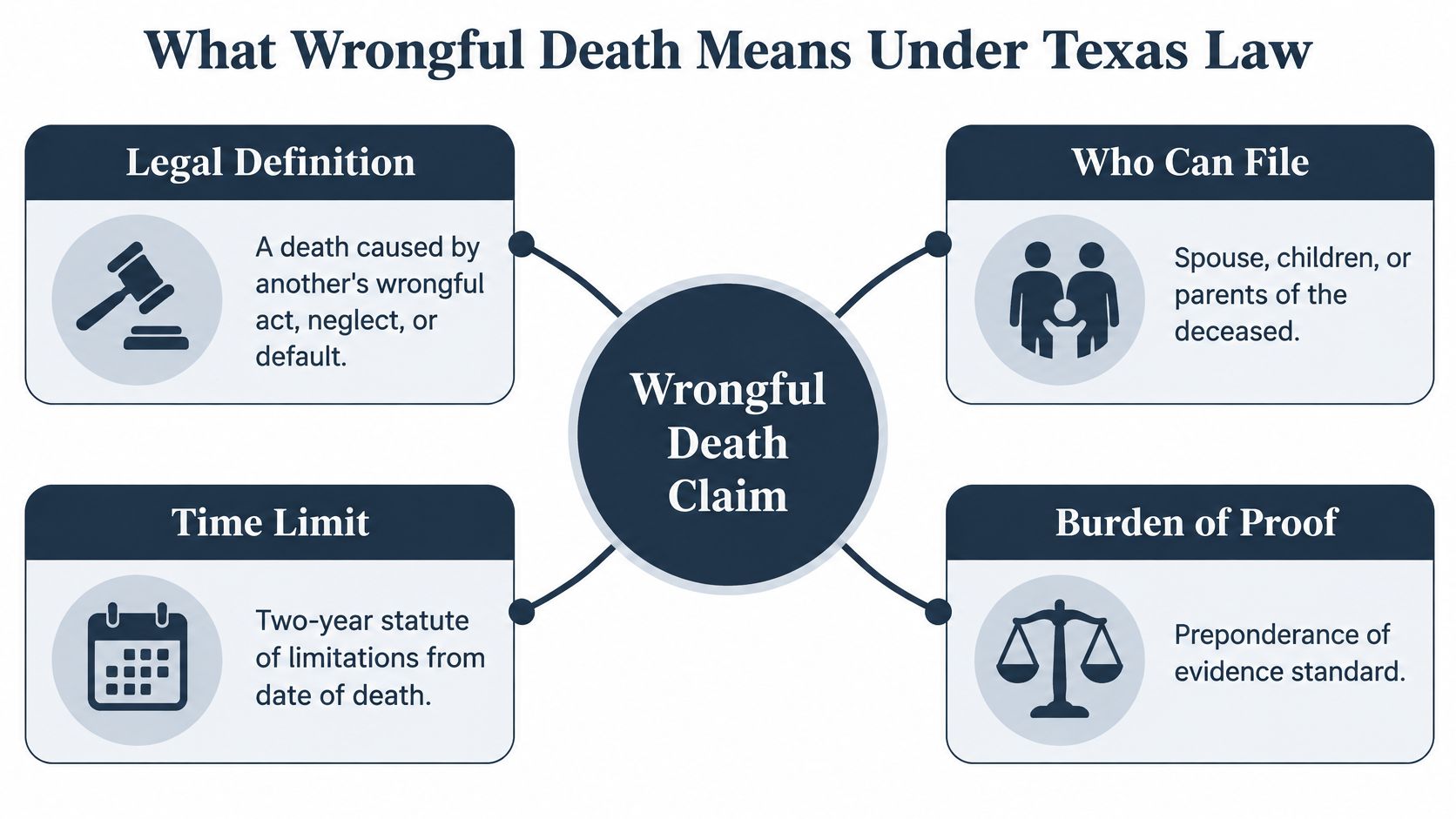
Two Claims That Often Travel Together
Families often hear two terms used as if they're the same. They aren't.
- Wrongful-death claim: This belongs to eligible family members. It covers losses they suffer after the death, such as lost support and companionship.
- Survival action: This belongs to the estate. It covers losses your loved one experienced between injury and death, such as medical expenses and pain before death.
Counsel may file both claims in one lawsuit. That doesn't merge them. Different people receive the money, and different evidence proves each part.
Why Medicine Sits at the Center
A court can't award damages for a death without a reliable link between conduct and outcome. Say a driver ran a red light, or a workplace machine failed, or treatment was delayed. The legal theory still needs medical proof of what caused death and whether that cause fits the event.
A clear legal theory without a supported medical cause leaves the most important question unanswered.
That is why records, photographs, toxicology, and autopsy findings matter from the start. Our team doesn't decide legal liability. Our board-certified forensic pathologists address the medical facts, and counsel uses those facts to evaluate liability.
This article is educational and isn't legal advice for your situation. A Texas attorney should review your family's specific facts.
Who May File a Wrongful-Death Claim in Texas
Texas limits this claim to a specific group. Under Texas Civil Practice and Remedies Code §71.004, the people who may seek damages are the surviving spouse, children, and parents of the person who died.
That's narrower than many families expect. Siblings and grandparents generally don't have an automatic right to bring this claim on their own, even when they were very close to the person who died.
How Eligible Relatives May File
Eligible relatives may file together. One or more may also bring the action for the benefit of all eligible family members, as §71.004 allows.
Adult children can qualify. Legally adopted children and adoptive parents can raise fact-specific questions that counsel should review with adoption records in hand. Marriage status can matter too, especially after separation or an informal marriage.
Don't assume one relative can speak for everyone. A spouse, an adult child, and a parent may each have separate losses, even inside one case.
The Three-Month Milestone
Texas law sets an early procedural trigger that surprises many families. If no eligible relative begins the case within three calendar months after the death, the executor or administrator of the estate generally must bring and prosecute the action, unless every person entitled to sue requests otherwise.
This rule can affect who controls the lawsuit. It can also affect settlement discussions and how evidence is gathered.
Practical rule: Don't wait for the three-month date to ask who is in charge of records, reports, and preserved specimens.
Early coordination helps protect medical records, employment records, toxicology information, photographs, and other evidence. If your family waits, the legal right may remain while the medical evidence becomes harder to review.
A useful first step is a short family list. Write down the spouse, each child, and each parent, then note who has spoken with an attorney, who holds records, and who is communicating with the funeral home or investigating office.
Statute of Limitations and Key Deadlines in Texas
A statute of limitations is a filing deadline set by law. Miss it, and a court may refuse to hear the claim even when the underlying facts are strong.
For most wrongful death in Texas cases, families should plan around the general two-year deadline from the date of death. Counsel should confirm how that deadline applies to your case, because exceptions can be narrow and fact-specific.
Two Dates Families Often Confuse
The two-year period and the three-month milestone do different jobs. One is the outside filing window. The other affects who must bring the action if eligible relatives haven't started it.
| Deadline | Trigger | Practical Effect |
|---|---|---|
| Two-year limitations period | Date of death | Sets the general deadline to file suit |
| Three-month milestone | Three calendar months after death with no filing by eligible relatives | Estate executor or administrator generally must bring the action unless all entitled persons request otherwise |
| Tolling or exception review | Facts such as minority, incapacity, or delayed discovery raised with counsel | May affect timing in limited situations and needs prompt legal review |
Exceptions Need Early Review
Some situations may pause or affect the clock, including claims involving a minor child or facts that could not reasonably be discovered right away. Claims involving a government entity can also involve separate notice requirements, so counsel should check those rules immediately.
Don't treat an exception as a safety net. The safer approach is to identify the date of death, mark the second anniversary, and speak with counsel well before the first year passes.
That early meeting also protects evidence. Hospital records can be requested, EMS data preserved, and retained tissue or toxicology specimens identified while they're still available. A forensic review started late may have fewer materials to work with, even when the lawsuit itself is still timely.
Types of Damages Texas Families Can Recover
Damages are the losses Texas law may compensate. They aren't a value placed on a person's life, and they aren't automatic. Each category needs evidence that connects the loss to the death.
The diagram below groups the main categories families and attorneys usually discuss.
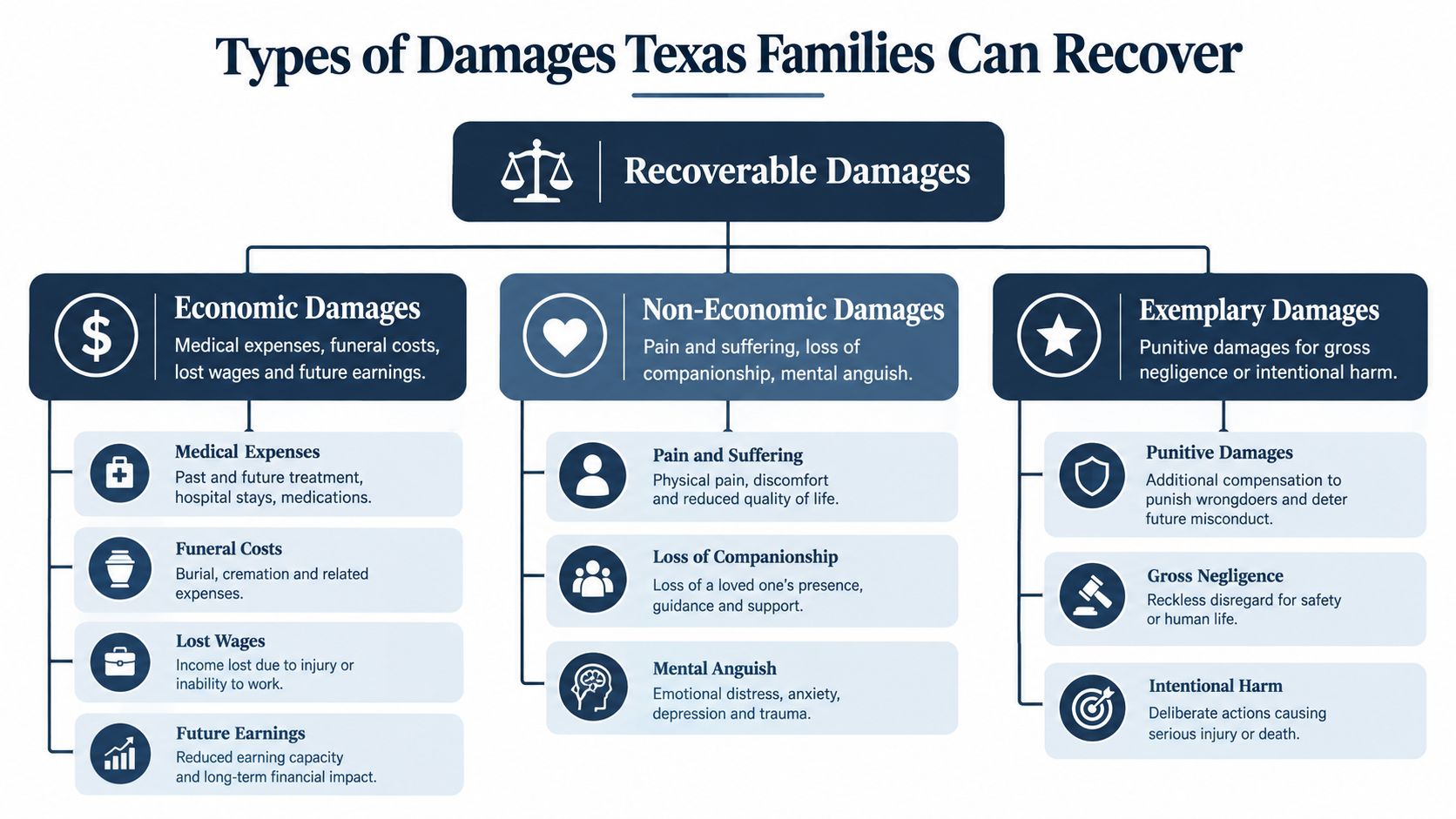
Economic and Noneconomic Losses
- Economic damages: These include losses that can be documented with records, such as lost earning capacity, lost financial support, loss of household services, and loss of inheritance. Pay records, tax returns, benefit statements, and employment history often support this part.
- Funeral and related expenses: Invoices and receipts help keep these amounts clear and provable.
- Noneconomic damages: These address human losses such as mental anguish, loss of companionship and society, and loss of consortium for a surviving spouse. Testimony, photographs, messages, and day-to-day records can help show the relationship that was lost.
Survival damages are different because they belong to the estate. They can include medical expenses before death, lost earnings between injury and death, and pain your loved one experienced before death.
The short video below offers another plain-language overview of how damages categories are organized.
Exemplary Damages and Proof
Exemplary damages, often called punitive damages, require more than ordinary negligence. Texas law requires a higher showing, such as gross negligence or malice, and caps can apply. Counsel should explain whether that category fits your facts.
Whatever the category, causation comes first. If the medical evidence doesn't support the claimed cause of death, damages evidence alone won't carry the case. That's why attorneys often want a reliable forensic opinion before serious settlement talks begin.
How Forensic and Autopsy Evidence Support a Texas Claim
Forensic evidence answers medical questions that legal documents can't answer alone. A hospital chart may show treatment, and a crash report may show impact, but neither automatically proves the medical cause of death.
Two terms matter here. Cause of death is the disease or injury that starts the chain of events leading to death. Manner of death classifies the circumstances as natural, accident, suicide, homicide, or undetermined.
The five steps below show how those findings move from examination into a legal case.
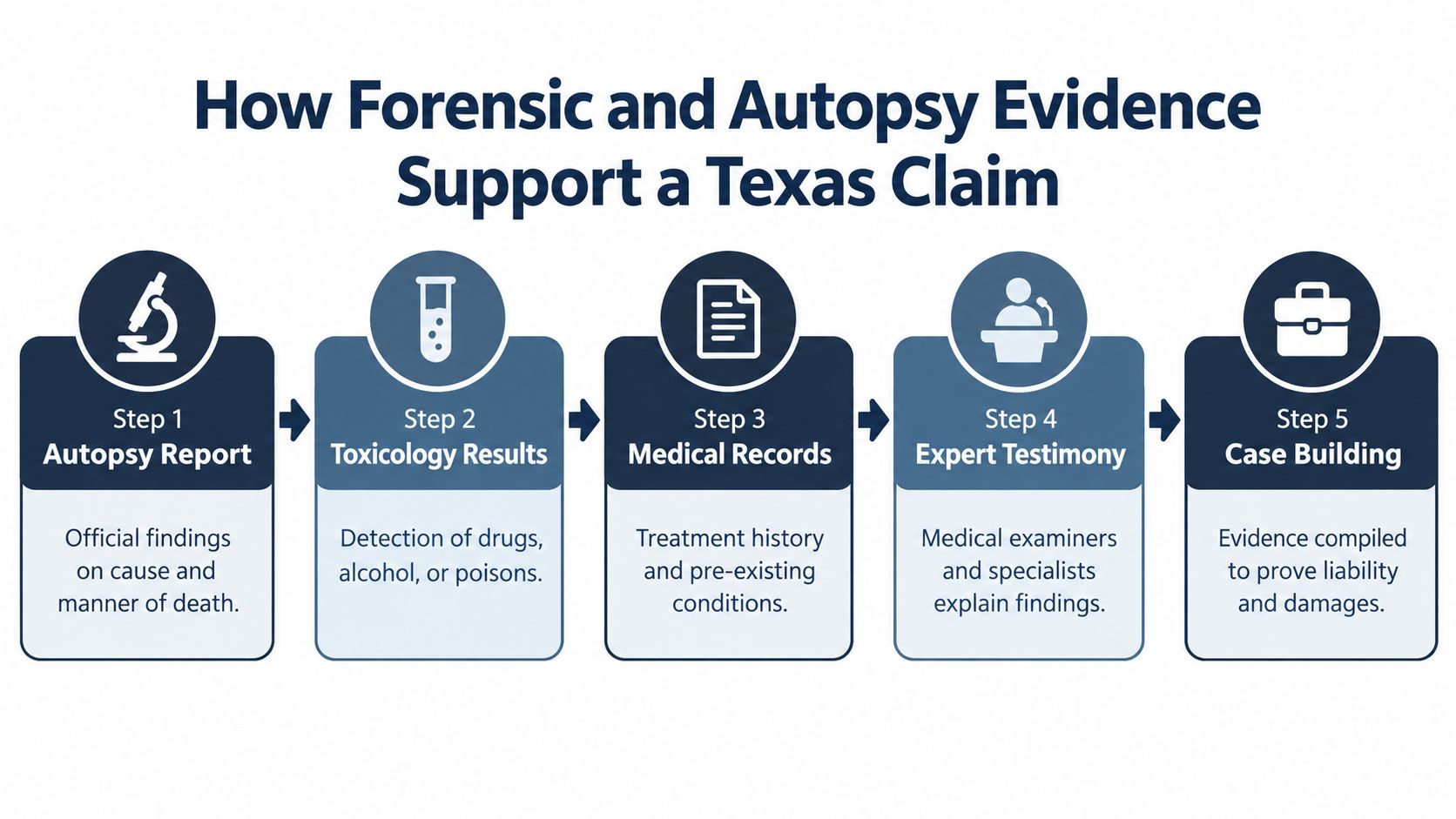
What a Forensic Pathologist Reviews
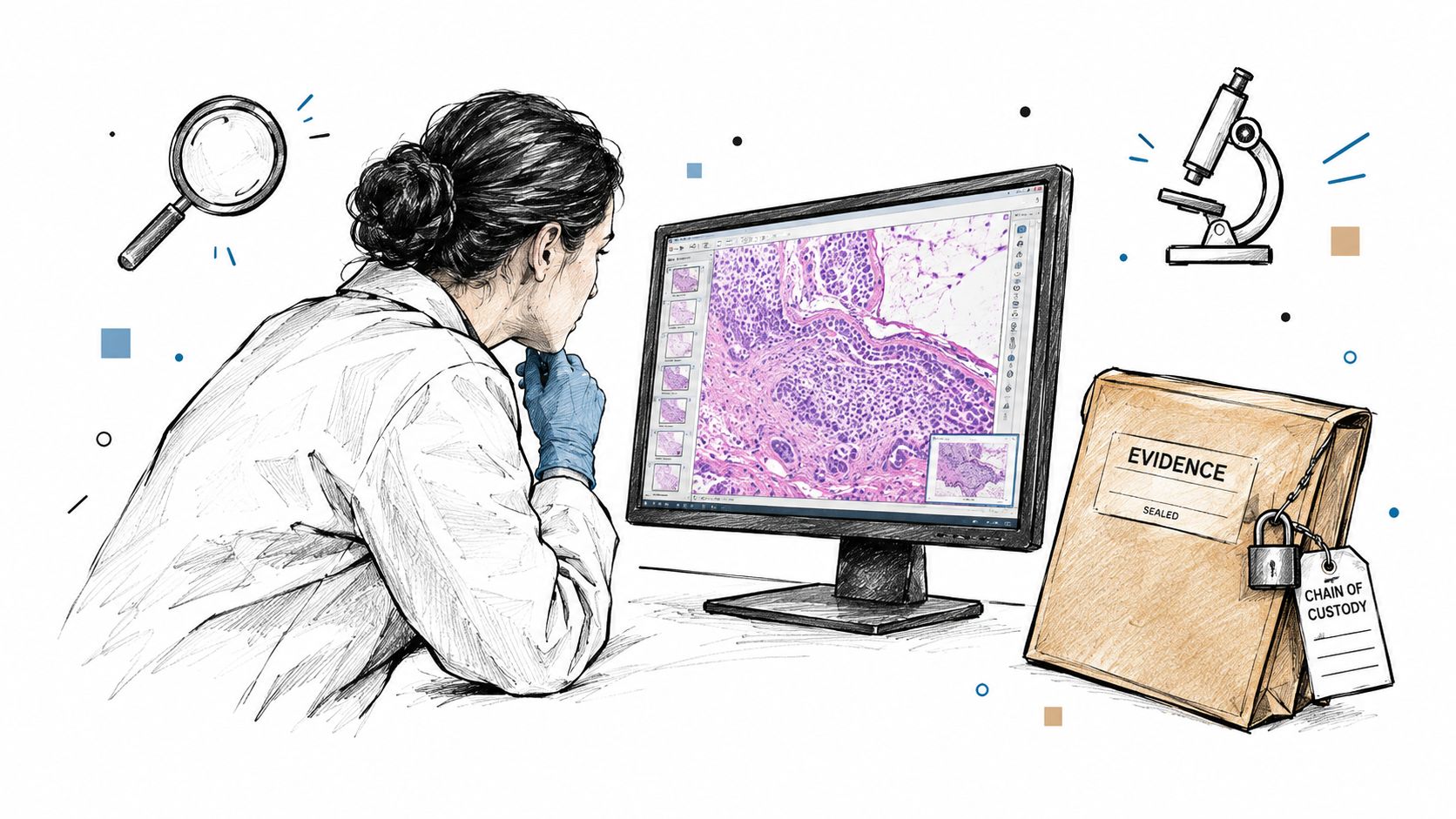
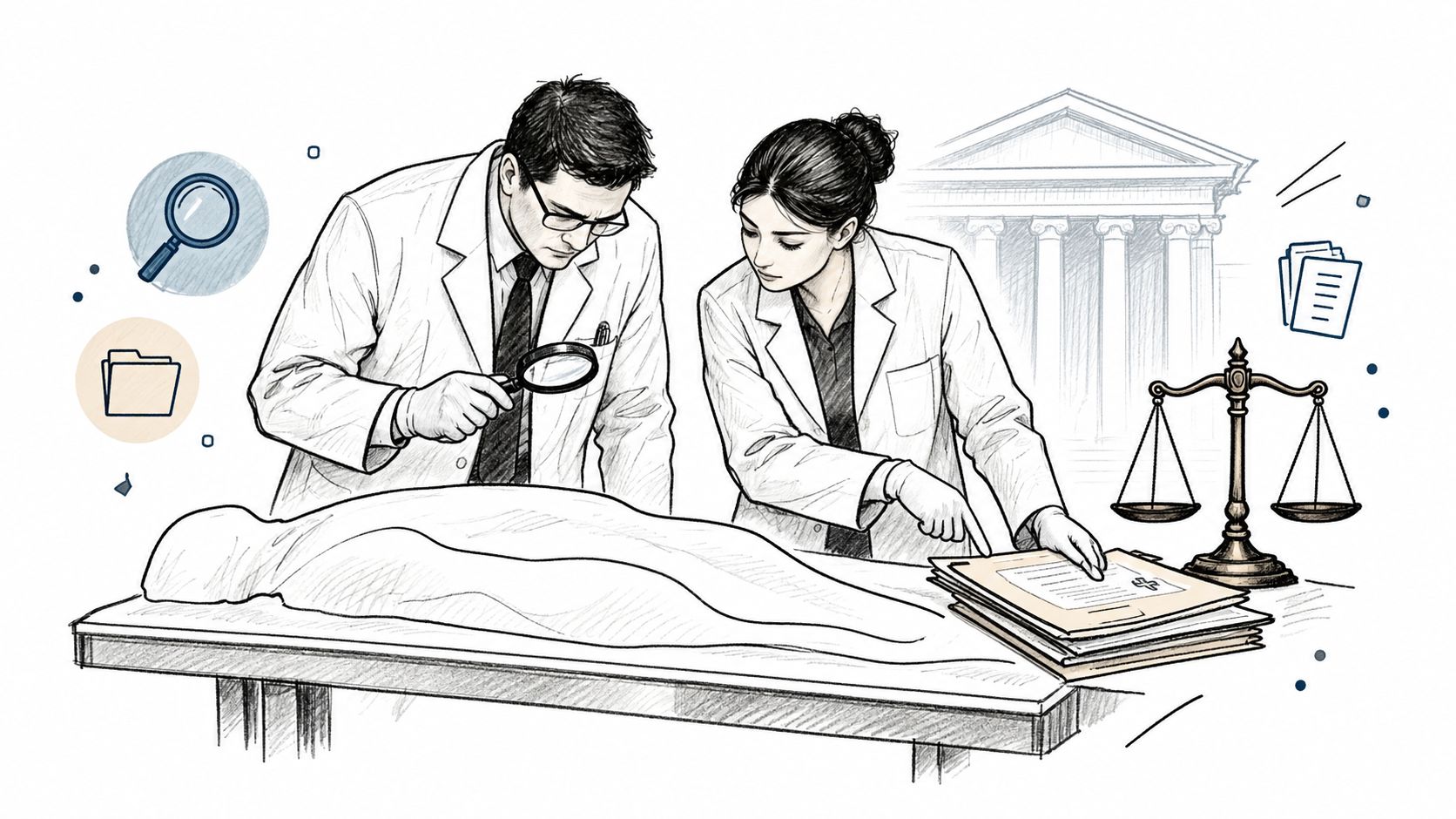
In a private autopsy or second opinion autopsy, our board-certified forensic pathologists correlate the body examination with records and testing. Every examination is performed by a forensic pathologist certified by the American Board of Pathology.
Useful materials can include the autopsy report, toxicology, histology slides, radiology, retained tissue, photographs, clothing, medical devices, medications, hospital records, EMS data, and prior reports. Our forensic pathology review process explains how those items are organized before an opinion is written.
Workplace deaths show why that breadth matters. Texas recorded 557 fatal occupational injuries in 2024, with a fatality rate of 3.9 deaths per 100,000 full-time-equivalent workers, according to the Texas Department of Insurance 2024 fatality report. The same report counted 242 transportation deaths, 91 contact incidents, 77 falls, slips, and trips, 75 violent acts, 62 exposure deaths, and 10 explosion or fire deaths, and those figures don't establish negligence in any individual case.
Chain of Custody in Plain Language
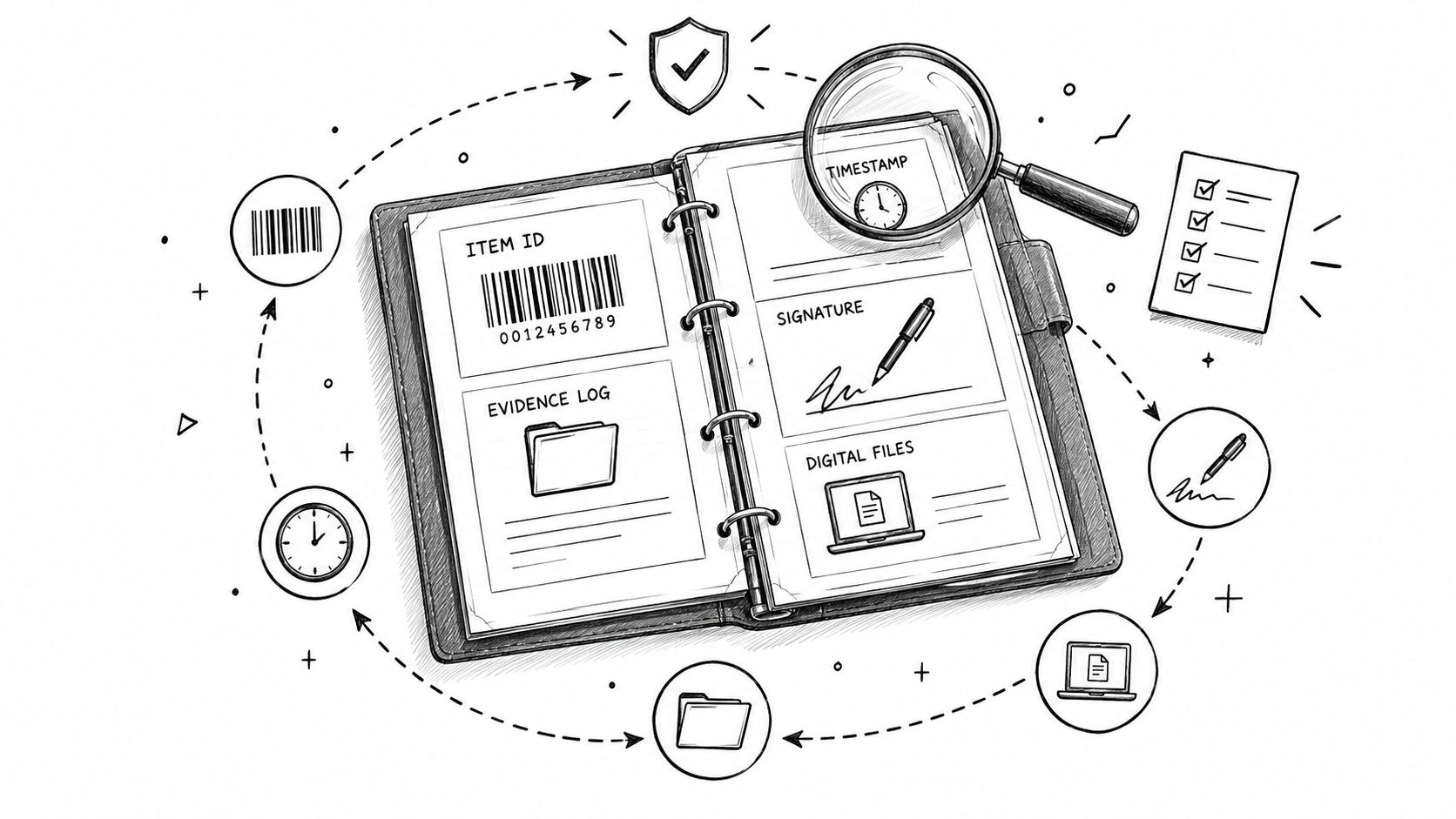
Chain of custody is the written record of who held evidence, when they held it, and how it was transferred. Each transfer should be recorded and acknowledged by the recipient.
A lab result without specimen provenance can be attacked as unreliable, even when the test itself was performed correctly.
Good documentation covers identity and condition at receipt, authorization, photographs, specimen type and container, seal, storage temperature, collection time, laboratory accession data, analytical method, and disposition of retained samples. That discipline separates observation from interpretation and gives counsel a report that can be tested in deposition and trial.
A careful cause of death investigation may support one cause, multiple contributing causes, or an undetermined conclusion. All three answers can be useful when they're honest and documented.
When the Official Autopsy Is Declined or Incomplete
Texas doesn't use one statewide system for every death investigation. Many counties use a justice of the peace inquest system, while other counties operate a medical examiner office.
A justice of the peace must conduct an inquest when statutory conditions apply and may seek a physician opinion on whether an autopsy is needed, as summarized in CDC guidance on Texas coroner and medical examiner law. When a county establishes a medical examiner office, that office assumes the death investigation duties justices of the peace otherwise exercise under Texas Code of Criminal Procedure Chapter 49A.
Family Wishes Don't Control the Official Decision
This point causes real confusion. A county medical examiner or justice of the peace decides whether an official autopsy is warranted. Family wishes may be considered, but they don't control that decision, and an authorized office may perform investigative autopsies without next-of-kin consent in sudden, unexpected, or unnatural deaths, a point addressed in Harris County Institute of Forensic Sciences frequently asked questions.
So what can your family do if the official office declines an autopsy or closes the case as undetermined? Our guidance on whether to seek a second opinion covers that decision in more detail.
What Private Review Can and Cannot Do
Private Autopsies provide an independent autopsy or records review outside the government investigation. They don't replace that investigation, automatically change a death certificate, or prove negligence.
They can identify unanswered medical issues, evaluate existing autopsy materials, guide requests for added testing, and give counsel expert evidence. Counties without a medical examiner may also need County Forensic Autopsies support through proper authorization.
Timing matters because transport, preserved tissue, toxicology, imaging, and disposition decisions affect what remains available. Texas disposition and death-care rules, including Texas Health and Safety Code Chapter 711 and oversight by the Texas Funeral Service Commission, make documented authorization and custody essential. Families searching for an autopsy near me should ask first who has legal authority, where the body is, and what evidence has been preserved.
Ask those questions within days, not weeks.
Steps Families and Attorneys Should Take Next
Start with preservation, then move to review. That order protects both the medical questions and the legal claim.
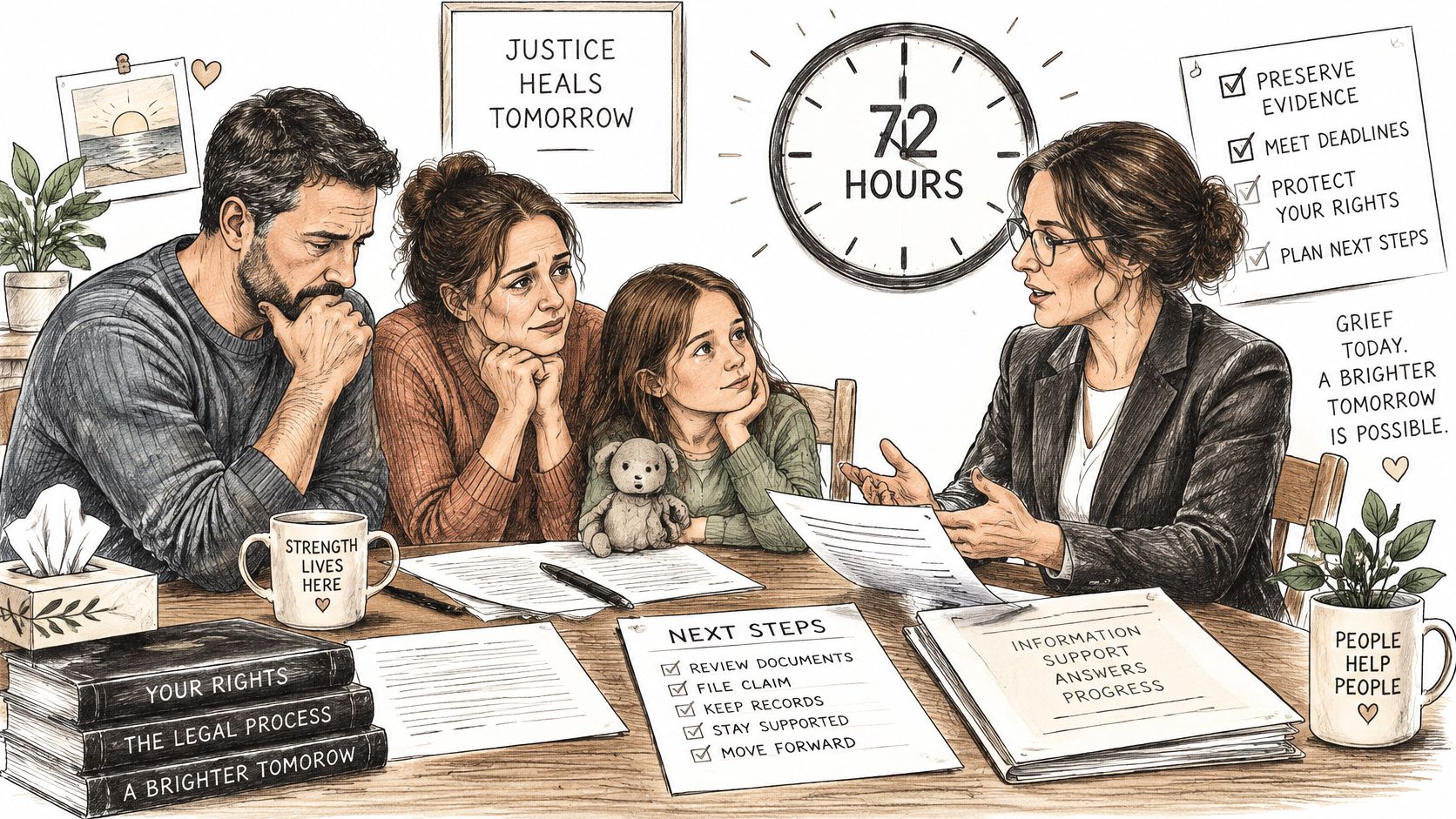
First Steps
- Identify the investigating authority: Confirm whether a medical examiner, justice of the peace, or another official handled the death investigation in that county.
- Request core records: Ask for the death certificate, investigative report, autopsy report if one exists, toxicology, photographs, and information about retained tissue or specimens.
- Preserve personal evidence: Keep clothing, medications, medical devices, messages, employment records, and funeral invoices in one secure place through the Waterloo Mortuary Partnership or your chosen funeral provider as appropriate.
Over the next few weeks, counsel can decide whether private autopsy services in Texas or a records-only review fits the case. Attorneys researching liability theories can use LegesGPT for case law to organize legal research while our team addresses the medical record. Our discussion of the wrongful death expert witness role explains how a written opinion is later used in deposition and trial.
Common Questions
Can a private autopsy prove negligence? No. A forensic pathologist determines medical findings. Negligence is a legal conclusion for counsel, a judge, or a jury.
How fast does the autopsy process move? Timing depends on authorization, transport, records, and testing. We explain that most cases move within 24 to 48 hours for the examination stage, while lab work and final reporting can take longer.
What if cremation is planned? Tell the funeral home and investigating office immediately that your family is considering independent review, because disposition can limit later examination.
Texas Autopsy Services serves all 254 Texas counties from Elgin as one option for families, attorneys, and county officials who need an independent forensic pathology expert review with documented chain of custody and direct communication with our team.
If your family is weighing a wrongful-death claim and the medical cause of death is still unclear, we can explain what a private autopsy or second-opinion review can realistically answer, what records we would need, and how authorization and transport are documented. Visit Texas Autopsy Services to contact our team directly and discuss the next step at a pace that respects your family.