December 4, 2025 · Texas Autopsy Services
Finding Truth in Loss The Role of a Wrongful Death Expert Witness
Discover the crucial role of a wrongful death expert witness in Texas. Learn how expert testimony and analysis can bring clarity to your case.
On this page
When a loved one dies unexpectedly due to suspected negligence, families need more than just answers. They need objective, scientific truth. In these situations, a wrongful death expert witness provides the clarity that the legal system requires to function justly.
- A forensic pathologist’s role is to provide an independent, objective cause of death based on scientific evidence.
- My opinions are built on a comprehensive review of medical records, a detailed autopsy, and analysis of all case-related documents.
- As an expert witness, I translate complex medical findings into clear, understandable testimony for attorneys, judges, and juries.
- The credibility of an expert witness rests on verifiable qualifications, including board certifications and extensive experience.
As a board-certified forensic pathologist, I have performed over 1,000 autopsies. My work is not about taking sides; it’s about establishing the medical facts that serve as the foundation for a wrongful death claim.
The Foundation of a Case Is Objective Truth
After a sudden loss, families are often left with grief and unanswered questions. When that loss may be due to a medical error, vehicle collision, or workplace incident, the central question is always the same: what really happened?
My role is to find that truth. My loyalty is to the facts revealed by medical science. By conducting a detailed postmortem examination and reviewing all available evidence, from medical records to incident reports, I establish an unbiased cause and manner of death. This process moves a case from speculation to certainty.
From Autopsy to Testimony
The path from an autopsy to the courtroom is a careful and deliberate one. It involves translating complex medical science into plain English that attorneys, judges, and juries can understand. Each step builds upon the last to create a solid foundation of evidence.
Here is what the process typically looks like:
- Independent Autopsy: I perform a comprehensive examination to determine the precise cause of death, separate from any initial state or county inquiry.
- Case Review: I analyze all existing medical records, toxicology reports, and other documents, searching for critical details or inconsistencies.
- Affidavits and Reports: I compile my findings into detailed, formal reports that serve as official evidence for legal filings.
- Deposition and Testimony: I explain my scientific conclusions clearly and professionally under oath, prepared to defend the medical facts.
This work ensures that a legal strategy is built on solid ground. In a wrongful death lawsuit, the autopsy report and expert testimony are often the most critical pieces of evidence. You can find a more detailed look at my role as a forensic expert witness.
My primary duty is to the truth as revealed by medical science. By providing an impartial and accurate cause of death, I offer clarity to grieving families and provide the factual basis necessary for the legal system to function justly.
Why Independence Is Critical
Hiring an independent expert witness is a crucial step. While a county medical examiner or coroner performs a vital public service, their offices often face staggering caseloads and resource limitations. Their initial autopsy might not have the depth required for complex civil litigation.
A private forensic pathologist, retained by a family or their attorney, can focus exclusively on a single case. This allows for the time and singular attention needed to explore every possibility and investigate every detail surrounding the death. It ensures no stone is left unturned and provides families and their legal teams with the complete, accurate picture necessary to seek justice.
The Qualifications of an Expert Witness
Not every physician is qualified to determine the cause of death in a complex legal case. The credibility of an expert witness is directly tied to their credentials. The right qualifications build a case on a foundation of solid science, while a lack of specialized training can cause it to collapse under scrutiny.
The benchmark for my field is certification from the American Board of Pathology. This verifies a physician’s skill in diagnosing injury and disease by examining tissues and bodily fluids. For a wrongful death case, however, that’s just the starting point.
The Three Pillars of Forensic Pathology Expertise
To offer an authoritative opinion in court, a pathologist needs specialized training that connects medicine to the law. My board certification is important because it demonstrates deep understanding across three related disciplines, each playing a critical role in a wrongful death investigation.
- Anatomic Pathology: This is the foundation. It is the skill of diagnosing disease by examining organs and tissues, both visually and microscopically. It’s the core of an autopsy.
- Clinical Pathology: This is the laboratory side of the work. It involves analyzing fluids like blood and urine to diagnose disease, which is vital for interpreting toxicology reports and understanding the chemical aspects of a death.
- Forensic Pathology: This is where medicine and law intersect. It’s the specialized field of determining the cause and manner of death in cases that are sudden, violent, or otherwise medically unattended.
This combination of training ensures that I not only see what happened inside the body but can also explain how and why it happened in the context of the events that led to the death. Having performed over 1,000 autopsies, I have direct experience with cases ranging from subtle medical oversights to clear instances of trauma. You can learn more about the demanding path to this profession by reviewing the education requirements for a forensic pathologist.
An expert's opinion is only as strong as the qualifications that support it. A board-certified forensic pathologist brings a level of authority that is difficult to challenge because it represents the highest level of training in the field.
To help clarify what to look for, the following table summarizes the most important credentials.
Key Credentials for a Forensic Pathology Expert Witness
This table breaks down the essential qualifications that validate an expert's authority and credibility in wrongful death cases.
| Credential | Why It Matters in a Wrongful Death Case |
|---|---|
| Medical Doctor (M.D. or D.O.) | The foundational medical degree is a non-negotiable starting point. |
| Anatomic & Clinical Pathology | Board certification here confirms a deep understanding of disease processes from both tissue analysis and lab results. |
| Forensic Pathology | This subspecialty board certification is the key credential. It proves expertise in applying medical science to legal questions of cause and manner of death. |
| State Medical License | A valid license to practice medicine ensures the expert is in good standing with regulatory boards. |
| Extensive Autopsy Experience | The number of autopsies performed (1,000+ is a strong benchmark) reflects hands-on, practical expertise across a wide range of death scenarios. |
These qualifications are not just for show; they ensure an expert can withstand intense legal scrutiny and provide clear, defensible answers.
Distinguishing Expertise from General Opinion
A family physician may have an opinion on a health issue, but they do not have the specific training to scientifically determine a cause of death that will hold up in court. Forensic pathology is a subspecialty because it requires years of dedicated training focused on postmortem science and its legal applications.
When an attorney or family chooses a wrongful death expert, they are selecting the person who will establish the central scientific facts of their entire case. That responsibility demands more than a medical degree. It requires proven, certified expertise in the science of death investigation.
Beyond diplomas, a comprehensive pre-employment screening process can help verify an expert’s background. An expert’s authority rests on a verifiable foundation of education, certification, and deep practical experience.
How an Autopsy Establishes the Facts
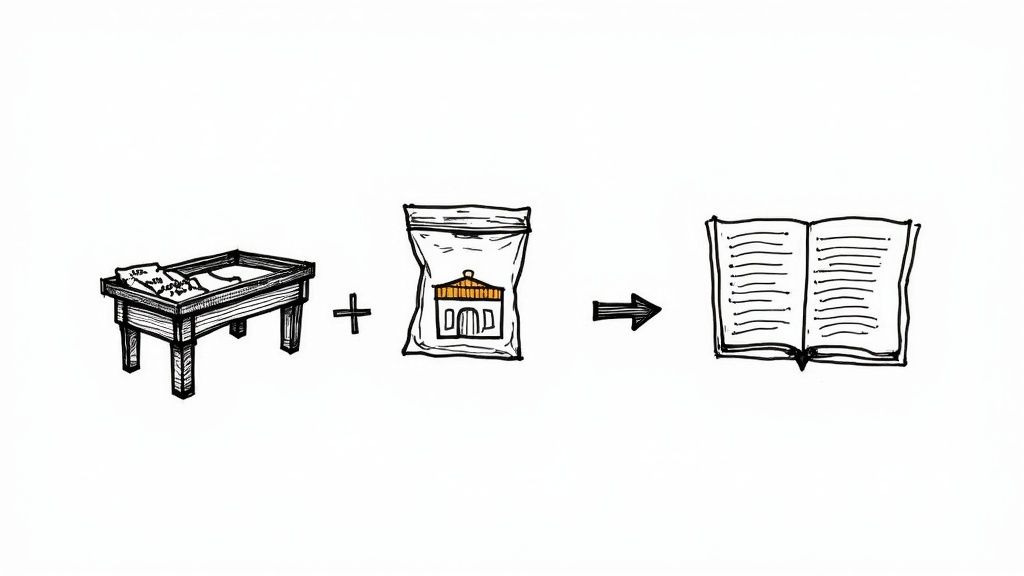
A private autopsy is more than a medical procedure; it’s a fact-finding mission that provides the scientific foundation for a wrongful death claim. My job as a forensic pathologist is to translate the physical evidence from the deceased into a clear narrative that can withstand legal challenges.
The process begins with a meticulous and systematic examination. I conduct a detailed external and internal review, documenting every injury, abnormality, or sign of disease. Each observation is a piece of a larger puzzle. This is where the raw data is gathered.
From there, I integrate this physical evidence with toxicology reports, microscopic tissue analysis, and a thorough review of all available medical records. The goal is to build an unshakeable medical narrative that explains precisely what happened inside the body that led to death.
Establishing Cause and Manner of Death
Two of the most critical conclusions from an autopsy are the cause of death and the manner of death. They sound similar, but in a legal setting, they serve very different and important functions. Understanding this distinction is key to seeing how an autopsy supports a wrongful death case.
Cause of Death is the specific medical reason a person died, such as "blunt force trauma to the head" or "acute medication toxicity." It is a purely medical determination based on my findings.
Manner of Death is the legal classification of how the death occurred. The five categories are: natural, accident, suicide, homicide, and undetermined. A finding of "accident" or "homicide" can directly support claims of negligence or intentional harm.
My role is to connect these two points with objective, scientific proof. I must show exactly how the actions or inaction of a third party led directly to the medical cause of death. This connection between action and outcome is what turns autopsy findings into powerful legal evidence.
The final autopsy report does more than just list medical findings; it tells a story grounded in scientific fact. It provides the "why" and "how" needed to prove causation in a wrongful death case, taking it from mere speculation to medical certainty.
The Importance of Chain of Custody
Evidence is only as good as its integrity. In any investigation that may lead to court, a strict chain of custody is essential. This is the paper trail that meticulously documents the handling of every piece of evidence, from its collection and transfer to its analysis and storage.
Every step is logged, from the moment I receive tissue samples to the final delivery of my report. This protocol ensures that all evidence is protected from tampering and that its integrity cannot be questioned in court. A single break in the chain of custody can render powerful evidence inadmissible.
As an expert witness, I must be disciplined about this process. It is the only way to guarantee that the scientific facts I present in reports, depositions, and testimony are based on evidence that is in the exact same condition as when it was collected.
From Report to Testimony
The comprehensive autopsy report is the final product of this detailed process. It’s a thorough document that outlines every procedure, analysis, and conclusion. For the legal team, this report becomes their source of truth and the foundation for everything that follows:
- Affidavits: Sworn statements summarizing my key findings for initial court filings.
- Depositions: Question-and-answer sessions under oath with opposing counsel to defend my methods and conclusions.
- Trial Testimony: Explanations of complex medical science in simple, clear terms for a judge and jury.
Every part of the autopsy is designed to create a clear, defensible set of facts. You can learn more about the specific steps in an autopsy in another one of my articles. A careful and independent autopsy provides the hard evidence needed to build a strong, credible case.
Assembling a Team of Experts
As a forensic pathologist, my job is to scientifically determine the cause of death, which serves as the cornerstone of a wrongful death case. But a strong claim is like a house, it needs more than just a foundation to stand. It requires a team of specialists working together, each adding a crucial piece to build a complete picture for the court.
My autopsy report establishes why someone died. Other experts then use that information to explain the full impact of that loss. This team-based approach is what makes a case compelling and persuasive.
Who Else Is on the Team
A sound legal strategy involves several key experts to translate every aspect of the loss into clear, understandable terms. Each expert addresses a different part of the claim, from the financial damages to the medical standards that should have been met.
Here are some of the experts I often work alongside:
- Forensic Economists: These experts calculate the financial devastation a death leaves behind. They analyze the deceased's earning potential, lost wages, and benefits to project the total economic damage to the family over a lifetime.
- Medical Specialists: If medical negligence is a possibility, an expert from that specific field is needed. This could be a cardiologist, oncologist, or emergency room physician who can speak to the accepted standard of care and explain where a deviation occurred.
- Accident Reconstructionists: For cases involving vehicle collisions or workplace incidents, these experts piece together the "how." Using physics and engineering, they recreate the event to prove causation and demonstrate fault.
The Human Element Experts
A wrongful death case is about more than money and physical evidence. It’s about the profound, personal loss a family endures. Specialists who can explain these intangible damages are also important.
For example, psychologists or psychiatrists are critical for evaluating the emotional and psychological trauma that surviving family members experience. The field of wrongful death experts includes a wide range of disciplines, from medical specialists who clarify standards of care to psychological experts who can distinguish between normal grief and something more severe, such as Prolonged Grief Disorder. You can learn more about how these experts contribute to a case by exploring resources from organizations like SEAK Experts.
A wrongful death case is a complex machine. My findings on the cause of death are the engine, but the economists, medical specialists, and psychologists provide the other essential components that make the whole thing work.
This collaborative approach ensures every angle of the loss is properly documented and clearly explained. When we all work together, we provide the legal team with a powerful, coherent story backed by credible, specialized testimony.
Of course, the person leading this effort is the attorney. Before any experts are hired, the first and most important step is finding the right legal counsel. For help with that critical decision, you might want to review a guide on choosing a personal injury attorney. A good lawyer knows which experts to bring in and how to weave their findings into the strongest possible case.
How to Engage a Wrongful Death Expert in Texas
Finding and hiring an expert witness for a wrongful death case should be a clear and straightforward process built on trust. I’ve outlined a simple roadmap for attorneys and families in Texas, so you know exactly what to expect when working with me.
The first step is always an initial consultation. This is a confidential, no-cost conversation where you can explain the details of your case, and I can determine if my expertise is a good fit.
The Preliminary Case Review
Before any formal agreement, I start with a preliminary case review. This is an initial look to see if the case has merit from a medical and scientific standpoint.
To do this, I usually need a few key documents:
- Official Death Certificate: The foundational legal and medical document.
- Medical Records: Hospital notes, physician reports, and paramedic run sheets—any records leading up to the death are helpful.
- Police or Incident Reports: These documents provide an official narrative of the event.
This initial review is a critical filter. It helps determine if there is enough evidence to warrant a deeper investigation, like a private autopsy. It also saves everyone time and resources by ensuring we only move forward on cases where my expertise can truly make a difference.
Understanding the Engagement Structure
If we decide to proceed, we formalize the relationship with a clear engagement agreement. I believe in complete transparency, so my clients understand the full process and all costs upfront. My fee structure is straightforward and usually begins with a retainer.
A formal retainer secures my availability for your case. It covers the initial in-depth review, the time to generate reports, and preparation for potential legal proceedings. This ensures I can dedicate the necessary time and resources to focus exclusively on uncovering the facts of your case.
This professional structure is designed to meet the high legal and ethical standards required in Texas courts. Every step I take, from reviewing records to providing testimony, is done with integrity.
The need for this kind of specialized expertise has grown across major legal markets like Texas. Professional networks now connect attorneys with qualified experts for services like case reviews, affidavits, and trial testimony. You can find additional insights about expert witness services on JurisPro.com.
Collaborating with a Team of Specialists
My work as a forensic pathologist is often the first piece of the puzzle. The diagram below shows how my findings can become the foundation for a whole team of experts.
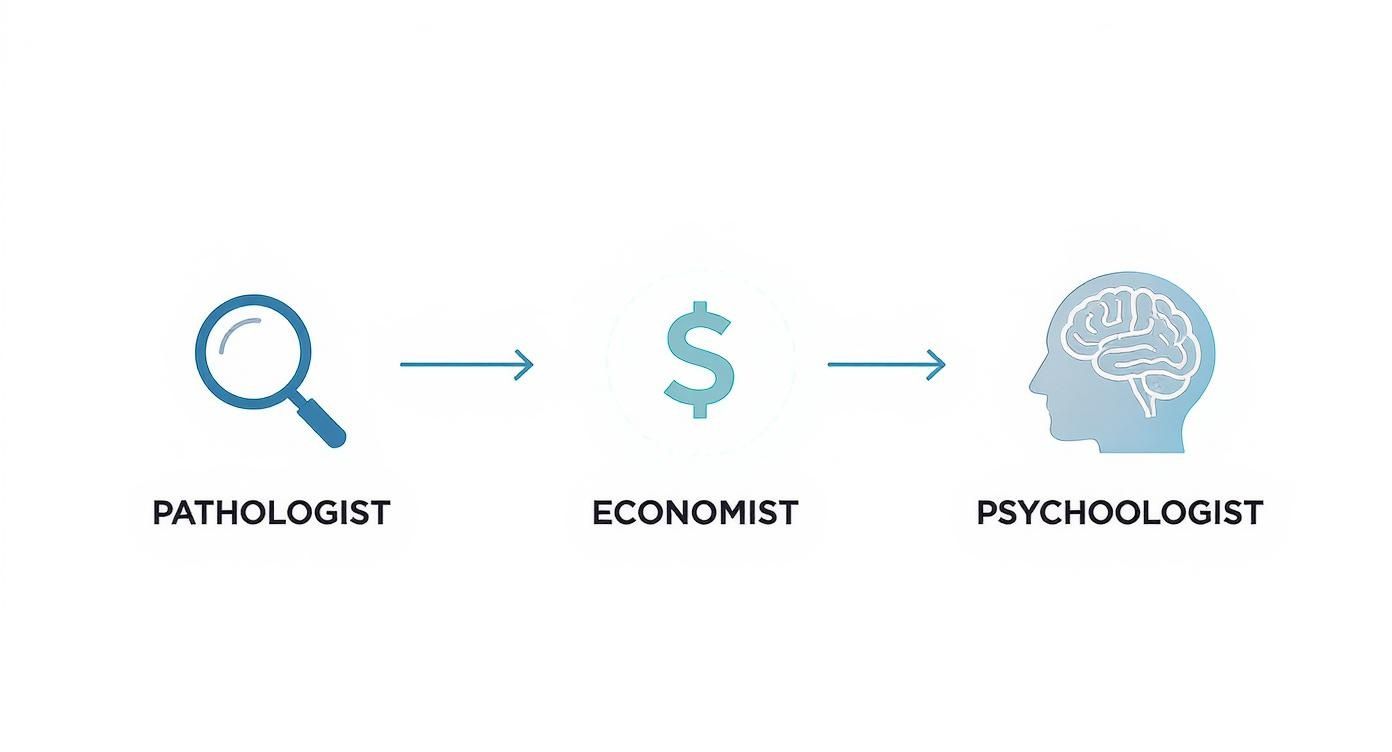
Each expert builds on the work of the others. The pathologist determines the cause of death, which allows an economist to calculate the financial loss, and so on. Together, we build a complete and compelling picture for the court.
Adherence to Texas Legal Standards
As a forensic pathologist practicing in Texas, everything I do is guided by state law, including the Texas Health & Safety Code. My reports and testimony are meticulously prepared to withstand the scrutiny of the Texas Rules of Evidence, ensuring they are both admissible and credible in court.
My promise is to provide objective, scientifically-grounded opinions that help the legal process find the truth. By holding myself to the strictest ethical and legal standards, I provide attorneys and families with an expert witness they can count on.
From Deposition to Courtroom Testimony
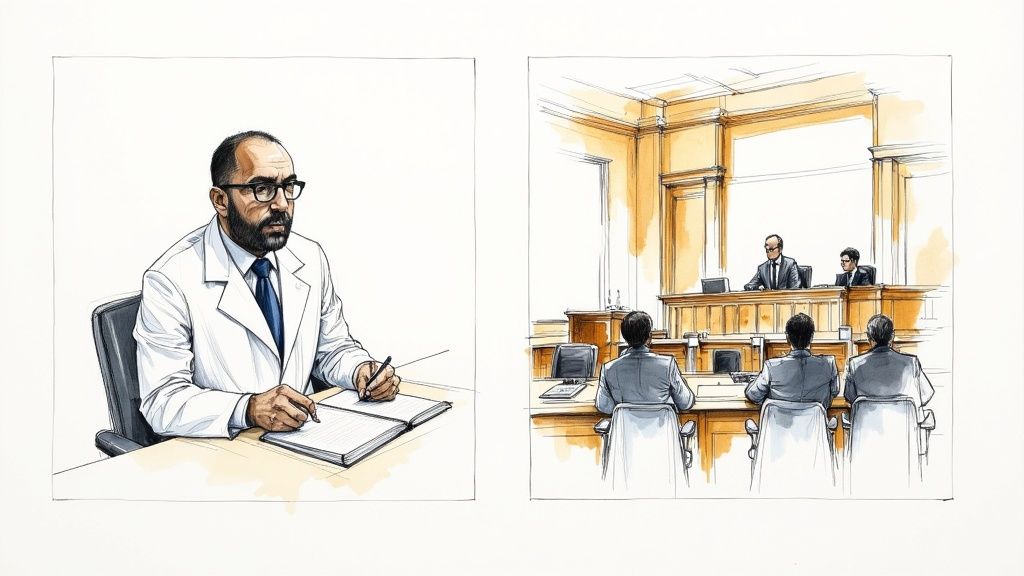
My work is not finished when I sign the final autopsy report. That document is the scientific foundation of a case, but its real test comes in the legal arena. At this stage, my role shifts from medical investigator to educator, ensuring the facts I uncovered are presented clearly and defended rigorously.
This process nearly always starts with a deposition. A deposition is a formal question-and-answer session outside of court, where I am placed under oath and questioned by the opposing side's attorney. It is a deep examination of my findings, methods, and conclusions.
During a deposition, the opposing counsel will scrutinize every detail in my report. My job is to stand by my scientific process, remain completely objective, and present the medical evidence exactly as I found it. I do not advocate; I state the facts.
Navigating the Deposition
The deposition is where an expert’s credibility is tested. It is not just about knowing the medicine; it’s about having the composure to handle intense, sometimes adversarial, questioning. I adhere to a few core principles:
- Answer Only the Question Asked: I give direct, factual answers without speculating or offering extra information.
- Adhere Strictly to My Findings: Everything I say is anchored to the conclusions drawn from the autopsy and the evidence in the case file.
- Maintain Professional Objectivity: My loyalty is to the scientific truth, regardless of who is asking the questions.
This process gives both legal teams a clear understanding of my medical opinion long before a trial might begin.
Educating the Court
If the case proceeds to trial, my role evolves again. I am now tasked with educating the judge and jury. This requires translating the complex world of forensic pathology into plain language.
My purpose in the courtroom is not to win the case for a client but to serve as an impartial educator for the court. I explain the science behind the cause and manner of death, empowering the jury to make an informed decision based on medical facts, not emotion or confusion.
This means avoiding jargon, speaking clearly, and often using visual aids to demonstrate how an injury occurred or to point out specific anatomical findings. An expert witness is only effective if they can make complex science clear and understandable.
From the examination table to the witness stand, my goal remains the same: to ensure the scientific truth withstands pressure and is understood by those who need to hear it.
Frequently Asked Questions About Wrongful Death Experts
Over the years, I've found that both attorneys and families tend to ask similar questions when first considering a wrongful death case. It’s an overwhelming process, and part of my role is to offer straightforward answers based on my experience.
When Is the Right Time to Engage an Expert?
The best time to engage an expert is as soon as possible. Involving an expert early allows me to evaluate the medical merits of a case before significant time and resources are invested. It also ensures that crucial evidence, such as medical records or physical specimens, can be obtained while it is still available and properly preserved. While I can join a case at any stage, early involvement provides the strongest footing for building a solid, science-backed legal strategy.
What Is the Difference Between a Private Autopsy and a Medical Examiner Autopsy?
This is one of the most critical questions. A medical examiner (ME) and I are both forensic pathologists, but we operate in different contexts.
Medical Examiner's Autopsy: An ME serves the public interest. Their primary role is to determine the cause and manner of death to satisfy state legal requirements. They often manage large caseloads, which can limit the depth of any single investigation. Their goal is to close the case for the county, not necessarily to uncover the specific details required for a civil lawsuit.
Private Autopsy: When I perform a private autopsy through Texas Autopsy Services, a family or their attorney has retained me. My focus is entirely on answering their specific questions. This allows for a more detailed and customized examination designed to find the exact evidence needed to support a wrongful death claim.
A private autopsy does not replace the ME's work; it supplements it. It's a focused second look, aimed at uncovering the nuanced medical facts that are so often the key to getting clarity and justice in a civil case.
How Do You Handle Conflicting Evidence?
It’s not uncommon for different pieces of evidence to conflict. A witness statement might contradict the physical injuries I observe, or an initial incident report may not align with final toxicology results. When this occurs, I rely on the science.
I evaluate every piece of information through an objective, scientific lens, integrating medical records, autopsy findings, and external reports. If a conflict exists, I determine which evidence is supported by medical fact and explain why discrepancies might exist. Ultimately, my opinion is always based on what the complete body of scientific evidence can prove.
At Texas Autopsy Services, my commitment is to deliver clear, unbiased answers during a difficult time. If you have questions or need to discuss a potential case, please contact my office directly. I am here to provide the scientific clarity your case deserves.