November 21, 2025 · Texas Autopsy Services
What Families and Attorneys Should Know About Forensic Expert Witnesses in Texas
Discover how forensic expert witnesses provide critical clarity in Texas legal cases. Learn how to choose the right specialist for your needs.
On this page
As a forensic pathologist, my work doesn't always end in the autopsy suite. It often extends into the courtroom, where I serve as a forensic expert witness. In that role, my purpose is simple: to be an objective guide. I translate complex medical evidence into clear, understandable facts for judges, juries, and attorneys. I'm not there to take a side—I'm there to explain the scientific truth as the evidence reveals it.
- A forensic expert witness provides objective, science-based testimony in legal cases.
- My role is to explain complex medical evidence, such as cause and manner of death, in clear terms.
- Expertise is built on verifiable credentials, including board certifications and extensive hands-on experience.
- An independent review can confirm official findings or uncover new evidence in civil and criminal cases.
- The process is confidential, objective, and compliant with all Texas legal standards.
The Role of a Forensic Expert Witness in Court

When a death becomes the focus of a legal proceeding, whether civil or criminal, the science can become complicated quickly. For judges, juries, and even attorneys, the medical details can be overwhelming. My responsibility is to bridge that gap. I analyze medical findings, interpret their meaning, and present them in a way that is both accessible and factually solid.
This role requires more than a medical degree; it demands a deep commitment to objectivity. My testimony isn't an opinion shaped by who retained my services. It's a conclusion built entirely on the evidence.
Clarifying Complex Medical Evidence
A key part of my job in the courtroom is explaining the critical difference between the cause of death and the manner of death. The cause is the specific medical reason for death—a heart attack, a gunshot wound, or blunt force trauma. The manner, on the other hand, is a legal classification: natural, accident, suicide, homicide, or undetermined. My analysis helps the court understand how these two crucial pieces of information fit together.
My work in this capacity typically involves several key areas:
- Interpreting Injury Patterns: I explain what specific injuries can tell us about the events that occurred.
- Reviewing Medical Records: A person's medical history often provides critical context for their death.
- Evaluating Toxicology Reports: I translate the presence of drugs or other substances into a clear explanation of their role.
- Providing Objective Testimony: I present my findings under oath, whether in a deposition or on the stand at trial.
The integrity of these findings is paramount. A crucial part of my process is meticulously documenting every step. For a court to consider a report, its integrity must be beyond question. That’s why it’s so important to understand methods for protecting forensic reports from unauthorized editing, ensuring the evidence remains untampered with.
The Growing Need for Medical Experts
The legal system's reliance on specialized medical testimony isn't just a perception; it's a growing trend. The global market for expert witness services was recently valued at approximately USD 627.63 million. Medical experts constituted the second-largest portion of that market, accounting for USD 231.0 million.
This segment is expected to continue growing, which tells us that specialized medical testimony is more crucial to litigation than ever. It underscores the vital role that qualified forensic pathologists play in our legal system.
Ultimately, my work as an expert witness comes down to providing clarity so that legal decisions are grounded in sound science. It’s a responsibility that requires a solid grasp of both medicine and the legal process, a topic you can explore further in our detailed guide on the role of forensic expert witnesses.
What Qualifies an Expert in Forensic Pathology
In a legal setting, not just any medical opinion is sufficient. True expertise in forensic pathology is built on a solid foundation of rigorous training, official board certification, and most importantly, years of hands-on experience. When a family or an attorney needs an expert witness, they aren't just looking for a doctor. They need an authority whose conclusions can withstand intense scrutiny.
So, what makes a pathologist a credible expert? It’s a combination of verifiable credentials and a deep well of practical work. This ensures that the testimony offered in court isn't just an opinion, but a conclusion firmly rooted in science.
The Foundation of Board Certification
The starting point for any forensic pathologist is board certification from the American Board of Pathology. This is the gold standard in my field. It’s not just a document; it’s proof that a pathologist has mastered the core knowledge and skills required to practice at the highest level.
I personally hold three distinct board certifications:
- Anatomic Pathology: The study of organs and tissues to diagnose disease.
- Clinical Pathology: The laboratory analysis of bodily fluids.
- Forensic Pathology: The specialized field applying pathology to legal questions.
This board certification is significant. It demonstrates a deep, well-rounded understanding of disease from every angle—structural and laboratory—which is critical for determining the cause of death in complex situations. It is a formal validation of a pathologist's specialized knowledge.
This level of credentialing is essential for anyone acting as a forensic expert witness. It tells the court that the person giving testimony has met the profession's most demanding standards. To get a better sense of this journey, you can read about the extensive steps to becoming a forensic pathologist and see the dedication it requires.
Experience: The Real Differentiator
While certifications provide the groundwork, they're only half the story. Nothing replaces the judgment and insight gained from years of performing the work. I've personally performed over 1,000 autopsies, covering everything from adult and pediatric cases to the most complex forensic investigations.
Every case is a unique puzzle. The sheer volume and repetition build a true understanding of injury patterns, subtle signs of disease, and the countless variables that can point to a cause of death. You begin to develop a pattern recognition that you can't get from a textbook.
This is the kind of practical, high-volume experience that allows a forensic pathologist to confidently differentiate between similar injuries or identify a rare condition that someone else might miss. When I explain my findings in court, my conclusions are backed not just by my education, but by thousands of hours of experience. It's this combination of top-tier certification and deep, real-world experience that truly defines an expert.
When to Engage a Forensic Expert Witness
Determining the right moment to call in an independent forensic expert is one of the most common—and critical—questions I hear from families and attorneys. The need usually arises when you reach a point where the official explanation doesn't align with the known facts.
Bringing in a forensic expert witness isn’t about creating conflict. It’s about seeking the truth through objective, scientific analysis when initial answers leave more questions than comfort.
My work often begins when someone needs to investigate beyond surface-level findings. For a family, that might mean getting clear answers when an official investigation feels rushed or incomplete. For an attorney, engaging an expert early can change the direction of a case, uncovering vital evidence or exposing weaknesses in an opposing argument before it’s too late.
For Families Seeking Answers
Losing a loved one is devastating, and the grief is often compounded by unanswered questions. Most families contact me when they need a second, unbiased set of eyes on the circumstances of a death.
A few common scenarios include:
- Questioning an Official Cause of Death: Sometimes, a family has good reason to believe a medical examiner’s conclusion is incorrect. A private autopsy can either confirm the official report, providing closure, or uncover new evidence that tells a different story.
- Suspecting Medical Malpractice: If someone passes away during or after a medical procedure, a forensic examination can be crucial. It helps determine whether the medical team followed the proper standard of care or if a preventable error occurred.
- Unclear or "Undetermined" Deaths: When a death is officially ruled "undetermined," it leaves a painful void. A detailed forensic review can often uncover overlooked details that point toward a more definitive conclusion.
In my experience, families aren't usually looking to assign blame. They're looking for peace of mind. An independent forensic examination offers a clear path to the truth by providing a final, impartial account based purely on medical evidence.
For Attorneys Building a Case
For lawyers, a forensic expert witness is an indispensable guide through the medical complexities of a case. My role can be as simple as an initial consultation to review facts or as involved as testifying in court. The most important thing? Engage an expert as early as possible.
An attorney might bring me on board to:
- Resolve Insurance Disputes: The cause of death is critical for life insurance claims. I can provide a clear, objective medical opinion that removes ambiguity and helps resolve conflicts over payouts.
- Offer a Second Opinion in Criminal Cases: Both prosecutors and defense attorneys need forensic experts to verify evidence. I analyze existing autopsy reports, crime scene photos, and lab results to give an independent interpretation.
- Help Shape Case Strategy: An early consultation helps an attorney grasp the medical realities of their case. This insight allows them to build a solid argument, prepare for challenges, and make an informed decision on whether to proceed to trial.
To give you a clearer picture, here are some of the most common situations where my expertise as a forensic pathology expert witness becomes essential.
Scenarios Requiring a Forensic Expert Witness
| Situation | Why an Expert Witness Is Needed | Potential Outcome |
|---|---|---|
| Contested Will or Estate | To medically confirm the decedent's state of health or mental capacity when the will was signed. | Validation or invalidation of legal documents based on medical evidence. |
| Workplace Accident | To determine if a pre-existing medical condition contributed to the death or if it was solely due to the accident. | Clarification for workers' compensation claims and liability assessments. |
| Civil Litigation | To provide a scientific basis for claims of wrongful death or personal injury. | Strengthened legal arguments supported by objective medical facts. |
Ultimately, a forensic expert is needed whenever the medical truth is the bedrock of a legal or personal question. My job is to establish that foundation with precision, objectivity, and a clear explanation of the science.
How the Expert Engagement Process Works
When you bring a forensic expert witness onto your team, you're beginning a process built on clear communication and a relentless focus on the facts. Whether you're an attorney building a case or a family searching for answers, understanding how we work together is important. The goal is simple: to move from confusion and uncertainty to clear, science-backed conclusions.
It all starts with a confidential consultation. This first conversation is where you can lay out the specifics of your situation without any obligation. It’s my chance to listen, understand the core questions you're facing, and determine if my expertise is the right fit. We might discuss a disputed cause of death, a question of medical negligence, or a complex insurance claim.
The Foundational Review of Documents
Once we decide to move forward, my real work begins with a deep dive into every document related to the case. This is the bedrock of the entire investigation. I'll meticulously review police reports, paramedic notes, complete medical histories, and any existing autopsy or toxicology findings.
Every document tells part of a story. My job is to piece it all together, looking for consistencies, spotting contradictions, and flagging areas that require further investigation. A large part of this work involves analyzing case studies effectively to identify patterns and critical details others might have missed. This careful review points me in the right direction, telling me whether we need a completely new examination or a second opinion on an existing one. You can get a better sense of my methodology by reading about my approach to a detailed medical records review.
The entire process is designed to bring clarity from chaos.
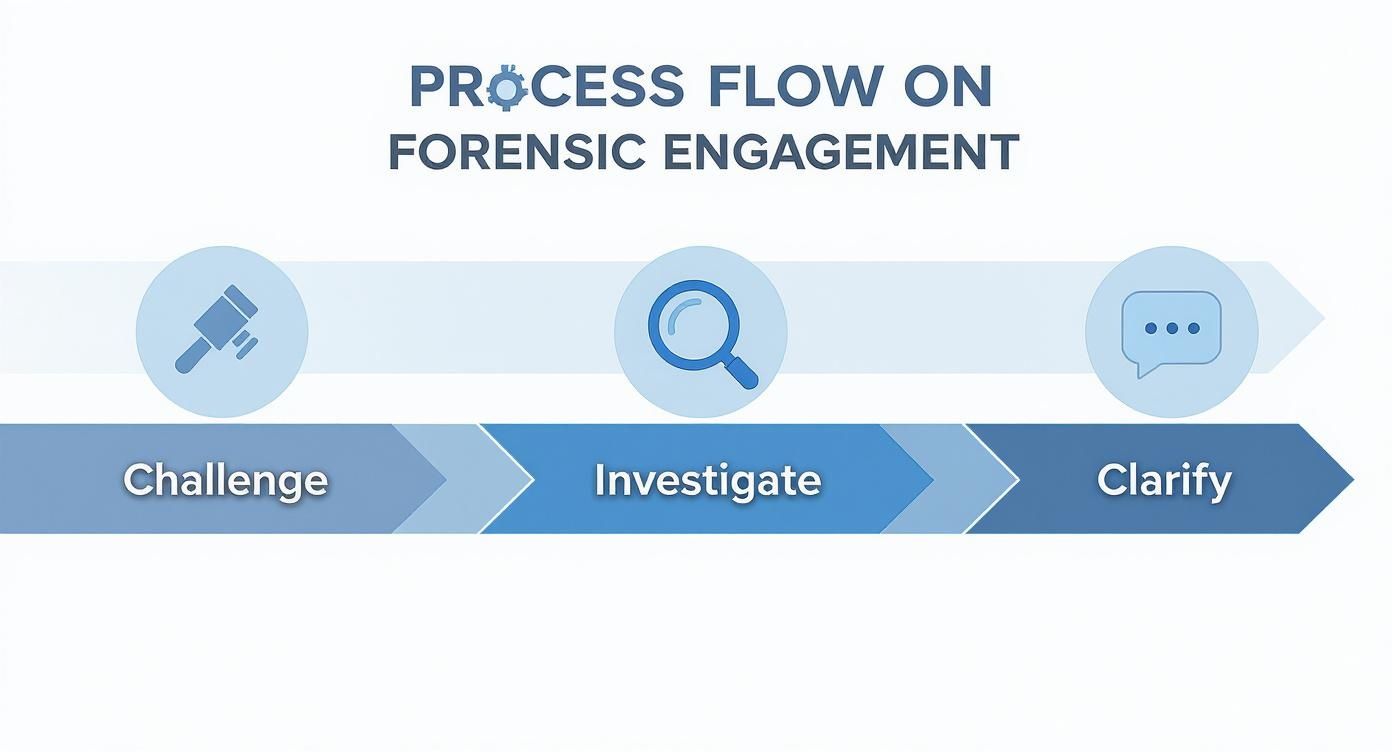
As you can see, we start with a challenge—a question that needs an answer—and through a structured investigation, we arrive at a clear, factual conclusion for you and, if necessary, the court.
Examination and Reporting
Depending on what the documents reveal, the next step might be a private autopsy or a second-opinion review of a prior one. Throughout this phase, I maintain an unwavering commitment to the chain of custody. This is a non-negotiable legal procedure that tracks every piece of evidence, ensuring its integrity is beyond question. Everything is documented, and every conclusion is rooted in the physical evidence.
After the examination, I translate my findings into a comprehensive, unbiased report. I write it in plain language, not medical jargon, so that attorneys, judges, and jury members can understand exactly what the evidence shows.
My report doesn't take sides; it presents the scientific truth. It will clearly state the cause of death, outline any contributing factors, and walk the reader through the medical evidence step by step. The objective is to provide a definitive, defensible summary of the facts.
This report is more than just a document; it's a powerful tool. It can arm a legal team for settlement discussions, guide trial strategy, or finally give a family the peace of mind that comes with knowing the truth.
Legal Involvement and Testimony
In many cases, the final step involves the legal system. This could mean providing a sworn affidavit, sitting for a deposition, or taking the stand at trial. In all these scenarios, my role remains the same: to be an educator for the court.
I prepare for testimony as rigorously as I conduct my examinations. I'll work with the legal team to ensure they grasp the science and can present it effectively. When I testify, my only job is to explain my findings clearly and objectively. My testimony is a direct extension of my report, built on verifiable facts and delivered with the confidence that comes from board certification and years of experience. From our first call to the final verdict, the process is defined by objectivity, transparency, and a commitment to the facts.
The Legal Landscape in Texas
When you're dealing with a legal case, the specific rules of the jurisdiction matter. Here in Texas, our legal system is both well-established and complex. This isn't a negative; it just means there's a constant need for specialists who can clarify evidence.
Across all 254 counties in the state, the sheer volume of civil and criminal cases means that judges, attorneys, and county officials often need an expert to make sense of the science. My job is to be that bridge, connecting complex pathology findings to the straightforward questions a jury needs answered. It’s a standard, and often critical, part of how justice works today.
Why Texas Courts Rely on Forensic Experts
The amount of legal activity in our state is significant. It's no surprise that North America leads the world in the market for expert witness services, valued at USD 250.6 million—a 39.93% global share. That figure reflects how much jurisdictions like Texas rely on litigation and the sophisticated legal framework that supports it.
With projections showing that market will only grow, it’s clear that expert testimony is becoming more essential. Learn more about the expert witness services market trends.
Bringing in a forensic pathologist isn't some dramatic, last-ditch effort you only see on television. It's a practical step to ensure the scientific facts are presented accurately. For a county official managing a heavy caseload, an attorney building a strong case, or a family simply wanting the truth, an independent expert provides an objective voice.
My purpose is to ensure the science is heard and understood correctly. In a state with such a robust legal framework, objective scientific testimony isn't a luxury; it's a cornerstone of a fair process.
Real-World Needs in the Texas Justice System
I've worked with legal teams all over Texas, from large firms in Dallas and Houston to solo practitioners in smaller counties. Regardless of their location, what they need is always the same: clarity.
An attorney might wonder if an official autopsy report is missing a key detail. A county official might need a second opinion to resolve conflicting evidence in a high-profile case. These are not unusual situations; they are the day-to-day realities of our justice system.
The Texas legal landscape holds evidence to a very high standard. As a forensic expert witness, my job is to meet that standard. That means providing testimony that is not just scientifically sound but also clear, impartial, and directly focused on the questions that need answers. This is how we make sure the legal process remains grounded in verifiable fact.
How to Choose the Right Forensic Expert
Selecting the right forensic expert is one of the most critical decisions in a legal case, whether you're an attorney building an argument or a family searching for answers. It's no exaggeration to say their credibility can make or break a case. An expert’s qualifications, real-world experience, and communication skills are the difference between a jury understanding the facts and being left confused.
This isn't just about reviewing a resume. It’s about finding a professional whose expertise aligns with the specific questions your case presents. Let's walk through how to evaluate potential forensic expert witnesses so you can choose with confidence.
Verifying Core Credentials
First, you must verify their credentials. This is the bedrock of their credibility. For a forensic pathologist, the gold standard is certification from the American Board of Pathology. Don't just take their word for it—confirm it independently.
Look for these essential qualifications:
- Board Certifications: The expert must be board-certified in Forensic Pathology. Additional certifications in Anatomic and Clinical Pathology are a significant advantage, as they show a deeper understanding of disease processes.
- Medical Licensure: Ensure they hold an active license to practice medicine in Texas or the relevant state.
- Professional Affiliations: Membership in key organizations, such as the National Association of Medical Examiners (NAME), shows a commitment to upholding professional standards and staying current in the field.
Think of these credentials as the foundation. They are objective proof that an expert has met the demanding standards set by their peers and is recognized as a legitimate specialist.
Assessing Experience and Communication
Once you’ve confirmed credentials, it's time to examine their practical experience. A long list of certifications means little without years of hands-on work to back it up. When you speak with a potential expert, be direct and ask about their background.
An expert’s value is measured not just by what they know, but by their ability to explain it clearly. The best forensic expert witnesses can distill complex medical concepts into simple, understandable language for a jury, judge, or family member without sacrificing scientific accuracy.
Here are the crucial factors to consider:
- Case History: How many autopsies have they personally performed? More importantly, have they handled cases similar to yours? Experience with pediatric deaths, complex toxicology, or blunt force trauma can be vital.
- Courtroom Poise: An expert must remain composed and articulate under the pressure of cross-examination. Ask about their history of giving testimony in depositions and trials.
- Communication Skills: Pay close attention during your initial consultation. Do they use dense medical jargon, or do they work to ensure you understand the science? Their ability to teach is just as important as their knowledge.
Finding the right expert is a methodical process. It requires due diligence to check credentials and a sharp eye to assess real-world experience and communication style. By focusing on these key areas, you'll be able to select a forensic expert witness who provides the clear, objective, and authoritative insights your case requires.
Common Questions About Forensic Expert Services
When families and attorneys first contact me, they often have similar questions. The process can feel overwhelming, and it's understandable to want a clear picture before moving forward. I've gathered answers to the questions I'm asked most often to help you see how an independent forensic expert can bring clarity to a case.
My entire practice is built on providing objective answers during times of uncertainty. Let's walk through some key concepts to demystify the process.
What's the Difference Between Cause and Manner of Death?
This is probably the most common point of confusion, and it's a critical one. The terms "cause" and "manner" of death are often used interchangeably in conversation, but in forensic pathology, they mean two very different things.
The cause of death is the specific medical diagnosis. It’s the injury or disease that initiated the chain of events leading to death. Examples include a gunshot wound to the chest or coronary artery thrombosis (the medical term for a heart attack). This is a purely scientific determination I make based on physical evidence.
The manner of death, on the other hand, is a legal classification of the circumstances surrounding the death. In Texas, there are only five official categories:
- Natural
- Accident
- Suicide
- Homicide
- Undetermined
My job as a forensic expert is to use the medical findings (the cause) to help the court understand the context that points to the correct manner of death. Simply put, the cause is the science; the manner is the conclusion based on all available evidence.
Can You Review a Case if an Autopsy Was Already Done?
Absolutely. I'm asked to do this frequently. A "second-opinion review," sometimes called a paper autopsy, is a significant part of my work as a forensic expert witness.
In these cases, I conduct a completely new, independent analysis of all materials from the original investigation. This includes the autopsy report, crime scene and autopsy photographs, toxicology results, microscopic slides, and any other evidence that was gathered.
My goal is simple: I either confirm the original findings with a fresh set of eyes, identify important details that may have been missed, or offer a different interpretation of the evidence based on my experience. This type of independent review is essential in legal cases where official findings are being challenged.
How Do You Remain Objective When One Side Hires You?
This is a fair and important question. My professional and ethical obligation is to the truth and to the court, not to the party who retains my services. My reputation and my board certification are staked on my objectivity.
I analyze the medical evidence as it is, without bias. My conclusions are driven only by the scientific facts of the case, regardless of how they may affect a legal strategy. An expert's value lies entirely in their credibility. If I were to offer a biased opinion, it would be unethical and would immediately destroy my standing in court, rendering my testimony worthless. The most valuable service I can offer any client is an accurate, science-based assessment they can rely on.
At Texas Autopsy Services, my role is to provide clear, objective, and compassionate answers. If you have questions or need to discuss a specific case, please contact my office. I am here to help guide you through this process with professionalism and respect. You can learn more at https://www.texasautopsyservices.com.