May 18, 2026 · Texas Autopsy Services
Genetic Testing After Death A Guide for Families
We explain genetic testing after death (molecular autopsy) in Texas, covering the process, costs, and implications for surviving relatives.
On this page
- Introduction A Path to Answers When Questions Remain
- What Is a Molecular Autopsy
- When Postmortem Genetic Testing Is Recommended
- The Testing Process Sample Collection and Analysis
- Understanding the Results and Implications for Relatives
- Requesting Genetic Testing with Texas Autopsy Services
- Frequently Asked Questions About Postmortem Genetics
- Genetic testing after death can help when a standard autopsy does not show a clear cause, especially after sudden and unexpected death.
- The most useful time to think about it is early, while EDTA blood or fresh-frozen tissue may still be available for testing.
- A meaningful share of sudden unexplained deaths have an inherited basis, so results may matter not only for the person who died, but also for children, siblings, and parents.
- Results aren't always simple. Some findings are clearly important, some are negative, and some remain uncertain and need careful interpretation.
- In Texas, families and counsel should approach this as both a medical and legal process, with attention to consent, specimen handling, and clear documentation.
A family calls after a sudden death. The decedent was young enough that no one expected this, healthy enough that the loss feels impossible, and the first autopsy report does not answer the question that matters most. What happened.
I see this pattern in forensic practice more often than is commonly understood. A heart can look normal. The microscope can be unrevealing. Toxicology may not explain the death. Yet the death is still real, and the unanswered risk to surviving relatives is real too. In some of these cases, genetic testing after death becomes the next responsible step.
As a board-certified forensic pathologist, I approach this carefully. This is not a test to order out of habit, and it is not a promise that every family will get a final, complete answer. It is a focused tool for specific situations, particularly when inherited cardiac disease is a serious possibility. When the cause of death remains unclear, families often first encounter terms like undetermined cause of death, and I explain that distinction in more detail in this guide on when a cause of death remains undetermined.
Introduction A Path to Answers When Questions Remain
The hardest part of postmortem medicine is often not the examination itself. It is helping families understand that a careful autopsy can still leave a gap, and that gap does not mean the investigation failed.
When the ordinary autopsy is not enough
A traditional autopsy looks for structural disease, injury, infection, and toxic exposures. That remains the foundation of sound death investigation. But some lethal conditions, especially certain inherited rhythm disorders, may leave little or nothing visible at autopsy.
In those cases, I tell families that we may need to look at a different level. Not at organs alone, but at DNA. That is the role of a molecular autopsy, which is one form of genetic testing after death.
A negative autopsy does not always mean there was no medical cause. Sometimes it means the cause was not visible in the usual way.
Why this matters to the living
This subject is sensitive because it reaches beyond the person who died. If testing identifies an inherited condition, surviving relatives may need evaluation by their own physicians and a genetics team. The postmortem result can become the first warning sign for a family.
That is why I discuss this topic with both compassion and precision. Families are grieving. Attorneys may be trying to preserve evidence or clarify liability. Clinicians may be asking whether relatives should be screened. All of them need the same thing. Clear, medically grounded information.
What Is a Molecular Autopsy
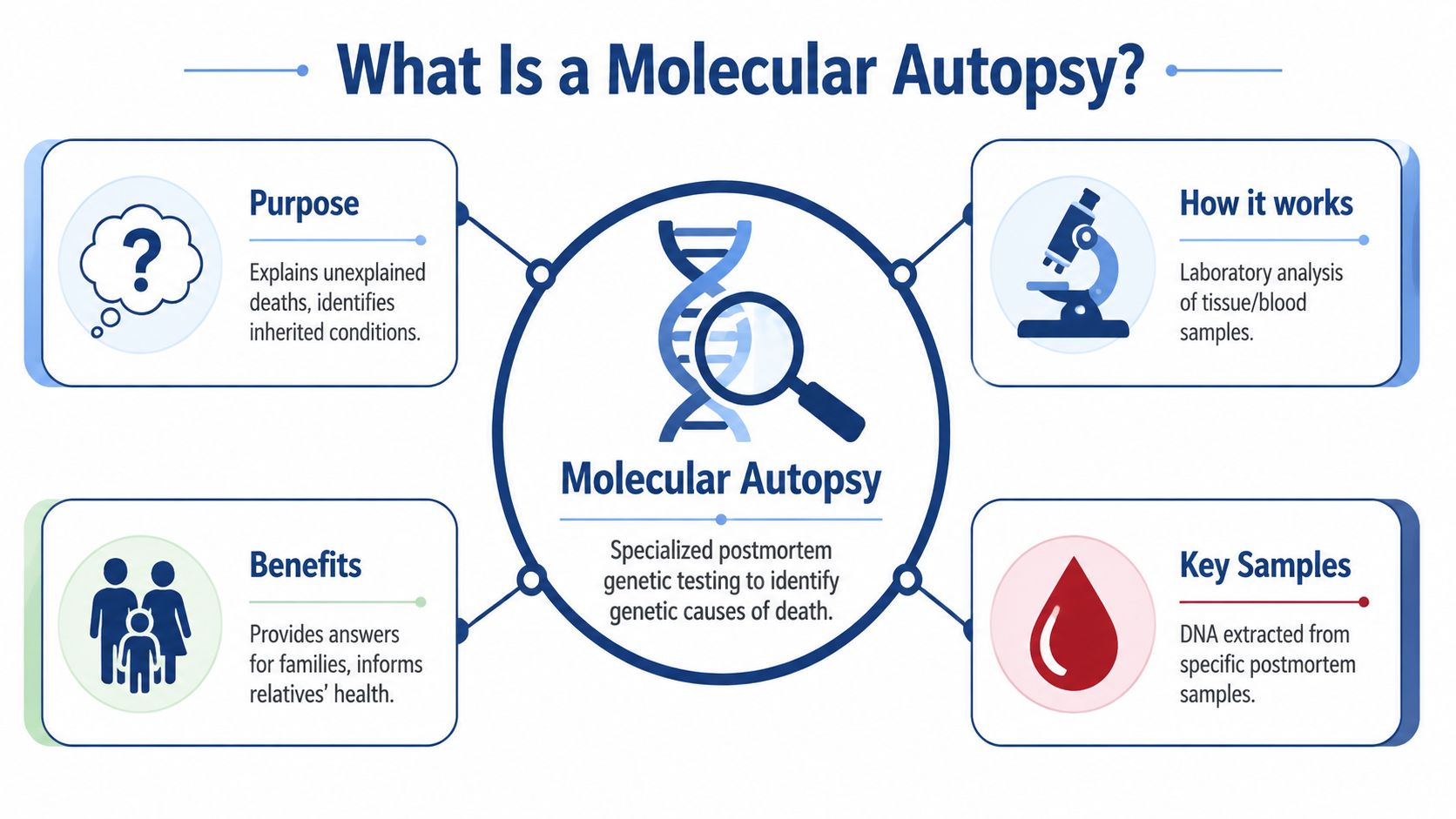
A molecular autopsy is postmortem genetic testing performed to look for an inherited condition that may have caused or contributed to death. It does not replace a standard autopsy. It adds a different layer of investigation when gross examination, microscopy, and routine studies do not fully explain what happened.
What it looks for
In practice, the main question is whether the decedent carried a genetic variant associated with a serious inherited disease. The classic examples involve the heart, particularly conditions that can trigger sudden arrhythmia or relate to cardiomyopathy.
This is why molecular autopsy often comes up after sudden collapse, sudden sleep-related death, unexplained drowning, unexplained motor vehicle events, or a death during exercise when the structural findings are absent or limited. A standard autopsy may say what is not present. Genetic testing may help explain what was present but invisible.
Why it is now part of real-world practice
This is not just an academic concept. In a large clinical cohort published in 2022, investigators reviewed 601 deceased individuals referred for postmortem genetic testing and found a likely pathogenic or pathogenic variant in about 15% of cases, with prior studies in sudden cardiac death showing a genetic predisposition in roughly 13% to 41% of cases reported in this clinical review of postmortem genetic testing.
For families, that means this testing has a practical role when the facts of the death fit the right pattern. It also means that preserving suitable specimens during the initial investigation can matter greatly, because the opportunity may be lost later.
What it does not do
A molecular autopsy is not a universal answer machine. It cannot correct poor specimen handling after the fact. It does not make every uncertain death certain. It also requires cautious interpretation, because some genetic findings are clearly disease-causing and some are not.
That distinction matters. A test result should never be read in isolation from the autopsy, the scene, the medical history, and the family history.
When Postmortem Genetic Testing Is Recommended
I do not recommend this testing for every death. I recommend it when the circumstances raise a serious concern for an inherited condition that ordinary autopsy methods may miss.
Common situations that prompt the recommendation
One common scenario is a sudden death in a younger person where the heart looks normal or nearly normal at autopsy. Another is a family that reports relatives with fainting, unexplained seizures, early sudden deaths, known cardiomyopathy, or rhythm disorders.
A third situation involves a death that has a suggestive history even if the anatomy is not dramatic. That may include collapse during exertion, sudden nocturnal death, or a death where witnesses describe abrupt loss of consciousness without a clear external cause.
How I frame the decision for families
I usually describe it as a question of fit. Does the case have features that make an inherited condition plausible enough to justify the added testing and interpretation.
Here are examples of cases where I would strongly consider discussing genetic testing after death:
- A negative autopsy after sudden collapse: The heart, brain, and lungs do not show a clear cause, and toxicology does not explain the death.
- A concerning family history: Relatives mention unexplained early deaths, implanted cardiac devices, inherited aneurysm concerns, or a known diagnosis such as cardiomyopathy.
- A decedent with prior symptoms that were never resolved: Episodes of syncope, palpitations, exercise intolerance, or seizure-like events can become important once the autopsy is complete.
- A legal case where medical clarification affects the broader picture: Attorneys may need to know whether inherited disease is a realistic explanation before assigning too much weight to other possibilities.
Practical rule: The strongest indication is often the combination of an unexplained death and a history that points toward inherited heart disease.
When it may not add much
There are also cases where genetic testing is less likely to help. If the autopsy already shows a clear, sufficient cause of death unrelated to inherited disease, adding broad postmortem genetics may create more confusion than clarity. The same is true when no adequate specimen was preserved and the remaining material is poor.
That does not mean the option disappears entirely. It means the expected value changes, and a careful discussion becomes even more important.
The Testing Process Sample Collection and Analysis
Families often worry that this process is mysterious or loosely handled. It should be neither. Good postmortem genetics depends on specimen quality, documentation, and a testing strategy that matches the case.
The specimens that work best
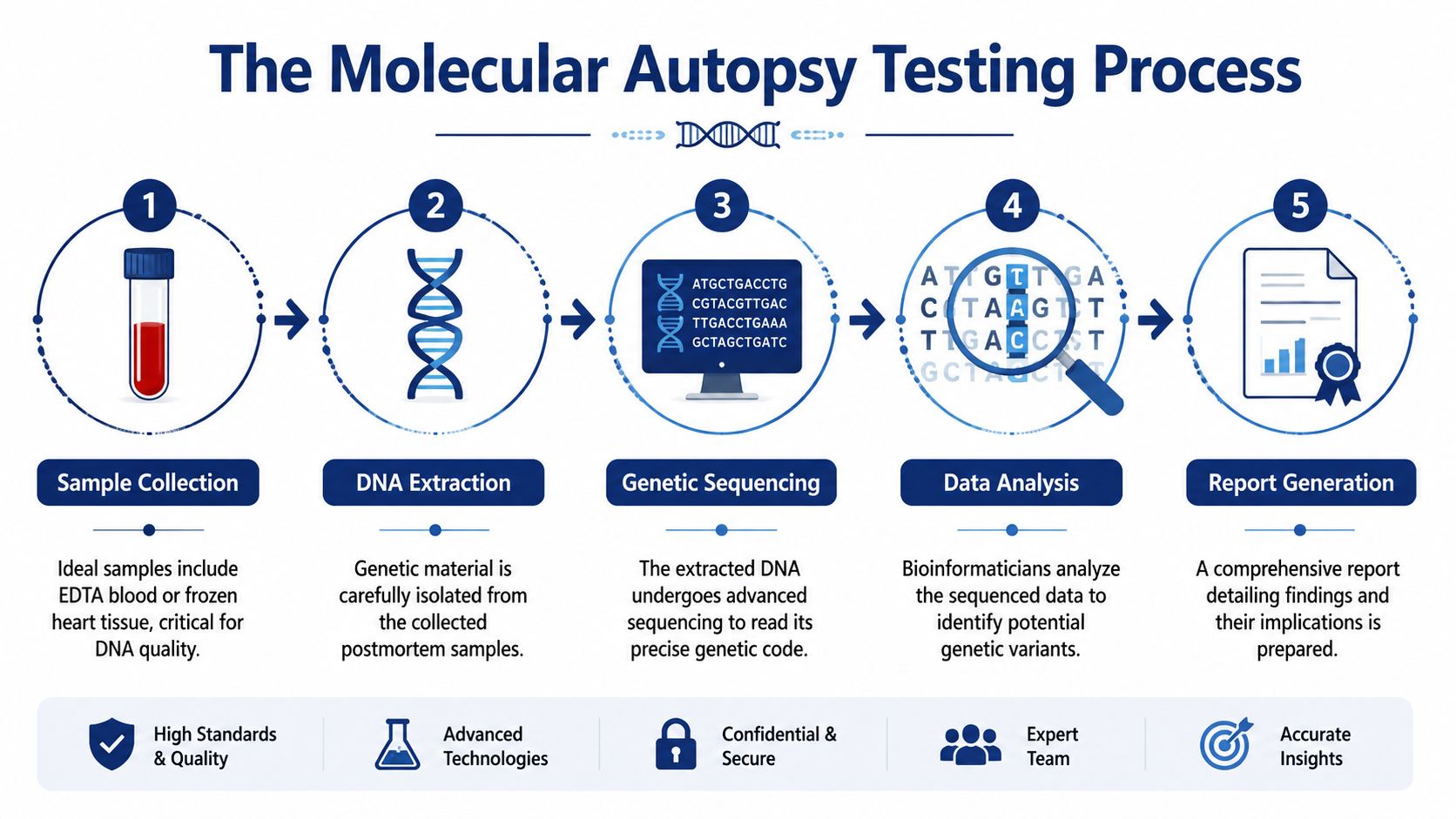
Expert guidance identifies EDTA blood and fresh-frozen tissue, especially heart, liver, or spleen, as the molecular gold standard for postmortem testing summarized by the National Society of Genetic Counselors. In plain terms, these samples preserve DNA better than many alternatives.
That is why early communication matters. If inherited disease is even on the differential diagnosis, the request to retain the right specimen should happen as soon as possible.
What happens when the sample is not ideal
Real life is rarely ideal. In an important earlier study of postmortem testing practice, EDTA blood was received for only 21.6% of patients, yet the laboratory still reported a 95% success rate for completing all test components across sample types described in this postmortem testing cohort.
That is reassuring, but it should not make anyone casual about collection. Better samples support better confidence. Suboptimal samples may still work, but they can narrow what a laboratory can do and how confidently a result can be interpreted.
Chain of custody and storage
For families and attorneys, chain of custody means the documented handling of a specimen from collection through transfer, storage, and testing. It helps show that the sample tested is the sample collected and that it was managed in a way that preserves integrity.
A simple summary is often useful:
| Term | Plain-language meaning |
|---|---|
| Cause of death | The disease or injury that led to death |
| Manner of death | The category of death such as natural, accident, suicide, homicide, or undetermined |
| Chain of custody | The record of who collected, stored, transferred, and received the specimen |
For readers who want a general overview of how controlled storage supports future laboratory use, the discussion of long-term sample preservation at Cryonos GmbH is a helpful background resource.
How the laboratory approach is chosen
The testing platform depends on the case. If the death strongly suggests a specific inherited disorder, a multigene panel is often the most efficient first step. Broader methods such as whole-exome or whole-genome sequencing may be considered in selected circumstances, but broader is not always better. It can increase complexity without improving practical usefulness.
Understanding the Results and Implications for Relatives
A family receives the report weeks after a sudden death. The first question is usually simple and painful. Does this answer what happened, and does it put anyone else in the family at risk?
That is the point where I slow the conversation down. As a forensic pathologist, I want families and counsel to understand two things at once. A genetic result can clarify the death investigation, and it can also create new medical decisions for surviving relatives.
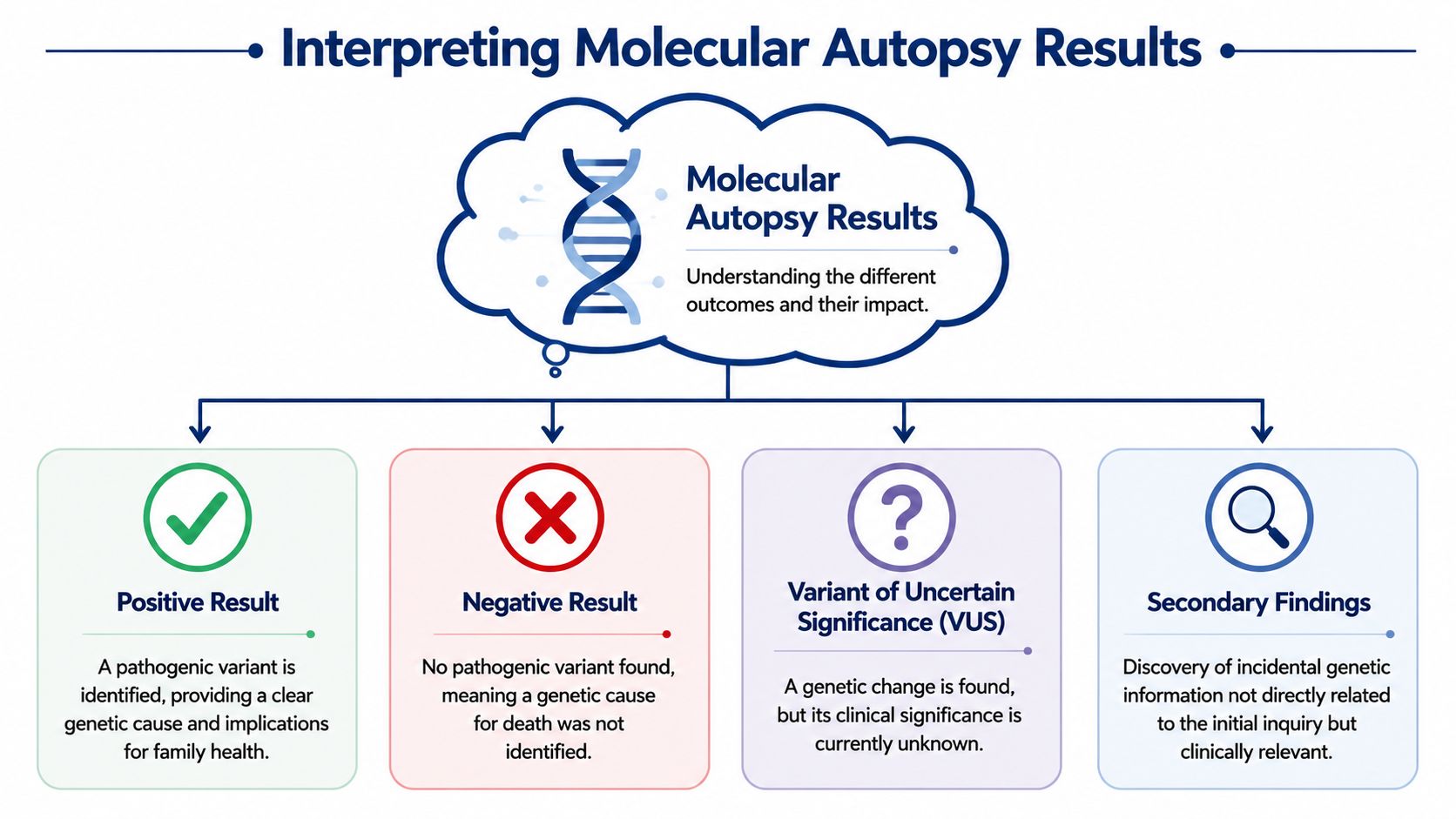
The main result categories
A positive result means the laboratory identified a pathogenic or likely pathogenic variant that fits the autopsy findings, scene history, and medical context. In practical terms, this may support the conclusion that an inherited disease caused or contributed to death. It can also give relatives a specific issue to discuss with their own physicians.
A negative result is often harder for families than they expect. It means the test did not find a reportable variant that explains the death. It does not rule out a genetic cause, because current testing cannot detect every relevant disorder and not every disease-causing variant is known.
A variant of uncertain significance, or VUS, is the result that causes the most confusion. The laboratory found a genetic change, but the available evidence does not show whether it is harmful. A VUS should not be treated as proof of disease, and it should not be used by itself to make major medical decisions for relatives.
Some reports also include findings unrelated to the suspected cause of death. Those findings may matter clinically, but they require careful review before anyone acts on them.
Why surviving relatives may need follow-up
The most important family question is usually, "Who else should be checked?" If the decedent had a clearly significant inherited variant, close biological relatives may be candidates for targeted evaluation, often called cascade testing. In Texas, that conversation usually starts with a cardiologist, medical geneticist, or genetic counselor who can review the decedent's report in the proper clinical setting.
I tell families to resist two common mistakes. The first is assuming a positive result means every child or sibling is affected. The second is assuming a negative result means the family is in the clear. Neither is a safe conclusion without clinical follow-up.
Families should not treat a postmortem genetic report as a stand-alone medical instruction. It is the starting point for a family-based clinical conversation.
This short video gives a useful overview of how these results are interpreted in practice.
Consent, privacy, and practical family questions
In Texas, the legal and practical issues matter almost as much as the science. Who can authorize release of results, who can approve added testing, and who can receive records depends on the case posture, the decedent's legal next of kin, and whether a medical examiner or justice of the peace is involved. Attorneys often need this clarified early, especially when there are disputes within the family or concerns about insurance, probate, or possible litigation.
Privacy also deserves careful handling. A postmortem genetic report concerns the decedent, but the implications can extend to children, siblings, and parents who were never part of the death investigation. I advise families to treat the report as a sensitive medical-legal document and to share it selectively with the clinicians who need it. This overview of how postmortem reports are used and interpreted can help frame that discussion.
Some families are managing these questions while making disposition decisions at the same time. If body donation is part of that separate discussion, the Evermore Directory article on body donation offers a practical overview of that process.
Requesting Genetic Testing with Texas Autopsy Services
The first request is often simple. A family member, attorney, or physician calls and says the death was sudden, the first answers are incomplete, and they want to know whether a hereditary condition should be considered.
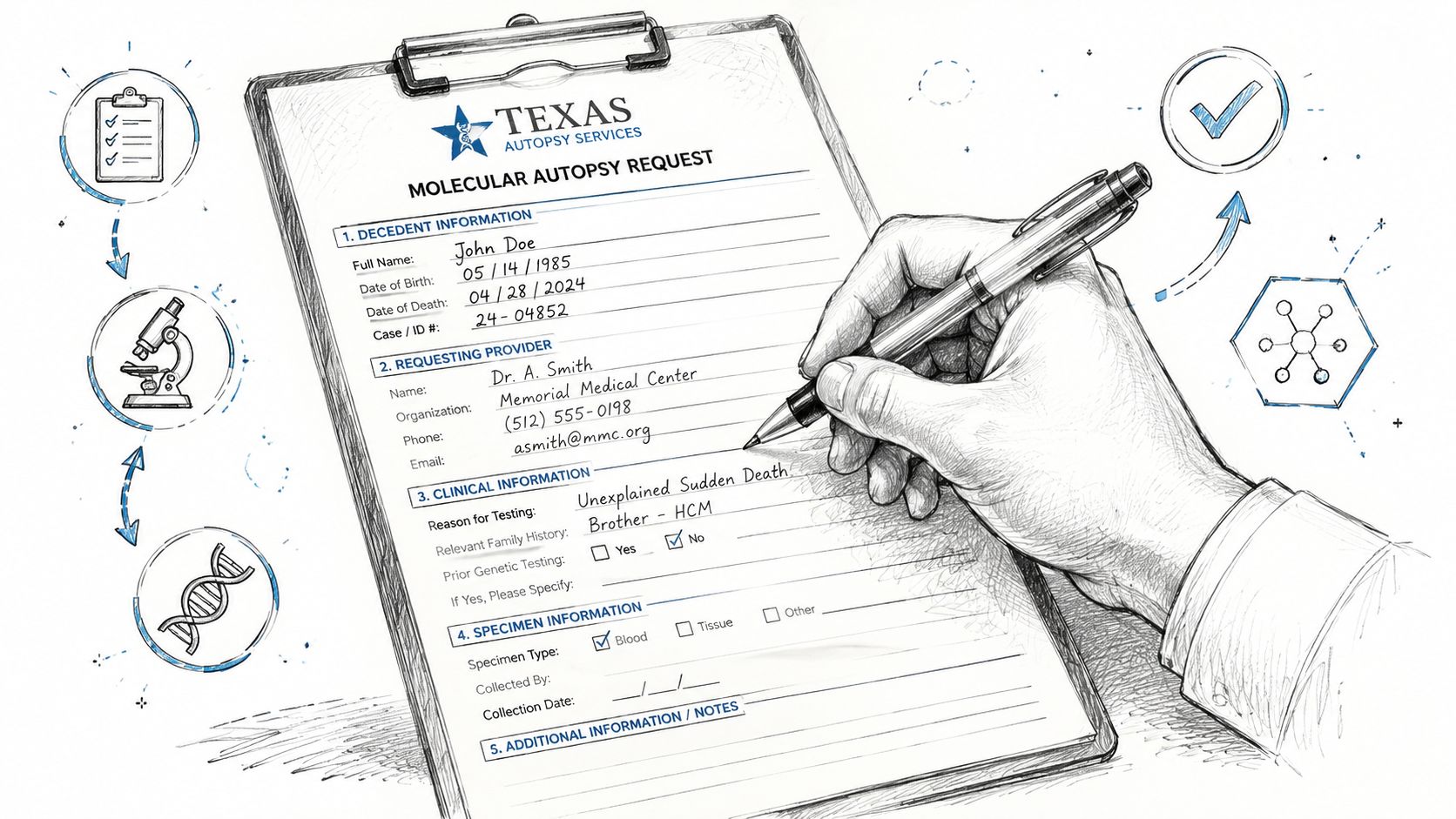
What information helps at the start
The most useful starting materials are the autopsy report if one exists, toxicology if available, the medical history, and any known family history of sudden death, rhythm disorders, cardiomyopathy, or unexplained collapse. If there has been no autopsy, the immediate question is whether appropriate specimens can still be collected and preserved.
It also helps to identify who has legal authority to request services. Families often need guidance on that threshold issue, and this explanation of who can request an autopsy can clarify the basics.
How the process usually moves forward
Once the case details are reviewed, the practical questions are straightforward:
- Is there an adequate specimen available: If yes, the next step is deciding whether testing should proceed now or whether specimen preservation should come first.
- Does the case history support focused cardiac genetic review: If the history and findings point strongly in that direction, a targeted strategy is often more useful than an overly broad one.
- Is legal documentation complete: Authorization, release forms, and custody records matter, especially if the case may later enter litigation.
For families seeking a private, independent evaluation, Texas Autopsy Services can incorporate molecular testing into certain postmortem investigations through its Private Autopsies services, and similar issues can arise in jurisdictional cases handled through County Forensic Autopsies. If a funeral home is coordinating logistics in Central Texas, our Waterloo Mortuary Partnership may also be part of those arrangements.
What families and attorneys should expect
No ethical pathologist should promise a guaranteed answer or a guaranteed timeline. Key variables include sample quality, case complexity, the need for records review, and the way any result fits with the full investigation.
What families should expect instead is a careful explanation of the likely value of testing, the limitations of the available specimen, and what the result may mean for living relatives. That is the honest standard.
Frequently Asked Questions About Postmortem Genetics
Can genetic testing after death still be done if a standard autopsy found nothing
Yes. In fact, that is one of the clearest situations where postmortem genetics may be worth discussing. Some inherited rhythm disorders may not leave a visible structural abnormality at autopsy. The key issue is whether a suitable specimen was saved.
Can testing still be done after embalming or cremation
The best options are usually before embalming and certainly before cremation. Once those steps occur, the highest-quality specimens may no longer be available. That does not automatically make all testing impossible, but it can make it less useful and less reliable.
Bottom line: If inherited disease is a concern, ask about specimen retention before final disposition decisions are completed.
Is a molecular autopsy result useful in legal cases
It can be, depending on the case. A well-documented postmortem genetic finding may help explain cause of death, narrow competing explanations, or inform expert review. But legal usefulness depends on the specimen history, the testing method, the interpretation, and how the result fits with the entire record.
Attorneys should think of it as one part of the evidentiary picture, not a substitute for the full forensic file.
What should hospitals, funeral professionals, or clinicians do if they suspect an inherited cause of death
Preserve the best possible sample early and document the handling carefully. If EDTA blood or fresh-frozen tissue can be retained, that keeps the widest range of options open. Clear labeling and written custody records matter.
Does a negative result clear the family of risk
No. A negative result means the laboratory did not identify a pathogenic variant with the method used on the specimen submitted. Family members may still need clinical review if the death history is concerning.
If a positive result is found, who in the family should act on it
Usually close biological relatives should discuss the finding with their own physicians and a genetic counselor. The exact priority depends on the identified condition and the family structure. The postmortem finding does not replace medical care for the living. It points them toward the right evaluation.
Does every uncertain result stay uncertain forever
Not always. Genetic interpretation evolves over time. A VUS may later remain uncertain, become more strongly associated with disease, or become less concerning as more evidence accumulates. That is one reason families should keep copies of reports and remain connected to clinical genetics when a meaningful question remains.
If your family or legal team is facing a sudden death with unanswered questions, a calm conversation is the right place to start. I encourage you to contact Texas Autopsy Services for guidance on whether postmortem genetic evaluation is appropriate, what specimens may still be available, and how to move forward with clarity and respect.