September 30, 2026 · Texas Autopsy Services
Molecular Diagnostic Testing in Autopsy
Learn how molecular diagnostic testing helps identify genetic and infectious causes of death. Discover the autopsy process, specimen needs, and limitations.
On this page
- Understanding Molecular Diagnostic Testing in Forensics
- Types of Molecular Tests Used in Autopsy Practice
- Specimen Collection and Chain of Custody Requirements
- Solving Unexplained Deaths and Infectious Diseases
- Interpreting Results and Understanding Limitations
- Requesting Molecular Testing from Texas Autopsy Services
A family is told that the autopsy, toxicology, and medical records did not identify why a loved one died. The absence of an obvious cause can be especially difficult after a sudden death, because “unexplained” describes an investigative result, not an explanation. In selected cases, molecular diagnostic testing can examine preserved DNA or other genetic material for information that cannot be seen during a conventional examination.
- Molecular autopsy uses genetic analysis when routine postmortem findings don't establish a conclusive cause of death.
- PCR and other molecular assays can evaluate infectious agents, mutations, and forensic identity markers, but every test must match the specimen and investigative question.
- DNA-friendly specimens, accurate labeling, secure storage, and a documented chain of custody protect both scientific reliability and legal usefulness.
- A genetic variant isn't automatically the cause of death. Results must be interpreted with the autopsy, toxicology, scene investigation, and medical history.
- We provide independent private autopsy and molecular testing coordination across all 254 Texas counties, with licensed transport and direct communication with our team.
Understanding Molecular Diagnostic Testing in Forensics
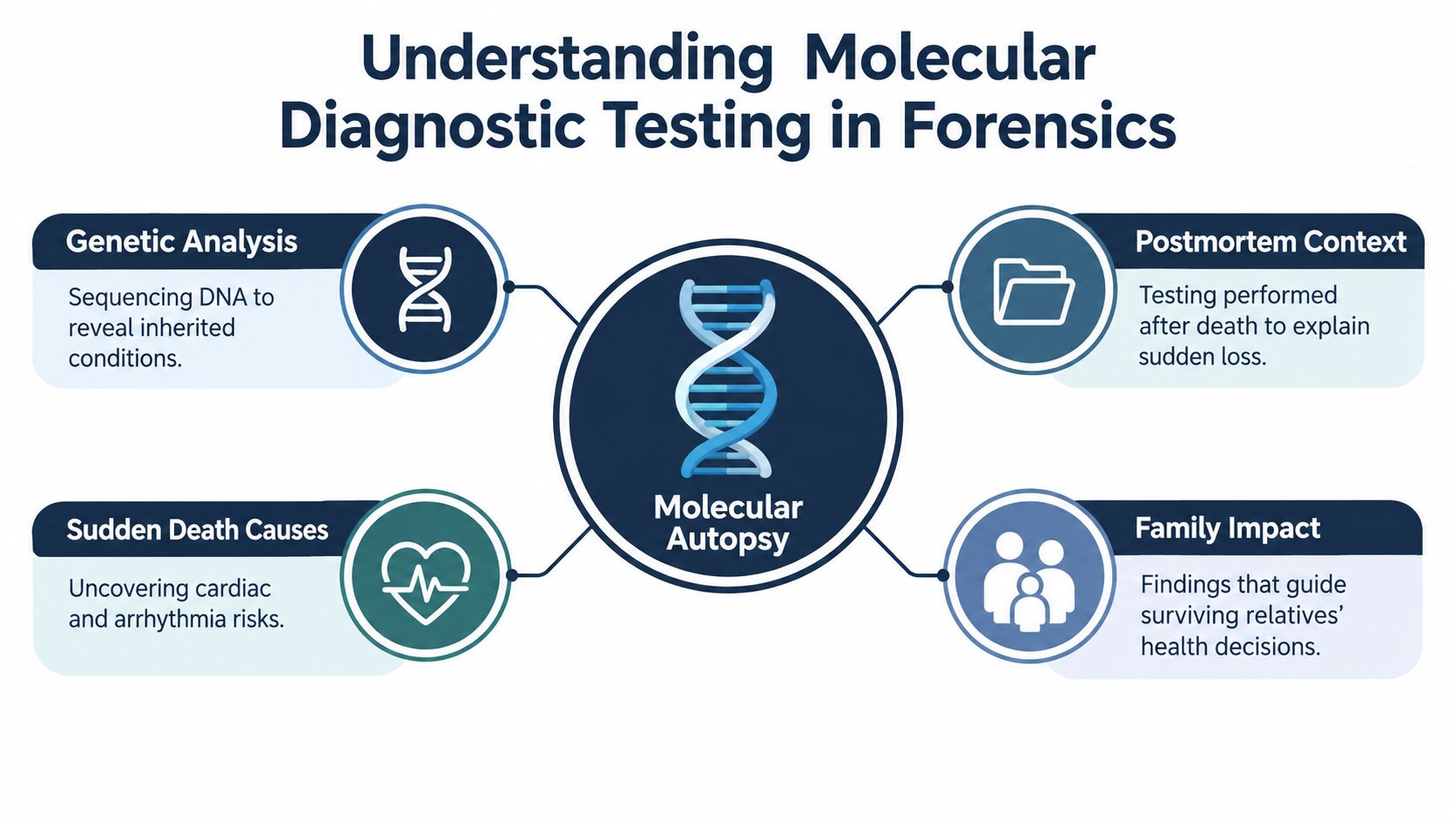
A molecular autopsy is a postmortem examination that uses genetic analysis to investigate a death that remains unexplained after the available structural, toxicological, and medical evidence has been reviewed. It doesn't replace a conventional autopsy. It adds another layer when the heart, brain, lungs, and other organs don't show a sufficient physical cause, and toxicology doesn't identify a fatal chemical exposure.
A traditional autopsy examines anatomy with the unaided eye and under a microscope. Toxicology evaluates drugs, alcohol, poisons, and other chemicals. Molecular diagnostic testing asks a different question: does the deceased carry genetic material associated with an inherited condition that could have contributed to death? Depending on the case, testing may also look for infectious organisms or other molecular targets.
Practical rule: A molecular result is evidence within a death investigation, not a substitute for the death investigation.
The field has deep roots in the movement from classic pathology to DNA-based medicine. In 1949, Pauling and colleagues introduced the concept of a “molecular disease” by linking a single amino acid change to sickle cell anemia, establishing a foundation for modern molecular diagnostics. Clinical applications expanded in the 1980s, including prenatal testing that used DNA-cutting enzymes for disorders such as thalassemia. PCR was invented in 1985, fluorescence in situ hybridization followed in 1986, and thermostable DNA polymerase optimization occurred in 1988. These milestones helped turn molecular testing from a research concept into a clinical tool capable of identifying small genetic changes with speed and specificity. The historical development of molecular diagnostics is reviewed in this medical literature.
Why this matters after an unexplained death
Sudden unexplained death may involve an inherited cardiac rhythm disorder, cardiomyopathy, or another condition that leaves limited or no visible structural evidence. Molecular testing can sometimes identify a variant that supports a cause-of-death opinion and alerts surviving relatives to discuss appropriate health evaluation with their own clinicians. It cannot, by itself, prove that every detected variant caused the death.
Families and attorneys who want a more detailed explanation of the laboratory role can review our resource on what molecular testing means after an autopsy. Our board-certified forensic pathologists consider the full case before recommending testing, including the circumstances of death, medical history, scene information, autopsy findings, and available specimens.
Types of Molecular Tests Used in Autopsy Practice
The appropriate assay depends on the question being asked. A test designed to detect a bacterial or viral target isn't interchangeable with a test designed to identify an inherited cardiac variant. Specimen quality, suspected disease, contamination risk, and the laboratory's validation data all affect the decision.
Polymerase Chain Reaction, or PCR, amplifies selected DNA or RNA targets so a laboratory can detect them. In pathology, PCR has been adapted to identify infectious agents, mutations, translocations, gene amplifications, and forensic identity markers. That range makes it useful in both medical and forensic casework, rather than limiting it to inherited disease investigations. A pathology review describes these applications of PCR.
Loop-mediated isothermal amplification, or LAMP, amplifies genetic material at a constant temperature rather than using the repeated temperature cycles required by PCR. Its simpler infrastructure can be useful in point-of-need settings, but simpler equipment doesn't remove the need for careful validation.
| Assay type | Primary forensic use | Key advantage |
|---|---|---|
| PCR | Detecting pathogens, mutations, translocations, and identity markers | Established method with flexible target selection |
| Real-time PCR | Detecting and monitoring selected genetic targets | Provides amplification and detection in a controlled workflow |
| LAMP | Rapid detection of selected molecular targets | Reduces infrastructure requirements |
| Gene-panel sequencing | Investigating inherited disorders when first-line evidence supports testing | Examines multiple relevant genes in one analysis |
| Fluorescence in situ hybridization | Evaluating selected chromosomal or genomic changes | Locates specific genetic sequences within cells |
Performance depends on validation
A 2026 systematic review identified 26 PCR-based assays and 3 isothermal amplification assays for point-of-need molecular diagnostics. Reported clinical sensitivities ranged from about 85% to 100%, while specificities were generally above 95%. Several multiplex PCR and singleplex LAMP or PCR assays reached 100% specificity, but those results depended on assay design, specimen type, controls, and the reference standard used for validation. The systematic review provides the cited performance ranges and assay counts.
A separate 2022 systematic review estimated LAMP sensitivity at 96.6% and specificity at 97.6%, compared with PCR sensitivity of 95.6% and specificity of 98.7%. The review also found that LAMP specificity can fall for fastidious bacteria. The comparative LAMP and PCR findings are reported in this review.
For readers assessing laboratory workflows beyond Texas, this overview of PCR lab casework for Utah labs offers useful context. The central lesson is practical: there's no universally superior assay. The laboratory must choose a method that fits the suspected condition and the postmortem specimen.
Specimen Collection and Chain of Custody Requirements
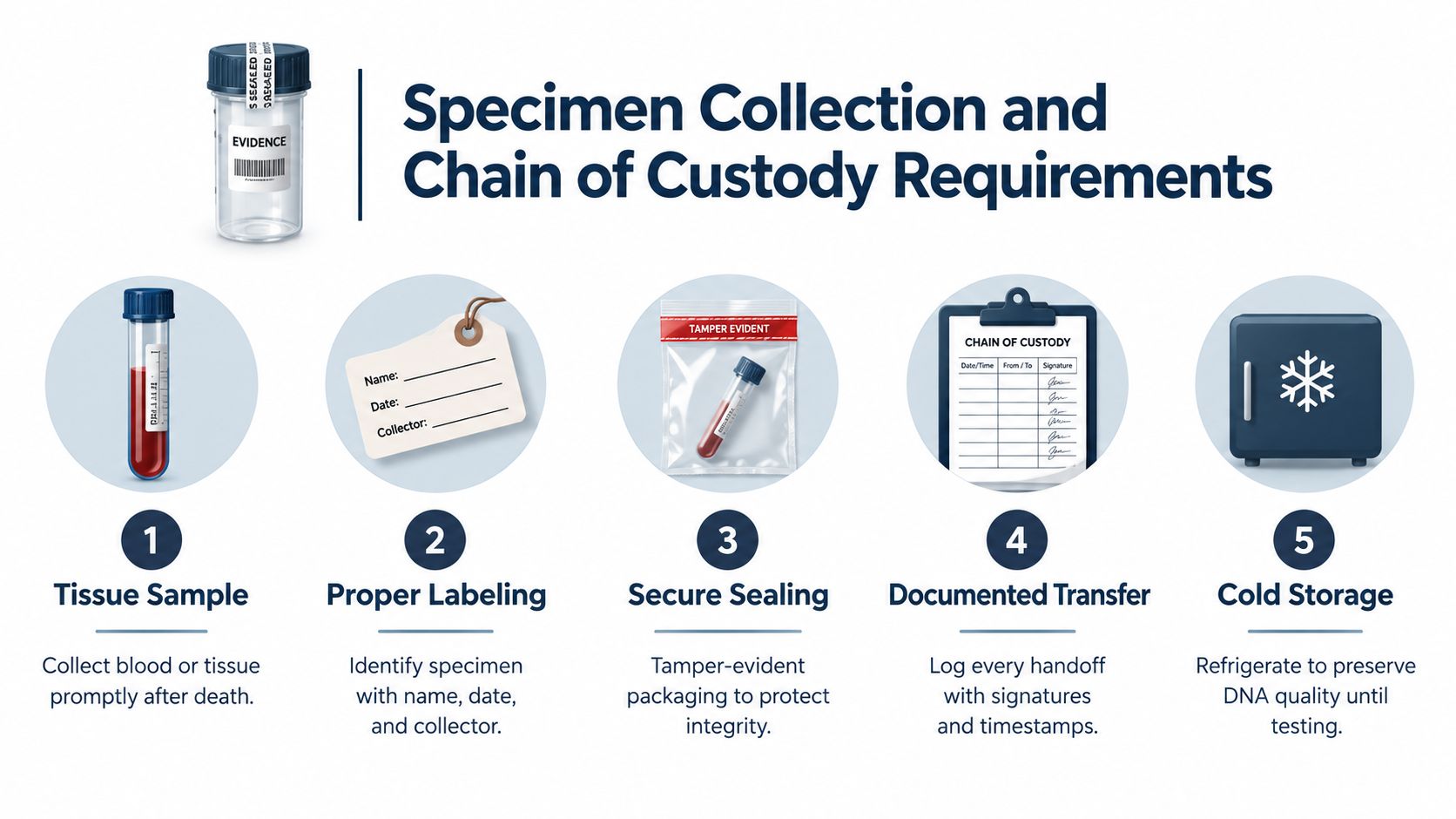
A molecular test can't recover information that was lost through poor collection, degradation, contamination, or uncertain specimen identity. For that reason, preservation begins during the autopsy, not when a laboratory receives the package.
Peer-reviewed guidance recommends collecting at least 5 to 10 mL of blood in an EDTA tube and, when appropriate, about 5 grams of fresh heart, liver, or spleen tissue for postmortem genetic testing. Another guide recommends retaining an additional 5 to 10 mL blood sample in K2-EDTA and freezing fresh tissue when possible. Specimen recommendations are discussed in this peer-reviewed review.
Collection and preservation
The exact specimen plan depends on the examination, condition of the remains, suspected cause, and laboratory requirements. Our team documents what was collected, from which anatomical source, when it was collected, and how it was stored. Fresh tissue should be handled in a way that limits degradation, while blood intended for genetic analysis should be placed in the appropriate anticoagulant tube rather than an unsuitable container.
What chain of custody means
Chain of custody is the documented history of an evidence item from collection through storage, transfer, testing, and reporting. It should show who handled the specimen, when the transfer occurred, where it was stored, and whether the package remained sealed and identifiable.
A defensible process generally includes:
- Clear identification: The specimen label and case documentation must correspond.
- Tamper-evident sealing: Packaging should protect the sample and reveal unauthorized opening.
- Documented transfers: Each handoff should identify the releasing and receiving person, with date and time records.
- Controlled storage: Conditions should preserve the specimen and be recorded.
- Laboratory reconciliation: The receiving laboratory should verify the package and specimen against the submission paperwork.
Families, attorneys, healthcare professionals, and county officials can find additional practical discussion in our guide to specimen collection procedures. Collection decisions should be coordinated with the forensic pathologist and laboratory rather than improvised after the body has been released.
Solving Unexplained Deaths and Infectious Diseases
A molecular autopsy is most useful when it addresses a defined investigative gap. Consider a sudden death in which the scene investigation shows no clear explanation, the medical history is limited, toxicology is unrevealing, and the autopsy doesn't identify a fatal injury or disease. In that setting, preserved blood or tissue may support testing for inherited conditions associated with arrhythmias, cardiomyopathies, or other disorders.
The result may have consequences beyond the death certificate. If a laboratory identifies a finding that is medically relevant and sufficiently supported, surviving relatives can take the result to their own healthcare professionals for individualized evaluation. We don't tell relatives what medical care they need, and molecular testing doesn't diagnose living family members. It can, however, provide information they may discuss with qualified clinicians.
The second major application is suspected infectious disease. Molecular assays can detect genetic material from infectious agents, including situations where routine findings don't establish the organism responsible. The interpretation still requires attention to specimen location, postmortem change, contamination, treatment history, and whether detection represents disease rather than incidental presence.
When testing may assist the investigation
- Sudden unexplained death: Structural and toxicological findings don't establish a sufficient cause.
- Possible inherited cardiac disease: The circumstances or family history raise concern about an arrhythmia or cardiomyopathy.
- Suspected infection: The clinical course, scene, or autopsy findings suggest an infectious cause that requires molecular confirmation.
- Complex legal review: An attorney needs an independent assessment of whether preserved specimens can answer a specific question.
- Family risk assessment: A validated finding may provide information for relatives to discuss with their clinicians.
A molecular autopsy can clarify some cases, but it won't resolve every unexplained death. Our discussion of molecular autopsy in postmortem investigations explains why the test must remain connected to the broader forensic record.
The following educational video provides additional visual background on molecular analysis. It shouldn't be treated as a case-specific medical or forensic opinion.
Interpreting Results and Understanding Limitations
The most important limitation is also the one most likely to be misunderstood: finding a genetic variant doesn't automatically establish cause of death. Human genetic testing can identify variants that are clearly associated with disease, variants that are likely benign, and variants whose significance remains uncertain. A variant of uncertain significance shouldn't be presented as a confirmed explanation just because it appears in a gene associated with sudden death.
The National Institute of Justice explains that molecular autopsy can improve cause-of-death determination when scene investigation, medical records, toxicology, and autopsy findings are negative, inconclusive, or suggest a possible genetic cause. It also notes that gene-panel testing is generally reserved as second-tier testing because variants may be misinterpreted or classified as uncertain. The NIJ guide describes this role and limitation.
Correlation protects against overstatement
Our board-certified forensic pathologists assess molecular results alongside:
- Autopsy findings: The organs and tissues must support the proposed mechanism where structural evidence exists.
- Circumstances of death: The location, activity, symptoms, witness accounts, and timing can change the significance of a result.
- Medical history: Prior fainting, seizures, cardiac symptoms, medications, and known family history may provide essential context.
- Toxicology: A genetic finding doesn't erase the potential contribution of drugs, alcohol, or poisons.
- Laboratory quality: The assay, controls, specimen condition, coverage, and classification method all affect confidence.
A negative result has limits as well. It may mean the tested genes didn't contain an interpretable finding, but it can't prove that no inherited condition existed. The test may not cover every relevant gene or every type of genetic change, and degraded postmortem material can affect analysis.
Interpretive caution: The strongest report may be one that explains what the evidence supports, what it doesn't support, and what remains unknown.
For attorneys, this distinction matters in written opinions and testimony. A scientifically careful report separates cause of death, the disease or injury that produced death, from manner of death, the classification describing how the cause arose, such as natural, accident, suicide, homicide, or undetermined. Molecular evidence may inform the cause opinion, but it doesn't independently determine manner.
Requesting Molecular Testing from Texas Autopsy Services
Families, attorneys, healthcare professionals, and county officials usually begin by providing the available case information rather than requesting a particular gene panel immediately. Useful records may include the death certificate or preliminary findings, medical records, toxicology results, scene information, prior autopsy reports, family history relevant to sudden death, and the location of preserved specimens.
Our practice is based in Elgin, Texas, and supports private autopsy services throughout all 254 Texas counties. Our team provides in-house licensed transport, secure temperature-controlled storage, specimen coordination, and communication with the laboratory when molecular testing is appropriate. Every examination is performed by a forensic pathologist certified by the American Board of Pathology.
How the request is evaluated
The first step is case review. We assess whether the death remains unexplained, whether the circumstances suggest an inherited or infectious process, whether suitable specimens exist, and whether testing is likely to answer a defined forensic question.
The next step is evidence planning. If an examination is pending, collection can be incorporated into the autopsy process. If an examination has already occurred, our team reviews what was preserved and whether the chain-of-custody documentation is adequate for the intended use.
The final step is reporting. The laboratory findings are considered with the autopsy report, medical records, toxicology, scene information, and other evidence. Reports are written for practical use by families, attorneys, agencies, and county officials, with clear explanations of limitations.
Timing, cost, and legal setting
Most cases are completed within 24 to 48 hours when referring to the initial autopsy workflow, but molecular testing often requires separate laboratory processing. The total time depends on specimen condition, assay selection, laboratory workload, confirmatory testing, variant interpretation, and the complexity of the death investigation. We don't guarantee a turnaround date before those factors are known.
Texas Autopsy Services offers flat-rate, all-inclusive pricing for its applicable services, with direct communication and no call center or middleman. Any legal or regulatory question involving an ongoing county investigation, cremation, release of remains, or statutory authority should be directed to the agency or official responsible under Texas law, including the applicable provisions of the Texas Health & Safety Code and the Texas Funeral Service Commission requirements.
Families seeking an independent autopsy can review our private autopsy services. County officials can also review our county forensic autopsy services, while our Waterloo Mortuary Partnership provides information about related mortuary coordination.
Frequently asked questions
What is a molecular autopsy?
A molecular autopsy is postmortem genetic analysis used to investigate a death that remains unexplained after a complete autopsy and related review. It may examine preserved blood or tissue for variants associated with inherited disease or other molecular evidence relevant to the case.
Can molecular testing prove why someone died?
Not by itself. A genetic finding must be evaluated with the autopsy, scene investigation, medical history, toxicology, specimen quality, and laboratory interpretation. Some findings are uncertain or incidental.
What specimens are useful?
DNA-friendly specimens commonly include EDTA-preserved blood and fresh tissue such as heart, liver, or spleen. The precise collection plan should be established with the forensic pathologist and testing laboratory.
Can relatives use the result as a diagnosis?
No. A postmortem result may provide information for surviving relatives to discuss with their healthcare professionals, but it isn't a diagnosis or treatment recommendation for any living person.
Who can request an independent autopsy in Texas?
The appropriate requester and authorization depend on the circumstances, custody of the remains, and any active county or justice-of-the-peace investigation. Families and attorneys should contact the responsible agency and an independent forensic pathology practice promptly so preservation and legal requirements can be reviewed.
Texas Autopsy Services offers independent private autopsy examinations, specimen preservation, and molecular testing coordination across Texas, with every examination performed by a forensic pathologist certified by the American Board of Pathology. If a death remains unexplained, visit Texas Autopsy Services to contact our team directly and discuss the available records, specimens, chain of custody, and next appropriate step.