August 11, 2026 · Texas Autopsy Services
What Is Molecular Testing? a Guide for Forensic Pathology
Learn what is molecular testing and how PCR, qPCR, sequencing, and DNA typing help forensic pathologists answer cause-of-death questions with precision.
On this page
- Understanding Molecular Testing in Postmortem Work
- Sample Collection and Chain of Custody
- What Molecular Testing Can Reveal That an Autopsy Alone Cannot
- Turnaround Time and How Results Are Reported
- Limitations and Common Misconceptions
- How Texas Autopsy Services Integrates Molecular Testing
- Questions Families and Attorneys Most Often Ask
Families and attorneys often meet the phrase molecular testing only after a death has already made the usual answers feel incomplete. In that setting, the term can sound technical and distant, but the idea is simple, it is a way to look for disease clues in DNA, RNA, proteins, or other molecules when the eye, the microscope, or even a standard autopsy cannot see enough on its own National Cancer Institute definition of molecular testing, APHL explainer on molecular diagnostic tests. In forensic work, that can matter when a family wants a clearer cause of death, when an attorney needs chain-of-custody documentation, or when a county official needs dependable results that can stand up in a legal file.
- Molecular testing looks at what can't be seen during a gross exam. It helps identify infections, inherited conditions, and biomarkers that may explain a death National Cancer Institute definition of molecular testing.
- It is often used with other autopsy findings, not instead of them. The strongest opinions usually come from combining the body examination, microscopy, toxicology, and molecular results.
- Timing and handling matter. A sample that is poorly collected or delayed can weaken the value of even a strong assay.
- Texas families can ask for a plain explanation. They should be told what the test can answer, what it cannot, and how the result will be reported.
A parent may hear, “The autopsy didn't show a clear reason,” and then learn that a molecular test can sometimes find a hidden infection or a genetic clue. That is not a promise of certainty, and it should never be presented that way. It is a focused laboratory method that can add detail, especially when the death was sudden, unexpected, or medically complex.
Understanding Molecular Testing in Postmortem Work
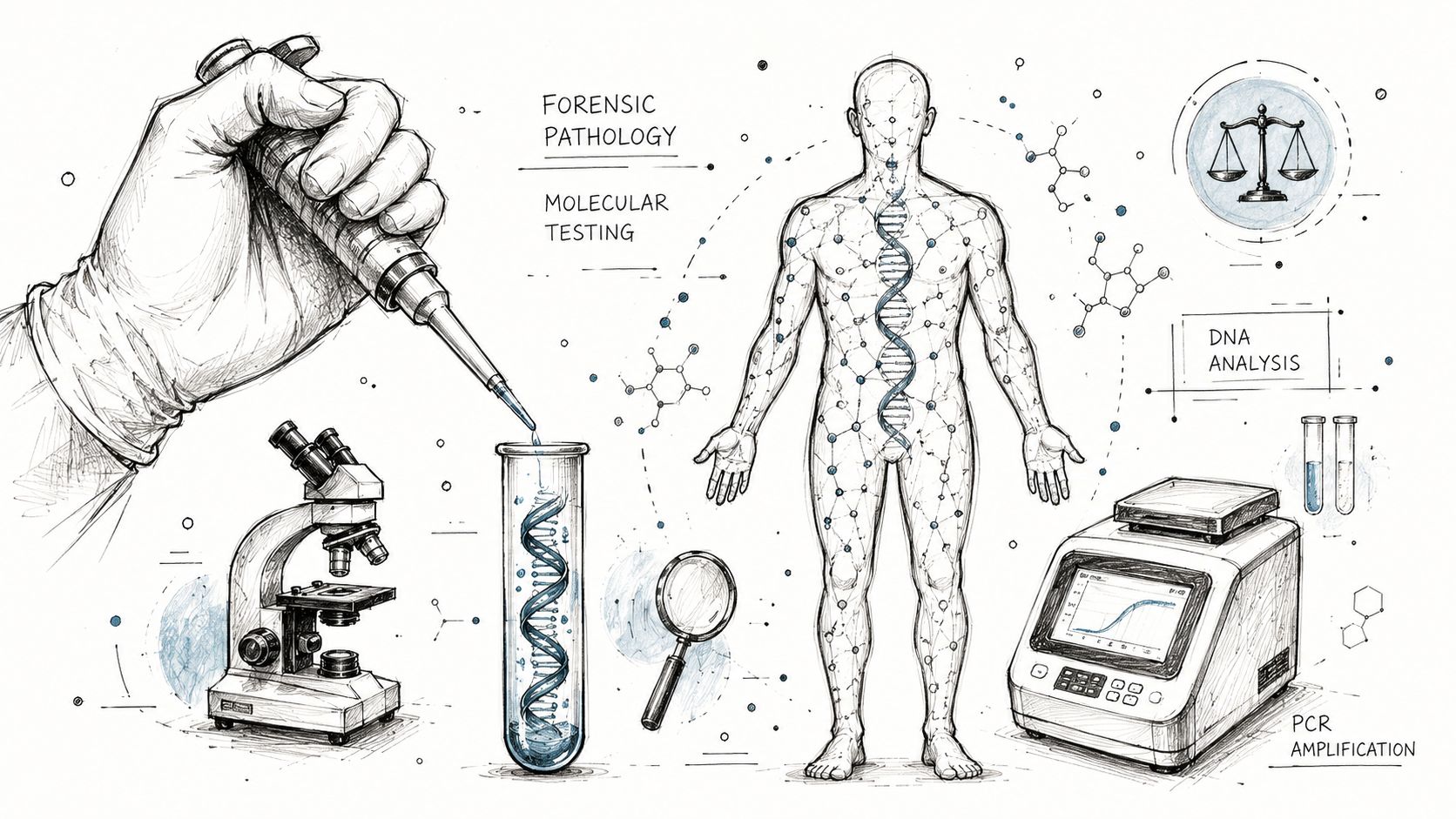
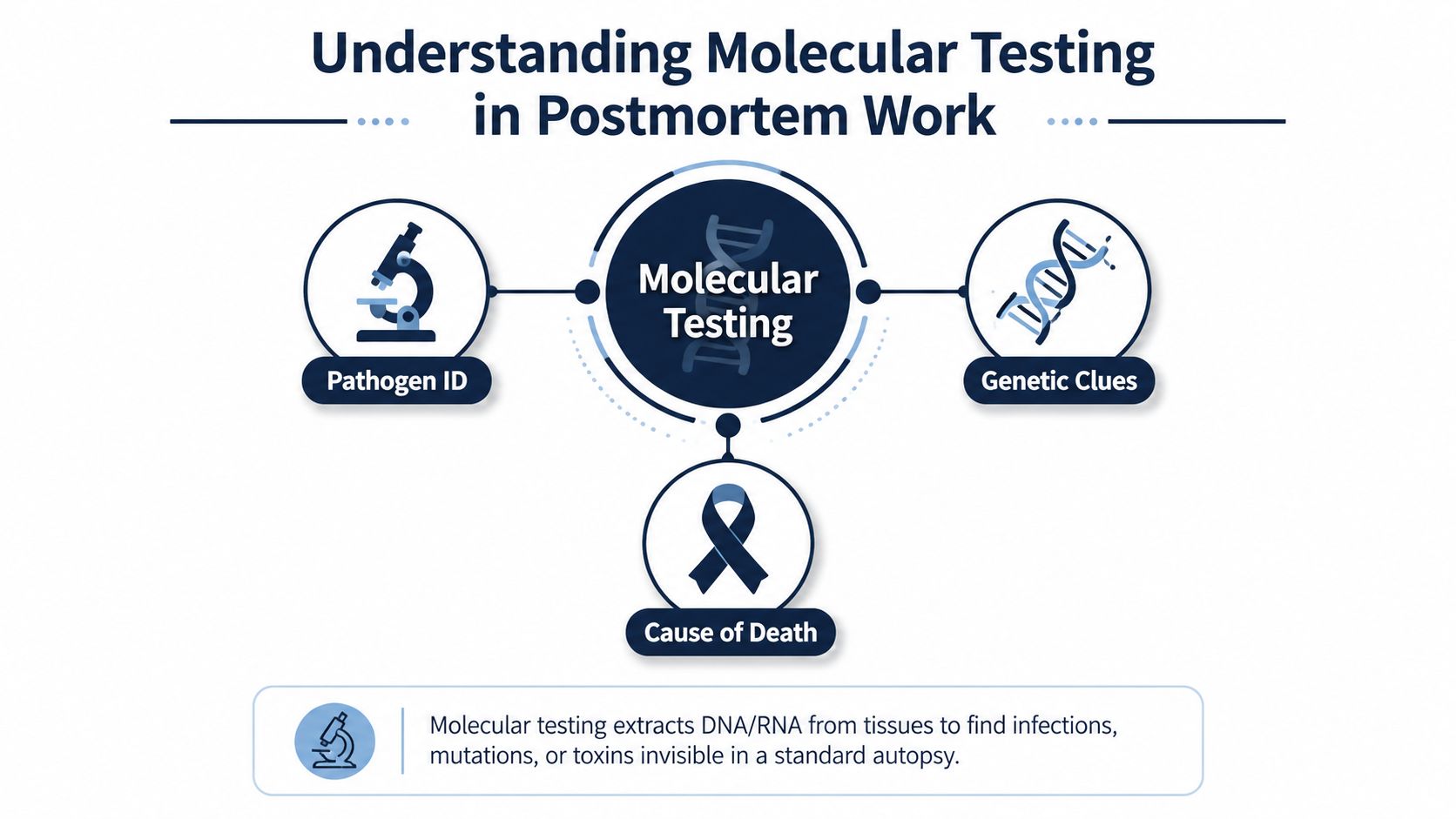
A family may hear the word molecular testing and wonder whether it means a blood test, a genetic test, or something used only in cancer care. In postmortem work, it is a way to study small pieces of genetic material or molecular markers from tissue, blood, or body fluids to answer a medical-legal question. That question may involve infection, inherited disease, identity, or a biomarker that helps explain the cause of death.
The basic tools are familiar once they are translated into plain language. PCR makes a tiny amount of target DNA or RNA easier to detect. qPCR does the same thing and also gives a sense of how much target material is present. Sequencing reads the genetic code of a gene or a pathogen. DNA typing compares identity markers, which is useful when remains are incomplete or when identification is uncertain.
A simple example shows why this matters. If a person had signs of meningitis but the autopsy did not show an obvious structural cause, PCR or sequencing may help look for a bacterial or viral target. If the concern is sudden cardiac death in a younger person, sequencing may identify a genetic change tied to an inherited rhythm disorder. If identity is the issue, DNA typing can help confirm who the decedent was when visual recognition is not reliable.
| Method | What It Does | Typical Autopsy Question |
|---|---|---|
| PCR | Amplifies a small amount of target DNA or RNA | Is there pathogen genetic material present? |
| qPCR | Measures target material after amplification | How much of the target is present? |
| Sequencing | Reads the exact genetic code of a region | Is there a variant or pathogen sequence linked to disease? |
| DNA typing | Compares identity markers | Can this person be identified with confidence? |
For readers who want a broader plain-English overview, VirusFAQ.com explains molecular diagnostics in a way that pairs well with the clinical picture. The National Cancer Institute defines molecular testing as a way to look for gene or chromosome changes that can affect diagnosis, prognosis, treatment selection, and monitoring response.
The clinical version and the postmortem version use the same scientific ideas, but they do not serve the same purpose. In a living patient, the test is ordered to guide treatment. After death, the sample is collected to answer a cause-of-death question that may carry medical and legal weight. That difference matters because preservation, labeling, and documentation have to stay exact.
Common Molecular Methods Used in Autopsy
A forensic team chooses the method based on the question already raised by the autopsy findings. PCR is often the first step when the target is known or strongly suspected. Sequencing is more useful when the question is broader or when a single marker does not explain the findings. DNA typing is separate from disease detection, because its role is identification.
Practical rule: the best test is the one that matches the question already raised by the autopsy findings, not a test ordered just because it sounds advanced.
Families often ask why this kind of testing has become so common in modern medicine. The answer is that it now helps doctors and pathologists answer questions that tissue alone may not settle. In the postmortem setting, the same logic can help clarify infection, inherited disease, or identity when the gross and microscopic findings do not give a complete answer.
A real-world molecular testing study showed how widely these methods are used in clinical care, especially when doctors need more than a visual diagnosis to guide decisions real-world molecular testing study. That clinical experience matters here because the underlying laboratory methods are the same, even though the postmortem purpose is different.
For families and attorneys in Texas, the practical question is not whether molecular testing sounds advanced. It is whether the sample can be collected, documented, and interpreted in a way that still holds up after the case leaves the autopsy suite. Texas Autopsy Services discusses that postmortem context in its overview of genetic testing after death.
For families, the takeaway is simple. Molecular testing is a laboratory way to look for answers that may not be visible under the microscope. It can help identify a pathogen, a genetic change, or an identity marker when the cause of death is still unclear.
Sample Collection and Chain of Custody
A valid molecular result starts long before the laboratory runs the test. If the sample is contaminated, mislabeled, delayed, or stored poorly, the result can be weakened or become hard to defend later. That is why chain of custody matters. It is the documented record of who collected the specimen, how it was sealed, where it went, and who handled it after that.
In a postmortem case, we may collect blood, vitreous humor, liver, spleen, lung, brain, or another site-specific sample depending on the question. The choice depends on what the autopsy shows and what type of target the pathologist is trying to detect. If infection is a concern, the sampling plan may differ from one used for a genetic question. If the body has been deceased for some time, tissue quality and degradation become part of the decision.
A family may never see this part of the process, but it is where reliability is built. Samples should be placed in sealed containers, labeled immediately, and tracked from the moment of collection. Our practice uses licensed transport and documented handoffs, because the result has to remain traceable from the table to the reference laboratory. In settings where evidence handling is central, resources such as forensic evidence drying cabinets 4 MH-USA show how much emphasis forensic work places on secure specimen control.
Clinical testing in a living patient also differs because the body is still changing in real time. Postmortem work has to account for tissue breakdown, the time since death, and the risk that a sample can pick up material from the environment. That doesn't make molecular testing less useful. It just means the collection step has to be disciplined.
A good specimen can survive transport better than a careless one can survive interpretation. That is why our team documents timing, storage, and transfer in a way that supports both the medical opinion and any later review.
Texas Autopsy Services specimen collection procedures
A result is only as credible as the sample that reached the instrument.
What Molecular Testing Can Reveal That an Autopsy Alone Cannot
A standard autopsy remains the foundation of postmortem work. It shows anatomy, injury, bleeding, organ changes, and other findings that matter for the final opinion. Molecular testing adds another layer when the body does not show enough to explain why the person died.
Some causes of death leave only faint traces. An infection may be present without creating a dramatic structural change in the tissues, which is important in sudden deaths, meningitis cases, and certain bloodstream infections. In those situations, molecular methods can look for viral, bacterial, or fungal material directly, even when the gross examination does not settle the question. In infectious-disease settings, molecular syndromic panels have shown much higher detection than traditional testing, with one study reporting a 35.5% positivity rate versus 6% for conventional testing, and multiplex PCR panels detecting bacteria at 7.8% versus 2.9%, viruses at 11.4% versus 0.63%, and parasites at 2.4% versus 0.15% compared with standard techniques review of molecular diagnostic techniques.
Molecular testing also helps in cases of unexplained death where inherited disease is a concern. A sequencing result may reveal a variant linked to a sudden arrhythmia, a thrombophilia, or a metabolic disorder. In those cases, the autopsy may show a heart, liver, or brain that does not fully explain the death, but the molecular result may point to a disease process that was not visible on the table.
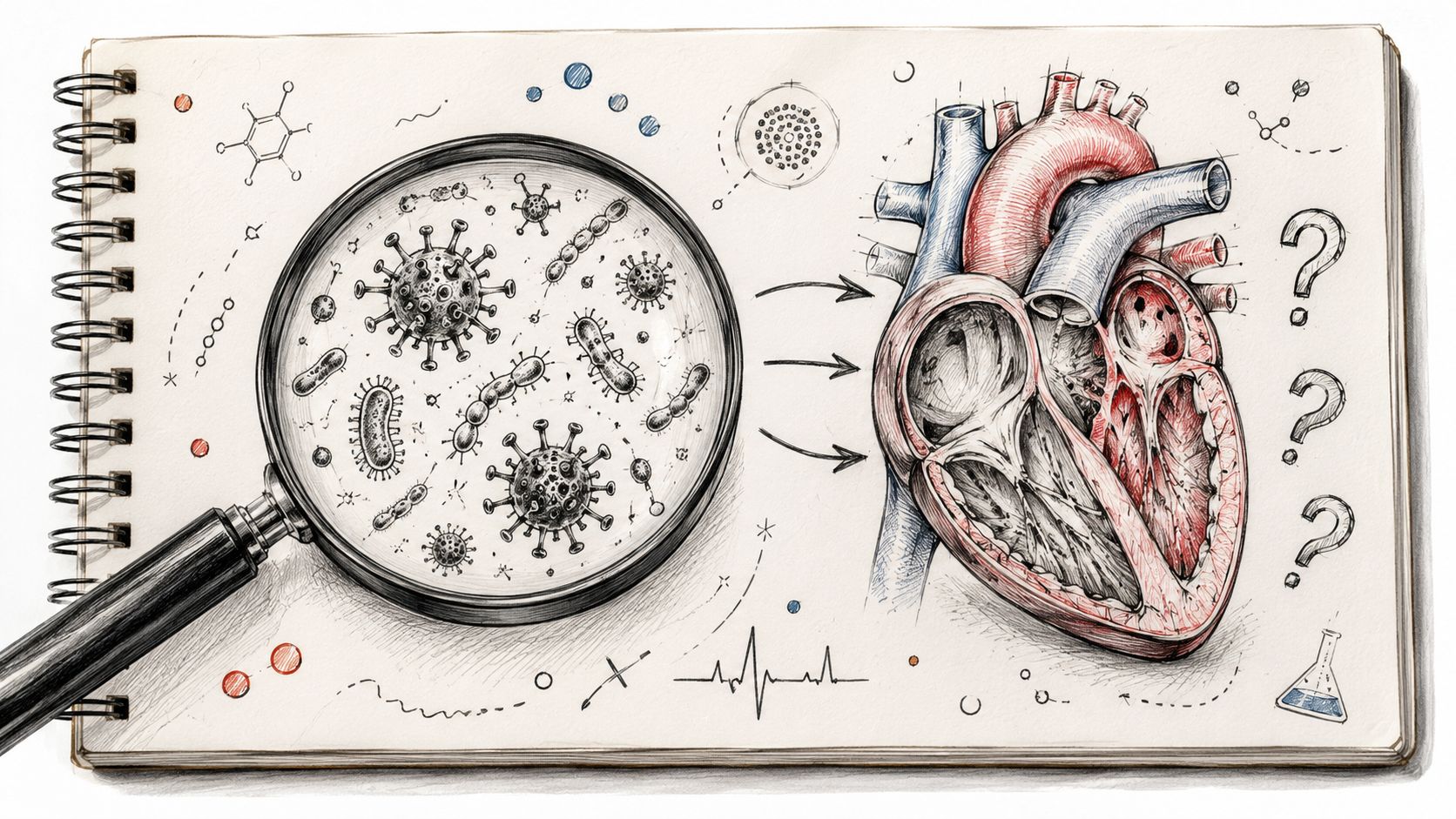
The distinction matters. Molecular testing does not replace the autopsy. It answers a different part of the question, like reading a hidden message that standard inspection cannot see. A positive result can support a diagnosis, but it still has to be interpreted with the scene, the medical history, and the tissue findings.
For families, that can be the difference between “we don't know” and “we have a medically supported explanation.” For attorneys, it can mean a report that ties the laboratory result to a documented cause-of-death analysis rather than leaving the finding isolated in a supplement.
A short video can also help families understand why a microscopic exam sometimes stops short of a final answer, then molecular testing fills in the gap.
Turnaround Time and How Results Are Reported
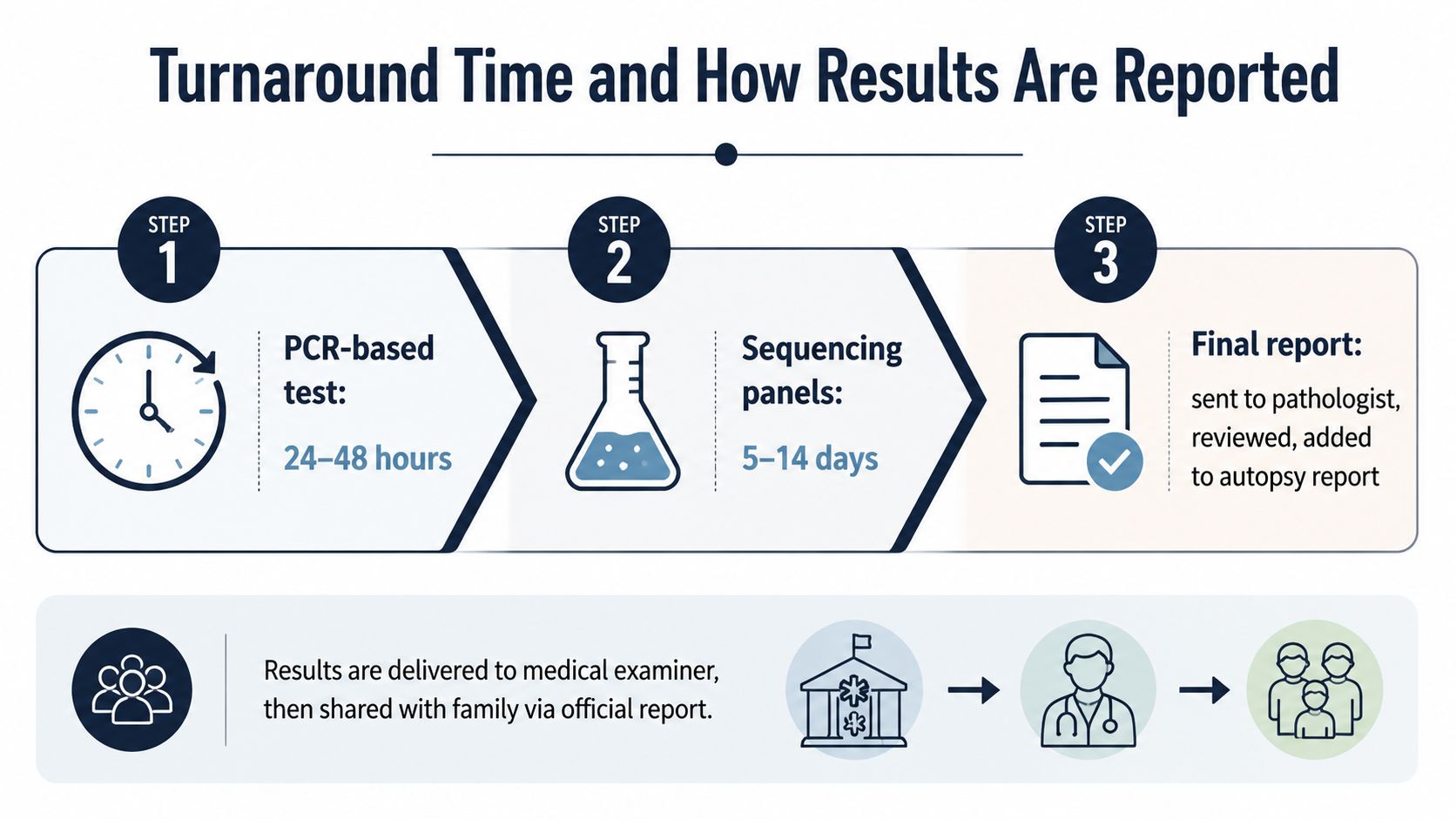
The timeline depends on the method, the sample, and the laboratory. PCR-based tests can return within 24 to 48 hours in many cases, while sequencing-based panels usually take longer because they involve more analysis and sometimes a second extraction if the first specimen is not adequate. Even a fast test can slow down if the sample is degraded or the reference lab has a backlog.
What happens before the report reaches the family
Once the specimen leaves the autopsy setting, the laboratory verifies identity, checks quality, and runs the assay. If a target is detected, the result is sent back to the pathologist for review in context. If the result is negative, the report still has to be read carefully, because a negative molecular result means the test did not find the target it was designed to detect. It does not automatically rule out all disease.
Practical rule: a molecular result matters most when it is interpreted alongside the autopsy, not read as a stand-alone answer.
Reporting also depends on whether the test was a screening panel or a confirmatory assay. A panel can help narrow the field. A confirmatory test can support a specific conclusion. The difference matters in court and in family discussions, because the wording in the final report should reflect how strong the evidence really is.
How results enter the final autopsy opinion
Our board-certified forensic pathologists integrate molecular findings into the written autopsy report when the result changes the medical opinion or clarifies the explanation of death. That can mean the molecular section supports an infectious cause, explains an otherwise unexplained death, or helps rule out a suspected mechanism. The goal is clarity, not volume.
A useful way to think about it is this. The molecular lab produces data. The forensic pathologist decides how that data fits the whole case. That separation protects the integrity of the final opinion and keeps the report useful to families, attorneys, and county officials.
Limitations and Common Misconceptions
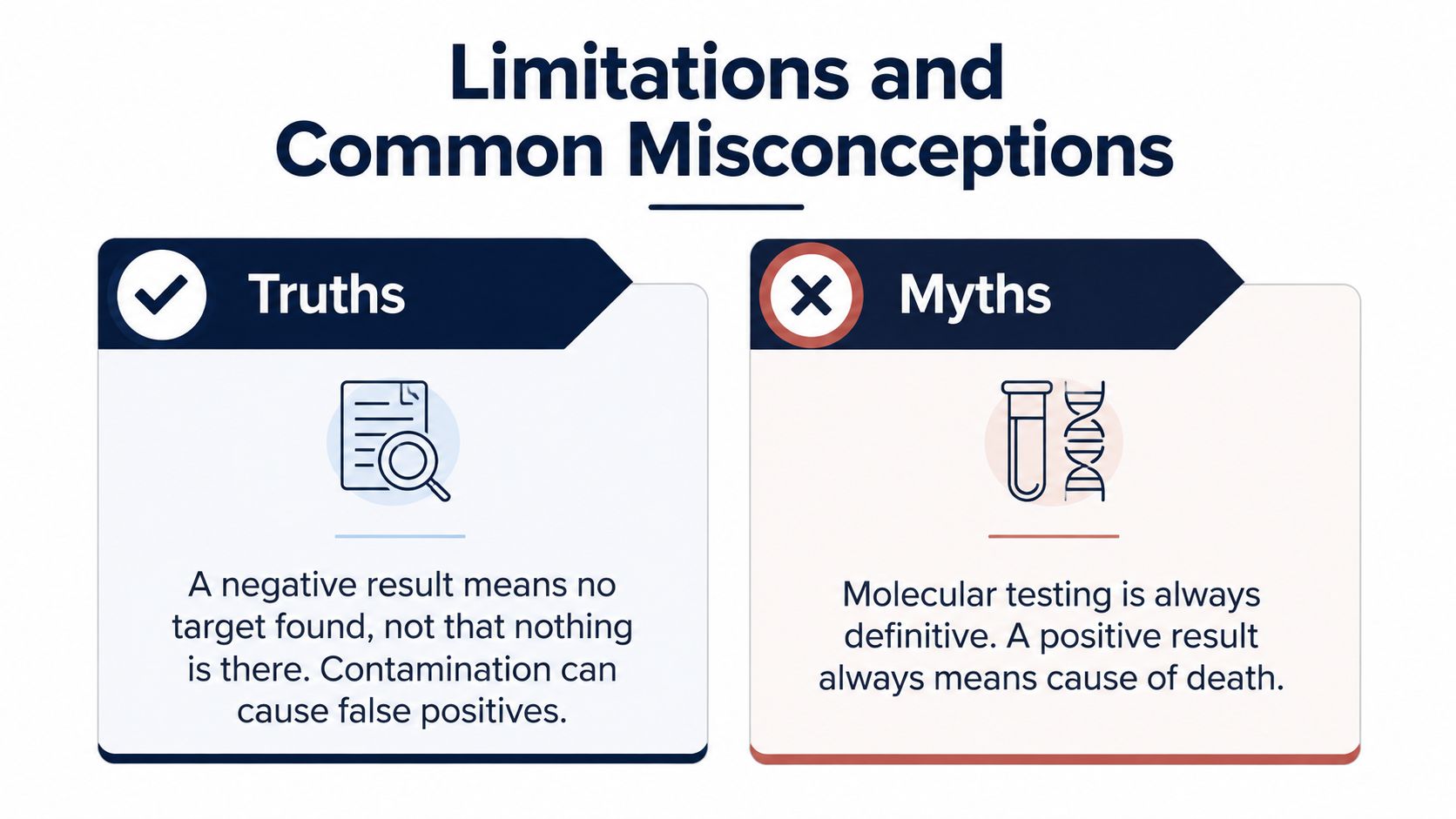
A negative result can be comforting, but it's easy to misread. Negative does not mean nothing was there. It means the assay did not detect the target under the conditions of that test. Sampling site, tissue degradation, and assay sensitivity all affect the answer.
What families often assume
Many people assume molecular testing is always definitive. It isn't. A positive result can point toward a cause, but it does not prove cause of death by itself. It still has to fit the anatomy, the timeline, and the circumstances of death. The opposite mistake is just as common. A negative result is sometimes treated as proof that disease was absent, which goes farther than the data support.
Another misconception is that molecular testing replaces a full autopsy. It doesn't. The body examination remains the starting point because it shows injuries, disease, and organ changes that molecular methods cannot see on their own. The best reports use both.
Why access can be uneven
Access is not uniform either. Some tests are available only through specialized labs, and cost, geography, provider buy-in, dataset bias, and public trust can all shape whether a family or hospital can get the right assay. That equity problem is real, and it matters in postmortem work just as it does in clinical medicine review on access and equity in molecular testing.
The practical point is straightforward. A family should ask what the test was designed to detect, where the sample came from, how it was handled, and whether the result is screening or confirmation. Those questions make the report easier to interpret and harder to overread.
For implementation details, our team also relies on laboratory standards and workflow review, including the broader concerns described in laboratory testing standards. In a forensic setting, the report should make clear what the test can support and where caution is still required.
How Texas Autopsy Services Integrates Molecular Testing
Texas families and attorneys usually need two things at once, medical accuracy and a process they can trust. We build molecular testing into a full forensic workflow so the result doesn't sit alone in a lab file. Every examination is performed by a forensic pathologist certified by the American Board of Pathology, and the molecular question is handled as part of the same cause-of-death investigation.
When molecular testing is appropriate, our team coordinates collection, labeling, transport, and reference laboratory selection. We use in-house licensed transport across all 254 Texas counties, temperature-controlled storage, digital imaging, and HIPAA-compliant reporting so the specimen remains documented from start to finish. That continuity matters when a case may later be reviewed in court or by another physician.
In a typical case, the autopsy findings set the direction. If infection remains a concern, we choose the best specimen and send it under chain-of-custody documentation. If inherited disease is a concern, we determine whether molecular work can meaningfully add to the opinion. If the case is better served by another tool, we say so. The report should reflect medical judgment, not the pressure to order every test available.
One practical option for families seeking a private or second-opinion review is Texas Autopsy Services, where molecular findings can be integrated into a court-admissible report rather than left as an isolated laboratory attachment. That integration is what makes the result usable to attorneys, families, and county officials who need an answer they can rely on.
The point is not to make molecular testing sound larger than it is. It is a useful tool, but only when it is handled with the same discipline as the rest of the autopsy process. Our role is to keep the science connected to the case, the case connected to the record, and the record connected to the truth.
Questions Families and Attorneys Most Often Ask
Who pays for molecular testing
Payment depends on the case, the scope of work, and whether the test is part of a private autopsy service or a separate laboratory charge. Families and attorneys should ask for a clear explanation before specimens are sent so there are no surprises later. In a private autopsy setting, flat-rate pricing may cover some services but not every outside assay, so the scope has to be confirmed in writing.
Can molecular findings be used in court
Yes, when the specimen is properly documented and the report is written with forensic care. Chain of custody, the method used, and the pathologist's interpretation all matter. Attorneys reviewing discovery should make sure the laboratory report and the final autopsy opinion line up cleanly. For broader litigation planning, Ares discovery guide for PI attorneys is a useful reference point for how medical records and expert materials are usually organized in a case file.
Can a family request a second opinion
Yes. A second-opinion review can be appropriate when a prior autopsy did not include molecular work, when the cause of death remains unclear, or when the original report leaves unresolved questions. The reviewing pathologist needs the prior report, relevant records, and the available specimen history before deciding whether additional testing is still feasible.
What if the first autopsy didn't include molecular testing
That does not automatically close the door. Sometimes stored tissue or retained samples can still be reviewed. Sometimes the answer is no because the specimen is no longer usable. The only way to know is to have the records and specimen handling history reviewed carefully by a forensic pathologist.
Families dealing with unanswered questions deserve plain language, not jargon. If you need help understanding whether molecular testing belongs in a private or second-opinion autopsy, call Texas Autopsy Services at (806) 230-1889. Our team can review the case, explain the options, and help you decide what makes sense under Texas law and the facts of the death.
If you're facing a death investigation and need a clear explanation of whether molecular testing could help, Texas Autopsy Services can review the case and explain the next steps in plain language. Our board-certified forensic pathologists work with families, attorneys, and county officials across Texas, with careful chain of custody and direct communication from the first call to the final report.