July 23, 2026 · Texas Autopsy Services
Laboratory Testing Standards: Private Autopsy Insights 2026
Understand how robust laboratory testing standards like ISO 17025 ensure reliable cause of death findings in private autopsies. Critical for families
On this page
A family can do everything right, ask the right questions, and still feel uncertain after a sudden death. An attorney can have a file full of records and still need one thing above all, a result that can stand up to scrutiny. In that setting, laboratory testing standards are not abstract rules. They are the reason a cause of death investigation can be trusted, repeated, and defended.
That trust starts long before a final report is written. It begins with how samples are collected, handled, documented, tested, and preserved. In forensic pathology, the value of a finding depends not only on the examination itself, but on the quality system around it, including competence, traceability, documentation, and chain of custody.
The Search for Answers Begins with Trust
A family may be waiting on answers after a death that happened without warning. A lawyer may be looking at a disputed report, trying to decide whether the conclusions are solid enough for court. In both situations, the same question sits underneath every other one, can the findings be trusted?
That trust depends on more than a skilled examiner. It depends on laboratory testing standards that make the process disciplined, documented, and defensible. The federal framework built around CLIA helped turn laboratory quality into a regulated system with external checks, including proficiency testing for moderate- and high-complexity work Clinical Laboratory Improvement Amendments background and framework.
For families, that means a report shouldn't rest on goodwill or assumptions. For attorneys, it means the work has to be more than persuasive, it has to be supportable. A forensic conclusion is only as strong as the method behind it, and that method needs records, controls, and review.
Practical rule: if a result can't be explained step by step, it's harder to defend in a medical-legal setting.
The same principle applies whether the question involves toxicology, tissue sampling, or specimen handling. Standards exist because human error can happen at any stage, and a reliable system is built to catch it before it changes the conclusion.
Understanding Key Laboratory Accreditations
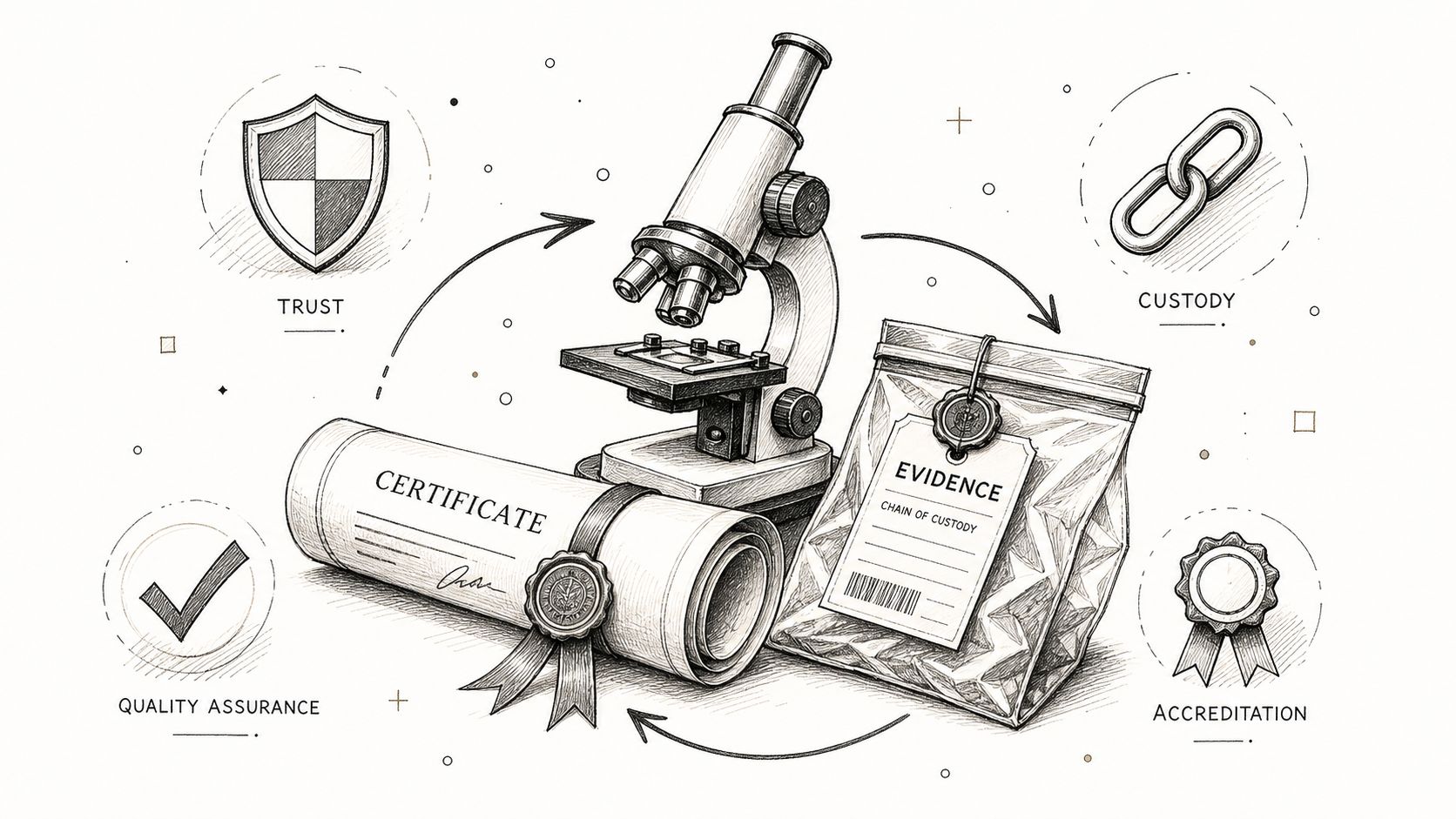
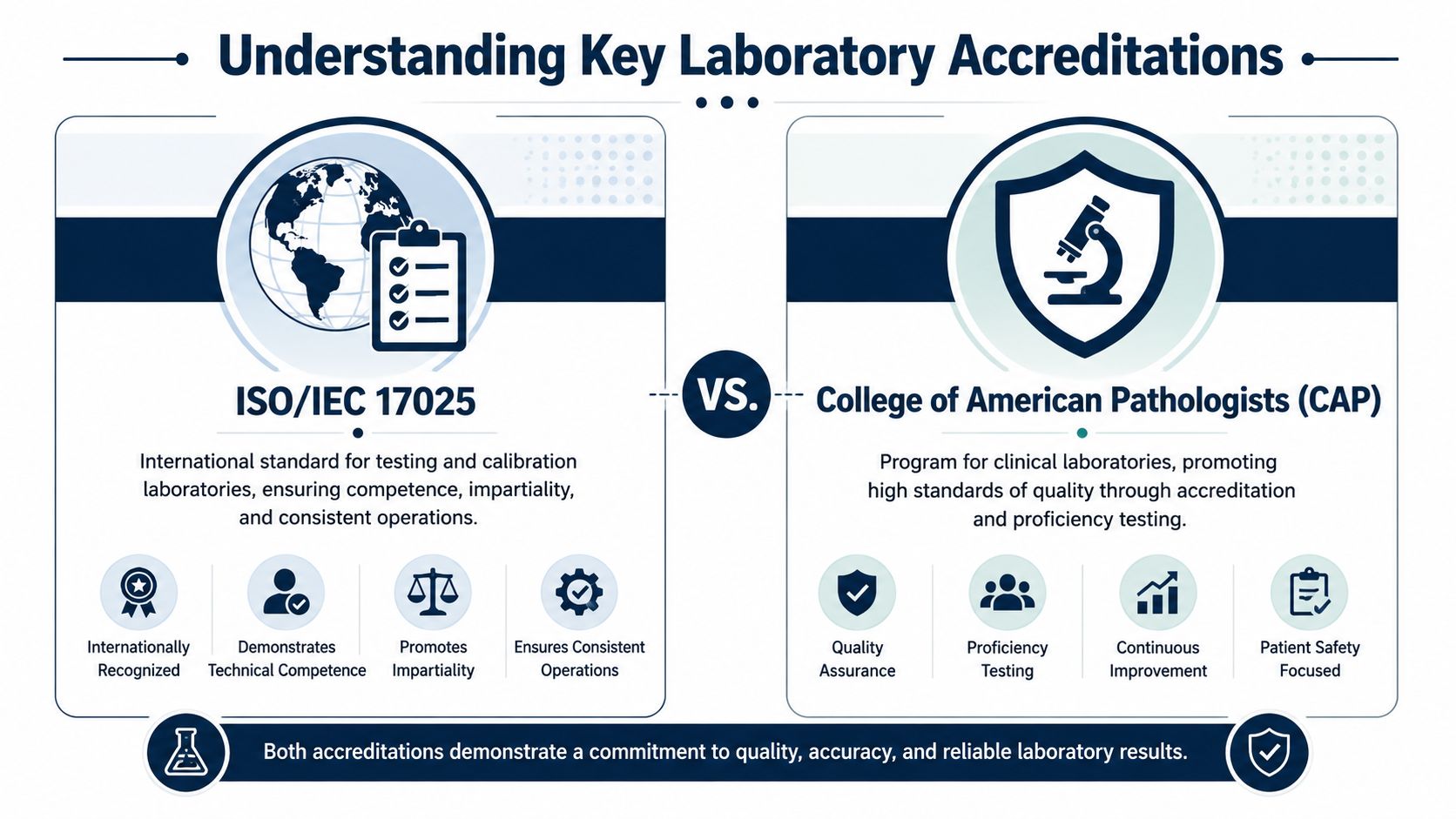
The names can sound interchangeable at first, but they serve different purposes. ISO/IEC 17025 is the international benchmark for testing and calibration laboratories. CAP focuses on clinical laboratory quality, and NAME sets expectations for medicolegal death investigation offices. Those labels matter because they tell you what kind of system is being measured and what type of work it is designed to support.
ISO/IEC 17025 and why competence matters
ISO/IEC 17025, first published in 1999, is widely recognized as the international standard for the technical competence of testing and calibration laboratories historical scope and role of ISO/IEC 17025. Under the 2017 version, laboratories must prove competence, impartiality, and consistent operation, not just say they have a quality system ISO/IEC 17025:2017 requirements.
In plain language, that means the lab has to show its work. Methods must be validated, equipment must be calibrated, measurement uncertainty must be estimated, and technical records must be complete. When those pieces are in place, results are more reliable and easier to compare across facilities and markets.
CAP and NAME in plain English
CAP accreditation is built around laboratory excellence in the clinical setting, where patient testing and quality oversight are tightly linked. NAME accreditation addresses the whole medicolegal death investigation office, not just the test bench. That broader focus matters because death investigations depend on people, procedures, and documentation as much as they depend on analytic instruments.
A useful way to think about it is this. ISO/IEC 17025 tells you whether a testing laboratory can prove technical competence. CAP looks at the quality of a clinical lab's operations. NAME examines whether a medicolegal death investigation system is organized and dependable enough for the work it does.
For readers trying to compare standards, the key is not the acronym. It's the function. You want to know whether the system can produce results that are technically sound, reproducible, and defensible in high-impact scenarios.
Our earlier laboratory accreditation overview provides additional background on how these frameworks are used in practice.
A laboratory standard is not a badge on the wall. It's a set of rules that should be visible in every result the lab reports.
The Pillars of Quality Assurance in Our Practice
Reliable work doesn't happen by accident. It comes from repeated checks that make it harder for a weak result to slip through. In forensic terms, that means quality assurance is the structure, and quality control is the day-to-day testing that tells you whether the structure is still sound.

The checks that keep a method honest
One of the clearest benchmarks is proficiency testing. That means a laboratory's methods are checked against external samples or known challenges so performance can be compared with an outside standard. It helps confirm that the method works outside the comfort of an internal routine.
Method validation is different. Validation asks whether a specific method is suitable for its intended use before it's applied in a case. A test can be technically impressive and still be the wrong tool for a particular specimen or question, which is why suitability matters as much as accuracy.
Documentation is part of the evidence
Records are not paperwork for its own sake. They're the trail that shows what happened, when it happened, and who handled it. Equipment calibration, specimen handling, analyst review, and result reporting all need to be documented so the final report has a clear foundation.
For families and attorneys, that matters because a report without a traceable record is much harder to trust. For courts, it matters because the report has to explain not just what was found, but how the finding was reached. The same logic applies to secure electronic records, where signature integrity and auditability support credibility. For a practical overview of that issue, secure electronic signature tips can be helpful background.
Our specimen preservation overview shows how careful handling supports later review and testing.
Bottom line: a defensible result depends on a documented process, not a single instrument reading.
Quality also depends on consistency across the team. If one step is missing or loosely recorded, the entire chain of reasoning becomes weaker. That's why strong laboratories treat records, calibration, and review as part of the science, not as administrative extras.
Protecting Evidence Integrity with Chain of Custody
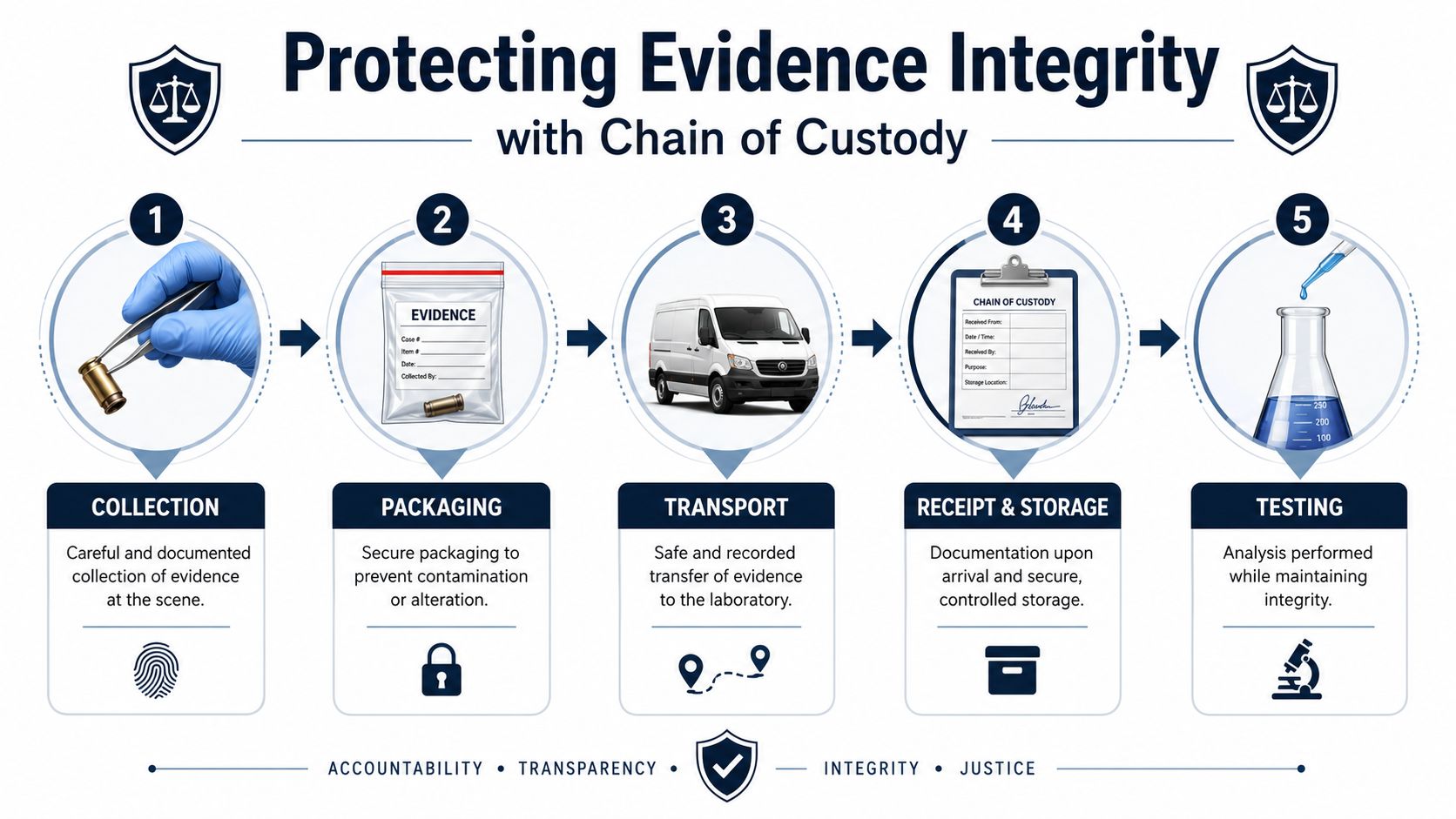
The pre-analytical phase is where many problems begin. Regulatory standards emphasize collection, labeling, transport, and storage because errors there can invalidate downstream testing, even when the analyzer itself is working correctly pre-analytical control and specimen handling requirements. In forensic work, that is why chain of custody is not a formality. It is part of the evidence itself.
The journey from specimen to result
The first step is collection, where the sample has to be gathered carefully and documented at the point of origin. The next step is packaging, which protects the sample from contamination or alteration. After that comes transport, where the transfer must be recorded so the location and custody of the evidence remain clear.
Once the specimen arrives, receipt and storage create another checkpoint. The sample should be logged, secured, and kept under controlled conditions until testing begins. Only then does testing take place, with the laboratory preserving the integrity of the sample throughout the process.
Why custody records matter in legal settings
A chain of custody answer has to be concrete. Who handled the sample? When did that happen? Was the sample sealed? Was it stored properly? Those are not small questions, because they tell the court whether the evidence is what it claims to be.
For readers comparing systems, the issue is similar to any record-based workflow where transfer matters. Resources on ITAD chain of custody records make the same point in a different industry, traceability protects trust. In death investigation, the potential repercussions are more severe because the sample may influence a cause of death determination, a claim dispute, or a legal proceeding.
Our chain of custody procedures overview gives more detail on how controlled transfer supports evidentiary reliability.
The practical result is simple. When custody is documented from the start, later questions about contamination or misidentification are easier to answer, and the findings are more likely to remain credible.
What Rigorous Standards Mean for Families and Attorneys
For a family, strict standards mean the conclusion was reached carefully, with no shortcuts in the handling of the case. A cause of death is the medical reason a person died. The manner of death is the broader classification, such as natural, accident, homicide, suicide, or undetermined. Clear standards keep those two ideas separate, so the report answers the right question.
For an attorney, the value is different but equally important. A report built on validated methods, documented handling, and complete records is easier to review, challenge, and defend. In court, the process behind the report often matters as much as the final wording, because the reasoning has to hold up under scrutiny.
Questions to ask any autopsy provider
A few direct questions help families and attorneys judge whether a provider takes standards seriously. They also make it easier to tell the difference between a polished report and a defensible one.
- Who performs the examination? Ask whether every examination is performed by a board-certified forensic pathologist certified by the American Board of Pathology.
- How is chain of custody preserved? Ask how specimens are labeled, transported, stored, and documented from start to finish.
- What records are kept? Ask whether equipment calibration, handling notes, and testing steps are documented in a way that can be reviewed later.
- How are competency issues addressed? Accreditation findings show that deficiencies often cluster around personnel competency, proficiency testing, and documentation, not just the test itself.
- How are special range checks handled? In some regulated settings, extra materials are used to confirm that reported values stay credible across a method's reportable range.
The details matter because they show whether the result is traceable. A clean-looking report can still leave questions if the underlying work was not documented well. A careful provider should be able to explain who did each step, how the sample was protected, and how the final result was checked before release.
Why this matters for Texas cases
In Texas, the same standards support work done for families, attorneys, and county officials who need dependable forensic findings. For those seeking County Forensic Autopsies, the key issue is not only whether a body was examined. It is whether the process was careful enough to support decisions that may affect legal rights, benefits, or public records.
A strong system does not promise a particular outcome. It promises a process that can be examined objectively, much like a well-kept case file that lets another professional follow the path from specimen to conclusion. That is what gives a final report weight.
Frequently Asked Questions About Our Standards
A family may receive a report that looks complete on the page and still wonder what stood behind it. These questions answer the parts that matter most, because laboratory testing standards are not abstract rules. They are the safeguards that help a result hold up under review, whether the review comes from a grieving family, an attorney, or a court.
| Question | Answer |
|---|---|
| What do laboratory testing standards actually protect? | They protect the reliability of the result by requiring competent methods, calibrated equipment, documented handling, and records that can be reviewed later. In a cause of death investigation, that means the conclusion rests on work that can be traced step by step. |
| Why does chain of custody matter so much? | The sample has to remain the same sample from collection through testing. If the trail is unclear, anyone reviewing the case has a reason to question whether the result still belongs to the specimen that was collected. |
| Does a good analyzer guarantee a good result? | No. A reliable instrument is only one part of the process. Problems often arise from personnel competency, proficiency testing, and documentation, which is why accreditation reviews commonly find issues in those areas rather than only in the machine itself. |
| What should families ask before choosing an autopsy provider? | Ask who performs the examination, how custody is preserved, and whether the report is built from documented, defensible methods. Those questions help show whether the findings can be trusted if the case is later reviewed. |
| Are these standards only for large institutions? | No. The same principles apply anywhere a result may be examined later, including private autopsy work, medicolegal cases, and county investigations. The size of the office does not change the need for careful records and defensible methods. |
A strong report is not just a final answer. It is a record that shows how the answer was reached, much like a case file that lets another professional follow the path from specimen to conclusion. That is what gives the work value for families who need clarity and for attorneys who need a record that can be defended.
When a death raises hard questions, families deserve clear answers and attorneys deserve records they can evaluate with confidence. If you need help understanding the standards behind an autopsy report or want to discuss a case with our team, please reach out to Texas Autopsy Services.