October 23, 2026 · Texas Autopsy Services
Forensic Genetic Testing Explained for Families
Forensic genetic testing explained for families, attorneys, and Texas officials. Learn test types, sample handling, limits, and how private autopsy labs use
On this page
- What Forensic Genetic Testing Is and When It Matters
- The Main Types of Forensic DNA Tests
- How Samples Are Collected and Handled
- Why a DNA Result Is a Probability Not a Certainty
- How Private Autopsy and Second-Opinion Workflows Use DNA Testing
- Texas Legal Rules and Confidentiality Protections
- Questions to Ask Before You Authorize Testing
- What Genetic Testing Can and Cannot Prove
You may be arranging an autopsy after a medical examiner declined the case, while an attorney asks whether DNA testing could answer a question the family still has. We understand that another test can sound like another promise. Before collecting a specimen, we first need to identify the question, determine whether genetics can address it, and explain what an uncertain result would mean.
- DNA testing answers specific questions. It can support identification or biological relationship analysis, but it doesn't independently establish how someone died.
- The test must fit the evidence. Sample condition, available relatives, and the investigative purpose guide laboratory selection.
- Documentation matters. A defensible interpretation depends on specimen handling as well as the genetic findings.
- A lead isn't proof. Database associations and genealogical findings require appropriate confirmation.
- An inconclusive result has limits. It doesn't necessarily rule out a biological relationship.
What Forensic Genetic Testing Is and When It Matters
Consider a representative situation, not a reported case: a family seeks an independent autopsy after learning that the medical examiner won't perform an examination. Their attorney also wants to know whether retained biological material could resolve an identity question. Those concerns belong in the same conversation, but they require different kinds of evidence.
Forensic genetic testing is the analysis of biological material for legal or investigative purposes. In a death investigation, it may help establish identity, evaluate a biological relationship, or compare specimens. It isn't a substitute for examining the body, reviewing medical records, or evaluating the circumstances of death.
The following overview separates its main applications.
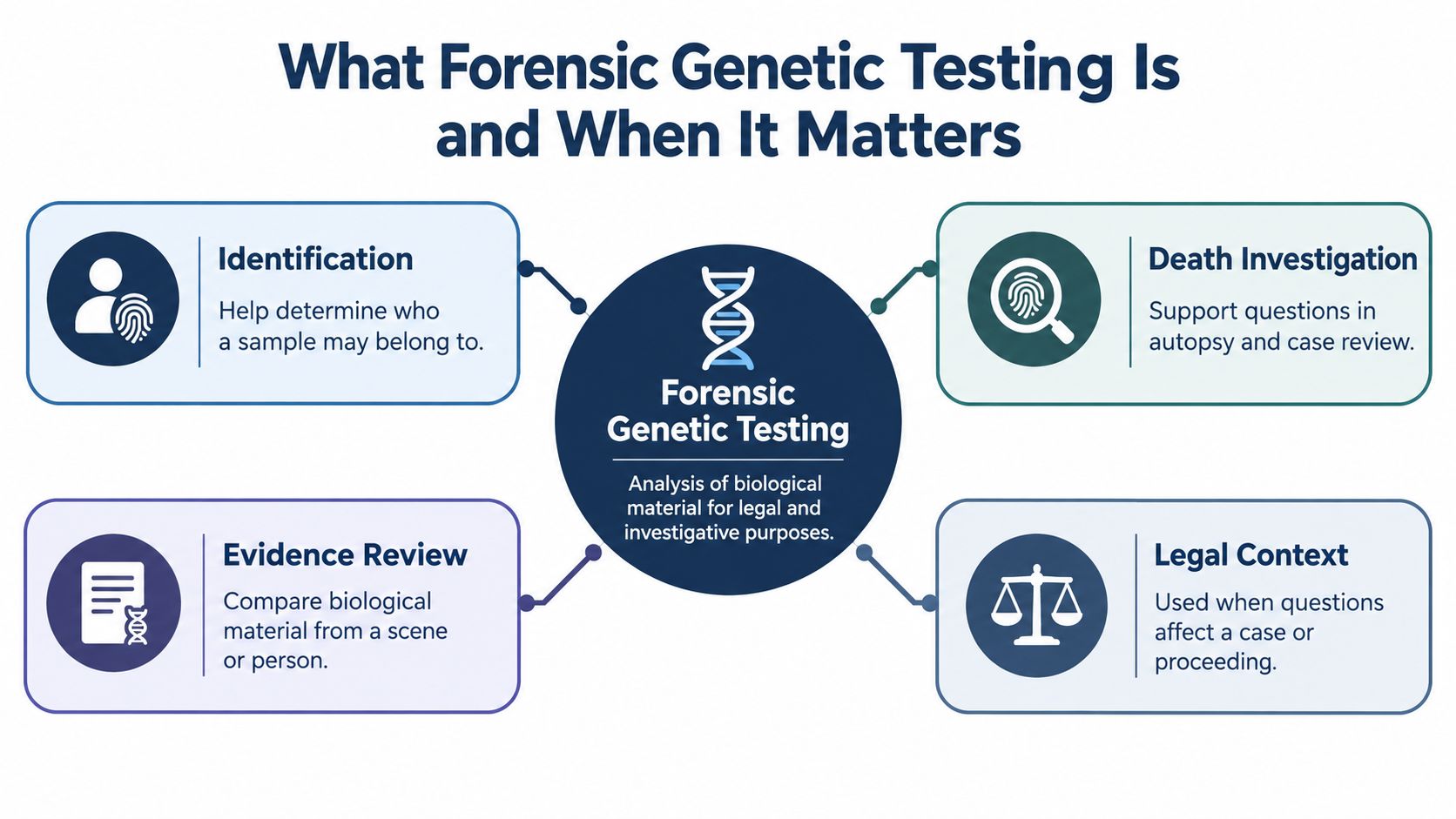
How identification differs from explaining a death
Cause of death means the disease or injury responsible for death. Manner of death describes the classification of the circumstances surrounding it. Establishing whose biological material was recovered doesn't, by itself, establish either conclusion.
For example, comparing unidentified remains with an appropriate family reference sample addresses identity. Determining whether an injury caused death requires pathology findings and case context. We keep those questions separate so a useful genetic finding isn't asked to support a conclusion beyond its scope.
Practical rule: State the question before selecting the test. An identification test and a medical investigation aren't interchangeable.
How the field developed
DNA fingerprinting was first applied in March 1985 to an immigration case, rather than a criminal prosecution. Its investigative use expanded through short tandem repeat profiling and standardized comparison systems; the DNA Identification Act of 1994 authorized the FBI's national identification index, as described in this history of forensic DNA analysis.
Today, questions involving unidentified remains, disputed parentage, or an unresolved issue in a prior autopsy report may justify considering testing. We begin by reviewing what evidence already exists and what additional finding would meaningfully change the investigation.
The Main Types of Forensic DNA Tests
A laboratory report should identify which genetic markers were examined and why that method fits the question. Different tests compare different parts of inherited DNA. They don't provide interchangeable answers.
Autosomal short tandem repeat testing, usually called STR profiling, examines variable repeated regions of DNA. Modern forensic databases generally use 20 core loci, or designated genomic locations, and a complete single-source profile can be highly discriminating. However, completeness, mixtures, degradation, and contamination affect interpretation, as the Federal Judicial Center's explanation of forensic DNA databases emphasizes.
Forensic DNA Test Types and What Each One Answers
| Test type | What it measures | Best sample | Question it answers |
|---|---|---|---|
| Autosomal STR | Repeated DNA regions inherited from both parents | A well-preserved, single-source specimen when available | How strongly does the evidence support a common source or proposed relationship? |
| Y-chromosome STR | Markers associated with the paternal line | Material containing suitable male DNA | Is a paternal-line association supported? |
| Mitochondrial DNA | DNA inherited through the maternal line | Material selected by the laboratory, including some degraded bone or hair specimens | Is a maternal-line association supported? |
| SNP-based testing | Single-letter DNA differences across selected genomic locations | Material meeting the selected panel's quality requirements | Can broader genetic comparisons support kinship research or a genealogical lead? |
“Best sample” isn't a universal laboratory instruction. The testing laboratory must evaluate the actual specimen before deciding whether it can support the proposed method.
Why a lineage association needs careful wording
Y-chromosome testing can assist when paternal relatives are available or when a mixture presents a male-DNA question. Mitochondrial testing can assist with maternal-line comparisons and certain degraded specimens. Because these approaches follow family lines, their interpretation must account for shared ancestry rather than imply that the finding uniquely names a person.
Single nucleotide polymorphism testing, or SNP testing, includes the dense marker approaches used in forensic genetic genealogy. It addresses a different comparison problem from routine STR database searching.
We recommend asking the laboratory to explain its choice in ordinary language: what it will measure, which comparison specimen it needs, and what conclusion remains unavailable even if testing succeeds.
How Samples Are Collected and Handled
A specimen's value depends partly on whether an independent reviewer can reconstruct what happened to it. Chain of custody is the documented record of who collected, possessed, transferred, and received a specimen, including relevant dates and handling conditions. A gap can make it harder to establish that the reported result belongs to the intended evidence.
Collection may involve blood, a buccal swab from inside the cheek, tissue, bone, or hair. We select material according to the investigative question and laboratory requirements rather than assuming every specimen will work equally well.
The handling sequence should remain traceable from collection to analysis.
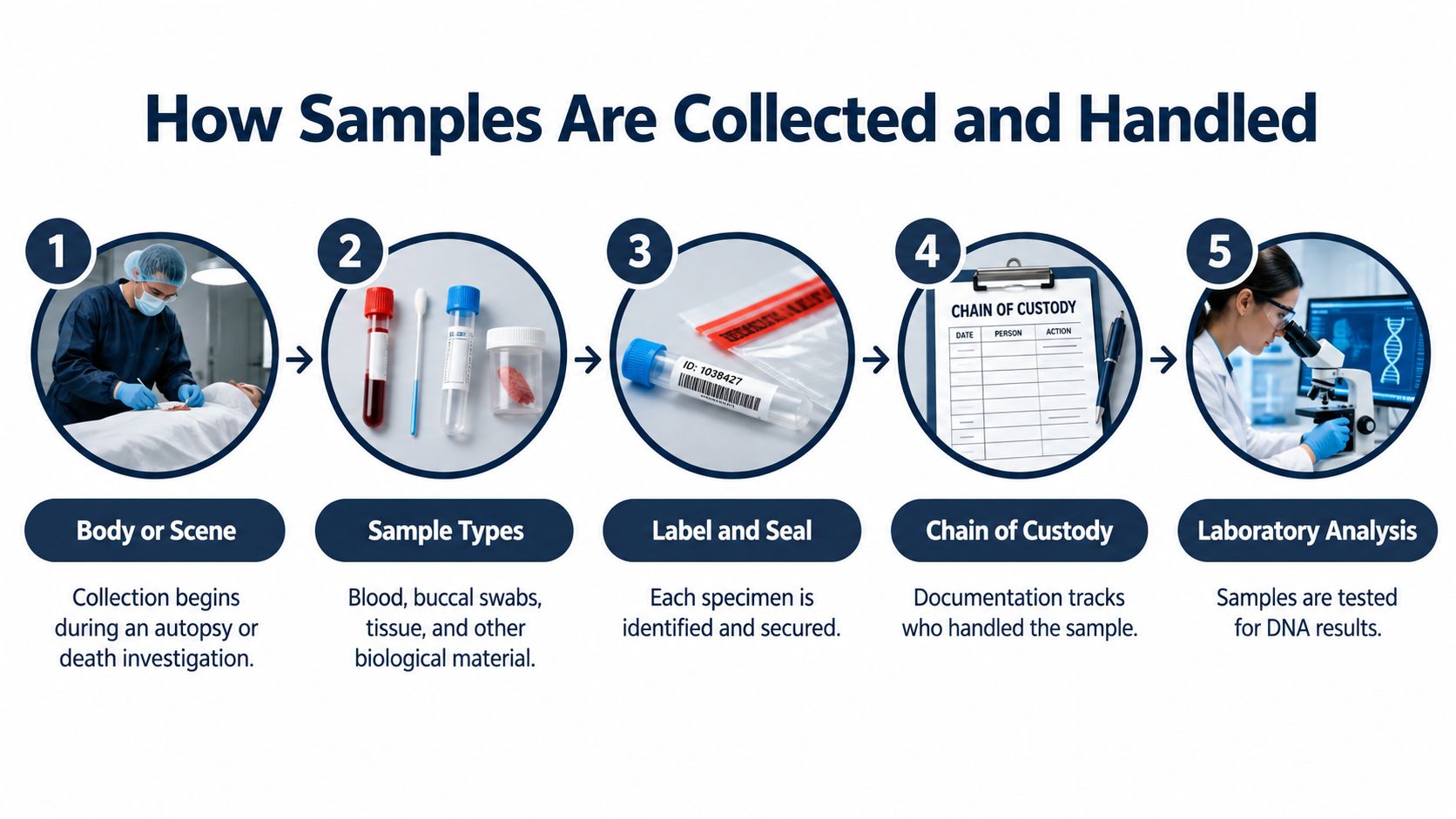
What the record should document
- Collection and identification: Record the anatomical source, collector, specimen label, and collection conditions.
- Packaging and transfer: Secure the material and document each handoff, including transport arrangements.
- Storage: Follow specimen-specific preservation and temperature requirements, with records that permit review.
- Laboratory receipt: Reconcile identifiers, assess specimen condition, and document acceptance or limitations.
- Retention: Establish what biological material and raw analytical data will remain available.
Our explanation of specimen collection procedures provides additional context for discussing these arrangements. Keeping separate specimens can preserve options if a molecular finding later conflicts with pathology or toxicology.
A retained record isn't always a retained specimen
Under Texas Government Code Section 411.142, a sample collected solely to create a DNA record may be destroyed after the results enter the relevant state and CODIS databases. Families and counsel should therefore ask about retention before assuming material will remain available for retesting.
Hair testing also requires careful terminology. A request to investigate drug exposure isn't the same as a request to identify a biological source. For families facing a separate child-protection issue, the Law Office of Bryan Fagan PLLC's resource on Texas CPS hair follicle testing addresses that distinct legal context, not postmortem DNA identification.
Why a DNA Result Is a Probability Not a Certainty
A laboratory evaluates the strength of genetic evidence under stated assumptions. It doesn't look at a graph and declare an absolute identity. Statistical interpretation becomes especially important when evidence contains little DNA or contributions from several people.
The laboratory's analytical display is part of the evidence that reviewers need to understand.
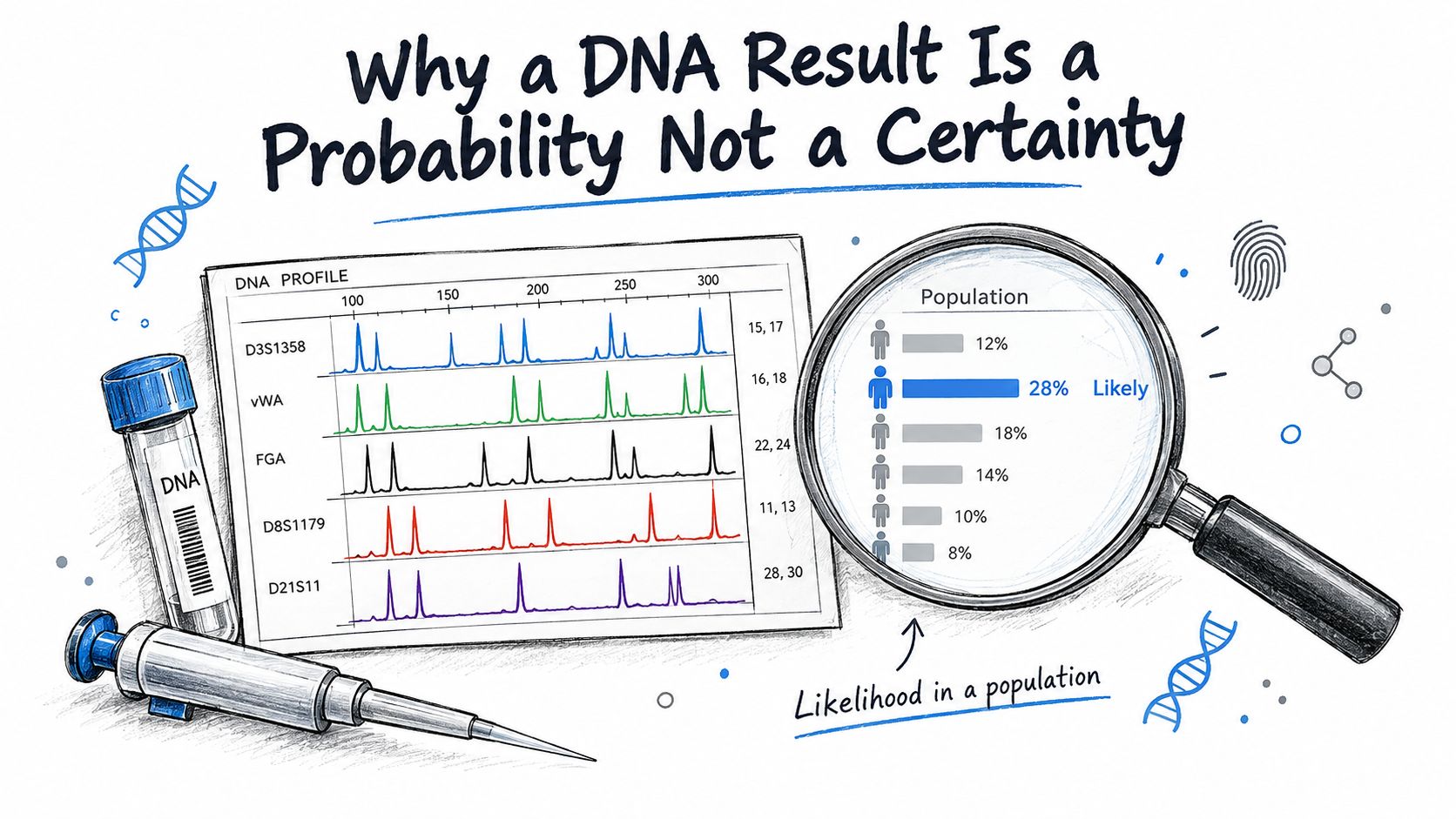
What makes interpretation difficult
Degradation can leave an incomplete profile. In low-template testing, PCR amplification may randomly fail to detect an allele, a version of a genetic marker. This allelic drop-out can make the observed result look simpler than the underlying biological material is.
For complex or low-level mixtures, probabilistic genotyping evaluates competing propositions using a likelihood ratio. For example, the model may compare a proposition that includes a person of interest as a contributor against one involving an unrelated contributor. It considers allele frequencies, contributor number, peak-height variation, drop-out, drop-in, degradation, and laboratory artifacts.
NIST's scientific review of DNA mixture interpretation identifies probabilistic genotyping as the best available tool for mixture interpretation at the sub-source level, meaning questions about whose DNA contributed. It also stresses case-dependent performance, validation with comparable known samples, and explicit assumptions.
A likelihood ratio compares explanations for the genetic findings. It isn't the probability that a person is guilty.
For additional visual context, the following video can accompany a discussion with the interpreting laboratory.
What counsel should request
- Raw analytical evidence: Electropherograms, the instrument-generated displays of detected genetic markers.
- Interpretive settings: Contributor assumptions, analytical and stochastic thresholds, and the population database.
- Method support: Validation studies and sensitivity analyses showing how assumptions affect the conclusion.
A numerical result without that foundation is difficult to assess independently. Our discussion of reasonable medical certainty addresses a related reporting issue: the language of a conclusion must remain consistent with the evidence supporting it.
How Private Autopsy and Second-Opinion Workflows Use DNA Testing
A family receives an autopsy report that explains the mechanism of death but leaves a harder question open, or an attorney reads a report and suspects the original examination never tested the evidence that mattered. Which path forward exists depends on three things: who holds jurisdiction over the case, what question remains unanswered, and what material is still available to test. Genetic analysis can support any of these routes, but it does not determine which authority controls the investigation.
| Pathway | Who initiates it | Purpose and place of DNA testing |
|---|---|---|
| County medical examiner or justice of the peace pathway | The responsible public authority | Supports the official death investigation, with testing selected for its needs |
| Private autopsy | A family or attorney, subject to appropriate authorization | Provides an independent examination; genetic comparisons may address a defined unresolved question |
| Second-opinion review | A family, attorney, agency, or other authorized requester | Evaluates existing reports and records; additional testing depends on suitable retained material |
A second-opinion review does not always involve another physical examination. Reviewing existing reports, photographs, slides, and retained specimens can be enough to evaluate whether the original conclusions were supported, and we explain that scope before arranging work. Our Private Autopsies and County Forensic Autopsies pages describe how each setting operates.
The diagram below summarizes the available pathways.
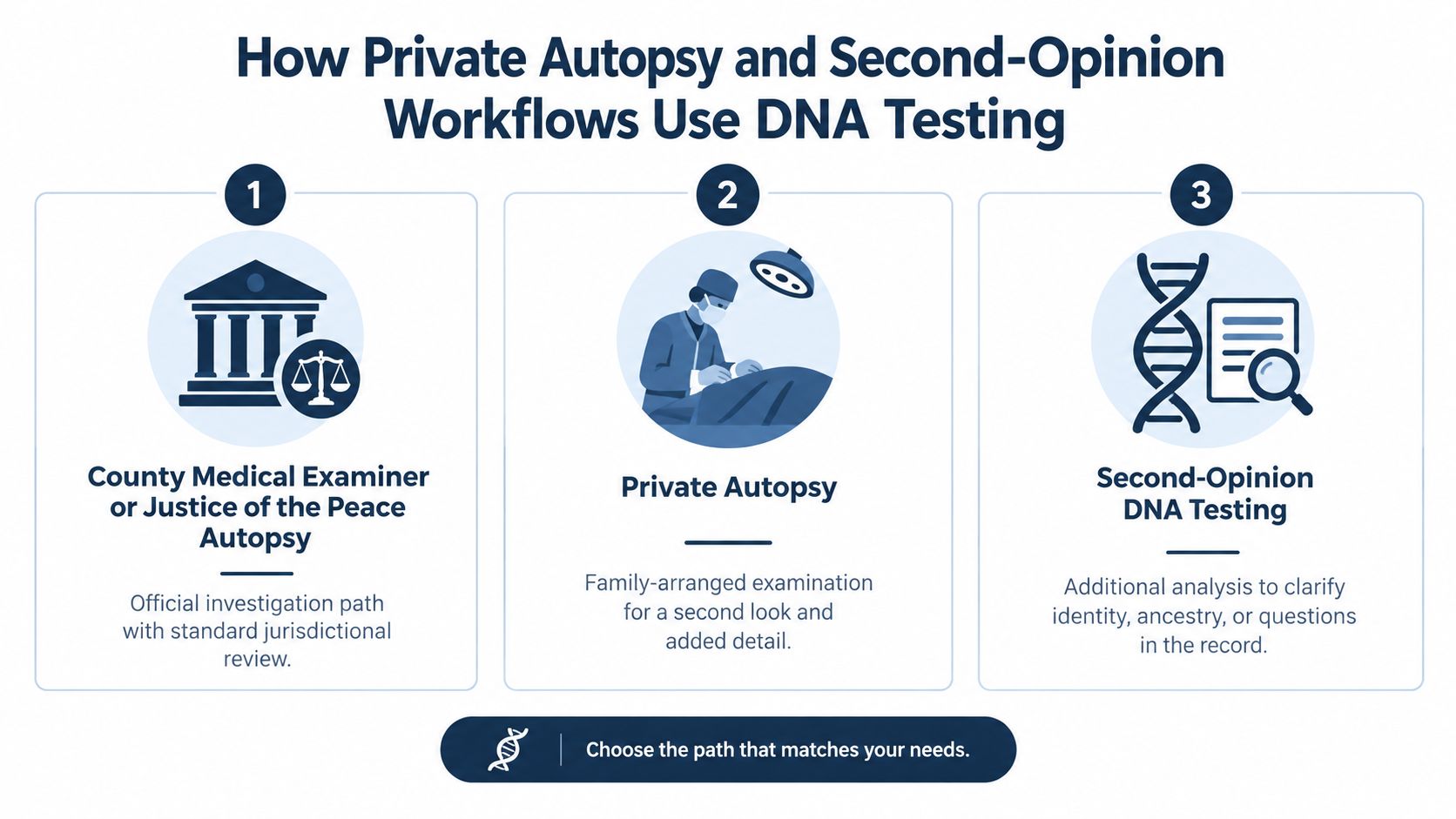
What our team coordinates
From our Elgin, Texas facility, we serve Central Texas and all 254 Texas counties statewide. Every examination is performed by a forensic pathologist certified by the American Board of Pathology.
A case can involve in-house licensed transport, secure temperature-controlled storage, digital imaging, toxicology, molecular testing arrangements, and HIPAA-compliant reporting with full chain of custody. Families and attorneys speak directly with our team rather than through a call center, and the Waterloo Mortuary Partnership provides additional pathology-service context.
Independence means no predetermined answer
We don't select tests to support a preferred allegation or family expectation. We assess whether the available evidence can address the stated concern and report limitations alongside findings.
That discipline matters because of how DNA output functions inside a case. A match to a reference sample, a database hit, or a lead developed through genealogical comparison is an investigative step that strengthens or weakens a hypothesis. None of those results, standing alone, constitutes proof. The reverse holds as well: a negative or inconclusive comparison can reflect degraded material, an unsuitable reference sample, or mixture complexity, so it does not automatically exclude the biological relationship being tested.
A forensic pathology expert may also conclude that further testing isn't justified or that retained material can't answer the question. That remains a useful professional conclusion when it prevents unnecessary testing or an unsupported interpretation.
Texas Legal Rules and Confidentiality Protections
A family that commissions private forensic genetic testing usually asks the same question first: who else gets to see this? Texas law draws a clear line between the state's DNA database and a privately commissioned report, and that line is worth understanding before anyone signs an authorization.
Texas maintains a DNA database built to classify, match, and store DNA-analysis results in a system compatible with the FBI's Combined DNA Index System, or CODIS. Eligible records include legally obtained crime-scene material, court-ordered testing, specimens from certain legally designated individuals, and a close biological relative's record when that relative is connected to a person reported missing to law enforcement. A genetic test a family pays for privately does not automatically enter that system. The report belongs to the person who authorized the work, and database submission would require separate legal authority, not just the existence of a result.
Searchable doesn't mean publicly available
Texas Government Code Section 411.153 excludes state database DNA records from disclosure under the Texas Public Information Act, and knowingly disclosing a DNA record or related analysis information to an unauthorized recipient is a state-jail felony.
Your private report sits outside that framework entirely. Its confidentiality depends on the consent form and release instructions you sign rather than on a database statute. Naming the intended recipients in writing, whether that is counsel, a specific relative, or no one beyond yourself, is the most direct way to control who reads the findings.
The same discipline applies wherever sensitive records are handled. IamVera.AI's discussion of verifying AI without compromising professional secrecy examines how systems can be checked without exposing confidential material, and the underlying caution carries over to forensic files: identifiable specimens and reports shouldn't move into outside platforms without authorization.
Familial searching and investigative boundaries
A familial search works from a relationship signal rather than an exact-profile match, which makes it an investigative lead rather than proof of identity. The National Institute of Justice's survey of familial-searching practices documents how differently jurisdictions regulate the procedure, so identifying which method produced a hit matters before anyone treats it as a conclusion. An absent or inconclusive database result likewise says nothing definitive about whether a biological relationship exists.
This discussion is educational, not legal advice. Counsel should assess the authorization and disclosure rules governing the particular case.
Questions to Ask Before You Authorize Testing
A useful authorization conversation ends with a written testing plan, not merely agreement to “run DNA.” We encourage families and attorneys to ask for the proposed question, laboratory method, specimen requirements, and reporting limits before consenting.
Bring the following checklist to a provider offering private autopsy services Texas families can access, or to the laboratory reviewing an existing specimen.
A practical authorization checklist
- Which test will be performed, and why? Ask how the selected method addresses the unresolved issue rather than producing more genetic information.
- What material is needed? Confirm whether existing specimens are suitable and whether a relative must provide a reference sample.
- How will the specimen be preserved? Request the storage plan, transfer documentation, and arrangements for retaining separate material.
- Who may access the findings? Identify intended recipients and whether any database submission is proposed.
- What will remain available afterward? Ask about specimen destruction, raw data retention, and access for an independent reviewer.
- How will uncertainty be reported? Request a plain-language explanation of the proposed comparison and possible inconclusive outcomes.
Laboratory qualifications also deserve attention. Our guide to laboratory accreditation standards can support that discussion, but accreditation alone shouldn't replace review of the particular method and its validation.
Before signing: Ask the provider to distinguish the examination schedule from the laboratory reporting schedule.
Timing and cost need separate explanations
Our examination scheduling guidance is most cases within 24–48 hours, subject to case circumstances. That isn't a promise that genetic analysis, toxicology, or the final report will be finished in that interval.
Testing turnaround depends on the method, specimen quality, additional review, and whether comparison material must be obtained. We explain those factors directly rather than offer an unconditional completion date.
Our practice uses flat-rate, all-inclusive pricing. Before authorizing work, request a written scope explaining how proposed molecular testing and any outside laboratory arrangements fit within that agreement.
For families searching “autopsy near me,” proximity is only part of the decision. Direct communication, documented handling, and an understandable report matter when the evidence may later need independent review.
What Genetic Testing Can and Cannot Prove
A database hit indicates that profiles correspond under a system's comparison criteria. Investigators must still assess specimen identity, lawful collection, laboratory quality, contamination controls, transfer history, and independent case evidence before deciding what that association means.
The scale of these systems doesn't change that boundary. As of April 2025, NDIS contained more than 18,431,162 convicted-offender profiles, 5,879,537 arrestee profiles, and 1,410,503 forensic profiles, according to the FBI's CODIS and NDIS statistics. Those are comparison resources, not automatic findings of responsibility.
A genealogical lead requires confirmation
Forensic genetic genealogy combines genetic associations with family research to identify possible relatives and investigative candidates. A NIST research-needs analysis of forensic genealogy identifies validation and transparency concerns that matter when evaluating those leads.
A genealogical lead isn't proof of identity or guilt. Appropriate independent confirmation, such as validated comparison with a suitable reference specimen, remains necessary.
Brief questions from families and attorneys
Does an inconclusive result exclude a relationship?
No. Degraded DNA, absent relatives, or limited reference resources may prevent a useful conclusion.
Does database representation affect the chance of finding relatives?
Yes. Research addressing forensic genealogy, privacy, and population representation describes disproportionate European American representation and implications for investigative visibility.
Does a relative's consent resolve everyone's privacy concerns?
No. Genetic information is relational, so an individual's participation can reveal information about relatives who never consented, including unexpected family relationships.
Can DNA findings establish cause of death on their own?
An identification association cannot. Our pathologists interpret molecular findings within the postmortem examination and the broader cause of death investigation, without extending the conclusion beyond what the evidence supports.
Texas Autopsy Services offers independent autopsies, second-opinion reviews, and coordination of postmortem molecular testing when a defined question warrants it. Families, attorneys, and county officials can call (806) 230-1889 or visit Texas Autopsy Services to discuss available records, specimen options, and whether testing is appropriate, without a promise of a particular finding.