July 22, 2026 · Texas Autopsy Services
Laboratory Accreditation Standards Explained
Learn why laboratory accreditation standards matter in autopsy and forensic testing and how to verify a lab’s accreditation and quality assurance steps.
On this page
A family gets a toxicology report that doesn't match what they were told at the hospital. An attorney sees two lab summaries that seem to point in different directions. A county official needs a test result that will stand up under review, but the paper trail isn't clear. In each case, the first question isn't only what the result says. It's whether the laboratory followed laboratory accreditation standards that make the work traceable, defensible, and suitable for the setting it was used in.
Summary
- Accreditation means an independent body has assessed a lab against a defined standard, but it doesn't mean every result is automatically perfect.
- Different standards apply to different settings, including ISO/IEC 17025, ISO 15189, CLIA, and CAP-style laboratory programs.
- In forensic work, accreditation matters because method validation, quality control, and recordkeeping help protect the reliability of results.
- Families and attorneys can verify more than a certificate. They can check scope, dates, audit history, chain-of-custody records, and proficiency testing.
- A practical verification checklist helps separate a lab's formal status from its day-to-day competence.
Introduction to laboratory accreditation standards
A lab can have advanced equipment, polished reports, and a professional-looking certificate on the wall, yet still leave families with unanswered questions if its methods aren't clearly controlled. That's why accreditation matters. It gives outside review of whether the lab can do the work it says it can do, under a defined scope, with documented competence and traceable procedures.
In plain terms, laboratory accreditation standards are the rules and checks that tell a lab how to prove its technical competence. They're not the same as day-to-day licensing, and they're not the same as a regulator's enforcement power. Accreditation bodies assess the lab's system, while regulators oversee legal compliance in their own framework.
For many readers, the practical issue is trust. A second-opinion autopsy, a postmortem toxicology review, or a forensic DNA result may carry legal, clinical, or family consequences. The scale of regulated testing is large, too, as the CMS CLIA database contained more than 317,545 certified laboratory facilities in the U.S. as of March 2024, which shows how broad clinical oversight has become bio-reach.org.
Practical rule: Ask what standard the lab works under, then ask whether the specific test in question falls inside that scope.
For Texas readers, that question also sits alongside state law and professional practice rules. In a postmortem setting, accreditation supports the larger goal of clear, documented, and court-ready work, but it doesn't replace the legal requirements that govern autopsy handling, chain of custody, or disposition.
Overview of key accreditation standards
Different labs answer to different frameworks because the work they perform isn't all the same. A forensic toxicology lab, a hospital chemistry lab, and a medical reference lab won't always follow the same standard, even when they all claim quality control. The key is to match the standard to the work being done.
ISO/IEC 17025 for testing and calibration
ISO/IEC 17025 is the standard most often tied to testing and calibration competence. By March 2025, more than 114,600 laboratories were accredited under the ILAC Mutual Recognition Arrangement for ISO/IEC 17025, which shows how widely accepted this framework has become across markets and cross-border work intuitionlabs.ai. In forensic settings, this standard is especially important because it focuses on whether the method itself is technically defensible.
ISO 15189 for medical laboratories
ISO 15189 is designed for medical laboratories. It sits closer to patient care and clinical interpretation than a general testing standard. In practice, that means a hospital lab may use this framework to support consistency, quality systems, and competence in patient-facing results.
CLIA and CAP programs
In the United States, CLIA is a major federal oversight system for clinical testing. It sets baseline requirements for lab operation, personnel, quality, and patient testing. CAP checklists often go further in structured peer review and laboratory process review, so some medical labs use CAP programs alongside regulatory requirements.
| Standard | Scope | Applicable Labs | Key Focus |
|---|---|---|---|
| ISO/IEC 17025 | Testing, sampling, calibration | Forensic, environmental, industrial, reference testing | Technical competence, method validity, traceability |
| ISO 15189 | Medical laboratory services | Hospital and clinical laboratories | Quality, competence, medical reliability |
| CLIA | Clinical laboratory oversight | U.S. clinical labs | Federal compliance for patient testing |
| CAP programs | Laboratory inspection and checklist review | Many hospital and reference labs | Peer review, process consistency, quality systems |
For readers comparing regulatory frameworks, a plain-language overview of business regulatory guidance can help separate internal compliance from external accreditation, especially when multiple standards overlap.
Texas readers may also want to compare how professional guidance differs across forensic and clinical settings, so a related discussion in Texas Society of Pathologists can help frame why laboratories choose one route over another.
Why accreditation matters in autopsy and forensic testing
In forensic work, the result has to do more than look correct. It has to be built in a way that another qualified professional can review, test, and defend. That is why accreditation matters so much in autopsy pathology, toxicology, and DNA analysis.
Method control is the real issue
Forensic laboratories under ISO/IEC 17025 must fully validate each method in proportion to its impact on result validity, maintain documented quality-control procedures, and track reference materials scc-ccn.ca. That means a high-stakes assay isn't treated like a casual screening step. The lab has to show why the method works, how it's controlled, and where the supporting materials came from.
Chain of custody depends on traceable work
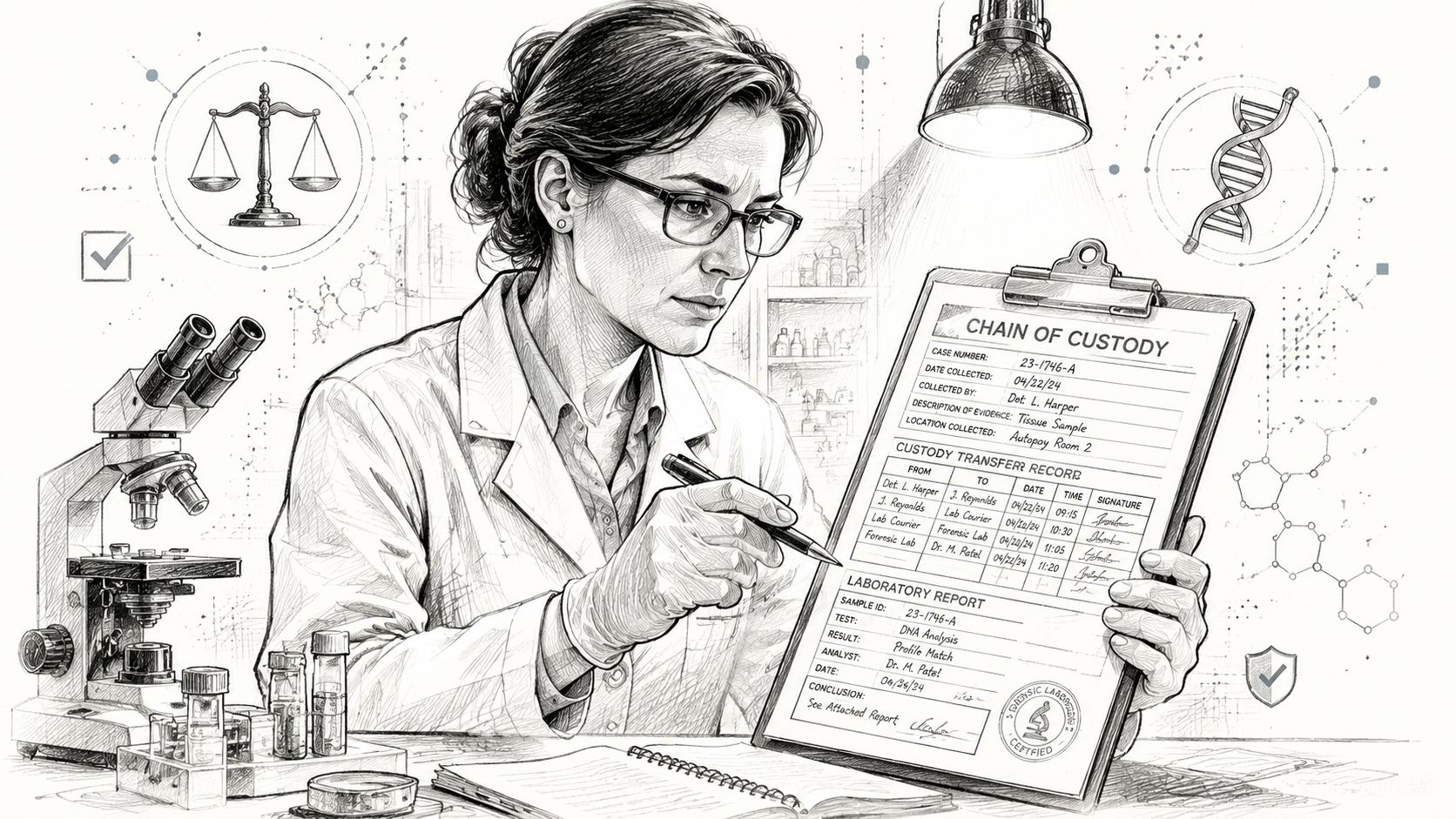
A forensic result loses force when the path from specimen to report is unclear. Chain of custody records, calibration logs, and documented review steps help show that the specimen handled in the lab is the same specimen described in the report. For families and attorneys, that traceability matters because it supports confidence in the final opinion and reduces disputes about how the evidence moved through the system.
A separate practical guide on forensic pathology labs can help readers see how lab controls connect to postmortem work in practice.
Accreditation doesn't promise a perfect answer. It requires the lab to prove its method, its controls, and its recordkeeping.
That distinction is easy to miss. A certificate shows the lab has been assessed. It does not mean every finding is beyond question. It means the lab has to work inside a quality system that makes errors easier to detect and harder to hide.
Typical accreditation process and ongoing requirements
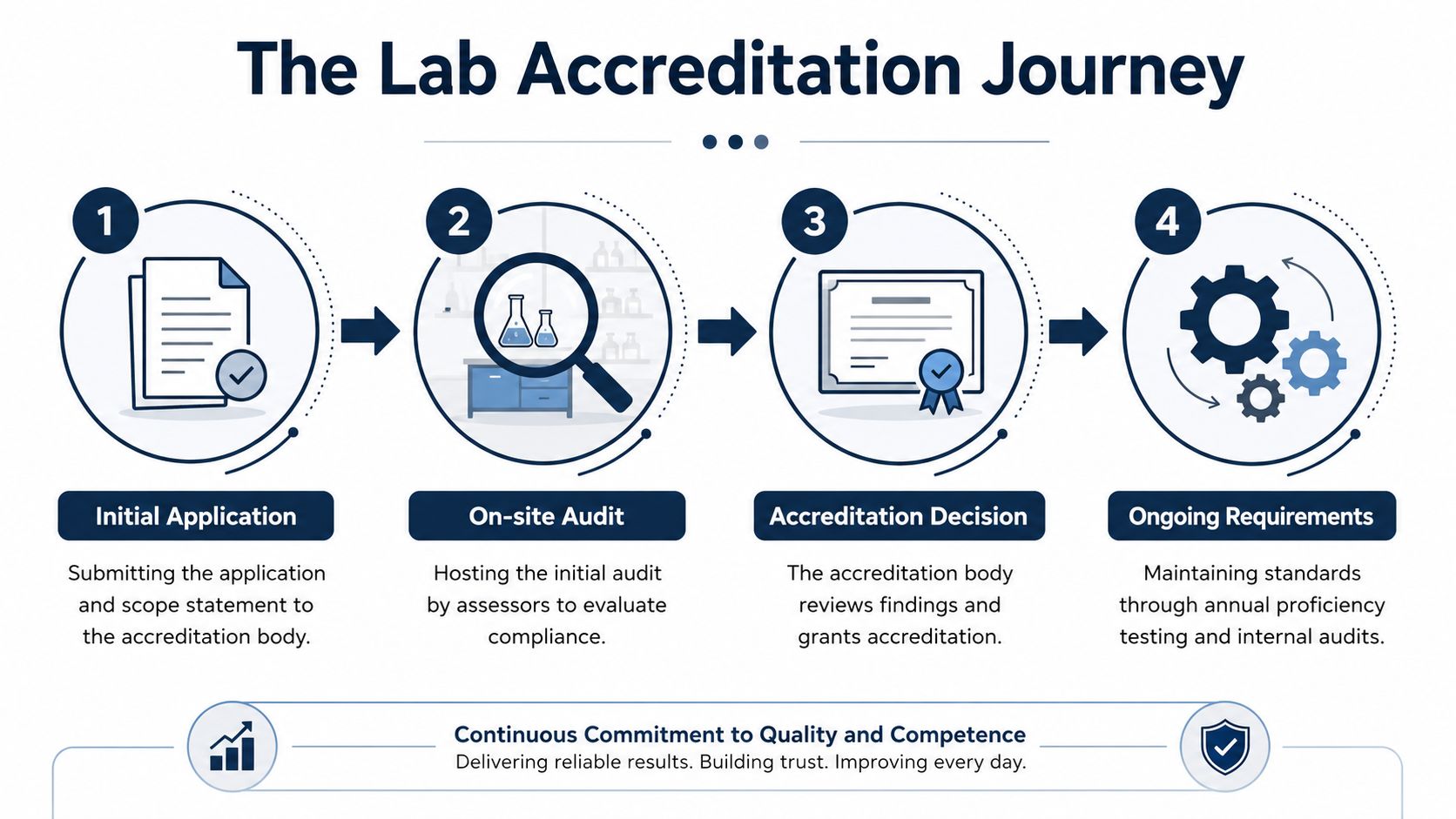
The accreditation path usually starts with a clear scope statement. A lab identifies what it wants to do, then submits evidence that it can do those tasks consistently. Assessors review documents first, then inspect the operation on site, then decide whether the lab meets the standard.
What ongoing review looks like
Accreditation isn't a one-time event. In forensic laboratory systems, accredited labs are expected to keep technical records for at least five years, participate in annual proficiency testing, and undergo external audits every two years for DNA functions cejsh.icm.edu.pl. Those requirements matter because ongoing review helps catch drift in method performance, equipment behavior, or analyst practice before it becomes a larger problem.
A concise process flow can help readers see the structure.
Documentation is part of competence
Accreditation also lives in the paperwork. Audit reports, corrective-action records, proficiency outcomes, and calibration histories all tell the story of whether the lab is still meeting its own obligations. That's why a resource on compliance documentation can be useful for readers who want to understand how formal review gets translated into records.
For healthcare and privacy-minded organizations, the same mindset appears in an essential HIPAA checklist for businesses, since record control and access discipline matter in both clinical and forensic settings.
Recordkeeping tip: If a lab can't produce the audit trail, the assurance behind the result gets weaker.
For specimen handling procedures that connect directly to this issue, readers can also review specimen collection procedures, because collection quality affects everything that follows.
Practical checklist for verifying lab accreditation
A certificate on the wall is a starting point, not the finish line. Families, attorneys, healthcare providers, and county officials can use a short checklist to see whether a lab's accreditation matches its real work in forensic and medical testing.
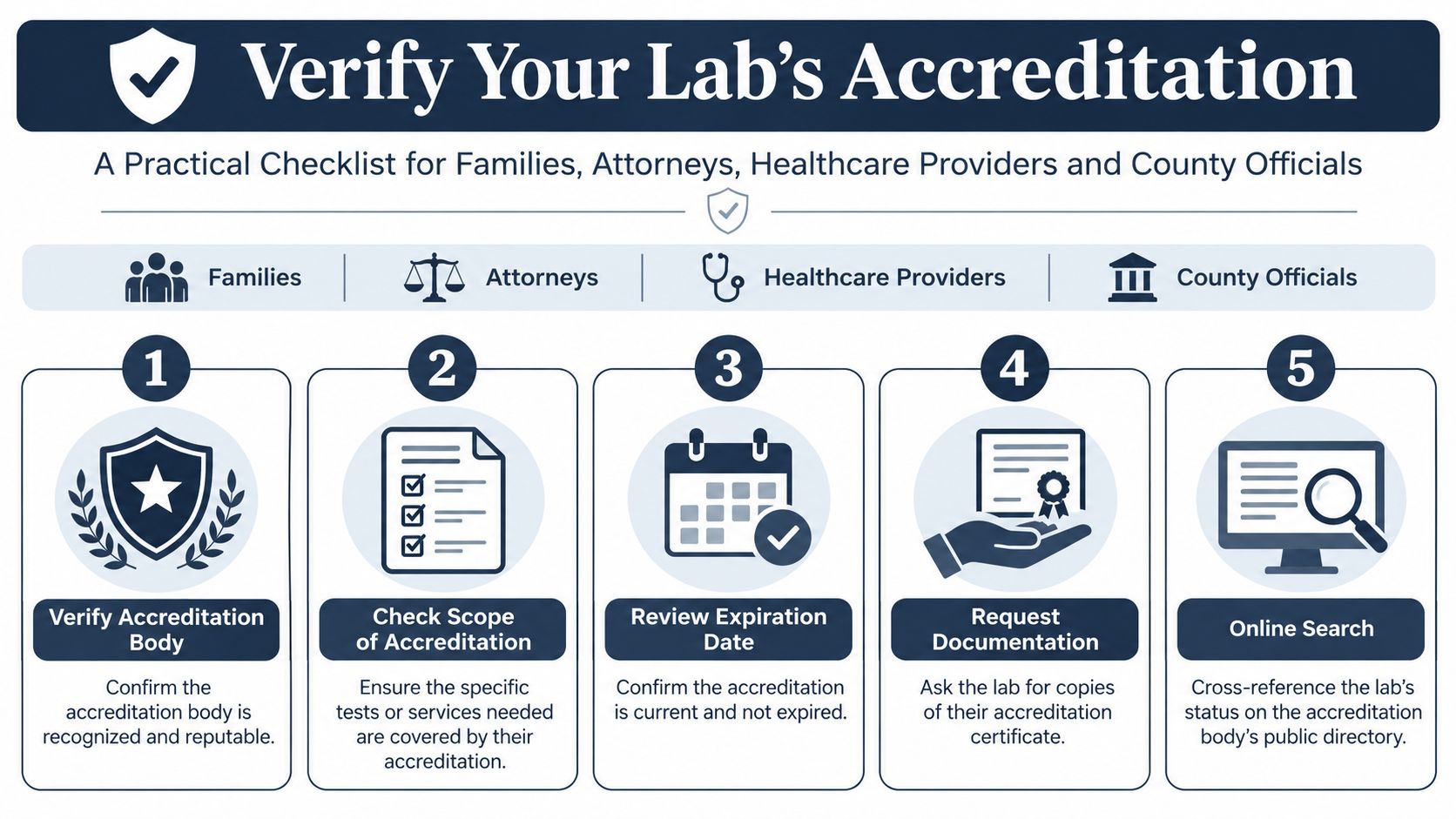
A simple verification checklist
- Verify the accreditation body: Confirm who issued the credential and whether that body is recognized for the type of work being performed.
- Check the scope: Make sure the specific test, method, or service you need is listed under the lab's accreditation.
- Review the dates: Look at issuance and expiration dates so you know the status is current.
- Request supporting records: Ask for the certificate, recent audit summary, and any corrective-action evidence tied to the service in question.
- Cross-check public directories: Use the accreditor's public listing when one is available, since that helps confirm the status independently.
A practical review should also ask whether the lab can carry out the work consistently, not just whether it holds a credential. Accreditation matters, but so does the way the lab handles specimens, documents results, and maintains chain of custody. If you want a closer look at the first part of that process, specimen collection procedures help show how collection quality shapes everything that follows.
For privacy-minded organizations, the same habit of checking records and access controls appears in the essential HIPAA checklist for businesses. The point is simple. A reliable lab should be able to show both formal approval and day-to-day discipline.
One common misunderstanding is that accreditation guarantees correctness in every case. It does not. As ukas.com explains, standards focus on process controls and traceability, not a blanket promise of perfect outcomes. That is why a lab should be judged on its status and on how carefully it works in practice.
Conclusion and next steps
Laboratory accreditation standards matter because they turn trust into something that can be checked. Families, attorneys, healthcare providers, and county officials should look past labels and verify scope, audit history, recordkeeping, and the controls behind each result. That approach protects both technical quality and legal confidence.
If you're reviewing a private autopsy, toxicology report, or forensic lab file and want help understanding what the documents do and don't show, we encourage you to reach out for direct, compassionate guidance.
A CTA for Texas Autopsy Services.