September 15, 2026 · Texas Autopsy Services
How to Get Genetic Testing After a Death in Texas
Learn how to get genetic testing after a death in Texas, including who can order it, sample types, chain of custody, consent, and how Texas Autopsy Services
On this page
- Why Postmortem Genetic Testing Is Different
- When Postmortem Genetic Testing Is Appropriate
- How to Request Genetic Testing After a Death
- Sample Types and What the Laboratory Will Accept
- Consent, Chain of Custody, and Texas Legal Standards
- Costs and Turnaround Factors
- Coordinating Genetic Testing With a Private Autopsy
A surviving spouse may call after a sudden cardiac death with one practical question: could genetic testing have shown that the death was coming? The answer depends on what the autopsy found, which specimens remain usable, who has authority to authorize testing, and whether the result is intended for family medical care, identification, or litigation.
Postmortem genetic testing isn't the same as ordering a routine clinical blood test. The deceased person can't provide consent, the sample may have been exposed to embalming or decomposition, and the clinical question is usually retrospective. Testing may help investigate an unexplained death, identify an inherited risk for relatives, or clarify a disputed cause of death. It can't promise a definitive explanation when the specimen or medical evidence is limited.
- The clinical question controls the test: Genetic testing should answer a defined question, such as suspected inherited arrhythmia or biological identification.
- Authorization matters: A legally authorized person and an ordering clinician or pathologist must be involved.
- Specimen condition affects interpretation: Blood and fresh tissue are often more useful than specimens collected after embalming, burial, or prolonged decomposition.
- Chain of custody protects credibility: Every transfer should be documented, sealed, and traceable.
- Results need professional interpretation: A genetic finding must be considered alongside autopsy findings, toxicology, histology, medical history, and family history.
Why Postmortem Genetic Testing Is Different
A living patient usually seeks genetic testing to guide future care. A postmortem investigation asks a different question: what might the deceased person's DNA reveal about the death or the family's future risk? That distinction determines the test, the specimen, the consent process, and the way the result is reported.
A sudden cardiac death may leave a family wondering whether an inherited channelopathy, such as long QT syndrome, Brugada syndrome, or catecholaminergic polymorphic ventricular tachycardia, played a role. In that setting, an arrhythmia panel may be considered if the autopsy and history support the question. The result might also help living relatives discuss their own testing with a clinician. It won't prove that a variant caused death by itself.
Why the specimen changes the decision
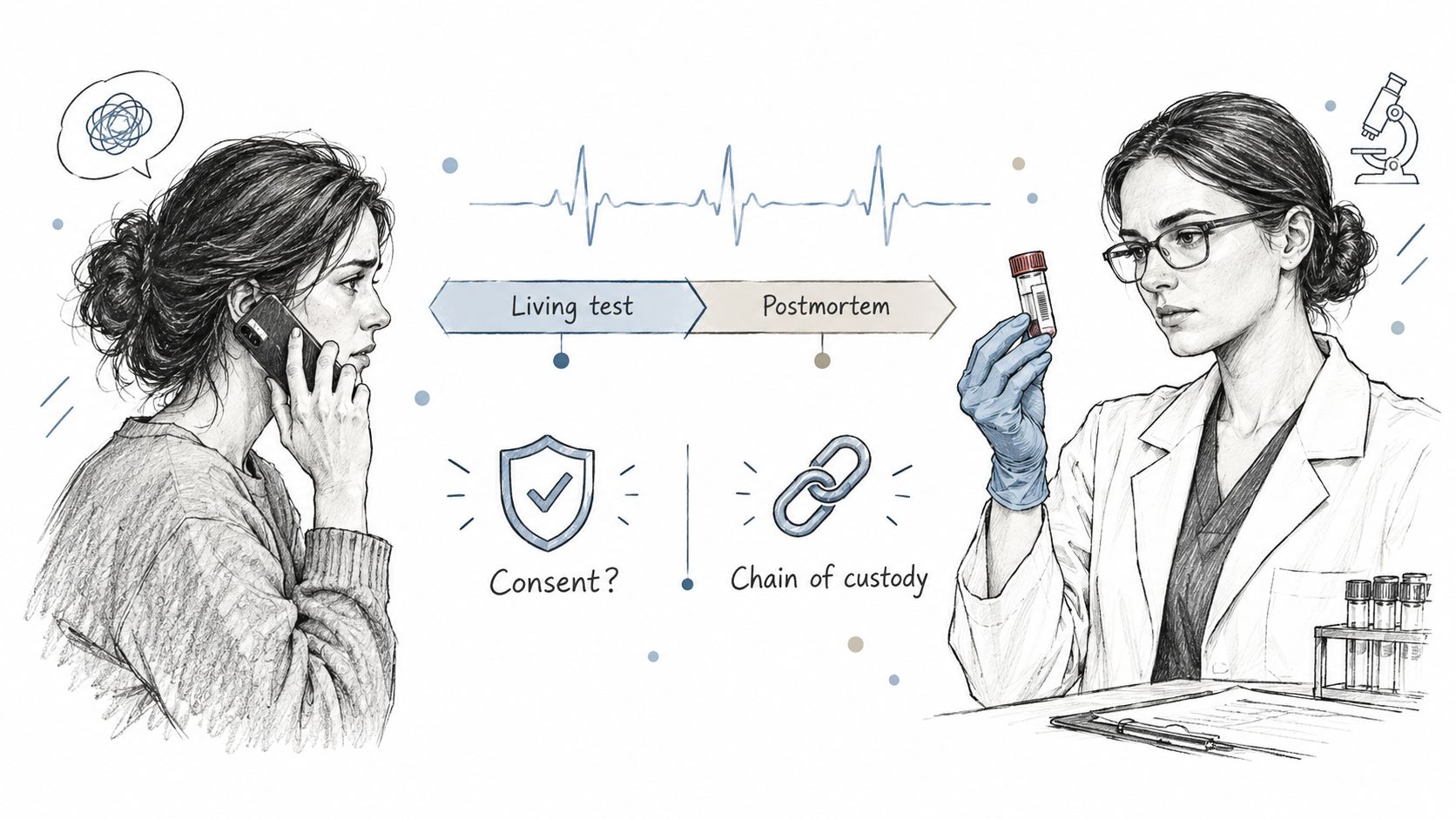
A routine clinical sample is collected under controlled conditions from a living person. A postmortem specimen may come from blood, fresh tissue, bone, teeth, or preserved tissue, and each matrix presents different risks. Embalming chemicals, heat, moisture, burial conditions, and the time between death and collection can affect DNA quality. The laboratory needs that pre-analytic history before it can judge whether a result is technically and clinically interpretable.
If a result may be used in a wrongful-death claim, estate dispute, or identification proceeding, collection also needs a documented chain of custody. In plain language, that means the case team records who collected the sample, how it was labeled and sealed, who transported it, and when the laboratory received it.
What testing can and cannot establish
Testing can identify a genetic variant, support biological relationship analysis, or provide evidence of an inherited susceptibility. It can't establish causation without context. A variant may be benign, pathogenic, or uncertain, and the pathologist must compare it with the anatomy, microscopic findings, toxicology, circumstances, and family history.
The NIH Genetic Testing Registry was created to help users find and compare genetic tests by condition, gene, laboratory, and what the test measures. That search function is useful, but choosing a postmortem assay still requires a defined forensic or clinical question and confirmation that the laboratory accepts the proposed specimen.
When Postmortem Genetic Testing Is Appropriate
Postmortem testing is most useful when the autopsy leaves a focused question rather than a general desire for more information. A structurally normal heart in a sudden unexplained death may support discussion of an inherited electrical disorder. If the heart shows findings compatible with a channelopathy, a targeted panel may be more informative than broad sequencing with no clinical direction.
Other indications arise from the disease pattern. A tumor found at autopsy may raise a question about an inherited cancer syndrome, including Lynch syndrome, BRCA-associated disease, or multiple endocrine neoplasia. Neuropathology may prompt consideration of a hereditary prion disorder or a Huntington-related question. In some cases, toxicology, histology, and microbiology narrow the possibilities but don't resolve whether an inherited condition contributed to death.
Circumstances that change the analysis
The family history can be as important as the autopsy. Repeated sudden deaths, early cardiac disease, unusual cancer patterns, or a known familial mutation may justify testing even when the gross examination is not dramatic. Educational material such as these guides on rare disease mechanisms can help families understand why a disease mechanism matters, but it shouldn't replace professional interpretation of a specific case.
Testing may not be appropriate when the cause is complete and mechanically established, such as an injury that fully explains death and carries no meaningful family-history concern. It may also be unsuitable when embalming, decomposition, cremation, or prolonged burial has left no specimen that the laboratory can validate for the requested assay. A technically possible test isn't automatically a medically useful test.
Attorneys may request testing to confirm biological relationship, assist with identification, or examine whether a heritable condition contributed to a wrongful death theory. The attorney's legal purpose doesn't replace medical ordering requirements or consent. The pathologist still needs to determine whether the test addresses a defensible question.
For a focused explanation of the postmortem process, families and counsel can review molecular autopsy testing after death, then discuss the case-specific options with the ordering professional.
How to Request Genetic Testing After a Death
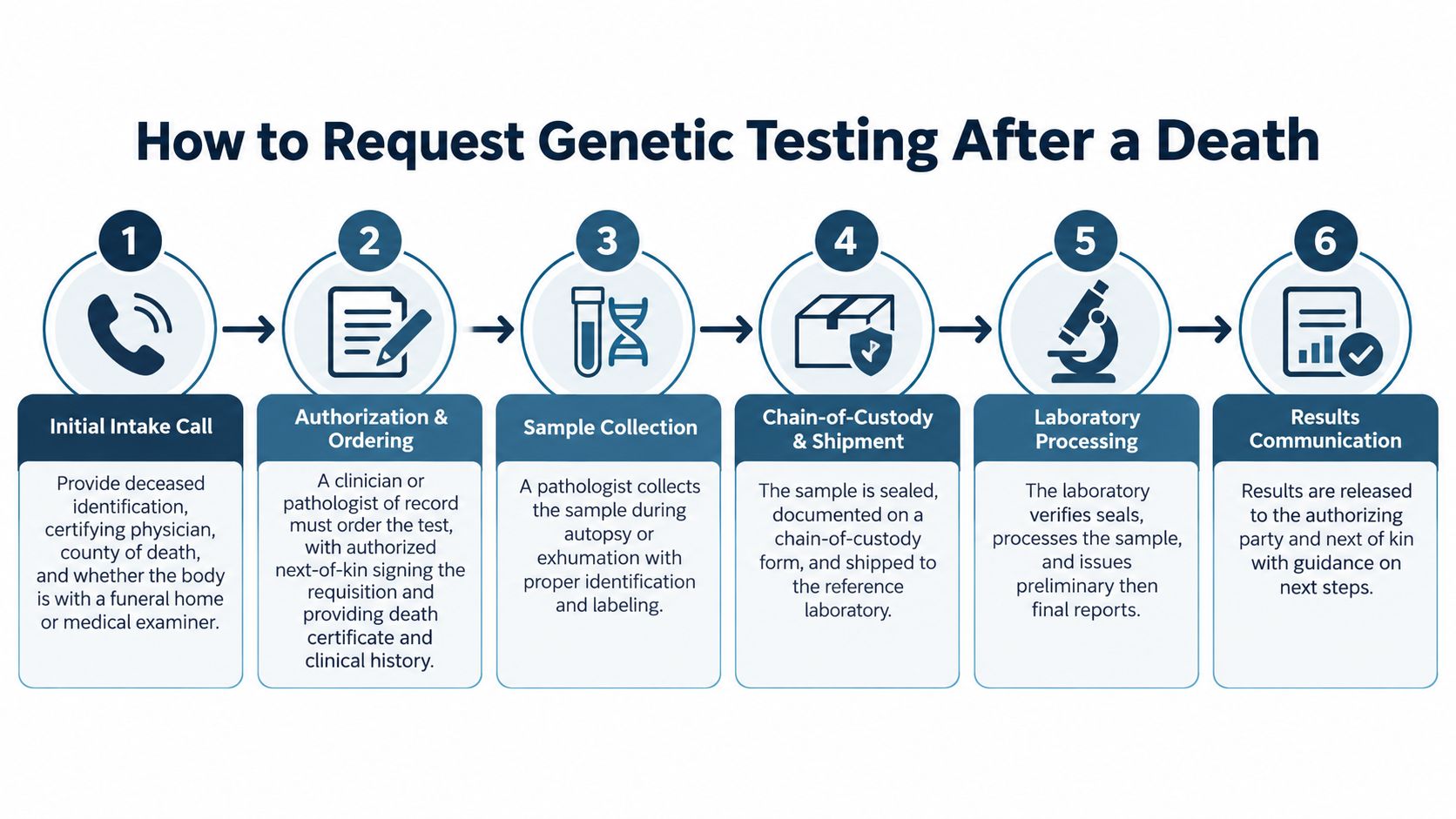
The process begins with an intake conversation, not with a kit. The family or attorney should provide the deceased person's identifying information, the certifying physician, the county of death, and the current location of the body. The team also needs to know whether the body is with a funeral home, under a medical examiner or justice of the peace jurisdiction, or available for a private examination.
A clinician or pathologist of record generally orders the test. The family doesn't independently order a postmortem assay because a relative requests one. If the deceased had no current treating physician, the pathologist responsible for the postmortem examination may determine whether testing is appropriate and sign the laboratory requisition, subject to the applicable authorization.
Documents the ordering team needs
The paperwork establishes identity, authority, and medical purpose. It commonly includes:
- Death documentation: A death certificate or other official record helps establish identity and jurisdiction.
- Written authorization: The legally authorized next of kin or other authorized representative provides consent consistent with the underlying autopsy authority.
- Clinical history: Medical records, family history, medication information, prior genetic results, and circumstances of death help the pathologist select an assay.
- Legal instructions: A court order, attorney request, or agency documentation may be relevant, but it doesn't eliminate the need for lawful consent.
During an autopsy or exhumation, the pathologist collects and labels the specimen against the case identifier. The sample is sealed, documented on a chain-of-custody form, and shipped to the reference laboratory. The laboratory verifies the packaging and receipt, processes the specimen, and issues a report according to its reporting protocol.
Who receives the result
The authorizing party and the ordering professional determine how the report is released. Appropriate next-of-kin communication may follow, particularly when a result could affect living relatives. Families should ask before collection who will receive preliminary findings, who will receive the final report, and whether a genetics professional will help explain implications.
The National Comprehensive Cancer Network patient guide describes genetic testing as a process involving counseling, test selection and consent, sample collection, laboratory analysis, and post-test discussion. The same basic discipline is important after death, even though the patient can't participate directly.
Sample Types and What the Laboratory Will Accept
No single specimen is best for every postmortem case. Fresh blood or tissue collected promptly may provide stronger DNA than material recovered after burial, but the laboratory's validation requirements control the final choice. Families and attorneys should confirm the acceptable matrix, minimum quantity, container, storage temperature, and shipping conditions before authorizing collection.
Comparison of common specimens
| Sample Type | DNA Yield | After Embalming | Storage Requirement | Chain-of-Custody Notes |
|---|---|---|---|---|
| Fresh tissue | Often useful when collected during autopsy | May be affected by chemicals and delay | Follow laboratory instructions, commonly refrigerated or frozen | Container, tissue source, collector, and seal must be recorded |
| Postmortem blood | Useful when collected before significant degradation | Embalming can compromise interpretation | Use the laboratory's approved tube and temperature | Record collection time, tube identification, seal, and transfer |
| Paraffin-embedded block | May preserve DNA from previously sampled tissue | Existing processing can limit some assays | Store and ship according to laboratory policy | Document block number, case identifier, and releasing facility |
| Bone and teeth | Important options in exhumation or advanced decomposition | Can remain useful when soft tissue is unsuitable | Protect from moisture and contamination | Photograph or document source and every transfer |
| Hair shafts | Yield and quality vary, especially without the root | May be affected by treatment and environmental exposure | Dry, clean packaging as directed | Separate packaging and detailed specimen labeling are essential |
| Buccal or reference swab | Useful for living relatives and comparison | Not a substitute for a suitable deceased-person specimen | Air-dry and package as instructed | Identify the donor and preserve consent documentation |
Blood is commonly collected from a vein in clinical testing, while saliva may be collected in a tube and mailed to a laboratory, as described by Mayo Clinic's overview of genetic testing specimens. Some laboratories prefer blood for constitutional testing and specify different requirements for molecular and cytogenetic assays. A laboratory may accept saliva for selected molecular tests but reject it for chromosome, FISH, microarray, exome, genome, or certain gene-panel work.
Embalming, cremation, and prolonged burial can narrow the available options. Bone and teeth may become more important in an exhumation, while a living relative's buccal swab may help interpret inheritance or compare a relationship. A reference sample doesn't automatically resolve a variant of uncertain significance, and the laboratory may request maternal or paternal samples depending on the interpretation plan.
Detailed preservation planning is addressed in specimen preservation for forensic testing. The practical rule is simple: confirm the laboratory's requirements before collection, not after an irreplaceable specimen has been handled.
Consent, Chain of Custody, and Texas Legal Standards
Genetic testing after death usually follows the authorization pathway for the underlying autopsy. In Texas, the family and investigative team must consider the applicable hierarchy for disposition and authority, including Texas Health & Safety Code Chapter 691 and the Chapter 692 framework addressing who may order or consent to an autopsy. The precise authority can change with the facts, including whether the case is under a county official, medical examiner, justice of the peace, funeral home, or court.
An attorney's request can identify an important legal question, but it doesn't by itself authorize the collection or release of genetic material. The legally authorized next of kin or other authorized representative must participate through the proper consent process. Special circumstances, including an out-of-state death, fetal remains, or an unidentified person, may require additional review under Texas law, the Texas Revised Uniform Anatomical Gift Act, or the law of the jurisdiction controlling the remains.
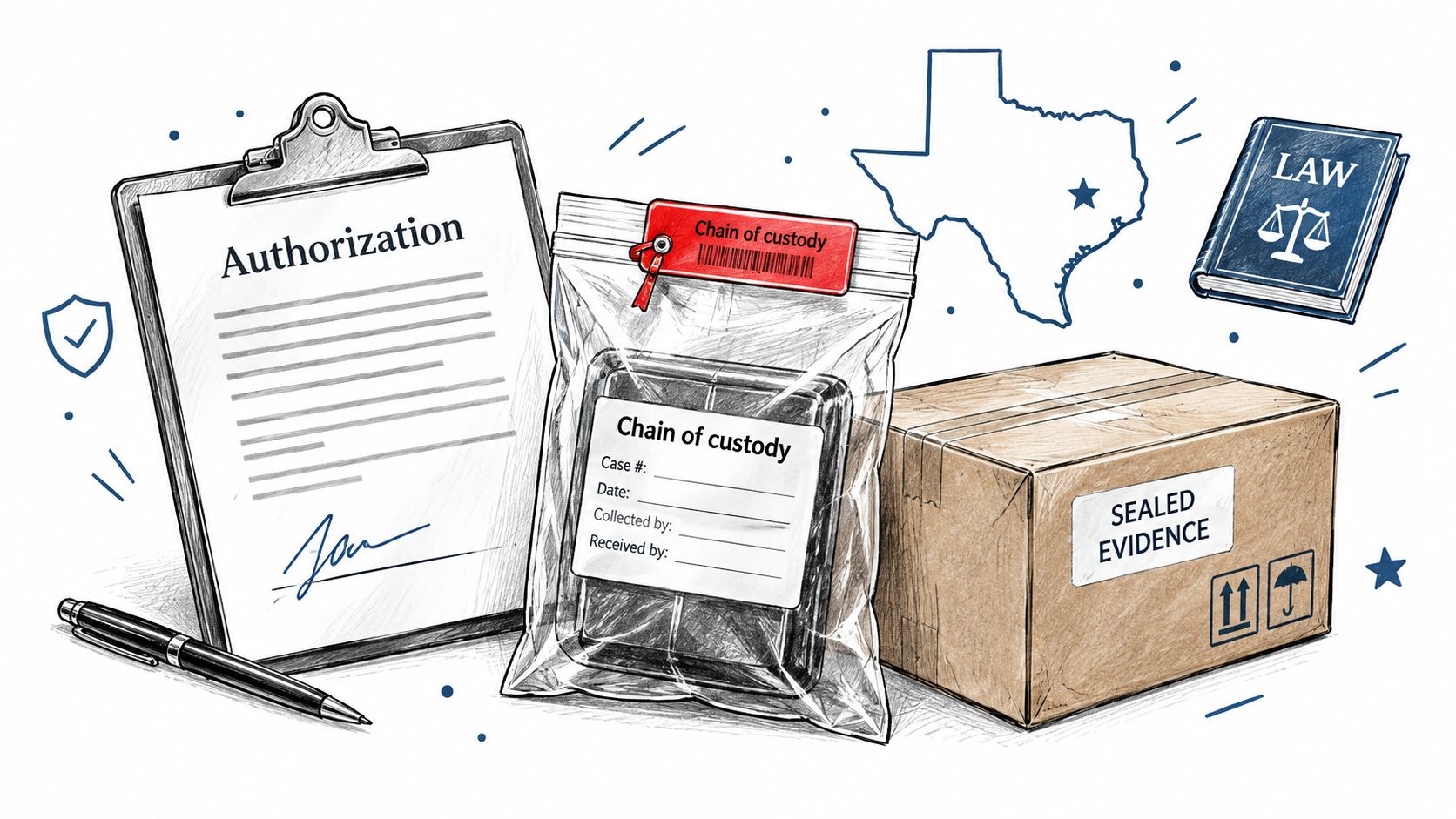
What chain of custody means
Chain of custody is the written record showing that the specimen tested is the specimen collected from the identified person. It should account for:
- Collection: The pathologist records the date, source, case identifier, and collector.
- Sealing: The specimen is placed in approved packaging and sealed against tampering.
- Transfer: Each person or facility accepting the specimen signs or otherwise records receipt.
- Laboratory verification: The laboratory documents receipt, checks the seal, and records any discrepancy.
This documentation matters most when the result may appear in court. It also protects families from uncertainty about whether the laboratory tested the intended specimen.
Genetic results are sensitive medical information. Release should be limited to authorized requesters and handled consistently with applicable privacy requirements, including HIPAA where it applies. Families can review the practical documentation issues in this chain-of-custody form guide before the specimen moves.
The Texas Funeral Service Commission regulates relevant funeral-service practices, while Texas Health & Safety Code provisions govern particular aspects of disposition, autopsy authority, and related records. Because jurisdiction and consent can be fact-specific, families should obtain case-specific legal guidance when authority is disputed.
Costs and Turnaround Factors
Postmortem genetic testing doesn't have one fixed price. The laboratory, assay design, specimen condition, interpretation level, and need for family comparison all affect the bill. A single-gene analysis is usually less complex than a cardiomyopathy or arrhythmia panel, while whole-exome sequencing can involve broader analysis and interpretation. Pharmacogenomic or toxicology-related molecular work is a separate question and may require different laboratory methods.
Private postmortem testing often creates an insurance gap. Health plans may cover medically indicated testing for a living patient but exclude testing ordered on a deceased person. Life insurance typically isn't a funding source for genetic analysis. Before authorization, ask for a written estimate that separates collection, pathology handling, laboratory analysis, interpretation, storage, shipping, and any family reference testing.
A general cost of genetic testing breakdown can help families understand why laboratory charges vary, but international pricing isn't a quote for a Texas case.
Why results take different amounts of time
Turnaround depends on the whole chain, not on whether blood or tissue was collected. Relevant variables include:
- Collection and refrigeration: Delays before stabilization may reduce specimen quality.
- Shipment: Weekend schedules, courier handling, and receiving-laboratory requirements can affect delivery.
- Laboratory batching: Some assays are processed on scheduled runs rather than immediately.
- Interpretation: A variant of uncertain significance may require additional review or family comparison.
- Reference samples: Testing a living relative can add consent, collection, shipping, and analysis time.
The NIH notes that direct-to-consumer testing appeared in 1996, the Human Genome Project was completed in 2003, and advertised direct-to-consumer prices changed from about $1,000 in 2007 to about $99 by 2012, as recorded in this NIH genetics education timeline. Those consumer figures don't establish the cost or timing of a forensic laboratory investigation.
Some urgent laboratory services report turnaround as short as 3 calendar days for selected rapid tests and 7 days for selected prenatal screening, but those examples don't apply automatically to postmortem sequencing. The laboratory's written estimate should control, and expedited processing may be available when a filing or estate deadline creates documented time pressure.
Coordinating Genetic Testing With a Private Autopsy
The most reliable coordination begins before dissection. The team defines the clinical or legal question, confirms authorization, checks the reference laboratory's specimen requirements, and identifies which tissues should be retained. Collecting fresh tissue during the autopsy avoids unnecessary handling and preserves the relationship between the specimen and the observed anatomy.
Each container should be logged against the case identifier. The pathologist records the source tissue, the collection details, and the destination laboratory, then maintains the documentation through shipment and receipt. A single consent record and a continuous chain of custody reduce the risk that genetic findings become disconnected from the autopsy evidence.
Why integrated interpretation matters
A genetic result shouldn't sit alone in a laboratory report. A cardiac channelopathy panel may be more meaningful when reviewed with the heart examination, microscopic findings, toxicology, circumstances of collapse, and family history. A connective-tissue panel may need to be considered alongside vascular anatomy and other autopsy observations. Pharmacogenomic testing may provide context for medication response, but it doesn't independently establish overdose, toxicity, or intent.
The authorizing clinician or pathologist retains authority over which tests are ordered and how results are released. A second sample sent to a university or hospital laboratory can be reasonable when the first laboratory lacks a validated method, a confirmatory assay is needed, or an independent interpretation has a clear purpose. Parallel testing without a defined question can create conflicting classifications, duplicate costs, and confusion for the family.
What families and attorneys receive
A coordinated case may produce an integrated report that discusses molecular findings alongside gross and microscopic observations, toxicology, and relevant history. The report should distinguish cause of death, the disease or injury that initiated the fatal sequence, from manner of death, the classification of how the death occurred, such as natural, accident, suicide, homicide, or undetermined when applicable. Genetic testing may inform the cause-of-death analysis, but it doesn't replace the complete forensic evaluation.
Texas Autopsy Services provides private autopsy services, specimen coordination, molecular testing arrangements, licensed transport, and written reporting across all 254 Texas counties. Families can begin with one intake call, written authorization, scheduling, specimen collection, laboratory submission, and a follow-up conference to discuss the integrated findings. For county matters, the practice also provides county forensic autopsy services, while families seeking an independent examination can review private autopsy services in Texas.
Frequently asked questions
Can a family order genetic testing directly?
Usually, no. A clinician or pathologist of record generally must select and order the assay, while the legally authorized person provides consent. The appropriate route depends on jurisdiction, custody of the remains, and the purpose of testing.
Is blood always required?
No. Laboratories may accept fresh tissue, preserved tissue, bone, teeth, or other specimens, depending on the assay. Blood and fresh tissue are often preferred when available, but embalming, decomposition, burial, or cremation can change what remains suitable.
Can genetic testing prove the exact cause of death?
Not by itself. A pathogenic variant may support an inherited disease hypothesis, but the pathologist must interpret it with the autopsy, toxicology, histology, circumstances, and family history.
Can testing be performed after burial?
Sometimes. Bone or teeth may be considered during an exhumation, but authorization, court or agency involvement, specimen integrity, and laboratory validation must be addressed before collection.
Who explains the result to living relatives?
The ordering clinician, pathologist, genetic counselor, or another qualified professional should explain the result and its limits. Relatives shouldn't make medical decisions from an isolated laboratory phrase, especially when the report identifies a variant whose significance remains uncertain.
Texas Autopsy Services coordinates independent postmortem examinations and molecular genetic testing through board-certified forensic pathologists certified by the American Board of Pathology, with licensed transport and chain-of-custody documentation across Texas. Families, attorneys, clinicians, and county officials can visit Texas Autopsy Services to request a confidential intake discussion about specimen preservation, authorization, and whether genetic testing fits the cause-of-death investigation.