September 13, 2026 · Texas Autopsy Services
Forensic Consultant Services in Texas Explained
Learn how forensic consultant services provide independent autopsy and second opinions in Texas. Discover the process, legal standards, and expert access.

On this page
A family may receive an autopsy report that lists a cause of death but still have unanswered questions. An attorney may discover that the medical records, toxicology results, photographs, and investigative history don't support a clear causal explanation. A county may need qualified forensic coverage when local resources are unavailable.
Forensic consultant services provide an independent medical and logistical bridge in those situations. At Texas Autopsy Services, our team supports families, attorneys, healthcare professionals, agencies, and Texas counties with private autopsies, second-opinion reviews, record analysis, transport coordination, and court-ready reporting. Every examination is performed by a forensic pathologist certified by the American Board of Pathology, with communication designed to remain precise, understandable, and respectful.
- Independent answers: An external review can assess whether the documented findings support the stated cause and manner of death.
- Flexible scope: A full private autopsy isn't always necessary. Records, imaging, slides, toxicology, or a targeted examination may answer the question.
- Statewide logistics: Our practice serves all 254 Texas counties, including rural areas where access to forensic pathology may be limited.
- Evidentiary discipline: Secure transport, documented custody, controlled storage, and complete reporting protect the value of postmortem evidence.
- Direct communication: Families and legal teams speak with our team throughout the process, with flat-rate, all-inclusive pricing.
When Families and Attorneys Need Objective Answers
A family may be told that a loved one died suddenly, yet the explanation feels incomplete. The death may have occurred outside a hospital, after a medical procedure, following an accident, or under circumstances that create questions about medication, injury, disease, or supervision. The family may not be seeking conflict. They may need to understand what happened before making decisions about probate, insurance, employment claims, or personal closure.
Attorneys approach the same problem from a different position. They must evaluate whether medical findings support a claim, defense, or regulatory concern. A cause of death may be documented as a disease process, but the available records may raise questions about trauma, treatment, intoxication, delayed care, or another contributing factor. A forensic pathologist reviews those issues through postmortem medicine, not through assumptions about liability.
What an independent review can clarify
Cause of death identifies the disease, injury, or condition that produced death. Manner of death describes the circumstances surrounding it, such as natural, accident, suicide, homicide, or undetermined, when the available evidence supports that classification. These conclusions are related, but they aren't interchangeable.
An independent forensic consultant may assess:
- whether the reported cause is medically supported;
- whether injuries, disease, toxicology, and imaging fit together;
- whether important records or specimens were overlooked;
- whether the original report explains the reasoning clearly;
- whether a full examination, targeted study, or records review is appropriate.
Practical rule: A second opinion should test the original causal chain independently, not merely repeat its conclusion.
A private autopsy can be especially important when no public autopsy was performed, when a medical examiner or coroner declined a case, or when the family or legal team needs an external opinion. It can't guarantee a different result. Its value lies in applying qualified, independent analysis to the evidence that exists and explaining what that evidence can and cannot establish.
The Growing Need for Independent Forensic Expertise
The need for outside forensic consultant services reflects a structural problem, not merely an individual office's scheduling difficulty. In the United States, roughly 2,040 medical examiner and coroner offices supported medicolegal death investigation in 2018, employing about 11,000 full-time equivalent staff and about 890 autopsy pathologists. Those offices received more than 1.3 million death referrals and accepted 605,000 for further investigation, while only about 17% were accredited, according to the Bureau of Justice Statistics report on medical examiner and coroner offices.
Those figures describe a system handling a large volume of legally significant deaths with limited specialist capacity. Geography adds another layer. Counties may have different procedures, transport arrangements, staffing levels, and access to subspecialists. Families can experience delays or uncertainty because the appropriate expertise isn't available nearby.
Why the workforce gap matters
Federal forensic science materials have used a workload benchmark of 250 autopsies and autopsy equivalents per pathologist per year. Studies cited in those materials found an average of 222 autopsies per pathologist in accredited offices. Experts estimated that 1,100 to 1,200 board-certified forensic pathologists were needed nationally, while about 500 full-time board-certified forensic pathologists were practicing at the time. A separate federal report identified 989 board-certified forensic pathologists in 2003, with only about 350 to 400 working full time. These figures appear in the National Commission on Forensic Science materials.
The practical result is uneven access to autopsies, second opinions, overflow coverage, and expert consultation. Independent practices can help counties manage referrals, give families another qualified review, and help attorneys determine whether the available evidence supports further investigation.
The same access concern appears outside the United States. A UK workforce report identified 61 filled consultant posts, 7 vacancies, and a need for 16 additional consultant posts to meet current demand. It also projected that 30% of the workforce would retire within 10 years, while only 10 residents were training in the specialty, as reported by The Pathologist. These conditions help explain why statewide coverage, licensed transport, and remote record review are practical parts of forensic pathology rather than administrative extras.
Core Services and Second Opinion Reviews
The appropriate service depends on the question, the condition of the remains, the evidence already collected, and the authority controlling the death investigation. A full private autopsy may be necessary in one case, while a careful review of existing materials may be more appropriate in another.
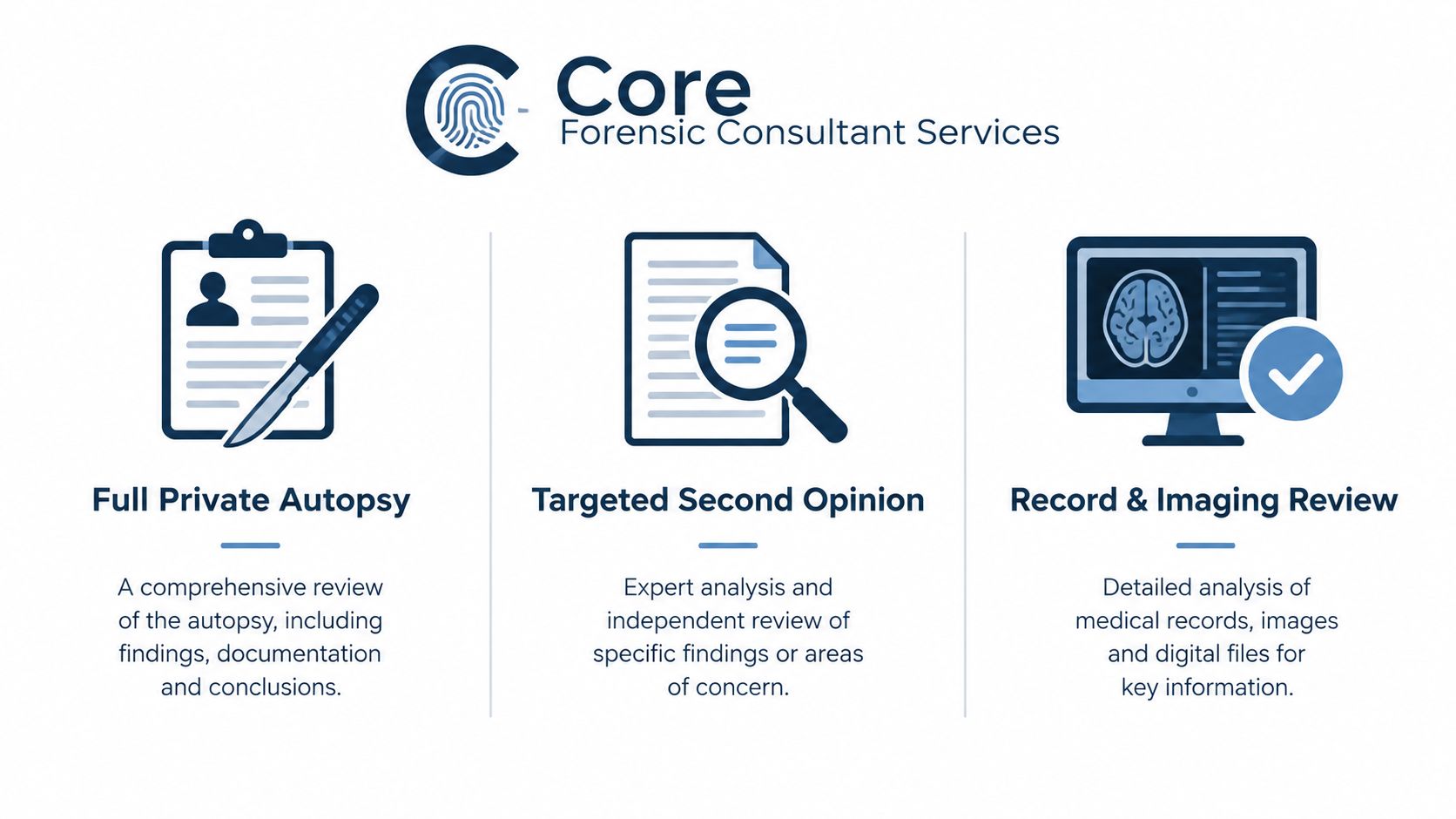
Full private autopsy
A full examination provides the broadest opportunity to evaluate injuries, organs, disease, retained specimens, photographs, imaging, and laboratory testing. It may be considered when no autopsy was completed, when the existing examination leaves a material question unresolved, or when an attorney needs an independent forensic pathology opinion.
A full autopsy still has limits. Postmortem changes, incomplete records, missing specimens, or delayed testing can restrict what can be concluded. A responsible report identifies those limits instead of presenting certainty that the evidence doesn't support.
Targeted examination and second opinion
A targeted examination may focus on a specific issue, such as an organ system, injury pattern, or retained specimen. A second opinion autopsy review may instead evaluate the original autopsy report, medical records, histology slides, toxicology, photographs, radiology, and investigative materials.
Accreditation guidance calls for access to consultants in neuropathology, forensic dentistry or odontology, forensic anthropology, radiology, and toxicology or clinical laboratory analysis when needed. Second-opinion standards also support a de novo review, meaning the external forensic pathologist approaches the case independently and uses the full available record. The National Association of Medical Examiners forensic autopsy standards provide that professional framework.
Record and imaging review
Record review can be useful when the central issue concerns the interpretation of prior findings rather than the absence of tissue examination. Imaging may help assess fractures, foreign material, injury patterns, or other findings, but it doesn't replace tissue examination in every case. The right scope is the one that answers the defined question with the least unnecessary intrusion while preserving medical and legal reliability.
For broader context on how medical specialists support legal matters, attorneys may also consult this guide to medical legal consulting. Our team also explains the practical role of pathology consultation services when a case requires expert review.
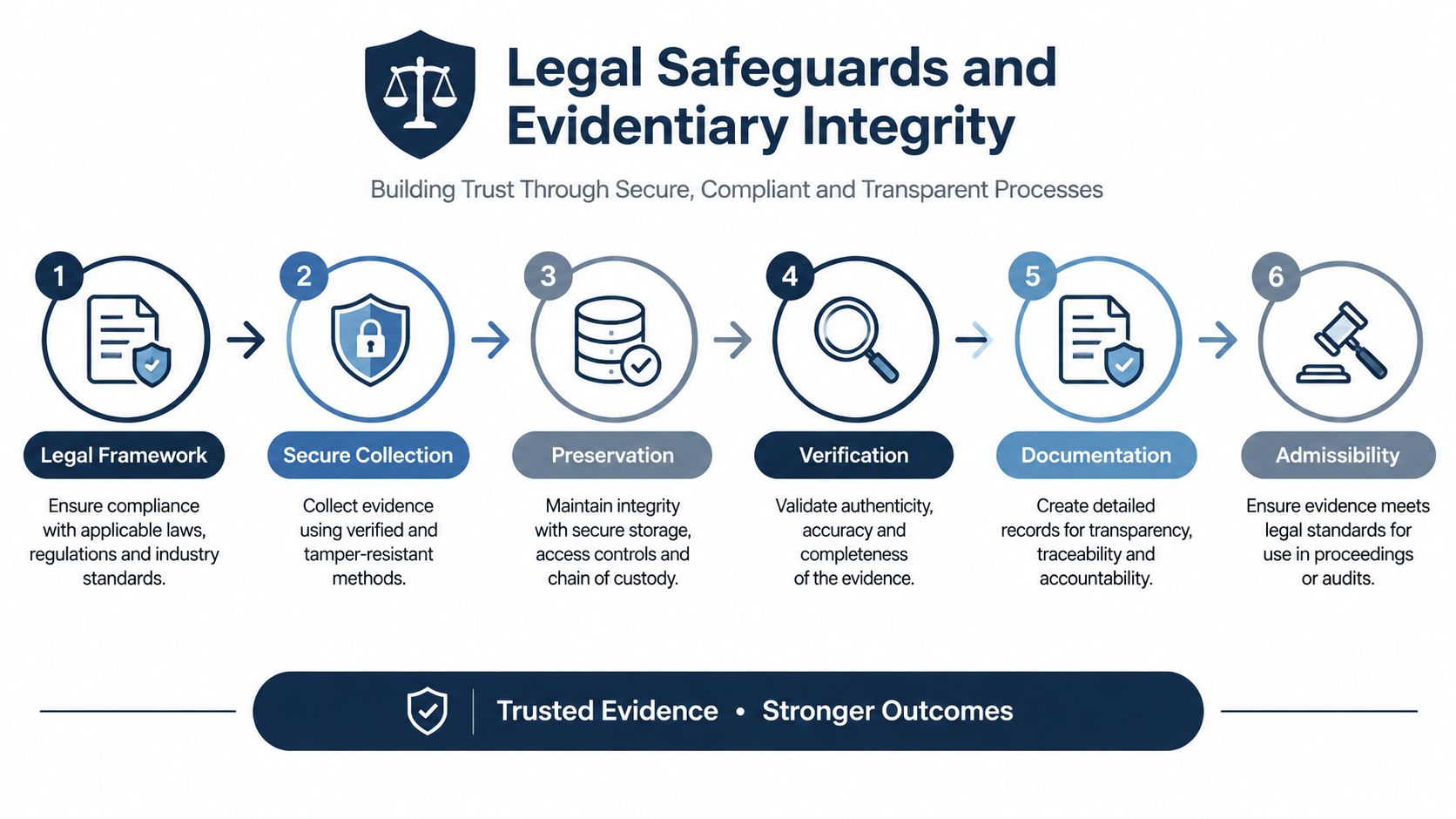
Legal Safeguards and Evidentiary Integrity
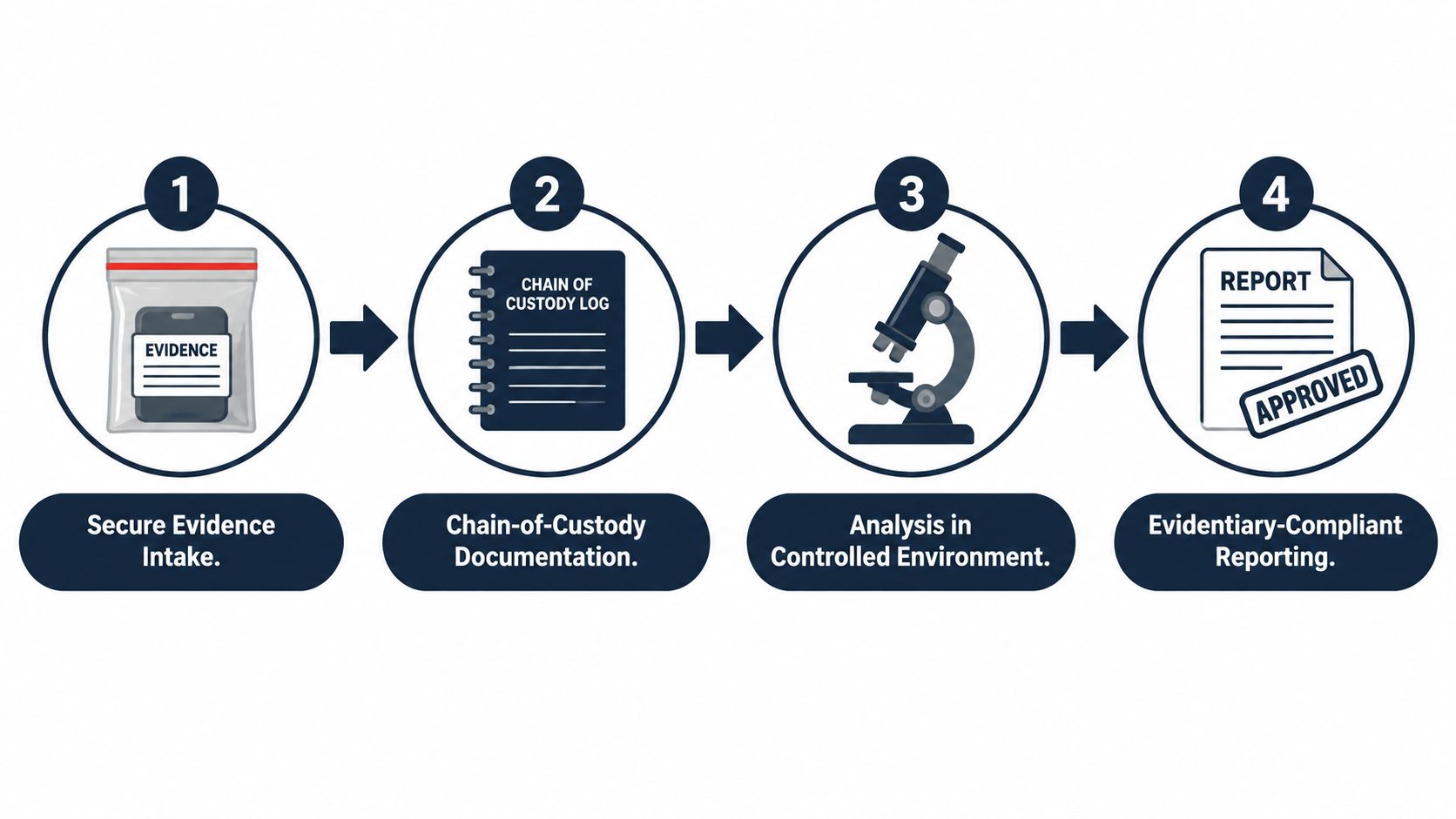
A forensic opinion is only as reliable as the evidence behind it. Chain of custody records who possessed each item, when control changed, what actions were taken, and its condition at every transfer. That documentation must allow a court, auditor, or accrediting body to confirm that the specimen or body-related evidence examined is the material collected at the beginning.
The requirement applies to toxicology samples, histology slides, retained organs, photographs, imaging, and other examination materials. Gaps in documentation can reduce evidentiary weight and may raise admissibility concerns. Forensic laboratories have long treated custody documentation as part of reliable practice, as discussed in Laboratory Medicine's chain-of-custody reference.
Transport and storage controls
Texas transportation rules require bodies and anatomical specimens to be transported properly, labeled as human tissue, and tracked with a commission-prescribed chain-of-custody form. The sender must maintain a permanent file identifying the deceased person's name, color, sex, age, and supposed cause of death. Sender and receiver records must remain available for inspection by the Texas Funeral Service Commission or a district or county attorney under Texas Health and Safety Code Section 691.031.
Texas Autopsy Services uses licensed transport and secure, temperature-controlled storage within its evidentiary workflow. These controls protect the examination before and after analysis. A technically sound autopsy or consultation can lose value if the body, specimen, or associated record is mishandled during transport, storage, or transfer.
Evidence must be traceable from collection through reporting. The report should show what was found, how the material reached the pathologist, and how it was preserved.
Texas law also defines an autopsy report broadly. The report includes the postmortem examination, X-rays and photographs taken during that examination, and toxicology or organ-structure reports produced after dissection. Investigative reports reviewed by the physician are excluded. A designated physician who performs an autopsy under state law must file the report within 30 days of the request, unless a required test cannot be completed within that period, according to Texas Health and Safety Code Chapter 671.
Families handling estate questions can consult this guide for Texas families on probate, while probate counsel should address legal advice. Attorneys, agencies, and families can also review Texas Autopsy Services' chain-of-custody procedures to understand how evidence is logged, transferred, stored, and incorporated into the final report.
Who Benefits and How to Request Services
Different clients begin with different questions. Families often want to know whether a private autopsy can clarify an unexpected death. Attorneys may need an expert review before filing a claim, responding to an opposing opinion, or preparing testimony. Healthcare professionals may seek an independent postmortem assessment, while county officials may need dependable forensic coverage when local resources are limited.
The first step is to define the question. “We need answers” is understandable, but the consultation becomes more useful when the team knows whether the concern involves trauma, medication, disease, treatment, toxicology, an existing autopsy, or the manner of death. We then identify the materials available and discuss whether a full examination, targeted examination, or record review is appropriate.
What to gather
Families and attorneys should provide the information available without delaying contact while trying to assemble a perfect file.
- Basic identification: The deceased person's name, location, date of death, and current custodian.
- Existing medical materials: Hospital records, death certificates, autopsy reports, toxicology, imaging, photographs, and pathology slides when available.
- Legal context: The attorney's contact information, relevant deadlines, agency involvement, and whether litigation or an insurance review is pending.
- Logistical details: Funeral home information, transport needs, cremation or burial plans, and any preservation concerns.
Texas Autopsy Services is based in Elgin and serves all 254 Texas counties with in-house licensed transport, secure storage, direct team communication, and flat-rate, all-inclusive pricing. The practice can coordinate one-way or round-trip transport, arrange testing when indicated, and provide a written report with a discussion in plain language. Families considering whether their records justify further review can begin with a case review consultation.
What does not work well
Rushing cremation or burial before discussing preservation can limit later options. Sending incomplete records without identifying the central question can also produce an inefficient review. Selecting a reviewer based only on a convenient location or a low initial price can overlook qualifications, custody procedures, laboratory access, and the ability to explain conclusions under scrutiny.
We don't promise a particular result. We explain the available evidence, the appropriate scope of work, the practical limitations, and the expected costs before proceeding.
Common Questions About Forensic Consultations
Can a second opinion replace a private autopsy?
Sometimes, medical records, imaging, toxicology, photographs, and pathology slides can resolve the disputed question. A second opinion cannot replace tissue examination when the answer depends on findings that were never documented or sampled. Our board-certified forensic pathologists first assess the available materials, then recommend an appropriate scope of work.
How quickly can an examination occur?
Timing depends on the body's location and condition, agency involvement, transport access, authorization, available records, laboratory testing, and the need for additional specialists. Most cases are completed within 24 to 48 hours, but laboratory or investigative factors can extend that timeframe.
What does Texas consider part of an autopsy report?
Texas law includes the postmortem examination report, examination photographs and X-rays, and toxicology or organ-structure reports produced after dissection. Investigative reports reviewed by the physician fall outside that statutory definition. The governing provision is Texas Health and Safety Code Chapter 671, which counsel should review for case-specific questions.
Who performs the examination?
Every examination is performed by a forensic pathologist certified by the American Board of Pathology. Board requirements include certification in anatomic pathology or anatomic pathology and clinical pathology, followed by 12 months of training in an ACGME-accredited forensic pathology program, as described in the American Board of Pathology requirements.
Does Texas require a pathologist to perform every autopsy?
Texas law does not require a pathologist to perform every autopsy under all state provisions. A justice of the peace may seek a county health officer's or physician's opinion about whether an autopsy is needed, while certain circumstances require action by a medical examiner or authorized deputy. Confirm agency authority before arranging an independent examination, as explained in the CDC legal summary for Texas.
Texas Autopsy Services provides independent autopsies, second-opinion reviews, forensic consultation, licensed statewide transport, and court-ready reporting across all 254 Texas counties. When important medical or legal questions remain, contact Texas Autopsy Services to discuss the evidence and appropriate next step with care.