July 16, 2026 · Texas Autopsy Services
Forensic Decomposition Analysis Explained
Learn what forensic decomposition analysis is, how it helps determine cause of death, and what to expect from a private autopsy in Texas for complex cases.
On this page
A family may already have a death certificate and still have no clear answer about how a person died. An attorney may have records, photographs, and conflicting accounts, yet still lack a medically reliable timeline. In those cases, decomposition analysis helps turn partial facts into a disciplined forensic opinion.
Forensic decomposition analysis is the medical examination of the changes that occur after death and what those changes may still reveal. In practice, it helps a forensic pathologist evaluate cause of death, manner of death, and the likely postmortem interval. The work is careful and methodical because postmortem change can blur injuries, alter organs, and affect which tests remain informative.
The process works much like reading a damaged document. Some lines are clear. Others are faded or distorted. A board-certified forensic pathologist does not rely on one clue in isolation. The body is examined alongside scene information, available records, tissue findings, toxicology, and, when appropriate, insect evidence. Each source has limits. Read together, they can still support sound medical and legal conclusions.
That point matters in Texas. A public autopsy does not occur in every death, and families or legal teams may be left with unanswered questions even after official paperwork is issued. Private autopsy services fill that gap by providing an independent, medically grounded review that follows proper documentation standards and can be used for family decision-making, insurance disputes, civil litigation, and other legal needs.
Decomposition does not end the search for answers. It changes the way the case must be handled. The standard is higher care, clearer documentation, and respect for both the deceased and the people who need a truthful explanation.
Understanding Forensic Decomposition Analysis
A delayed discovery often leaves people with two fears at once. First, that something important happened before death. Second, that decomposition means no one can tell anymore. In forensic pathology, those fears are understandable, but they are not the same as the medical reality.
Forensic decomposition analysis is the structured evaluation of postmortem changes in order to answer practical medicolegal questions. It is not a single test. It is a disciplined review of the body, the scene, the records, and supporting laboratory work.
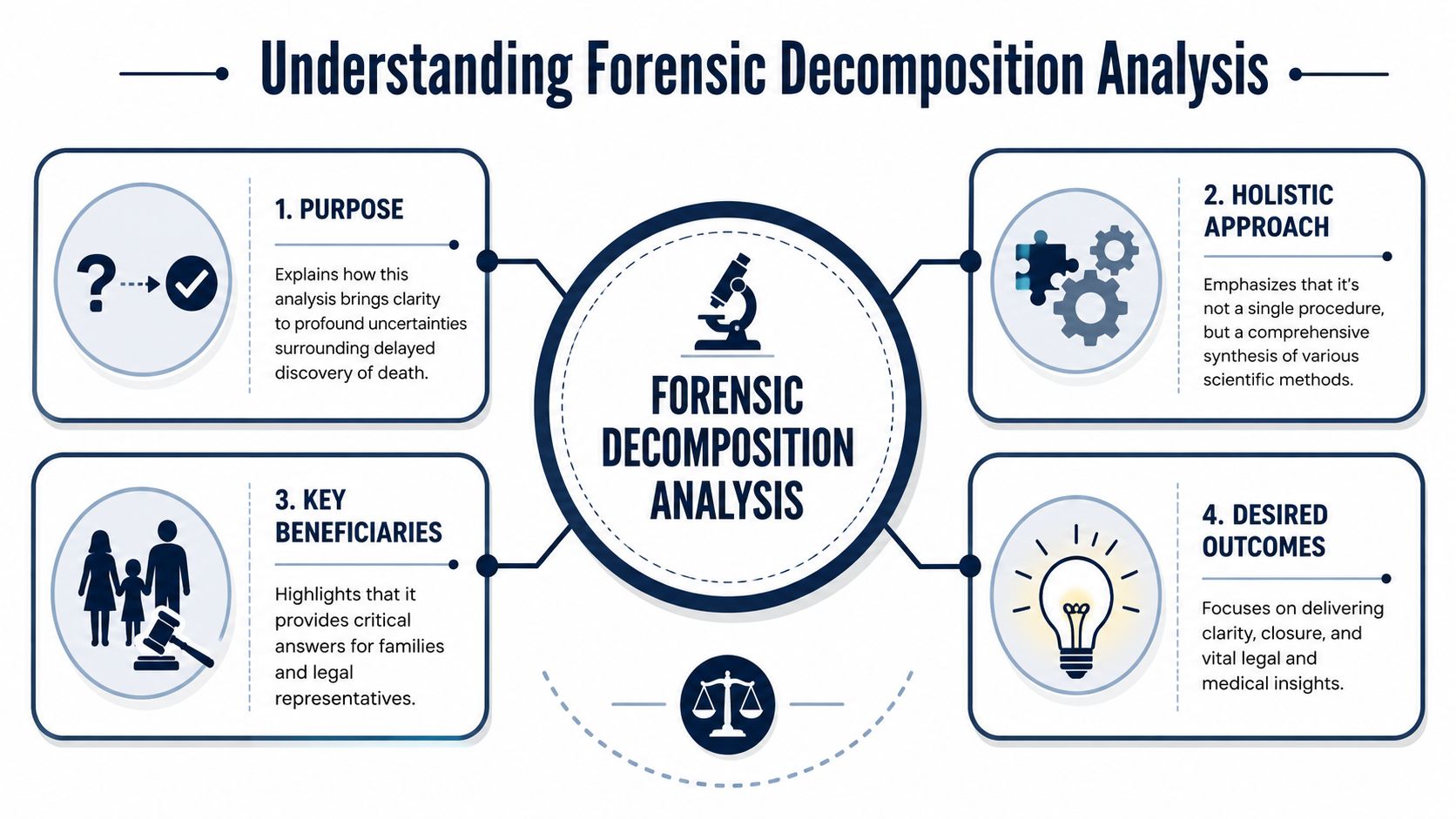
What the term means in forensic work
Outside medicine, the same phrase can mean something very different. In statistics, decomposition analysis is a foundational method that divides an observed change into separate contributing parts and is defined so the contributions sum to 100% (IntechOpen chapter on decomposition analysis). That is useful in economics, demography, and environmental research.
In forensic pathology, the phrase points to something else. We use it to mean the careful interpretation of how the body changed after death and what those changes do, and do not, allow us to conclude.
That distinction matters because readers often encounter both meanings online. One is a mathematical framework. The other is a medicolegal investigation.
Why families and attorneys hear this term
In a decomposition case, the central task is still familiar. The pathologist must assess whether disease, injury, intoxication, environmental exposure, or another mechanism caused death. The challenge is that decomposition can hide some findings and distort others.
Practical rule: Decomposition changes how an autopsy is interpreted. It does not automatically prevent a reliable opinion.
For families, that means a difficult case may still yield a meaningful answer. For attorneys, it means the opinion must be built from multiple lines of evidence rather than a single striking finding. For both, the process is slow, methodical, and grounded in documentation rather than assumption.
Key Drivers of Postmortem Change
A family may ask why one person found after several days still has findings a pathologist can interpret, while another person found sooner shows far greater breakdown. The answer is that postmortem change follows patterns, but those patterns are shaped by conditions. Time matters, yet time never works alone.
What changes after death
After death, the body loses the circulation, oxygen delivery, and temperature regulation that kept tissues stable during life. From that point on, change begins at different speeds in different places. Soft tissues often alter early. Some deeper structures, injuries, medical devices, and certain disease processes may remain readable much longer.
A useful comparison is fruit left on a kitchen counter. The peel, the flesh, and the core do not change at the same pace, and heat or moisture can speed one process while slowing another. Human decomposition is far more complex, but the basic lesson is similar. One appearance does not tell the whole story.
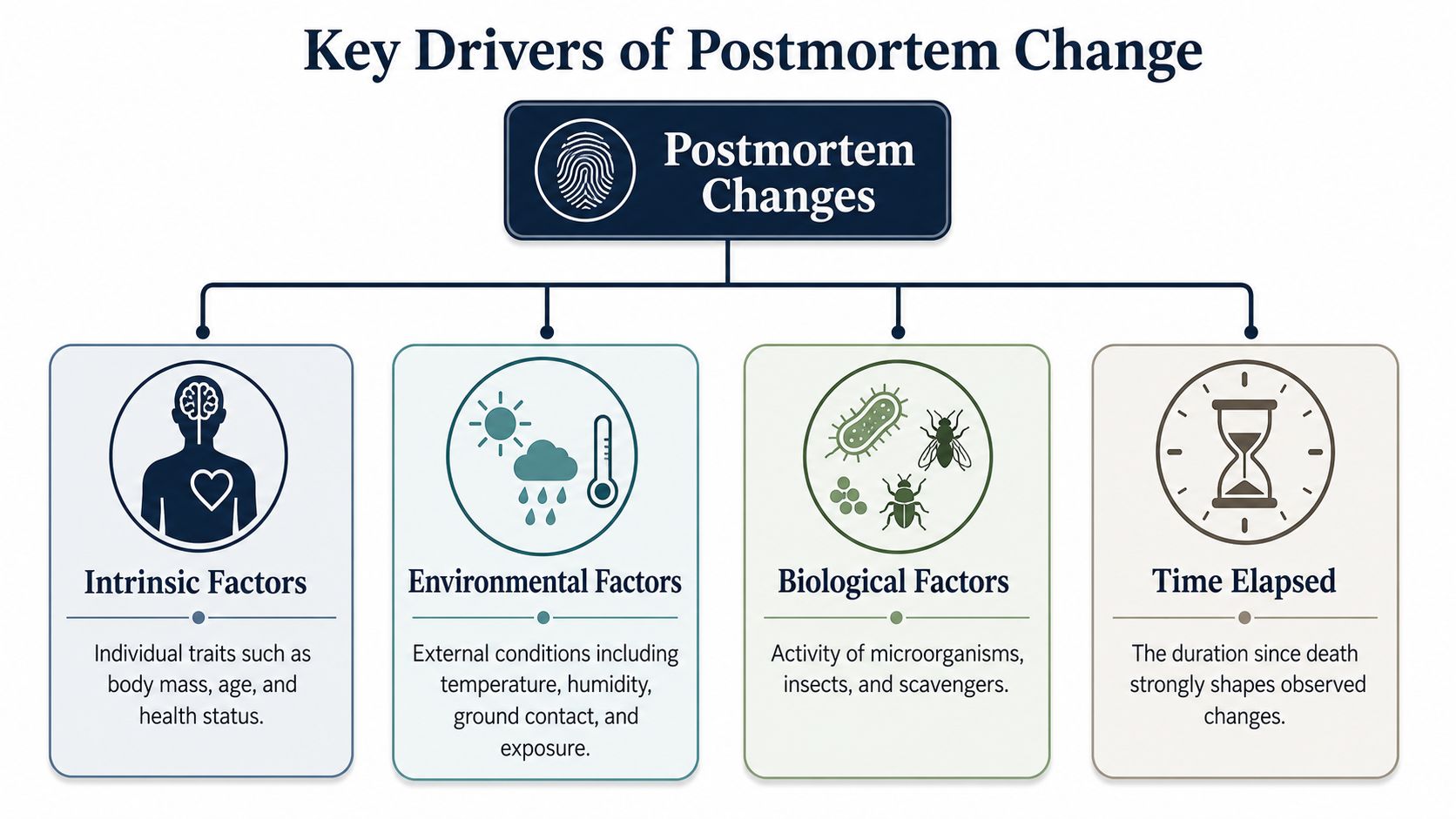
For that reason, a forensic pathologist does not treat decomposition as a single condition. We look at several drivers at once:
- Intrinsic factors include body size, age, health conditions, trauma, and natural variation in tissue composition.
- Elapsed time contributes to change, but it must be weighed alongside all other conditions.
- Biological activity includes the action of bacteria, other microbes, and insects.
- Location and exposure shape temperature, moisture, airflow, sun exposure, water contact, clothing effects, and animal access.
Why environment changes the picture
Environment often explains why two cases with a similar timeline look very different. A body in an air-conditioned room may follow one pattern. A body in a locked vehicle during Texas heat may follow another. Shade, direct sun, burial depth, wrapping, water, and soil contact can each alter the rate and character of postmortem change.
This matters in practice. Families may hear generalized online timelines and expect a simple answer based on appearance alone. Attorneys may need to know whether conditions at the scene could have accelerated tissue breakdown or limited insect access. In a private autopsy setting, especially in Texas, those questions affect how findings are interpreted, how records are reviewed, and whether added disciplines such as entomology should be considered.
This short visual overview helps show why insect evidence can become part of the timeline analysis.
The role of insect activity
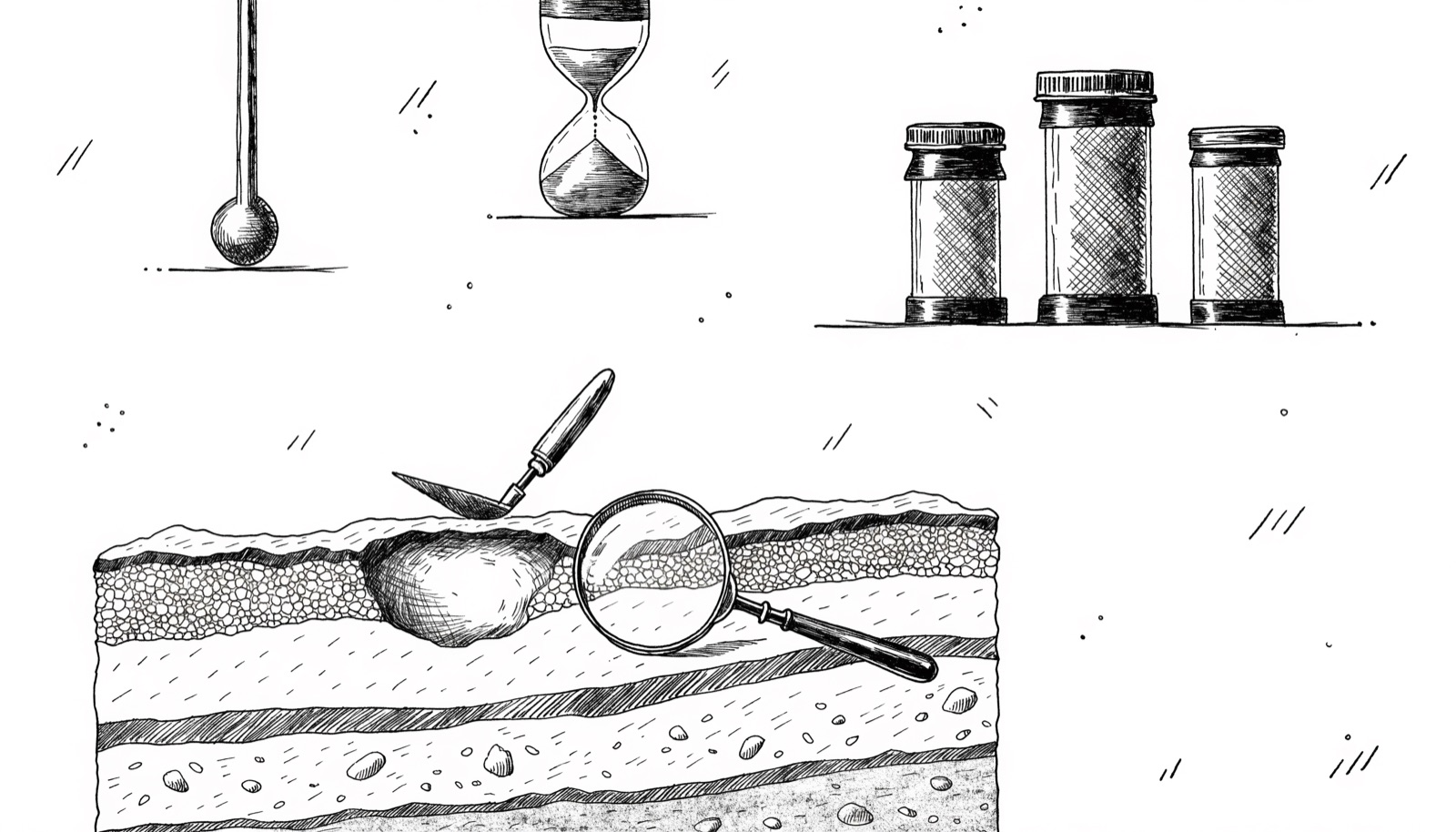
Insects can help estimate part of the postmortem interval, but only if the specimen collection, scene history, weather context, and species identification are handled correctly. Insect presence alone is not a clock. It is one line of evidence that must be read with care.
Access matters. A body indoors, wrapped, submerged, or placed where insects cannot easily reach it may show a different pattern from a body exposed outdoors. Local climate matters too. Development depends on species and temperature, so the same finding can mean different things in different settings.
Readers who want a plain-language example can review our discussion of insect evidence in the mouth and dental area. It shows how entomology can support a medicolegal opinion when the scene, the body, and the collection process are documented properly.
Environmental conditions do more than speed or slow decomposition. They also affect which findings remain available for interpretation and which findings require greater caution.
In private autopsy work, this is more than academic. It guides whether a case needs scene correlation, added photography, toxicology planning, or consultation beyond the gross examination. That bridge between forensic science and careful case handling is often what families and legal professionals need most when answers are delayed by decomposition.
Evidence Sources in a Decomposition Case
A family may be told that decomposition has made the case "too far gone" to answer. That is not how careful forensic work proceeds. In our practice, a decomposition case is read the way a fire investigator reads a damaged house. No single room explains everything. The conclusion comes from patterns that still remain, how they fit together, and what was preserved correctly from the start.
The body, the scene, and the record each carry part of the answer
The examination begins with disciplined documentation. We study the body condition, visible injury, clothing, coverings, personal effects, and any features that may connect the remains to the reported circumstances. In decomposed cases, photographs, measurements, and chain of custody records matter greatly because later interpretation often depends on details captured early and accurately.
The internal examination adds a second layer. Even after postmortem change, a pathologist may still identify trauma, natural disease, fractures, hemorrhage, aspiration, foreign material, or implanted medical devices. Imaging such as X-rays can reveal projectiles, broken bones, or hardware that may not be clear on the surface.
The scene is a third layer, not background information. Body position, enclosure, water exposure, heat, air flow, animal access, and the witness timeline all shape what the postmortem findings mean. A body recovered from a hot vehicle poses different interpretive questions than a body found indoors with climate control. The same appearance can point in different directions once the setting changes.
This matters in Texas private autopsy work because families and attorneys often need answers that fit both science and legal scrutiny. A sound opinion requires more than a body on a table. It requires correlation.
Why multiple evidence streams are compared, not isolated
Decomposition changes the body unevenly. Some tissues break down quickly. Others hold useful information longer. For that reason, forensic pathologists compare several evidence sources instead of relying on one method as a clock or a shortcut.
Histopathology, the microscopic study of tissue, may still show disease processes or tissue reactions in areas that remain interpretable. Toxicology can help assess drugs, alcohol, or poisons, but those findings must be handled carefully because decomposition can alter concentration, movement, and stability after death. Entomology can assist with timing and exposure history when collection and identification were done correctly. Medical records, EMS reports, hospital records, and law enforcement documentation may also clarify whether a finding began before death, around the time of death, or after death.
A simple way to view the evidence is to picture a mosaic. One tile rarely shows the image. Enough well-preserved tiles can.
| Evidence type | What it may help answer |
|---|---|
| External and internal exam | Injury, disease, identification features, and overall body condition |
| Histopathology | Microscopic disease, inflammation, tissue reaction, and some trauma patterns |
| Toxicology | Possible substance exposure, impairment, poisoning, or medication presence |
| Entomology | Insect access, body exposure history, and part of the postmortem interval |
| Imaging | Fractures, foreign objects, gas patterns, and medical hardware |
| Scene and records review | Context needed to interpret all other findings |
Specimen handling often determines whether later review is possible. If blood, tissue, vitreous, insects, or trace material are collected late, stored poorly, or labeled incompletely, the opportunity for clarification narrows. Our explanation of specimen preservation in forensic cases outlines why this step is so important for families seeking clear answers and for attorneys preparing a case that may be examined closely months later.
Answering Critical Questions About Causation and Timeline
A family may come to us with two pressing questions. What caused this death, and when did it happen. In a decomposed case, both questions can still be examined carefully, but the answers usually come from patterns rather than from one isolated finding.
Cause of death and manner of death
Cause of death is the injury or disease that set death in motion. Manner of death is the medicolegal classification, usually natural, accident, suicide, homicide, or undetermined.
In decomposed remains, the pathologist builds that opinion the way a physician reads a difficult clinical case. One finding may be incomplete. Several findings that fit together can still form a reliable medical and legal conclusion. Tissue changes, injury patterns, toxicology results, imaging, records, and scene details are weighed together to decide what is supported, what is only possible, and what cannot be said responsibly.
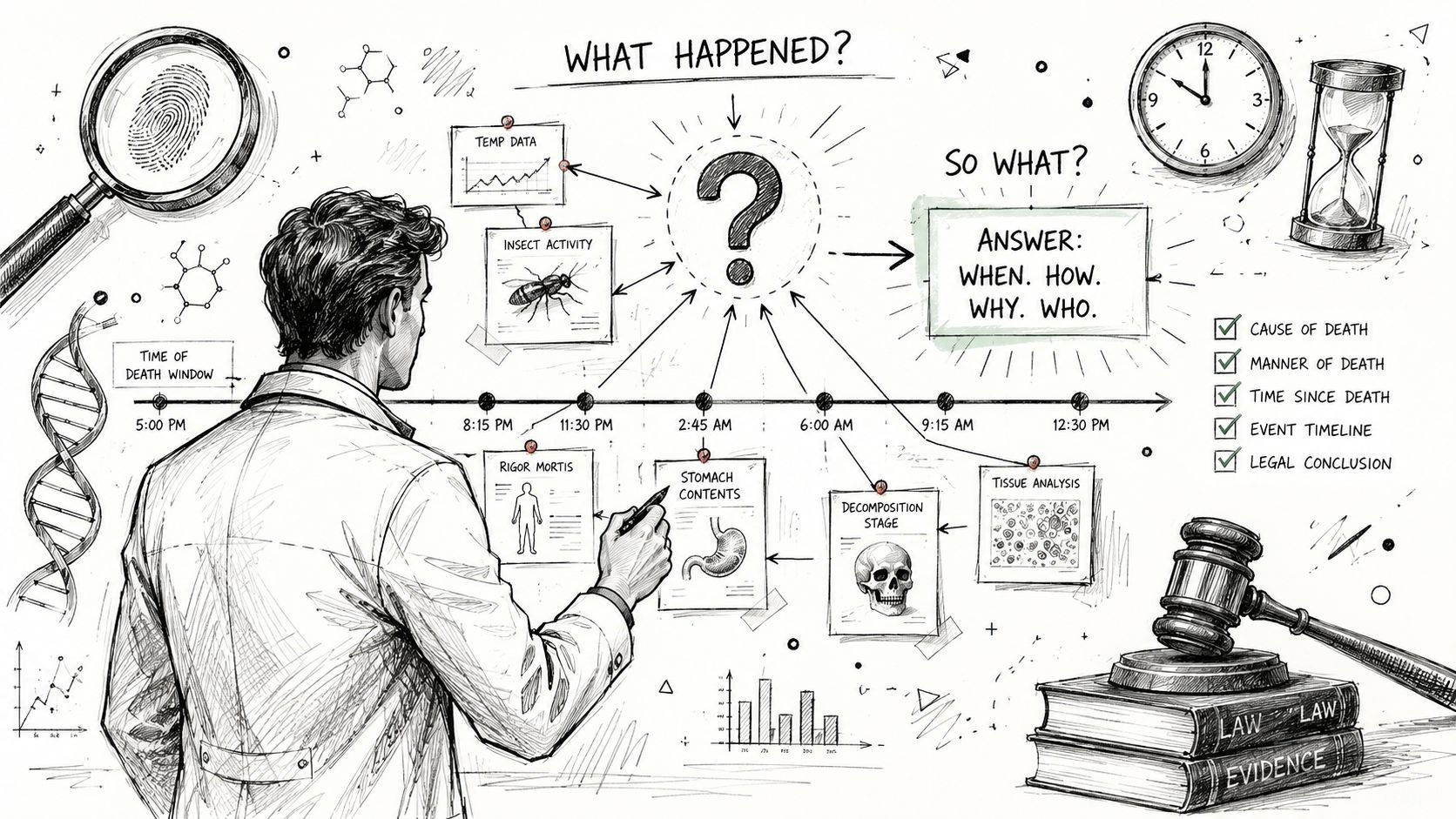
Decomposition can hide detail, but it does not erase every answer. Bone injury may remain visible. Some deep organs and autolysis-resistant tissues may still provide microscopic clues. Toxicology may still be informative, depending on the specimen and the condition of the body. A careful opinion in these cases requires restraint. If the evidence supports only a range of possibilities, the report should say so plainly.
That distinction matters in Texas private autopsy work. Families often need a clear explanation they can trust, while attorneys need opinions that are careful enough to withstand close review. Our role is to connect the science to those practical needs without stretching beyond the evidence.
What postmortem interval means
The postmortem interval, or PMI, is an estimate of the time since death. It is not a clock reading. It works more like narrowing a window, then testing whether that window fits the medical findings, the scene, and the known events around the death.
Decomposition analysis helps define that window. Body condition, insect activity, temperature history, clothing, shelter, moisture, trauma, and access by animals can all change the pace of postmortem change. For that reason, timeline opinions must be tied to the actual conditions of the case, not to a chart applied in isolation. Our discussion of how forensic teams determine time of death explains that process in greater detail.
For families, a sound PMI estimate can clarify whether a loved one was likely alone for hours, days, or longer. For legal professionals, it can help test witness statements, phone activity, surveillance gaps, transport records, and facility documentation. In wrongful death litigation, timing may shape both liability analysis and case strategy. Attorneys reviewing Legal options after a Texas fatal accident often need medical timeline evidence that is explained in plain language and documented with forensic discipline.
In the end, causation and timeline are answered the same way. Methodically. Respectfully. Within the limits of the science.
Why a Private Autopsy Is Essential for Answers in Texas
A family may leave a hospital with a death certificate pending, a brief explanation, and a long list of unanswered questions. An attorney may have the same problem in a different form. Records exist, but the medical picture is still incomplete. In Texas, that gap often leads to a private autopsy.
The reason is practical. County medical examiners and justices of the peace serve a public medicolegal role, but they do not examine every death. Texas law draws a clear line between public death investigation and private postmortem examination. Under Texas Health and Safety Code §671A.001, a private autopsy facility is a facility owned or operated by a physician who performs autopsy services for a fee, and the definition excludes medical examiner offices (FindLaw text of Texas Health and Safety Code §671A.001).
That legal distinction matters because unanswered medical questions do not disappear when a case falls outside the county's required duties.
Texas Code of Criminal Procedure Article 49.25 requires medicolegal autopsies in certain categories of death, such as deaths that are sudden, unexpected, violent, suspicious, or otherwise unnatural. If a death does not fit those categories, a public autopsy may never occur. Families sometimes read that as reassurance. It is not reassurance by itself. It may mean the case did not trigger a mandatory county examination.
Forensic decomposition analysis makes this especially important. Postmortem change can blur injuries, alter organ appearance, and complicate the timeline if no one documents the body promptly and carefully. A private autopsy gives the case a controlled medical review while those findings can still be interpreted in context. That is the bridge between academic forensic science and what families and lawyers need. A respectful examination, legally authorized, properly documented, and clear enough to use in court or to answer a family's questions.
For families, a private autopsy can answer whether disease, injury, neglect, intoxication, delayed treatment, or environmental exposure played a role. For legal professionals, it can preserve observations and specimens that may later support or challenge a claim. Attorneys evaluating Legal options after a Texas fatal accident often need that kind of medical foundation before they can assess liability, damages, or causation with confidence.
Texas also adds a geographic reality. Procedures and local resources can vary from county to county, and families may be dealing with a death far from a major metropolitan medical examiner office. In that setting, private autopsy services help close the distance between a complex forensic question and a usable answer.
A careful autopsy cannot promise certainty in every case. It can preserve evidence, apply medical judgment to difficult findings, and give both families and counsel a clearer path to the truth.
Our Compassionate and Comprehensive Autopsy Process
A family may call us within hours of a death, still trying to understand what happened and what can still be learned. An attorney may call with a different concern. Whether observations, specimens, and documentation are being handled in a way that will stand up to later scrutiny. In both situations, the process must be orderly, respectful, and medically precise from the first conversation onward.
From first contact to transport
We begin with a direct discussion of the facts known so far, the reason the examination is being requested, and who has legal authority to authorize it. Families often need simple, plain-language guidance at this stage. Attorneys and agencies often need clear procedural answers. Both deserve the same careful attention.
Transport is part of the forensic process, not a side detail. In decomposition cases, each transfer matters because condition, packaging, labeling, and timing can affect later interpretation. We use in-house licensed transport across Texas so the decedent is treated with dignity and so the record of custody remains clear from pickup through examination.
Chain of custody works like a signed handoff log for medical evidence. It documents who received the body, who handled specimens, when photographs were taken, and how materials were stored. That record helps protect the reliability of the findings in court, in licensing matters, and in private case review.
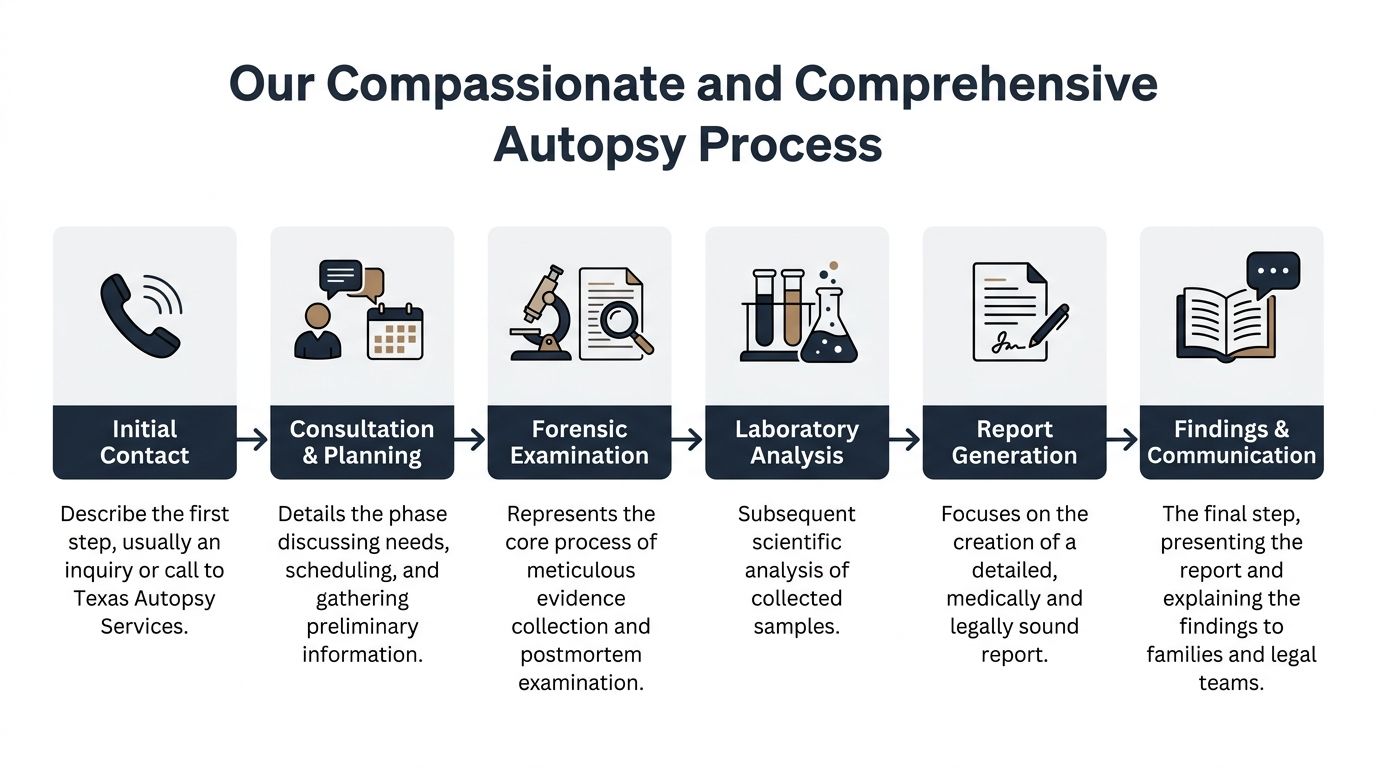
The process usually follows this sequence:
- Case intake to gather the known history, identify the authorizing party, and confirm the scope of the request.
- Transport coordination so the decedent is moved respectfully, with documented custody at each step.
- Autopsy examination by a forensic pathologist certified by the American Board of Pathology.
- Additional studies when needed, including histology, toxicology, X-rays, or other case-specific testing.
- Report preparation and communication with the authorized family member, attorney, or agency.
In Texas, that structure matters for a practical reason. Families may be far from a medical examiner office, and lawyers may need an independent medical review on a short timeline. A private autopsy service closes that gap by combining forensic standards with a process that can be arranged, documented, and explained clearly.
Examination, documentation, and reporting
No two cases require the same examination. A decomposed case may call for targeted dissection, selective tissue sampling, radiology, toxicology, review of prior medical records, or comparison with an earlier autopsy. The goal is to answer the actual medicolegal question presented by the case, not to apply a routine script.
The report must also do more than announce a conclusion. It should show how observations, photographs, specimen collection, and laboratory findings support the medical opinion. As noted earlier, Texas law defines autopsy reporting broadly enough to include the underlying materials that make the opinion reviewable. For families, that means clearer answers. For legal professionals, it means a documented basis for analysis rather than a single unexplained summary.
Timing depends on the condition of the body, the need for outside testing, and how quickly records become available. Some cases are finished quickly. Others require more time because careful forensic work cannot be rushed without risking the quality of the answer.
For readers who are evaluating options, our pages on Private Autopsies, County Forensic Autopsies, and our Waterloo Mortuary Partnership provide additional practical details about access and coordination in Texas.
FAQ
Can decomposition still allow a reliable cause of death opinion
Sometimes, yes.
Postmortem change can obscure findings, but it does not erase every answer. A forensic pathologist evaluates what remains usable, then compares those findings with toxicology, medical records, scene information, and investigative history. In some cases, that allows a well-supported opinion about disease, injury, intoxication, or another cause of death.
The practical question is whether enough reliable evidence remains to answer the medicolegal issue with professional confidence. For families in Texas, that distinction matters. A private autopsy can provide an independent review when difficult questions remain after significant decomposition.
What is the difference between cause of death and manner of death
Cause of death is the disease or injury that produced death. Manner of death is the legal classification assigned to that cause, such as natural, accident, suicide, homicide, or undetermined.
These terms are often heard together, so families may assume they mean the same thing. They do not. A gunshot wound may be the cause of death, while the manner depends on the surrounding facts, records, and investigation.
What does chain of custody mean in an autopsy case
Chain of custody is the documented record of who handled the body, specimens, photographs, and related evidence at each step.
It works like a signed transfer log. Each handoff is recorded so a family, court, insurer, or attorney can verify that materials were identified correctly, preserved appropriately, and protected from mix-ups or undocumented alteration. In a decomposed case, that documentation supports both medical reliability and legal review.
Is an autopsy automatic in Texas
No. Texas law requires public death investigation and autopsy in certain categories of death, but not in every case.
That gap is often where families and attorneys need private forensic services. If a death falls outside the county system's legal duties or practical capacity, a private autopsy may be the path to an independent medical opinion. In decomposition cases, that can affect burial planning, insurance questions, civil claims, and estate disputes.
Why does time since death estimation require more than one method
Time since death cannot be read from one sign alone.
Body temperature, insect activity, tissue change, the environment, clothing, body size, burial or exposure conditions, and prior illness can all shift the estimate. A sound opinion comes from comparing methods and seeing whether they point in the same direction. That is why decomposition analysis is careful forensic synthesis, not a simple calculation.
If your family is facing a death discovered after significant postmortem change, the need is often immediate and personal. You may need clear science, respectful communication, and documentation that can withstand legal scrutiny. Attorneys may need a documented medical basis for opinion. Families may need plain language about what can still be learned, what remains uncertain, and what steps are available in Texas.
For help with that process, contact Texas Autopsy Services. We serve all Texas counties, and each examination is performed by a forensic pathologist certified by the American Board of Pathology. Our team handles every case with medical precision, documented chain of custody, and respect for the person who has died.