February 4, 2026 · Texas Autopsy Services
A Pathologist's Guide to Determining Time of Death
A Texas forensic pathologist explains the science of determining the time of death, from classic signs to advanced methods used in private autopsies.
On this page
- Determining the time of death, or postmortem interval (PMI), is a meticulous process, not an exact science.
- In the first 72 hours, I analyze physical signs like body temperature (algor mortis), blood pooling (livor mortis), and muscle stiffening (rigor mortis).
- For deaths older than 72 hours, forensic entomology (the study of insect life cycles) provides the most reliable timeline.
- Biochemical analysis, especially of potassium levels in the eye's vitreous humor, offers a precise chemical clock in the early stages.
- My final conclusion is always a probable range, carefully calculated by weighing all evidence, including environmental and individual factors.
When a family retains my services for a private autopsy, the first question is almost always the same: "When did it happen?" In my field, we call this the postmortem interval (PMI), and establishing it is one of the most critical parts of any death investigation. It’s not like what you see on television, where a gadget provides an exact time. The reality is a meticulous process of piecing together scientific clues to build a reliable timeline.
Why the Timeline Matters
Establishing an accurate PMI isn't just about satisfying curiosity. A precise timeline can verify or discredit an alibi in a legal case, help investigators understand the sequence of events, and give grieving families the concrete answers they need to begin processing their loss.
Here at Texas Autopsy Services, I apply these principles every day. Whether I'm performing an examination for a family seeking clarity or providing county forensic autopsy services, the goal is always precision and compassion. A solid timeline is the foundation of the entire investigation. Without it, evidence can be misunderstood, and the story of what happened remains incomplete.
As a forensic pathologist board-certified by the American Board of Pathology, I interpret the story a body tells after death. This isn't a single skill but a combination of direct observation, advanced scientific testing, and an experienced understanding of how the body changes once life ends. My experience includes over 1,000 autopsies performed across adult, pediatric, and specialized cases, each reinforcing the importance of a methodical approach.
Estimating the time of death is a complex puzzle, and several key pieces influence the final picture:
- The Environment: A body left in the Texas summer heat changes dramatically faster than one in an air-conditioned room.
- The Individual: A person's body weight, clothing, and overall health at the time of death all have a significant impact.
- The Circumstances: How someone died can sometimes speed up or slow down the natural postmortem processes.
My job is to put all these variables together to form a scientifically sound opinion. The initial examination sets the stage for everything else, shaping how a medical examiner establishes the cause of death. Knowing how the scene is handled, including police and coroner's perspectives on unattended death, provides crucial context to the medical findings.
The First 72 Hours: The Classic Signs
In the first few days after death, the body undergoes a series of predictable physical changes. When I begin an examination, my first step is to look for what we call the "triad of death": algor mortis, livor mortis, and rigor mortis. Each of these signs is a critical piece of the timeline puzzle.
First is algor mortis, the cooling of the body. Once the heart stops, the body’s internal furnace shuts off, and it gradually adjusts to the temperature of its surroundings. You’ll often hear a rule of thumb that a body cools at about 1.5°F per hour, but that’s just a rough starting point.
In reality, that rate varies widely. I must consider everything. Was the person bundled in a heavy coat? Was the room air-conditioned, or was it a hot day? Factors like body fat, which acts as insulation, or even a slight breeze can dramatically change the cooling process. This is where experience really comes into play.
Reading the Signs in Blood and Muscle
Next, I look for livor mortis, or lividity. This is the purplish-red discoloration on the skin as gravity pulls the blood down to the lowest parts of the body. It starts to appear within a few hours.
Lividity is incredibly revealing. It helps narrow the timeline because the pattern becomes "fixed" and won't shift after about 8 to 12 hours. More importantly, if the pattern of lividity doesn't match the body's position—say, the discoloration is on the back, but the person is found face down—it indicates that the body was moved.
Finally, there’s rigor mortis, the stiffening of the muscles. This process is predictably sequential. It begins in the small muscles of the jaw and face within a couple of hours, works its way through the larger muscle groups, peaks, and then fades as the muscles start to break down. By checking which parts of the body are stiff, I can establish a reasonable bracket for the time of death.
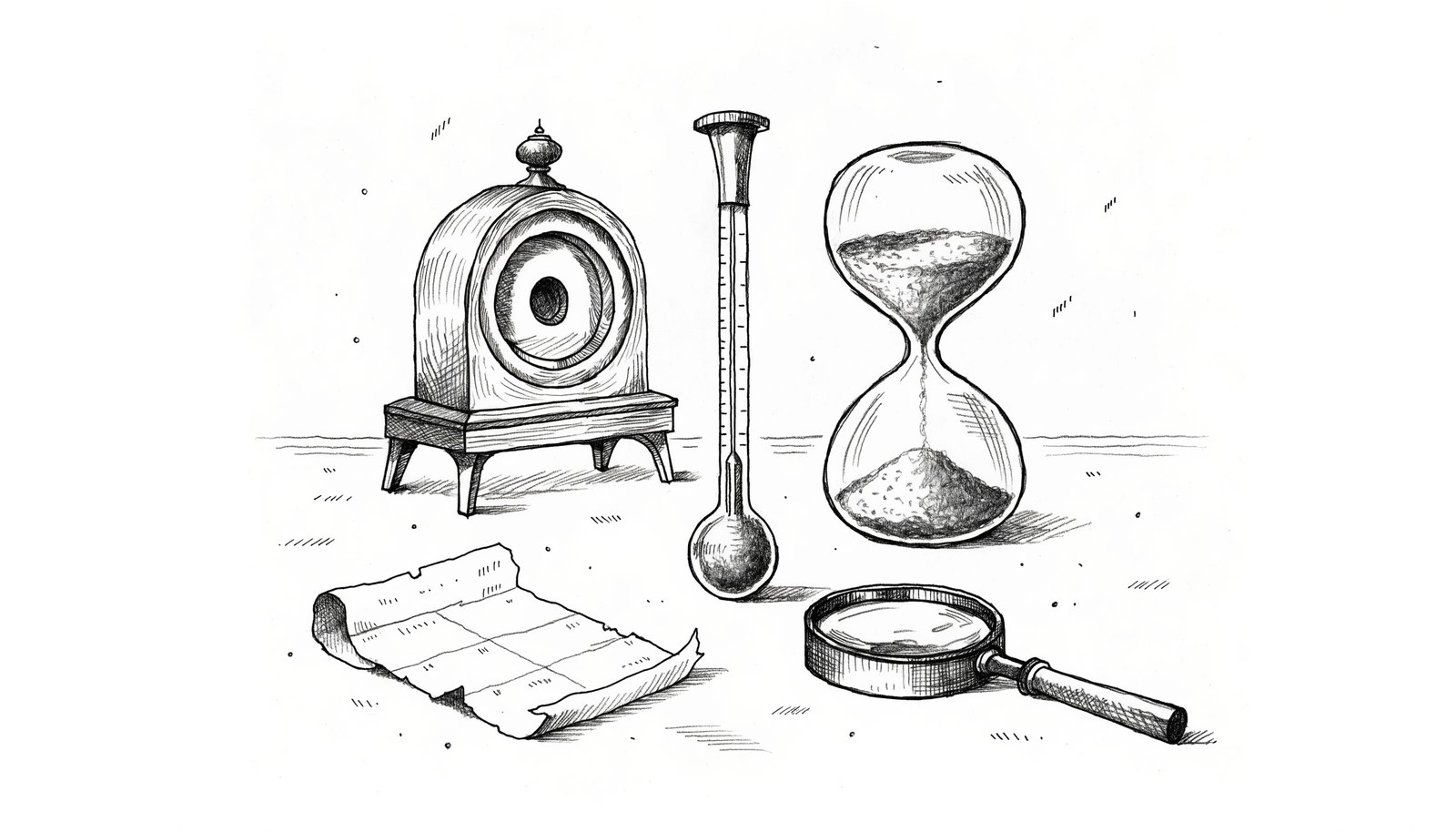
The infographic below shows how these early observations are the foundation for building the entire postmortem interval.

As the visual lays out, it's not a single observation but a systematic process of gathering clues to build a scientifically sound timeline.
Integrating the Data for an Accurate Estimate
None of these signs works in a vacuum. The real skill is in piecing them all together. I have to cross-reference what I see with the scene and the environment. For example, a body that's still warm but completely limp (flaccid) tells me death likely occurred within the last 3 hours. On the other hand, if the body is cold and stiff, we’re probably looking at a window between 8 to 36 hours.
This table gives a quick overview of how these classic indicators work together.
| Indicator | Description | Typical Timeline | What I Look For |
|---|---|---|---|
| Algor Mortis | The cooling of the body to ambient temperature. | Begins immediately; rate varies. | Core body temperature compared to the environment. |
| Livor Mortis | Gravitational pooling of blood causing skin discoloration. | Noticeable in 2-4 hours; fixed by 8-12 hours. | Color, location, and whether the pattern is fixed or "blanchable." |
| Rigor Mortis | The stiffening of muscles after death. | Starts in 2-4 hours, peaks around 12 hours, gone by 48-60 hours. | Which muscle groups are affected and the degree of stiffness. |
By weaving these observations together, I construct that crucial initial estimate. This is the foundation that guides the rest of the investigation. You can explore published research on postmortem interval estimation for more detail.
These early signs are our most reliable tools for the first 72 hours. After that, they start to fade in usefulness as decomposition takes over, and we have to switch to a different set of scientific methods to continue refining the timeline.
Beyond 72 Hours: Forensic Entomology
Once about 72 hours have passed, the classic signs used to estimate time of death become less reliable. The body’s own processes are no longer following a predictable schedule. This is where nature provides an entirely different kind of clock, one managed by the field of forensic entomology.
Put simply, this is the scientific study of insects.
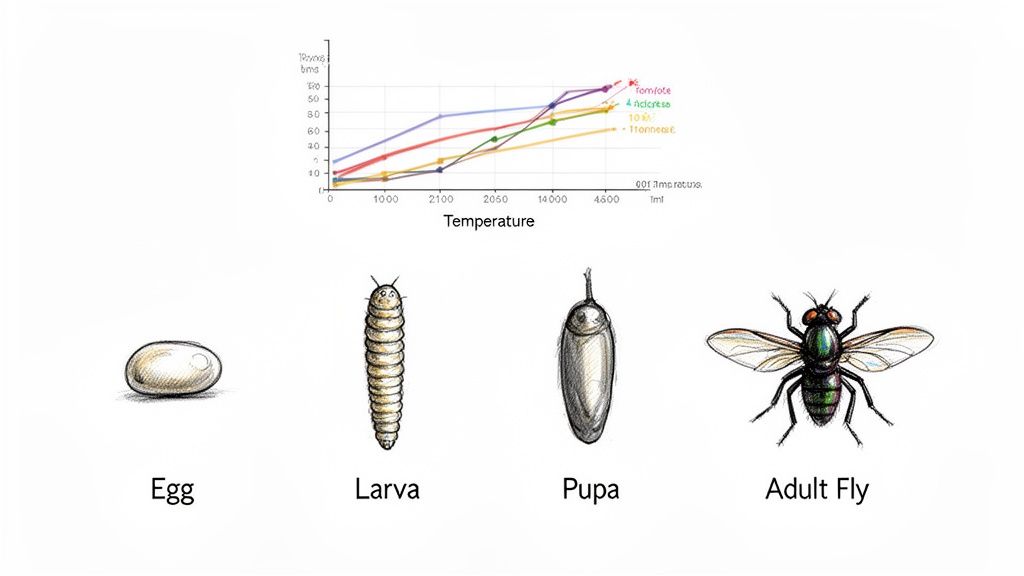
It may sound macabre, but the life cycles of certain insects, especially blowflies, are incredibly predictable. They are often the first to arrive at a scene, sometimes within minutes of death, to lay their eggs. This consistent, instinctual behavior is what allows us to extend time of death estimates far beyond the first few days.
How Insects Create a Timeline
I often describe it to families as a biological clock that starts ticking almost immediately, particularly when a death occurs outdoors. The development of insect larvae (maggots) is directly tied to two key factors: temperature and time.
Different species also show up in predictable waves, a process we call insect succession. This gives us a layered timeline.
- First Responders: Blowflies are the first on the scene. Their presence, and the developmental stage of their larvae, helps us understand the timeline from the first few hours up to several days.
- The Second Wave: As decomposition progresses, different tissues become available, attracting beetles and other types of insects. Their arrival signals that more time has passed.
- Late-Stage Specialists: Some species, like certain moths and mites, only appear weeks or even months later, offering clues in cases that are much older.
By collecting and analyzing the insect evidence, a forensic entomologist can calculate a minimum time since death with remarkable accuracy. Blowflies, for example, often lay eggs that hatch within 8-24 hours. Their growth is so calibrated to temperature that at a steady 77°F (25°C), some common fly larvae mature in just 10-15 days. This can help us narrow the postmortem interval down to a day or two. You can read more on the scientific principles of forensic entomology to get a deeper sense of the science.
It Takes a Team
As a forensic pathologist, I know my strengths and when to call in another expert. While I can recognize when an entomological analysis is needed, the detailed work of identifying species and calculating their growth against temperature data is a job for a board-certified forensic entomologist.
My job is to be the first line of defense for the evidence. I carefully collect and preserve the insects at the scene or during the autopsy and provide the entomologist with any available environmental data, like temperature logs from the area. This kind of collaboration is crucial. It’s about using every scientific tool at our disposal to deliver the most accurate answers possible. At Texas Autopsy Services, I’m committed to a scientifically rigorous process that my partners at Waterloo Mortuary and I believe in.
Microscopic and Chemical Clues
What the naked eye can see is only part of the story. To get a clearer picture, we must look closer, down to the cellular and chemical level. This is where histopathology (the study of tissues under a microscope) and biochemistry provide hard data to back up physical observations.
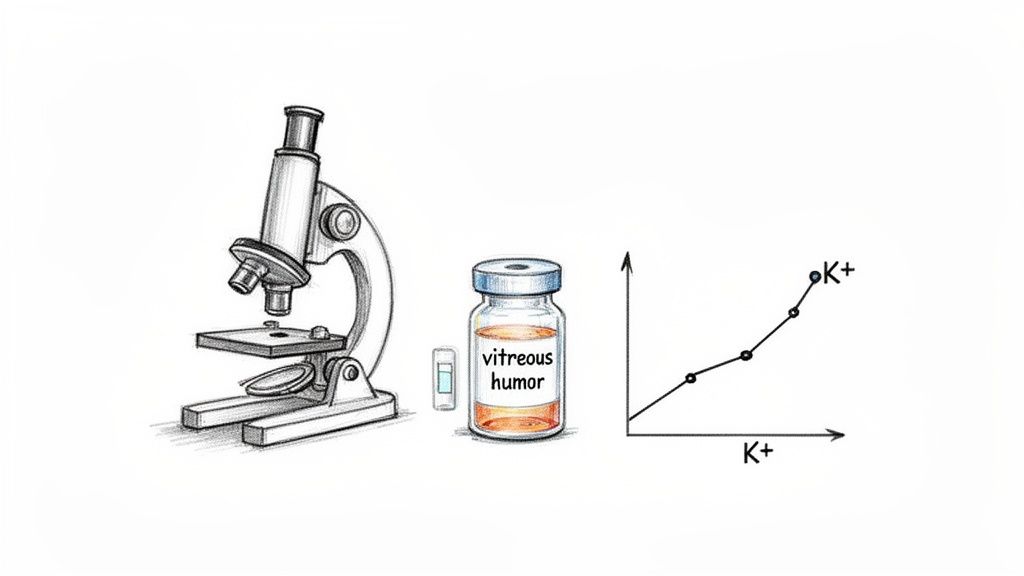
During a private autopsy, I take tiny tissue samples to examine the rate of cellular breakdown. It's a process called autolysis, where a cell’s own enzymes start to digest it from the inside out after death. This self-destruction happens at a reasonably predictable pace.
At the same time, certain chemical shifts in the body’s fluids can act like a ticking clock, especially in the early hours after death. These chemical markers give us solid numbers that aren't as easily skewed by the outside environment as the classic signs are.
The Chemical Clock in the Eye
One of the most reliable methods we have involves analyzing the fluid from inside the eyeball, called the vitreous humor. After someone passes away, the cells around the eye slowly release potassium into this fluid at a very steady rate. By taking a small sample and measuring the potassium levels, I can work backward to calculate a surprisingly accurate time of death.
The real benefit of this method is that the eye is a self-contained, protected environment. This means the vitreous humor is shielded from the contamination and temperature swings that can throw off other measurements. These biochemical and cellular changes are most useful in the early postmortem period, especially within the first 84 hours. The potassium level in the vitreous humor starts around 2.5 mmol/L at the time of death and climbs to between 8-10 mmol/L by the 24-hour mark.
When we plot these numbers against standard charts, we can often narrow the time of death down to a window of ±2 to 4 hours. In controlled settings, labs in the U.S. report 85-90% reliability with this test on fresh cases. For those interested in the details, you can read more about the scientific basis of the post-mortem interval.
Building a Complete Picture
Of course, none of these tests are ever used in isolation. My job is to weave all the evidence together—the classic signs like rigor mortis, the temperature of the body, the scene environment, and these lab results. Each one is a piece of the puzzle. When we add in results from post-mortem toxicology, the timeline becomes even more robust. I always explain what these complex tests mean in simple terms, showing how objective lab data supports the physical exam.
The Importance of Context and Environment
If I had to pick one thing that can throw off a time of death estimate, it would be the environment. It’s the single most powerful variable we deal with, and it’s why determining a precise moment of death is an expert estimation rather than an exact science.
A body left in the Texas summer heat is on a completely different timeline than one found in a cool, air-conditioned bedroom. Temperature drives almost everything that happens after death, from how quickly the body cools to the life cycle of the insects that arrive on the scene. That’s why the first questions I ask are always about the "where"—where was the person found, what was the room temperature, were they in direct sunlight?
More Than Just Temperature
But it’s not just about the thermostat. A range of factors creates a unique biological clock for every case, and I have to weigh each one to build a reliable timeline.
Here are a few I always consider:
- Body Type and Health: A person's physical condition is a major factor. Someone with a higher body fat percentage will cool down much more slowly because fat acts as a natural insulator. This directly impacts our algor mortis calculations.
- Clothing and Coverings: Was the person wearing a heavy coat or under a thick blanket? Anything that traps body heat can dramatically slow the cooling process and even affect the timeline for rigor mortis.
- Pre-existing Medical Conditions: The cause of death itself can skew the timeline. Someone who passed away with a high fever from an infection starts with a higher-than-normal body temperature, which throws off standard cooling models. Conditions like sepsis can also accelerate decomposition.
The Pathologist's Role in Weighing Evidence
This is why my final report always gives a range for the time of death, not a single timestamp. My job is to interpret biological clues, carefully weighing all interacting variables to narrow that window as much as the evidence allows. It’s a lot like detective work, but my clues are biological and chemical.
One piece of evidence might point to a shorter time since death, while another suggests a longer one. I must figure out which clues are the most reliable in that specific scenario. For instance, testing the potassium levels in the eye's vitreous fluid can be incredibly accurate. But if the body is too decomposed, that test is useless, and I must pivot to what the insect evidence is telling me.
This is where experience is everything. Having performed over 1,000 autopsies as a board-certified forensic pathologist, I've developed the judgment needed to synthesize these complex, often contradictory, data points. Ultimately, providing that clarity is at the heart of what we do at Texas Autopsy Services. It demands a methodical, careful approach that respects both the science and the human story behind every case.
An Independent Autopsy Provides the Clearest Answers
When a loved one passes away, uncertainty can be one of the heaviest burdens. Families and their attorneys often have more questions than answers, which is why they turn to a private autopsy to get a clear, complete picture of what happened. An independent examination by a board-certified forensic pathologist provides an unbiased, purely medical investigation into the facts. It’s a process that stands apart from any official inquiry, ensuring total objectivity.
At Texas Autopsy Services, my focus is on meticulously documenting every detail, following the most rigorous legal and ethical standards in Texas, including those set by the Texas Funeral Service Commission. My job isn't to assign blame. It's to uncover the scientific truth, which can provide much-needed clarity for both personal closure and legal proceedings. That independence is what makes a second opinion so powerful. The sole aim is to produce a comprehensive, evidence-based final report that can stand on its own merits.
This work is about more than just science; it’s about providing a compassionate service that gives families the clarity they deserve during a time of immense grief. From a complete external and internal examination to coordinating advanced toxicology and histology, my only objective is to provide a clear, accurate, and defensible cause of death. You can learn more about what a private autopsy service involves and see if it’s the right path for your situation.
What an Independent Examination Involves
A private autopsy is a deep dive designed to leave no stone unturned. It isn't just about determining the time of death; it's about piecing together the complete medical story of a person's final hours.
Here’s what that process typically looks like:
- A Complete Review of Records: First, I analyze all the paperwork—medical history, scene reports from law enforcement, and any witness statements—to build a foundational understanding of the circumstances.
- Thorough Physical Examination: This is a detailed external and internal examination to document every sign of injury or underlying natural disease.
- Advanced Laboratory Testing: I arrange for specialized testing, like toxicology to screen for drugs or other substances, and histology to examine tissues under a microscope.
- A Comprehensive Final Report: In the end, families and their legal counsel receive a detailed report that lays out the cause and manner of death in plain language, all backed by solid scientific evidence.
When the official cause of death is "undetermined," or if you feel something was missed, an independent autopsy offers a way forward. It provides the objective, science-based foundation needed to truly understand what happened, helping families find peace and legal teams build their cases on solid ground.
Common Questions About Determining Time of Death
Over the years, I've had countless conversations with families and attorneys about how we determine the time of death. When you're going through a difficult time, you deserve clear, straightforward answers.
How accurate is the estimated time of death?
The accuracy hinges on how long it's been since the person passed away. In the first 24 to 48 hours, I can usually provide a tight estimate, often a window of just a few hours. I rely on the classic trio of signs—body temperature, rigor mortis, and lividity—and can cross-reference those findings with chemical tests like vitreous potassium.
As more time passes, that window widens. After 72 hours, for instance, clues from forensic entomology become incredibly useful, but environmental factors always introduce uncertainty. That’s why my final opinion is always presented as a probable range, never an exact moment. It’s an expert estimation built by piecing together all the scientific evidence I can find.
Can you determine time of death after embalming?
This is a major challenge. Embalming dramatically alters the body, essentially wiping away many of the key clues a forensic pathologist needs. The process removes blood, which means livor mortis (the settling of blood) is gone. The chemicals used also interfere with the natural course of rigor mortis and halt decomposition. While a seasoned pathologist can still uncover some information, our ability to narrow down the time of death is drastically reduced. This is one of the most important reasons to arrange a private or second opinion autopsy before any embalming occurs, if possible.
Why would a family need a private autopsy for this?
Families seek a private autopsy to clarify the time of death for a few critical reasons. Sometimes, particularly in an unattended death, an official autopsy might not be performed by the medical examiner or justice of the peace. This can leave the family with an unknown timeline and many unanswered questions. In other scenarios, a family or their legal team might have serious doubts about the official findings and need an independent second opinion from a board-certified expert. This is common in civil lawsuits or insurance disputes, where establishing an accurate time of death can be a critical piece of evidence.
My role at Texas Autopsy Services is to step in when these questions arise. I provide an objective, thorough, and scientifically rigorous examination to deliver the definitive answers that families need for closure and legal teams require for their cases.
When you need clear, compassionate answers, Texas Autopsy Services is here to help. Please contact our office directly to discuss your specific needs with me. You can reach us at https://www.texasautopsyservices.com.