March 20, 2026 · Texas Autopsy Services
A Guide to the Lake County Coroner's Office for Families
Navigating the Lake County Coroner's Office? My guide explains their role, processes, and how a private autopsy can provide answers for your family.
On this page
- Understanding the Lake County Coroner's Office
- What to Expect When the Coroner Is Involved
- The Coroner's Autopsy and Death Certificate Process
- How Public Data Gives Families and Advocates a Powerful Voice
- When to Consider a Private Autopsy or Second Opinion
- How an Independent Forensic Pathologist Can Help
- Frequently Asked Questions About Death Investigations
- The Lake County Coroner's Office investigates sudden, unexpected, or suspicious deaths to determine the cause and manner of death.
- A coroner is an elected official who manages investigations; they are not required to be a physician and contract with forensic pathologists for autopsies.
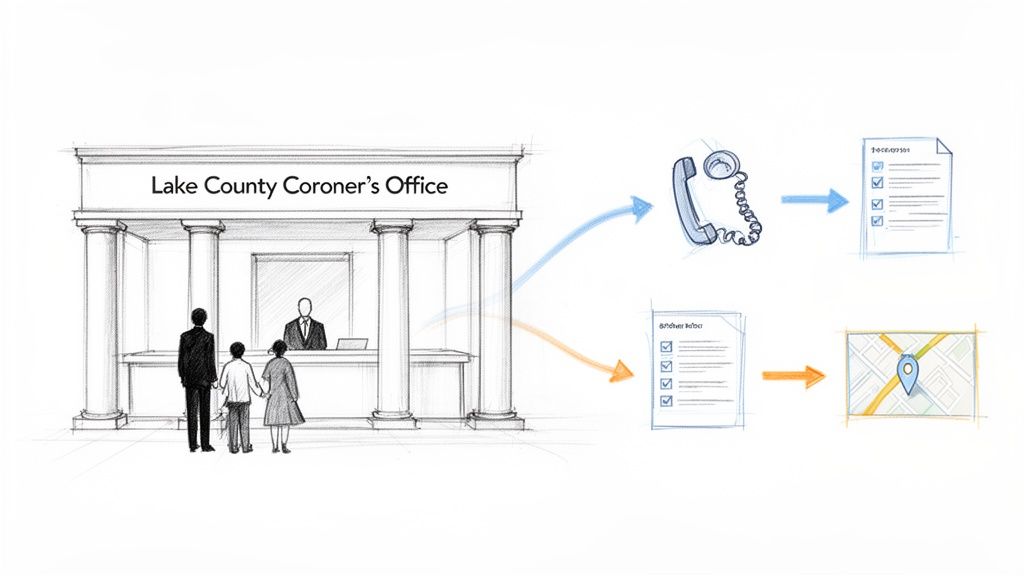
- The coroner's process involves responding to the scene, conducting an investigation, and certifying the cause of death.
- Families can seek a private, independent autopsy for a second opinion, especially if the cause of death is undetermined or if there are concerns about medical care.
- My role as a board-certified forensic pathologist is to provide families and attorneys with objective, scientifically precise answers.
As a forensic pathologist, I've spent years working with families and attorneys trying to make sense of a sudden, tragic loss. One of the first official contacts they have is often with the local coroner, and it's an interaction that can be confusing and intimidating. My goal here is to explain what the Lake County Coroner's Office does and what its role is in these difficult situations.
Understanding the Lake County Coroner's Office
The Lake County Coroner's Office is the government agency responsible for investigating deaths that are sudden, unexpected, or occur under unusual circumstances. Their primary duty is to determine the cause and manner of death when the answers aren't immediately clear.
If someone passes away from a known illness while under a doctor's care, that doctor can typically sign the death certificate. But when a death results from an accident, an act of violence, or if a person dies suddenly without a recent medical history, the coroner's office is legally required to step in.
Their investigation is independent and fact-driven. The coroner's jurisdiction generally covers cases like:
- Deaths resulting from violence, including homicides and suicides.
- Fatal accidents, like car crashes or incidents at a workplace.
- Sudden deaths, especially when the person appeared to be in good health.
- Any situation where a physician isn't available or willing to certify the death.
- Deaths that occur under any suspicious or unexplained circumstances.
This work is a crucial public service. It provides the first official answers for the family and for the public record.
Coroner vs Medical Examiner
People often use the terms "coroner" and "medical examiner" interchangeably, but they are quite different.
A coroner is typically an elected official who runs the office. They may or may not be a doctor; their role is primarily administrative and investigative. A coroner manages the investigation but does not perform autopsies.
On the other hand, a medical examiner is a physician—specifically, a forensic pathologist like me—appointed to run the office. Because they have extensive medical training, they can lead investigations and perform the autopsies.
Lake County operates with a coroner system. This means when an autopsy is necessary to determine the cause of death, the coroner's office contracts with an independent forensic pathologist to perform it. Both systems are designed to find answers. You can learn more about the differences between a coroner and a medical examiner in our guide.
At its heart, the coroner's office has a simple but profound mission: to speak for the dead and give answers to the living. Their findings create the official record of what happened, which becomes the foundation for death certificates, insurance claims, and any legal proceedings that may follow.
What to Expect When the Coroner Is Involved
It’s a call no one ever wants to get. When a deputy coroner explains that a loved one has passed away, the shock and confusion can be overwhelming. My goal here is to explain this process, so you know what’s happening, why it's happening, and what comes next.
When the Lake County Coroner's Office gets involved, it’s because a death occurred under circumstances that legally require an independent investigation. The first step is usually that difficult phone call to the legal next-of-kin from a deputy coroner or investigator. They understand this is devastating news and are trained to be sensitive while gathering necessary initial information.
The Initial Scene and Investigation
While you are receiving this news, an investigation is already underway. A team from the coroner's office is at the scene, working alongside law enforcement. Their job is to secure the area, carefully document everything, and piece together the events that led to the death. It’s a methodical and careful process that is crucial for the integrity of the entire investigation.
After the on-scene work is done, your loved one will be transported to the coroner’s facility with dignity and respect. Any personal belongings they had are meticulously inventoried, secured, and held for the family. The office will later explain how you can retrieve these items.
This entire process, from the first report of the death to the final certification, is designed to be thorough and precise.
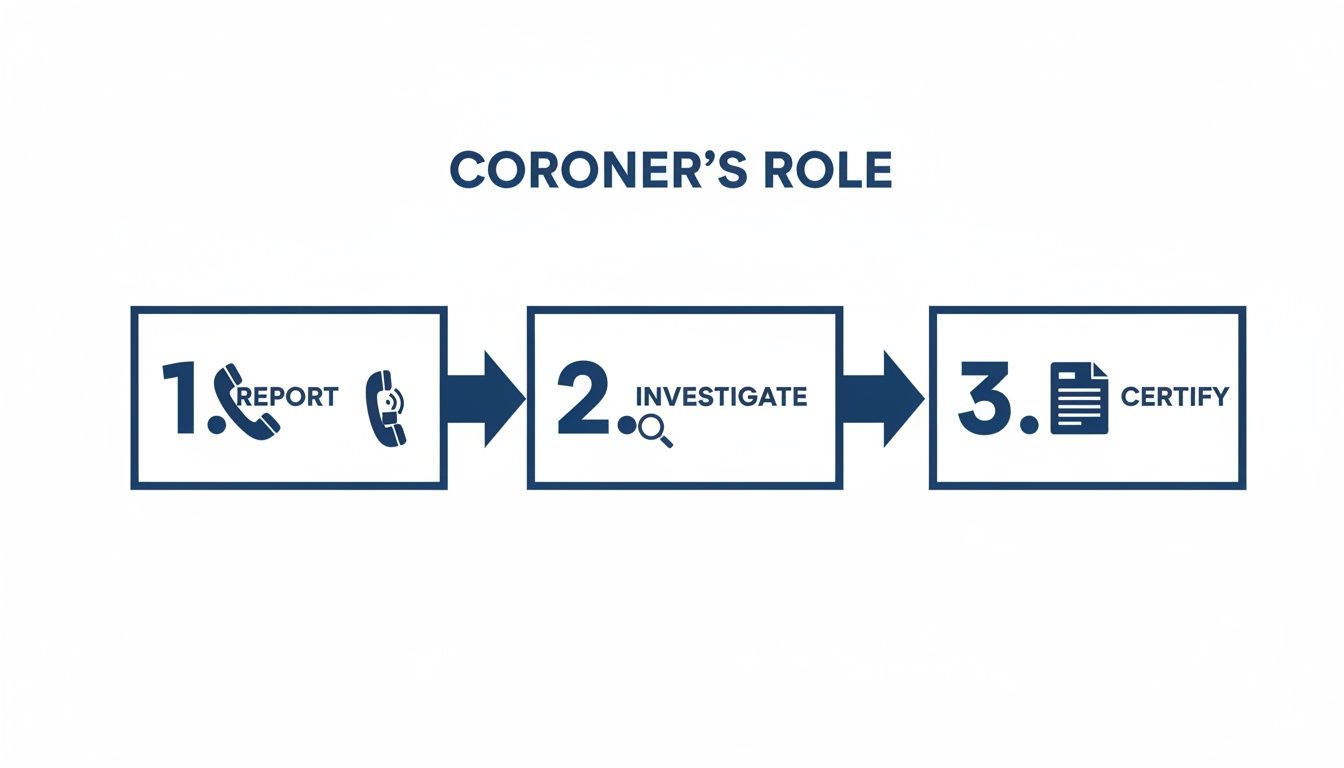
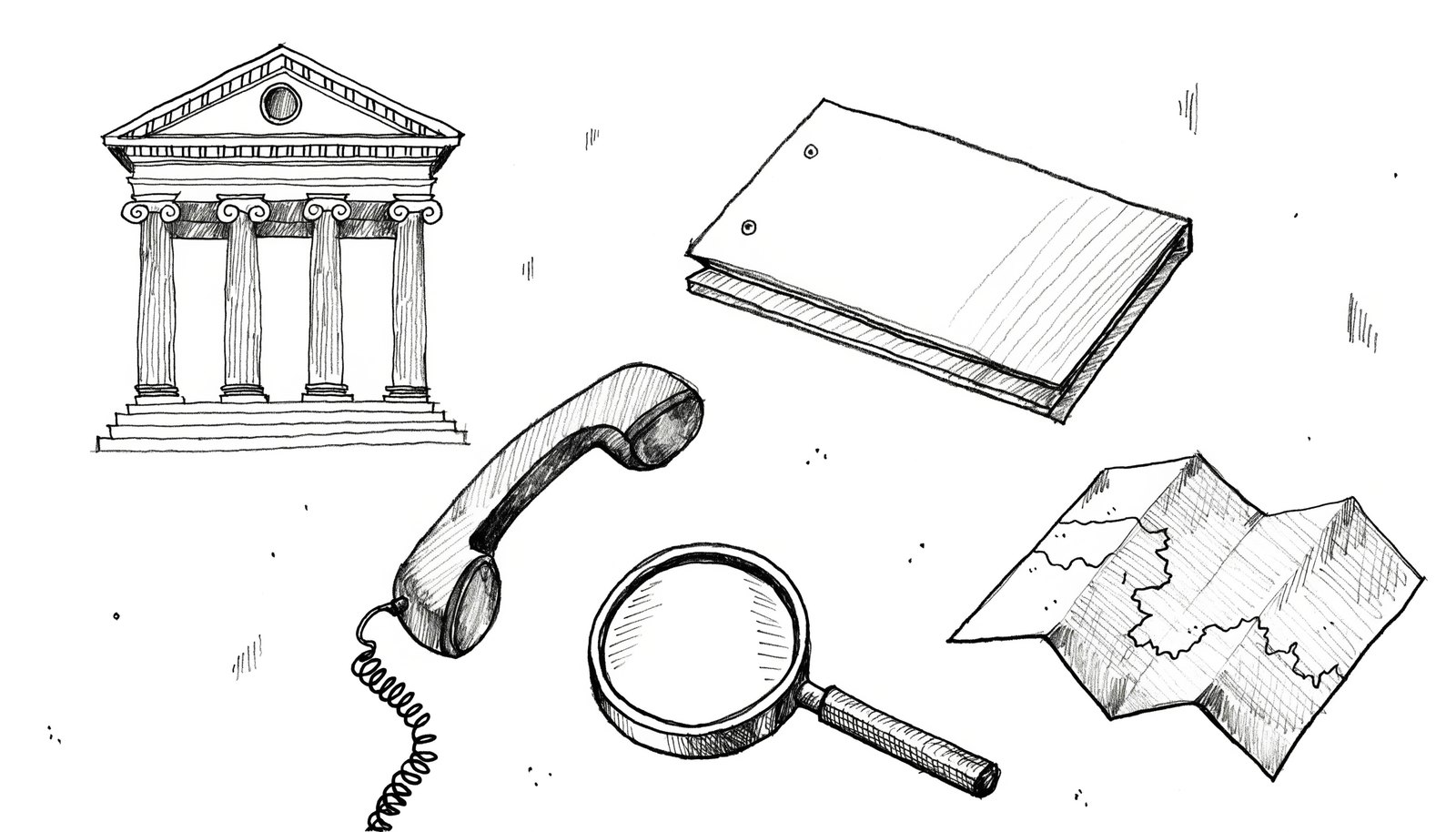
As you can see, the core functions are straightforward: respond, investigate, and certify. Each step provides a piece of the puzzle needed to determine the cause and manner of death.
Identification and Next Steps
One of the first and most critical tasks is confirming positive identification. While a family member might be asked to help, coroners often prefer to use scientific methods like dental records, fingerprints, or DNA. This ensures 100% certainty, which is a legal requirement before any death certificate can be issued.
Around this time, you’ll also be asked to select a funeral home. Once you've made a choice, the coroner's office communicates directly with the funeral director to coordinate the release of your loved one’s remains. This allows you to focus on making arrangements without being caught in the middle.
The coroner will also decide if an autopsy is necessary to determine the cause of death. This decision is based on specific legal and medical criteria. If you'd like to understand more, we have an article that goes into greater detail on when autopsies are typically performed. The ultimate goal is always to provide clear answers.
The Coroner's Autopsy and Death Certificate Process
A forensic autopsy can provide definitive answers, but it's not performed for every death. The decision to proceed with an autopsy is based on specific circumstances where the cause of death isn't immediately clear. Let’s walk through how this process works.
The Lake County Coroner's Office has a legal duty to investigate certain types of deaths. If a death falls under their jurisdiction and the cause is questionable, they determine if an autopsy is needed. This typically happens when a death appears to be from non-natural causes.
When an Autopsy Is Ordered
So, what triggers a coroner to order an autopsy? It usually comes down to a few key situations:
- Any suspected homicide or suicide.
- Accidents where the exact cause of injury isn't obvious, such as a person found after a fall.
- Deaths that occur under suspicious or unusual circumstances.
- When the deceased person had not recently been under a doctor's care for a known medical condition.
This isn't done to be invasive. It’s done because it’s often the only way to get conclusive medical evidence. As a forensic pathologist, I know an autopsy reveals a story that a simple external exam just can't tell.
The procedure itself is a highly systematic medical examination. A pathologist conducts a thorough external and internal review and collects tissue and fluid samples. These samples are crucial for toxicology tests and microscopic analysis. Every single step is carefully documented.
A coroner's autopsy has one primary goal: to determine the cause and manner of death with scientific certainty. It is a fact-finding mission, carried out with the deepest respect for the person who has passed away.
The Death Certificate and Pending Cases
Once all the investigative work and testing are complete, a pathologist can establish two critical pieces of information: the cause of death (the specific injury or disease that led to death) and the manner of death (which falls into one of five categories: natural, accident, suicide, homicide, or undetermined).
This information is then used to complete the official death certificate.
You might see the cause of death listed as "pending." This is a completely normal part of the process. It simply means that we are waiting on further test results, usually from toxicology, before making a final determination. Getting those results back can take several weeks.
As soon as all lab results are in, the coroner’s office will update the death certificate with the final findings. This document is the legal proof of death required for settling estates, filing life insurance claims, and handling other official matters.
For a closer look at this crucial document, you can learn more about how a death certificate is completed and how a cause of death is determined in our detailed article.
How Public Data Gives Families and Advocates a Powerful Voice
A coroner's investigation provides critical answers for a grieving family. But when you step back and look at the data from all investigations across a county, a much larger story emerges. This bigger picture is an essential tool for improving public health and community safety. It allows officials to stop reacting to tragedies and start proactively preventing them.
The Lake County Coroner's Office in Illinois is a fantastic example of this principle in action. They’ve embraced transparency by creating public dashboards that let anyone see and understand what's happening in their community. It’s a way of turning heartbreaking individual losses into valuable information that can genuinely save lives.
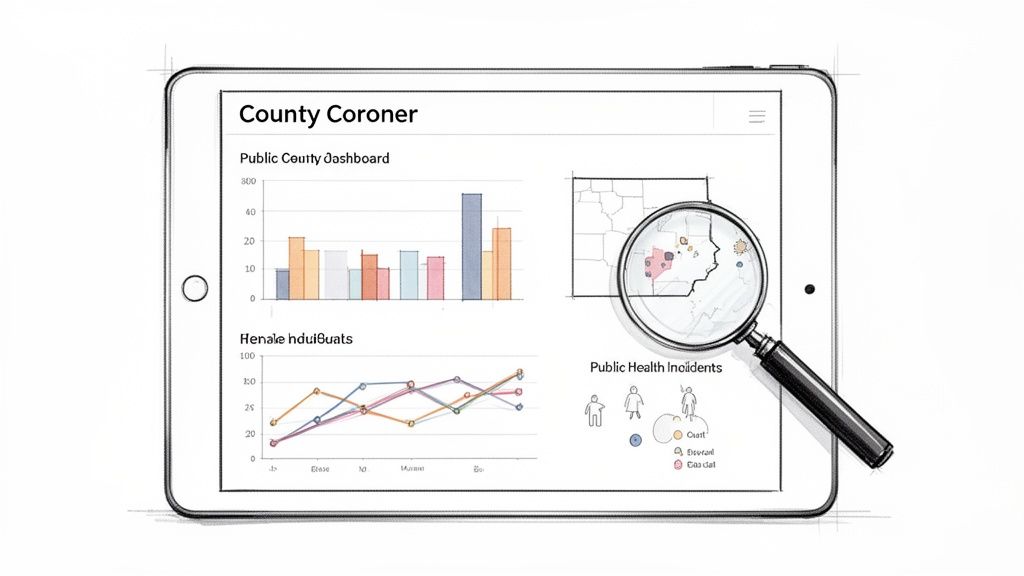
Putting Data to Work for Prevention
This isn't just about charts and numbers; it's about real-world impact. Here’s how different groups can use this information:
- Public Health Advocates can point to rising overdose numbers to secure more funding for addiction services or naloxone.
- Attorneys and Families can see if a tragic accident is part of a larger pattern, which can provide crucial context.
- Traffic Engineers can use crash data to pinpoint dangerous intersections that need immediate attention.
- Mental Health Groups can identify which communities are most affected by suicide and direct their support and outreach efforts.
For families navigating the aftermath of a loss, the details on the death certificate are often a starting point for legal questions. Understanding the wrongful death lawsuit timeline and what to expect can be an important part of their journey toward finding answers.
When a community can clearly see its own challenges through transparent data, it gains the power to demand and create real change. This is the foundation of informed advocacy.
This commitment to clarity is exactly what I believe in at Texas Autopsy Services. My entire focus is on delivering definitive, evidence-based answers, whether it's for a single family searching for peace or a community trying to understand the full story.
A Model for Public Transparency
The Lake County Coroner's Office took a major step forward with its comprehensive Data Hub. It’s a source for data on overdoses, suicides, homicides, and vehicle crashes, with information going back to 2020 and updated every week.
This gives officials and the public an almost real-time look at safety trends and health crises. You can explore their annual reports and data dashboards to see the trends yourself.
When to Consider a Private Autopsy or Second Opinion
A county coroner’s investigation is a crucial first step, but it doesn’t always provide the final word. Due to heavy caseloads or specific jurisdictional rules, the official exam might not go deep enough to answer all of a family's questions. Sometimes, a government-mandated autopsy isn't performed at all.
This is where a private autopsy can be a powerful tool for finding clarity. As a board-certified forensic pathologist, I often work with families across Texas who find themselves in this exact situation. They simply need more answers. A private autopsy offers an independent, thorough review that can either confirm the county's findings or uncover new information that is vital for closure or legal proceedings.
Circumstances Warranting an Independent Examination
When does it make sense to seek a second opinion? I've seen several key situations where families and their attorneys realize a private autopsy is the right path.
- When the Cause of Death is "Undetermined": This ruling means the official investigation could not reach a conclusion. A private autopsy can bring a fresh perspective and a more targeted approach to solve the puzzle.
- Concerns About Medical Care: If you have questions about the treatment your loved one received in a hospital or nursing home, a private exam can specifically search for evidence of medical error or negligence.
- When an Official Autopsy Isn't Performed: A coroner operates under a strict set of criteria for ordering an autopsy. If a death doesn't meet that threshold but the family is left with questions, a private autopsy is often the only way to get a complete medical explanation.
- For Legal or Insurance Purposes: A detailed, unbiased report from an independent forensic pathologist can become the cornerstone of a wrongful death lawsuit or an insurance claim. It provides objective evidence that can stand up in court.
The Value of Unbiased, Data-Informed Expertise
My job is to deliver a purely scientific analysis of the medical facts. This work is also informed by the bigger picture we see in forensic data. For example, the Lake County Coroner's Office in Illinois has done incredible work using data dashboards to track things like overdoses and suicides. This helps public officials see trends and provides a broader context for individual cases.
That same commitment to data-driven clarity is what I bring to my work with Texas Autopsy Services. Learning from forward-thinking agencies like the Cook County Medical Examiner's Office helps ensure my private autopsy services provide the highest level of expertise.
A private autopsy isn’t about arguing with the coroner. Think of it as getting a second, more detailed look. It’s about empowering families with every possible piece of information. My goal is to provide those answers with both compassion and scientific precision.
How an Independent Forensic Pathologist Can Help
Deciding to get a private autopsy often comes at a moment of deep grief and confusion. When you’re facing unanswered questions about a loved one's passing, the last thing you need is more uncertainty. This is where I can step in. My work at Texas Autopsy Services is about giving your family clear answers, compassionate guidance, and an objective report you can trust.
We understand that you have other arrangements to make. That’s why we coordinate directly with the funeral home to ensure the entire process is seamless and doesn't cause any delays. The examination is always performed with the utmost respect for your loved one and won't interfere with your plans for a viewing or an open-casket service.
Upholding a Standard of Excellence
My board certification from the American Board of Pathology represents a deep commitment to getting things right. Having performed over 1,000 autopsies, I’ve learned that every single detail matters. It's this level of rigor that gives families peace of mind and produces evidence that holds up under legal scrutiny.
Public agencies operate with a similar dedication. For instance, the Lake County Coroner's Office in Illinois uses its reporting to spot mortality trends that inform public health strategies. This methodical, data-driven approach is a cornerstone of effective postmortem care. You can read more about how this data informs their community on their official site. I bring that same exhaustive, fact-based discipline to every private case I handle.
An independent autopsy gives you a dedicated investigation focused entirely on your questions. My only responsibility is to you—the person authorizing the autopsy—which guarantees a completely unbiased and confidential process from start to finish.
After the examination and any specialized lab work is complete, I put together a comprehensive final report. I make sure to explain all my findings in plain, understandable language. My goal is simple: to bring clarity where there was confusion and give your family or legal team a solid foundation of truth to stand on.
Frequently Asked Questions About Death Investigations
In my work, I talk to families and attorneys every day who are navigating an incredibly difficult time. There's so much uncertainty after a loved one passes, and I've found that getting clear, straightforward answers can be a small source of comfort. Here are the questions I hear most often.
Can I Request a Private Autopsy if the Coroner Already Did One?
Yes, you can. It's quite common for families to request a second-opinion autopsy, especially if they have lingering questions or feel the initial examination wasn't thorough enough.
Think of it like getting a second opinion from another specialist for a complex medical diagnosis. A private autopsy can confirm the coroner's findings or explore specific concerns that weren't the focus of the official investigation. This provides a much more detailed picture, which can be invaluable for legal reasons or simply for your own peace of mind. I can review the original reports and, if necessary, perform a new examination to make sure every one of your questions is addressed.
Will a Private Autopsy Delay Funeral Arrangements?
This is a huge concern for families, and I can assure you that a private autopsy almost never delays funeral plans. We understand how important it is to move forward and honor your loved one without interruption.
I coordinate everything directly with your chosen funeral home, often through our partnership with Waterloo Mortuary, to schedule the procedure as quickly as possible, usually within 24 to 48 hours. The entire process is handled with the utmost respect and will not interfere with plans for an open-casket viewing.
The findings of a private autopsy are completely confidential. The final, detailed report is a private document provided only to the person who legally authorized it, usually the next-of-kin or their attorney. It is never a public record.
When legal action is a possibility, understanding the full scope of a formal investigation can be complex. Learning more about how a wrongful death investigation is conducted can give you helpful context for these broader questions.
How Much Does a Private Autopsy Cost?
The cost can change based on how complex the case is and what kind of lab testing is needed. At Texas Autopsy Services, we believe in being completely transparent, so we provide a clear, all-inclusive price right from the start.
This single fee covers transportation coordination, the full examination by a board-certified forensic pathologist, all standard lab work, and the final, comprehensive report that gives you the answers you're looking for.
If you have other questions or just need to talk through your specific situation, please don’t hesitate to call. As a forensic pathologist with Texas Autopsy Services, my role is to provide clear, compassionate, and definitive answers when you need them most. You can reach my office directly at (806) 230-1889 for a confidential consultation.