February 21, 2026 · Texas Autopsy Services
What Families Should Know About The Purpose of an Autopsy in Texas
Discover the purpose of an autopsy and how it clarifies causes, supports families, and advances medical knowledge.
On this page
- An autopsy provides an independent, objective cause-of-death determination when answers are needed most.
- The primary purpose is to deliver medical clarity, support legal proceedings, or offer a family peace of mind.
- The process is performed by a board-certified forensic pathologist with respect for the deceased, allowing for traditional funeral arrangements.
- Findings from a private autopsy are completely confidential and compliant with Texas law.
- This examination can uncover hereditary health conditions, providing vital information for living relatives.
A family once contacted my office after their father’s sudden death at a hospital. The attending physician had listed a heart attack on the death certificate, but something felt wrong to them. Their father had no history of heart disease, and the explanation seemed too simple. They needed certainty. This is a story I hear often, and it gets to the very core of why an autopsy is performed: to replace uncertainty with fact.
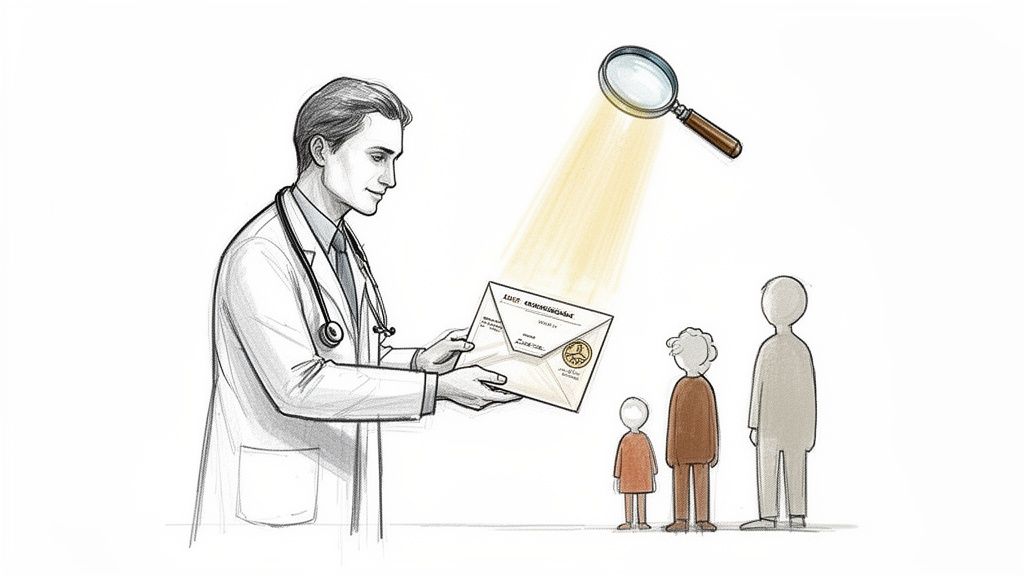
As a forensic pathologist and owner of Texas Autopsy Services, I’ve conducted over 1,000 autopsies. I can tell you that an autopsy is more than a medical procedure; it is a meticulous search for truth. It provides objective information that is essential for three key reasons:
- Emotional Closure: A definitive medical explanation can resolve lingering doubts, which is a crucial step in the grieving process.
- Legal Clarity: The findings are often vital for insurance claims, inheritance issues, or workers' compensation benefits. Understanding the true cause of death is also critical if you are considering legal options, such as consulting a wrongful death lawyer.
- Family Health: An autopsy can reveal undiagnosed genetic conditions, like certain heart diseases or cancers, that could impact the health of living relatives.
Correcting the Medical Record
The value of an autopsy is often underestimated. Medical studies have shown that autopsies reveal major discrepancies in the presumed cause of death in a significant percentage of cases. This isn't about assigning blame; it's about ensuring the final record is accurate. An incorrect cause of death can have lasting consequences for a family’s medical history and legal standing. My purpose is to approach every case with the respect and precision required to deliver these critical answers, giving families a solid foundation to move forward.
Why an Autopsy is Necessary
When a death is sudden, unexpected, or the cause isn’t clear, an autopsy is often the only way to find definitive answers. Families, attorneys, and medical professionals all turn to this process searching for the same thing: truth. In my experience, the need for an autopsy nearly always falls into one of three main categories.
Medical Clarity
From a medical standpoint, an autopsy is a vital tool for quality control and understanding disease. It can confirm a suspected diagnosis, reveal the true extent of an illness, or even correct a diagnosis made while the person was alive. For example, a postmortem examination might uncover a hidden infection or a structural heart defect that went unnoticed. These discoveries are invaluable for medical education and directly help improve how we care for future patients.
Legal and Forensic Evidence
In the legal world, an autopsy provides hard, scientific evidence that is often essential. As a board-certified forensic pathologist, my findings form the cornerstone of many official proceedings:
- Criminal Investigations: In any suspicious death, the autopsy establishes the official cause and manner of death, which are key facts a criminal case is built upon.
- Insurance Claims: Many insurance policies, particularly those with accidental death benefits, require an official cause of death before paying a claim.
- Workers' Compensation: When someone dies on the job, an autopsy can clarify whether the death resulted from workplace conditions or a preexisting personal health issue.
In each of these situations, the goal is to replace speculation with documented facts. My role is to be an unbiased interpreter of the medical evidence.
A Family’s Peace of Mind
Beyond the medical and legal reasons, a deeply personal need drives families to request a private autopsy: finding closure. Grieving is difficult enough without the added burden of unanswered questions. An autopsy can put lingering doubts to rest and provide a clear narrative, which is often the first step in the healing process.
There is another critical benefit, too. The examination can uncover hereditary conditions. Discovering a genetic link to something like heart disease or a specific cancer is life-saving information for living relatives, empowering them to take preventative steps for their own health. The answers found in an autopsy don’t just explain the past; they can protect the future. You can learn more about the specific reasons why autopsies are performed in our detailed guide.
Understanding the Different Types of Autopsies
Not all autopsies are the same. The term describes a procedure that can serve very different purposes, from confirming a medical diagnosis in a hospital to determining the cause of death in a criminal investigation. Knowing the difference is the first step in getting the answers your family needs.
Sometimes a hospital may decline an autopsy request, or the circumstances of a death may not legally require one from the county. This can leave families in a painful state of uncertainty. It's important to know you still have options.
Clinical or Hospital Autopsies
A clinical autopsy, sometimes called a hospital autopsy, is usually performed for medical or educational reasons. Think of it as a final quality check. The hospital's pathology department might perform one to confirm a diagnosis, evaluate the extent of a disease, or determine if a specific treatment was effective. While valuable for advancing medical science, these autopsies are not designed to answer legal questions. They require permission from the next of kin, and it has become less common for hospitals to perform them, even when requested.
Forensic Autopsies
A forensic autopsy is different because it isn't optional; it is a legal requirement. In Texas, a justice of the peace or medical examiner orders one when a death is sudden, violent, suspicious, or unexplained. Its sole purpose is to determine the official cause and manner of death for legal proceedings. These examinations are a key part of a formal death investigation, conducted by a specially trained forensic pathologist. The final report is a public record used by law enforcement and the court system. To learn more about this process, you can read our guide on what a forensic autopsy involves.
Private and Independent Autopsies
This is where I focus my work at Texas Autopsy Services. A private autopsy is a procedure that a family or their attorney chooses to have performed independently. It’s a way to get a clear, unbiased second opinion when you still have unanswered questions. Families often turn to an independent autopsy when a hospital has declined their request or when a government-mandated forensic autopsy isn't required, but something still doesn't feel right. It provides a confidential path to the truth.
A private autopsy puts control back into the hands of the family. It is a direct path to obtaining unbiased answers from a dedicated specialist, free from any institutional pressures or limitations.
Within this category, I also conduct specialized fetal and perinatal autopsies for families navigating the devastating loss of a stillbirth or newborn. The goal here is to find medical answers that can explain why the tragedy happened, providing information that can be vital for future family planning and helping to bring some measure of closure.
To make these distinctions clearer, the table below breaks down the key differences between the main autopsy types.
Comparison of Autopsy Types
| Feature | Clinical Autopsy | Forensic Autopsy | Private Autopsy |
|---|---|---|---|
| Primary Purpose | Medical quality control, education, confirm diagnosis | Determine cause and manner of death for legal investigation | Provide answers to family, second opinion, legal support |
| Who Requests It? | Next of kin (with hospital's agreement) | Medical Examiner or Justice of the Peace | Family, next of kin, or legal counsel |
| Is Consent Needed? | Yes, from the next of kin | No, it is legally mandated | Yes, from the next of kin or legal representative |
| Cost | Typically absorbed by the hospital (if performed) | Paid for by the county/government | Paid for by the family or requesting party |
| Report Confidentiality | Part of the confidential medical record | Public record | Completely confidential and owned by the family |
Understanding which path is right for your situation is the first step. Each type is designed to answer a different set of questions, and knowing your options empowers you to find the clarity you deserve.
What to Expect: The Autopsy Process Step by Step
Knowing what happens during an autopsy can make a difficult time feel more manageable. I want to walk you through exactly what happens during a private examination, from our first conversation to the moment you receive the final report. When families understand the methodical, respectful steps involved, it often relieves some of their anxiety. The entire process is built on thoroughness, dignity, and transparency.
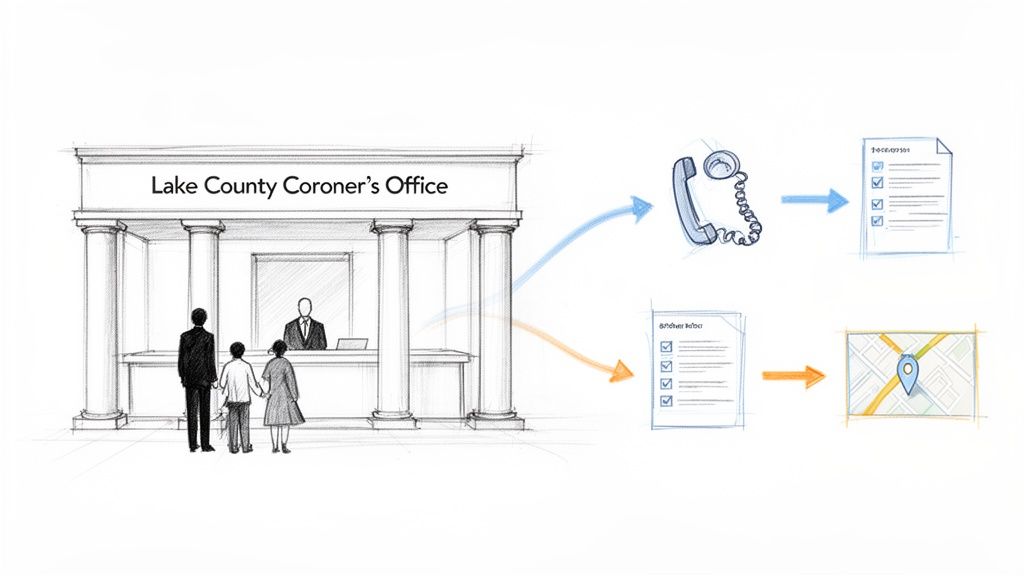
First, it helps to see where a private autopsy fits into the broader picture.
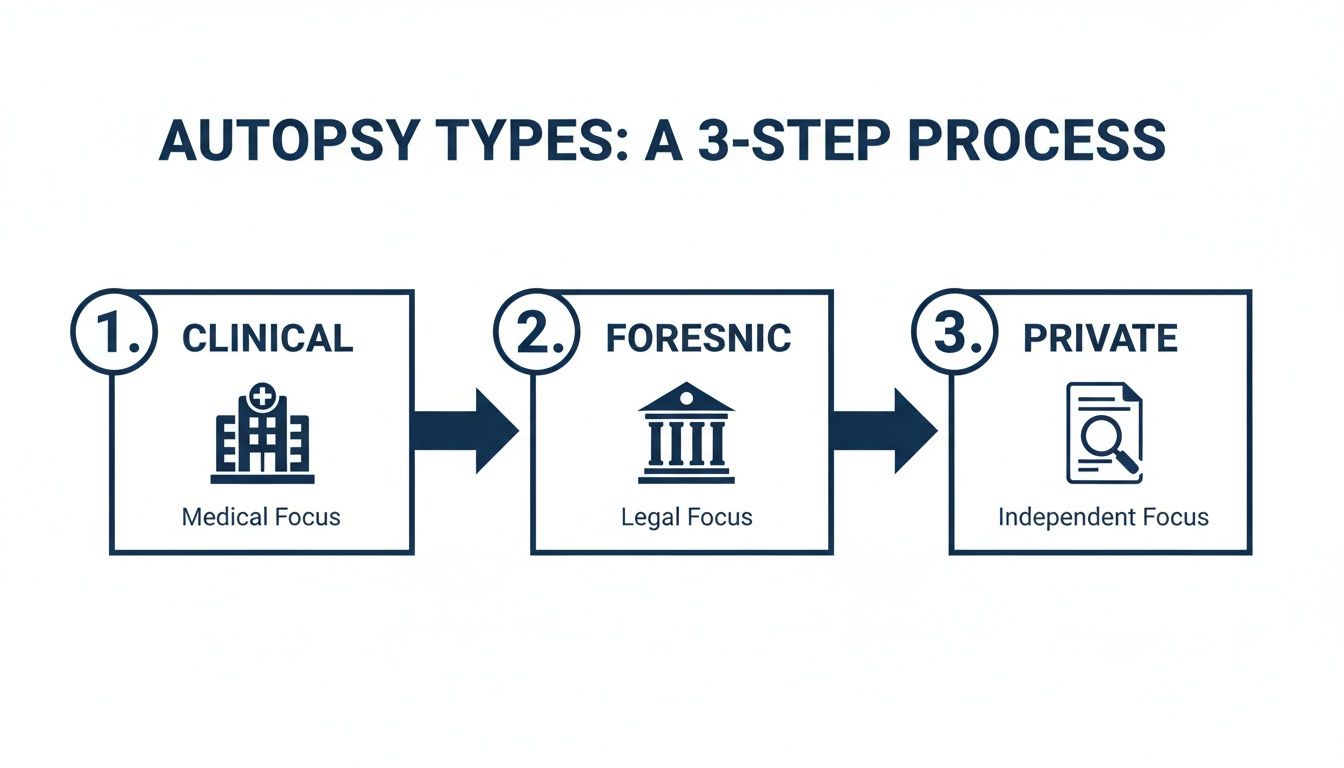
As you can see, a private autopsy is initiated by the family. This gives you direct control and ensures the examination is focused on getting the specific answers you're looking for.
The First Steps: Consultation and Authorization
Everything begins with a conversation. I speak directly with the family or their attorney to listen to their concerns and understand what they need to know. This initial discussion is about defining the goals of the examination.
Once you decide to move forward, the first official step is securing legal authorization. In Texas, the legal next of kin must provide consent. We manage all the required paperwork to ensure every action is fully compliant with the Texas Health & Safety Code. At the same time, we begin collecting relevant medical records and details about the circumstances of the death. This background information provides critical context for an accurate investigation.
The Examination
After authorization is complete, we arrange for the respectful transport of your loved one to our modern facility, which we coordinate through our partnership with Waterloo Mortuary. The examination is a meticulous procedure:
- External Examination: I begin with a thorough visual inspection of the body, carefully documenting every physical characteristic, including any signs of injury or evidence of medical treatment.
- Internal Examination: Next is a careful examination of the internal organs. This is essential for identifying diseases, abnormalities, or injuries not visible from the outside.
- Sample Collection: I collect small tissue and fluid samples for specialized testing. These are sent for microscopic analysis (histology) and toxicology to check for medications, drugs, or other substances.
- Reconstruction: When the examination is finished, the body is respectfully reconstructed. We perform this step with the utmost care so that your family can proceed with any planned funeral services, including an open-casket viewing.
For a more detailed look at each stage, our guide breaks down the complete step-by-step autopsy procedure.
The Final Report
Once all lab results are back—a process that often takes several weeks—I bring all the findings together into a single, comprehensive report. This document clearly states the cause of death and explains all the medical evidence in plain, understandable language. The final report is completely confidential and is delivered directly to the person who authorized the autopsy.
While providing answers for your family is my primary goal, this work also serves a greater purpose. Autopsies are vital for public health, helping to improve the accuracy of mortality statistics that shape health policy. My commitment is to provide a definitive, medically sound conclusion for your family, one that brings clarity and helps ensure accuracy in our public health data.
The Importance of an Independent Forensic Pathologist
When you’re investigating a death, nothing is more important than an objective, expert opinion. Whether a family needs answers or a court case depends on medical facts, the credibility of the forensic pathologist is everything. An independent examination, one performed completely separate from the systems where the death occurred, provides a vital, unbiased perspective.
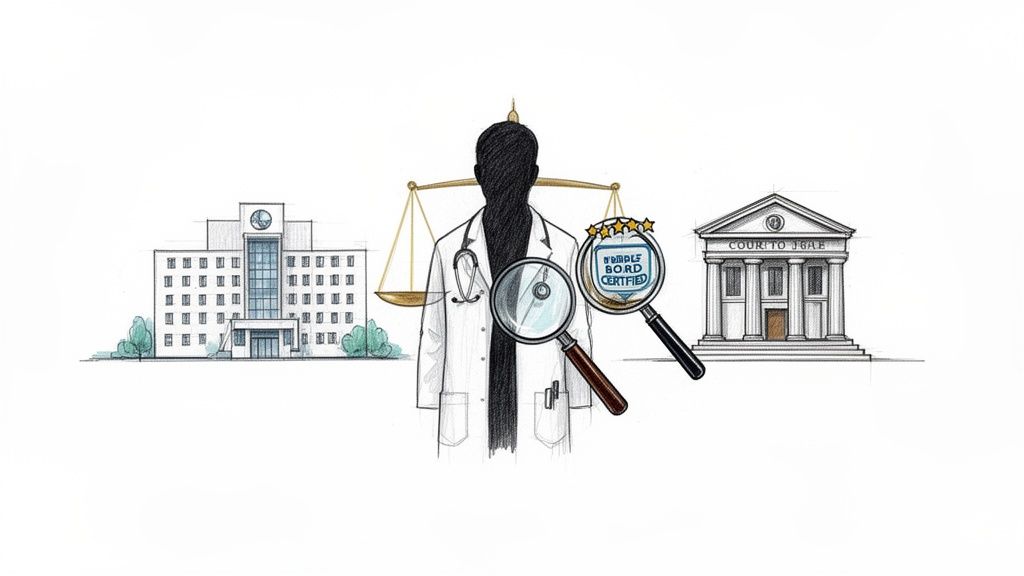
This is the core principle of my work at Texas Autopsy Services. Being free from potential conflicts of interest means my only duty is to the truth the evidence reveals.
Expertise You Can Trust
I am a forensic pathologist who is board-certified by the American Board of Pathology in Anatomic Pathology, Clinical Pathology, and Forensic Pathology. This level of training and certification ensures the highest standards are met in every case. I have personally performed over 1,000 autopsies, and that experience is the foundation of every investigation I lead. My job is to deliver a balanced, evidence-based conclusion that will hold up under scrutiny, whether I'm sitting down with a grieving family or testifying in court.
A Commitment to Unbiased Truth
An independent autopsy isn't just a medical procedure; it's a dedicated search for impartial truth. I approach every case with meticulous care, following the strict ethical guidelines of my profession and the legal standards of the Texas Funeral Service Commission and Texas Health & Safety Code.
My sole focus is to translate complex medical findings into a clear, understandable narrative. This means providing a comprehensive report that is medically precise for legal and clinical review, and accessible enough for a family to understand what happened to their loved one.
This dedication to clarity and objectivity is why autopsies remain so important. Beyond helping individual families, they have always been a cornerstone of medical progress. Postmortem examinations continue to reveal critical findings for medical research and quality assurance in healthcare. Ultimately, a truly independent examination gives families and legal professionals confidence that the conclusions are based purely on science, free from any outside pressure.
Common Questions About the Autopsy Process
When families and attorneys consider a private autopsy, practical questions always come up. I believe providing clear, direct answers is one of the most important services I can offer. My goal is to equip you with the information you need to make the right decisions during what I know is an incredibly difficult time.
Below, I’ve answered some of the questions I hear most frequently, based on my experience performing over a thousand autopsies and my commitment to a transparent, respectful process.
How long does an autopsy take and when do we get results?
This is usually the first question families ask, and it's a critical one for planning funeral services. The physical examination itself is typically completed within a few hours. This means that in almost all cases, the autopsy will not delay your family’s plans.
The final report, however, takes longer. We must wait for specialized lab tests to return, which are essential for a complete and accurate cause of death investigation. These often include:
- Toxicology: A detailed analysis of blood and other fluids to check for medications, alcohol, or other substances.
- Histology: A microscopic examination of tissue samples to find signs of disease or injury at a cellular level.
The entire process, from the initial examination to delivering the final, comprehensive report, usually takes several weeks. I always provide preliminary findings quickly and keep families updated on the timeline.
Will an autopsy prevent an open-casket funeral?
This is a very common and completely understandable concern. The answer is almost always no. I perform every examination with the utmost respect for the deceased and a deep appreciation for the family’s wishes.
My team and I take great care to ensure that all incisions are made in a way that will not interfere with a traditional open-casket viewing. After the examination, we perform a respectful reconstruction. This is a standard and crucial part of my work, done to ensure your loved one can be presented with dignity.
Who can legally authorize a private autopsy in Texas?
In Texas, the authority to consent to a private autopsy is very specific. That right belongs to the legal next of kin, and the state has a clear order of priority for who can make that decision.
The general hierarchy is as follows:
- A person designated in a written instrument signed by the decedent.
- The surviving spouse.
- Any surviving adult child of the decedent.
- Either of the decedent’s surviving parents.
- Any surviving adult sibling.
This legal framework is laid out in the Texas Health & Safety Code Chapter 711. We ensure every authorization is fully compliant before moving forward, which protects both the family and the integrity of the process.
What is the difference between cause and manner of death?
These two terms are cornerstones of a forensic pathology report, but they mean very different things. Understanding the distinction is key to making sense of the findings from any cause of death investigation.
Cause of Death: This is the medical reason for the death. It’s the specific injury or disease, or a combination of both, that directly led to the person’s passing. Examples include "coronary artery disease" or "gunshot wound to the head."
Manner of Death: This describes the circumstances that brought about the cause of death. There are five officially recognized categories: Natural, Accident, Suicide, Homicide, and Undetermined.
For example, a person’s cause of death might be a brain injury. The manner, however, could be accidental (if they fell) or homicidal (if they were assaulted). As a forensic pathologist, my job is to determine both, providing a complete picture of what happened.
Navigating these questions can feel overwhelming. If you have other concerns or need to discuss your specific situation, I encourage you to reach out directly. My team at Texas Autopsy Services is here to provide guidance with compassion and clarity. Please call our office for a confidential consultation.