April 16, 2026 · Texas Autopsy Services
Bugs in Your Teeth A Forensic Autopsy Insight
We explain what 'bugs in your teeth' means in a forensic autopsy, how insects help determine time of death, and what families can learn.
On this page
Families and attorneys sometimes arrive at this phrase from very different places. One person has searched “bugs in your teeth” after hearing a dentist describe cavity-causing bacteria. Another has opened an autopsy report and seen mention of insect activity in the mouth. Those are not the same issue, and confusing them can make an already difficult situation harder.
At Texas Autopsy Services, every examination is performed by a board-certified forensic pathologist experienced in medicolegal death investigations. Our work centers on one principle: follow the evidence carefully, explain it plainly, and treat the deceased and their family with respect.
TL;DR
- “Bugs in your teeth” has two meanings. In dentistry, it often means bacteria that cause plaque, cavities, and gum disease. In forensic pathology, it can refer to insect activity in the oral cavity after death.
- Oral insect activity is not random. The mouth is one of the natural openings that often attracts early insect colonization during decomposition.
- That evidence can help estimate time since death. Species identification, growth stage, and scene conditions all matter.
- Insect findings can also answer other questions. They may help assess body movement, possible wounds, and, in some cases, support toxicology work.
- Documentation must be careful and respectful. In a private autopsy or second opinion autopsy, collection, labeling, photography, and chain of custody all matter.
The Two Meanings of Bugs in Your Teeth
The phrase bugs in your teeth often brings to mind “sugar bugs.” That phrase is common in dental education, especially for children. It refers to bacteria that live in plaque and feed on dietary sugars.
The dental meaning
Among the better-known organisms is Streptococcus mutans, which helps convert sugars into acids that erode enamel. Tooth decay affects 42% of American children and 59% of adolescents ages 12 to 19, according to NIDCR data on cavity-causing oral microbes. The same body of information also notes that periodontal disease is common, promoted by organisms such as Porphyromonas gingivalis, Tannerella forsythia, and Treponema denticola.
That matters in autopsy practice because the mouth reflects health during life. Dental disease can show long-term patterns of hygiene, diet, chronic inflammation, and sometimes broader medical burden.
A few practical points are worth keeping separate:
- Cavities are bacterial disease during life. They arise when oral bacteria metabolize sugars and lower pH enough to damage enamel.
- Gum disease is also a living process. It develops over time and can leave visible changes in the teeth, gums, and supporting structures.
- Neither should be confused with postmortem insect activity. They may coexist in the same mouth, but they answer different forensic questions.
The forensic meaning
In forensic pathology, “bugs” may mean insects. After death, the body enters a natural process of decomposition. Certain insects are drawn to that process, and natural openings such as the mouth often become important sites of early activity.
That doesn’t mean the person suffered because of insects during life. It doesn’t mean the body was mistreated. It means the body is undergoing predictable biological change after death, and that change can be studied carefully.
Key distinction: Bacteria in plaque may help explain disease during life. Insects in the oral cavity may help explain what happened after death.
For families, this difference reduces a great deal of fear. For attorneys, it prevents a common interpretive error. An autopsy report may discuss both oral disease and insect evidence, but those findings serve different purposes.
Why this distinction matters in an autopsy
When I examine the mouth, I’m looking at more than one timeline.
One timeline concerns health before death. Was there advanced decay, periodontal disease, or a dental infection? Another concerns change after death. Is there insect colonization? Where is it located? What stage of development is present?
Those are separate lines of evidence. If they are blended together, the conclusions become less reliable.
A careful forensic pathologist keeps them apart, documents each one on its own terms, and explains the limits of each finding. That’s especially important in an independent autopsy, where families and legal professionals often need a clear second opinion rather than a broad or confusing summary.
Forensic Entomology and the Oral Cavity
Forensic entomology is the study of insects as they relate to legal investigations. In death investigation, it often becomes relevant when decomposition is advanced enough that insect activity provides useful timing evidence.
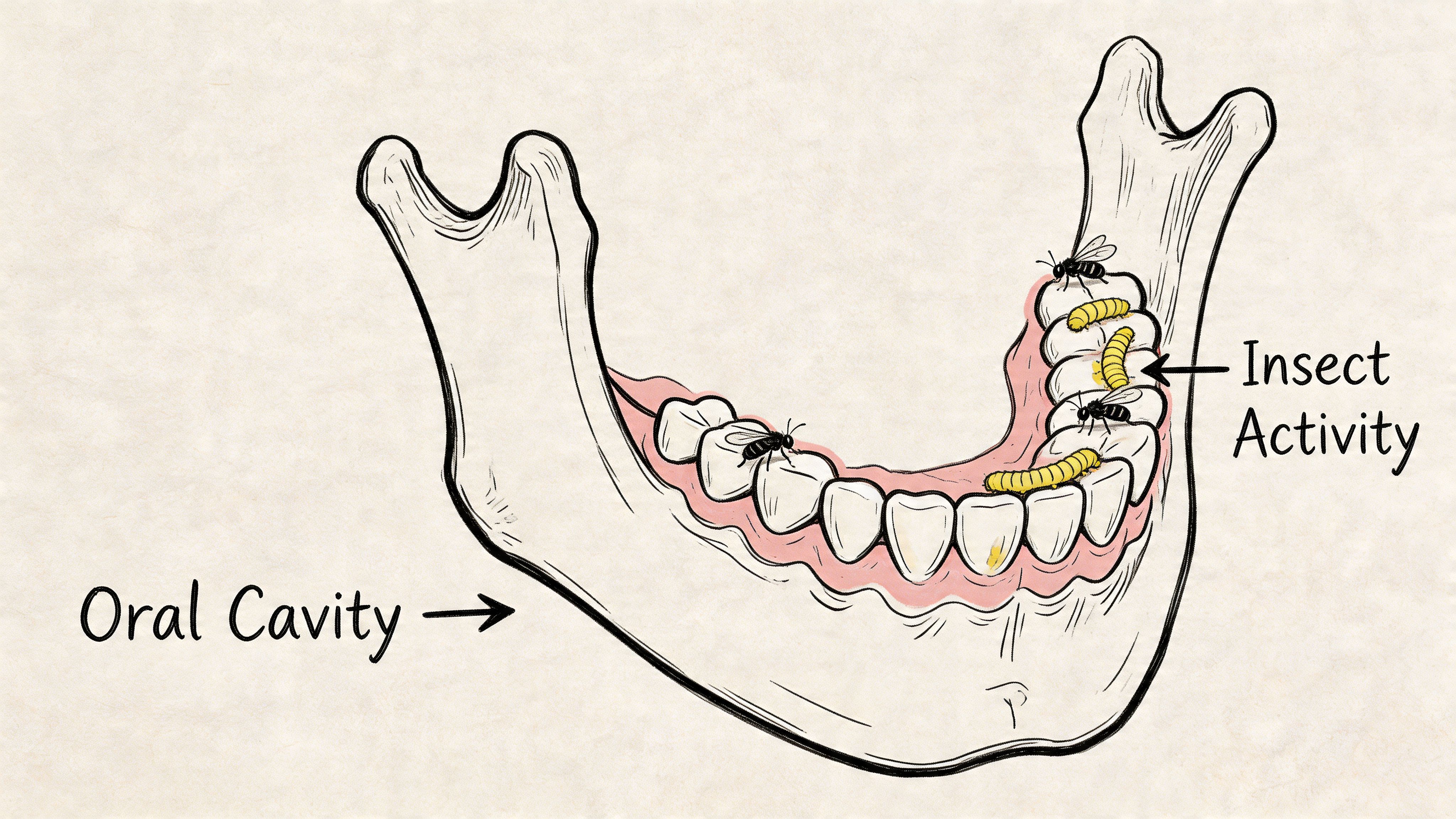
Why the mouth matters
The oral cavity is a common focus because it offers what insects seek early in decomposition. It is moist, relatively sheltered, and connected to soft tissues that break down faster than intact dry surfaces.
Flies are often among the first insects involved. In many cases, the mouth, nose, and eyes receive attention early because they are natural access points. If the mouth is open, exposed, injured, or contaminated with fluids, it may become even more important.
This is a biological process, not a moral one. Families sometimes hear “insects in the mouth” and assume neglect, abandonment, or rough handling. That conclusion is often unsupported. Insects respond to environment and tissue change. They do not follow human ideas of dignity or disrespect.
What pathologists look for
I don’t treat oral insect activity as a dramatic detail. I treat it as evidence. The important questions are practical:
- Location: Are eggs or larvae limited to the mouth, or present elsewhere first?
- Distribution: Is colonization symmetric, or concentrated in a specific area?
- Access: Was the body indoors, outdoors, covered, wrapped, or enclosed?
- Stage: Are the insects eggs, larvae, pupae, or adults?
Each of those observations gains meaning only in context. A body in a hot outdoor setting will not behave like a body in a climate-controlled room. A mouth that remained closed may show different patterns than one that was open.
Why insects select natural openings
Natural openings are useful to insects because they expose softer tissue and trapped moisture. The oral cavity also protects developing larvae from some environmental extremes. In practical terms, that means the mouth can act as an early and informative site of colonization.
The presence of insects in the mouth is often a sign of normal postmortem colonization, not proof of trauma or neglect.
That said, the pattern still has to be interpreted. If insects colonize a wound before the mouth, that may suggest that the wound was accessible and significant. If oral activity appears out of proportion to the rest of the body, I consider scene conditions, body position, coverings, and any barrier to access.
A short visual explanation can help clarify the process families and legal teams are often reading about in reports.
Why this evidence is useful
In forensic work, insects can function as a kind of biological clock. They do not give a perfect timestamp. They do provide developmental evidence that can support or challenge other information in the case.
That’s why oral insect findings are documented with care. A small cluster of eggs along the gums or lips may become very important when compared with witness statements, environmental history, body transport records, or a disputed time last seen alive.
How Insects Help Determine Time of Death
One of the most useful roles of insect evidence is estimating the postmortem interval, meaning the time that has passed since death. More precisely, insect evidence often helps establish a minimum interval, because colonization starts after insects gain access to the body.
The blowfly life cycle
A common model involves the blowfly. Its life cycle progresses through recognizable stages: egg, larva, pupa, and adult. Investigators and pathologists compare what is present on the body with known development patterns for that species under the conditions involved.
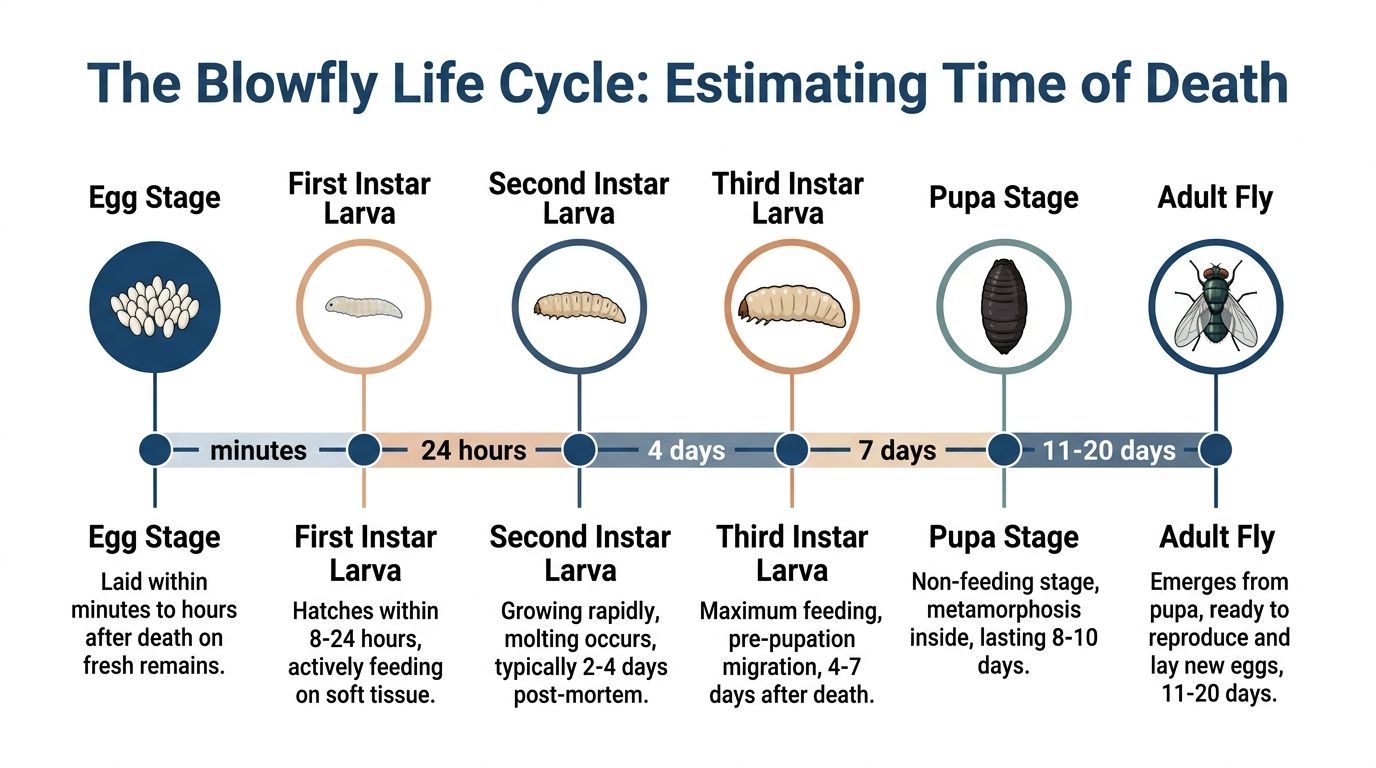
The timeline in that life cycle is affected by temperature, access, humidity, and the exact species involved. That is why broad assumptions are dangerous. Two scenes can look similar and still produce different developmental timing.
What gets collected
When oral insect activity is present, specimen collection is targeted rather than casual. The goal is to preserve what was there, where it was, and what stage it had reached.
Typical collection includes:
Eggs or small larvae from the mouth itself
These may be taken from the lips, gingiva, tongue, or pooled fluids within the oral cavity.Larger larvae from nearby facial areas
These can help show whether the mouth was the primary colonization site or one part of a broader pattern.Pupae or empty casings from clothing, hair, or the scene
These sometimes provide a wider developmental picture than the mouth alone.Environmental information
Temperature history, indoor or outdoor setting, shade, enclosure, and body covering all matter.
How the estimate is made
The estimate does not come from a single observation. It comes from a chain of reasoning.
A pathologist, and in some cases a forensic entomologist, first identifies the insect species. Then we determine the developmental stage. Then we compare that stage with the environmental conditions documented at the scene and during recovery.
That gives a minimum postmortem interval, not an exact minute of death. Colonization can be delayed if insects had limited access to the body. It can also progress differently depending on weather and location.
For readers who want broader context on decomposition itself, this overview of the stages of human decomposition helps place insect activity within the larger postmortem process.
Why independence can matter
Time of death is often one of the most disputed parts of a death investigation. That dispute may affect insurance review, civil litigation, criminal defense, alibi analysis, or family trust in the official findings.
An independent forensic review can be useful when:
- Scene records are incomplete
- Specimens were not preserved clearly
- The reported interval conflicts with witness accounts
- The family or legal team needs a second look at decomposition evidence
I’ve written separately about determining the time of death because it is one of the areas where people most often expect certainty that science cannot reliably provide.
Practical rule: Insect evidence is strongest when it is interpreted with scene data, body findings, and investigative history together. By itself, it should not be oversold.
What insect timing can and cannot do
A short comparison helps.
| Question | Insect evidence may help | Insect evidence alone may not resolve |
|---|---|---|
| When did death likely occur | Yes, by supporting a minimum interval | The exact clock time of death |
| Was the body accessible to insects | Often | Why access was delayed |
| Did decomposition progress at the reported scene | Sometimes | Every movement or handling event |
| Do witness timelines fit the biology | Often | Credibility questions by themselves |
This is why the mouth matters. It is not only a place where insect activity is seen. It is often one of the better places to study that activity in a structured way.
What Oral Insect Activity Reveals Beyond the Timeline
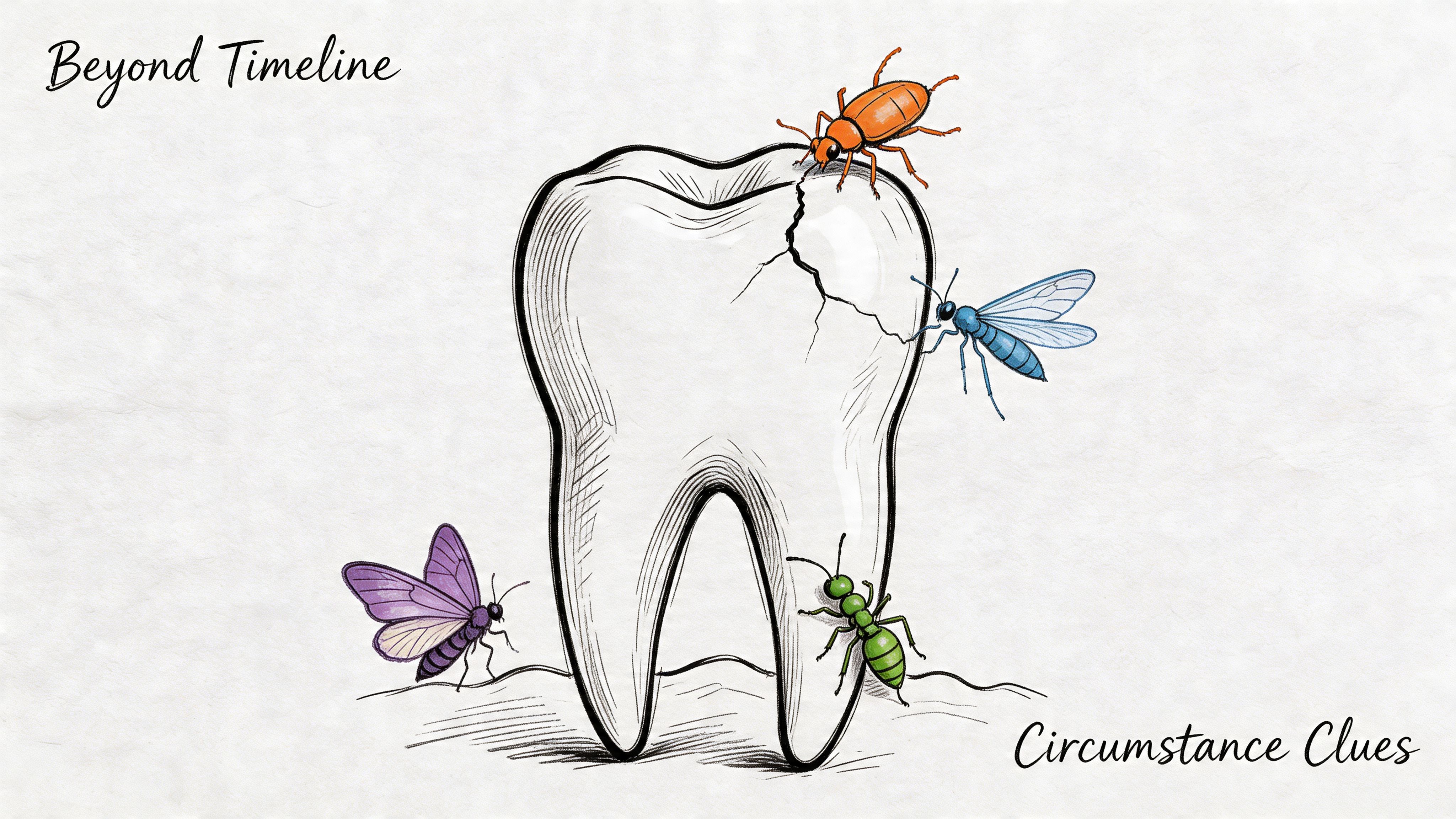
The first question is often timing. It is not the only question. Insect activity in and around the mouth can also help build a broader picture of the circumstances surrounding death.
Clues about movement and exposure
Different species favor different settings. Some are more likely in indoor environments. Others are associated with outdoor exposure, open access, or certain ecological conditions. If the insect pattern does not fit the reported scene, that mismatch may matter.
It doesn’t automatically prove a body was moved. It does create a question worth testing against scene photographs, transport history, witness statements, and the rest of the autopsy findings.
Clues about wounds and access points
Natural openings often attract the earliest colonization. When that pattern changes, I pay attention.
If insects are concentrated first in a facial wound, a scalp defect, or another focal injury rather than the oral cavity, that may support the presence of an accessible injury. It does not by itself prove whether that injury occurred before or after death. It does help direct the examination and documentation.
This is one reason insect evidence should never be treated as separate from anatomy. Entomology and pathology work best together.
Entomotoxicology
In some decomposed cases, standard tissues may be limited or altered. Insects feed on the tissues available to them. Under the right circumstances, that can make larval analysis useful in toxicologic investigation.
The interpretation requires caution. Insect-based toxicology is not a shortcut. It is a specialized tool, and the result must be weighed against decomposition, drug redistribution, specimen quality, and the broader case record.
Still, in difficult cases, it may provide useful support when conventional samples are compromised.
In advanced decomposition, a small biological specimen can become important if it is collected correctly and interpreted modestly.
Oral health findings during life still matter
Even when the article’s focus is postmortem insects, the mouth also tells us about health before death. Severe decay, longstanding infection, and periodontal disease can carry medical importance.
Chronic periodontitis bacteria like Porphyromonas gingivalis can translocate systemically and have been linked to atherosclerosis and cardiovascular mortality. With 47% of US adults over 30 having some form of periodontitis, an autopsy may help assess whether severe oral infection contributed to a fatal event, as discussed in this overview on oral bacteria and systemic disease.
That does not mean gum disease becomes the cause of death in every person who has it. It means significant oral infection should not be dismissed as irrelevant, especially when the decedent had broader signs of chronic illness.
Putting the pieces together
A sound cause of death investigation does not rely on one dramatic finding. It integrates:
- Autopsy anatomy
- Scene evidence
- Insect activity
- Toxicology
- Medical history
- Dental and oral findings
When those pieces fit, the conclusions become stronger. When they don’t fit, the disagreement itself can be informative.
The Autopsy Process Collecting and Documenting Evidence
By the time a family reads that insect activity was present, the wording can feel cold. The actual work is much more careful than the phrase suggests. In a forensic autopsy, oral insect evidence is collected methodically and with respect for the deceased.
What happens first
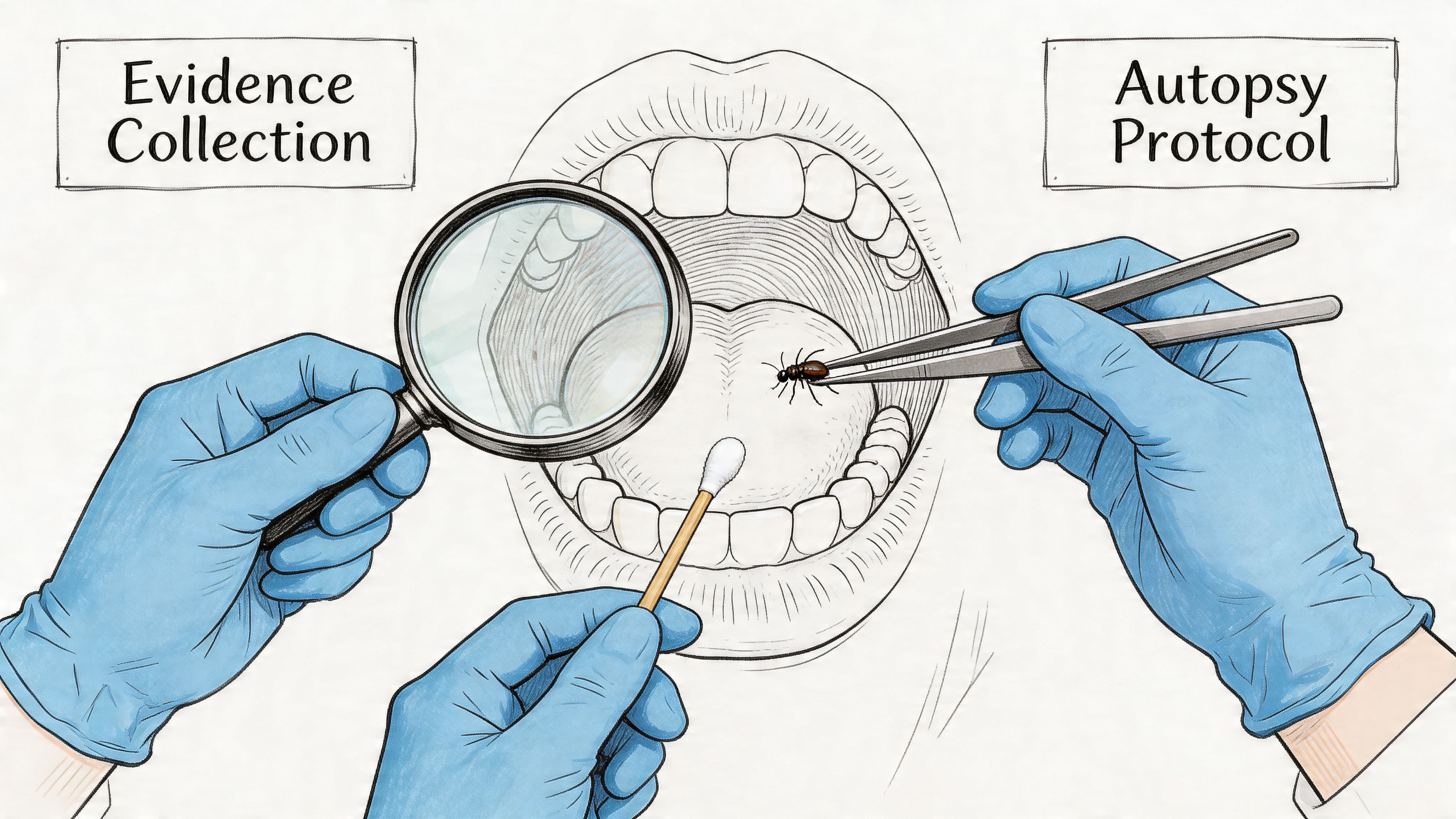
The first step is observation before disturbance. I examine the face and mouth as found, noting visible insect activity, location, and distribution. Photography comes before removal whenever possible.
That sequence matters. Once evidence is moved, the original pattern is gone. Photographs preserve the condition in place, which is often essential for later review by attorneys, agencies, or other physicians.
How specimens are collected
The collection itself is selective. I do not indiscriminately remove everything into one container. Different stages may be present at the same time, and each stage can matter.
A practical workflow often includes:
Preserved specimens
Some insects are placed into preservative promptly so their development stops at the stage observed.Live specimens
Some may be retained alive for controlled development, which can help confirm species identification later.Location-specific labeling
Samples from the mouth are labeled as oral cavity specimens, and I note the exact area when possible.Scene-linked documentation
The specimen record must align with photographs, diagrams, and recovery information.
Chain of custody and legal use
Chain of custody means the documented record of who collected, handled, transferred, stored, and examined each specimen. That record matters if findings may appear in court or support a legal opinion.
For families, this may sound technical. For legal professionals, it is foundational. If the specimen history is unclear, the evidentiary value of the specimen can weaken quickly.
A private autopsy or second opinion review may also involve studying whether evidence was collected properly in the first place. Sometimes the issue is not what the insects show. It is whether the collection process preserved their meaning.
For readers who want a more basic overview of body examination before internal dissection, my discussion of the external examination in an autopsy gives useful context.
Respect and facility standards
Families often worry that forensic collection sounds invasive or impersonal. That is understandable. In practice, respectful technique and precise technique usually go together.
At the mortuary or examination facility, the body is handled under controlled conditions. Positioning, draping, identification, specimen handling, and photography all follow medical-legal discipline. In Central Texas and across the state, coordination with licensed funeral and mortuary professionals is also part of maintaining lawful and dignified care.
What appears in the final report
Not every report needs a lengthy entomology section. The detail depends on the case. When oral insect evidence is relevant, the report may address:
| Report component | Why it matters |
|---|---|
| Location of insect activity | Helps interpret access and colonization pattern |
| Developmental stage observed | Supports time-since-death analysis |
| Specimens collected | Shows what material exists for review |
| Preservation method | Affects later identification and analysis |
| Limits of interpretation | Keeps conclusions medically honest |
Documentation matters as much as the specimen itself. A poorly described insect finding can be less useful than a modest finding recorded well.
That careful record is one reason independent forensic pathology can be valuable. It creates a clear medical document rather than a vague reference to “bugs” that leaves everyone guessing.
Questions for Families and Legal Professionals
Some of the hardest moments come after the report is issued. A family member sees “insect activity in the oral cavity” and pictures something far worse than what the phrase medically means. An attorney may need to know whether that finding changes the timeline, the scene interpretation, or the reliability of another opinion.
Does insect activity in the mouth mean the person was neglected
Not by itself. Postmortem insect colonization is a natural process. The mouth is a common site because it is a natural opening with moisture and soft tissue access.
Neglect cannot be concluded from that finding alone. It has to be assessed from the full history, scene conditions, care circumstances, and the rest of the autopsy.
Can oral insect activity tell you the exact time of death
No. It can help estimate a minimum time since death when the evidence is suitable and well documented. It does not function like a clock on the wall.
The most reliable interpretation combines insect findings with scene investigation, weather history, body condition, and other postmortem changes.
If the official report mentions insects, is a second opinion still useful
Sometimes, yes. A second opinion may be helpful if the insect evidence was not collected clearly, if the stated timeline conflicts with witness accounts, or if legal consequences hinge on the estimate.
For families sorting through authority and consent issues, this explanation of who can request an autopsy is often a useful place to start.
Can insect findings help in a legal case beyond time since death
They can. Depending on the case, they may support analysis of body movement, access to the remains, possible wounds, and toxicologic questions. Their usefulness depends on how well the evidence was preserved and whether the conclusions stay within the science.
Attorneys who manage medically complex records often benefit from structured case review tools alongside expert consultation. For workflow support, some legal teams also explore resources on best AI tools for legal professionals, especially when organizing reports, timelines, and document sets. That does not replace expert medical interpretation, but it can help manage volume.
What should families ask when a report mentions bugs in your teeth
Ask for plain language. The right questions are often simple:
- Was this bacteria during life or insect activity after death
- Where exactly was it found
- Was it used to estimate time since death
- Were specimens collected and preserved
- What limits apply to the conclusion
Those questions often reduce confusion quickly.
Families deserve direct answers in ordinary language, especially when technical wording appears in an autopsy report.
Does severe oral disease still matter if the main issue is insect activity
Yes, but for a different reason. Insect activity helps address postmortem change. Oral disease may help address health during life. If both are present, they should be analyzed separately.
That separation is one of the basic disciplines of good forensic pathology. It keeps the report clear, fair, and medically defensible.
If you need clear answers after a death, whether for a family question, an attorney review, or an independent cause of death investigation, Texas Autopsy Services can help you understand the findings with care, precision, and respect for the person who died.