July 5, 2026 · Texas Autopsy Services
A Guide to Forensic Specimen Preservation in Texas
Learn about proper specimen preservation for forensic autopsies in Texas. Our guide covers types, preservatives, storage, and legal chain of custody.
On this page
- Why Specimen Preservation is the Foundation of a Trustworthy Autopsy
- The Goals of Forensic Preservation Halting Time for a Clearer Answer
- A Guide to Major Specimen Types and Their Handling
- Packaging and Labeling The First Links in the Chain of Custody
- Secure Transport and the Unbroken Chain of Custody
- Legal and Reporting Considerations for Autopsies in Texas
- Frequently Asked Questions About Specimen Handling
- Specimen preservation starts at collection. If tissue or fluid degrades early, later testing may not answer the question a family or attorney is trying to resolve.
- Forensic preservation is not the same as museum preservation. The central concern is evidentiary integrity for microscopy, toxicology, and legal review.
- Different specimens require different handling. Wet tissue and blood do not use the same preservatives, and using the wrong one can compromise results.
- Packaging, labeling, and transport matter as much as the preservative itself. A specimen that is preserved but poorly documented can still become difficult to defend.
- Texas law draws a clear line between medical examiner autopsies and private autopsies. The consent rules and legal authority are not the same.
A family often reaches out after an earlier examination left important questions unanswered. Sometimes the issue is not whether a sample was collected. The problem is whether it was collected, preserved, labeled, and transported in a way that still allows reliable review.
That distinction matters. In forensic pathology, poor specimen preservation can weaken both the medical value of an autopsy and the legal weight of the findings. Families need answers they can trust. Attorneys need evidence that can withstand scrutiny. Medical professionals need documentation that reflects what was present at the time of death, not what changed afterward.
Why Specimen Preservation is the Foundation of a Trustworthy Autopsy
When a sample exists but the answer is still lost
A specimen can exist on paper and still be unusable in practice. We see that problem most often when a prior examination involved delayed stabilization, the wrong preservative, incomplete labeling, or storage conditions that were adequate for general handling but not adequate for a forensic review.
In those cases, the family may hear that “samples were taken,” yet the remaining material cannot reliably support toxicology, microscopy, molecular work, or a meaningful second opinion. That is one of the hardest situations to explain, because the gap is not obvious from the outside. The record may look complete. The science may not be.
Most available information fails to bridge the gap between traditional preservation methods and the specific forensic requirements for legal admissibility. While some sources detail general storage, they often omit the forensic necessity of immediate stabilization to preserve toxicological integrity for court cases, a critical detail for families and attorneys, as discussed in this review of traditional specimen storage and forensic admissibility.
Why forensic work has a higher bar
General wet specimen guidance has an important place in science. Fluid-preserved collections have been foundational in zoology since the late seventeenth century, and the method formally traces back to Frederik Ruysch in the 1600s, with long-term preservation built around fixative and storage solutions such as formalin and alcohol, as summarized in this history of wet specimen preservation methods. That history is useful context, but a forensic autopsy has a different purpose.
A forensic examination is not trying to prepare a specimen for display or broad future study. It is trying to preserve evidence in a condition that still reflects the body as closely as possible at the time of death. That affects whether findings can support a cause of death investigation, whether later experts can independently review the work, and whether the final report remains defensible in litigation.
A well-preserved specimen helps answer practical questions:
- Was there enough integrity for toxicology to detect or exclude relevant substances?
- Was the tissue fixed correctly so microscopic changes can still be interpreted?
- Was the anatomical source documented clearly so the sample can be tied back to the proper organ or site?
- Was the handling traceable from collection through transfer?
If those answers are weak, the autopsy itself becomes harder to trust, even when everyone involved acted in good faith.
The Goals of Forensic Preservation Halting Time for a Clearer Answer
What preservation is trying to stop
The core purpose of forensic preservation is simple. It aims to stop change.
Once a person has died, tissues and fluids do not remain static. Autolysis means self-digestion by the body's own enzymes. Putrefaction means breakdown driven by bacteria. Both processes can alter what a pathologist sees under the microscope and what a toxicologist can measure in a fluid sample.
That is why preservation is not a side task performed after the meaningful work is done. Preservation is part of the examination itself. If degradation continues unchecked, the specimen begins to tell a less reliable story.
Practical rule: The closer preservation occurs to the time of collection, the more confidence later reviewers can have that the specimen still represents the original condition rather than later decay.
What fixation means in practice
For wet tissue, forensic preservation relies on fixation. Wet tissue specimens require immersion in a 10% formalin fixative solution, which chemically cross-links proteins to halt decay. After this initial fixation, specimens must soak for at least 48 hours in formalin to ensure complete preservation from the inside out before further analysis, as detailed by the National Museum of Health and Medicine in its guidance on preserving wet tissue specimens.
That “inside out” point is easy to miss. Surface exposure alone is not enough. Proper fixation depends on fluid exchange through the specimen. In practice, that is why tissues may need to be opened or sampled in a way that allows preservative to penetrate fully.
A well-fixed specimen gives the pathologist a fair chance to assess structure. A poorly fixed specimen may show breakdown that clouds interpretation. That distinction matters when the question is subtle, such as whether a lesion was real, whether inflammation was present, or whether decomposition has obscured an originally important finding.
For families, the plain-language version is this. Preservation helps hold the evidence still long enough to study it properly. It does not create a diagnosis. It protects the possibility of one.
A Guide to Major Specimen Types and Their Handling
A specimen can answer the medical question and still fail the legal one if it was collected or preserved the wrong way. In Texas casework, that distinction matters. Courts do not admit conclusions on trust alone. They admit conclusions that can be tied to a specimen that remained identifiable, stable, and suitable for the specific test performed.
Different specimen types serve different purposes. We choose the container, preservative, collection site, and storage conditions to match the question at issue, whether that question involves intoxication, injury timing, natural disease, or whether another expert can later review the same material and reach an independent opinion.
Blood samples for toxicology
Blood for toxicology is especially sensitive to post-collection change. A result can be challenged if the sample was not preserved in a way that limits microbial activity and chemical breakdown. For that reason, forensic toxicology practice commonly uses sodium fluoride as a preservative for blood testing, as discussed in this review of blood sample preservation in toxicology.
The practical point is straightforward. If alcohol is alleged, if medication levels matter, or if an impaired-driving death may lead to civil or criminal litigation, preservation choices affect whether the laboratory result reflects the decedent's condition or a change that occurred after collection.
Site selection matters too. Peripheral blood is often preferred over central blood because postmortem redistribution can complicate interpretation. A toxicology number without collection context is harder to defend.
Tissue samples for histology and later review
Histology asks a different question. The goal is to preserve architecture well enough to distinguish true disease or injury from artifact. In forensic work, that often means retaining tissue in a condition that supports both the original diagnosis and later re-examination by another pathologist.
Poor handling creates predictable problems. Tissue that is too thick for adequate fixative penetration may autolyze internally. Cautery artifact, crushing, drying, and delayed fixation can also limit what the slide can show. In a private autopsy or second-opinion review, those limits may become the central issue.
Contamination control also matters whenever multiple specimens are collected in sequence. Blood on instruments, carryover between containers, or tissue fragments placed in the wrong cassette can alter interpretation and invite challenge. For a practical overview of contamination prevention principles, see Herbilabs on lab contamination.
Readers who want the procedural side can review our guide to specimen collection procedures for autopsy testing and review.
Wet organs and retained anatomical specimens
Whole organs or larger anatomic specimens are sometimes retained for documentation, consultation, or later demonstration of a key finding. These specimens present a trade-off. Leaving a structure intact may preserve relationships that matter, such as the course of a wound track or the extent of a hemorrhage. Opening or sectioning the specimen may improve penetration of fixative and reduce internal breakdown.
That choice should be made deliberately and recorded clearly. If a retained heart, brain, or other organ will later be reviewed in a legal setting, the record should show what was retained, how it was preserved, whether it was opened or sampled, and what limitations followed from that choice.
Previously collected specimens under second-opinion review
A second-opinion case often begins with materials collected by someone else. The first task is not interpretation. It is suitability assessment. We examine whether the original preservation method, elapsed time, storage history, and available labeling still support meaningful review.
Sometimes the answer is yes. Sometimes only limited conclusions remain possible. A faded label, prolonged warm storage, depleted fixative, or uncertain source site can narrow what can be said with confidence. In forensic medicine, saying less is sometimes the more defensible opinion.
Reference table for common forensic specimens
| Specimen Type | Preservative | Storage Condition | Purpose of Preservation |
|---|---|---|---|
| Blood for toxicology | Sodium fluoride | Handled under controlled conditions appropriate for forensic toxicology | Protect analyte integrity for testing of substances such as ethanol, opioids, and cocaine |
| Tissue for histology | 10% formalin | Immersed long enough for fixation from the inside out | Preserve tissue architecture for microscopic examination |
| Wet organ or anatomical specimen retained for review | Formalin first, with later storage approach based on the specimen and purpose | Sealed, observed for leakage, and periodically inspected | Maintain structural integrity for later examination and documentation |
| Previously collected specimen under second-opinion review | Depends on what was originally used | Evaluated case by case | Determine whether the sample is still suitable for microscopy, toxicology, or limited re-examination |
The useful question is never whether a specimen was "preserved" in the abstract. The real question is whether it was preserved well enough for the exact medical and legal issue the case may have to withstand.
Packaging and Labeling The First Links in the Chain of Custody
A specimen can be chemically well preserved and still fail as evidence if the container, seal, or label leaves room for doubt. We see this problem in second-opinion and private autopsy reviews. The tissue may be intact, but a vague source site, an unsecured lid, or a missing collection time can limit what we can defend in a Texas courtroom.
What has to appear on the container
The label has one job. It must connect that specimen to one decedent, one collection event, and one anatomical source without ambiguity.
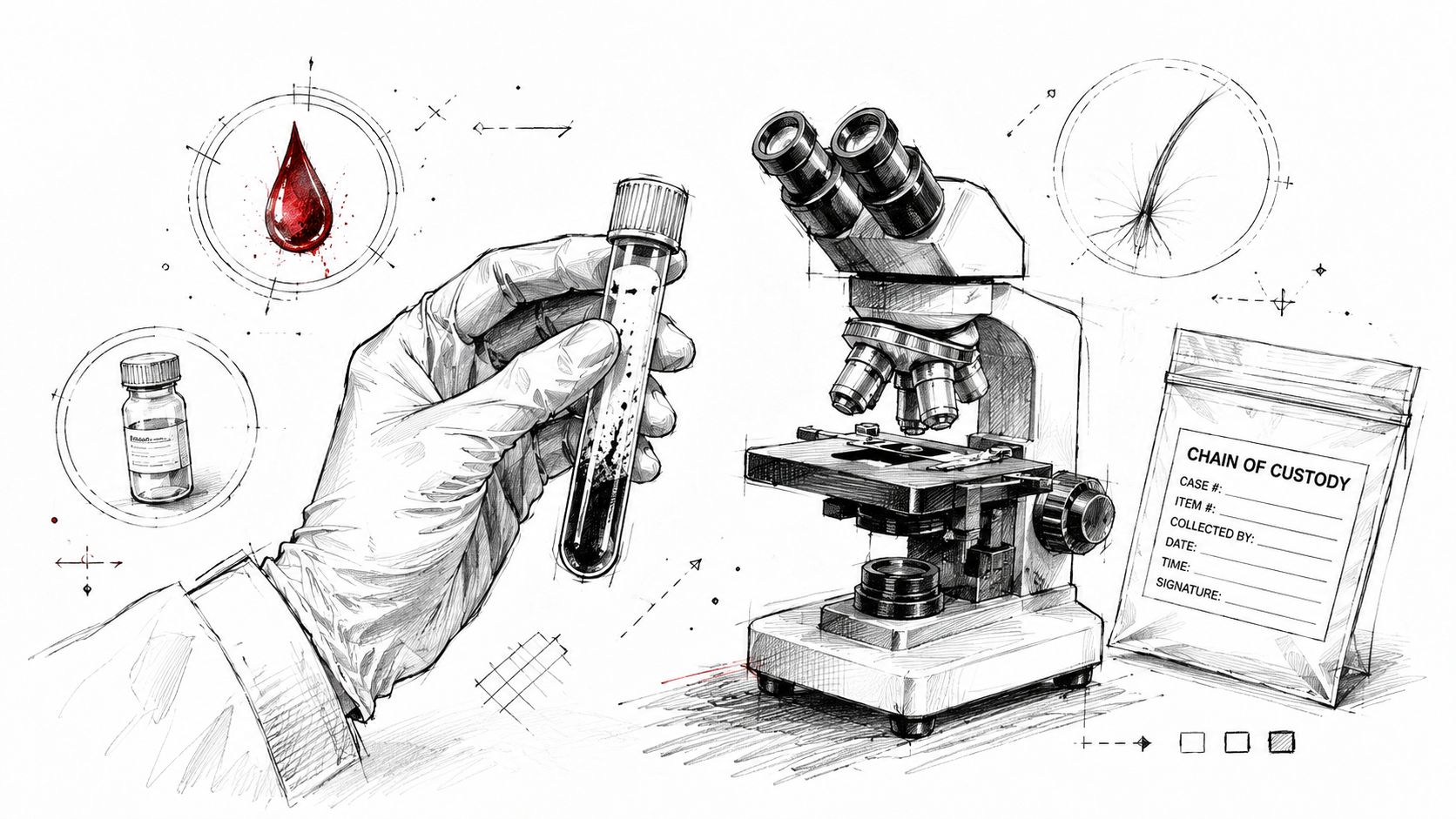
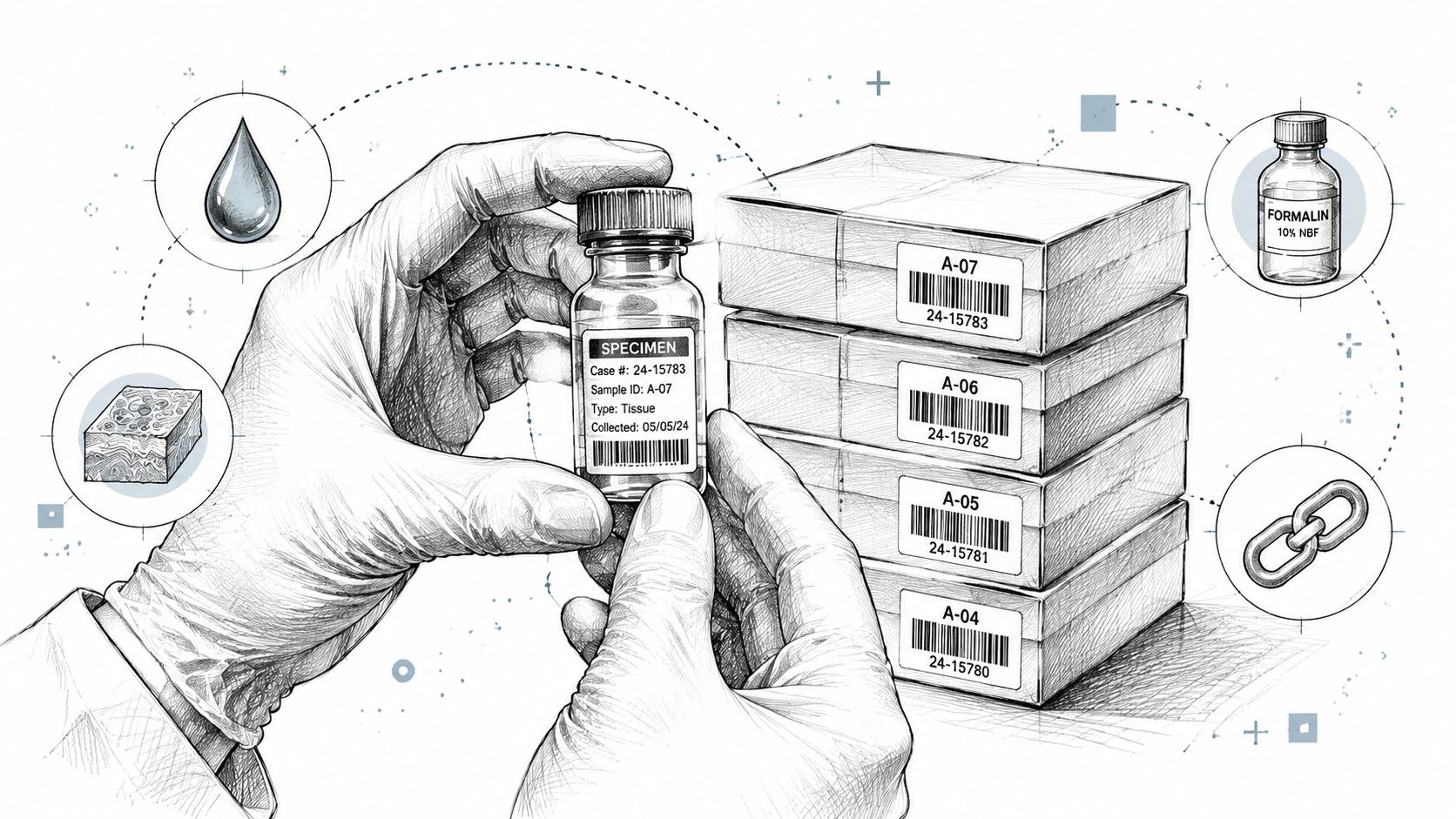
In practice, the container should show the decedent's identifying information, the case number, the date and time of collection, the specimen type, the precise source site, and the identity of the person who collected or sealed it. "Liver" may be adequate in one setting. "Wedge section, right hepatic lobe" is stronger if later review turns on sampling location. The same principle applies to blood, vitreous, gastric contents, and retained organs. Specific wording reduces later disputes about what was indeed tested or examined.
The label also has to stay readable after refrigeration, transport, and handling. Ink that runs, tape that lifts, and handwriting that cannot be read create avoidable legal exposure. Laboratories and forensic services that rely on structured tracking often use principles similar to the best lab sample management systems, where specimen identity, status, and custody are recorded in a form that can be audited later.
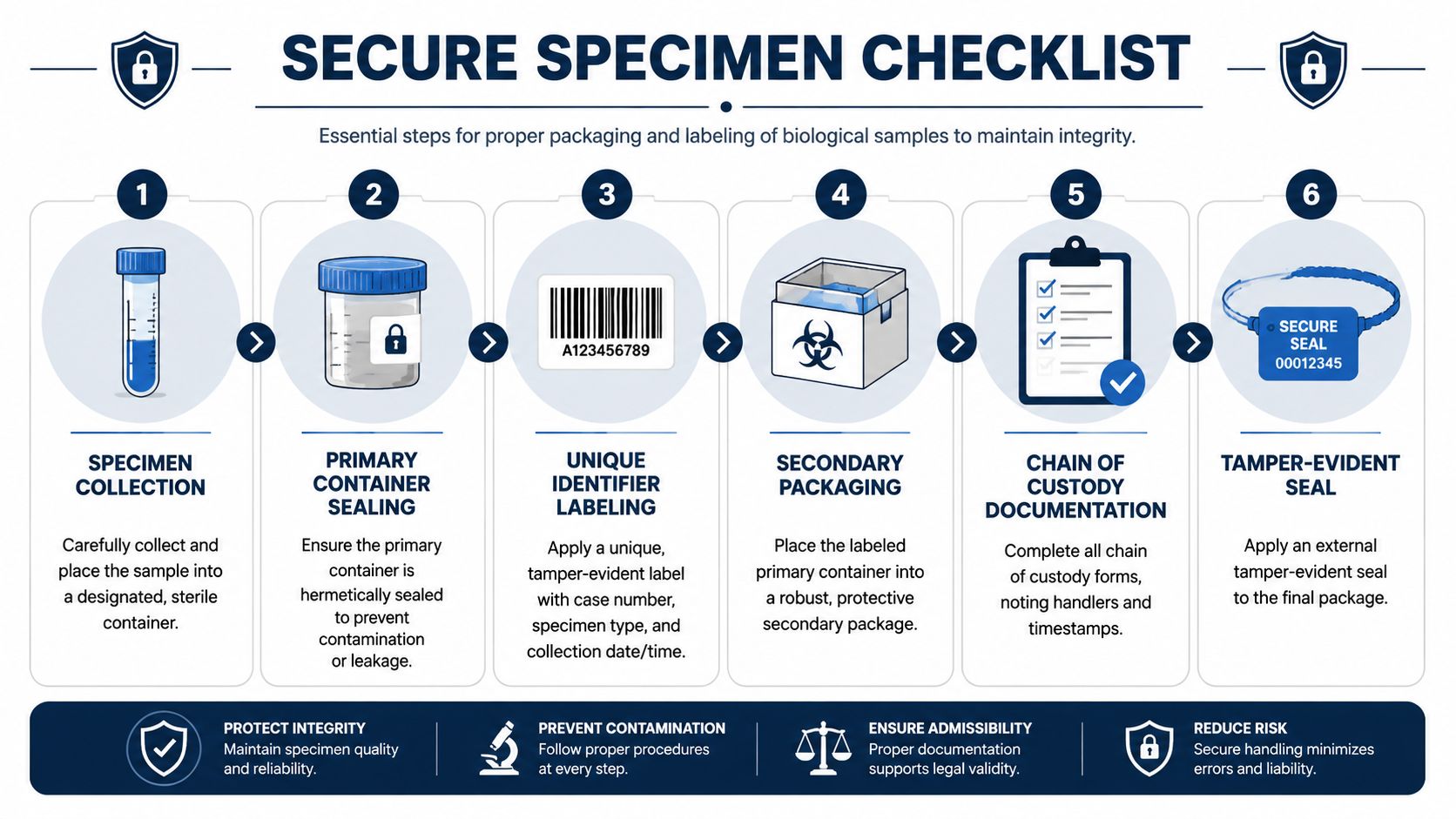
Why packaging errors become legal problems
Packaging decisions affect admissibility, not just organization. In forensic pathology, the container, seal, and label are the first physical proof that the specimen presented for testing is the same specimen collected at autopsy.
A sound process usually includes:
- A primary container sized for the specimen so tissue is protected and fluid can be retained without leakage
- A secondary protective layer to contain spills and shield the label from moisture or abrasion
- Tamper-evident closure so any opening is visible to the next custodian
- A documented handoff record linked to the package from the start
These steps matter because challenges in court rarely focus on preservation in the abstract. They focus on identity, continuity, and whether a reasonable reviewer can exclude mix-up, substitution, or undocumented access. Our office treats packaging as part of the medical opinion itself, because weak packaging can weaken an otherwise sound finding. For a more detailed discussion of documentation standards, see these chain of custody procedures for autopsy specimens.
When these safeguards are missing, the consequence is practical. The specimen may still have scientific value, but the opinion based on it becomes harder to defend under scrutiny.
Secure Transport and the Unbroken Chain of Custody
Preservation has to survive movement. A specimen can be collected correctly and still be compromised during transport if the seal fails, the documentation separates from the sample, or the transfer record becomes incomplete.
Preservation has to survive the trip
Transport is where the medical side of the case and the legal side of the case meet. The specimen must remain physically secure, but it must also remain traceable. That means every transfer needs a receiving person, a sending person, a time point, and a documented condition of the package.

A clear transport workflow also reduces avoidable disputes later. If an attorney asks where the sample was between collection and testing, there should be a documented answer, not a reconstruction based on memory.
For a practical look at the importance of receipt confirmation and transfer documentation, these proof of delivery features show the kind of recordkeeping logic that supports defensible handoffs in many evidence-sensitive settings.
How transport records support admissibility
The transportation record should show continuity, not just movement. A complete chain demonstrates that the sample:
- Was sealed before transport
- Traveled in a controlled and documented manner
- Reached an authorized recipient
- Was logged on arrival without unexplained gaps
For readers who need a closer look at documentation standards, our discussion of chain of custody procedures explains why every handoff matters in forensic practice.
This short video also gives useful visual context for specimen handling and movement in a forensic setting.
A specimen that cannot be tracked cleanly from collection to review may still exist physically, but its evidentiary value becomes harder to defend.
Legal and Reporting Considerations for Autopsies in Texas
Texas families and attorneys often assume that any autopsy follows the same consent rules. That is not correct. The legal pathway depends on who is ordering the examination and why.
Who can authorize a private autopsy
Under Texas Health & Safety Code Chapter 711, legal authority to authorize a private autopsy follows a strict order of priority: first the surviving spouse, then an adult child, parent, or adult sibling if no spouse exists, as explained in this summary of autopsy authorization under Texas law.
That order matters in real cases. A disagreement among relatives does not automatically create equal decision-making authority. The statute places that authority in a defined sequence.
When family consent is not required
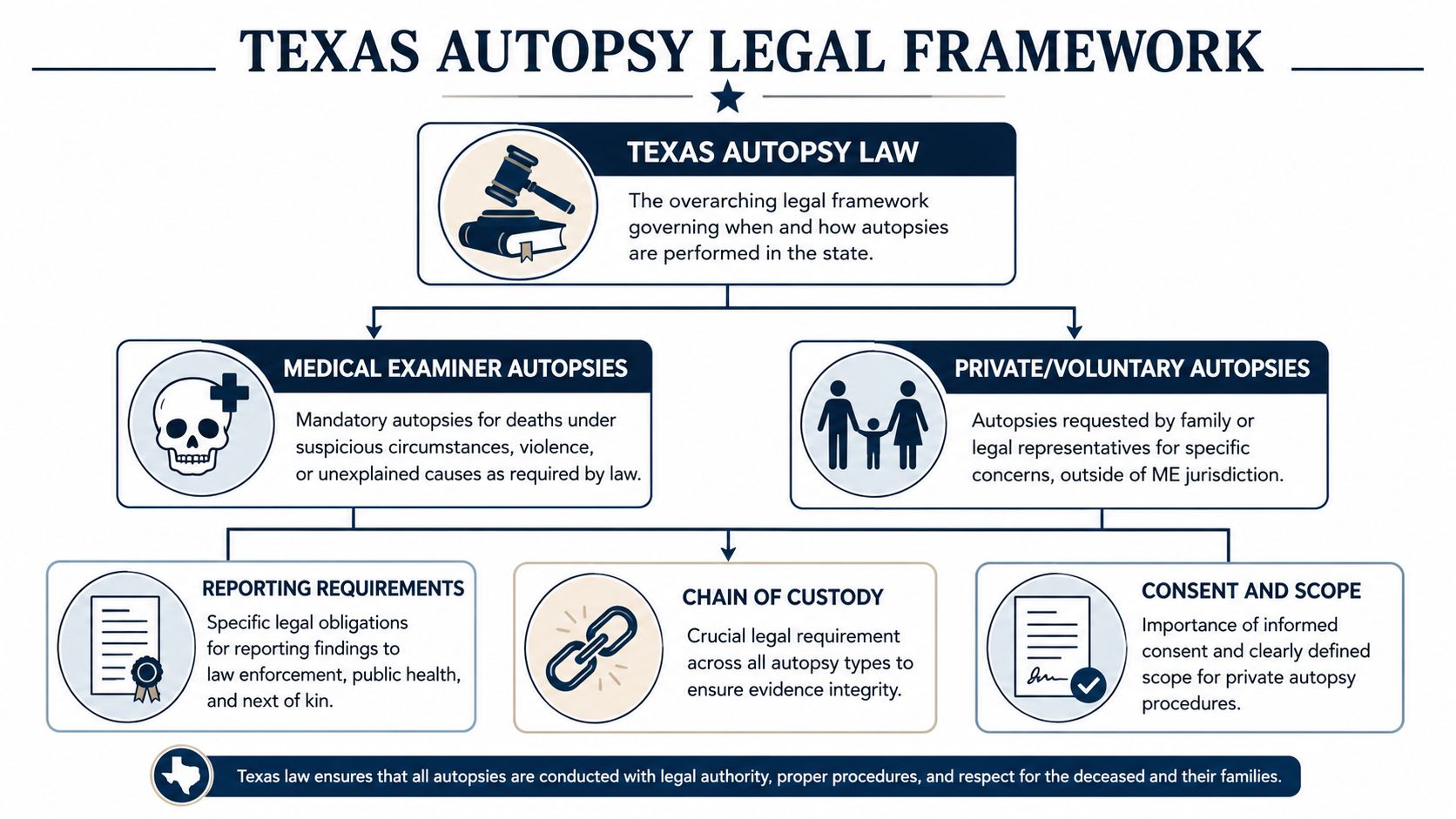
Texas law also distinguishes a private autopsy from a medical examiner autopsy. Under Texas Code of Criminal Procedure Article 49.25, county medical examiners must perform autopsies for sudden, unexpected, violent, suspicious, or unnatural deaths without requiring family consent. That is different from non-mandatory private autopsies, which require written consent from the legal next of kin, as noted in the same Texas law discussion linked above.
This distinction often affects specimen handling and reporting expectations. In a medical examiner case, statutory duties control the investigation. In a private autopsy, the scope is defined by consent, applicable law, and the questions the examination is meant to address.
Why reporting language matters
A final report has to do more than describe findings. It has to use terms correctly.
- Cause of death means the disease or injury that produced death.
- Manner of death means the classification of how the death occurred, such as natural, accident, suicide, homicide, or undetermined.
- Chain of custody means the documented possession and transfer history of the specimens and related evidence.
Those definitions sound straightforward, but precision matters. A toxicology finding without a reliable preserved specimen may carry less weight. A tissue diagnosis without sound fixation may be vulnerable to challenge. A report can only be as strong as the material supporting it.
Attorneys reviewing toxicology-related issues may also find it helpful to understand how specimen handling affects interpretation of post-mortem toxicology, particularly when questions of delay, preservation, and admissibility overlap.
Private autopsy facilities in Texas also operate within a defined legal framework. Under Health & Safety Code §671A.001, a private autopsy facility is an entity owned or operated by a physician performing autopsy services for a fee, excluding medical examiner offices, and §671A.002 requires a complaint notice to be posted in a conspicuous public area, as set out in the text of Texas Health and Safety Code §671A.001. For families, that is part of the broader compliance picture that also includes the Texas Funeral Service Commission and the relevant provisions of the Texas Health & Safety Code.
Frequently Asked Questions About Specimen Handling
Can a second opinion still be useful if preservation was poor
Sometimes, yes. Sometimes, no. The answer depends on what material still exists, what preservative was used, how the sample was stored, and what question the second reviewer is being asked to answer.
A frequent but underserved issue is how to evaluate specimen viability for a second-opinion review, especially when prior autopsies used suboptimal preservatives. Formalin fixed material is generally the better starting point, while other substances can degrade DNA and toxicology markers, creating uncertainty for families seeking a second opinion, as reflected in this discussion of specimen preservation techniques and second review concerns.
That does not mean review is pointless. A second-opinion autopsy review may still assess the original report, photographs, slides, preserved tissue, and the logic used to reach the stated conclusions. In some cases, the preserved material still supports meaningful re-examination. In others, the reviewer can explain exactly what the preservation problem prevents anyone from saying reliably.
Will specimen collection interfere with funeral arrangements
This depends on the circumstances, the scope of the examination, and how logistics are coordinated. Families often worry that specimen retention automatically creates major delay or prevents customary arrangements. That is not always the case.
What matters most is timely communication with the funeral home, the examining team, and any agency with legal jurisdiction. If the case also involves a public investigation, additional approvals may affect timing. When private review is being considered, early decisions usually preserve more options than late ones.
If there is a concern about toxicology, histology, or a future second opinion, that concern should be raised as early as possible. Preservation choices are strongest at the front end of the case.
What do cause of death, manner of death, and chain of custody mean
These terms are often used together, but they do different jobs.
Cause of death is the medical reason death occurred. For example, it may be an injury, a toxic exposure, or a disease process.
Manner of death is the forensic classification of the circumstances. It places the cause into a legal and public health framework.
Chain of custody is the documentation showing who handled the specimen or evidence from collection forward.
A report may discuss all three. The medical findings support the cause. The broader facts and investigative context support the manner. The records of handling support the reliability of the evidence behind both.
What should attorneys ask about preserved evidence
Attorneys do not need to become laboratory specialists, but a few direct questions can clarify whether a specimen is likely to hold up under scrutiny:
- What exactly was collected and from which anatomical site?
- What preservative was used for each specimen type?
- When was the sample collected and stabilized?
- How was the specimen labeled, sealed, and transferred?
- Is there a complete chain-of-custody record?
- Does the available material support independent review or only limited review?
Those questions often reveal the difference between a complete record and a merely present record. In contested matters, that difference can shape both litigation strategy and expert opinion.
Do all preserved specimens remain useful indefinitely
No. Preservation is not the same as permanence. Some specimens remain highly informative for long periods if they were collected and fixed correctly. Others lose value quickly if the wrong preservative was used, the sample was inadequately penetrated, or decomposition had already advanced.
That is one reason forensic pathology differs from general specimen archiving. The purpose is not just to keep material. The purpose is to keep it in a condition that still answers the case-specific question.
Does a private autopsy follow the same legal rules as a medical examiner autopsy
No. In Texas, private autopsies and medical examiner autopsies arise under different legal authority. A private autopsy requires authorization from the legally recognized next of kin in the order established by Texas law. A medical examiner autopsy under Article 49.25 does not depend on family consent when the death falls within the categories the law assigns to the medical examiner.
That legal difference can also affect access to specimens, records, and later review. Families and attorneys should confirm which pathway applies before making assumptions about consent, release, or timing.
If you're facing unanswered questions after a death and need clear information about specimen handling, preservation, or a possible second-opinion review, Texas Autopsy Services can help you understand the process. Our team serves all 254 Texas counties, and every examination is performed by a forensic pathologist certified by the American Board of Pathology. We know these calls often come during a difficult time, and we respond with direct, respectful guidance.