August 12, 2026 · Texas Autopsy Services
What Is Toxicology Testing: A Forensic Guide
What is toxicology testing in a forensic autopsy? Learn how screening works, what specimens are used, and how results shape cause-of-death findings.
On this page
- What Toxicology Testing Actually Means in a Death Investigation
- Screening Versus Confirmatory Testing in the Lab
- Common Analytes and Specimen Types Collected During Autopsy
- Detection Windows and Why Timing Changes the Result
- Limitations and Interpretation Issues Families Should Know
- Toxicology Inside the Forensic Autopsy Process
- When Families or Attorneys Should Request Toxicology
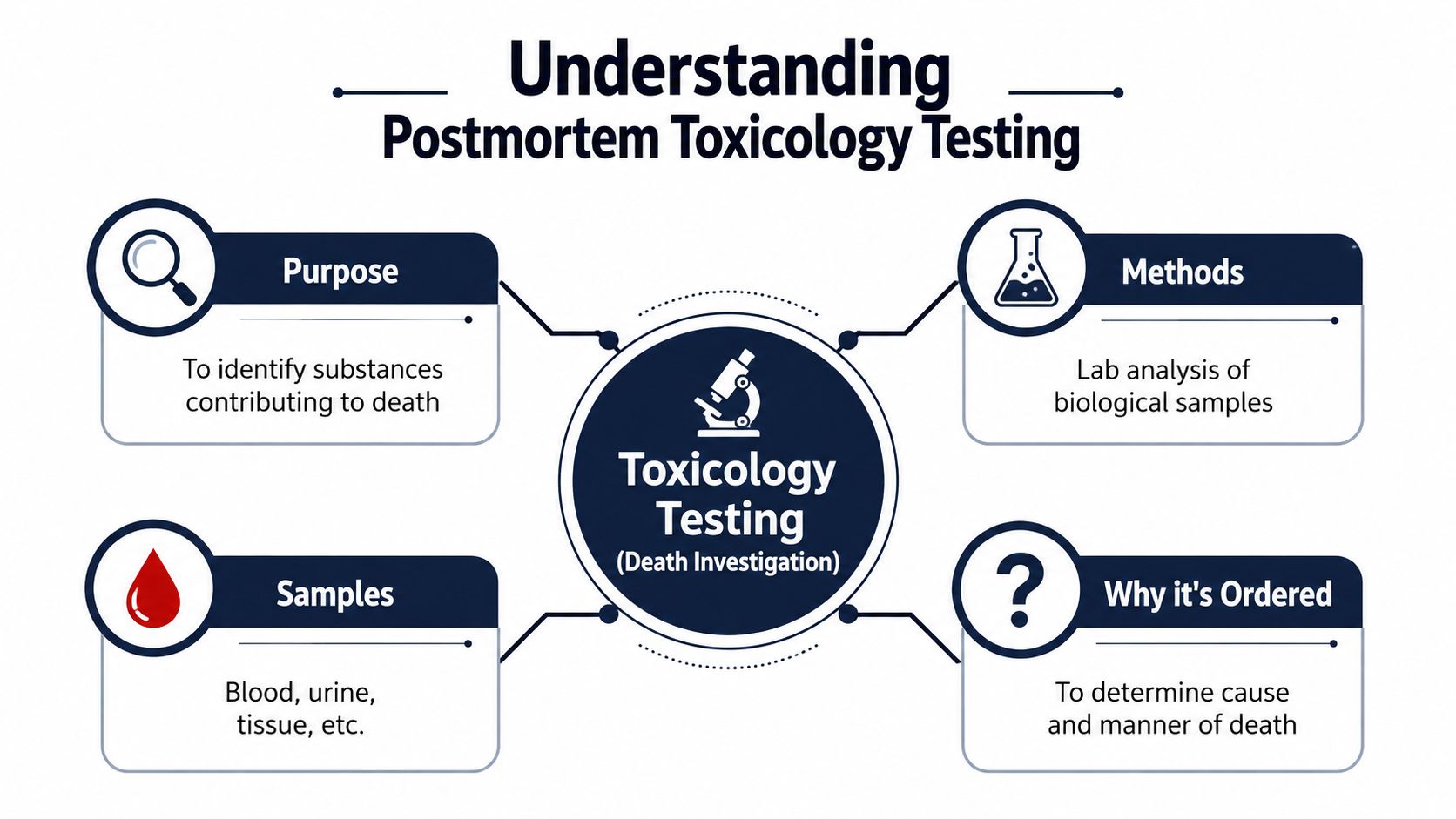
Toxicology testing is the laboratory analysis of biological specimens to detect drugs, alcohol, poisons, or other chemical agents and support a cause-of-death determination. In a death investigation, it is usually part of a broader forensic review, not a stand-alone answer.
- Postmortem toxicology helps identify whether a substance may have contributed to death, but it must be read with the autopsy, scene findings, and medical history.
- A positive screen is not the same as a confirmed result, and a negative screen does not always rule out exposure.
- Specimen type and timing matter. Blood, urine, vitreous fluid, tissue, and other samples answer different questions.
- Families and attorneys often need toxicology because the report may explain, or fail to explain, a sudden or disputed death.
- In a forensic setting, the final interpretation depends on chain of custody, the lab method used, and how the pathologist fits the results into the full case.
A family may hear that a toxicology panel was “negative,” then later learn that the specimen collected wasn't the most useful one for the substance of concern. Another case may show a “positive” screen that still needs confirmation before anyone can rely on it in court or in a cause-of-death opinion. That gap between a lab result and a defensible conclusion is where most confusion starts.
What Toxicology Testing Actually Means in a Death Investigation
A death scene can leave families with a simple question and no simple answer. The body may show no obvious sign of poisoning, yet the story of the death can still depend on what was in the blood, urine, bile, vitreous fluid, or tissue at the time of death. Postmortem toxicology is the analysis of those body fluids and tissues after death to look for drugs, alcohol, toxic metals, gases, pesticides, and other chemicals that may have played a role in the death. It is part of the medicolegal death investigation process, which means it helps the pathologist build or test a cause-of-death opinion rather than replace it.
Modern toxicology did not appear all at once. Its history includes a major public health failure, the 1937 sulfanilamide disaster, which killed more than 100 people and helped drive the Food, Drug, and Cosmetic Act in 1938. That law required evidence from animal toxicity studies before a drug could be marketed, which shifted toxicology from a research activity toward a public safety requirement. The National Toxicology Program was later established in 1978 to coordinate federal toxicology testing and strengthen the science base for evaluating potentially toxic chemicals (National Academies).
Toxicology Is a System, Not a Single Test
Families sometimes hear the word toxicology and picture one blood test that either “finds the drug” or doesn't. Real cases are more layered than that. The laboratory may test for prescription drugs, illicit drugs, alcohol, metals, inhalants, pesticides, carbon monoxide, cyanide, and other toxicants depending on the investigative clues.
A useful way to understand it is to separate the laboratory result from the medical conclusion. The result may show that a substance was present, absent, or below the lab's reporting threshold. That alone does not prove the substance caused death, and it does not rule out a toxic death if the specimen was collected late, the wrong tissue was tested, or the wrong panel was ordered.
That is why toxicology is usually paired with the autopsy process, the scene investigation, and the medical record. A toxicology report can support a conclusion, but it cannot answer every question by itself. The pathologist still has to weigh specimen quality, the timing of collection, the chain-of-custody, and whether the detected substance fits the medical findings.
Practical rule: a toxicology result is best treated as one piece of evidence, not the entire case.
The field has also developed in stages. Historical reviews describe a move from acute-lethality testing to more standardized and ethically debated programs, with phases of incubation, increasing acceptance and spread, maturation, and then a major change after 2007 (WellBeing International Studies Repository). That history matters because it explains why modern toxicology depends on method, context, and interpretation, not just detection.
Screening Versus Confirmatory Testing in the Lab
A family may see a toxicology report and assume a positive or negative line gives the full answer. In the lab, that first result is usually only the starting point. Forensic toxicology often begins with a rapid screening test, often an immunoassay, and then moves to confirmatory testing if the screen is positive or if the case still raises concern. Screening is built for speed. Confirmation is built for specificity and identification.
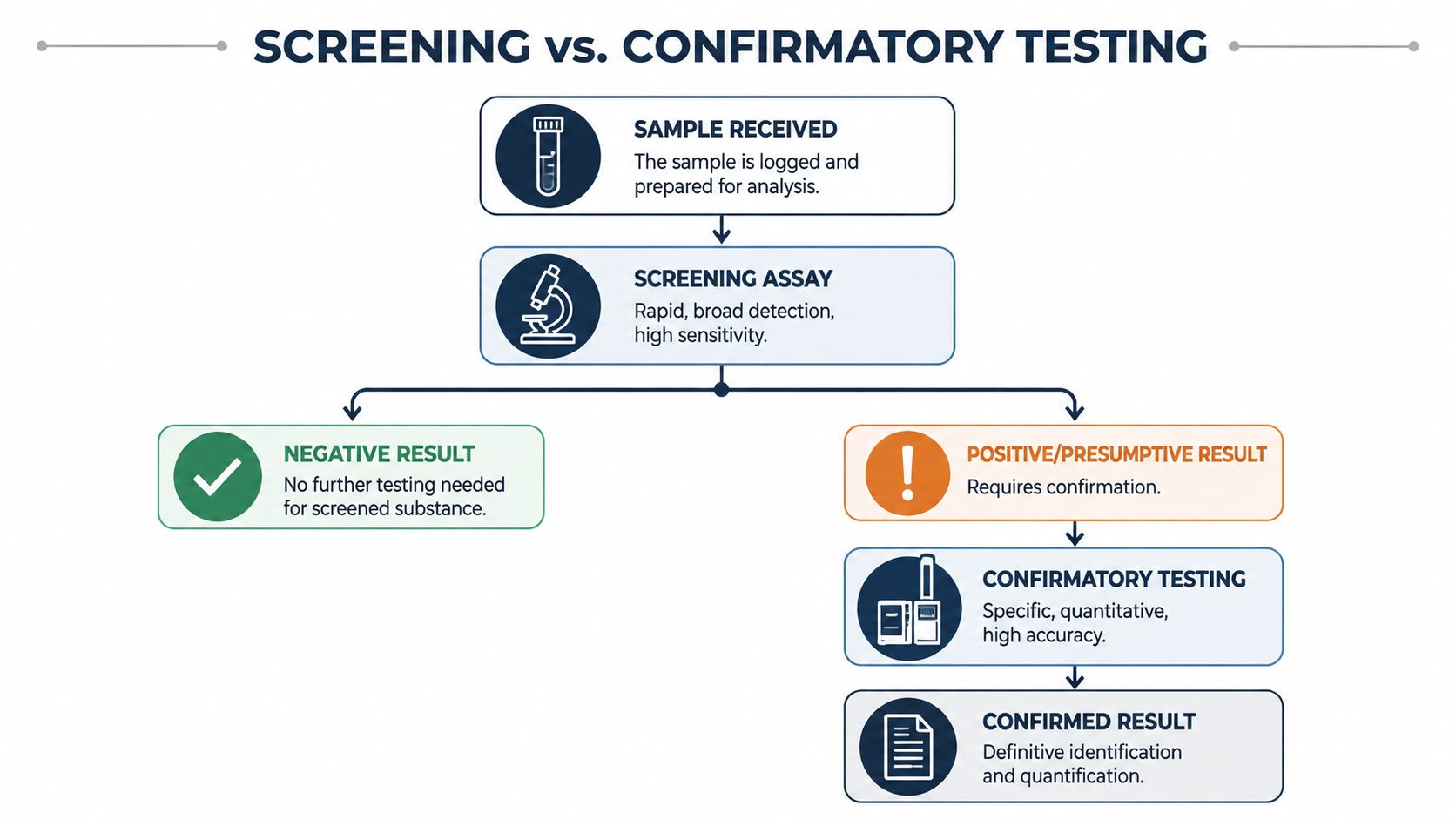
That difference matters because a screen can react to substances that are chemically similar to the target compound, even when the exact drug is not present. Confirmatory methods, including chromatographic and mass spectrometric techniques, are used to narrow that uncertainty and identify the substance in a way that can stand up in forensic and legal review (WebMD).
Why the Second Step Matters
A screening result is usually presumptive, not final. It is like a rough sketch before the finished drawing. If the screen is negative, the lab may stop there for that panel. If the screen is positive, or the case still appears suspicious, the lab confirms the finding with a more specific method. That second step is what gives the result enough reliability for a death investigation, especially when attorneys, insurers, or a court may later examine it.
What a Family Should Look For in the Report
The report should say whether a finding was screened, confirmed, or both. That distinction changes how much weight the result should carry. A positive screen alone is a signal to look closer. It is not the same as a confirmed identification. If the document lists only a screen without confirmation, the pathologist still has to decide how much reliance, if any, the result deserves.
A confirmed result is not just a stronger signal. It is the step that makes the finding medically and legally usable.
Clinical toxicology sources also note that screens usually show whether certain substances are present, not how much was taken, when it was taken, or whether it caused impairment or addiction (WebMD). In a death investigation, that limitation matters because the final opinion depends on timing, specimen quality, and whether the lab result fits the scene and the autopsy findings.
Common Analytes and Specimen Types Collected During Autopsy
A family may hear that a toxicology exam was “done,” but the real question is what the pathologist needed to learn from it. The substance list in a forensic case depends on the scene, the history, and the question being asked. In an autopsy, the lab may look for prescription medications, illicit drugs, alcohol and volatiles, metals, inhalants, pesticides, carbon monoxide, cyanide, and other toxicants selected from the facts of the case.
The Sample Has to Match the Question
No single specimen answers every toxicology question. Blood is often central for many drugs because it reflects what was circulating near the time of death. Urine can show exposure, but it does not always pin down timing. Vitreous humor can help in some alcohol and electrolyte questions. Tissues become important when blood levels are hard to interpret or when the case involves chronic exposure.
| Common Specimens and What They Best Detect | Best Use | Limitation |
|---|---|---|
| Peripheral blood | Many drugs and alcohol interpretation | Levels can shift after death |
| Central blood | Quick access in some autopsies | More vulnerable to postmortem redistribution |
| Urine | Broad exposure history | Doesn't show exact timing or impairment |
| Vitreous humor | Helpful for some alcohol-related interpretation | Limited for many drugs |
| Tissue, such as liver or brain | Useful when blood is unavailable or misleading | Interpretation can be more complex |
| Hair | Longer-term exposure patterns | Not useful for immediate, acute timing |
For specimen collection procedures, families and attorneys often want the practical sequence, not just the theory. Our internal guide on specimen collection procedures explains why the collection step itself affects the value of the final report.
Why Different Samples Answer Different Questions
A blood specimen may help show recent exposure. A tissue specimen can better support a search for chronic exposure or help when the body has been changed by decomposition. Hair may show a longer pattern of exposure, but it does not tell the story of the last hours or minutes before death.
That is why autopsy toxicology often uses more than one matrix. If the substance is short-acting, one specimen can miss it. If the exposure is long-term, another specimen may matter more. In postmortem work, the pathologist chooses the sample based on the suspected agent and the survival interval after exposure.
Detection Windows and Why Timing Changes the Result
A toxicology result starts with a basic timing question. A substance does not stay visible in every sample for the same length of time, and the answer depends on the drug's half-life, the dose, whether use was chronic, the specimen tested, and how long the person survived after exposure.
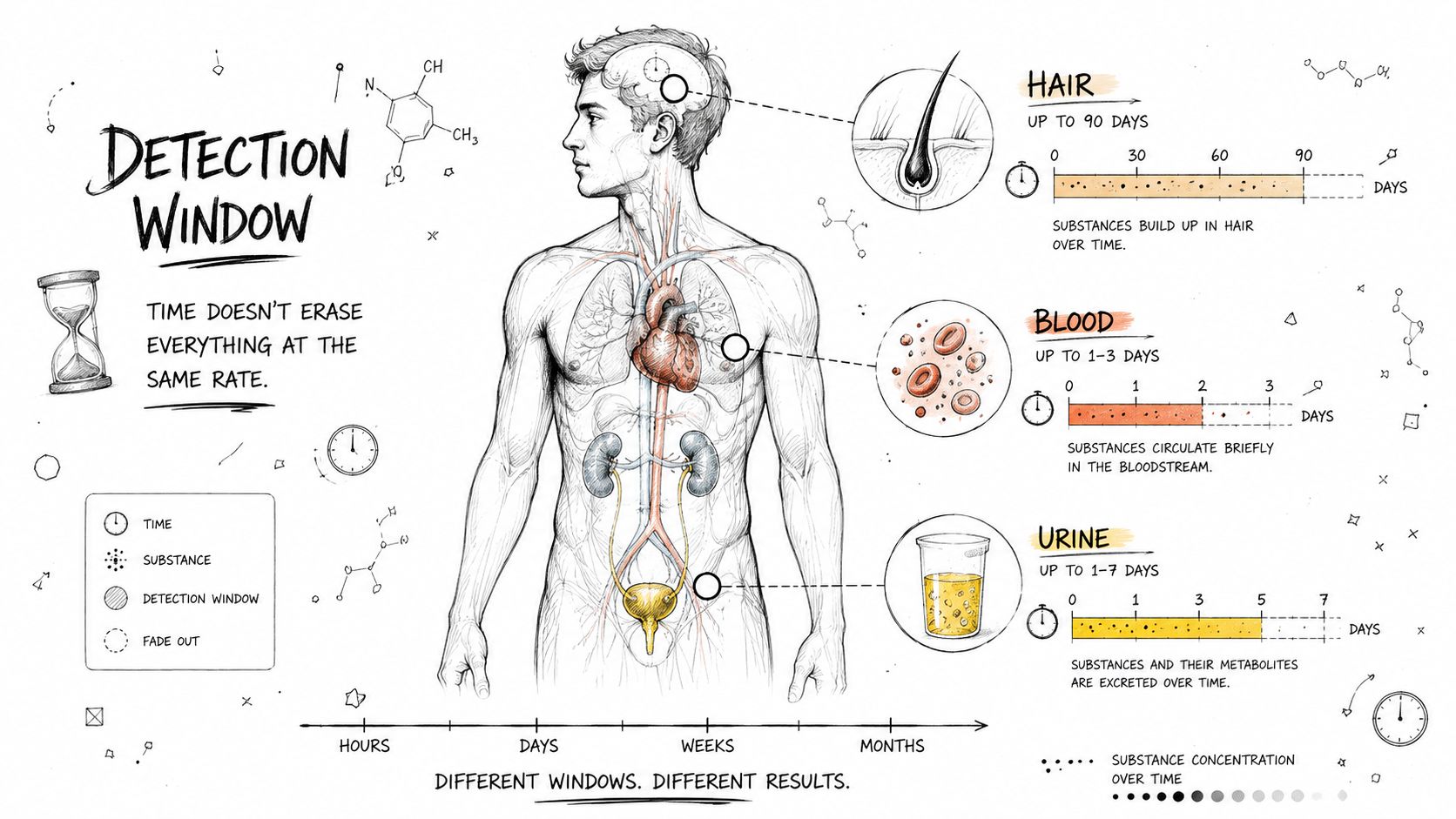
A plain-language discussion of timing appears in the Tru Dallas Detox Norco guide. It explains a simple point that becomes harder after death. Living bodies metabolize chemicals, but postmortem specimens reflect chemistry that may have shifted after circulation stopped.
The same timing problem is why the post-mortem toxicology review matters in death investigations. A result only has meaning when the specimen, the interval, and the surrounding facts line up.
Why a Negative Result Can Still Be Incomplete
A negative result does not automatically mean the substance was never present. It may mean the lab examined the wrong specimen, used the wrong panel, or collected the sample outside the useful detection window. It may also mean the person died after the compound cleared from blood, while a metabolite or tissue marker remained in another matrix.
Postmortem redistribution adds another layer of uncertainty. After death, some substances move between body compartments, which can change measured concentrations and make central blood less reliable than femoral blood for many analytes. That is one reason femoral blood is often preferred when the case allows it.
The postmortem toxicology review in PMC notes that toxicology is commonly obtained after death to help determine cause of death, so it is interpreted together with the autopsy and scene information rather than by itself (PMC). Timing works the same way. The specimen type, the survival interval, and the circumstances have to fit before anyone can treat the result as meaningful.
Practical rule: the farther the death is from the exposure, the more careful the interpretation has to be.
Families sometimes look to general drug-timing references for help with the first layer of understanding. Those sources can explain broad detection concepts, but they cannot replace postmortem interpretation, because death investigation depends on specimen source, redistribution, and the medical context.
Limitations and Interpretation Issues Families Should Know
A toxicology report can support a cause-of-death opinion, but it usually cannot prove that opinion by itself. That is the point many families miss at first. A result showing a substance is present does not automatically show how much was taken, when it was taken, or whether it caused death.
A positive result can still leave room for doubt. A lab may identify a drug or metabolite, yet the concentration may be too low, too high, or too hard to interpret without the rest of the autopsy picture. In death investigation, a number in isolation is like a single sentence pulled from a longer story. It may be true, but it is not the whole meaning.
Why a “Clean” Result Can Still Mislead
A clean panel can give false reassurance when the wrong specimen or the wrong test menu was used. It can also miss substances that fell outside the detection window or were present mainly in another tissue. In a death investigation, that matters because the absence of a detected substance is not the same as proof that no toxic exposure occurred.
False positives can also happen. Cross-reactivity, decomposition products, and prescribed medications can complicate a screening result. WebMD describes toxicology testing in general terms, but postmortem interpretation is narrower and more context dependent. That is one reason confirmation testing matters before anyone relies on a screening result in court or in a final report.
Why Disease Still Matters
Mixed-drug cases are difficult, but underlying disease can be just as important. A person may have a detectable substance and still die primarily from natural disease. The pathologist has to weigh the toxicology with the autopsy findings, the medical record, and the circumstances of death before assigning cause and manner.
A number on a lab report is not a cause of death. It is a finding that still has to be interpreted.
For families reading a report, a practical guide helps. Our internal article on how to read a toxicology report explains the difference between detection, interpretation, and the final medicolegal opinion. That matters because the final conclusion may be broader, narrower, or different from what the lab result seems to suggest at first glance.
The Questions That Usually Need Answers
- Which specimen was tested? Blood, urine, vitreous, or tissue can each tell a different story.
- Was the result confirmed? Screening alone is not enough for a defensible conclusion.
- Does the drug level fit the scene? A result has to make sense with the timeline and findings.
- Could another disease explain the death? Toxicology rarely answers that by itself.
Toxicology Inside the Forensic Autopsy Process
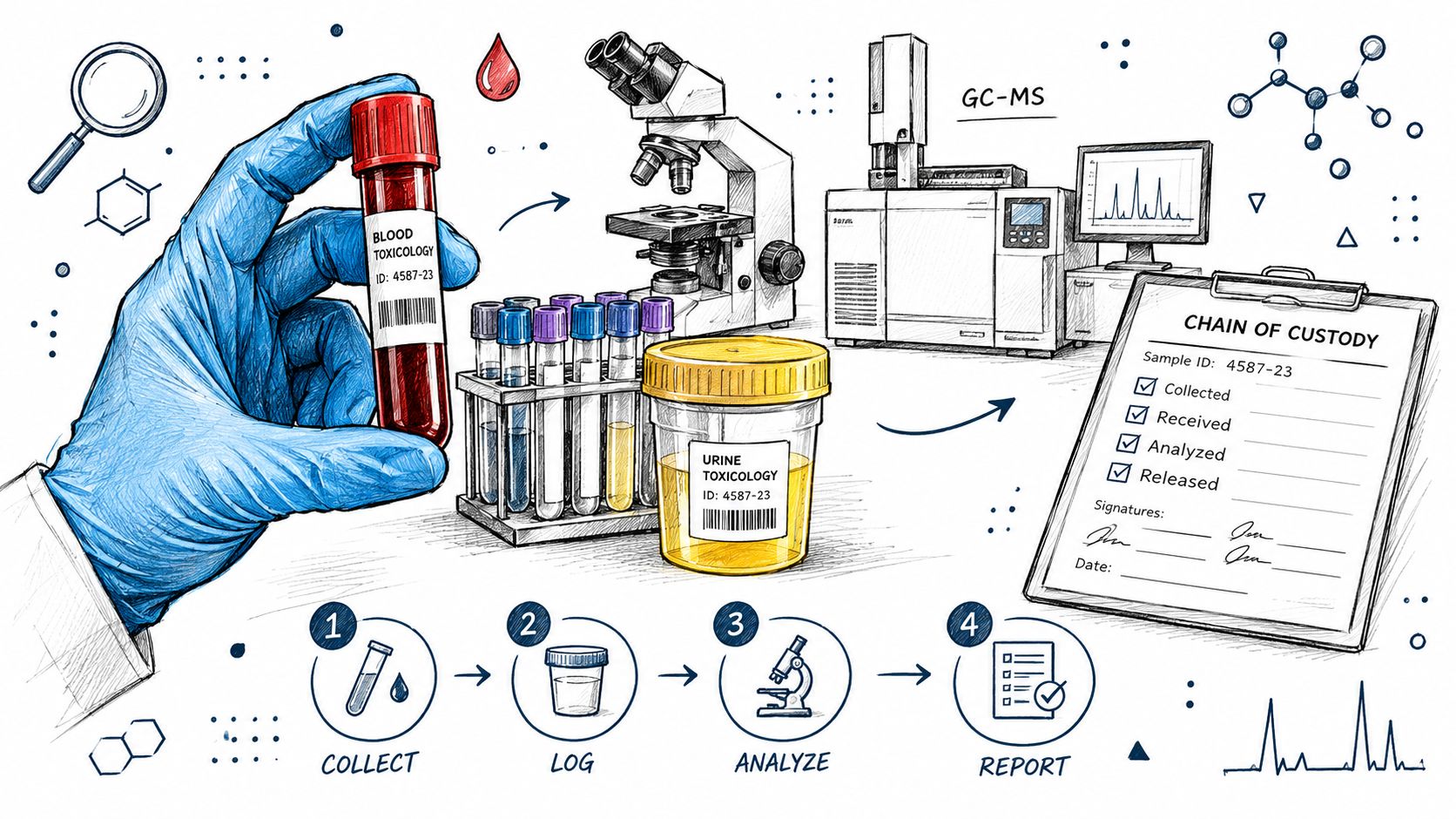
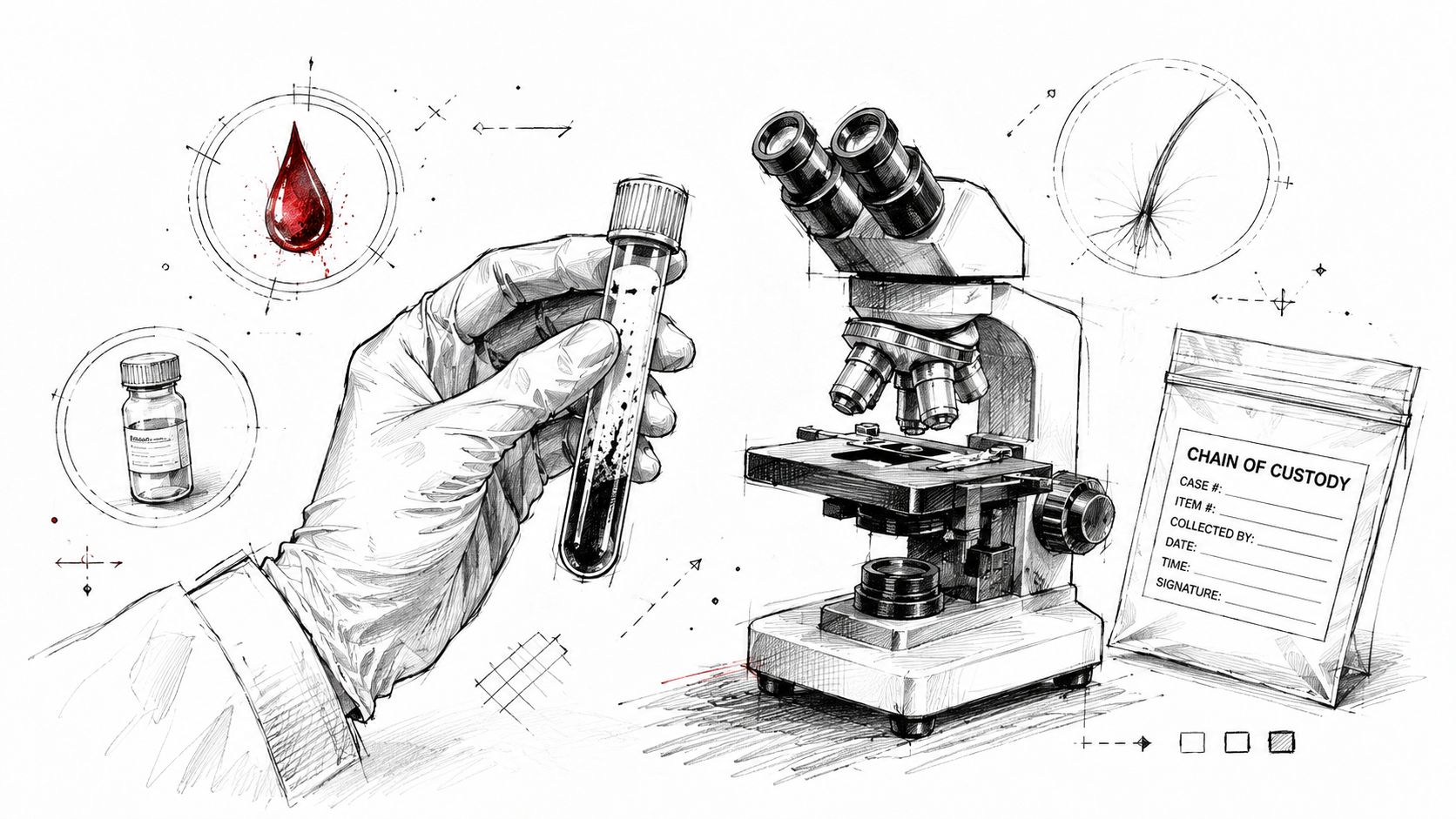
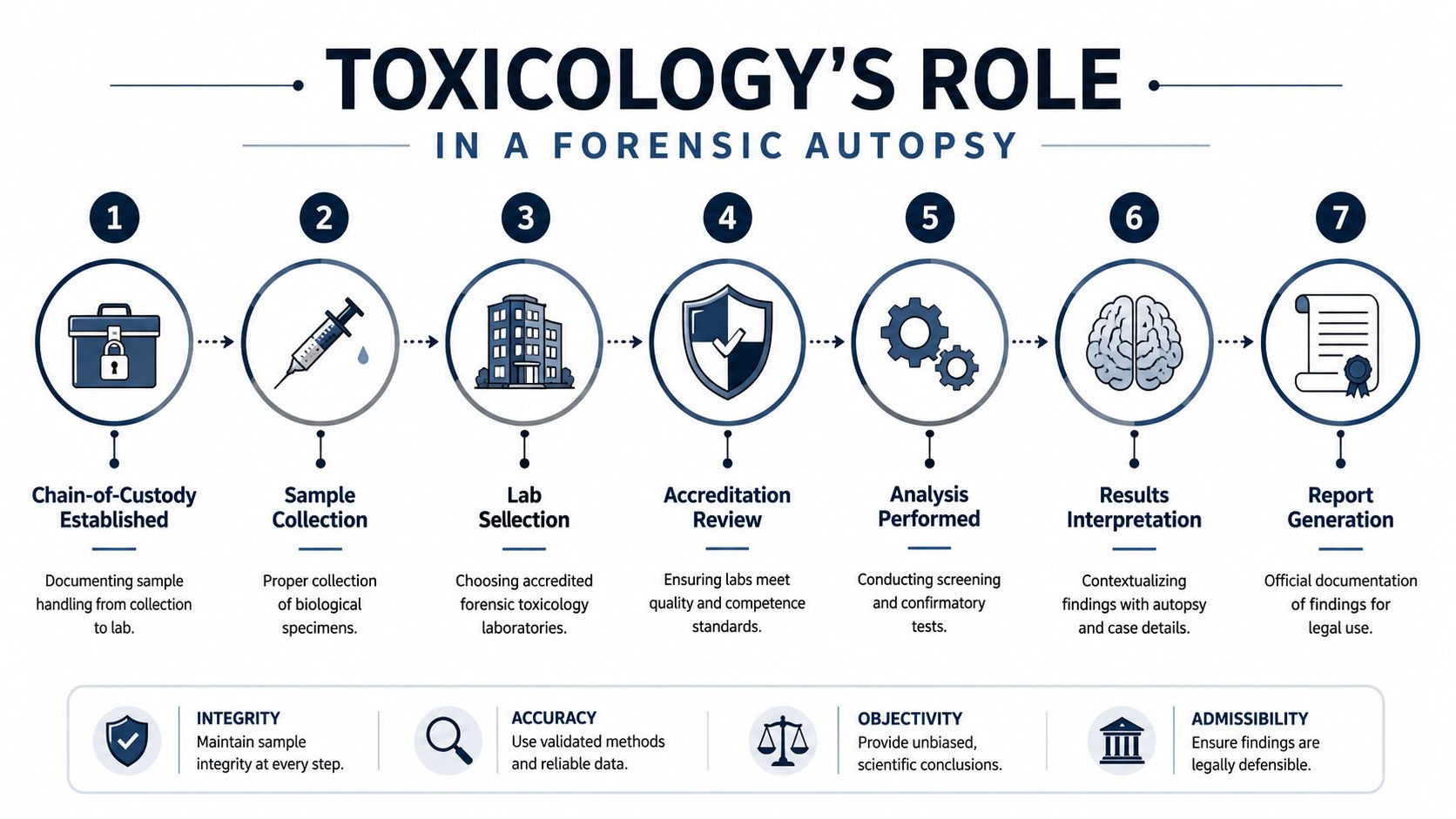
In a private or medicolegal autopsy, toxicology is one step in a documented chain, not a separate event. At Texas Autopsy Services, every examination is performed by a board-certified forensic pathologist, and the toxicology samples are collected, labeled, and transferred under a written chain of custody so the results can be traced from collection to analysis.
How the Case Moves Through the Lab
The lab sequence starts with specimen collection. The samples are sealed with identifiers, then sent to an accredited analytical laboratory for screening and confirmation. Accreditation matters because courts and attorneys often look closely at whether the lab follows recognized quality and competence standards.
A typical toxicology report will list what was tested, what was detected, and which findings were confirmed. The pathologist then places those findings next to the autopsy findings and the scene information before finalizing cause and manner of death. That integrated review is what keeps the conclusion medically grounded.
Texas Autopsy Services uses toxicology as part of a larger medicolegal workflow. In cases where additional review is needed, our team can coordinate toxicology with the broader autopsy and reporting process, including direct communication with families and attorneys and, when appropriate, court-ready documentation.
Why the Report Isn't Written in Isolation
A laboratory may know whether a substance was present. The pathologist has to decide what that presence means in the death investigation. That includes checking the specimen source, the chain of custody, the lab method, the autopsy findings, and any scene clues that point toward poisoning, overdose, or a non-toxicologic cause.
Turnaround depends on the complexity of the panel and the substances under review, so it's better to think in terms of case factors than promises. A basic panel may move faster than a broad one with specialized testing, but no responsible practice should guarantee a fixed outcome before the specimen is analyzed.
When Families or Attorneys Should Request Toxicology
Toxicology adds the most value when the death is unexpected, unwitnessed, or disputed. It also matters in suspected overdose, medication toxicity, poisoning, workplace or environmental exposure, and deaths involving minors or older adults with complex prescriptions. If a prior autopsy did not include toxicology, the case may still benefit from a second opinion review with targeted testing.
What to Ask Before Testing Starts
The first question is simple. Ask which substances are being tested and why those analytes match the facts of the case. Then ask which specimens will be collected, whether the lab is accredited, and how the pathologist will interpret the results in the final report.
If you're working with an attorney, those questions matter even more. The report may later be reviewed in litigation, so the testing has to be documented well enough for a third party to understand what was done and what it means. A result that looks useful in isolation may be weak if the specimen choice or collection chain is unclear.
When Toxicology Changes the Case
Toxicology is often most useful when it can either strengthen or narrow a hypothesis. If a death scene suggests poisoning, toxicology can support that direction. If the scene suggests overdose but the lab is negative, the pathologist still has to ask whether the panel, specimen, or timing window was appropriate.
For families, that can be the difference between closure and uncertainty. For attorneys, it can be the difference between a supported opinion and a report that still needs clarification. In either setting, the goal is the same, a medically sound explanation that respects both the deceased and the facts.
Practical rule: request toxicology when the cause of death isn't already clear from the autopsy and history alone.
If you need a private autopsy, a second-opinion review, or help deciding whether toxicology belongs in a case, Texas Autopsy Services can review the circumstances, explain the testing options, and document the findings in a clear forensic report. Visit Texas Autopsy Services to speak directly with our team about your case.