July 28, 2026 · Texas Autopsy Services
Sudden Cardiac Death: A Forensic Guide for Texas Families
Understand sudden cardiac death with our forensic guide for Texas families, covering causes, signs, and legal considerations in 2026.
On this page
- What Sudden Cardiac Death Actually Means
- The Causes and Risk Factors Behind SCD
- How SCD Differs from Heart Attack and Cardiac Arrest
- Where and How SCD Typically Happens
- The Forensic Autopsy and Ancillary Testing
- Texas Legal and Medical Workflow for SCD
- Family Risk and What Relatives Should Do Next
- Practical Next Steps and How Texas Autopsy Services Can Help
A sudden death at home leaves families with two urgent questions. What happened, and does it change the risk for the people still here? In sudden cardiac death, the answer depends on careful medical definition, not guesswork. It is an unexpected death presumed to be of cardiac origin that occurs within 1 hour of symptom onset, or within 24 hours of last being seen alive and well if the event was unwitnessed NCBI Bookshelf definition.
What Sudden Cardiac Death Actually Means
A person can seem healthy, feel fine earlier in the day, then collapse at home with no warning. In that moment, the family often gets a rushed explanation before any investigation is complete. The formal forensic definition matters because it keeps the classification tied to timing and mechanism, not emotion or assumption.
Sudden cardiac death is an unexpected death presumed to be of cardiac origin that occurs within 1 hour of symptom onset, or within 24 hours of last being seen alive and well if unwitnessed NCBI Bookshelf definition. That timing rule is one of the main reasons a pathologist can distinguish sudden cardiac death from other sudden deaths. It also explains why two cases that look similar to a family may be classified differently in medical records.
Why the timing rule matters
If a death happens quickly after symptoms begin, it fits the sudden cardiac death framework. If the person had been ill for a longer period, or the chain of events clearly points elsewhere, the classification may change. The same physical collapse can later be described as sudden cardiac arrest, heart attack, or another sudden death category depending on what the investigation shows.
Practical rule: the clock is not a detail. It is part of the definition, and it shapes how the death gets recorded and investigated.
For attorneys and county officials, that distinction affects the language used in reports and death certification. For families, it affects what questions remain open after the first call from responders. A label on the first page is not the final answer.
The Causes and Risk Factors Behind SCD
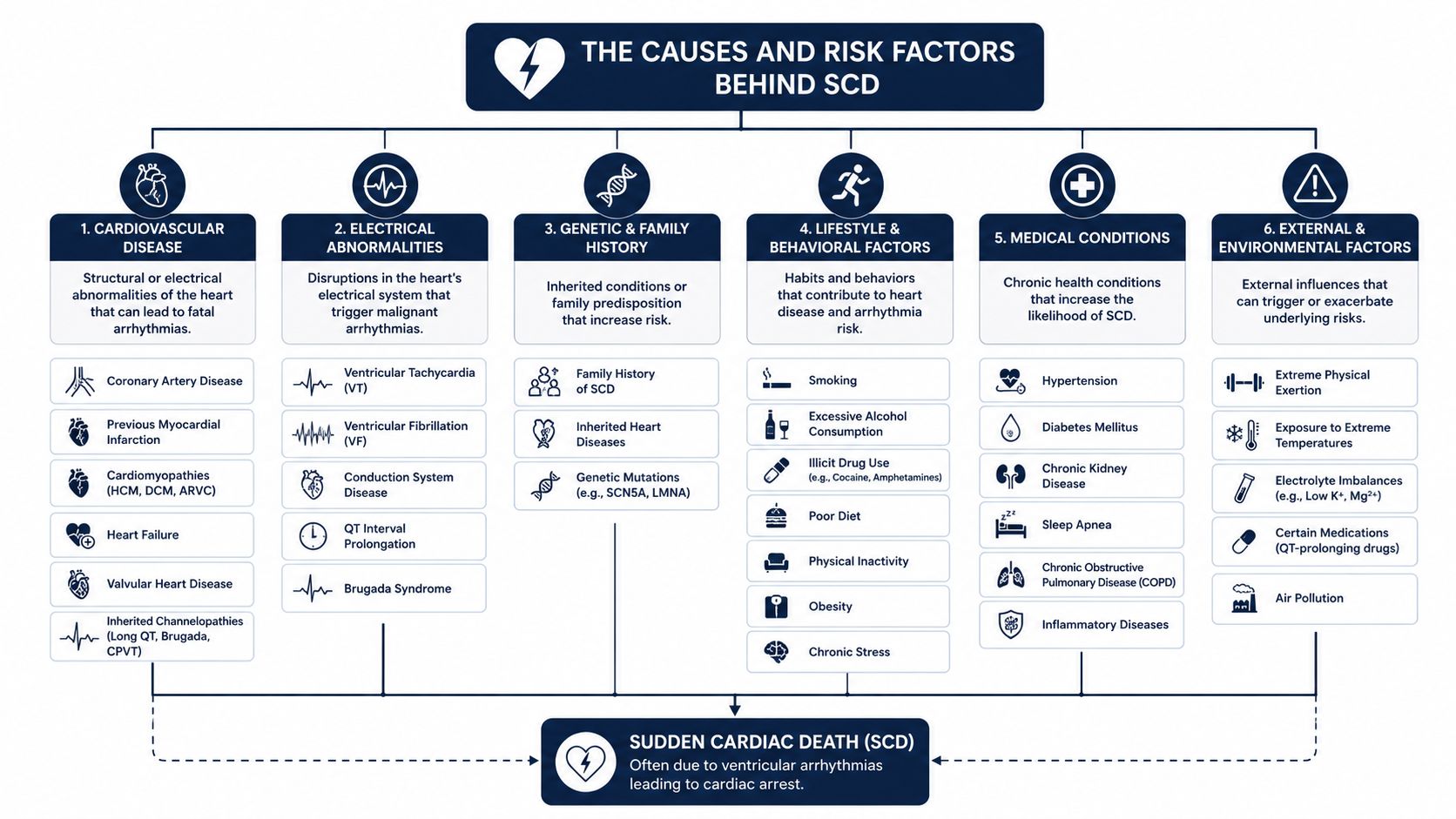
A sudden collapse from sudden cardiac death often begins with an electrical event in a heart that already carries hidden strain. In structural heart disease, the terminal rhythms are often ventricular tachycardia or ventricular fibrillation, and the underlying setting is often advanced myocardial disease with poor ventricular function Columbia pathophysiology review. The heart may have looked chronically diseased for years, yet the final loss of pulse happens because the rhythm can no longer sustain circulation.
The biggest disease burden sits in coronary heart disease
In the United States, coronary heart disease underlies about 80% of sudden cardiac deaths PubMed review. That figure does not mean every case is a classic heart attack. It means coronary disease is the most common background problem, even when the last event is a fatal arrhythmia rather than a prolonged infarction.
Age changes the picture as well. A Circulation review reported an incidence of about 100 per 100,000 in 50-year-old men versus 800 per 100,000 in 75-year-old men SCA Aware statistics page. The increase is steep, and it helps explain why risk assessment depends on age, sex, and known heart disease.
Inherited risk can be real even when the person seemed well
Family history is not a vague warning sign. A cited prospective study found that a history of sudden cardiac death in one parent increased offspring risk of fatal arrhythmia by 80%, while a history in both parents increased risk by about 9-fold PMC family risk study. That does not diagnose anyone by itself, but it does justify careful family review when a death has no clear explanation.
Younger people require a different lens. Inherited electrical disorders and structural cardiomyopathies carry more weight than age-related coronary disease. Long QT syndrome, hypertrophic cardiomyopathy, and similar conditions can remain hidden until the first collapse. No prior diagnosis is not the same thing as no underlying disease. When a Texas coroner, medical examiner, or attending physician orders an autopsy after an unexpected death, ancillary testing can help sort those hidden causes. A forensic autopsy may be paired with toxicology, histology, and targeted cardiac evaluation, and that information can change how relatives are counseled about future risk. For families and lawyers who want a practical explanation of how sudden death is investigated after the fact, a focused heart attack autopsy review helps show how the findings are sorted into disease, mechanism, and family implications.
How SCD Differs from Heart Attack and Cardiac Arrest
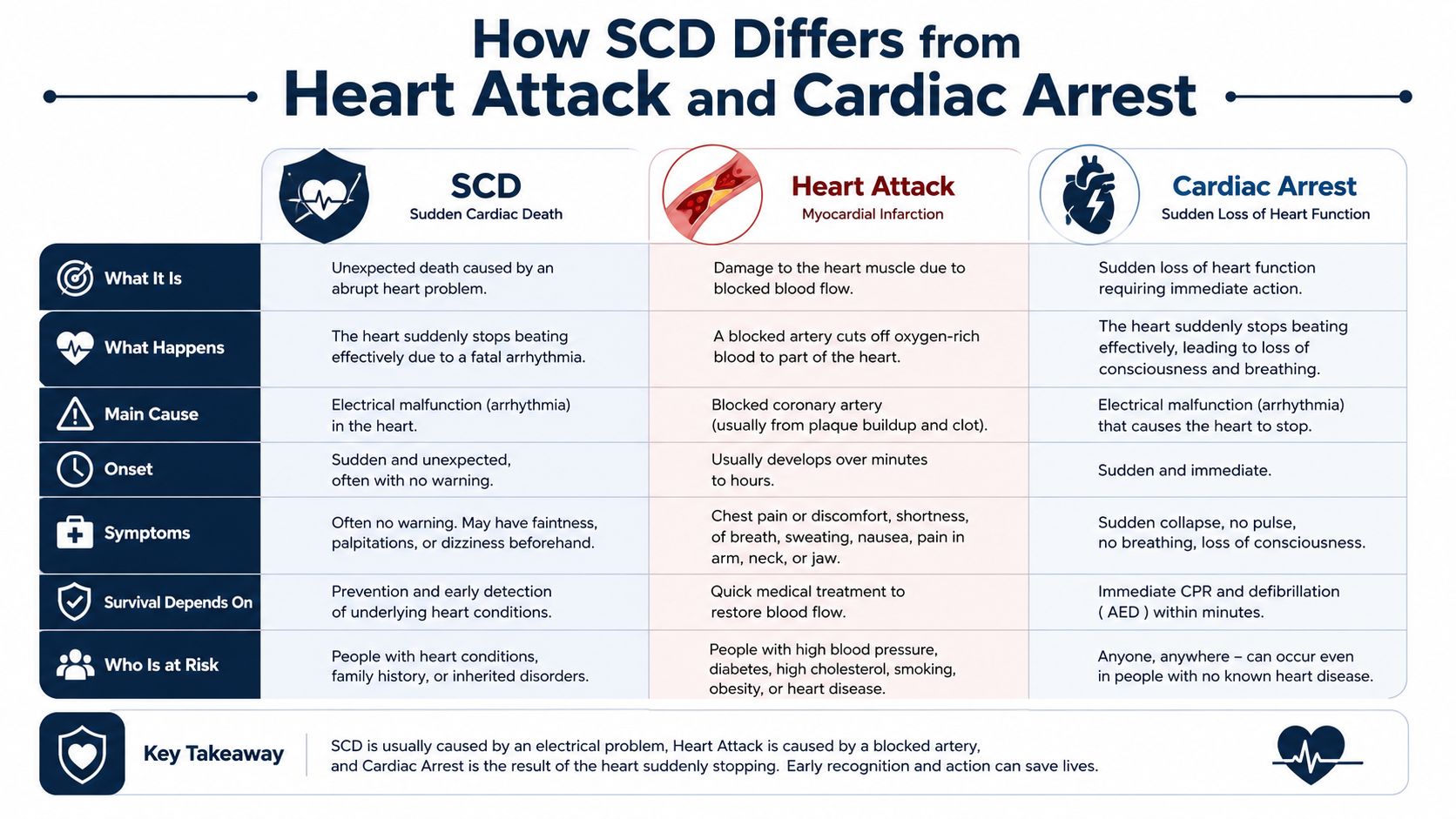
Families often use “heart attack,” “cardiac arrest,” and “sudden cardiac death” as if they mean the same thing. Medically, they don't. A heart attack is a blood-flow problem in the heart muscle, usually from blocked coronary arteries. Cardiac arrest is the moment the heart stops pumping effectively, most often because the rhythm has failed. Sudden cardiac death is the outcome, a death that occurs rapidly from a cardiac cause.
The difference matters because the autopsy can show different findings. A person can have a heart attack and survive. A person can have cardiac arrest without a heart attack. A person can die suddenly from an arrhythmia without a major coronary blockage being the immediate trigger.
The death certificate should match the mechanism, not the shorthand phrase that sounds easiest in conversation.
For a family, that distinction affects what comes next. If the record says “cardiac arrest,” that may describe the final rhythm problem, not the underlying disease. If it says coronary disease, arrhythmogenic cardiomyopathy, or another specific cause, that points toward a more precise risk picture for relatives. For a legal claim, the difference between a mechanism and a cause can change what evidence matters most.
A related practical question is how the death was investigated. A focused discussion of heart-attack autopsy findings is available in our heart attack autopsy guide.
The distinction is also useful in the emergency setting. A person can be in arrest without any prior complaint of chest pain. A death certificate that uses the correct language helps avoid confusion later when records are reviewed by physicians, attorneys, or county officials.
Later, the video below reinforces those differences in plain language.
Where and How SCD Typically Happens
Many sudden cardiac deaths happen where the person feels safest, at home. About 80% of sudden cardiac deaths occur at home, and around 60% are witnessed PMC review. That means responders and investigators often arrive with very limited clinical history, a short timeline, and no recent cardiology records in hand.
The collapse is usually fast, and delay is unforgiving
Survival drops rapidly when defibrillation is delayed. One review states survival decreases by 7-10% per minute without CPR and by 3-4% per minute with immediate CPR, and after 10 minutes without defibrillation about 95% of patients die PMC review. Those figures explain why bystander action matters so much in emergency care.
The pathologist, however, still has to determine why the event happened. Whether a neighbor started CPR or an AED was used can affect survival statistics and the medical record, but it doesn't by itself define the cause of death. The underlying disease process still has to be investigated.
What the scene tells us
A home death with a short collapse-to-death interval raises suspicion for arrhythmia, coronary disease, or another sudden cardiac cause. A witnessed event often gives better timing data, while an unwitnessed event may rely on the last-known-well window. Either way, the scene description helps the autopsy team decide how much emphasis to place on coronary examination, myocardial sampling, toxicology, and possible family-risk implications.
The report should reflect the actual circumstances, not a guess based on the setting. That is why the scene history matters as much as the body itself. It frames the examination without replacing it.
The Forensic Autopsy and Ancillary Testing
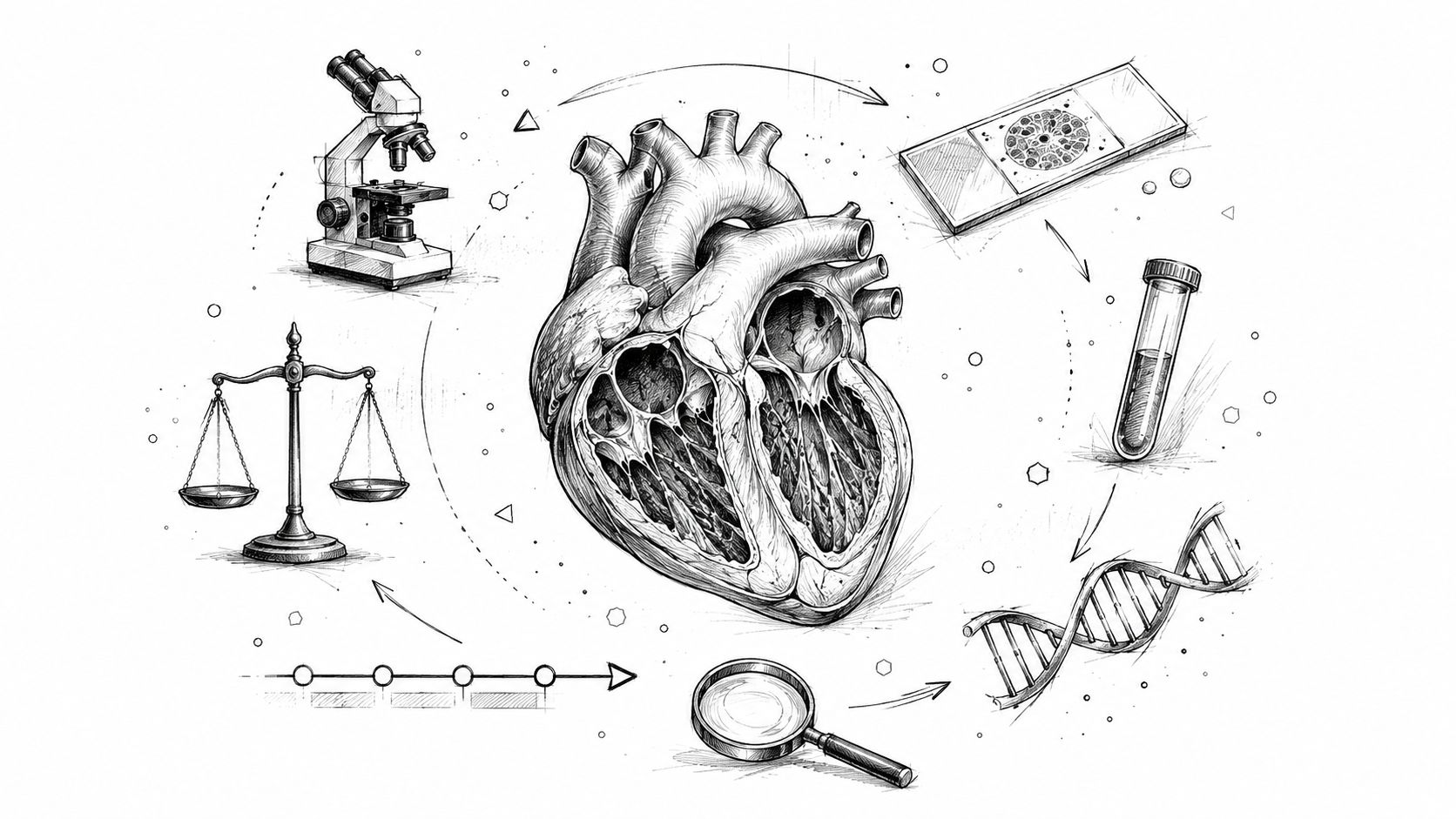
A sudden cardiac death case often reaches the autopsy room with one question hanging over it, what failed first. The forensic autopsy answers that by turning the body into a documented medical record. The examiner begins with the external examination, then moves to the internal organs, careful heart dissection, and targeted ancillary testing when the first findings do not fully explain the death. The goal is a cause-of-death determination that can hold up in a medical record, a courtroom, and a family conference.
What the pathologist looks at first
The heart receives the closest attention. The coronary arteries are checked for narrowing, thrombosis, and scarring. The ventricular walls are measured for thickness, because structural disease can be present even when the outside of the heart looks ordinary. If needed, the conduction system is sectioned in a way that can reveal disease in the pathways that control rhythm.
Microscopy matters just as much. Histology can show fibrosis, inflammation, cardiomyopathy, or other disease that is not visible to the naked eye. Toxicology checks for substances that can trigger lethal arrhythmia or interfere with cardiac function. Molecular or DNA-based testing may be retained when an inherited disorder is suspected, especially if the heart looks structurally normal or the phenotype is unclear Mayo Clinic autopsy guidance.
Some cases also call for postmortem blood studies. The pattern of electrolytes, medications, and other laboratory values can support or weaken a working diagnosis, but the results have to be interpreted in context, because blood changes after death are not the same as blood tests in a living patient. For a closer explanation of that process, see our blood tests in autopsy guide.
Practical rule: when the cause is not obvious, the right answer often depends on waiting for microscopy and toxicology rather than forcing an early conclusion.
Cause of death and manner of death are not the same
Cause of death is the disease or injury that started the fatal sequence. Manner of death is the classification, usually natural, accident, suicide, homicide, or undetermined. A person can die of natural heart disease, but the mechanism still has to be documented carefully.
If the cause remains unclear after examination and testing, the report should say so. That is not weakness. It is accuracy. Families deserve a complete answer, not a rushed one.
The autopsy file may also shape what happens next for relatives. When the heart shows inherited disease, or when the cause is uncertain enough to raise that possibility, the findings can change how surviving family members are screened and how their risk is assessed. A clean explanation of the pathology gives the treating physician, the attorney, and the family a common starting point for those next decisions.
Texas Legal and Medical Workflow for SCD
Texas deaths that are sudden, unexpected, or outside a hospital may fall under a medicolegal pathway. In practice, that can mean involvement by a justice of the peace or a medical examiner's office, depending on jurisdiction and circumstances under Texas law. The point is simple, even if the paperwork is not. The death has to be classified and handled through the proper legal channel.
Two pathways can apply
A medicolegal autopsy is ordered through the public death-investigation system when the case falls under legal jurisdiction. A private autopsy or second-opinion review is requested directly by a family, attorney, or county when independent medical clarification is needed. Both can be appropriate, but they serve different roles.
Texas law and related practice standards, including the Texas Health & Safety Code Chapters 711, 716, and 651, shape how these cases are handled. The Texas Funeral Service Commission also sits within the regulatory environment that governs transport and funeral service interactions. When a body is transferred for examination, chain of custody means there is a documented trail showing who had the body, when it moved, how it was stored, and who received the findings.
Why the paperwork matters
Retained tissue, photographs, and digital images can support later review if a case is reopened or challenged. Exhumation may also be necessary when a later autopsy is needed and the original workup was incomplete. Those steps are not routine, but they are part of the available workflow when the facts require them.
The practical difference is this. Public jurisdiction cases focus on legal obligation and public interest. A private autopsy focuses on independent medical clarification for the family, counsel, or county who needs the answer. Texas Autopsy Services provides independent private autopsy and forensic pathology services across Texas, including county forensic autopsies, and the process is built around documented custody and written findings.
Family Risk and What Relatives Should Do Next
When a death is sudden and unexplained, relatives usually ask the hardest question first. Could this happen to someone else in the family? That question deserves more than reassurance, because inherited risk can be real even when a person appeared healthy.
What family history can mean
The family-risk signal is strongest when the autopsy points toward a cardiomyopathy or channelopathy. Prior family history still matters even without a formal diagnosis, because sudden cardiac death in a parent can mark a shared vulnerability that deserves medical review, as noted earlier. That does not tell a relative exactly which condition is present, but it does justify evaluation.
Cardiogenomics guidance for young sudden death cases recommends first-degree relative screening with medical history, ECG, echocardiography, exercise testing, Holter monitoring, and sometimes cardiac MRI, plus postmortem DNA analysis when the cause is not clear ESC cardiogenomics guidance. In practice, that means the autopsy is not just about the person who died. It also helps define which living relatives need a cardiology workup and which tests are most likely to find something meaningful.
What makes screening more focused
A careful autopsy changes the family conversation in a practical way. Hypertrophic cardiomyopathy and long QT syndrome point to different patterns of follow-up, different counseling, and different relatives to prioritize. When the pathology report documents the phenotype, clinicians can decide who should be seen first and which studies should come next.
The forensic workflow can also include ancillary testing that families do not always expect. Tissue retained from the autopsy, toxicology results, microscopic examination, and DNA analysis can all add pieces to the picture. If genetic testing after death is being considered, this guide to genetic testing after death explains why postmortem samples may matter when the initial cause is uncertain.
For families with children or dependent grandchildren, the next steps can also affect guardianship and planning. A practical overview of that side of the legal picture is available in the Texas minor guardianship guide from the Law Office of Bryan Fagan, PLLC. That is not a substitute for a pathology review, but it can help relatives and counsel think through related legal questions at the same time.
This is not medical advice, and it does not replace a clinician's judgment. It does, however, show why postmortem findings matter beyond the decedent. They can change what surviving relatives are told, what they are tested for, and how closely they are followed over time.
Practical Next Steps and How Texas Autopsy Services Can Help
Families, attorneys, and county officials usually need the same three things after an unexplained sudden death, a clear cause-of-death answer, a defensible report, and a process that protects the evidence. Our team handles in-house licensed transport, secure temperature-controlled storage, digital imaging, toxicology coordination, and written reporting with full chain of custody. Every examination is performed by a forensic pathologist certified by the American Board of Pathology.
Direct communication matters most when the timeline is tight and the family needs plain language, not speculation.
A private autopsy or second-opinion review begins with case documents, a death certificate if available, and any scene or hospital records that help reconstruct the sequence. In some cases, a family needs a later exhumation or a review of retained tissue and images instead of a fresh postmortem exam. For questions involving a child's estate, custody, or family decision-making after death, the Texas minor guardianship guide can help frame related legal issues, but it doesn't replace a pathology review.
We provide flat-rate, all-inclusive pricing so the financial side is clear up front. If you're dealing with an unexplained sudden cardiac death in Texas, a direct conversation with our team is usually the most useful next step because it lets us explain the options for that specific case.
Texas Autopsy Services provides independent private autopsy and forensic pathology support for sudden cardiac death cases, with documented transport, testing, and reporting handled by our board-certified forensic pathologists. If you need a second opinion, county support, or a cause-of-death investigation that is careful, objective, and respectful, visit Texas Autopsy Services and contact our team directly.