July 24, 2026 · Texas Autopsy Services
Heart Attack Autopsy: What Forensic Pathologists Look For
Learn how a heart attack autopsy works, what forensic pathologists examine, and what families and attorneys can expect from the results.
On this page
- When a Heart Attack Becomes a Question That Needs Answering
- What a Heart Attack Autopsy Actually Is
- The Cardiac Examination Step by Step
- Biomarkers Toxicology and Molecular Testing
- From Findings to Cause of Death and Manner of Death
- Consent Chain of Custody and What Families Should Expect
- Limits of Postmortem Diagnosis and Common Misconceptions
- Questions Families and Attorneys Ask Most Often
A sudden death leaves families with two painful uncertainties at once, what happened inside the body, and whether the first answer on the death certificate is complete. In a heart attack autopsy, we look for the tissue and vessel changes that can confirm, refine, or correct that first answer, especially when medical records are incomplete or the death was unexpected.
At Texas Autopsy Services, we approach that work as a forensic pathology examination, not a guess. Every examination is performed by a board-certified forensic pathologist certified by the American Board of Pathology, and the goal is always the same, to give families, attorneys, and clinicians a clear, medically grounded explanation that can stand on its own.
When a Heart Attack Becomes a Question That Needs Answering
A family may hear, “It was probably a heart attack,” and still feel uneasy. That uncertainty is common when the person died suddenly, the collapse happened outside a hospital, or the clinical record doesn't explain enough to settle the matter. In those cases, a heart attack autopsy becomes a careful way to test the presumed answer against the actual anatomy.
Sudden cardiac death work depends on more than a brief look at the heart. In one forensic study of sudden cardiac deaths, coronary occlusion accounted for 56.9% of cases, the highest number of deaths occurred in people aged 50 to 59 years, and the reported male-to-female ratio was 10 to 1 (PMC forensic study). Those patterns matter because they show how often fatal coronary disease is tied to structural blockage rather than a single isolated event.
A tentative clinical impression is not the same thing as a postmortem conclusion.
That distinction matters to families and attorneys alike. A true autopsy can separate a myocardial infarction, another cardiac cause, or a non-cardiac sudden death mechanism when the circumstances are unclear. It can also produce court-admissible medical evidence when the death was unexpected, disputed, or legally significant.
A private or second-opinion exam is often sought when the family wants clarity that a standard record never provided. We see that need often in Texas, where a careful cause of death investigation can answer a question that paperwork alone can't resolve. The work is medical, but it's also human, because each finding has to be explained plainly to people who are already carrying grief.
What a Heart Attack Autopsy Actually Is
A heart attack autopsy is a targeted forensic examination of the cardiovascular system. Its purpose is to decide whether myocardial infarction caused death, contributed to death, or was not present at all. The work is more exacting because the heart can fail in several different ways that look similar from the outside.
In short, the autopsy produces a sequence of observations that either support or reject coronary disease as the cause of death.
What it can prove
The exam can identify coronary occlusion, plaque rupture, thrombus, scarring from prior injury, and areas of fresh or healed infarct. It can also show whether the heart was enlarged, whether the valves were abnormal, and whether another structural condition may have weakened the circulation. Modern postmortem diagnosis now goes beyond gross dissection alone and increasingly uses biomarkers and imaging alongside traditional pathology, with cardiac troponins described as the most frequently used clinical biomarkers because they're the most sensitive and specific indicators of cardiomyocyte injury (2020 review).
That matters because a pathologist is not looking for a single dramatic sign. The question is whether the heart shows a pattern that fits a fatal ischemic event, or whether another lesion explains the death more clearly.
What it can't prove
It can't tell the exact minute symptoms began, and it can't reconstruct how pain felt. It also can't read intent. The exam is built to answer structural questions, not to retell the person's inner experience.
That is the line between structural and functional diagnosis. Postmortem work can show the tissue damage and the disease process, but it can't measure consciousness, discomfort, or the subjective moment a person noticed something was wrong. In some cases, that means the heart looks badly diseased; in others, the heart looks relatively normal and the explanation points elsewhere.
The two formal outputs are cause of death and manner of death. Cause of death names the disease or injury that started the fatal chain. Manner of death classifies the circumstances as natural, accident, suicide, homicide, or undetermined. Families often need both, because one explains the medical mechanism and the other places it in the legal record.
For families and attorneys, the practical value is in the chain from observation to conclusion. The findings can be read against the case history, the scene information, and the medical record so the final language reflects what the body shows, not just what was suspected before the exam. If you want a plain overview of how that work is organized, this step-by-step autopsy guide gives a broader framework.
The Cardiac Examination Step by Step
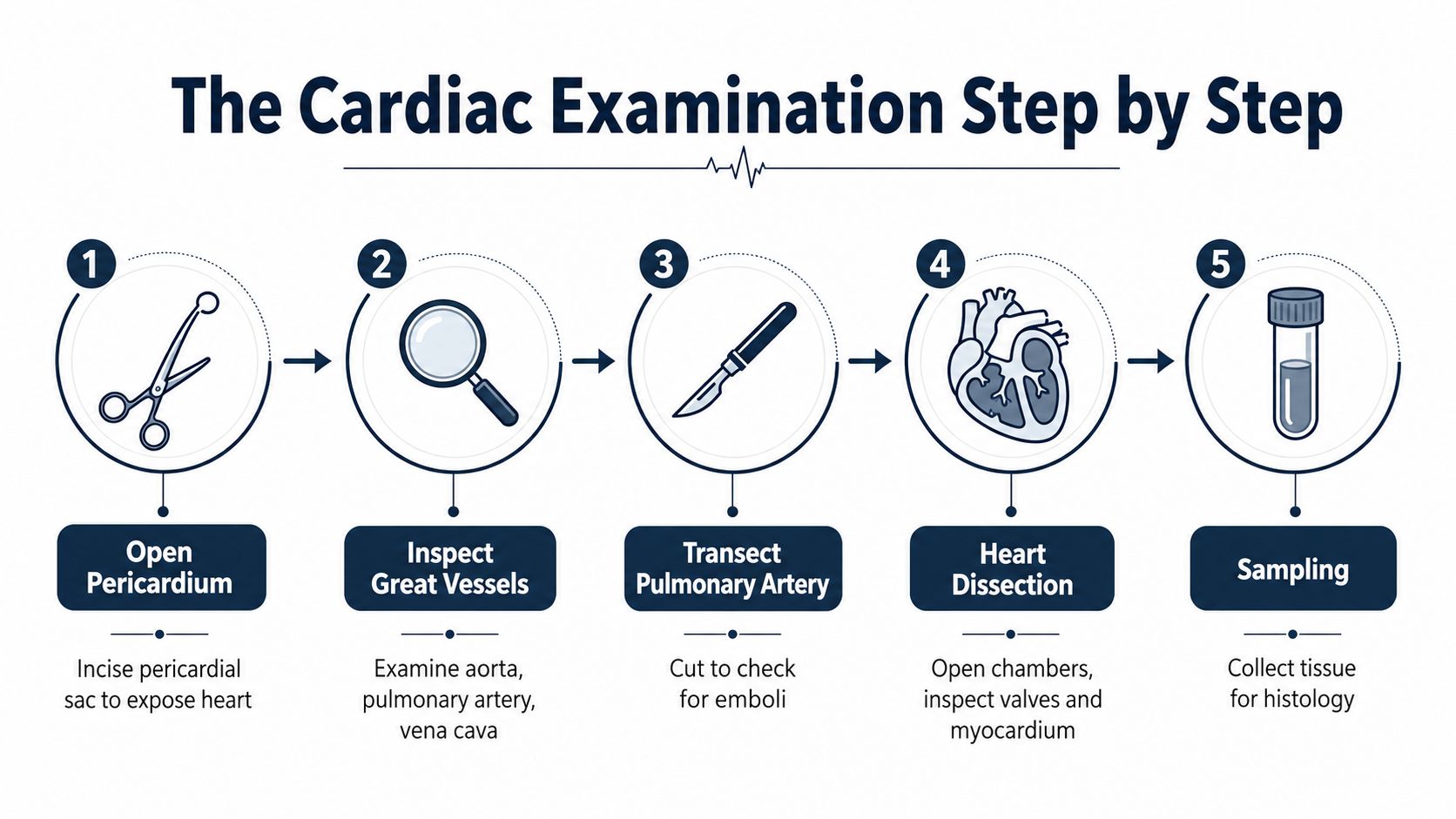
A family may be waiting for a clear answer, while the examiner is working through a heart that has to be read in layers. The first layer is the outside of the organ, because clues can be lost if the exam moves too fast. European cardiovascular pathology guidance says the examiner should open the pericardium, inspect the great arteries, and transect the pulmonary artery in situ to look for embolus before cutting the vessels 3 cm above the aortic and pulmonary valves (European guidance). That order helps avoid missing a clot or another vascular obstruction.
Gross dissection follows blood flow
The rest of the dissection moves in the direction blood normally travels. The guidance also calls for completing the examination of the atrial and ventricular septa, atrioventricular valves, ventricular inflows and outflows, and semilunar valves. If congenital heart disease is suspected, the heart and lungs may be removed en bloc by cutting the pericardium from the diaphragm and transecting the inferior vena cava, aorta, and esophagus.
That sequence is not cosmetic. A lesion tucked into the outflow tract, a valve abnormality, or a structural defect can change the path blood took through the heart during life, and a hurried look can miss it. In a disputed death, those details can separate a full explanation from a partial one.
Slicing and sampling matter as much as opening
A standard heart attack autopsy should use short-axis ventricular slicing at 1 cm intervals from the mid-ventricle toward the apex, because that exposes both myocardium and endocardium for gross assessment and supports consistent sampling of infarct border and center (autopsy protocol). The same protocol recommends histology from the left ventricular free wall, septum, right ventricular free wall, and papillary muscles so patchy or uneven injury is less likely to be overlooked.
The cut surface is like a map. A narrow lesion can hide between sampling points, so the pathologist needs enough coverage to see both obvious damage and smaller areas that may not stand out at first glance.
That detail also shapes the wording of the report. A tiny healed scar and a fresh infarct are different findings, and both must be described carefully. For families and attorneys, the method becomes part of the evidence, not just the backstory.
For readers who want a broader procedural overview, our guide to the steps of autopsy explains how cardiac findings fit into the larger postmortem exam.
What histology adds
Gross dissection shows what the eye can see. Histology shows what the microscope can prove. In sudden death cases, that microscopic layer helps confirm whether the tissue injury is acute, older, or absent altogether.
Biomarkers Toxicology and Molecular Testing
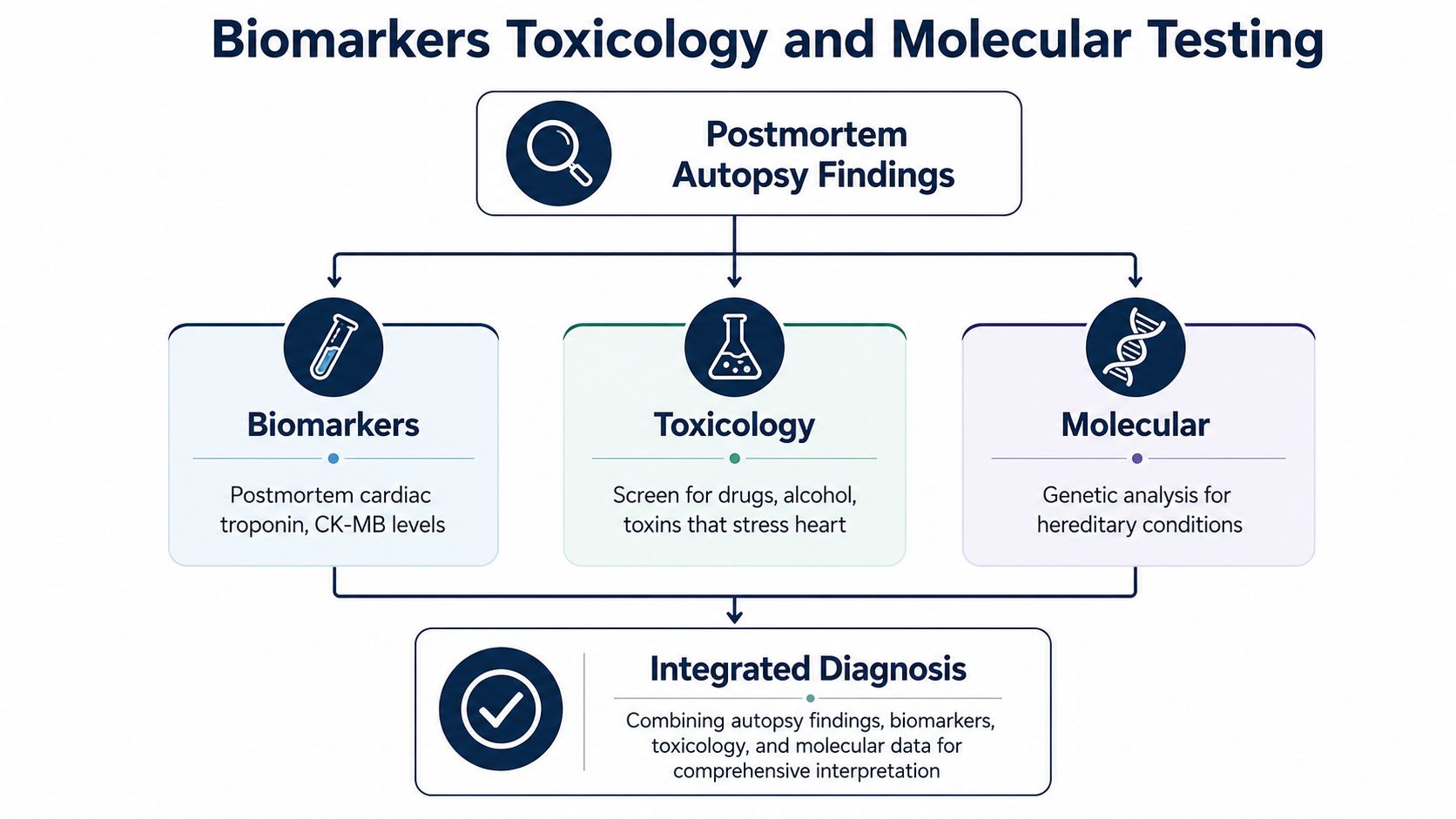
A modern heart attack autopsy does not stop at the dissection table. Laboratory testing helps the pathologist see whether the tissue findings fit the timeline and whether another process may have contributed to death. That matters most when the heart shows injury, but the pattern is still not fully clear.
Troponin and the timing problem
Cardiac troponins are the most frequently used clinical biomarkers because they are sensitive and specific indicators of cardiomyocyte injury. The same review notes that high-sensitivity cardiac troponin T (hs-TnT) can detect myocardial infarction within about 3 hours of symptom onset. That does not give a precise clock reading for death, but it shows how quickly evidence of injury can appear.
That timing matters because the pathologist has to line up tissue change with the known circumstances. A person who collapsed soon after chest pain may show a different postmortem pattern than someone found dead after an unwitnessed event. The laboratory results help narrow the possibilities, but they do not replace the full examination.
Toxicology and inherited risk
Toxicology looks for drugs, alcohol, and other substances that may have strained the heart or complicated the event. Molecular testing can be appropriate when a heritable cardiac condition is suspected, especially in cases where the heart is structurally subtle but the family history raises concern. For a closer look at that part of the work, see our discussion of molecular genetic testing.
Devices can hold useful evidence
If a pacemaker or defibrillator is present, it should be identified and read out by a cardiologically experienced specialist before internal examination begins (device guidance). The same guidance says a defibrillator should be switched off and removed before the internal inspection starts, because these devices can record rhythm disturbances that tissue alone cannot prove.
Rhythm history can exist even when the heart tissue does not show a neat explanation.
That is why lab data and device interrogation belong in the forensic record, not as afterthoughts. In some cases, those findings support a clearer cardiac cause. In others, they show that the death mechanism was more complex than the first label suggested.
From Findings to Cause of Death and Manner of Death
The final report has to turn anatomy into plain legal-medical language. Cause of death is the disease or injury that started the sequence leading to death. Manner of death is the classification that places the death in a broader category, such as natural or undetermined.
How the wording is built
If the autopsy shows coronary thrombosis with plaque rupture and tissue injury consistent with infarction, the cause of death may be written to reflect that cardiac sequence. If the findings support a true myocardial infarction, the manner of death is usually natural. That's because the underlying process is disease, not external violence.
The wording has to be specific enough to be useful and careful enough to be defensible. A report that says only “heart disease” may not help an attorney, insurer, or reviewing clinician. A report that distinguishes acute infarct, prior scarring, and severe coronary disease gives a much clearer medical record.
Why the report matters outside medicine
These conclusions can affect insurance claims, corrections to records, and legal proceedings. A court-admissible report depends on documented chain of custody and verifiable credentials, because the evidence has to be traceable from collection to final interpretation. That chain is part of trust, not just paperwork.
The autopsy document also becomes a reference point for the family's understanding of what happened. In some cases, it confirms what everyone suspected. In others, it corrects a diagnosis that sounded certain at first but wasn't fully supported by the body.
A plain-language distinction
- Cause of death names the medical event.
- Manner of death classifies the surrounding circumstances.
- Chain of custody shows who handled each specimen and when.
For families, that distinction is often the hardest part to sort out. A death can be natural even when it was sudden, and a cardiac cause can be present even when no one saw the warning signs in time.
Consent Chain of Custody and What Families Should Expect
A private or second-opinion autopsy begins with authorization and ends with a report that can be reviewed, shared, and defended. Under Texas practice, the right person has to consent, and the consent has to cover the scope of the exam, tissue sampling, imaging, and any ancillary testing needed to reach a conclusion. The legal framework also has to align with Texas Health & Safety Code Chapters 711, 716, and 651 and applicable Texas Funeral Service Commission standards.
What families usually want to know first
The first questions are usually practical. Who can request the exam, how long will it take, and what will the family receive in writing. In most cases, initial findings can be available within 24 to 48 hours, while full histology and ancillary studies take longer depending on what the case requires.
That timing is a range, not a promise, because tissue processing and lab work vary by case. But families should expect an early communication about preliminary findings and a fuller report when the final interpretation is ready.
What chain of custody protects
Each specimen, image, and report needs a clear handling record. That protects the integrity of the evidence if the case later enters a legal dispute or insurance review. Our chain of custody procedures explain why that record matters from the first transfer to the final archive.
A complete report usually includes the gross findings, microscopic findings, toxicology or other ancillary testing when indicated, and the final cause and manner of death. Families should also expect secure communication and careful storage of materials, because the information is sensitive.
Independent review and burial questions
A second-opinion autopsy can be useful when another exam was already done but the conclusion still feels unclear. In some situations, an exam can still be pursued after burial or exhumation, depending on the legal authority and case facts. Texas Autopsy Services also provides in-house licensed transport and can coordinate the logistics when a family or attorney needs a formal examination handled with a documented chain of custody.
Limits of Postmortem Diagnosis and Common Misconceptions
A respectful autopsy report should be honest about what it can't prove. A person may die suddenly from a cardiac rhythm problem even when the heart doesn't show a dramatic structural lesion. Another person may have severe coronary disease and still not have a clearly time-stamped infarct that can be pinned to a precise minute.
What can blur the picture
Resuscitation can alter the body in ways that make interpretation harder. Chest compressions, defibrillation, and emergency procedures can leave marks or obscure the original sequence of events. Postmortem changes can also make very early injury harder to see, especially when death was rapid.
The forensic literature also recognizes autopsy-negative sudden unexplained death, where conventional autopsy and histology don't identify a structural cause. A review of postmortem biomarkers notes that up to 10 to 15% of sudden cardiac death cases can fall into that category (postmortem biomarkers review). That's one reason a normal-looking heart doesn't automatically end the inquiry.
Common misconceptions families run into
- A normal-looking heart rules out a lethal cardiac event. It doesn't. Rhythm-related death can leave little gross evidence.
- An autopsy always confirms the clinical diagnosis. It doesn't always do that. Sometimes it refines the diagnosis, and sometimes it changes it.
- A private autopsy conflicts with a medical examiner's work. It doesn't have to. An independent review can add clarity when the original record is incomplete or disputed.
- Every heart attack looks the same. It doesn't. Acute infarct, old scar, thrombus, and chronic coronary disease are different findings.
The point isn't to force the heart into a label. The point is to let the findings speak for themselves.
An independent, board-certified forensic pathology review can add clarity rather than redundancy in disputed cardiac deaths. That's especially true when the family needs a plain, defensible answer and the original records don't tell the full story.
Questions Families and Attorneys Ask Most Often
How long does a heart attack autopsy take?
Initial findings often come first, with full microscopic and ancillary testing taking longer. Most families hear preliminary results within 24 to 48 hours, depending on the case.
Can it be done after burial?
Sometimes, yes. The decision depends on the legal authority, the condition of the remains, and the questions the case still needs to answer.
Who can request one in Texas?
The person with legal authority to consent can request it, and the exact answer depends on the circumstances and the governing Texas laws.
Is the report court-admissible?
A well-documented exam with verified chain of custody and proper credentials can produce a report suited for legal review.
What if no clear cardiac cause is found?
That result is still useful. It narrows the possibilities and can point to rhythm-related, toxicologic, genetic, or non-cardiac mechanisms.
| Common Heart Attack Autopsy Questions at a Glance | What to Expect |
|---|---|
| Timing | Preliminary findings first, final report after microscopy and testing |
| Burial status | Sometimes possible after burial, case-dependent |
| Legal request | Depends on who has authority to consent under Texas law |
| Court use | Strong documentation helps support admissibility |
| No clear cause | The report still narrows the diagnosis and next steps |
If you're facing this decision now, contact Texas Autopsy Services at Texas Autopsy Services so we can talk through the facts of the case, explain what an independent heart attack autopsy can and can't answer, and help you decide the next step with the care the situation deserves.