July 9, 2026 · Texas Autopsy Services
Molecular Genetic Testing in a Texas Autopsy
Learn what molecular genetic testing is and its role in a private autopsy investigation in Texas. Our board-certified pathologists explain the process.
On this page
What Families and Attorneys Should Know About Molecular Genetic Testing in a Texas Autopsy
- A standard autopsy does not always identify a cause of death. In a sudden unexplained death, molecular genetic testing may help uncover an inherited condition that leaves little or no visible trace.
- Postmortem genetic testing depends on proper samples. The gold standard is EDTA blood or fresh-frozen tissue from the heart, liver, or spleen, and without a proper sample, testing may not be possible.
- Results matter beyond the death investigation. A molecular finding can clarify cause of death and also give surviving relatives information they may wish to discuss with their own physicians.
- Legal reliability depends on process, not just science. Chain of custody, secure handling, and clear documentation are essential if findings may later be used in court or litigation.
- A positive genetic result is not a guarantee of disease. It may indicate risk rather than certainty, and interpretation often requires careful clinical context.
A family may receive an autopsy report and still be left with the hardest sentence in the case: no definitive cause of death identified. An attorney may have the same problem from a different angle. The records are complete, the toxicology is negative or non-explanatory, and the central question remains open.
That situation is more common than many people expect in sudden deaths, especially when the person had no obvious structural injury or known terminal disease. In forensic pathology, that may lead to a negative autopsy, meaning the usual examination did not reveal a clear cause. At that point, the investigation may need to move from what can be seen with the eye and microscope to what is written in the person's DNA.
As an independent forensic pathology practice serving Texas, we see how important that shift can be for both families and legal matters. A postmortem genetic study is not a replacement for a careful autopsy. It is a separate tool used when the facts of the case suggest an inherited disorder, particularly one affecting the heart's electrical system or muscle.
When an Autopsy Itself Is Not Enough
A family may do everything right. They authorize an examination, wait for toxicology, and expect the final report to answer what happened. Then the conclusion comes back without a clear explanation. That is often the moment when grief turns into uncertainty.
When the report still leaves questions
In forensic practice, a negative autopsy means the usual methods did not identify a cause of death. There may be no fatal injury, no clear intoxication, and no disease process visible enough to explain the death. In sudden unexplained death, that can point the investigation toward inherited arrhythmogenic syndromes or related cardiac disorders. Molecular autopsy is specifically recommended in those negative autopsy cases where conventional structural, toxicologic, or histologic analysis fails to identify a cause and suspicion shifts to inherited arrhythmogenic syndromes, as discussed in this overview of molecular autopsy in sudden unexplained death.
Sometimes the most important forensic finding is recognizing that the answer may exist at the genetic level rather than the gross or microscopic level.
For families, this is not an abstract distinction. It can mean the difference between a death remaining unexplained and a death being linked to an inherited condition that also matters to siblings, children, or parents.
Why this matters beyond the death certificate
A postmortem genetic result may help clarify cause of death, but it can also help surviving relatives understand whether they should seek medical evaluation. That doesn't mean every sudden death requires genetic testing. It means the testing becomes relevant when the case facts, age, medical history, and autopsy findings point in that direction.
The broader field has expanded quickly. The global genetic testing market reached USD 10.525 billion in 2024 and is projected to reach USD 24.53 billion by 2033, with North America holding a 54% revenue share in 2024, according to market data summarized in the National Library of Medicine article. That growth reflects how often genetic tools now inform medical and forensic decision-making.
In Texas, families often contact us after a hospital death, a sudden death at home, or a second-opinion review where standard answers were incomplete. In those circumstances, private autopsies can include discussion of whether postmortem genetic analysis is appropriate.
What Is Molecular Genetic Testing
A plain-language definition
Molecular genetic testing is the analysis of DNA, and in some settings RNA or proteins, to look for changes that may explain disease or death. The simplest way to understand it is to think of DNA as the body's instruction manual. Genes are individual sections of that manual. Testing is a method of reading those sections closely to look for a harmful change in the text.
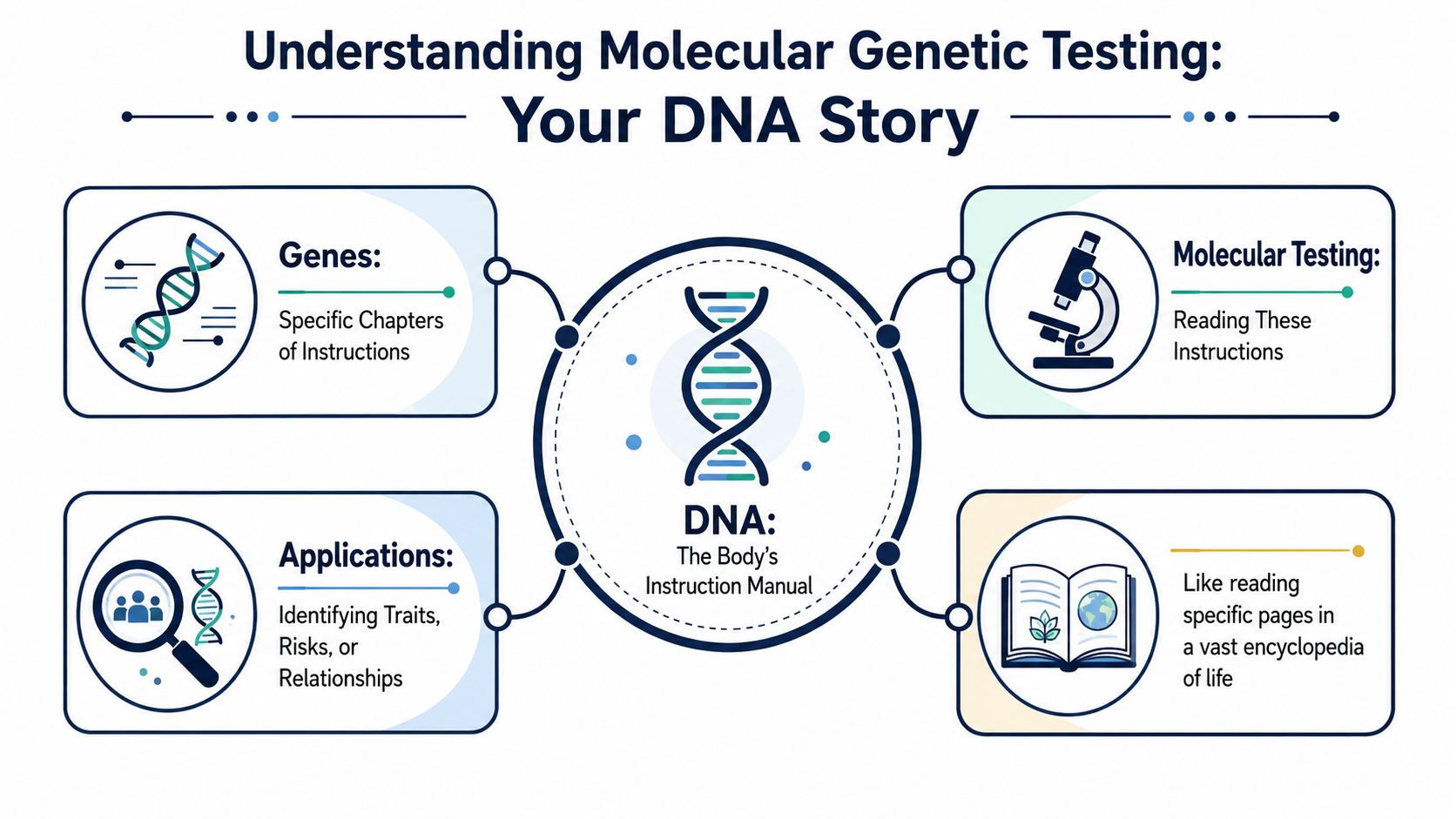
In a postmortem setting, the question is usually not general ancestry or broad wellness screening. The question is narrower and more serious. Did the decedent carry a genetic variant that could explain a sudden death, a known hereditary condition, or an unexpected medical event that wasn't obvious on routine autopsy?
What the test is looking for
The laboratory may look for a single suspected change in one gene, or it may examine many genes associated with a particular category of disease. In forensic work, that often involves genes linked to arrhythmia syndromes, cardiomyopathies, connective tissue disorders, or other inherited conditions relevant to the death investigation.
A useful way to frame this for families is the difference between finding a misspelled word and reviewing a whole chapter. Some tests are focused. Others examine a wider set of instructions because the likely cause could sit in more than one place.
Practical rule: Molecular testing is strongest when the forensic question is specific. It works best when the history, circumstances, and autopsy findings point toward a defined inherited disease process.
For readers who want a broader explanation of whole genome sequencing in rare disease work, Rare Disease Watch offers insights into WGS for rare diseases. That resource is clinical rather than forensic, but it helps explain why reading more of the genome can matter when a narrower test does not answer the question.
Common Methods in Postmortem Genetic Analysis
A family may hear that "DNA testing" is being considered and assume that means one standard test. In postmortem practice, it does not. Different methods answer different questions, and the choice affects cost, turnaround time, interpretation, and whether the result will help a death investigation or a legal case.
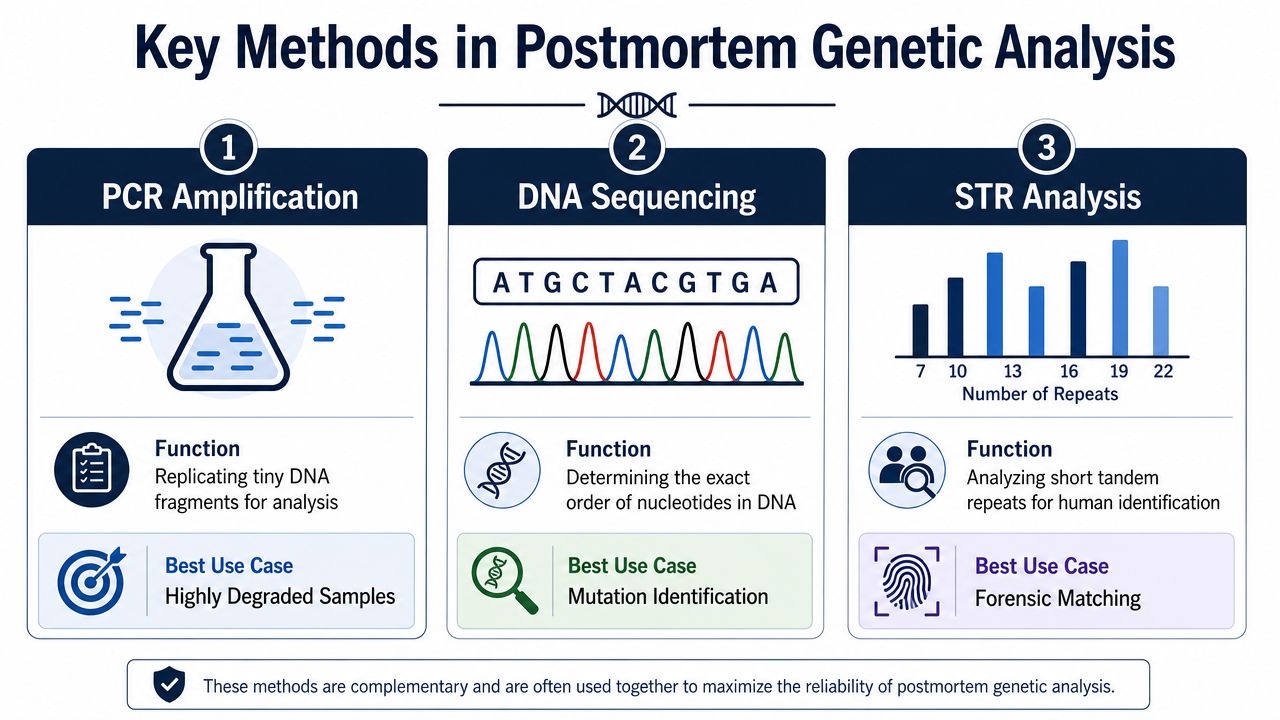
PCR amplification
PCR stands for polymerase chain reaction. It makes many copies of a selected DNA region so the laboratory has enough material to analyze. That matters after death because blood, tissue, or stored specimens may contain limited or degraded DNA.
PCR works best when the laboratory is looking at a defined target. If the case history, autopsy findings, or family history points to a specific gene region, PCR can be an efficient first step. It is narrower than sequencing, but that limitation can be an advantage. A focused method often reduces noise and keeps the testing tied to the actual forensic question.
DNA sequencing
Sequencing determines the order of DNA bases in the region being tested. In postmortem work, this is the method used to look for variants that may explain an inherited disease process relevant to the death.
Sequencing can be directed at one gene, a group of genes, or a broader portion of the genome, depending on the case. The trade-off is straightforward. Broader sequencing can find more potentially relevant changes, but it also increases the chance of uncertain findings that do not clearly answer the cause-of-death question.
For families weighing that decision, our discussion of genetic testing after death in Texas cases explains why broader testing is not always the better choice.
A technically advanced platform does not solve every problem. Laboratory validation, contamination control, bioinformatics review, and careful variant interpretation still determine whether the final opinion is medically and legally sound.
STR analysis
STR stands for short tandem repeat analysis. This method is usually used for identity and relationship testing, not for finding a disease-causing variant. It examines repeating DNA patterns that differ between individuals.
In forensic pathology, STR analysis may help confirm identity, compare specimens, or evaluate kinship. That can matter if multiple samples exist, if remains are not immediately identified, or if there is a question about whether the tested specimen came from the decedent. In our practice, that distinction matters because a disease-focused result has little value if the specimen identity is uncertain.
A short comparison helps:
| Method | Main purpose in postmortem work | Typical use |
|---|---|---|
| PCR | Amplify a selected DNA region | Focused testing when a specific target is suspected |
| DNA sequencing | Read the genetic code | Detect variants linked to inherited disease |
| STR analysis | Compare individual DNA profiles | Identification and relationship analysis |
Laboratories match the method to the forensic question. In postmortem cases, that decision also has to fit specimen quality, chain-of-custody requirements, and the degree of certainty the case will need if the findings are later reviewed by attorneys, insurers, or a court.
Forensic and Autopsy Applications
The most important application of molecular genetic testing in autopsy practice is the investigation of a sudden death that remains unexplained after standard examination, making the phrase molecular autopsy particularly useful. It refers to genetic analysis performed after death to look for inherited disorders that may have caused or contributed to death.
When we consider a molecular autopsy
We consider this approach when the facts of the case support it. Common examples include a young or previously healthy person who dies suddenly, an autopsy without a structural explanation, a history of fainting or unexplained seizures, a family history of sudden death, or a case in which toxicology does not account for the event.
The key issue is often the heart, even when the heart appears normal at autopsy. Some inherited arrhythmia disorders can cause a lethal rhythm disturbance without leaving a dramatic structural finding behind. In those cases, a negative gross and microscopic examination does not end the inquiry.
For families who want a focused discussion of this issue, we often recommend reviewing genetic testing after death as part of the broader decision-making process.
How findings can change the case
A genetic finding can affect the case in several ways:
- Cause-of-death clarification: It may support a conclusion that an inherited cardiac condition caused or contributed to death.
- Family risk awareness: It may identify a condition that surviving relatives can discuss with their own physicians.
- Case reconciliation: It may help explain why a person died despite limited or absent structural findings.
- Second-opinion value: It can provide a medically grounded path forward when an earlier cause-of-death investigation stopped short of an answer.
A molecular result does not stand alone. We interpret it with the scene history, medical records, autopsy findings, and toxicology.
This is also where independence matters. An independent autopsy or second opinion autopsy should not begin with a preferred outcome. It should begin with the evidence. In our practice, every examination is performed by a forensic pathologist certified by the American Board of Pathology, and genetic findings are considered as one part of the full postmortem record.
For attorneys, the trade-off is straightforward. Molecular testing can sharpen a case when the factual pattern supports inherited disease. It does not fix weak documentation, poor sampling, or speculative interpretation. For families, the trade-off is equally important. Testing may provide a meaningful answer, but it may also return a result that requires careful follow-up rather than a simple conclusion.
A few forensic applications come up repeatedly:
- Sudden unexplained death: Especially when routine autopsy is unrevealing.
- Possible inherited cardiomyopathy or channelopathy: Particularly when there is a suggestive family history.
- Clarifying complex medical history: When records raise suspicion for a hereditary condition not established before death.
- Cases with negative or non-explanatory toxicology: When substances do not explain the event.
That is the practical value of molecular genetic testing in forensic pathology. It is not used because it is novel. It is used because some causes of death cannot be seen without it.
Specimen Collection and Preservation
The quality of the sample often determines whether testing is possible at all. This is one of the least visible parts of the process, but it is one of the most important.
What samples matter most
For postmortem molecular genetic testing, the gold standard specimen is EDTA blood or fresh-frozen tissue from the heart, liver, or spleen, because these materials preserve DNA integrity more effectively. Without a proper sample, genetic testing cannot be performed on deceased individuals, as explained by the National Society of Genetic Counselors guidance on postmortem testing.
That point deserves emphasis because it affects timing. If a family is considering molecular testing, specimen planning should happen early, before the best samples are lost, degraded, or discarded.
Why preservation cannot be an afterthought
Formalin-fixed tissue has value in pathology, but for some forms of molecular work it is not the preferred material. Decomposition, heat, delay, and improper storage all reduce DNA quality. Once that happens, no later paperwork can repair the biological problem.
We explain specimen handling in plain terms because the process needs to be understandable:
- Collection at the right time: The sample should be obtained promptly during the autopsy process.
- Correct container and labeling: EDTA blood must be placed in the proper tube and identified accurately.
- Temperature control: Tissue intended for molecular analysis must be preserved in a way that protects DNA quality.
- Documented transfer: Every movement of the specimen should be recorded.
Families and attorneys who want more detail on this practical issue can review our discussion of specimen preservation.
In statewide practice, logistics matter. Transport delays, inconsistent storage, and fragmented handoffs are common reasons useful samples are lost. That is why specimen planning is part of the autopsy process itself, not a separate afterthought once the report is already underway.
Chain of Custody and Legal Admissibility
For legal purposes, a sound scientific method is only part of the equation. The other part is proof that the sample tested is the sample collected, and that every transfer was documented.
What chain of custody means
Chain of custody is the unbroken record of who collected, labeled, stored, transported, received, and analyzed a specimen. In plain language, it answers a basic legal question: can the court trust that this sample was handled correctly from start to finish?
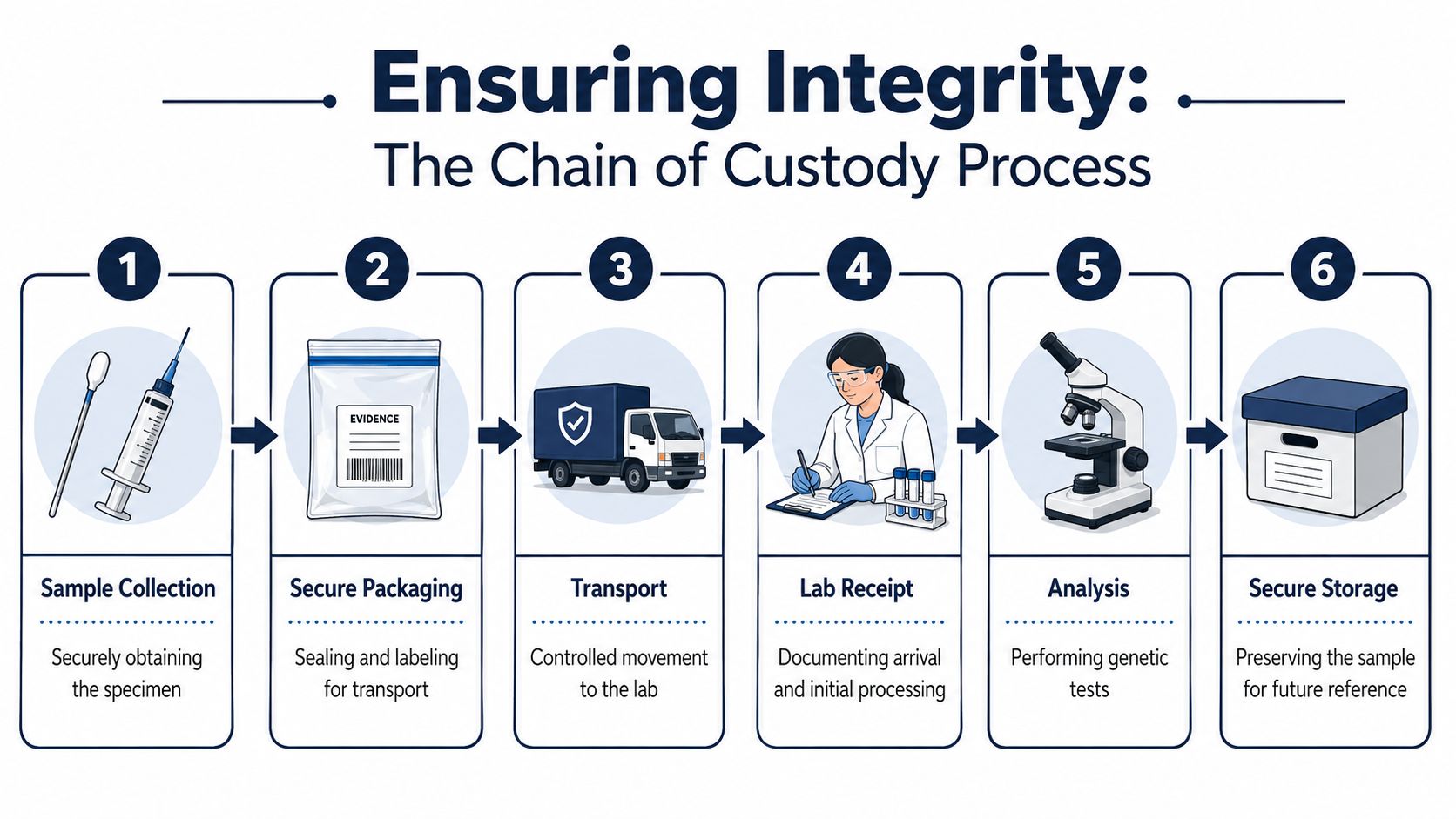
When chain of custody is weak, even a scientifically valid test can become harder to defend. That matters in wrongful death litigation, probate disputes, insurance matters, and criminal proceedings.
For readers who want to see the concept explained visually, this short video is helpful:
Why attorneys focus on documentation
A court-admissible report depends on records that are complete, chronological, and consistent. That includes specimen labels, transfer logs, storage conditions, laboratory accession records, and the identity of the personnel who handled the material.
Legal point: Chain of custody is not paperwork for its own sake. It is the framework that allows a judge, jury, insurer, or agency to rely on the result.
In Texas, this attention to process sits alongside the broader legal structure governing death care, body custody, and related procedures, including the Texas Funeral Service Commission and the Texas Health & Safety Code, such as Chapters 711, 716, and 651 where applicable. Families and attorneys who are evaluating evidentiary handling can review our explanation of chain of custody procedures.
This is one place where a private forensic practice can make a meaningful difference. Texas Autopsy Services provides in-house licensed transport, secure handling, and documented specimen transfer as part of its postmortem workflow. That does not guarantee a particular result. It does help preserve the integrity of the evidence.
Limitations Consent and Privacy
A family may agree to postmortem genetic testing hoping for a single clear answer. In practice, the result may clarify the medical picture, narrow the possibilities, or raise a new question that has to be weighed against the autopsy findings, scene information, and family history.
What the science can and cannot do
No honest forensic practice will suggest that every postmortem test produces a final answer.
Some findings are straightforward. Others remain uncertain, especially when a laboratory identifies a variant of uncertain significance or when testing is negative even though an inherited disorder still remains on the table. In postmortem work, that uncertainty matters because attorneys and families often need to know not only what was found, but how much weight the finding can carry.
Several limits come up repeatedly in real cases:
- Variant interpretation can change: A result that appears suspicious today may be reclassified as benign or pathogenic as medical literature develops.
- A negative result does not rule out a hereditary condition: The selected test may not cover every relevant mechanism, and some disease genes are still poorly understood.
- Context determines value: The same variant can have very different meaning depending on age, symptoms, relatives, and the circumstances of death.
- Specimen quality can limit analysis: Decomposition, heat exposure, contamination, or delayed collection can reduce what the laboratory can reliably interpret.
These are not technical footnotes. They affect whether a result supports a death certificate opinion, a family risk discussion, or a legal argument.
Consent and confidentiality
Postmortem genetic testing should proceed only with legally valid authorization from the proper next of kin or other authorized party, depending on the posture of the case and the governing legal process in Texas. Consent should be informed and specific. The person authorizing the test should understand what is being examined, why the test is being requested, what the laboratory may or may not find, and whether the result could have significance for blood relatives.
Privacy is more complicated in this setting than many families expect. A genetic finding belongs to the decedent's medical story, but it may also signal risk to living relatives. That creates a real tension between confidentiality and the potential benefit of sharing medically relevant information within the family. Our practice handles these results as confidential forensic medical information and releases them only to authorized recipients, with careful attention to how the report is worded and who is legally entitled to receive it.
For attorneys, consent and privacy are also admissibility issues. If authorization is unclear, if the purpose of testing was never documented, or if reporting extends beyond the proper recipients, the value of the evidence can be challenged even when the laboratory work itself was technically sound.
The terms below often get blurred together, so we define them plainly:
| Term | Plain-language meaning |
|---|---|
| Cause of death | The disease or injury that led to death |
| Manner of death | The classification of how the death occurred, such as natural, accident, suicide, homicide, or undetermined |
| Chain of custody | The documented history of how evidence or specimens were handled from collection to final storage or testing |
Frequently Asked Questions
Families and attorneys usually need direct answers at this point. The table below addresses the questions we hear most often in postmortem molecular cases.
| Question | Answer |
|---|---|
| Can postmortem genetic testing prove why someone died? | Sometimes it can strongly support or clarify cause of death, especially in sudden unexplained deaths with suspected inherited cardiac disease. It does not replace the autopsy, scene investigation, toxicology, or medical records review. |
| Does a positive molecular diagnosis mean a relative will definitely develop the disease? | No. A positive result indicates risk, not certainty. Variable expressivity and other genetic factors can affect whether disease develops and how severe it becomes. |
| Who has to consent to testing after death? | The legally authorized next of kin or other proper legal authority usually must approve testing, depending on the case and procedural setting. |
| Can these findings be used in court? | They can be more useful in court when specimen handling, documentation, and reporting were done with full chain of custody and clear forensic standards. |
Can postmortem genetic testing prove why someone died
It can contribute powerful evidence, but it should not be oversold. The strongest conclusions happen when the genetics fit the death circumstances, autopsy findings, family history, and other records. A genetic result without context can be incomplete.
Does a positive molecular diagnosis mean a relative will definitely develop the disease
No. A positive molecular diagnosis indicates risk, not certainty, and interpretation may be modified by variable expressivity and polygenic scores, as noted in this discussion of common genetic testing questions in clinical trials. In practical terms, that means a family member may carry a relevant variant but never develop the same disease or may develop it differently.
The most responsible answer is often the least dramatic one. A positive result can be important without being predictive in an absolute sense.
Who has to consent to testing after death
In most private postmortem settings, testing should not move forward without consent from the legally authorized person. That consent process should be documented carefully. If litigation, a justice of the peace matter, or another governmental process is involved, the procedural path may differ.
Can these findings be used in court
Yes, if the science is sound and the handling is defensible. Courts do not merely ask whether a test exists. They ask whether the specimen was properly collected, preserved, tracked, analyzed, and interpreted. That is why cause of death investigation in forensic cases must be both medically precise and procedurally careful.
If your family is facing an unexplained death, or if you are an attorney evaluating whether molecular testing may clarify a case, a direct conversation often helps more than general online information. Our team can explain whether the circumstances support testing, what specimens may still be available, and what limits should be understood before any decision is made.
If you need guidance after a sudden or unexplained death, Texas Autopsy Services is available to discuss the facts of the case, the autopsy process, and whether molecular genetic testing may be appropriate. We serve families, attorneys, medical professionals, agencies, and county officials across Texas with direct communication, full chain of custody, and examinations performed by a forensic pathologist certified by the American Board of Pathology.