August 14, 2026 · Texas Autopsy Services
Infant Death Investigation: A Complete Family Guide
Learn how infant death investigation works, what to expect from autopsy, scene, and reports, and how families can seek clarity and answers with compassion.
On this page
- When an Infant Dies and the Investigation Begins
- What Infant Death Investigation Is Trying to Answer
- Step by Step Through Scene, Autopsy, and Lab Testing
- Medicolegal Autopsy vs Private Autopsy
- Chain of Custody, Reports, and Expert Testimony
- Why Some Investigations Come Back Incomplete
- Support, Resources, and How to Reach Us
A call can come in at any hour. A parent, grandparent, or attorney may be told that an infant died suddenly, and the first questions are usually the simplest ones, what happened, who responds, and how can anyone know the answer when so much is still unclear. An infant death investigation is built to answer those questions with care, using scene work, medical review, autopsy findings, and laboratory testing to reach a defensible conclusion while treating the family with respect.
Families often expect one test to produce the answer. In reality, the process is a coordinated review of the death scene, the child's history, and the body itself, because each part can change how the final conclusion is understood. That is especially true in sudden unexpected infant death cases, where evidence can be incomplete and the classification can shift when the full picture is assembled.
Key points
- Infant death investigation is a coordinated forensic and medical process, not a single exam.
- Cause of death and manner of death are different questions, and both matter.
- Scene documentation, autopsy, and lab testing each contribute different facts.
- A private or second-opinion autopsy can help when the official record feels incomplete.
- Families and attorneys need clear reports, chain of custody, and plain-language explanations.
When an Infant Dies and the Investigation Begins
A sudden infant death usually starts with a call no family expects. Depending on the county, the first responders may include law enforcement, emergency medical personnel, a justice of the peace, a coroner, or a medical examiner, and the body may be transferred before any formal examination begins. That early response matters because the scene can hold fragile details about sleep position, bedding, room temperature, and the infant's position when first found.
In Texas and other states, the death may be reported to the local authority that has legal responsibility for medicolegal deaths. Families often hear terms like “coroner” or “medical examiner” before they hear a medical explanation, but those words describe the legal pathway of the case, not the final answer. The investigation begins before anyone can say what caused the death, because the scene, the medical history, and the body all need to be reviewed together.
Practical rule: the first reports after an infant death are part of the evidence. What responders document, and what they don't, can shape the rest of the case.
At this stage, families are usually asked for basic information about the infant's recent health, sleep routine, medications, and anything unusual noticed before the death. That can feel intrusive, but it serves a forensic purpose. The goal is to preserve facts while they're still fresh, not to assign blame.
For parents trying to understand the broader medical context, our explanation of sudden infant death syndrome provides a plain-language foundation for why these deaths are investigated so carefully. An infant death case can be medically complex even when it looks simple on the surface. The job is to avoid assumptions and gather enough evidence to support a reliable conclusion.
What Infant Death Investigation Is Trying to Answer
The investigation asks two different questions. Cause of death is the medical reason the infant died, such as infection, injury, a metabolic disorder, or another physiological process. Manner of death is the classification of how the death is labeled, such as natural, accident, homicide, suicide, or undetermined.
A simple analogy helps here. Cause of death is the engine problem, while manner of death is the category placed on the final report. The same medical findings can lead to different manner-of-death conclusions if the surrounding circumstances are not fully documented.
The CDC's sudden unexpected infant death framework is important because many infant deaths fall into overlapping categories, including SIDS, unknown causes, and accidental suffocation or strangulation in bed, and the classification depends on how complete the evidence is. In 2022, the CDC reported about 3,700 sudden unexpected infant death cases in the United States, including 1,529 SIDS deaths, 1,131 deaths from unknown causes, and 1,040 accidental suffocation or strangulation in bed deaths (CDC data). That range shows why the field cannot rely on one label alone.
The key point is that the investigation is multidisciplinary from the start. Scene findings, witness statements, medical records, and autopsy results all matter because no single piece of information tells the full story. For a family, that can be hard to hear. For an attorney, it's the reason a thin report may not hold up well if the case is reviewed later.
The World Health Organization reported 2.3 million newborn deaths in 2022, and 47% of deaths in children under 5 occurred in the first 28 days of life (WHO neonatal mortality data). Those figures explain why infant and neonatal death work demands careful review. The medical stakes are high, and the emotional stakes are even higher.
Step by Step Through Scene, Autopsy, and Lab Testing
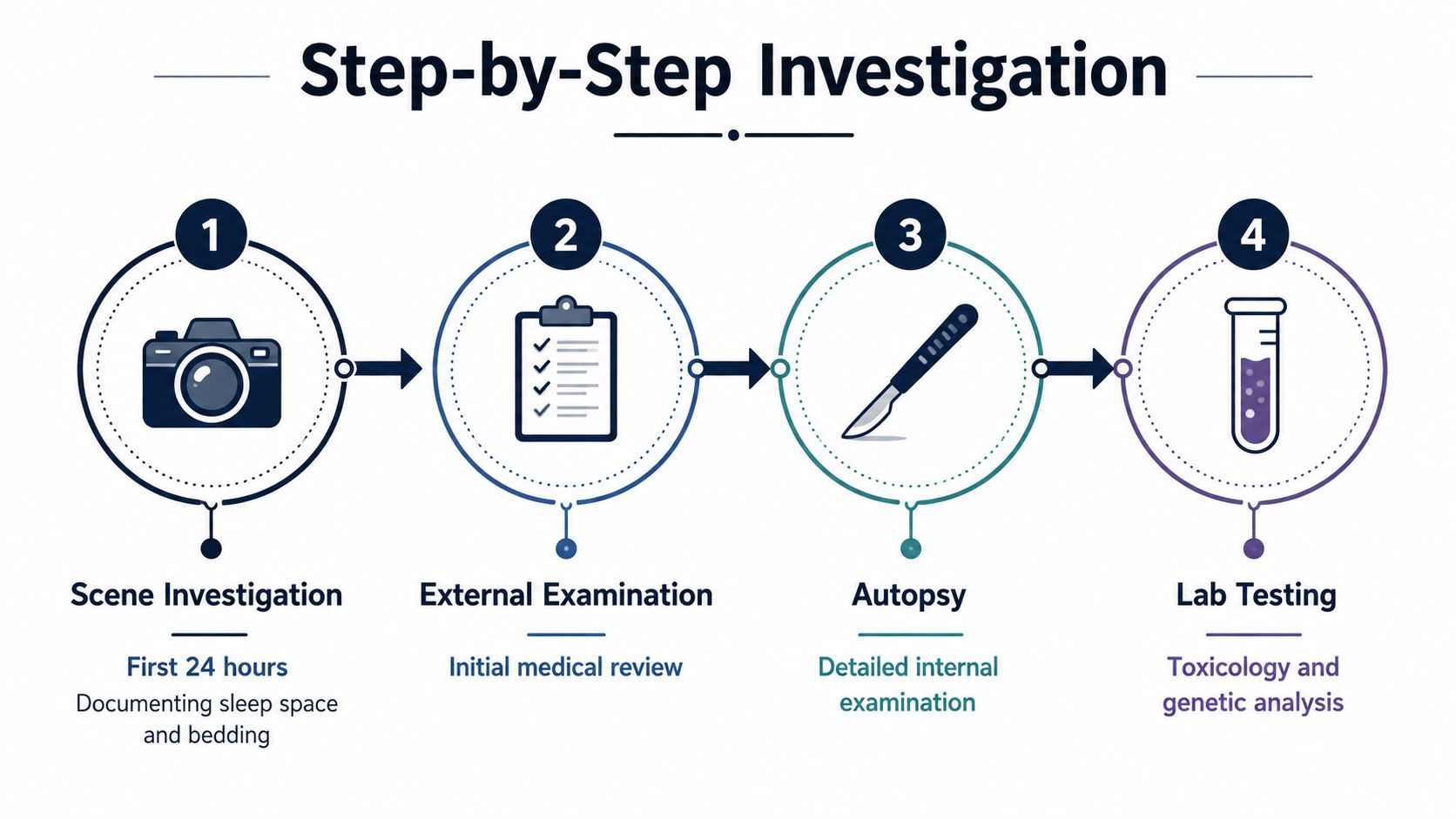
The scene comes first
A parent may be told the infant has been found. An investigator is already thinking about the room, the bedding, the temperature, and the last time the child was seen alive. That first look sets the tone for everything that follows.
The scene investigation should happen within 24 hours whenever possible (NCBI pediatric death guidance). Investigators document the sleeping environment, bedding, ambient temperature, and the infant's position, and they may use a doll reenactment for children up to 24 months of age when it is developmentally appropriate. That matters because the scene can hold evidence that no later test can recreate. It is a bit like reading the opening page of a case file before any other page is added.
A complete scene response also includes a careful record of when the infant was last seen alive and how the child was found. The CDC notes that the original position of the infant when first found unresponsive should be determined as precisely as possible through witness questioning and detailed recording (CDC scene guidance). If that step is delayed or done poorly, important details can disappear.
The autopsy examines the body in depth
After the scene review, the autopsy looks for findings that are not visible from the outside. CDC guidance and pediatric-death literature recommend a complete autopsy with histology, neuropathology, toxicology, and microbiologic studies, plus examination of the brain, neck structures, thoraco-abdominal organs, brain tissue, meninges, heart, lungs, airways, and liver, with blood and urine collected for analysis. That work helps identify infection, microscopic disease, occult trauma, metabolic disease, or toxic exposure.
Histology means looking at tissue under the microscope. Neuropathology focuses on the brain and nervous system. Microbiology looks for infectious causes. Toxicology checks for medication or poison exposure. Molecular or genetic testing may be added when the history suggests an inherited condition or when the autopsy does not fully explain the death.
For families who want to understand how inherited conditions are approached after death, our discussion of genetic testing after death explains why that step can matter in selected cases.
No single test should be treated as the whole answer. The most reliable conclusions come from agreement between the scene, the autopsy, and the lab results.
Timing affects the quality of the answer
Some results come quickly, others do not. Transport, specimen handling, and laboratory workload can all affect turnaround, so a careful investigator avoids promising a fixed outcome before the evidence is complete. The important point is sequence. Scene first, body second, lab work after that, then review everything together.
Medicolegal Autopsy vs Private Autopsy
A medicolegal autopsy and a private autopsy can both help answer hard questions, but they serve different roles. A medicolegal autopsy is authorized by a coroner, justice of the peace, or medical examiner, paid for by the jurisdiction, and used to support the official death certificate determination. A private autopsy is requested and paid for by the family or attorney, and it produces an independent report that can confirm, challenge, or supplement the earlier conclusion.
This difference matters when a family says the official explanation feels incomplete. It also matters when litigation is expected, when the medical examiner declined jurisdiction, or when a prior autopsy left unresolved questions. In those situations, a second opinion autopsy can review records, images, toxicology, and pathology slides with fresh eyes.
| Factor | Medicolegal Autopsy | Private Autopsy |
|---|---|---|
| Who initiates it | Coroner, justice of the peace, or medical examiner | Family, attorney, or other private requester |
| Who pays | Jurisdiction | Family or attorney |
| Primary purpose | Official cause and manner determination | Independent review and additional clarity |
| Report use | Supports death certificate and official record | Can supplement, confirm, or challenge prior findings |
| Best use case | Unexplained or reportable deaths under county authority | Unresolved questions, second opinions, or litigation support |
Texas adds a specific legal context. The work of autopsy and cremation oversight intersects with Texas Health & Safety Code Chapters 711, 716, and 651 and the role of the Texas Funeral Service Commission, so the authority for each step has to be clear. That's one reason families and attorneys should know which process is being used before they assume all reports carry the same weight.
Texas Autopsy Services provides private autopsy services Texas families and attorneys can use when an independent review is appropriate, and the practice also supports County Forensic Autopsies when counties need forensic pathology coverage. Every examination is performed by a board-certified forensic pathologist certified by the American Board of Pathology.
Chain of Custody, Reports, and Expert Testimony
Chain of custody means the record showing who handled evidence, when they handled it, and where it went next. In plain English, it's the proof that the specimen or record you're looking at is the same one collected during the case, untouched by gaps in handling. That matters in both civil and criminal matters, because a result can lose strength if the evidence trail is unclear.
A typical autopsy report includes the external examination, internal findings, organ weights, microscopic pathology, toxicology, and the final cause of death and manner of death statement. When needed, the report also references radiology, microbiology, and genetic results. For families, the useful question isn't whether the report sounds technical, it's whether the report explains how the conclusion was reached.
For attorneys, the report often becomes the foundation for an expert witness review. A forensic pathologist may be asked to explain why certain findings support one conclusion over another, what evidence was missing, and whether the available data are enough for a defensible opinion. That testimony has more value when the report is organized, the chain of custody is clear, and the findings are consistent with the scene investigation.
If you want a more detailed explanation of evidence handling, our article on chain of custody procedures walks through the same concept from a records perspective. Families also deserve privacy. Reports should be handled in a HIPAA-compliant way, and the final explanation should be delivered in plain language whenever possible.
Practical rule: if a report can't show where the evidence came from, what was tested, and how the conclusion was formed, the opinion is harder to defend later.
Why Some Investigations Come Back Incomplete
An infant death investigation can still end with gaps, even when the people involved are acting carefully and in good faith. Recent U.S. data found that 24% of sudden unexpected infant death investigations were incomplete, and incompleteness was more likely in rural scenes and when the investigation was led by law enforcement rather than a medical examiner (U.S. study on SUID investigation quality). That matters because the conclusion is only as dependable as the record behind it.
Some of the missing pieces are not small. The same study found gaps affecting American Indian and Alaska Native infants, including missing narrative descriptions, doll reenactments, SUID forms, and witness interviews. When those pieces are absent, the case file can read like a photo album with several pages missing. You can still see part of the story, but you cannot see how the whole picture was put together.
A complete investigation usually brings together several parts:
- Narrative scene description with the infant's position and environment
- Witness interviews with clear timing and consistency
- Doll reenactment when age-appropriate
- Medical history review and recent symptom history
- Autopsy findings with microscopic and laboratory support
The multi-state study of sudden unexpected infant death investigations found that 98% included a death-scene investigation, 90% included a narrative description of the circumstances, 88% included witness interviews, and 85% had critical information on 10 infant sleep-environment components (multi-state SUID study). Those figures show an important point. A case can look complete at first glance and still leave out details that matter for interpretation, especially when the scene, medical history, and autopsy do not line up neatly.
For families, that kind of gap often feels frustrating because they are left with uncertainty at the very moment they need clarity. For attorneys, it raises a different concern, whether the report can support the conclusion if it is tested later. If the scene notes are thin, the autopsy summary is brief, or the witness history is missing, a second-opinion review may be appropriate. That is especially true when the case may be reviewed in court or when the family still does not have a clear explanation.
Support, Resources, and How to Reach Us
An infant death investigation affects more than the medical record. Families often need grief support, clear communication, and a process that doesn't feel cold or fragmented. Child death review programs, counseling referrals, and advocacy organizations can help with those needs, and practical gestures can matter too, including thoughtful memorial gifts for grieving families when a family wants a simple way to acknowledge the loss.
Texas Autopsy Services supports families, attorneys, healthcare professionals, and county officials with private autopsy, second-opinion review, fetal and perinatal examination, exhumation support, and statewide service across all 254 Texas counties with in-house licensed transport. We also provide direct communication with our team, because families shouldn't have to repeat painful details through layers of intermediaries.
When the official investigation leaves questions open, an independent review can help organize the medical facts, preserve evidence, and explain what can and can't be concluded. That work belongs in the hands of a forensic pathologist who can balance precision with restraint, especially in cases involving infants.
If you need an independent review after an infant death, Texas Autopsy Services can help with private autopsy, second-opinion case review, and forensic pathology support across Texas. Every examination is performed by a board-certified forensic pathologist, and our team can explain the findings in plain language. Visit Texas Autopsy Services or call (806) 230-1889 to speak directly with us about your case.