July 31, 2026 · Texas Autopsy Services
Suicide by Overdose: A Forensic and Family Guide
Suicide by overdose explained with compassion and forensic clarity. Learn how examiners determine intent and what families can expect.
On this page
- When an Overdose Death Leaves More Questions Than Answers
- Cause of Death and Manner of Death Explained
- How Forensic Pathologists Determine Intent in an Overdose
- Drugs Most Often Involved in Suicide by Overdose
- Why Intent Is Easy to Misclassify After an Overdose
- How a Private Autopsy or Second Opinion Adds New Information
- Timelines, Reporting, and Texas Compliance
- Frequently Asked Questions for Families and Attorneys
Families often reach us after a death that was first labeled accidental or undetermined, yet the facts still feel incomplete. The toxicology report may show a dangerous mix of drugs, but toxicology alone cannot tell you whether the person meant to die. That gap is why suicide by overdose is one of the hardest forensic questions we see, and why a careful postmortem review matters for families, attorneys, and county officials alike.
Key points
- Cause of death and manner of death are different findings, and families need both terms explained clearly.
- Intent in an overdose case comes from the full investigation, not toxicology alone.
- Opioids and barbiturates are the most lethal drug classes in suicidal overdose cases reviewed in large studies.
- Misclassification is common when the scene history is thin or the evidence is mixed.
- A private autopsy or second-opinion review can add independent findings when the original record leaves questions open.
- Texas cases also depend on chain of custody, Texas statutes, and proper forensic reporting.
When an Overdose Death Leaves More Questions Than Answers
A family may be told that a loved one died from an overdose, and the death certificate may list the manner as accident or undetermined. The paperwork can feel final, but the people closest to the deceased often know there were warning signs, a recent crisis, or comments that never made it into the record. That conflict is not rare, and it is not solved by toxicology alone.
The CDC reports that suicide involving drug overdose increased 31% from 2003 to 2012, from 1.3 to 1.7 deaths per 100,000, then declined to 1.2 in 2020 and stayed stable through 2023 (CDC NCHS Data Brief 526). In the broader U.S. overdose picture, the NIH notes that about 5% to 7% of overdose deaths in 2020 were recorded as intentional (CDC NCHS Data Brief 526). That small share still matters because each case asks a separate medicolegal question.
Practical rule: a drug list can show what happened physiologically, but it cannot prove why the death happened.
Families usually start with one of three concerns. They may question whether the person could have taken the drugs on purpose, whether the substances were taken accidentally, or whether the original investigation missed context that changed the interpretation. Attorneys often raise the same issue when a death certificate affects insurance, probate, or litigation.
A careful forensic review looks at the whole picture, not just the bottle labels or lab numbers. That includes the scene, the medical record, the prescription history, and the body itself. When those pieces do not line up cleanly, a second opinion can be the difference between a tentative conclusion and a more defensible one.
Cause of Death and Manner of Death Explained
These two terms are often confused, even on official documents. Cause of death is the disease or injury that starts the fatal chain, while manner of death is the legal classification of how that cause came about, usually natural, accident, suicide, homicide, or undetermined. In an overdose case, the cause is often drug toxicity, but the manner can still be disputed.
A simple way to keep them straight is this, cause is the mechanism, manner is the verdict. If a person dies from the toxic effect of a medication, that explains the physiological process. It does not, by itself, explain whether the drugs were taken unintentionally, in self-harm, or in a mixed set of circumstances.
The CDC's 2024 drug overdose data show how separate intent classification really is. Of 79,384 overdose deaths, 5.6% were classified as suicides, compared with 91.6% unintentional, 2.7% undetermined, and less than 1.0% homicides (CDC NCHS Data Brief 549). That split shows why investigators do not treat every overdose as the same event.
A death certificate may list a clear cause and still leave the manner unresolved. That is especially common when toxicology is positive but the scene history is thin. Families often read the certificate as a final moral judgment, but forensic medicine treats it as a classified finding based on evidence.
Why the distinction matters
- Cause of death answers what physically killed the person.
- Manner of death answers how the fatal event is categorized in forensic terms.
- Drug toxicity can be the cause in both accidental and intentional overdoses.
- Intent usually requires more than laboratory results.
Once that distinction is clear, the rest of the investigation makes sense. The question is not just what was in the body, it is how the evidence fits together. That is where forensic pathologists do their most careful work.
How Forensic Pathologists Determine Intent in an Overdose
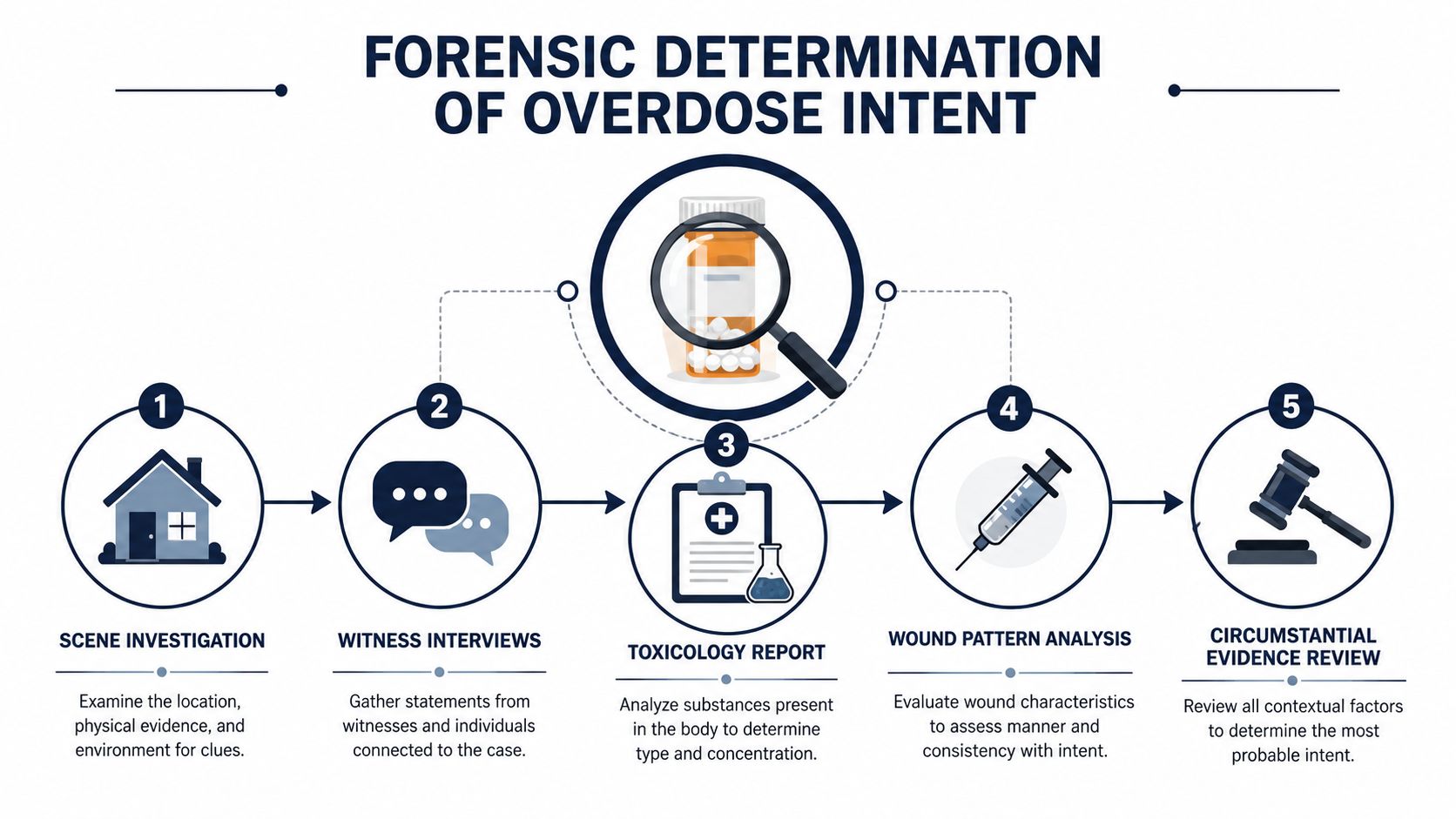
A pill bottle on the counter can point in one direction, while the medical records point in another. An overdose death is rarely explained by a single clue. Examinations are performed by board-certified forensic pathologists who look for convergence across the scene, the history, the body, the lab work, and the surrounding circumstances. When those sources line up, the conclusion is stronger. When they do not, the case stays carefully qualified.
Scene, history, and records
The first building block is the scene investigation. Investigators look for pill containers, recent prescriptions, empty bottles, notes, text messages, and the location of the body. Witness statements and family history also matter, because a recent loss, psychiatric care, or prior overdose attempts can change how the evidence is read.
Prescription review is just as important. A drug that was prescribed months earlier may still be present in the home, and a refill pattern can show whether access was routine or unusual. Medical records can also reveal diagnoses, prior admissions, or substance exposure that toxicology alone cannot explain.
A forensic pathologist reads these materials the way a clinician reads a chart beside a bedside history. The value is in how the pieces fit together, not in any one item standing alone.
The strongest forensic conclusions come from matching the body to the scene, not from reading either one in isolation.
Autopsy, toxicology, and ancillary studies
The external examination and full autopsy document physical findings that may support or challenge the scene story. Toxicology identifies which substances were present, but it still does not prove intent by itself. Ancillary studies, such as histology or vitreous chemistry, can help confirm whether the body's changes fit the suspected timing and drug effect.
That is why the autopsy is only one part of the process. A body may show findings consistent with drug toxicity, yet the manner of death can still remain uncertain if the surrounding evidence is incomplete or conflicting. The question is not just whether a drug was present, it is whether the overall pattern fits self-harm, accident, or another explanation.
A large cross-sectional study of 421,466 medically identified suicidal drug overdoses and 21,594 deaths found that the fatality risk was highest when an opioid or barbiturate was involved, and opioids appeared in 33.3% to 47.8% of fatal suicide poisonings (PMC7090840). In that same study, the death risk was about 5.18 times higher when opioids were involved. For families trying to understand why a case is treated as intentional, that kind of pattern matters more than the drug name alone.
Forensic pathologists do not use one finding alone. They weigh the evidence as a whole, then classify the death in a way that is reproducible and reviewable. In most jurisdictions, that process follows a preponderance-of-evidence approach, not a criminal trial standard. The result should be careful, documented, and tied to facts, not guesswork.
When the record is thin, the question often turns on small details. A locked pill cabinet, an empty blister pack, a recent text, or a refill that does not match the expected use pattern can carry more weight than a toxicology result by itself. If a family wants a second review of the medical record and autopsy findings, a private examination can also help clarify what the original case file did not explain, including questions raised in what to do after trazodone overdose.
Drugs Most Often Involved in Suicide by Overdose
The substances that matter most are not always the ones families expect. In fatal intentional overdoses, the greatest concern usually centers on opioids and barbiturates, because those drug classes are strongly associated with lethal poisoning patterns seen in forensic review. In U.S. suicide trend data, the drug categories most often involved include antidepressants, prescription opioids, and benzodiazepines, while psychostimulants have also become more visible in suicide deaths (PubMed 39116399).
| Case-Fatality Risk of Common Substances in Suicidal Overdose | ||
|---|---|---|
| Drug Class | Relative Lethality | Notes for Investigators |
| Opioids | Highest in the cited study | Strongly associated with fatal suicidal overdose, and often central when multiple sedating drugs are present. |
| Barbiturates | Very high | Less common than opioids, but dangerous when present in intentional poisoning cases. |
| Prescription opioids | High concern | Often require review of access, refill timing, and whether leftover medication was available at home. |
| Benzodiazepines | Moderate to high concern | Can become more dangerous in combination with other depressants. |
| Antidepressants | Variable | Common in suicide investigations, but interpretive weight depends on the specific drug and co-ingestants. |
| Psychostimulants | Emerging concern | Suicide deaths involving psychostimulants increased over time in the cited U.S. trend data (PubMed 39116399). |
Polysubstance findings make the analysis harder. A person may have one sedating medication, one prescribed anxiety drug, and an illicit substance in the same blood sample, and each one changes the risk picture. That is why pathologists review the full toxicology panel, the medication list, and the scene together.
Families often ask whether a particular medicine was likely to cause death on its own or only in combination with other drugs. A practical article such as what to do after trazodone overdose can help explain immediate safety concerns, but it does not replace forensic review of the death itself. The clinical question is different from the medicolegal one, and the distinction matters when a pathologist is deciding whether the pattern fits suicide, accident, or another explanation.
When the history is incomplete, scene details can matter as much as the toxicology. Empty pill bottles, mixed prescriptions, recent changes in access, and a medication trail that does not match ordinary use all help show whether the overdose was arranged deliberately or happened in a different context. For a closer explanation of how investigators sort those facts, see how overdose scenes can be misread as accidents.
Why Intent Is Easy to Misclassify After an Overdose
Intent is often the hardest part of an overdose case to prove. The University of Rochester notes that overdose deaths are especially difficult to classify after death, and that as many as 30% of deaths recorded as accidental or undetermined may be suicides (University of Rochester). That figure is not a rule for every case, but it shows the size of the blind spot.
Where the evidence breaks down
Misclassification often happens when there is no suicide note, no witness statement, and no clear documentation of what happened before death. It also happens when prescription access is ambiguous, because leftover medication in the home can look routine unless someone checks the refill record and medication timeline carefully. Polysubstance toxicology can point toward recreational use or self-medication, which makes intent even harder to assign without more context.
Social pressure also shapes rulings. Stigma, religious concerns, and family disagreement can make a suicide classification harder to reach, even when some facts point that way. That is not a criticism of medical examiners. It is part of the environment in which these decisions are made.
The Texas Autopsy Services perspective is that families deserve a clear explanation of the evidentiary gaps, not a vague label. When a death certificate leaves questions open, a second opinion can help identify whether the original ruling was well supported or whether the case needs closer review. Our earlier article on making suicide look like an accident addresses the same investigative challenge from a forensic angle.
Rule of thumb: if the body, the scene, and the history do not match cleanly, the manner of death deserves a second look.
The most useful follow-up cases are the ones with incomplete scene information, disputed medication access, or a family history that was never fully incorporated into the first report. Cases that already have strong, consistent evidence may confirm the original ruling. The goal of review is not to force a new answer, it is to test whether the first one was complete.
How a Private Autopsy or Second Opinion Adds New Information
A private autopsy is an independent postmortem examination requested by a family, attorney, insurer, or other party when the original investigation does not answer all the questions. In some cases, we review an existing autopsy report and medical file instead of performing a full new exam. A second-opinion review can be valuable when the family wants an independent written analysis of how the original findings were reached.
For families seeking private autopsy services Texas, the process usually begins with records collection and a direct conversation about what questions need answering. Texas Autopsy Services handles in-house licensed transport with full chain of custody, then an examination by a board-certified forensic pathologist certified by the American Board of Pathology. When needed, toxicology and ancillary testing are added to support the final opinion. A consultation service such as pathology consultation services can be helpful when an attorney or family needs a second read on complex findings.
What a family typically receives
- Independent findings, focused on cause and manner of death.
- Written documentation, prepared for medical, legal, or insurance use.
- Chain-of-custody handling, so specimens and records stay traceable.
- Direct communication, without call-center buffering or unclear handoffs.
Texas Autopsy Services is also one option for families who need a private autopsy with plainspoken reporting and full case documentation. Our role is not to advocate for a conclusion before the evidence is examined. It is to test the evidence carefully and explain what it supports.
The final written report is often the most important product. It should be understandable to families and detailed enough for attorneys, courts, and insurers. That balance matters because a report that is only technical can leave the family confused, while a report that is too general may not hold up in a formal review.
Timelines, Reporting, and Texas Compliance
Most families want to know how long the process takes and what governs it. Preliminary findings often come together quickly after the exam, while final reports depend on toxicology and any added studies. In practice, most cases within 24 to 48 hours can yield preliminary findings, and a final report may take a few weeks when lab work is pending, as discussed in how long autopsy results.
Texas cases also sit within a defined legal framework. The Texas Funeral Service Commission, Texas Health & Safety Code Chapters 711, 716, and 651, and local death-investigation procedures all shape how remains are handled and how findings are documented. In counties without a medical examiner, justices of the peace can play a central role in death certification and referral.
What chain of custody means in plain language
Chain of custody is the documented path of a body, specimen, or record from one responsible person to the next. It shows who handled the material, when they handled it, and why. That record matters because a report is only as reliable as the handling behind it.
Court-admissible reporting also requires clear method, traceable specimens, and language that distinguishes what was observed from what was inferred. A pathologist should be able to explain why the evidence supports one classification over another without leaning on speculation. That is true whether the case is a county referral or a private review.
Texas families and attorneys should expect the paperwork to match the science. If records are incomplete, if custody is unclear, or if toxicology is delayed, the timeline can extend. Clear communication from the start helps avoid false expectations later.
Frequently Asked Questions for Families and Attorneys
Can the manner of death be changed after the death certificate is filed?
Yes, sometimes it can, if new evidence or a stronger independent review supports a different conclusion. The process depends on the jurisdiction and the strength of the forensic record. A correction is more likely when the original file was incomplete, the scene information changed, or the medical findings were reinterpreted in light of additional evidence.
What can a second-opinion review do?
It can test whether the first opinion was well supported, identify missing facts, and explain whether the original conclusion still fits the evidence. It cannot recreate evidence that no longer exists. For families, that distinction matters because a second opinion should bring clarity, not false certainty.
Will a suicide classification affect insurance or benefits?
It can, depending on the policy and the wording of the contract. That is why the exact manner of death and the supporting documentation matter so much. Families often need a clear forensic explanation before they can have meaningful conversations with insurers or attorneys, and supportive guidance from ways to provide verbal support can help during those conversations.
What does exhumation involve?
Exhumation is the lawful recovery of a buried body for renewed examination when the original work was incomplete or when a new question must be answered. It is usually considered only when records, jurisdiction, or unresolved forensic issues justify that step. The value comes from asking whether the body can still provide information that the first investigation missed.
Texas Autopsy Services provides independent private autopsy and second-opinion review work for families, attorneys, and county officials who need careful cause-of-death investigation in Texas. If a death by overdose still doesn't make sense, our board-certified forensic pathologists can review the evidence, explain the findings in plain language, and help you decide what comes next. Please visit Texas Autopsy Services to contact our team directly.