June 19, 2026 · Texas Autopsy Services
Pathology Consultation Services a Complete Texas Guide
A complete guide to pathology consultation services in Texas. Learn about private autopsies, second opinions, and how to get answers for your family or case.
On this page
- When Answers Are Needed Most
- What Are Pathology Consultation Services
- The Process for Obtaining an Independent Autopsy
- Guidance for Families Seeking Answers
- A Resource for Attorneys and Legal Professionals
- Supporting Texas Counties with Forensic Services
- How to Choose a Qualified Pathology Provider
- Frequently Asked Questions
A family calls us after an unexpected death. They've been given fragments of information, a preliminary explanation, and a stack of records that don't quite answer the question they're asking: what happened, and can anyone review this independently?
That moment is where pathology consultation services matter most. In practice, these services help families, attorneys, physicians, and public officials move from uncertainty to a documented medical opinion grounded in records, specimens, and formal review. Pathology is central to modern care. The Royal College of Pathologists notes that about 95% of clinical pathways rely on pathology services in its pathology facts and figures summary.
For grieving families, the need is often personal and immediate. For attorneys, it's about evidence that can withstand scrutiny. For county officials, it's about meeting statutory responsibilities with a reliable forensic process. The work is different for each audience, but the underlying standard is the same. The opinion must be independent, documented, and medically sound.
- Pathology consultation services are more than a second look. They can include records review, clinical-pathologic correlation, ancillary testing support, and formal written findings.
- Independent review matters when the first explanation feels incomplete or disputed. That includes autopsy questions, injury cases, toxicology issues, and complex medical histories.
- The process should be structured and lawful. In Texas, that means proper authorization, secure transport, documented chain of custody, and clear reporting.
- Different audiences need different things. Families need plain language and respectful handling. Attorneys need defensible documentation. Counties need dependable forensic support.
- Provider selection matters. Every examination should be performed by a forensic pathologist certified by the American Board of Pathology, with strong logistics and direct communication.
When Answers Are Needed Most
Uncertainty after a death has its own weight. A family may have heard one explanation from the hospital, another from a death certificate discussion, and something else from a relative who saw the medical history up close. None of that means anyone acted improperly. It does mean the picture may still be incomplete.
That is often when people start searching for pathology consultation services, an independent autopsy, or a second opinion autopsy. They aren't looking for conflict. They're looking for a careful medical review that respects both the deceased and the facts.
We see this most often in cases involving sudden collapse, treatment complications, disputed injury timelines, delayed diagnoses, or deaths where the family cannot reconcile the reported cause with what they observed. The same need arises in legal settings when the central issue is not grief alone, but proof.
Independent review is often most valuable when the existing answer is too brief, too uncertain, or too disconnected from the full record.
A proper pathology consultation gives that uncertainty a structure. It asks what records need review, whether specimen materials are available, whether toxicology or histology needs reevaluation, and whether the final opinion should address cause of death, manner of death, injury interpretation, or a narrower medical question.
Three plain-language terms matter here:
- Cause of death means the disease or injury that led to death.
- Manner of death means the category of death, such as natural, accident, suicide, homicide, or undetermined.
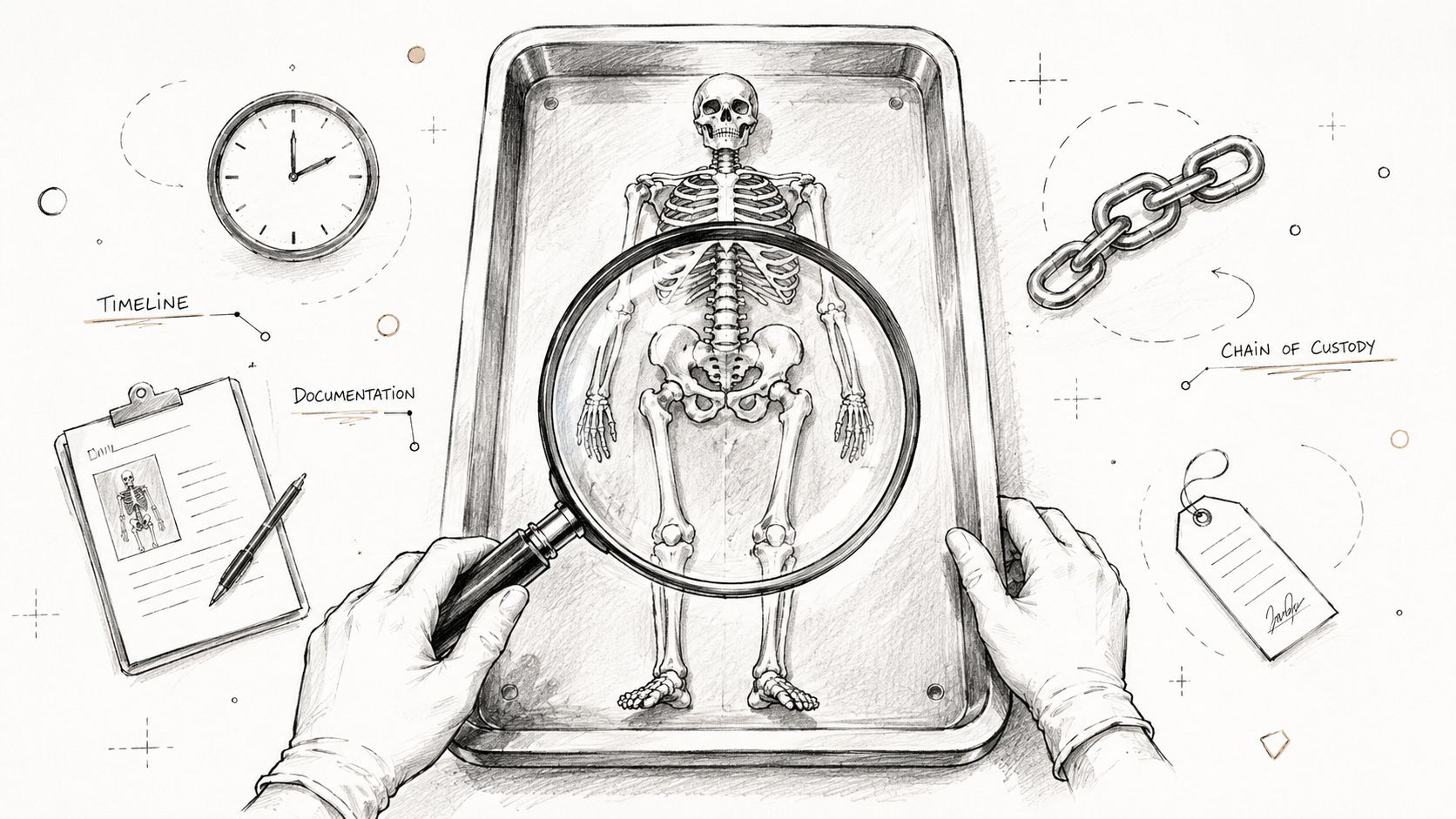
- Chain of custody means the documented handling of remains, specimens, and evidence from one person or location to the next.
Families deserve clarity. Attorneys need defensible analysis. Public officials need a process they can trust. Those needs differ, but they all begin in the same place. Someone needs an answer that can be explained and documented.
What Are Pathology Consultation Services
Pathology consultation services are formal medical reviews performed when an existing diagnosis, autopsy finding, specimen interpretation, or cause-of-death conclusion needs further analysis. In practical terms, that can include review of tissue slides, autopsy reports, hospital records, toxicology, imaging, operative notes, and supporting documents.
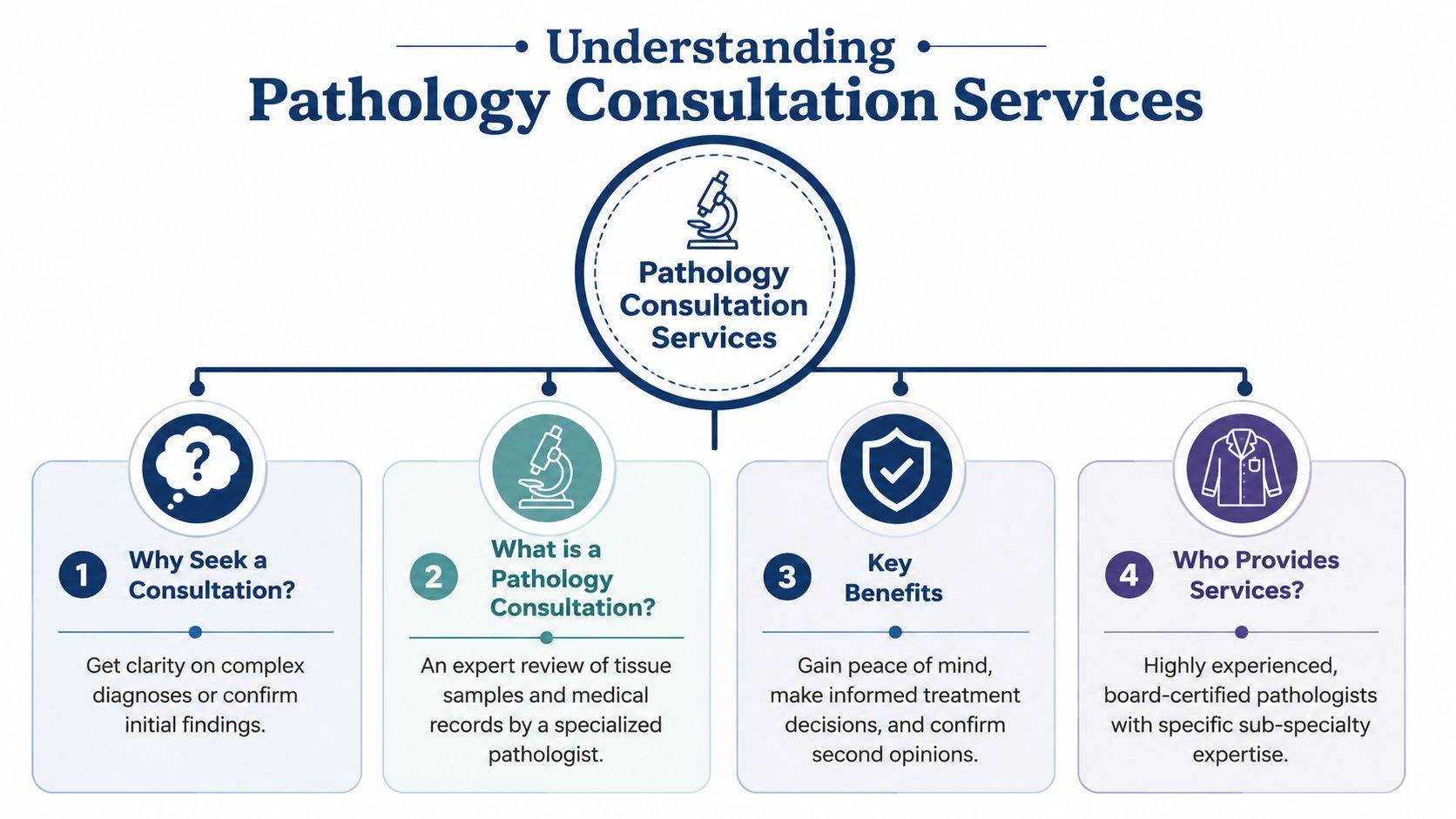
Some consultations are narrow. A lawyer may ask whether a prior autopsy opinion is medically supportable. A family may want a second review of an existing report. A physician may need clarification on difficult pathology findings. Other matters are broader and may involve a full private autopsy, slide review, ancillary testing, and record integration.
What a consultation actually includes
The biggest misunderstanding is that consultation means a pathologist glances at slides and confirms or disagrees. In reality, a detailed consultation often includes clinical-pathologic correlation, immunohistochemistry, special stains, molecular testing support, and documentation review as part of a structured diagnostic reconciliation process, as described by Wisconsin Diagnostic Laboratories' pathology consultation overview.
That distinction matters. A useful consultation does not isolate one data point from the rest of the case. It puts the medical findings back into context.
A consultation may involve:
- Record review: Hospital charts, emergency records, imaging reports, operative notes, and prior pathology.
- Material review: Tissue slides, paraffin blocks, toxicology materials, photographs, or prior autopsy documentation.
- Focused questions: Whether the original diagnosis fits the clinical course, whether injury timing is consistent, or whether another cause should be considered.
- Written conclusions: A report that explains the reasoning, not just the bottom line.
Practical rule: The best consultations start with a precise question. “Please review” is far less useful than “Please assess whether the reported cause of death is supported by the autopsy findings and medical records.”
How this differs from a routine autopsy or hospital review
A hospital autopsy, medical examiner investigation, and private forensic review do not always serve the same purpose. A hospital review may focus on clinical explanation. A medicolegal investigation may focus on statutory duties and public reporting. A private consultation often addresses unanswered family concerns, disputed medical issues, or litigation needs that require a separate assessment.
That is why these services can include private autopsy services in Texas, second opinion pathology and slide review, fetal or perinatal examination, toxicology coordination, and targeted review of prior reports. The scope depends on the question being asked and the materials available for review.
What works is specificity, complete records, and a clear request. What doesn't work is sending partial information and expecting a dependable answer from fragments alone.
The Process for Obtaining an Independent Autopsy
An independent autopsy should never feel mysterious. The process is serious, but it should also be clear. Families and counsel need to know who can authorize the examination, how transport is handled, how the remains are cared for, and when they can expect findings.
What happens first
The first step is confirming authority and purpose. In Texas, that means identifying the legally authorized person and reviewing any constraints involving burial, cremation, county jurisdiction, or pending official investigation under the Texas Health & Safety Code and related procedures. If an attorney is involved, the request should define the issues early.
Next comes collection of records and logistics. For some consultations, that means obtaining prior autopsy reports, slides, and medical records. For a full independent autopsy, it may also mean arranging secure transport and preserving a documented chain of custody from the point of transfer onward.
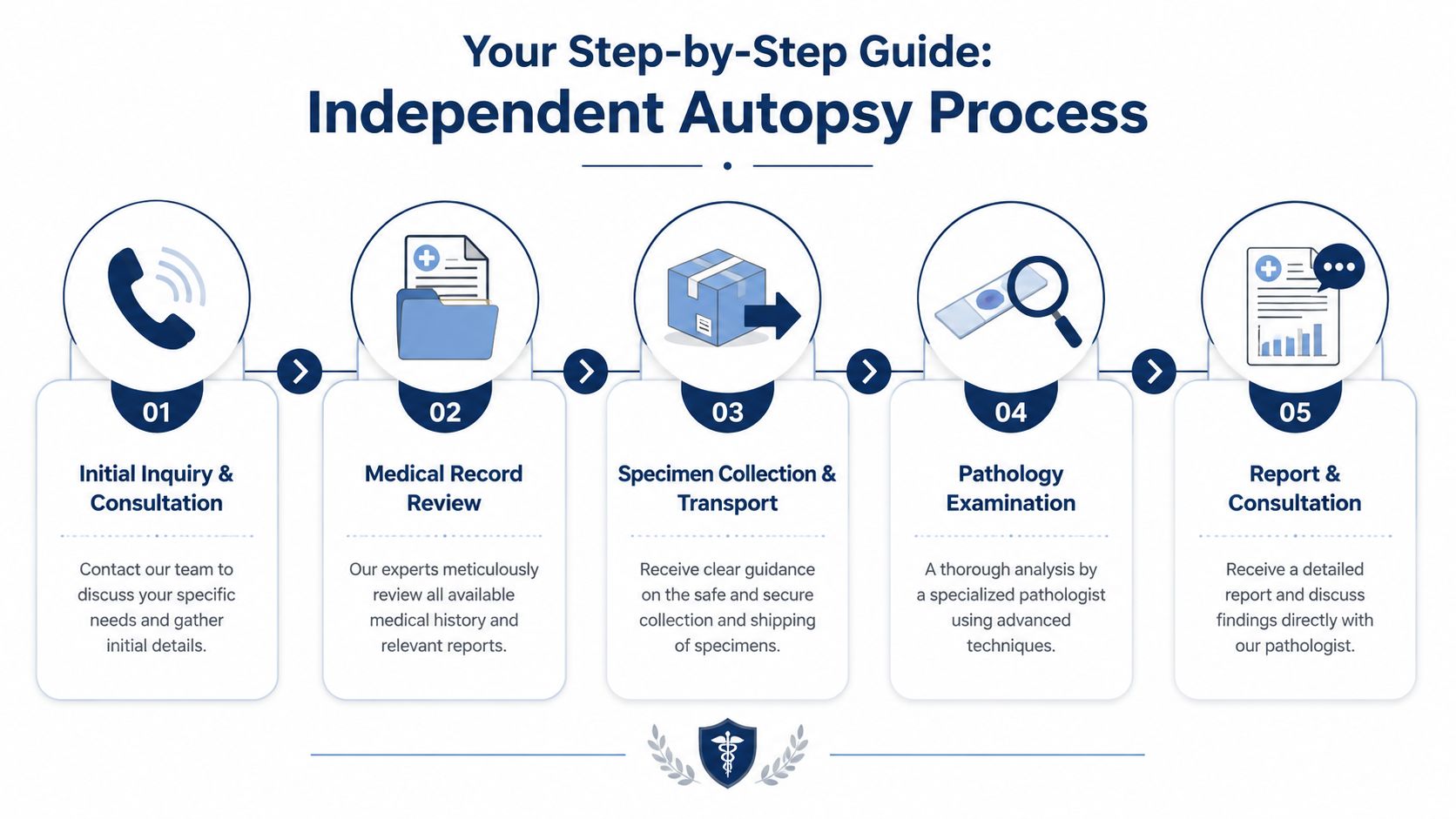
A practical sequence usually looks like this:
Initial call and intake
We clarify what happened, what questions remain, and whether the case calls for a record review, second opinion, or full examination.Authorization and document gathering
Consent forms, identity information, medical records, and any prior reports are collected before the examination moves forward.Transport and custody controls
The remains or materials are transferred using documented handling procedures so that identity and evidence integrity are preserved.
To understand how independent fact-finding is approached in other contested settings, some readers also find answers on independent injury investigations helpful as a legal-process comparison.
A later step often depends on how complete the submission is. For example, Mayo Clinic Laboratories notes in its pathology consultation guidance that bone and soft tissue consultations require preoperative imaging because without that correlation a definitive diagnosis cannot be made.
How the examination and reporting process works
The examination itself depends on the scope of the case. A full autopsy may include external examination, internal examination, specimen sampling, toxicology coordination, microscopy, and review of records and circumstances. A consultation-only case may center on record analysis, slide review, and report reconciliation.
This video gives a general overview of how independent review is approached in practice.
The final report should do more than list findings. It should explain how the opinion was reached, what materials were reviewed, and whether any limitations affected the conclusion. That's especially important if the report may later be used in court, in a probate dispute, in an insurance matter, or as the basis for further medical review.
A well-run process protects both dignity and evidence. Those are not competing goals.
Guidance for Families Seeking Answers
Families usually contact us when the official explanation feels too thin, too technical, or unfinished. They may not know the full medical history. They may be worried that asking for an independent review will delay services. They may also be concerned about whether their loved one will be handled respectfully. Those concerns are normal.
What families usually need to know right away
A private autopsy or consultation does not require a family to have every answer before making the first call. We can often begin with the known facts, the place of death, and whatever documents are already available. Missing records can often be obtained later through proper authorization.
Families also ask whether an examination prevents a traditional funeral. In many cases, funeral plans can still move forward, but the exact timing depends on transport, authorization, the condition of the remains, and whether other agencies are involved. This is a practical issue, not something that should be guessed at. It should be discussed directly at intake.
For families considering a full independent review, our private autopsy guidance covers the basic options and legal considerations in plain language.
A second concern is communication. Families deserve direct, respectful updates from the team handling the matter. They should not be left trying to interpret medical terms alone. Related postmortem record issues are also discussed in our medical review service overview.
Why an independent review can matter later
The value of a consultation is not limited to the immediate cause-of-death question. A careful review may help clarify whether an illness was natural, whether a treatment complication is being alleged without support, whether an injury pattern fits the reported events, or whether surviving relatives should raise further questions with their own physicians.
That last point needs a careful disclaimer. A pathology consultation is not medical advice for living family members. It can, however, identify findings that may be relevant for later clinical follow-up.
For many families, the most important outcome is simpler than that. They need a report they can read, discuss, and return to later without feeling that the truth disappeared into a file they never fully understood.
A Resource for Attorneys and Legal Professionals
Attorneys don't need broad reassurance. They need a pathology consultation that is documented, independent, and usable. In litigation, the value of forensic review depends less on how strongly an opinion is stated and more on whether the opinion is tied to reviewed materials, accepted pathology methods, and a defensible chain of reasoning.
What makes a consultation legally useful
A formal pathology clinical consultation is not the same as an informal conversation with a doctor. It must include a written report prepared by the pathologist in response to a request from a physician or other qualified healthcare professional, as outlined in CAP Today's discussion of pathology clinical consultation services. That distinction matters when the issue is admissibility, credibility, and the difference between background discussion and a true medical opinion.
For counsel, the core checklist is straightforward:
- Documented request: Who asked for the consultation and what question was posed.
- Material identification: What records, slides, photographs, toxicology, or specimens were reviewed.
- Chain of custody: How materials were received, tracked, stored, and returned or retained.
- Written findings: A report that states conclusions and the basis for them.
A forensic pathology expert can materially affect a case. If the opinion changes after additional materials are reviewed, the report should show why. If the opinion does not change, the report should show why that conclusion remains supported.
Where legal cases often benefit from forensic review
Legal review is often useful in wrongful death claims, treatment-delay cases, disputed trauma timelines, workplace fatalities, insurance disputes, and challenges to an existing cause-of-death determination. In some employment-related death matters, attorneys and families may also want background context on wrongful death workers' compensation claims, especially when medical and legal timelines overlap.
Our forensic pathology associates overview speaks to the practical role of independent forensic review in case preparation, including how expert analysis differs from a summary reading of records.
The strongest forensic report is rarely the loudest one. It is the one that can be followed, sourced to the record, and defended under questioning.
Supporting Texas Counties with Forensic Services
County officials in Texas work within a system that is practical, local, and often demanding. In counties without a medical examiner office, justices of the peace and other responsible officials still need dependable forensic support when a death falls within medicolegal jurisdiction. The need is not abstract. It affects scene coordination, transport decisions, family communication, case closure, and public record accuracy.
What county officials need from a forensic partner
A useful forensic service for counties must understand statutory duties, documentation needs, and the reality of distance across Texas. Officials need a provider that can receive the case information promptly, coordinate lawful transfer, preserve identity and evidence integrity, and return findings in a format that supports the county's responsibilities.
The practical priorities tend to be:
- Clear intake procedures: County staff should know what documents and authorizations are needed.
- Reliable handling: Transfer, storage, and examination protocols must support evidence integrity.
- Court-ready reporting: Findings should be written with enough precision to support later review if needed.
- Respectful coordination: Families, funeral homes, and county offices all need accurate information without confusion.
Our county forensic autopsy services are structured around those operational realities for counties across Texas.
Why statewide logistics matter
Texas is large enough that logistics can determine whether a case proceeds smoothly or becomes delayed by preventable handoffs. A county may have authority to order or request a forensic examination, but that alone does not solve transport, storage, communication, or specialized testing needs.
That is why counties should evaluate whether a provider can handle the full chain from intake through reporting. Texas Autopsy Services is one example of a statewide option. The practice serves all 254 Texas counties, uses in-house licensed transport, and provides independent private and county forensic autopsy services with full chain-of-custody procedures.
What usually causes problems is fragmentation. One vendor handles removal, another stores the remains, another performs a limited review, and key information gets separated along the way. Counties are better served when responsibility is clearly assigned and documented from the beginning.
How to Choose a Qualified Pathology Provider
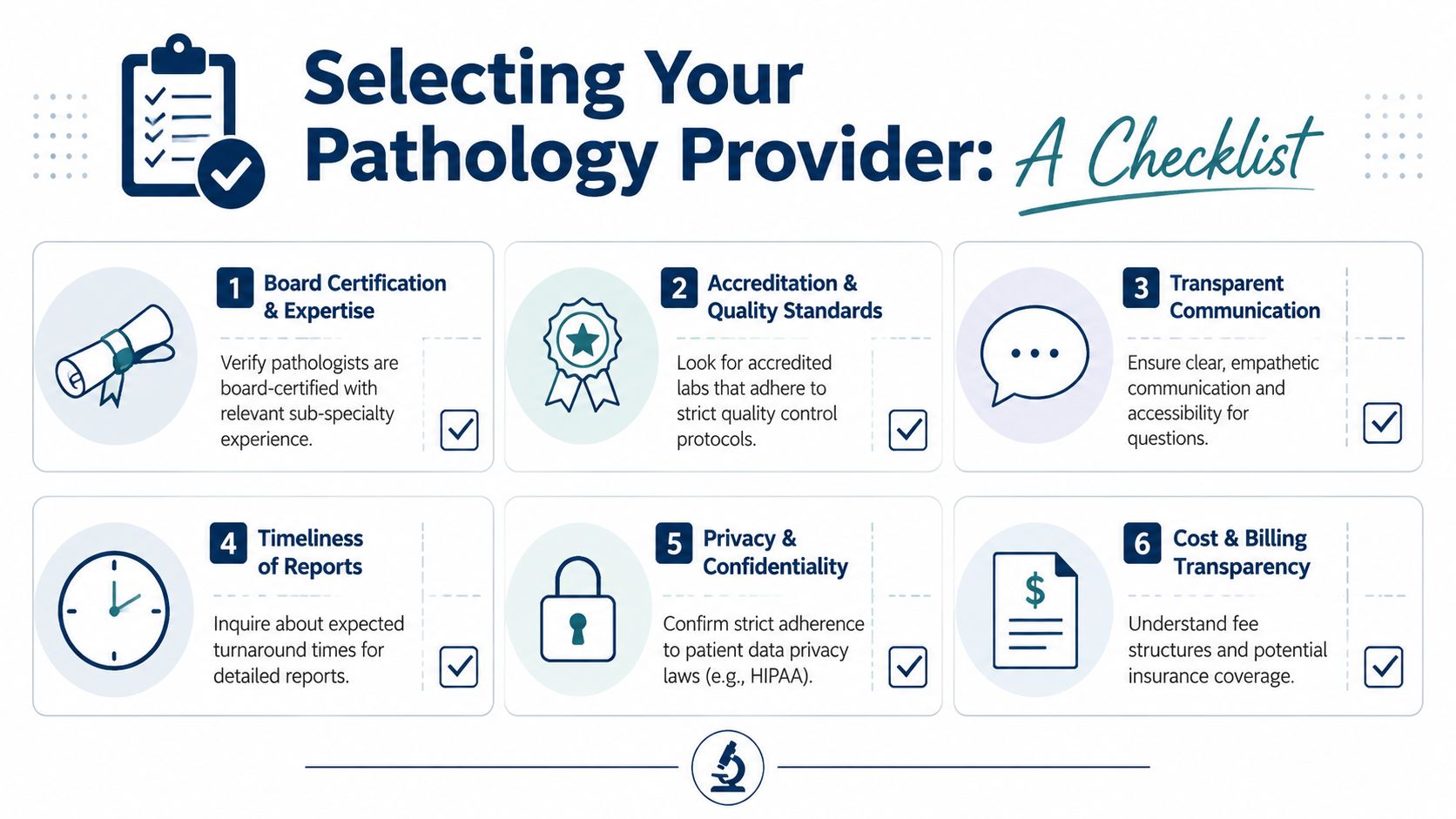
Families, lawyers, physicians, and county officials often ask the same basic question in different words: how do we know a pathology provider is qualified to handle this case properly? The answer is not a slogan. It is a checklist.
Questions worth asking before you authorize a case
Start with the person performing the examination. Every examination should be performed by a forensic pathologist certified by the American Board of Pathology. If the provider is vague about who does the actual work, that is a problem.
Then ask how the service is structured. In the United States, the current CPT consultation code set for pathology clinical consultation was updated in 2022. It includes 80503 for 5–20 minutes, 80504 for 21–40 minutes, 80505 for 41–60 minutes, and add-on code 80506 for each additional 15–30 minutes beyond 60 minutes. CAP guidance tied to these codes describes a formal consultation as one requiring a written report in response to a qualified request, with code selection based on time or medical-decision complexity, as summarized in XIFIN's review of the 2022 pathology clinical consultation code additions.
That coding detail does not apply to every private autopsy matter in the same way, but it does show what serious consultation work looks like. It is formal, documented, and structured.
What works and what usually causes problems
A sound provider should be able to answer practical questions without evasion.
- Who handles the case: Confirm that a board-certified forensic pathologist performs the examination and signs the opinion.
- How materials move: Ask about transport, evidence handling, and chain of custody.
- What communication looks like: You should know who will update you and how findings will be explained.
- How billing works: Transparent pricing prevents avoidable conflict in already difficult cases.
Another point is logistics. Access to subspecialty expertise and modern digital workflows can affect both turnaround and the quality of review in difficult or disputed matters. For readers comparing consultation options, our pathology consultation page outlines the practical issues we believe any provider should address directly.
Choose the provider that can explain the process plainly before the case begins. Clear process is usually a sign of reliable work.
What does not work is choosing based only on proximity or a marketing claim. In pathology consultation services, process quality matters as much as credentials.
Frequently Asked Questions
| Question | Answer |
|---|---|
| Can a family request an independent autopsy in Texas? | Yes, if the legally authorized person gives proper authorization and no legal restriction prevents the examination. The details depend on the circumstances of death, county involvement, and disposition status. |
| What is the difference between cause of death and manner of death? | Cause of death is the disease or injury that led to death. Manner of death is the category used to classify the death, such as natural, accident, suicide, homicide, or undetermined. |
| Do pathology consultation services only apply to full autopsies? | No. They may involve a full autopsy, review of an existing autopsy report, slide review, toxicology review, medical record analysis, or a targeted second opinion on a specific medical question. |
| Will an independent review always change the original conclusion? | No. Sometimes the original opinion is supported. The value of consultation is not that it changes an answer, but that it tests the answer against the available evidence and explains the basis for the conclusion. |
| What is chain of custody in a forensic case? | Chain of custody is the documented record showing who handled the remains, specimens, slides, photographs, or other evidence at each stage. It helps preserve identity, integrity, and legal reliability. |
If you're facing unanswered questions after a death, or you need an independent forensic review for a legal or county matter, direct communication matters. We encourage you to contact Texas Autopsy Services for a confidential discussion of the case facts, available materials, and the next lawful step.