June 24, 2026 · Texas Autopsy Services
Blunt Force Trauma Analysis: Expert Guide 2026
Texas's board-certified forensic pathologists explain blunt force trauma analysis. Covers injury types, autopsy processes, and legal insights. Get expert
On this page
- Introduction Why Blunt Force Trauma Analysis Matters
- Defining Blunt Force Injuries and Mechanisms
- The Forensic Examination A Comprehensive Workflow
- Evidence Documentation and The Chain of Custody
- Interpreting Findings Common Pitfalls and Nuances
- The Final Report and Legal Considerations in Texas
- When to Request an Independent Autopsy or Second Opinion
- Frequently Asked Questions About Blunt Force Trauma Analysis
Understanding Blunt Force Trauma Analysis
- Blunt force trauma analysis helps answer two different questions at once. Families need to understand what happened. Attorneys need medically sound findings that can support or challenge a legal theory.
- Every examination we perform is conducted by a forensic pathologist certified by the American Board of Pathology. That standard matters when injuries must be documented, interpreted, and explained in court-ready language.
- The details of the injury pattern matter. Abrasions, contusions, lacerations, and fractures each tell a different part of the story about force, timing, and mechanism.
- Good forensic work is both medical and procedural. Accurate interpretation depends on careful examination, microscopy, imaging, toxicology when needed, and full chain of custody.
- Independent review can be appropriate when findings are unclear, disputed, or legally significant. That includes unwitnessed falls, vehicle collisions, suspected assaults, and cases where an official conclusion does not fully answer the practical questions.
A family may be told that a loved one died after a fall, but the visible injuries don't seem to match that explanation. An attorney may have a case involving a crash or a workplace incident where liability turns on whether the injuries came from one impact, multiple impacts, or a later event after death. Those are not abstract forensic problems. They affect insurance disputes, civil claims, criminal investigations, and a family's ability to understand the final hours of someone they lost.
In those moments, blunt force trauma analysis becomes more than a technical phrase. It is the process of examining the body, documenting injuries, studying tissue changes, and connecting physical findings to a mechanism of injury that can be explained clearly and defended medically.
We approach that process with two obligations. The first is scientific accuracy. The second is clarity. Families should not have to interpret dense pathology language on their own, and attorneys should not have to guess whether an injury pattern supports the facts of a case.
Introduction Why Blunt Force Trauma Analysis Matters
Individuals who contact us generally are not looking for a lesson in forensic pathology. They are looking for an answer that makes sense.
A common situation is an unwitnessed injury. An older adult is found after a reported fall. A person involved in a multi-vehicle collision dies after emergency treatment. A family receives a death certificate, but the wording feels incomplete. An attorney receives records that describe trauma without explaining how the injuries connect to a specific event. In each of those situations, the core issue is the same. Someone needs a medically grounded explanation of how force acted on the body.
That is where blunt force trauma analysis matters. In forensic pathology, blunt force trauma is not a broad label for any visible injury. It is a careful examination of the body for signs of impact, crush, compression, and fracture, followed by interpretation of whether those findings fit the reported history.
This work has practical consequences. In forensic pathology, blunt force trauma excluding ballistic trauma is classified as a low-velocity impact, and it is the most common type of injury encountered in autopsy examinations, especially in homicide cases. The head is the most frequent location, and linear fractures make up approximately 70% to 80% of all cranial injuries according to the verified forensic data provided for this topic. That distinction matters because broad force over a wider area tends to produce linear fractures, while more localized force is associated with more destructive depressed fractures.
Practical point: A bruise or skull fracture is not self-explanatory. The meaning depends on location, shape, associated internal injuries, tissue response, and whether the body findings match the reported event.
For families, that analysis can clarify whether a death was likely accidental, inflicted, or still medically uncertain. For attorneys, it can identify whether the mechanism of injury has been stated with enough precision to support causation arguments. Every examination we perform is conducted by a forensic pathologist certified by the American Board of Pathology, because these distinctions require trained judgment as well as documentation.
Defining Blunt Force Injuries and Mechanisms
What blunt force trauma means in plain language
In forensic literature, blunt force trauma is defined as a “relatively low-velocity impact over a relatively large surface area” in forensic anthropology trauma analysis guidance. That definition matters because it separates blunt injuries from sharp force injuries and projectile injuries.
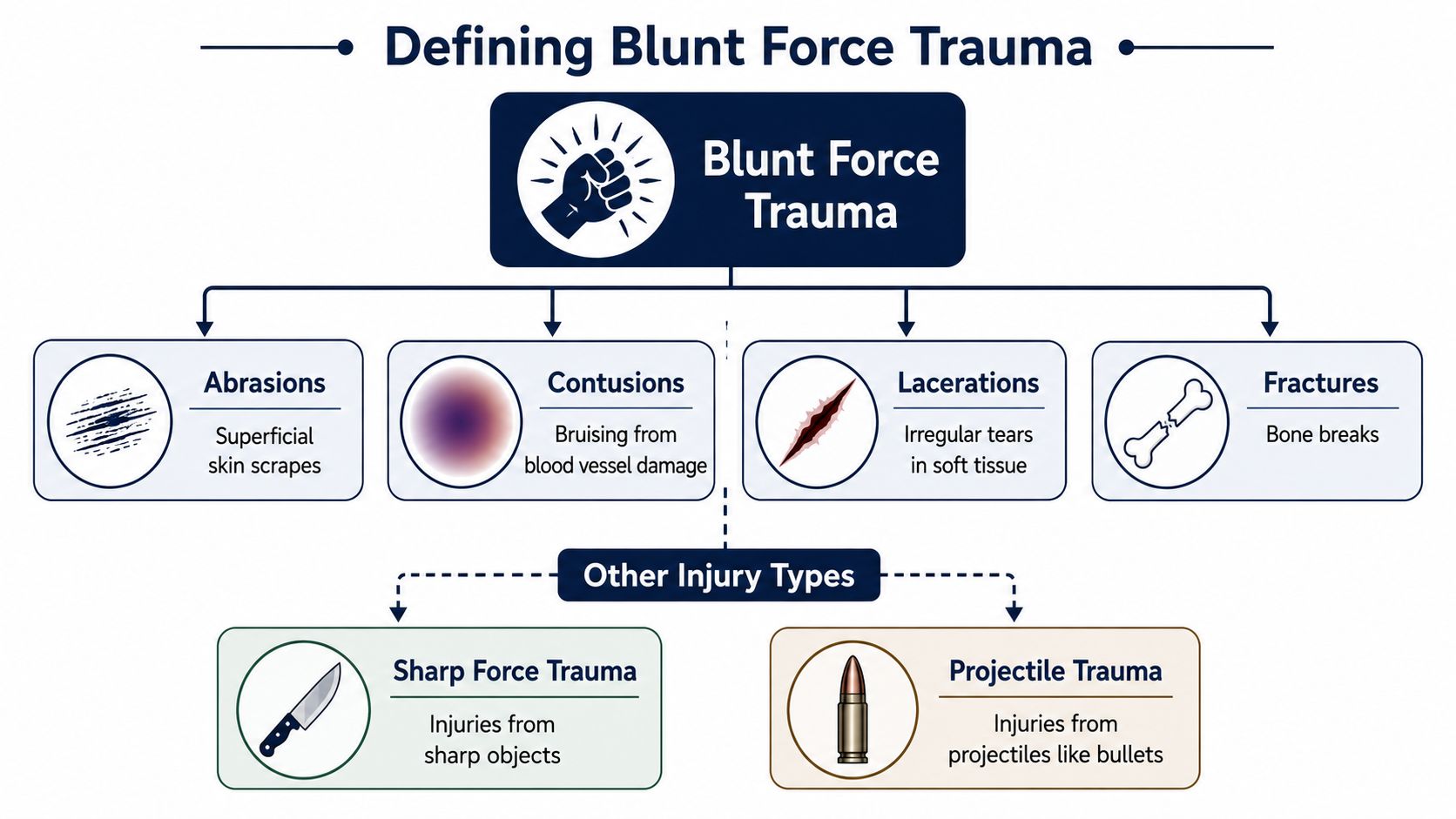
In practical terms, a blunt object transfers force by impact, compression, or bending. It does not cut in the way a knife does, and it does not behave like a high-velocity projectile. That difference affects what we expect to see in skin, soft tissue, and bone. Fractures, hematomas, and contusions result from compression and bending rather than cutting or tearing by a sharp edge.
For non-experts, a simple comparison often helps. If force is spread across a surface, the body absorbs it differently than if force is concentrated at a point. That is why two events may both involve “head trauma” but produce very different findings.
The four main injury categories
Blunt impact injuries are generally classified into four categories: contusion, abrasion, laceration, and fracture. Each category gives us different information about force, direction, contact surface, and possible sequence of events.
- Abrasion means a superficial scrape in which the skin layer is removed. Abrasions may help show contact with a rough surface and can sometimes suggest movement across that surface.
- Contusion is a bruise caused by hemorrhage in the skin and subcutaneous tissue. Contusions can indicate impact, but they still have to be interpreted in context because not every bruise points to the same mechanism.
- Laceration is an open wound caused by crushing and tearing of skin and underlying tissue. This is one of the most misunderstood terms in legal cases. A laceration is not the same thing as a cut.
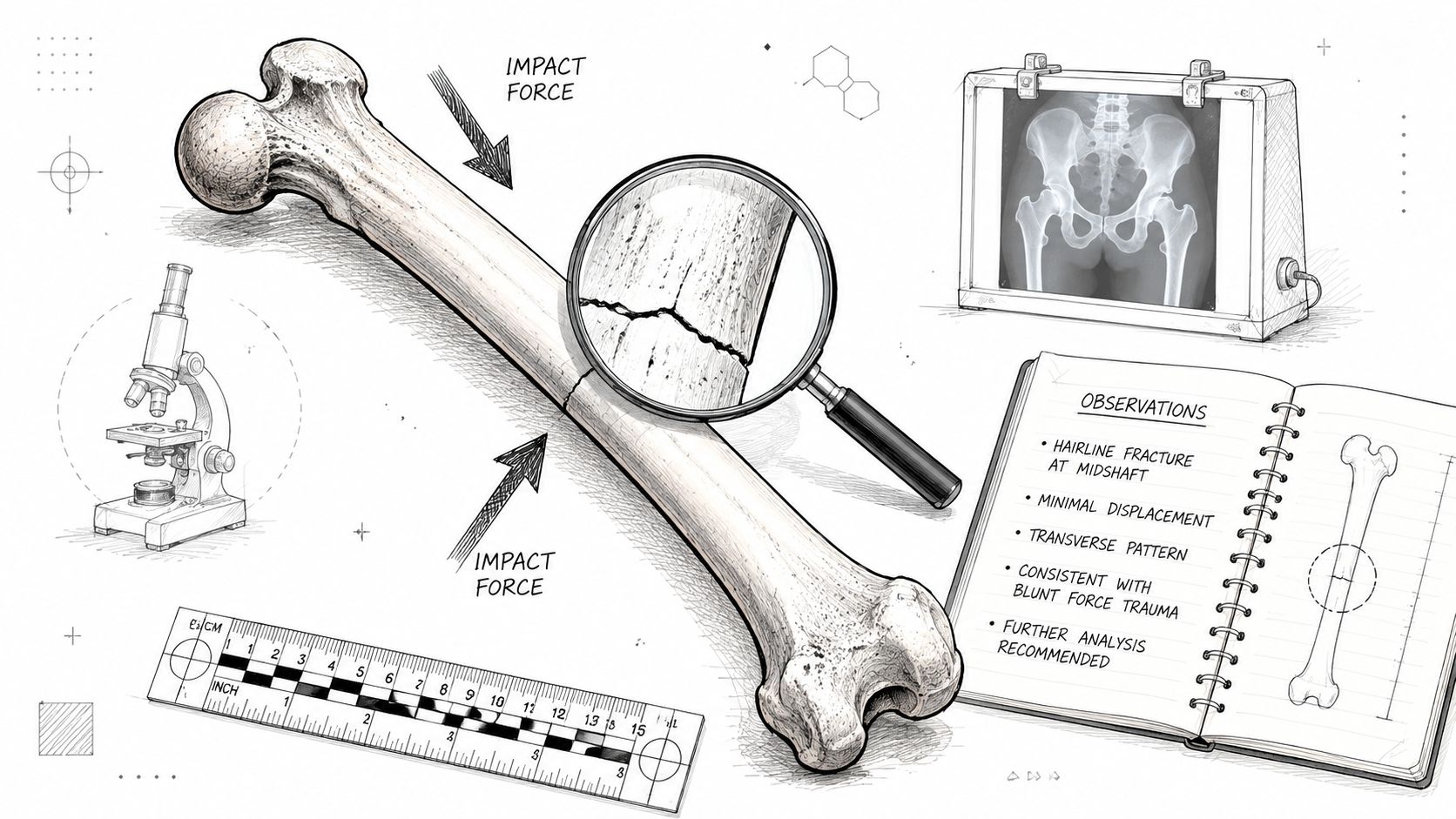
- Fracture refers to a break in bone. Fracture type, location, and pattern often provide some of the most useful biomechanical evidence in fatal trauma analysis.
A skull fracture is a good example of why mechanism matters. Verified forensic data for this topic notes that low-speed injuries involving a wider area typically produce linear fractures, while higher-speed trauma produces smaller, depressed fractures. That doesn't turn every case into a formula, but it does give the pathologist a biomechanical framework for asking whether the findings fit a fall, a crash, or an assault.
Some injuries look dramatic but tell us little by themselves. Others appear limited on the surface and become far more important once internal examination begins.
Blunt force trauma is also a major public health issue. Verified data for this article states that it is the leading cause of morbidity and mortality in patients under 35 years of age and the sixth leading cause of death worldwide. That is one reason careful postmortem evaluation remains so important in both civil and criminal matters.
The Forensic Examination A Comprehensive Workflow
A reliable opinion on blunt trauma does not come from a single bruise, a single photograph, or a single record. It comes from a workflow. Families often assume an autopsy is one event. In practice, it is a series of connected examinations and tests, each answering a different question.

For readers who want a broader overview of the full autopsy sequence, our steps to an autopsy guide outlines the process in plain language.
External examination
We begin with the body surface. That includes documenting injuries to the scalp, face, torso, limbs, and hands, as well as noting medical treatment artifacts that could affect interpretation.
This stage is not just descriptive. We assess whether injuries are patterned, whether they cluster in a way that suggests defense or restraint, and whether skin findings are consistent with the reported history. Color alone is not enough to age an injury reliably, so the external exam is only one part of timing analysis.
Internal examination
The internal examination is where blunt trauma often becomes clearer. We evaluate hemorrhage, organ injury, fractures, and deeper soft tissue damage that may not be visible externally.
Head injury cases often require especially careful correlation between scalp injury, skull fracture, intracranial bleeding, and brain findings. In forensic pathology, blunt force trauma under 100 km/h is characterized as low-velocity impact in this cranial injury forensic review. That same review discusses fracture features such as plastic deformation, delamination, concentric fracture beveling, and internal-to-external beveling as findings that help confirm external impact force.
Imaging and laboratory studies
Radiology can reveal fractures and structural injuries that are subtle on gross examination. Toxicology may be important when impairment, sedation, or medication effects could have influenced the circumstances of injury or survival after injury.
Ancillary work must also be handled with laboratory discipline. For readers interested in the safety systems behind laboratory environments, this guide to lab safety for researchers offers a practical overview of why controlled workflows matter when specimens and chemicals are handled.
Histology and timing
Microscopic examination often answers the timing questions that visual inspection cannot. According to SWGANTH trauma guidance from NIST, recent blunt force injuries within hours show acute hemorrhage microscopically, while older injuries over days to weeks show red and white blood cell degeneration, fibroblast proliferation, and hemosiderin deposition. Those markers help determine whether trauma occurred antemortem, perimortem, or postmortem.
That distinction matters in real cases. A postmortem abrasion may appear tan or yellow and parchment-like because blood flow is absent, while an antemortem abrasion shows acute hemorrhage. Fractures can also be dated by looking for callus formation and remodeling.
Why this matters: The question is often not only what injury exists, but when it happened in relation to death.
Most cases are not solved by one finding. The useful opinion comes from correlation across the entire workflow.
Evidence Documentation and The Chain of Custody
Why documentation must be exact
A forensic opinion is only as reliable as the record behind it. That is why documentation in blunt force trauma analysis must be exact from the beginning.
We create a detailed written account of injuries, their locations, measurements, and relationships to one another. We also preserve photographic documentation and diagrams when appropriate. In legal settings, precision is not a matter of style. It is what allows another physician, an attorney, a court, or a county official to understand how the conclusion was reached.
For families pursuing Private Autopsies, this matters because the written report may later be reviewed in insurance disputes, civil litigation, or criminal proceedings. A conclusion without supporting documentation may feel reassuring in the moment, but it won't hold up when challenged.
A practical comparison helps here. For attorneys building injury cases before death, this guide to documenting accident injuries shows how careful records strengthen causation arguments. Postmortem work follows the same logic, but with stricter forensic controls.
What chain of custody means
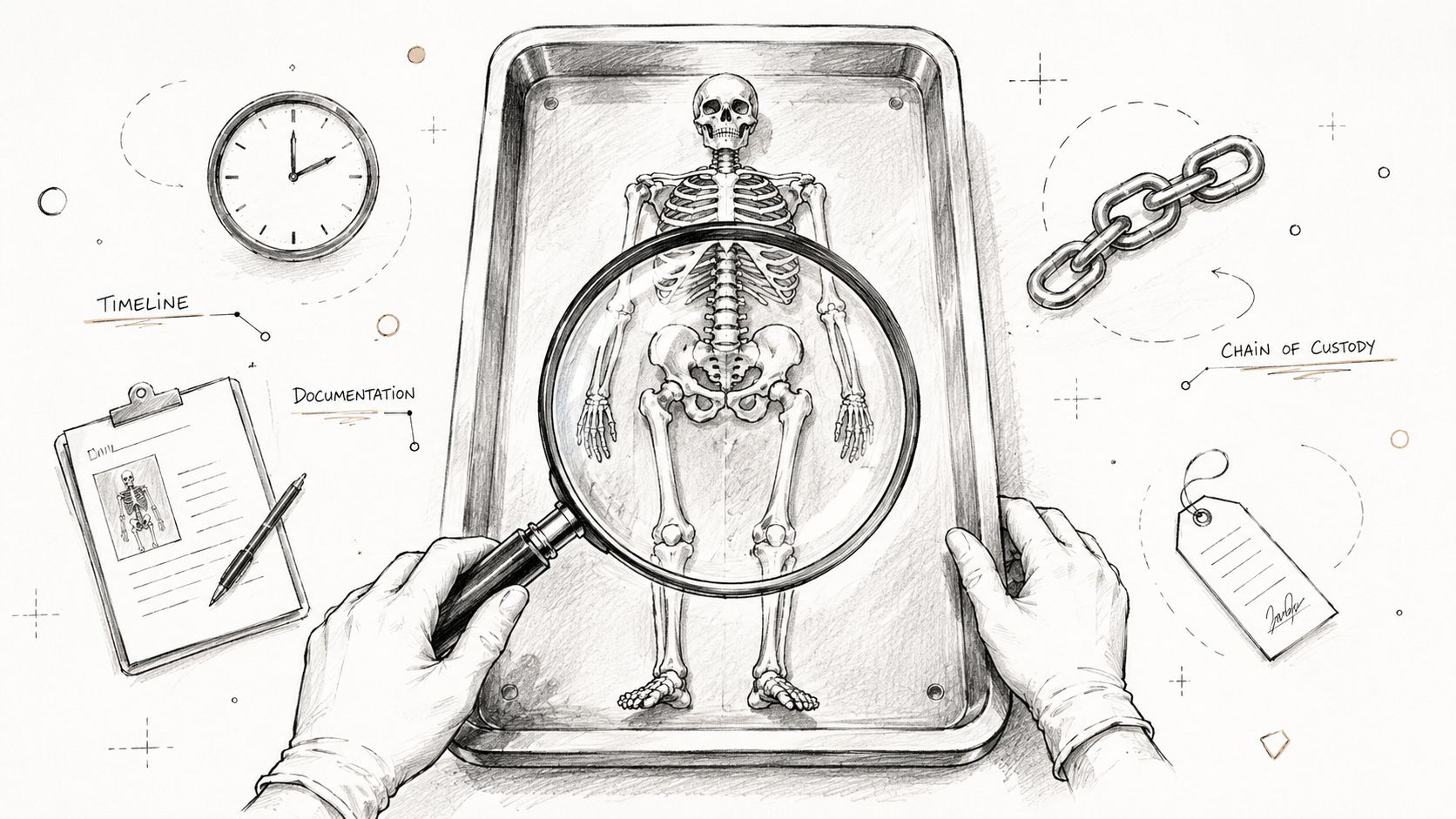
Chain of custody means the chronological record showing who handled the body, specimens, photographs, slides, and related evidence, when they handled them, and how they were secured.
Our chain of custody procedures overview explains the concept in more detail, but the plain-language point is simple. If evidence changes hands without documentation, the reliability of later opinions can be attacked.
That record protects everyone involved.
- For families: It helps ensure the examination was conducted with respect, order, and accountability.
- For attorneys: It preserves admissibility and reduces avoidable challenges to specimen integrity.
- For county officials and agencies: It supports compliance with Texas procedures and helps maintain confidence in the record.
A strong report is not just medically accurate. It is traceable from intake through final documentation.
This procedural side of forensic pathology is often invisible to the public. It should never be casual.
Interpreting Findings Common Pitfalls and Nuances
Interpretation is where many cases become difficult. Two injuries can look similar at a glance and mean very different things once bone, tissue response, healing, decomposition, or thermal damage are evaluated.
Patterned injuries and object identification
Forensic analysis of blunt force trauma relies heavily on pattern recognition. Different blunt instruments can leave distinct, measurable marks on bone. In this forensic science review on blunt weapon patterns, studies are described showing that morphometric variables, specifically the maximum diameter and depth of the injury, can differentiate between patterns produced by various blunt weapons.
In practical terms, that means we are not limited to saying “there was impact.” Sometimes the geometry of the injury helps narrow the type of object or contact surface involved. Patterned fractures such as Parry or Colles fractures may also suggest a defensive or fall-related mechanism, depending on the larger context.
Where interpretation goes wrong
The most common mistakes usually come from oversimplification.
A fall is not diagnosed because there is a head injury. An assault is not diagnosed because an injury appears severe. Mechanism requires correlation among injury distribution, fracture morphology, internal findings, scene information, medical records, and the body's tissue response.
Several problem areas deserve special caution:
| Issue | Why it matters |
|---|---|
| Decomposition | Tissue breakdown can distort injury appearance and make older trauma harder to classify. |
| Postmortem artifact | Handling, environmental pressure, scavenging, and movement after death can create changes that mimic trauma. |
| Burned remains | Heat can crack bone in ways that resemble blunt fractures unless fracture borders and hemorrhage are assessed carefully. |
| Medical intervention | Surgery, intubation, resuscitation, and transport can alter or obscure original injury patterns. |
Verified data for this topic identifies a major underserved problem in decomposed remains. A 2024 National Institute of Justice study found that 38% of perimortem blunt force classifications in decomposed skeletal remains were later reclassified as postmortem artifacts because of insufficient training on degradation signatures. That issue is especially relevant in rural Texas cases where delayed discovery changes what the body looks like by the time it is examined.
Burned bone creates another trap. Verified forensic guidance notes that thermal fractures can mimic blunt force trauma, and interpretation depends on features such as fracture border morphology and the absence of hemorrhage.
Interpretive rule: The injury pattern never stands alone. Context either strengthens the opinion or weakens it.
That is why second opinion reviews can be valuable. They are not about creating conflict for its own sake. They are about checking whether the interpretation matches the evidence.
The Final Report and Legal Considerations in Texas
Cause of death and manner of death
The final forensic report translates medical findings into conclusions that families, attorneys, agencies, and courts can use. Two terms matter most.
Cause of death is the specific injury or disease that produced death. In a blunt trauma case, that may involve cranial injury, internal hemorrhage, multiple blunt injuries, or another defined pathology supported by the examination.
Manner of death describes the circumstances category. In plain language, that usually means natural, accident, suicide, homicide, or undetermined. Cause and manner are related, but they are not the same. A person may die from blunt head trauma, but the manner still depends on whether that injury came from a fall, an assault, a crash, or circumstances that remain unclear.
When we prepare a report, we explain the findings that support both conclusions. That includes gross examination, microscopy when relevant, ancillary studies, and a discussion of limits when the evidence does not justify certainty.
Why legal framing matters
In Texas, blunt force trauma findings often affect more than the death certificate. They may shape insurance questions, civil negligence arguments, criminal charging decisions, and county death investigation procedures governed by the Texas Funeral Service Commission and the Texas Health & Safety Code, including Chapters 711, 716, and 651 where applicable.
That legal connection is one reason mechanistic clarity matters so much. Verified data for this topic states that a 2025 review of Texas state court rulings found 42% of civil negligence cases involving blunt force trauma were dismissed prematurely because plaintiffs failed to articulate the mechanistic link between the force vector and the defendant's duty of care. A good report does not argue the law, but it can provide the physical analysis needed for attorneys to connect medical facts to legal responsibility.
For county work, our reports in County Forensic Autopsies are structured to support medicolegal review within Texas requirements. For private matters, the same principle applies. The report should be understandable, medically defensible, and clear about what the evidence supports versus what remains uncertain.
The most useful forensic report does not overstate. It explains the injury, the mechanism, the limits, and the reasoning.
That restraint is part of objectivity. Families deserve honesty, even when the honest answer includes uncertainty.
When to Request an Independent Autopsy or Second Opinion
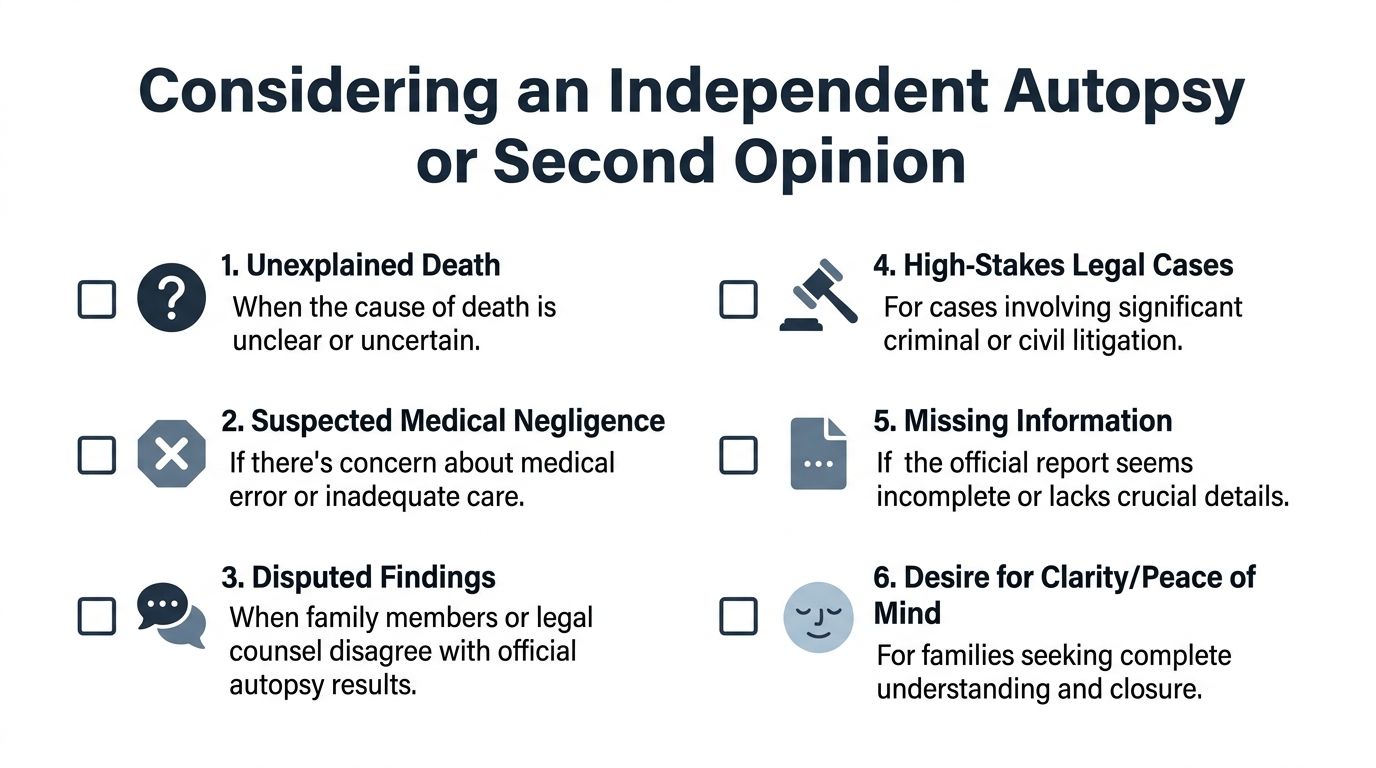
An independent review is not a challenge to every official finding. Sometimes the official conclusion is sound. Sometimes it is incomplete for the family's needs, or too general for the legal issues that follow. The question is whether more analysis would materially help.
Situations that justify an independent review
Certain patterns make a second opinion more useful.
- Unclear official conclusion: If cause or manner of death is listed as undetermined, the family or attorney may need a more detailed review of injuries, records, and context.
- Mismatch between history and findings: Reported circumstances may not seem to fit the injury pattern, especially in unwitnessed falls, vehicle incidents, or suspected assaults.
- Anticipated litigation: Civil and criminal cases often require a more explicit mechanism analysis than a short summary report provides.
- Questions about timing: Cases involving delayed discovery, prior injuries, or treatment before death often require microscopic review and careful chronology.
- Concerns about postmortem artifact: This is especially important in decomposed or environmentally exposed remains.
- Need for a records-based review: Sometimes the body is no longer available, but the existing autopsy, photographs, imaging, and medical records can still be evaluated.
For readers considering that step, our review my case page outlines what materials are most useful at intake.
What families and attorneys can expect
An independent autopsy or second opinion should be structured, not adversarial. We start by clarifying the question. Is the issue identification of trauma, timing, causation, discrepancy review, or report interpretation for legal use?
From there, the process may include:
- Record collection including medical records, scene information, and prior autopsy materials.
- Body examination or record review depending on whether an autopsy is still possible.
- Ancillary testing such as histology, imaging, or toxicology when appropriate.
- Written conclusions that define cause of death, manner of death, and the medical basis for those opinions.
When service logistics matter, families often need practical answers as much as medical ones. Texas Autopsy Services provides independent private autopsy and forensic pathology services across all 254 Texas counties, with in-house licensed transport, direct team communication, and detailed reporting. We also work closely with partners such as Waterloo Mortuary Partnership when coordination is needed around postmortem care and next steps.
Most cases are completed within 24 to 48 hours, although the final timeline depends on factors such as transport, records availability, tissue studies, and laboratory testing. That is not a guarantee. It is the typical range for many cases, not all of them.
For families, seeking another review is often about certainty. For attorneys, it is often about whether the medical evidence has been stated clearly enough to support the case theory. Both are legitimate reasons to ask for help.
Frequently Asked Questions About Blunt Force Trauma Analysis
Can blunt force trauma analysis tell the difference between a fall and an assault
Sometimes yes, sometimes not with certainty. The answer depends on the full pattern of injuries, fracture type, internal findings, records, and scene context. A single bruise or fracture is rarely enough by itself.
What is the difference between cause of death and manner of death
Cause of death is the medical reason a person died, such as a specific injury or disease. Manner of death is the circumstances category, such as accident, homicide, suicide, natural, or undetermined.
What does chain of custody mean in an autopsy case
It is the documented history of who handled the body, specimens, and related evidence from collection through reporting. It helps preserve reliability and legal defensibility.
Is a private autopsy appropriate if an official autopsy has already been done
Yes, in some cases. A second opinion autopsy may involve review of the prior report, photographs, slides, imaging, toxicology, and medical records. If the body is still available, an additional examination may also be possible depending on timing and legal circumstances.
How quickly can answers be available
Initial findings may be available before all laboratory work is complete. Many cases are finished within 24 to 48 hours, but timing depends on transport, record collection, toxicology, histology, and case complexity. We do not treat that range as a promise in every matter.
Is this medical advice
No. Postmortem forensic analysis is not medical advice and does not replace treatment guidance for living patients. It is a structured examination used to determine cause of death, manner of death, and injury mechanism after death.
If you need help understanding whether an independent autopsy, second-opinion review, or blunt force trauma analysis is appropriate, contact Texas Autopsy Services. We'll explain the process clearly, discuss the available options, and treat your questions with the seriousness and respect they deserve.