August 3, 2026 · Texas Autopsy Services
Sudden Infant Death Syndrome: A Guide for Families
Learn about sudden infant death syndrome, its risk factors, safe-sleep practices, and forensic investigation to bring clarity to affected families.
On this page
- What Sudden Infant Death Syndrome Actually Means
- Understanding Risk Factors and the Triple-Risk Model
- Safe Sleep Guidance and Real-World Prevention
- How Forensic Pathologists Investigate Sudden Infant Deaths
- When a Private or Second-Opinion Autopsy Makes Sense
- What Families and Attorneys Can Expect from the Process
- Next Steps and Resources for Families Seeking Answers
A baby can be found unresponsive after a sleep period that seemed ordinary the night before. Parents, relatives, and investigators are left with the same difficult need, a clear explanation of what happened, what was ruled out, and what the record can responsibly say. Sudden infant death syndrome sits at the center of that search for answers, but it is only one part of a broader medicolegal and public-health picture.
Families often hear the term long before they understand how it is used in an autopsy report. In forensic practice, the label is not a shortcut. It is a conclusion reached only after a complete investigation, and that distinction matters for grief, for legal review, and for honest communication.
What Sudden Infant Death Syndrome Actually Means
A family may hear that an infant death was “unexpected” long before they hear the word SIDS. In forensic medicine, that term does not mean a guess, and it does not mean the case was left unfinished. It means the death remained unexplained after a complete investigation, including a complete autopsy, review of medical and clinical history, and a death-scene investigation, which is the standard definition used by the National Institute of Child Health and Human Development (NICHD factsheet).
The historic standard for this kind of review dates back to the 1969 NIH consensus conference, which described SIDS as the sudden death of an infant or young child that is unexpected by history and for which a thorough postmortem examination fails to find an adequate cause of death (NIH consensus history). That framework still shapes modern death investigation. It is one reason forensic pathologists treat SIDS as a diagnosis of exclusion, not a single disease with one visible lesion.
A SIDS determination depends on what the investigation finds, and just as important, what it rules out.
Why the label matters in practice
Families sometimes assume a natural-appearing death needs no further explanation. In reality, the label can only be used when the evidence supports it. That is why careful autopsy, scene review, and medical history review are central to a defensible conclusion.
The distinction is important for attorneys and investigators too. A report that uses SIDS should reflect a completed process, not a shortcut around uncertainty. When the underlying facts are incomplete, the final wording may be different, and that difference has real legal and emotional consequences.
SIDS also sits within a broader system of sudden unexpected infant death classification. The same death can be described differently depending on how the autopsy, scene findings, and history fit together. That is why precise terminology matters, especially when families are comparing one report with another or trying to understand why two cases that look similar on the surface are not labeled the same way.
Understanding Risk Factors and the Triple-Risk Model
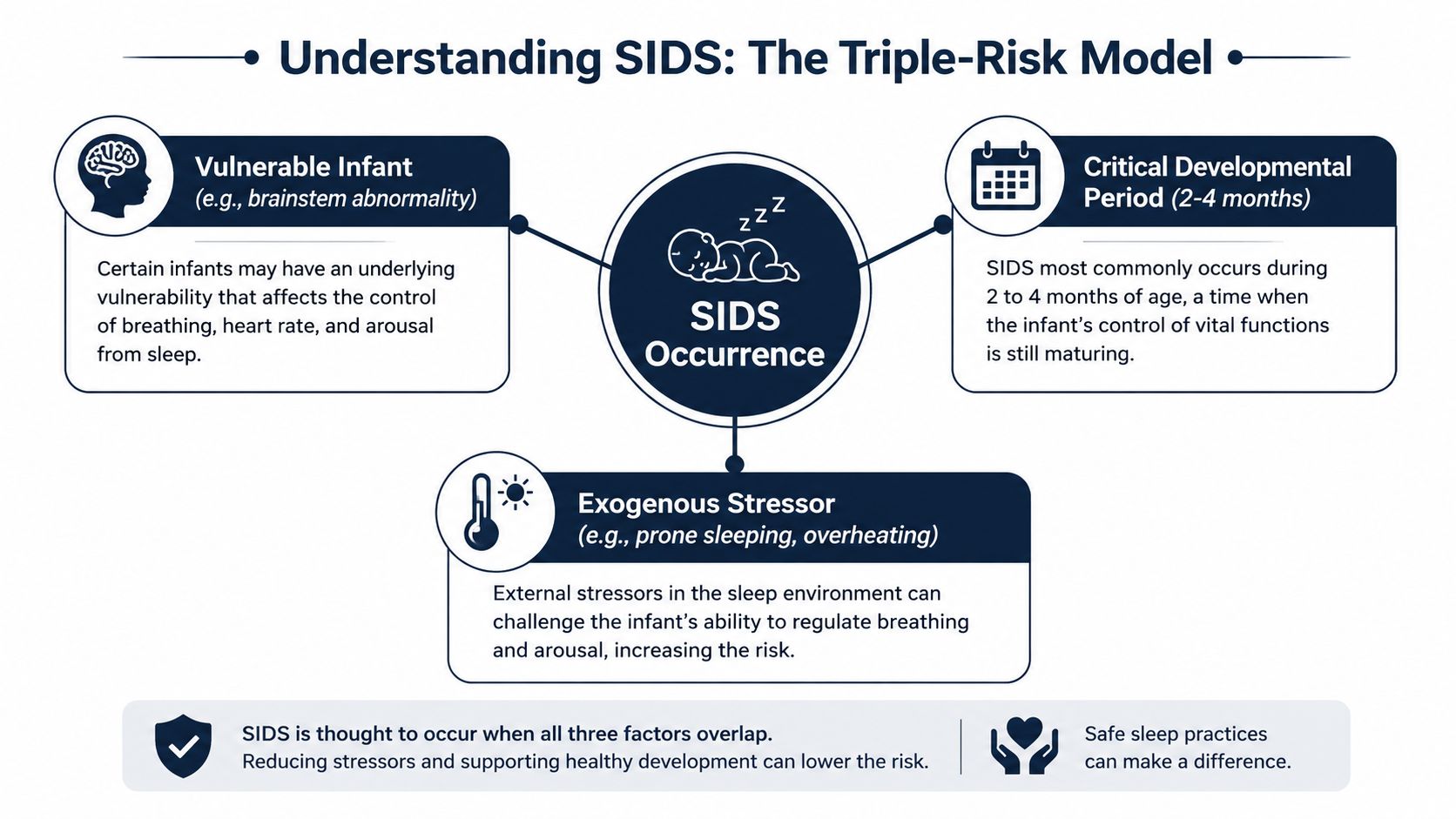
SIDS is best understood through the triple-risk model, which combines three conditions, a vulnerable infant, a critical developmental window, and an external stressor (triple-risk review). The model helps explain why a baby can appear healthy and still be at risk during sleep. It also helps forensic pathologists think beyond one cause and look at how multiple factors may have overlapped.
In the United States, the CDC reported about 3,700 SUID deaths in 2022, including 1,529 classified as SIDS, 1,131 as unknown causes, and 1,040 as accidental suffocation and strangulation in bed. The same CDC data show that SUID occurred at a rate of 100.9 deaths per 100,000 live births in 2022, and SIDS accounted for 41% of SUID deaths that year (CDC data). Those figures matter because they show that SIDS is not the whole category. It is one part of a larger medicolegal classification system.
The triple-risk model
The vulnerable period is roughly 1 to 6 months, with the highest risk between 1 and 4 months and a peak at 2 to 4 months (CDC data, triple-risk review). In that window, a sleep-related stressor such as prone sleep position, overheating, soft bedding, or smoke exposure can overwhelm immature breathing and arousal control. That does not mean a single factor explains every case. It means the infant's developmental stage can make ordinary stressors far more dangerous.
Neuropathology work points to brainstem respiratory-control dysfunction rather than a purely external mechanism, and autopsy literature notes that no single pathognomonic lesion defines SIDS (StatPearls review). That is why the investigation must be broader than a search for visible trauma alone. It may also need infection, metabolic, and genetic testing when the history or findings point that way.
Practical rule: a normal-looking infant can still have hidden vulnerability, so the sleep environment and the full medical context matter.
Why the broader SUID category matters
SUID trends can change when certification practices change. The CDC data show how SIDS sits inside a larger forensic system, not outside it. Global work shows the same pattern on a wider scale, with SIDS deaths falling from 74,782 in 1991 to 30,608 in 2021, and the global mortality rate declining from 58.72 to 24.16 per 100,000 infants. That analysis also reported an estimated annual percentage change of about -3.07% across the period (global burden analysis).
Public health messaging often focuses on the sleep surface, and that advice matters. But research priority work has also pointed to the need to understand the biological mechanism of death, identify biomarkers that help pathologists determine cause of death, and improve data collection and sharing (research priorities). Those unanswered questions are part of why a careful forensic process still matters after prevention guidance has been given.
Safe Sleep Guidance and Real-World Prevention
Safe sleep advice is straightforward in principle and hard in practice. The core steps are widely repeated because they address known risks, not because they guarantee a specific outcome. In plain terms, families are trying to reduce the chance that a vulnerable infant will face a stressor during sleep.
The research record also shows that risk does not sit evenly across populations. Recent U.S. data reported sudden unexpected infant death rates rising from 89.9 to 100.5 per 100,000 between 2020 and 2022, with the highest rates in American Indian or Alaska Native, Black, and Native Hawaiian or Other Pacific Islander infants (PubMed review). That matters because prevention advice has to be usable in real homes, not only in ideal settings.
Practical steps that reduce risk
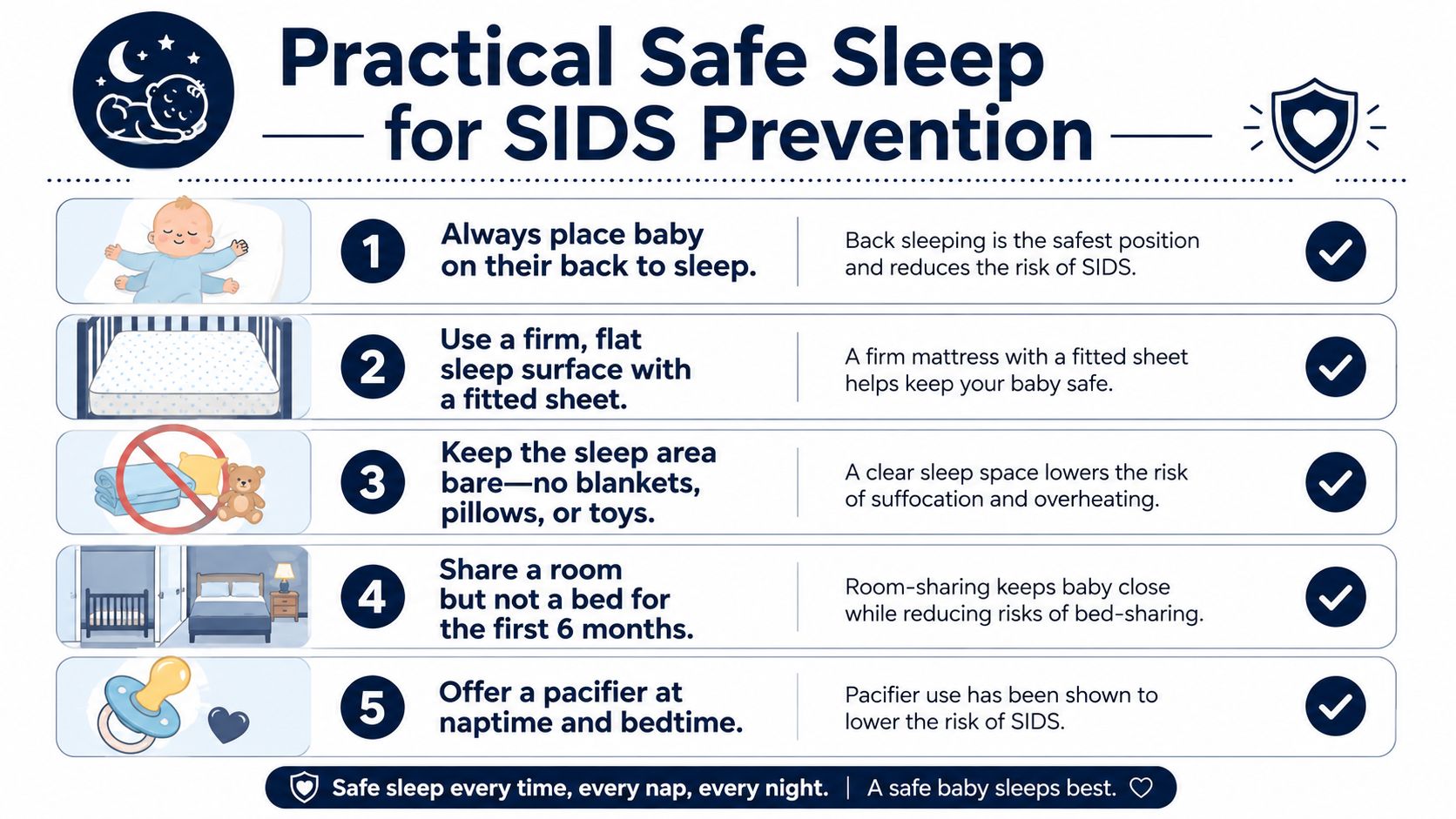
The most consistent guidance stays centered on the sleep environment:
- Back sleeping: Place the baby on the back for every sleep.
- Firm surface: Use a firm, flat sleep surface with a fitted sheet.
- Bare sleep area: Keep blankets, pillows, and toys out of the sleep space.
- Room sharing: Share a room, but not a bed, for the first 6 months.
- Pacifier use: Offer a pacifier at naptime and bedtime if the family uses one.
These steps line up with the broader evidence base on sleep safety. They are also the kinds of details that matter in a postmortem review, because the sleep surface and surrounding environment can be part of the death-scene record.
Why advice has to fit real households
The right advice can still be hard to follow if a family lacks a safe crib, has limited space, or is dealing with exhaustion, shifting work schedules, or shared caregiving. Research on SUID has emphasized that social context matters, including poverty, historical trauma, access to prenatal care, smoking cessation support, and breastfeeding support (PubMed review). That doesn't replace safe sleep guidance. It explains why simple slogans often miss the actual barriers families face.
Safe sleep works best when the recommendation matches the household's reality, not just a perfect checklist.
The same review also notes that topics such as prenatal care, smoking, alcohol or drug use, and vaccination are discussed less often than bedding or sleep position, even though they are part of evidence-based prevention (PubMed review). Families deserve the full picture. A single rule is rarely enough to describe the whole risk environment.
How Forensic Pathologists Investigate Sudden Infant Deaths
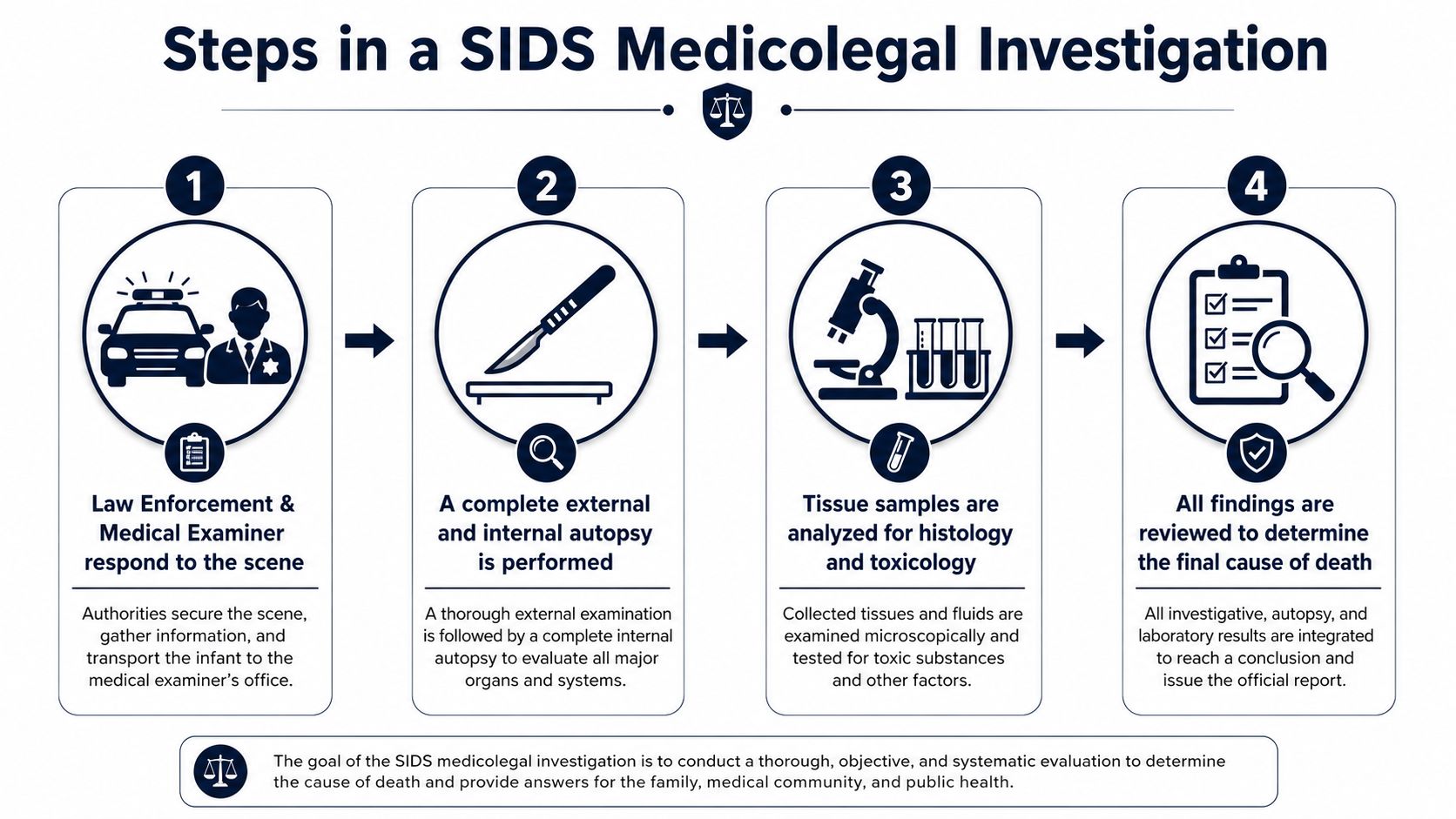
When an infant dies unexpectedly, the medicolegal response has to be complete. A forensic pathologist doesn't just ask what the body shows. The work also includes the scene, the medical history, and any testing that may explain why the death occurred when it did.
This process becomes especially important for families and attorneys. SIDS is a diagnosis of exclusion, and that means the final conclusion depends on disciplined fact gathering. If the death appears unexplained after complete review, the report may use SIDS. If the findings point elsewhere, the classification changes.
Cause of death and manner of death
Cause of death is the injury or disease that led to death. Manner of death is the category used to describe how that death came about, such as natural, accident, homicide, suicide, or undetermined. In infant death work, those two terms are not interchangeable, and confusing them can lead to serious misunderstanding.
The autopsy literature is clear that there is no single pathognomonic lesion for SIDS (StatPearls review). That means a forensic pathologist has to build the conclusion from the full picture, not one tissue slide or one scene detail. The strongest mechanistic evidence points toward brainstem respiratory-control dysfunction, but that does not remove the need to look for infection, metabolic disease, or genetic contributors when the case warrants it.
The same review reports that about 95% of SIDS cases have at least one recognized risk factor and 78% have at least two (StatPearls review). That supports a multifactorial model rather than a single-cause explanation.
Why the medical record and scene matter
A complete investigation includes the death scene, clinical history, and autopsy findings working together. The CDC and NICHD definitions both make that clear (CDC data, NICHD factsheet). The sleep setting, recent illness, and possible exposures all help determine whether the infant had a plausible trigger during the critical developmental period.
Chain of custody also matters. Every specimen, image, and reportable finding has to be accounted for from collection through analysis and final reporting so the record can be defended later if needed. In legal cases, that documentation is often as important as the final diagnosis itself.
A useful working rule is simple.
If the scene, history, and autopsy do not agree, the conclusion needs more review, not less.
For a closer look at how a broader medicolegal death review is handled, see our overview of forensic investigation services.
When a Private or Second-Opinion Autopsy Makes Sense
A county report can answer many questions, but not every family feels the questions are fully resolved when it arrives. That's where an independent review can help. A private autopsy or second-opinion autopsy may be appropriate when the official findings leave uncertainty, when the cause of death remains contested, or when legal review requires more detail than the initial investigation provided.
The difference is not about replacing public authorities. It is about whether another qualified forensic review could add clarity. Families often seek that second look after they've read the report, spoken with counsel, or reviewed the scene and medical history with new concerns in mind.
When another review adds value
A second opinion can be useful when:
- The conclusion is unclear: The report leaves open questions about whether the death was fully explained.
- The legal record matters: Litigation may need an independent, court-admissible opinion.
- The family wants detail: The initial report may be accurate but still too brief to answer practical questions.
- Medical issues were complex: Prematurity, illness, prior treatment, or other conditions may need a deeper forensic look.
There's also a practical difference between a county-conducted autopsy and an independent examination. A county process is tied to the jurisdiction's medicolegal authority. An independent review is separate, and it can be especially helpful when families or attorneys need another set of eyes on the medical evidence. For readers weighing that choice, our case review guidance explains the kinds of records that usually matter most.
Why independence matters
Objectivity is the core value here. An independent examination should not start with a conclusion and work backward. It should follow the evidence where it leads, with the report written in plain, defensible language.
Texas law also frames how these services operate, including the Texas Funeral Service Commission rules and Texas Health & Safety Code Chapters 711, 716, and 651. Those statutes shape the legal environment around death care and forensic work in the state. Families and attorneys don't need to memorize the code, but they do need to know that the process is governed by law, not informal practice.
What Families and Attorneys Can Expect from the Process
The first call usually comes during a hard, disorienting period. In that moment, families want to know who will answer, what happens next, and how quickly they'll get information. Attorneys want the same core facts, plus a clear chain of custody and a report that can stand up in a legal setting.
A good independent autopsy process starts with direct communication. The team should gather the case history, explain what records are needed, and outline how transport and examination will be handled. From there, the work becomes methodical. A complete report typically draws together gross examination, microscopic study, and any additional testing that the case requires.
What the process usually involves
The exact path depends on the case, but the sequence is usually straightforward:
- Initial review of records and circumstances. Medical history, scene details, and any available prior reports are gathered.
- Transport and custody documentation. The body and related materials are handled under documented control.
- Autopsy and testing. External and internal examination may be paired with histology, toxicology, or other studies.
- Written findings. The final report explains the cause of death determination and the reasoning behind it.
Turnaround depends on the evidence, and no honest practice should promise a result before the testing is done. Some cases are resolved faster than others. If family members are managing legal and funeral tasks at the same time, they may also want a practical wrongful death compensation options resource from Porter Law Group, especially when questions about liability are part of the larger record.
Confidentiality and report use
Families often ask whether the process is private. The answer should be yes, with proper handling of records and HIPAA-compliant communication where applicable. Attorneys often ask whether the findings can be used in court. The answer depends on the case, the qualifications of the examiner, and the quality of the documentation, which is why the chain of custody and the clarity of the report matter so much.
For medical-legal work, a careful report does more than name a cause. It shows how the conclusion was reached. That is what makes the record useful for both closure and litigation.
Next Steps and Resources for Families Seeking Answers
A family sitting with an unexplained infant death usually needs two things at once, facts and steady guidance. The first practical step is to gather records, including any hospital notes, emergency response information, and the official autopsy or investigative paperwork. Those documents help a forensic pathologist see whether the case was fully evaluated or whether a second opinion could clarify something important.
For legal and estate matters, it can also help to keep a simple checklist of immediate responsibilities. A Texas death legal checklist from the Law Office of Bryan Fagan, PLLC can be a useful companion when families are trying to manage practical tasks while grieving. If genetic questions are part of the case, our genetic testing after death resource explains why that testing sometimes becomes relevant in unexplained infant death work.
A second step is to speak with a forensic pathology practice that can review the case confidentially and explain the options without pressure. That conversation should be plainspoken, respectful, and focused on the record, not on assumptions. Families deserve answers that are medically sound and legally defensible, even when the final conclusion is difficult to hear.
Texas Autopsy Services provides independent private autopsy and forensic pathology support for families, attorneys, and county officials who need careful answers after an infant death. Our board-certified forensic pathologists handle these cases with clarity, dignity, and full attention to the medical and legal record. If you need help understanding a sudden infant death case, visit Texas Autopsy Services to speak with our team.