September 16, 2026 · Texas Autopsy Services
Trauma Center Second Opinion Review What to Know
Learn how a trauma center second opinion review works, who requests it, what it uncovers, and how an independent forensic pathology review adds clarity

On this page
- What a Trauma Center Second Opinion Review Actually Is
- How Trauma Quality Review Is Structured
- When a Second Opinion Review Changes the Picture
- Internal Peer Review Versus an Independent Forensic Review
- How an Independent Review Request Moves Through Texas Autopsy Services
- What the Evidence Actually Shows About Second Opinion Reviews
- What to Ask Before You Retain an Independent Reviewer
A family may receive a trauma center death summary that lists hemorrhagic shock as the cause of death while an attorney notices that the documented timeline doesn't seem to match the imaging. That situation creates a difficult but important question: did the original record fully explain what happened, or could another qualified reviewer identify a different injury, complication, or sequence of events?
A trauma center second opinion review provides an independent examination of the available evidence after a serious injury or trauma death. It can confirm the original conclusions, clarify an unresolved question, or identify a discrepancy that matters to the family, a legal case, or a public agency. The review should be precise, transparent, and honest about its limits.
- A second opinion review is an independent assessment, not a second surgery.
- The reviewer may examine records, imaging, autopsy materials, histology slides, toxicology, and investigative documentation.
- Trauma centers already use layered internal quality-review systems, but an external review comes from outside the treating institution.
- Published trauma imaging data show that second interpretations can change management in a meaningful subset of transferred patients.
- A review can confirm the original cause of death, but confirmation can still provide important clarity.
- Texas Autopsy Services provides independent forensic pathology reviews for families, attorneys, healthcare professionals, and county officials throughout Texas.
What a Trauma Center Second Opinion Review Actually Is
A trauma center second opinion review is an independent forensic assessment of a trauma case after the original treatment or death investigation. Our board-certified forensic pathologists review the existing evidence without being part of the treating team that performed the resuscitation, surgery, imaging interpretation, or original postmortem examination.
The reviewer may begin with the emergency department record, ambulance documentation, vital signs, laboratory results, operative notes, nursing records, radiology reports, and the actual imaging when available. If an autopsy was performed, the review can also include the autopsy report, photographs, histology slides, toxicology findings, and other supporting materials.
What the reviewer is trying to answer
The central question depends on the request. A family may want to know whether the stated cause of death is supported by the evidence. An attorney may ask whether the injury pattern is consistent with the reported event, whether an injury was overlooked, or whether the timeline supports a proposed explanation.
A forensic review differs from a clinical second opinion. A clinical reviewer advises a living patient about diagnosis or treatment. A forensic pathologist evaluates postmortem findings and medical-legal evidence, then explains how those findings support or fail to support conclusions about cause and manner of death.
Practical distinction: A second opinion reviews the evidence. It doesn't automatically replace the original opinion.
The process usually produces a written report that addresses specific questions from the family, attorney, county official, or other authorized requester. It may state that the original conclusion is supported, that the evidence is incomplete, or that an amended interpretation deserves consideration. It isn't a second surgery, and it isn't automatically a re-autopsy. A new examination of the body requires separate authorization and depends on the condition and availability of the remains.
Families often need a plain-language explanation of the difference between cause of death, the injury or disease that led to death, and manner of death, the classification describing how the death occurred, such as accident, homicide, suicide, natural causes, or undetermined. A reviewer may evaluate both, but the available evidence and the governing authority determine what can responsibly be concluded. Our medical review resource explains how a structured review can organize complex medical records without assuming that a disagreement must exist.
How Trauma Quality Review Is Structured
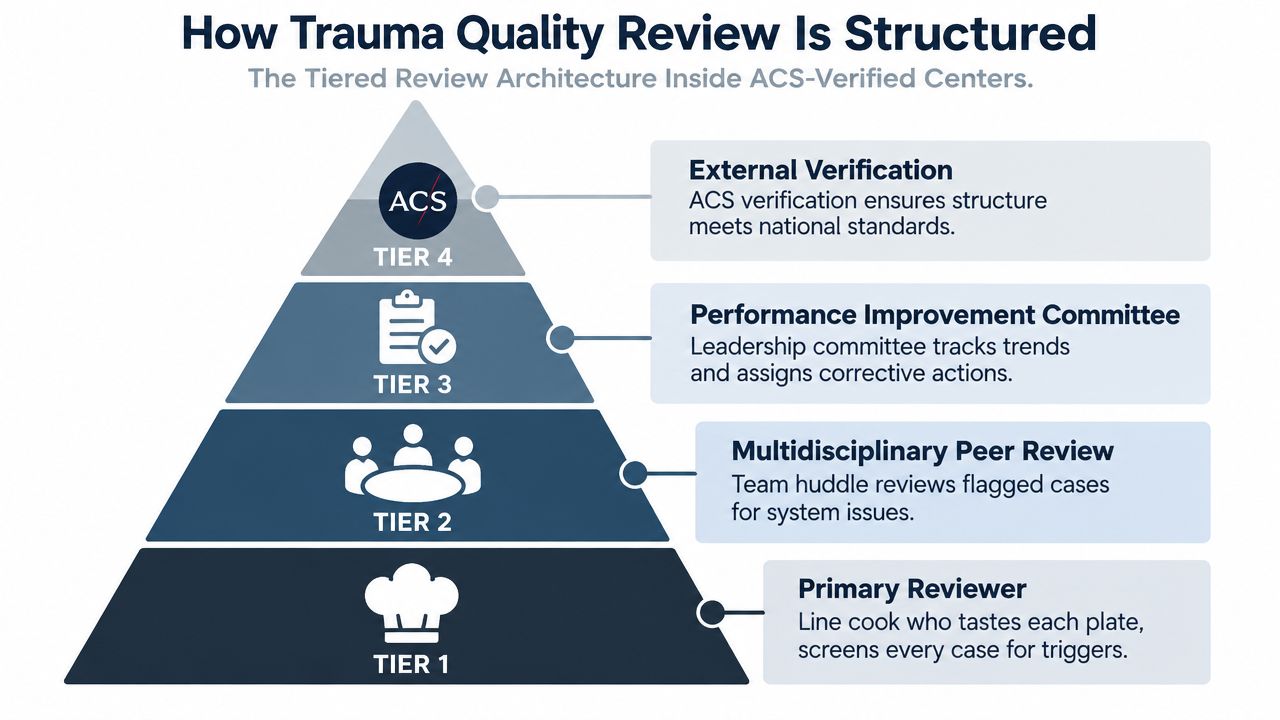
A trauma case may pass through several review points before a program decides whether a concern needs corrective action. The structure grew from national standards for trauma resources, verification, and registry-based improvement. In 1976, the American College of Surgeons Committee on Trauma published the first edition of Optimal Hospital Resources for Care of the Seriously Injured and established Level I through Level IV trauma-center standards. A formal verification process followed in 1987. The first trauma registry had been developed at Cook County Hospital in 1973, and by 1986, trauma registries were required for Level I and II centers. The history of trauma systems and registries explains why trauma review depends on defined resources, onsite verification, and recorded outcome data.
The process works like quality control in a professional kitchen. A line cook checks each plate at the station. A sous chef examines problems that do not fit the expected pattern. An executive chef studies recurring issues across the kitchen and assigns corrective steps. Trauma programs use a comparable progression, with each level asking a broader question.
The internal review levels
- Primary review: A trauma attending, registry professional, or designated reviewer screens cases for triggers such as death, complication, delayed response, or an unexpected outcome.
- Secondary review: The trauma medical director or designee examines the records and decides whether the concern needs broader analysis.
- Tertiary review: A multidisciplinary peer-review group, morbidity-and-mortality conference, or performance-improvement committee evaluates the case and considers whether the documented care met the applicable standard.
- Loop closure: The program records the result, closes the case, or escalates it for corrective action, education, protocol changes, or continued monitoring.
Registry data can reveal patterns such as delayed team activation, prolonged emergency-department stays, or delayed physician presence. ACS guidance also addresses complete and timely registry abstraction. One published ACS-related benchmark sets completion of registry records within 2 months of discharge at 80%. ACS trauma standards describe the formal requirements. A GLP compliance guide from Herbilabs offers related background on documentation and quality practices in laboratory settings.
An independent forensic review sits outside this institutional sequence. It does not redo the hospital's peer review. It examines the records, imaging, autopsy findings, and other medical-legal evidence from outside the trauma center's reporting chain. In some cases, that review identifies a gap. In others, it confirms that the trauma team's documented findings and conclusions are consistent with the available evidence.
When a Second Opinion Review Changes the Picture
Second-opinion review matters most when the original record contains a clinically significant discrepancy. In one level-one trauma-center transfer population, outside imaging rereads found at least one discrepancy in 12% of cases. Those discrepancies changed the treatment plan in 92% of affected patients, and 81% of those patients needed an extended emergency-department stay. The reported trauma imaging findings illustrate that an outside interpretation can alter care after transfer.
A separate second-opinion CT review found inconsistent reports in about 8% of cervical-spine CT scans. The over-read confirmed positive findings in 29% of cases, reassured clinicians about negative findings in 63%, cleared a false diagnosis in 3%, and detected a missed diagnosis in 5%. These results don't mean every trauma scan contains an error. They show why a second interpretation can be valuable when the clinical picture and the initial report don't align.
Where changes can occur
| Review domain | Documented discrepancy finding | What may change |
|---|---|---|
| Outside imaging reread after trauma transfer | 12% had at least one discrepancy, with management changed in 92% of affected patients | Treatment plan, observation, consultations, or length of emergency-department stay |
| Cervical-spine CT over-read | About 8% had inconsistent reports | Confirmation, removal of a false diagnosis, or detection of a missed diagnosis |
| Postmortem forensic review | No single universal rate applies to every trauma program | Cause of death, manner of death, injury mechanism, or confidence in the original conclusion |
For a deceased pedestrian, the original trauma summary might attribute death to head injury after a short resuscitation. An independent reviewer could find that the imaging, operative notes, and autopsy findings point more strongly to an unrecognized aortic injury, or could identify a procedural complication that requires careful evaluation. That example illustrates a possibility, not a conclusion about any specific case.
Most reviews confirm at least part of the original work. That confirmation still has value when the family needs a documented explanation. A careful report separates established findings from interpretation, identifies missing evidence, and avoids changing the cause of death because another explanation seems possible.
Internal Peer Review Versus an Independent Forensic Review
A hospital's internal peer review and an independent forensic review may examine the same death, yet they serve different purposes. Internal reviewers ask whether the trauma system responded appropriately and what the institution should improve. An independent reviewer asks whether the medical records, imaging, and postmortem evidence support the conclusions already documented.
A direct comparison
| Dimension | Internal peer review | Independent forensic review |
|---|---|---|
| Initiator | Trauma program, registry process, medical director, or performance-improvement committee | Family, attorney, authorized official, hospital, or other permitted requester |
| Reviewers | Trauma physicians, nurses, radiologists, registry staff, and peer-review participants within the program | A forensic pathologist outside the original treating chain |
| Primary scope | System performance, response times, complications, deaths, and corrective action | Cause of death, manner of death, injury interpretation, autopsy findings, imaging, and record consistency |
| Main audience | Hospital leadership and the trauma program | Family, counsel, agency, court, insurer, or requesting institution |
| Deliverable | Internal quality findings, action items, and loop closure | Written report explaining opinions, evidence, limitations, and rationale |
| Independence | Connected to the institution that provided care | Separate from the institution that conducted the resuscitation or original examination |
Internal review can include deaths, complications, sentinel events, response thresholds, and corrective actions. Its working question resembles an inspection of the entire bridge: did the system, team, and handoffs function as expected? The resulting findings generally guide hospital leadership and the trauma program rather than provide an outside opinion for a family or court.
An independent forensic review examines the case from outside that institutional process. The reviewer may compare emergency and operative notes with imaging, toxicology, autopsy findings, photographs, and the stated cause and manner of death. The task is not to criticize every imperfect outcome. It is to distinguish documented fact from interpretation, identify missing or conflicting evidence, and explain whether the original conclusion remains supported.
That distinction matters when a family or attorney requests an independent look. The report may identify an overlooked injury, clarify how several findings fit together, or confirm that the trauma team's documented explanation is consistent with the available evidence. Confirmation is still useful when the family needs a clear, independent account.
An external report may support a litigation matter, insurance claim, family conference, or request to reconsider a death investigation. Its legal treatment depends on the engagement's purpose, jurisdiction, and applicable privilege or discovery rules. Counsel should address those questions directly rather than assume that every medical review receives the same protection.
The Nares Law Group IME guide provides related background on independent medical examinations. A hospital mortality review overview further explains the internal pathway. Texas Autopsy Services can use that distinction to frame a review: internal peer review examines the originating system, while independent forensic review tests the explanation from outside it.
How an Independent Review Request Moves Through Texas Autopsy Services
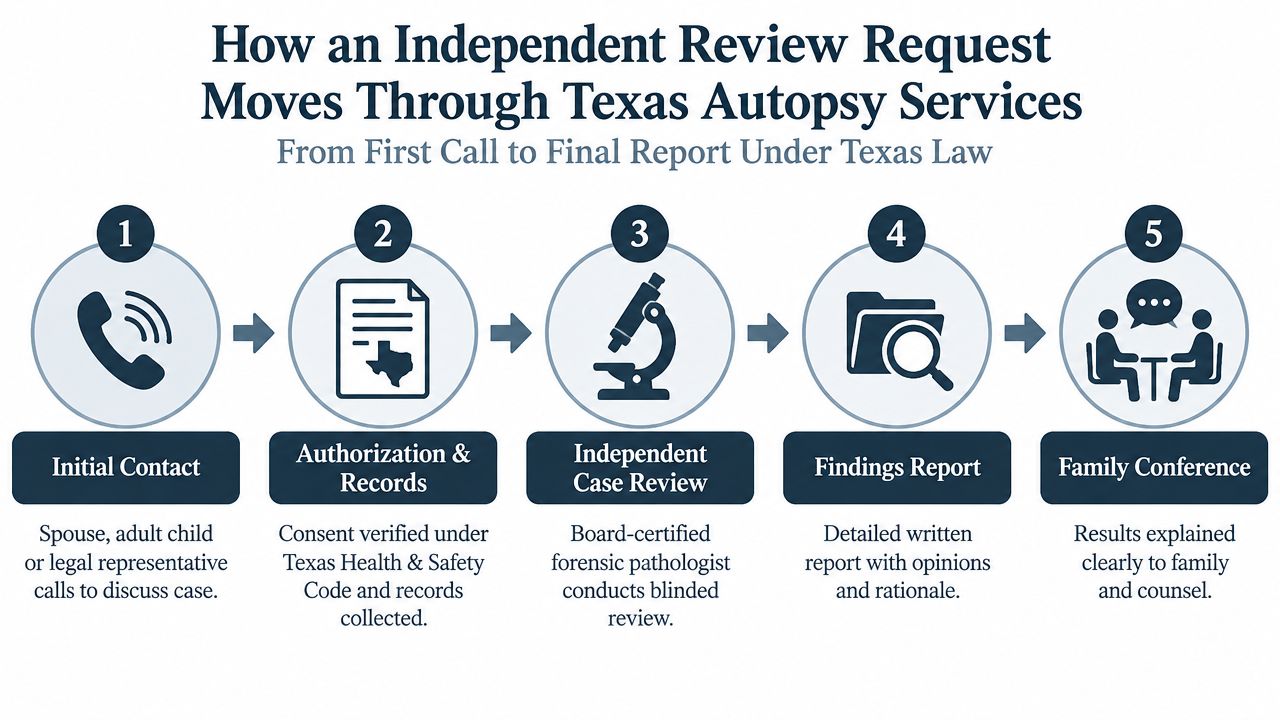
A representative request often begins with a spouse, adult child, or attorney who has received an autopsy report or hospital death summary and wants an independent assessment. The first call is used to identify the legal authority involved, preserve relevant evidence, and determine whether the question can be answered through records alone.
Texas law matters at each stage. Texas Code of Criminal Procedure Chapter 49 and Health and Safety Code Chapter 671 address aspects of death investigation, autopsy authority, and postmortem examination. In Texas, a justice of the peace may seek a physician's opinion about whether an autopsy is needed to determine or confirm the cause and nature of death. A physician may perform a postmortem examination or autopsy only when authorized by the appropriate official and within the statutory 24-to-48-hour window identified by Texas law. Texas coroner and medical-examiner law provides an accessible overview of that authority.
The typical review path
- Initial contact: We document who is requesting the review, what conclusion is disputed, whether an autopsy occurred, and whether litigation or an active death investigation is pending.
- Authorization and records: The team obtains appropriate releases and requests the autopsy report, photographs, imaging, operative notes, emergency records, toxicology, histology slides, and investigative materials.
- Independent case review: Every examination is performed by a forensic pathologist certified by the American Board of Pathology. The reviewer compares the findings with the clinical timeline and identifies supported conclusions, inconsistencies, and unanswered questions.
- Supplemental examination when indicated: A physical review of the body, additional microscopy, or testing may be considered when authorized and medically appropriate. A records-only review doesn't become a re-autopsy without separate permission.
- Report and conference: The final written report explains the evidence and reasoning. We then discuss the findings with the requesting family or counsel in clear language.
Texas law defines an autopsy report broadly. It can include the postmortem report, X-rays, photographs, toxicology results, and other reports concerning examination of internal organs. Texas Health and Safety Code Chapter 671 supports the need to preserve a complete, court-usable record rather than relying on a short cause-of-death summary.
Most cases may be completed within 24 to 48 hours when the necessary materials are available, but that isn't an unconditional promise. Missing slides, delayed imaging access, complex toxicology, transport requirements, authorization questions, or the need for additional consultation can extend the process. Our case-review guidance explains the information that helps the team determine scope before engagement.
What the Evidence Actually Shows About Second Opinion Reviews
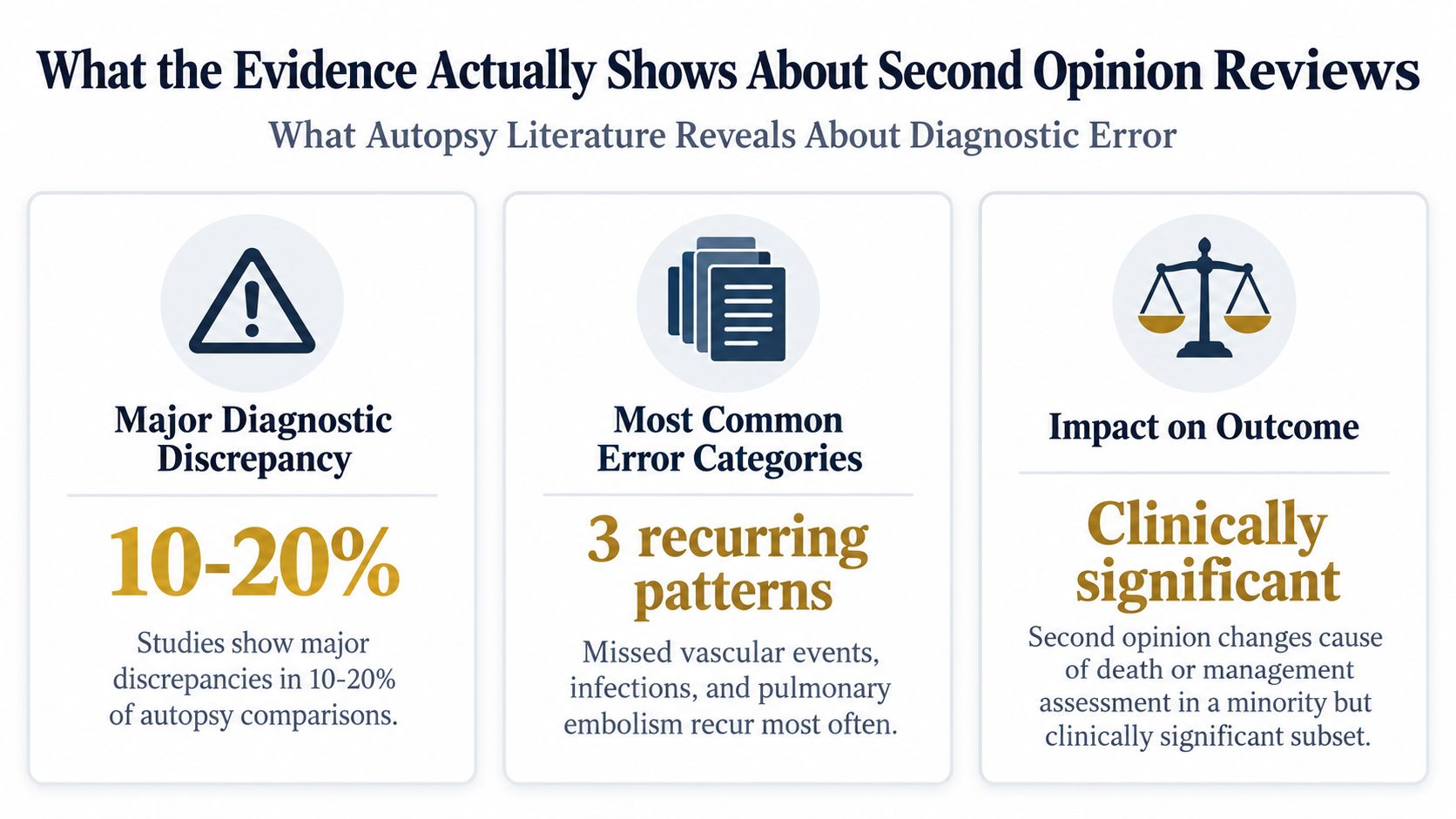
A second opinion doesn't guarantee a different diagnosis, treatment assessment, or cause of death. The strongest evidence supports a more measured conclusion: independent review can identify meaningful discrepancies, but the published literature still has important limits.
The broader second-opinion literature includes observational work concentrated in particular institutions and patient groups. In one scoping review of spinal-surgery second opinions, 12 studies were examined, 11 were judged low quality, and the authors found no randomized controlled trials. The review also found limited information about whether second opinions changed treatment. The scoping review is relevant because it shows how difficult it is to connect disagreement between reviewers with downstream patient outcomes.
Where reviewers may add the most value
A forensic pathologist can be especially useful when the question concerns:
- A missed or delayed injury: Imaging, operative notes, and autopsy findings may not tell the same story.
- An injury mechanism: The documented pattern may need comparison with the reported event and scene information.
- A complicated cause of death: Multiple injuries, disease processes, medications, or toxicology findings may interact.
- A disputed manner of death: The evidence may support accident, homicide, suicide, natural, or undetermined classification differently than the original report.
- An incomplete timeline: Prehospital care, emergency treatment, and transfer records may leave an important sequence unclear.
Postmortem review also has limits in mature trauma systems. One trauma-center study found no Goldman type I errors among either autopsied or non-autopsied deaths. The authors concluded that autopsy information appeared to add little useful information to peer review in that mature program, although it identified one potentially technical error. That finding supports a careful approach. A reviewer should not imply that an independent examination will uncover an error because a family remains uncertain.
Recent mortality data from a 2026 Stockholm review of 6,483 trauma patients found that 396 died within 30 days, with potentially preventable deaths at 7.0% and preventable deaths at 0.5%. Delayed surgery or definitive treatment was the most frequent care-related error. The indexed trauma mortality study suggests an important question for every review: does the evidence identify an actionable error, or does it confirm what the trauma team already documented?
What to Ask Before You Retain an Independent Reviewer
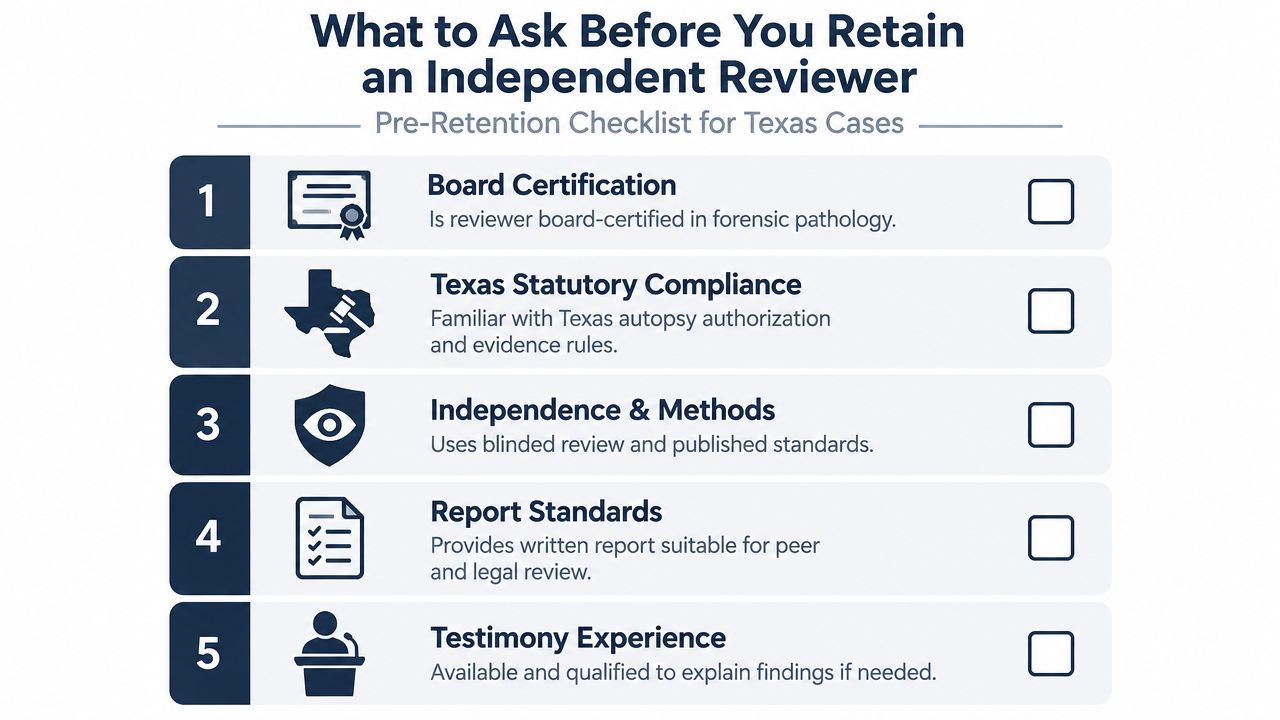
A family or attorney can evaluate a reviewer by asking focused questions before releasing records or authorizing an examination. The answers should define what the reviewer can assess, which materials are needed, and what the final work product will contain.
Questions that clarify qualifications and scope
- Is every examination performed by a forensic pathologist certified by the American Board of Pathology? The American Board of Pathology has certified forensic pathology as a subspecialty since 1959. Current requirements include prior certification in AP/CP or AP plus 12 months of training in an ACGME-accredited forensic pathology program. The forensic pathology certification history provides the credentialing background.
- Does the reviewer understand Texas authorization and evidence requirements? Ask how the practice handles the justice of the peace, medical examiner, hospital, family, and counsel when more than one authority is involved.
- Will the reviewer define the assignment in writing? The scope might include the cause of death, manner of death, injury mechanism, radiology, histology, toxicology, or the adequacy of the original report.
- What materials are available? Confirm whether the reviewer can obtain the original autopsy report, photographs, X-rays, CT scans, slides, toxicology, operative notes, emergency records, and investigative documentation.
- What report and communication should be expected? Ask whether the deliverable will distinguish facts, opinions, assumptions, missing evidence, and limitations. Counsel should also ask about testimony availability and the difference between a medical opinion and a legal conclusion.
Texas has additional requirements for child deaths. A sudden or unexplained death of a child 12 months old or younger must be reported immediately. The justice of the peace or medical examiner must inform the parents or legal guardian that an autopsy will be performed, parents or guardians must be notified of the results after completion, and the state reimburses the county $500 when sudden infant death syndrome is the primary cause. Texas Health and Safety Code Section 673.002 describes those requirements.
A responsible reviewer should be able to say both what the evidence supports and what it cannot establish.
Texas Autopsy Services is an independent private autopsy and forensic pathology practice based in Elgin, Texas. Our team provides second-opinion autopsy reviews, records assessment, imaging and histology review, toxicology coordination, licensed transport, and court-usable reporting across all 254 Texas counties. We also coordinate with families, attorneys, hospitals, justices of the peace, medical examiners, and county officials while maintaining documented chain of custody.
FAQ
Is a trauma center second opinion review the same as a re-autopsy?
No. A records-based review examines existing documentation and materials. A re-autopsy is a separate physical examination that requires appropriate authorization and may not be necessary or possible in every case.
Can a second opinion change the cause of death?
It can identify evidence that supports an amended cause or manner of death, but it may also confirm the original conclusion. The reviewer must base any change on the complete available evidence.
Who can request an independent forensic review in Texas?
A family member, attorney, authorized official, hospital, or agency may request a review, but the documents required depend on the case, the status of the remains, and the applicable Texas authority.
What does chain of custody mean?
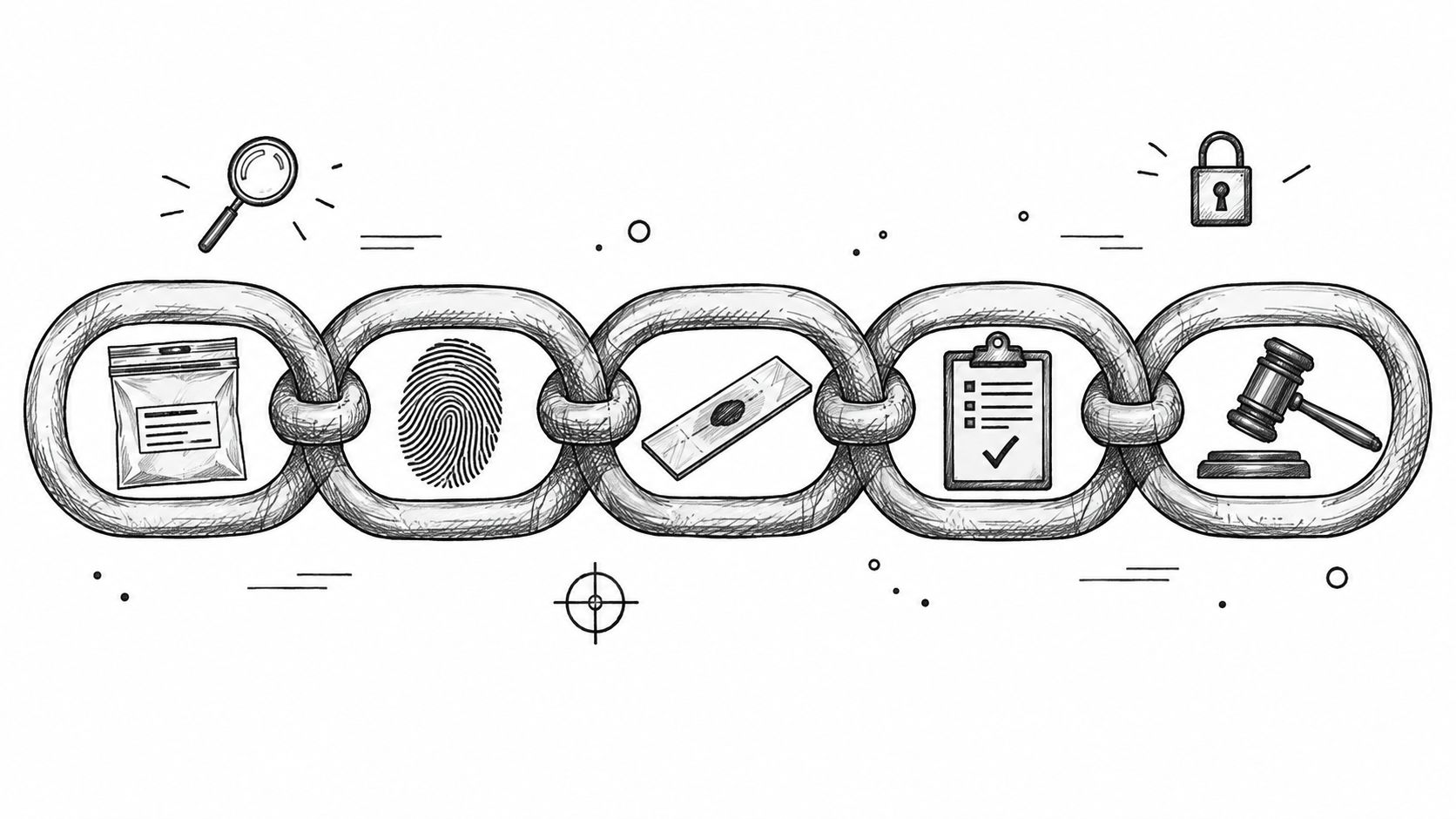
Chain of custody is the documented record showing who collected, transferred, stored, examined, and returned evidence. It helps demonstrate that specimens, slides, photographs, and other materials were handled consistently and can be identified in a legal proceeding.
Does every trauma death need an independent review?
No. A review may be most useful when the cause or manner of death is disputed, the injury pattern is unclear, imaging and autopsy findings conflict, or the family needs an outside explanation of a complex record.
Texas Autopsy Services can review prior autopsy reports, medical records, imaging, histology, toxicology, photographs, and investigative materials to clarify the medical evidence in a trauma death. Visit Texas Autopsy Services to request a confidential scope discussion with our team and determine which records or specimens may be needed for an independent review.