April 19, 2026 · Texas Autopsy Services
What Is Medical Review A Path to Clarity After Loss
Learn what is medical review and how an independent forensic pathologist provides clear answers on cause of death for families and attorneys in Texas.
On this page
- Finding Answers When Questions Remain
- Understanding the Different Types of Medical Review
- The Purpose of an Independent Forensic Examination
- The Forensic Medical Review Process Explained
- The Critical Role of Independence and Objectivity
- When and How to Request a Private Medical Review
- Frequently Asked Questions About Forensic Reviews
- A Compassionate Path to Factual Clarity
When a family calls after an unexpected death, the first question usually isn’t technical. It’s simple and painful. They want to know what happened, and they want to know whether the answer they’ve been given is complete.
At Texas Autopsy Services, every examination is performed by a board-certified forensic pathologist experienced in medicolegal death investigations. Our work centers on one principle: follow the evidence carefully, explain it plainly, and treat the deceased and their family with respect.
TL;DR
- Medical review can mean different things, but in forensic pathology it refers to a structured death investigation aimed at determining cause of death, mechanism of death, and manner of death.
- A private forensic medical review is especially important when the death certificate feels incomplete, the autopsy findings are disputed, or legal questions remain.
- The forensic process follows three core stages: examination, correlation, and interpretation as described in forensic pathology references.
- Independence matters. An outside forensic pathologist is not part of the treating hospital or the original investigating office.
- Families and attorneys can help a review move efficiently by gathering the death certificate, available medical records, autopsy documents, and investigative materials early.
Finding Answers When Questions Remain
A common call to my office comes from a family that has already received paperwork, but not clarity. The death certificate may list a broad medical event. The hospital course may look confusing. A parent, spouse, or adult child reads the report and feels that something important is missing.
That reaction matters. It does not prove that an error occurred, and it does not mean the first opinion was wrong. But it often means the family needs a more careful explanation from someone whose job is to reconstruct death medically and objectively.
Why this kind of review is often overlooked
Most public discussions of medical review focus on insurance claims, workplace drug testing, or internal hospital review. That leaves out a very important use of the term. A private forensic review for families and attorneys. As noted in this discussion of medical review and forensic second opinions, only 5-10% of deaths receive autopsies, while 20% of families request second opinions after unexpected deaths.
Those numbers help explain the gap I see in Texas. Many people are looking for a path to factual clarity, but they are not sure where to start or what kind of physician handles that work.
Practical rule: If the explanation of death feels vague, internally inconsistent, or medically incomplete, an independent forensic review may be appropriate even when official paperwork has already been issued.
What families are really asking for
In plain language, they are asking for truth that can be explained. Sometimes the answer confirms the original findings. Sometimes it refines them. Sometimes it identifies issues that were not fully developed in the first review, such as toxicology significance, timing of injury, or perinatal factors in the death of an infant.
Attorneys often come with a related but different need. They need medically sound analysis that can stand up to scrutiny. That means the review cannot be advocacy dressed up as science. It has to be evidence first, opinion second.
A proper forensic medical review serves both needs. It respects grief, but it does not substitute emotion for method. It gives families and counsel a disciplined way to examine what happened.
Understanding the Different Types of Medical Review
The phrase medical review causes confusion because it is used in several settings. Some reviews are administrative. Some are internal quality processes. Some are legal or forensic. Those are not interchangeable.
Four common meanings of medical review
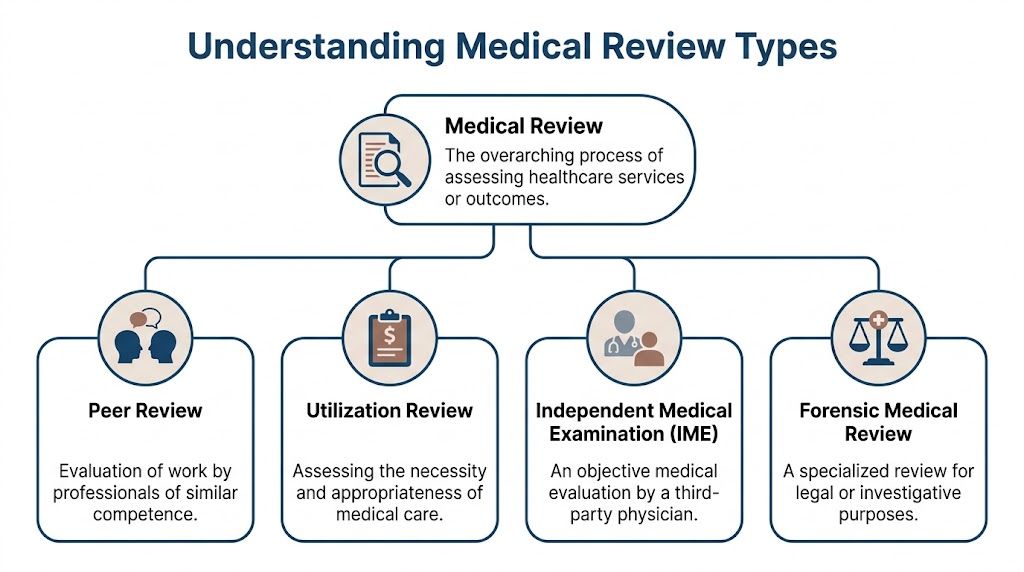
Think of the term as a category name, not a single procedure. The major types are:
- Peer review reviews a clinician’s work within a professional setting, usually by colleagues.
- Utilization review looks at whether care was necessary or appropriately authorized, often in an insurance context.
- Independent medical examination is a third-party medical evaluation, commonly tied to injury claims or disability questions.
- Forensic medical review examines death or injury for legal and investigative purposes.
The practical problem is that families searching online for what is medical review often land on the wrong kind of answer. They find insurance language when what they need is death investigation guidance.
Internal reviews versus independent forensic reviews
A chart review or mortality review inside a hospital usually asks whether care followed expected standards, whether documentation was complete, or whether systems should change. Those reviews can be important, but they are not the same as a forensic opinion on cause and manner of death.
A forensic review starts with different questions. What injury or disease started the fatal sequence? What physiological process caused death? Does the evidence support a natural, accidental, suicidal, homicidal, or undetermined manner of death?
For readers trying to separate a records-based analysis from a postmortem investigation, I’ve written separately about medical records reviews in death investigation.
Where legal cases fit
Attorneys sometimes need more than one kind of review. In some medical malpractice cases, the legal team may need both a records-based standard-of-care analysis and a forensic pathology opinion about the death itself. Those are related, but they are not identical tasks.
| Review type | Main purpose | Typical setting |
|---|---|---|
| Peer review | Professional evaluation by colleagues | Hospital or group practice |
| Utilization review | Necessity and appropriateness of care | Insurance or payer systems |
| Independent medical examination | Third-party evaluation of condition or injury | Litigation or claims |
| Forensic medical review | Cause, mechanism, timing, and manner analysis | Death investigation and legal review |
A family may hear one phrase and assume one process. In practice, the right review depends on the question being asked.
That distinction matters because expectations differ. A hospital committee may improve policy. A forensic pathologist determines whether the medical facts support the stated explanation of death.
The Purpose of an Independent Forensic Examination
Families often seek a second opinion because uncertainty has changed the nature of grief. Instead of mourning with an answer, they are mourning with unresolved facts. Attorneys seek the same review for a different reason. Courts and claims processes depend on precise medical conclusions, not broad impressions.
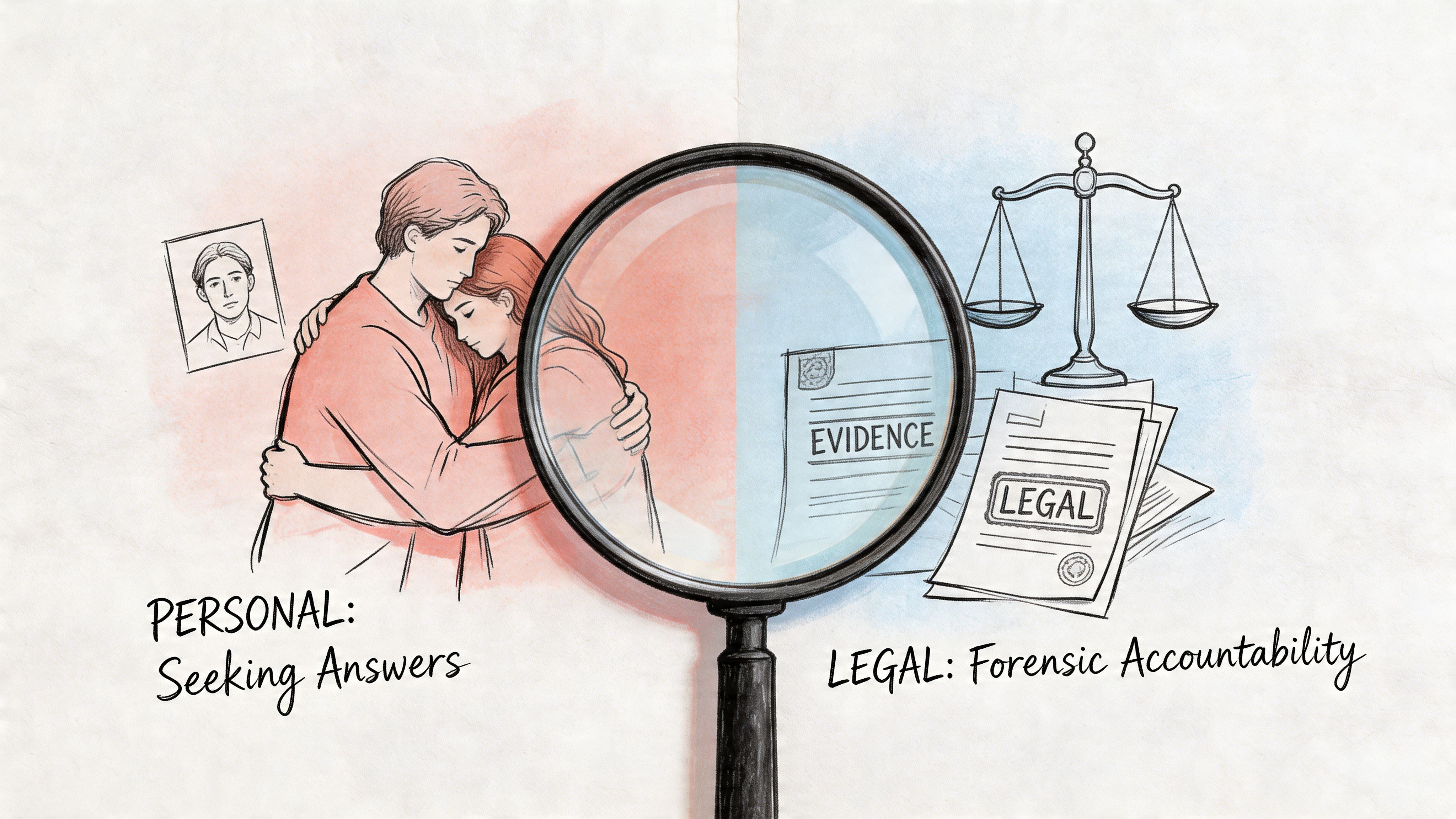
Why a second review can matter
An independent forensic examination serves several legitimate purposes:
- Clarifying the death itself when the listed cause is broad, medically unsatisfying, or disputed.
- Testing the internal consistency of the record when scene facts, hospital records, and autopsy findings do not align cleanly.
- Supporting legal analysis in cases involving possible negligence, wrongful death, criminal allegations, or insurance disputes.
- Identifying family-relevant disease patterns when inherited conditions may be part of the medical story.
In many matters, the issue is not whether anyone acted improperly. The issue is whether the medical explanation is complete enough to be trusted.
Independence changes the frame of review
A private forensic pathologist is not part of the treating institution and is not tasked with defending prior decisions. That does not guarantee a different conclusion. It does create the right conditions for a fresh one.
When families ask about Private Autopsies, I explain that independence is useful precisely because it lowers the pressure to fit findings into an existing narrative. The pathologist’s obligation is to the evidence.
What works is a disciplined review anchored in records, scene information, laboratory findings, and pathology. What does not work is beginning with a theory and then forcing the facts to support it.
The examination may answer more than one question
Sometimes the original concern is narrow. A family may only want to know whether a medication contributed to death. After a proper review, the central issue may turn out to be an undiagnosed natural disease, an overlooked injury pattern, or a mismatch between the medical timeline and the stated conclusion.
For readers who want a broader overview of how a postmortem examination unfolds, the steps of autopsy are helpful background.
The strongest forensic opinions usually come from cases where the pathologist is willing to confirm the original conclusion if the evidence supports it, and willing to disagree if it does not.
That is the point of independence. Not contradiction for its own sake. Clarity for its own sake.
The Forensic Medical Review Process Explained
A Texas family calls after a death that still does not make sense. The official paperwork gives them an answer, but the records, the timeline, and the physical findings do not line up in a way they can trust. For a private forensic review, that is usually the starting point.

A real forensic medical review is a structured analysis of evidence. In my practice, that process usually moves through three connected tasks: examination, correlation, and interpretation. The goal is to determine whether the medical findings support the stated cause of death, mechanism of death, and manner of death, or whether a second opinion is warranted.
Step one: examination
The first question is simple. What material is available for review?
In a private case, that may include the body, preserved tissue, autopsy photographs, histology slides, toxicology, EMS records, hospital charts, imaging, scene photographs, and investigator notes. If I am asked to perform a second opinion autopsy in Texas, the examination includes the direct postmortem assessment of the body and organs. If I am asked to review an autopsy already completed elsewhere, the work centers on the medical record, pathology materials, and the quality of the original documentation.
This stage often identifies what is present and what is missing. Missing records matter. So do missing photographs, incomplete toxicology methods, or tissue samples that were never taken.
A few terms should be clear from the start:
- Cause of death is the injury or disease that set the fatal process in motion.
- Mechanism of death is the physiological failure that produced death, such as arrhythmia, blood loss, or respiratory failure.
- Manner of death is the medicolegal classification, such as natural, accident, suicide, homicide, or undetermined.
Step two: correlation
Findings from an autopsy or record review do not stand on their own. They have to fit the full history.
I compare the pathology to the scene information, witness statements, prehospital care, emergency department treatment, hospital course, laboratory results, imaging, and known medical conditions. In a Texas custody death, jail death, traffic fatality, or suspected medication-related death, the central issue is often not whether one fact is true. The issue is whether all of the facts can coexist without contradiction.
Chain of custody also matters here. That term means the documented handling of specimens, records, and physical evidence from collection through review. If a toxicology sample is poorly documented or a slide label does not match the report, the weakness is not technical trivia. It can change how much confidence a family or attorney should place in the conclusion.
Correlation often brings the fundamental dispute into focus:
- The timeline of symptoms does not match the listed cause of death.
- The injury pattern does not fit the reported event.
- A positive toxicology result is real, but its medical significance is overstated.
- Natural disease, trauma, and treatment effects all appear in the file, and the question is which one actually drove the death.
A forensic opinion becomes reliable when the pathology, records, and circumstances support the same conclusion.
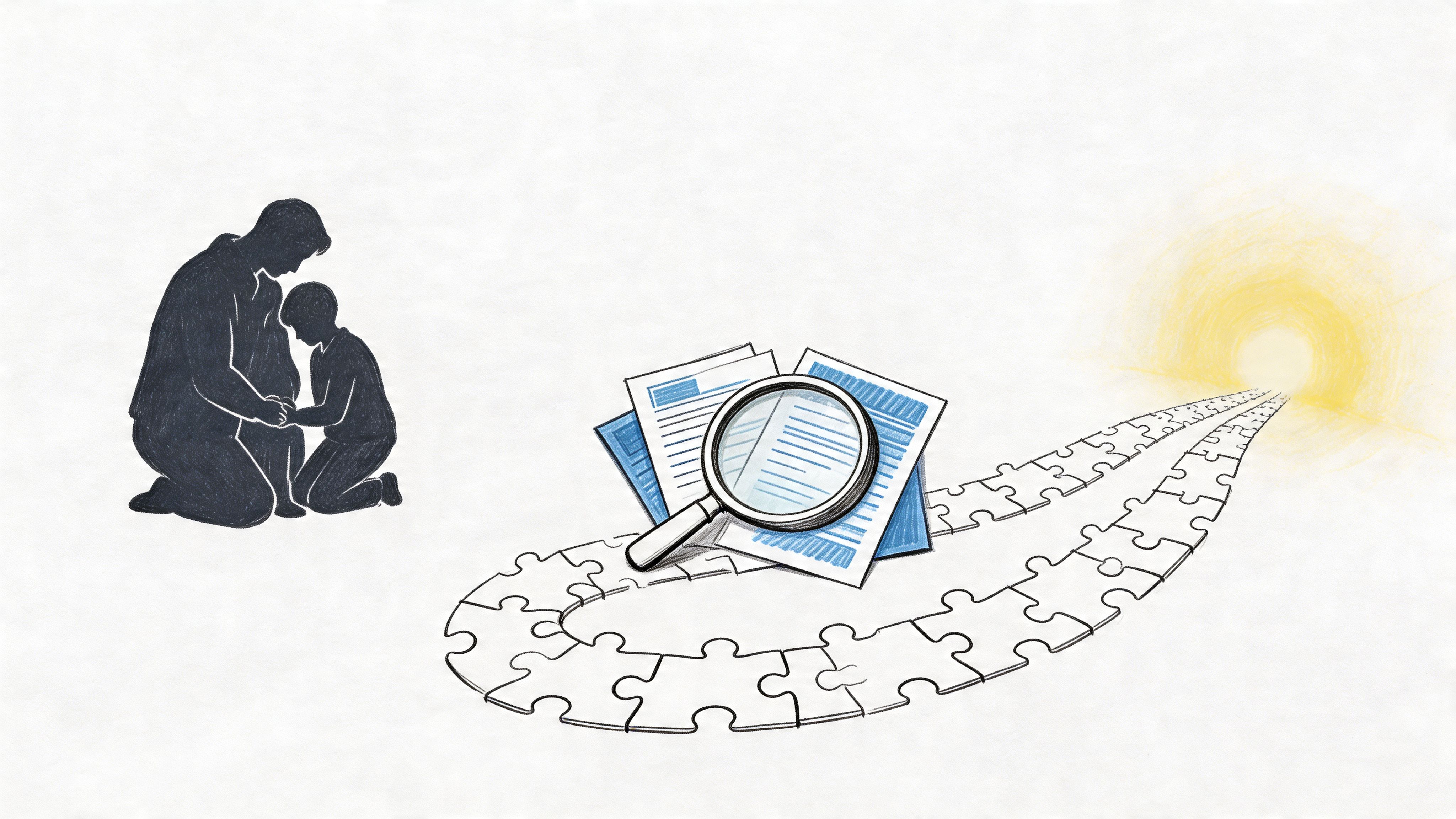
A useful visual summary of the process appears below.
Step three: interpretation
Interpretation is where the review becomes a defensible medical opinion.
That does not mean choosing the most dramatic explanation. It means reconstructing the sequence of events with discipline. If trauma is alleged, I assess whether the injuries are sufficient, timely, and anatomically consistent with death. If intoxication is suspected, I read the toxicology in context, including dose history, tolerance, metabolism, treatment, and postmortem redistribution issues. If the concern is delayed medical care, the review asks a narrower question. Did the records show a missed diagnosis, a preventable complication, or a death that would likely have occurred even with proper treatment?
That restraint matters in private forensic work for families and attorneys. Some cases support the original conclusion. Some do not. Some end with an undetermined opinion because the evidence will not carry more weight than that. A careful reviewer says so plainly.
What families and attorneys can expect to receive
The final product is usually a written report. It explains what was reviewed, what findings were confirmed, where inconsistencies remain, and how the medical reasoning leads to the opinion. Depending on the assignment, the report may address whether the original autopsy is well supported, whether a second opinion autopsy changes the analysis, whether the death certificate language should be reconsidered, or whether the case raises concerns relevant to civil or criminal litigation.
Attorneys sometimes request this review early to test a theory before filing. Families often request it because they need factual clarity before deciding whether to pursue legal action at all. Both uses are legitimate. Both benefit from a physician who recognizes weak assumptions, including some of the common IME doctor tricks that can distort how medical opinions are framed in adversarial cases.
| Term | Plain-language meaning |
|---|---|
| Cause of death | The injury or disease that began the fatal sequence |
| Mechanism of death | The bodily failure that actually led to death |
| Manner of death | The legal classification of how the death occurred |
| Chain of custody | The documented handling of evidence and specimens |
Early review usually produces a better record because materials are easier to obtain, witnesses recall details more accurately, and tissue or slide review is still feasible when needed. Delay can narrow the options, especially in cases where families are considering a private second opinion autopsy after the original investigation left important questions unanswered.
The Critical Role of Independence and Objectivity
Objectivity is not a slogan in forensic pathology. It is the condition that makes the opinion useful.
An independent forensic review matters because the physician is not part of the hospital where treatment occurred, not part of the original investigating office, and not responsible for defending earlier conclusions. The work begins with the evidence, not the institution.
What objectivity looks like in practice
In my field, objectivity means documenting what is present, what is absent, and what cannot be concluded. That sounds simple, but it requires training across pathology, laboratory medicine, and forensic reconstruction.
The role goes beyond reading an autopsy report. Forensic pathologists evaluate death scene evidence, decedent history, and autopsy findings to assess timing and injury causation, drawing on training in trace evidence, serology, and patterned injuries, as described by the Tarrant County forensic pathology overview. That same overview notes that autopsy-histology concordance exceeds 92% for natural diseases and rises to 98% with ancillary tests, and that scene-autopsy correlation identifies inconsistencies in 15-20% of violent deaths.
Those details capture an important truth. A conclusion becomes more reliable when it is tested against multiple lines of evidence, not when it rests on one observation.
Why outside review can be especially useful
Independent review is often most valuable in cases with one of three features:
- Institutional overlap where the death occurred in a system already generating its own internal assessment
- Conflicting narratives from witnesses, records, or agencies
- Technically difficult pathology involving subtle injuries, toxicology significance, or fetal and perinatal questions
The same Tarrant County overview notes that fetal autopsies can detect anomalies in 25-40% of cases using perinatal protocols. That matters for families because a second review may have implications not only for the death investigation, but also for future family health planning.
Independence does not mean opposition. It means freedom to agree or disagree based solely on the medical record and the physical evidence.
Attorneys sometimes confuse a forensic review with an adversarial exam such as an IME arranged for litigation. Those are different settings. If you want a plain-English example of how adversarial framing can shape expectations in non-forensic evaluations, this discussion of common IME doctor tricks is a useful contrast.
What does not support objectivity
Several habits weaken forensic reliability:
- Starting with blame instead of starting with facts
- Overreading toxicology without clinical and scene correlation
- Ignoring negative findings that cut against an attractive theory
- Confusing possibility with probability
An independent pathologist has to resist all of that. The opinion should be clear, but it should also show its work.
When and How to Request a Private Medical Review
Some cases call for a private review quickly. Others become candidates only after the family receives records, an autopsy report, or a death certificate that raises new concerns. The key is to recognize the warning signs early enough to preserve options.
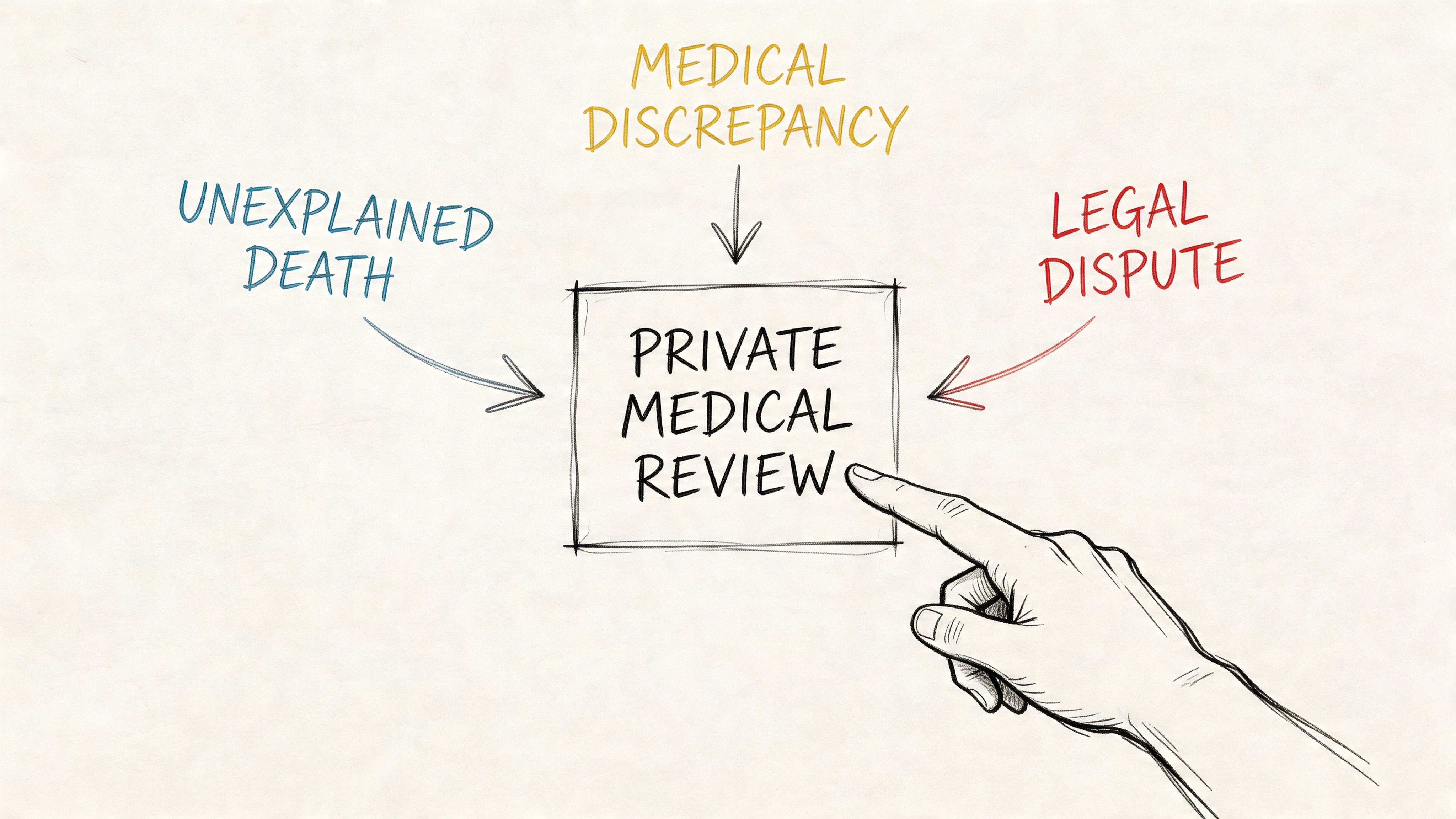
Situations that often justify review
A private forensic review is often worth considering when:
- The death certificate is vague or lists broad terms that don’t answer the family’s practical questions.
- The death was unexpected in a younger or apparently healthy person and the explanation feels incomplete.
- There is concern about medical care before death and the records need independent interpretation.
- The official manner of death is disputed by the available facts or by later information.
- An infant, fetal, or perinatal death occurred and the family needs a more detailed pathology assessment.
For people trying to make sense of official paperwork, understanding the autopsy report process in Texas can make the next steps easier.
What to gather before you call
You do not need every document in hand before speaking with a forensic pathologist, but having core materials helps.
- Death certificate if one has been issued
- Autopsy report or preliminary findings, if available
- Hospital and clinic records from the relevant time period
- EMS, law enforcement, or scene reports if those exist
- Toxicology or laboratory reports already released to the family or counsel
A short written timeline is also helpful. Dates of symptoms, treatment, collapse, transport, and death can reveal issues that are hard to see when records arrive as separate files.
Who usually makes the request
Families may request a private review directly. Attorneys may do the same with proper authorization. Counties may also seek forensic pathology support in certain situations. My work includes County Forensic Autopsies, which means the same basic standards of documentation and objectivity apply whether the request comes from a family, a lawyer, or a public entity.
If a private autopsy or second-opinion review is being considered, one available option is Texas Autopsy Services, which performs independent postmortem examinations and records-based forensic reviews in Texas.
Bring the records you have. Do not delay a call simply because your file is incomplete. Early guidance often helps identify which missing documents matter most.
Frequently Asked Questions About Forensic Reviews
Families usually ask direct questions. They should. This process is personal, technical, and often unfamiliar.
FAQ Quick Guide
| Question | Answer Summary |
|---|---|
| Is a forensic medical review the same as a hospital review | No. A forensic review focuses on cause, mechanism, timing, and manner of death rather than internal quality review alone. |
| Can a second opinion agree with the first autopsy | Yes. Independence means the physician follows the evidence, whether that confirms or disputes the original conclusion. |
| Do I need a full autopsy to request a review | Not always. Some cases can begin with records, reports, and existing pathology materials. |
| Can attorneys request reviews | Yes, with proper authority and access to the relevant records and reports. |
| Is embalming the end of the process | Not necessarily. It can affect what is possible, but records review and some forms of postmortem evaluation may still be useful. |
Is a medical review always a new autopsy
No. Sometimes the most appropriate starting point is a review of records, autopsy findings, toxicology, and investigative materials. In other cases, a full independent autopsy is the right step. The decision depends on what happened, what has already been done, and what questions remain unresolved.
What if the family disagrees with the Medical Examiner’s conclusion
Disagreement alone is not enough. There needs to be a medical reason for further review. That may be a mismatch in the records, an unclear timeline, questionable injury interpretation, or incomplete explanation of toxicology or disease. A second opinion can assess whether the available evidence supports the original ruling.
Can a body be reviewed after embalming
Sometimes, yes. Embalming changes tissue and can limit certain findings, so it is not ideal if a full autopsy is being considered. But it does not automatically end the possibility of useful forensic work. Records review, review of prior photographs, microscopic materials if retained, and consultation on the existing evidence may still provide meaningful clarification.
How long does the process take
Timing depends on the case. Toxicology, record collection, outside agency response times, and the complexity of the death all affect the schedule. It is better to expect a careful process than a rushed one.
What is included in a forensic review
That depends on the scope of the engagement. It may include record review, review of the death certificate, review of an existing autopsy report, independent autopsy examination, tissue sampling, toxicology, written opinion, and in some cases consultation with counsel regarding the medical issues raised by the findings.
A Compassionate Path to Factual Clarity
In Texas cases, the hardest part is often not the paperwork. It is the unanswered question that keeps a family or attorney from trusting the official account of a death. A private forensic review offers something more specific than reassurance. It provides an independent medical opinion, stated plainly, with the evidence and its limits laid out side by side.
I have seen that kind of clarity change the course of a case and, just as often, give a family enough certainty to stop reliving the same doubts. If you need to discuss whether an independent forensic review is appropriate, you can contact Texas Autopsy Services. Conversations about these cases should be confidential, factual, and handled with care.